About this episode
Dear friends,
We do love to receive your questions and comments. The way to reach us is through [email protected]. We don’t promise to respond privately or publicly, but we do promise to read and consider your viewpoints and enquiries.
Today as we proceed through 1 Corinthians 3, we think of the pressing problem for modern Western culture: that of identity. Apparently, many people struggle with the questions, “Who am I?” or “What am I?”. This chapter answers these questions for Christians.
Yours,
Phillip
Freely available, supported by generosity.
If you enjoy Two Ways News, why not lend us a hand? Consider joining our Supporters Club—friends who make it possible for us to keep producing this article/podcast.
This is a public episode. If you'd like to discuss this with other subscribers or get access to bonus episodes, visit www.twoways.news/subscribe
Get every episode summarized
Each time Two Ways News publishes, we email you a written briefing from the transcript — the topics, who appeared, and any specific claims, with the ad reads skipped.
Email me new episodesFree for 3 shows. No card needed.
Hosts & guests
Transcript ready
263 searchable segments. Every word is indexed and playable.
Full transcript
Two Ways News — Christian Identity. Machine-transcribed; use the interactive transcript above to jump the player to any line.
Hello and welcome again to Two Ways News. Thank you for those who send us questions and comments. We do read them and like to hear from you. We don't always reply to each one of them. We're not promising to do that but we really like the interaction that takes place. You can email us at respondattwm.email. That's our address and what about team? We'll certainly be reading or Peter and I'll be reading them and thinking about them and occasionally, especially if they have wider applications for our audience. We love to be able to speak to those issues that have improved our discussion. I think Peter, which can lead improvement, can't it? Well, it can, Philip. You know, I've just been sitting here thinking of poem issues. That's an interesting idea. Yes, just in poems
that might have my name in it. Limericks, perhaps, and I've just realised Peter rhymes with Eta or Flietta, neither of which would go with each other. But anyhow, Ceta, I'm just trying to think out what it does through. Very limited, isn't it? It is limited. We're looking at one Corinthians chapter three and Philip, what's a theme this time? Well, I think it's identity is the way we talk about it as a theme for today. You know, the question that people seem to have, who am I? Or what am I? Kind of questions. Okay, well, these are key questions I have to agree. I've noticed that when I meet someone new, I often ask them what they do for a living. So I was talking to a checkout guy yesterday, for example. And I just said to him, he was a young man. I said, do you studying? He said, yes, I said, whereabouts? What are you studying? So it was a, what do you do for the living type of question? Why do we go for that question? Well, I presume it's because one of the key ways in which
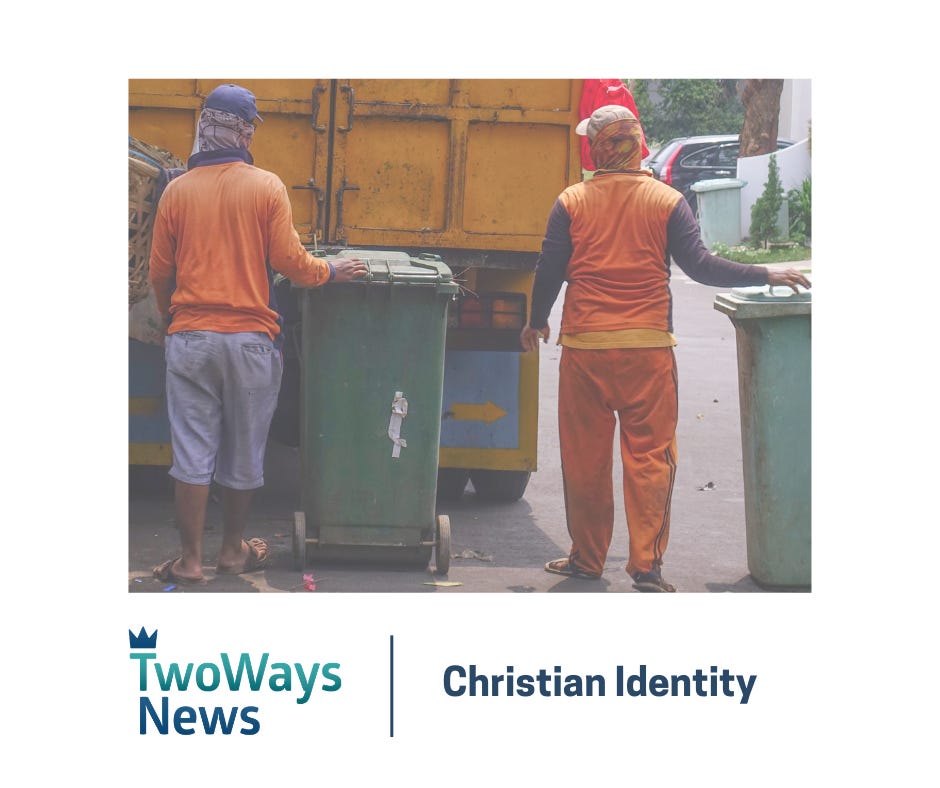
we define ourselves, identify ourselves is by what we do. You know, I'm a lawyer, I'm carpenter, I'm a surgeon or someone who really earns money, I'm a plumber. Fascinating that we're very selective. We don't identify ourselves as I'm a prison officer or I'm a garbage collector or a street sweeper. We're anxious that our children, especially you see, go into the kind of top professions, we have a very clear pegging order of what we can be proud of our children going into and what we slightly embarrassed and will change the subject quickly. But we think people are what they do. And there's other sides to it, aren't they? By what you do tells us about your level of education, it may tell you something of the person's status, wealth, it can also tell you something of their IQ, although they're highly intelligent these days, I suspect they avoid a lot of our educational processes. It's the women's issue too,
isn't it? That is, getting women into the workforce is a way of establishing their place and their importance in society. It's the feminist drive for establishing you as a real person is to do a significant job. It has to be significant, of course, as a job. But it gets you away from saying, well, I'm just a mum. It's interesting, I agree with what you're saying, and interesting, however, that earlier generations may well identify themselves by family connections. I am who my family is. I suspect it's well that if we went to lots of different cultures, the same thing would apply. The individual, and you're talking about human identity here, the individual is less important than the family that the person belongs to. You are part of this clan, part of this wider group. You are the son of someone, you are the sibling of someone else, you are the father, you are the grandfather. Now, it's caught up in the Russian name, isn't it? Tell me what you mean.
Well, the middle name is illitch, and evident, depending on whether you're the daughter of or the son of. You are Peter Arthur Illich Jensen, which tells you which Jensen's, Arthur Jensen's son, you are. So your description, the trick of reading Russian novels, isn't it, is to try and drop a little list of characters before you start. That's true, very true. I agree with you. But it's got to do with this, and I'm sorry for our Russian listeners if I have misunderstood little and mispronounced, but there is a code, but the code has got to do with where you fit in the family. Now, surely that's better than identifying yourself by your work. I mean, it's not wrong to say, oh, yes, I'm this, so I'm that. It's not wrong. In fact, it can lead to a good discussion, but to identify yourself by your work is a little wiring. It's not wrong when Luke is the doctor. Luke has the doctor. That's right. It's not entirely wrong. But is it enough? And even is the
family enough? It can become, in either the case of the family, all the work, a form sort of pride of achievement or pride in family. It's not helpful. I definitely think it's better to identify yourself by family. I think that is better. I think, you know, the question of identity is who am I? What am I? A better question is who are we, rather than who am I? Individualism is one of the weaknesses of Western culture. And I think you're right. The other cultures of the world have held family as a more important way of understanding oneself. It's the way God has created us too. He's created us through family, through the father and the mother, through the unity that they have. And so I think families are a lot better than Korea as a way of saying, you know, you are of the Jensen family, you are Peter Jensen. And it's a way of thinking of ourselves. But
you're right. We can still follow the trap of pride in family, you know. Well, and also does that, doesn't it? Indeed it does. But, or it used to at least. But also in those cultures that where family is everything and the individual is subservient of the family, it can be a very, very imprisoning sort of context. There is something to be said for individualism as well. Collectiveism is the worst form of the other. Individualism on the right hand. So what we want to I presume is communal, communalism. Yeah. The cultures that practice family identity, are the cultures that also practice shame and control by the shame system, which is joyful. And tribalism is one of the weaknesses of our society. And family is something of the tribalism. It's part of it. And the countries that Africa, where tribes are so strong, has, it's difficult. But you mentioned pride. And yes, you can have pride. You can have pride in
your achievements. You know, you can wave your Oxford doctorate if you wish to. It's been known to be done by some people. Well, it's better than a Cambridge doctorate. Let me put it that way. I do not have either. And therefore I think I'll leave to the listeners to come back at the tech Peter on that subject. But we do have one Corinthians. We haven't actually got very far at one Corinthians. Have we? It's in the one Corinthians issue. It's pride in ministry. Pride in what we do in the ministry of the gospel. And frankly, that's worse still. You know, that is really strange. And I think we need God's wisdom to understand and evaluate ourselves and our ministries. I'm not just about full-time ministers. I'm talking about some skill teachers for that matter or youth fellowship leaders, home Bible study group leaders, whatever ministry. We need God's wisdom. And that's what one Corinthians gives us. And so Peter, why don't you read to us the first paragraph of one Corinthians? Okay. But I, brother, this could not
address you as spiritual people, but as people of the flesh, as infants in Christ. I fed you with milk, not solid food, for you were not ready for it. And even now you are not yet ready, for you are still of the flesh. For while there is jealousy and strife among you, are you not of the flesh and behaving only in a human way? For when one says, I follow Paul and another, I follow us. Are you not being merely human? This follows on from chapter 2, where we saw two wisdoms, really. The contrast to these two wisdoms, the wisdom of the world, which wind up crucifying the Lord of glory in its folly. And the wisdom of God, which was made known by the spirit of God. And so this is a reason from strife in the church. The intrusion of the wisdom of the world into the church, gathering in Corinth. The Christians, they hadn't been Christians
very long, but they were still carrying over the wisdom of the world. And that worldview, that value, the significance and importance of the wisdom of the world. And that carrying over that idea meant that there were parties, there were disagreements of people claiming as the heroes various Christian teachers. And divided, as we saw right in chapter 1, so we're still dealing with the same issue in chapters 1, 2, 3, and I think into 4. Is this an identity thing as well? Well, yes, it can be guarded. I'm a Lutheran. You're an Anglican. I'm not a Lutheran friends. I don't know if you're still an Anglican or you've heard it, but there's identity that I find myself in this, or it can be more down to your heart and the followers of Billy Graham. It can be that way as well. Yeah. So it's called an identity. Okay, but the interesting thing here is that he's speaking to and about Christians. Now we're talking about their lack of wisdom. He says some pretty harsh
things about them, but these are Christians who have been drawn to God by the spirit of God, the spirit of wisdom. And he has some pretty harsh things to say about their behavior and what leads to it. They've been fed with milk. They allow the flesh to dominate their thinking and behavior. They're going to be fed with milk again because they haven't got beyond that. We certainly aren't dealing with the perfect church here. In fact, of course, we never are. But this church was marked by jealousy and strife. Pretty serious. I mean, were they real Christians? What was going on? Now, when I was a new Christian, a young person, I was reading some books that were doing the rounds at the time, popular books at the time, about holiness. And I was taught in some of the books from this passage that there are two sorts of Christians. Now, using the old words from the old authorised version, the ones of the flesh were the carnal ones, carnal of the flesh. And then there were the ones of the spirit. The Corinthians were Christians, carnal Christians
of the flesh. And according to the books I was reading, you needed a second blessing, as it was called, to become a spirit-filled Christian, the one that you ought to be. Philip, what would you have said to my young self back then? How I would say it would be slightly different, but I'd say you're wrong. That's what I'd say. And you mustn't follow that kind of teaching. See, this letter to the Corinthians is written to the church of God that is in Corinth. So those sanctifying Christ call to be saints together with those who in every place call on the name of the Lord Jesus Christ by their Lord and ours. These are Christian people. To divide Christian people is a fundamental era. And that's not what's happening here. Paul's not saying that there are two kinds of Christians, the carnal and the spiritual. What he's saying is I can't talk to you as the spiritual. They have to be spiritual otherwise they wouldn't be Christians at all. But you are acting childishly. And so I can't talk to you as adults. I'm having to talk to you as if you are still
children. So he's adjusting his speech to them as if they're babies, as if they're not Christians. He's using the arguments of these worlds, if need be. And he's saying you should be thinking as adults, but you're not. In fact, when you continue swabbling like this, you are just showing yourself to be childish and the kind of challenge to grow up, be mature. He actually uses the same imagery in one Corinthians chapter 14, I think it's verse 20, isn't it, about in your in your sin be children, but in your thinking be adults. And here's this kind of problem. And so there's not a question that there are two kinds of Christians. There's two kinds of wisdoms. These Christians are showing the world's wisdom. And he's saying turn your mind to that which is of God rather than the things of this world. Okay, so when you get to the end of the chapter, which I'll read now, and it's interesting, we're now going to the beginning and the end of the chapter, which I think
is a good way to read things sometimes. We'll come back to the middle in due course, but the summary at the end goes like this. And verses 18 to 23, let no one deceive himself. If anyone among you thinks he is wise in this age, let him become a fool that he may become wise. For the wisdom of this world is folly with God. For it is written, he catches the wise in their craftiness. And again, the Lord knows the thoughts of the wise that they are futile. So let no one boast in men. For all things are yours, whether Paul or Apollos or Kifas or the world or life or death or the present or the future, all are yours. And you are Christ's and Christ is God's. Yeah, this wisdom of the world has the profound quality of deception. And when you conquer the wisdom of this world, your ability when you
achieve the wisdom of this world, it puffs you up. And that kind of puffing up, that kind of world, the wisdom, that kind of arrogance is a deception. You start to think you are something when you are nothing. God's wisdom is quite different. So our boasting is never in human achievement, our achievement or in other persons achievement. That's not it is. The thing that we have to boast about in Christ is that we are in Christ. And frankly, what we have a boast about is infinitely more valuable than the things the world boasts about. I was showing once some Olympic gold medals. It doesn't matter about the Olympic gold medals. I actually listened to the Olympics in which this person had won their gold medals. I couldn't remember their name. It was a thing of which you can boast, but it is of no significance. But to be in Christ Jesus gives you everything in this
world that has. But you've got to value it. You've got to see what it is. And so the wisdom of this world is deceptive because it tells you great wealth, great house, great education, great job, makes you someone very significant when you're not. And it also lies, well, you have Christ, you have eternity, you have the temple of God. Well, so what? Well, the presenting problem in Corinth, of course, is one that's not untypical in our churches, is the worldly problem of following the great leader, in this case Paul or Apollos, the key fasts. And so we are fairly constantly, even in our circles, invited to identify ourselves with some great leader, past or present, Calvin and the Calvinists, Wesley, or even identify ourselves, prematurely, with a denomination, Anglican, Orthodox, rather than Christ. Now, we owe, let me say, much to others who have been out teachers and friends. I am not unhappy to be an Anglican, but we are not disciples of the great ones.
We are disciples of the great one, namely the Lord Jesus Christ, and we learn from him above all. And so if that is true wisdom, let's go back to the middle of the chapter. Okay, when we pick it up there's five. What then is Apollos? What is Paul? Servants through whom you believed as the Lord assigned to each. I planted a Apollos water, but God gave the growth. So neither he who plants nor he who waters his anything, but only God who gives the growth. He who plants and he who waters are one, and each will receive his wages according to his labour, for we are God's fellow workers. You are God's field, God's building. According to the grace of God given to me, like a skilled master builder, I laid a foundation, and someone else is building upon it. Let each one take care how he builds upon it. For no one can lay a foundation other than that, which is laid, which is Jesus Christ. Now, if anyone builds on the foundation with
gold silver precious stones would hail straw, each one's work will become manifest for the day will disclose it, because it will be revealed by fire, and the fire will test what sort of work each one has done. If the work that anyone has built on the foundation survives, he will receive a reward. If anyone's work is burnt up, he will suffer loss that he himself will be saved, but only as through fire. Do you not know that you are God's temple and the God's spirit dwells in you. If anyone destroys God's temple, God will destroy him for God's temple is holy, and you are that temple. Well, I'm so glad that the grace of God figures here, say verse 10, according to the grace of God given to me. In other words, the whole of it, and this is particularly addressing to those in ministry, but as Philip has said in a way, we're all in ministry, and please remember that there's written to all the Corinthians, not just the leaders,
but anything we achieve for God goes back to the grace, the mercy, the kindness, the love of God, undeserving as we are, the grace of God. It's interesting to see the description of God's work here, that the result of the preaching of God's Word is described as a field, a God's field where he grows things. It's described as a building in verse 9. I laid the foundations and someone else is building upon it, etc., etc., it's described as a field, it's described as a building, and then finally, it's described in here. You can't help but think of course of the church. Do you not know that you are God's temple and the God's spirit dwells in you? We think of the church, but of course it's true of the individual as well. You are the temple of the Lord in whom the spirit dwells, and then the Word is also used of church, but the work of God, God's field, God's building, God's temple, all from the grace of God, God's spirit dwells within, and it makes nonsense,
by the way, of the misreading that we refer to before, verses 1 to 4, about two sorts of Christian, because he declares that all are indwelt by the spirit of God. What do we learn here about the workers, those in ministry, because this is, well, irrested in a way. If we're in this world's wisdom that sees our identity in our work, we transfer this world the wisdom to think of our identity and value in the work of ministry that we're doing. It sounds a little bit more pious to be saying, I'm a Sunday school teacher, rather than saying, I'm a shop owner or I'm an engineer, but it's the same philosophy of identity in what I do. I mean, the status is fascinating because verse 9, we are the fellow workers with God. You couldn't have a higher status than to be, I'm God's partner. I mean, I really am at a very high level God's servants. You can't have a
higher status than to be God's partner, but yet we are nothing. The one who plants, the one who waters, they're not anything. Because although we've got God as our partner, it's God who does the work and yet God uses our work to do His work. And so we are God's servant. The skilled and masterly servants, it's not as if humans are only puppets. We're more than that. God gives us wisdom. God gives us an ability. I mean, that's an extraordinary little phrase, difficult to translate in this quarrels about it about the skilled master builder. But where are these people who have got great abilities who actually do water, who actually do plan to do lay foundations? But yet it's God who does the work through us. And so while I am God's partner, that's a terrific status. I'm not anything because it is God who is working through me. Now, the other things are said about working
here too. We're united in the fact that there's one building. There's one foundation stone upon which we lay and yet we're diverse. So, verses six to eight speaks of our diversity, our planter, our water. There's different things that we are doing. And in fact, we're individuals. So that's what we're talking about earlier. It's not just individualism or anti-individualism. It's not just communalism. It's we work together as individuals who are all God's partners doing different tasks because, verse 10, we're given. Verse seven, we're assigned different tasks from God. God is working through us in different and varied ways. But nobody is to think that he is better or worse, she is better or worse than anybody else. Because we are all working on the same task, the same group. It's just that united effort that we have and our task will come through the grace of God,
or the gift of God. But as individuals, we've got to take care what we're doing because what we're working on is the temple of God. So, somebody lays the foundation in the Lord Jesus Christ, verse 10, you'll see, we've got to take care about it. We will receive wages, reward for our labour is spent here in verse 8 and verse 14, because in the end, when the judgment day comes, what we have done will be revealed. If we've built with shabby materials, would haste double, well, it'll get burnt up and we'll be soon for what we've done was really of no great significance. If we build with the precious stones that come through the fire, then what we see will be of great significance. And so, our work will be soon. But we're not talking here about salvation judgment. We're just, we're talking about the judgment of our Christian life.
So, yes, we'll be saved. But what will our life have added up to? What will be soon? I mean, I think one Thessalonians 2, where Paul speaks of the Thessalonians, he says, what is our hope or joy or crown of boasting before our Lord Jesus Christ at His coming? Is it not you? For you are our glory and our joy. So, the work we do has eternal significance. The work we do will be seen for its significance, but it's the quality of the work that we're doing, the way in which we're doing the work. It is not that I am the preacher, as opposed to the musician, as to the person who cleans the building, because God uses us all to bring about His purposes. And it will be seen on the last day how we've shared in the purposes of God. But given this, go back to our first topic. What is it all add up to in terms of my identity or your identity? Well, I've just been listening
to you and thinking about life in ministry. And there are times when the minister of a church when this happens also another, you think of it as headmasters, headmasters of schools as well. Well, everyone smiles at you. Everyone says, oh, good, you know, well done on this sort of thing. What they may say behind your back is different. And so over time you get the impression from the smiles of other people at you that you are somebody that you draw your identity from this, rather than from the Lord Himself. Now, we need to be careful here, of course, because there are moments when the Lord uses another person to encourage us when we need to be encouraged. I don't doubt that. But there is the danger of actually believing, believing the smiles that everyone gives us and drawing our identity from that, rather than drawing our identity from God and the grace of God and the ultimate fact that we are in Christ Jesus. So when you stand
before the Lord of the last day, are you going to stand as a bishop? No, sorry, I shouldn't laugh. I'm just putting my trust and confidence in the Lord and knowing that there will be things which I have done, things which I have failed to do, which will be drawn to my attention. It may well be that there will be people that I now think little of who are way out ahead of me in the kingdom that is to come. And I will rejoice in this, because I'll be a better person. But no, I may only trust in Jesus. So remember thinking of one of our heroes, how does John Newton's identity, how did he perceive himself and his identity and his famous statement? His last word, so to speak, all words as he was thinking of his end, he said when all are said and done and he had done a great deal and his influence goes on to this very day, of course.
All I wanted to be said is that I am a great sinner and that Christ as a great Savior, amazing grace. But it doesn't mean that what we've done has no eternal significance. No, no. No, I plant us water and God gives the grace. But that's not my identity. No, it's not our identity, you know. Okay, how about a prayer? Father in heaven, we do thank you for this reminder of finding our boast in Christ Jesus, his death for us, his resurrection, the forgiveness that he's brought to us, that we may see ourselves as your creatures in your image, but remained in your memory, born by your spirit, that we may see ourselves correctly and not boast in ourselves, not boast in what we have done, not boast in what we have done for you, but that we may boast in the Lord Jesus Christ and the forgiveness that he has done for us and we pray this in Jesus' name. Amen.
More episodes