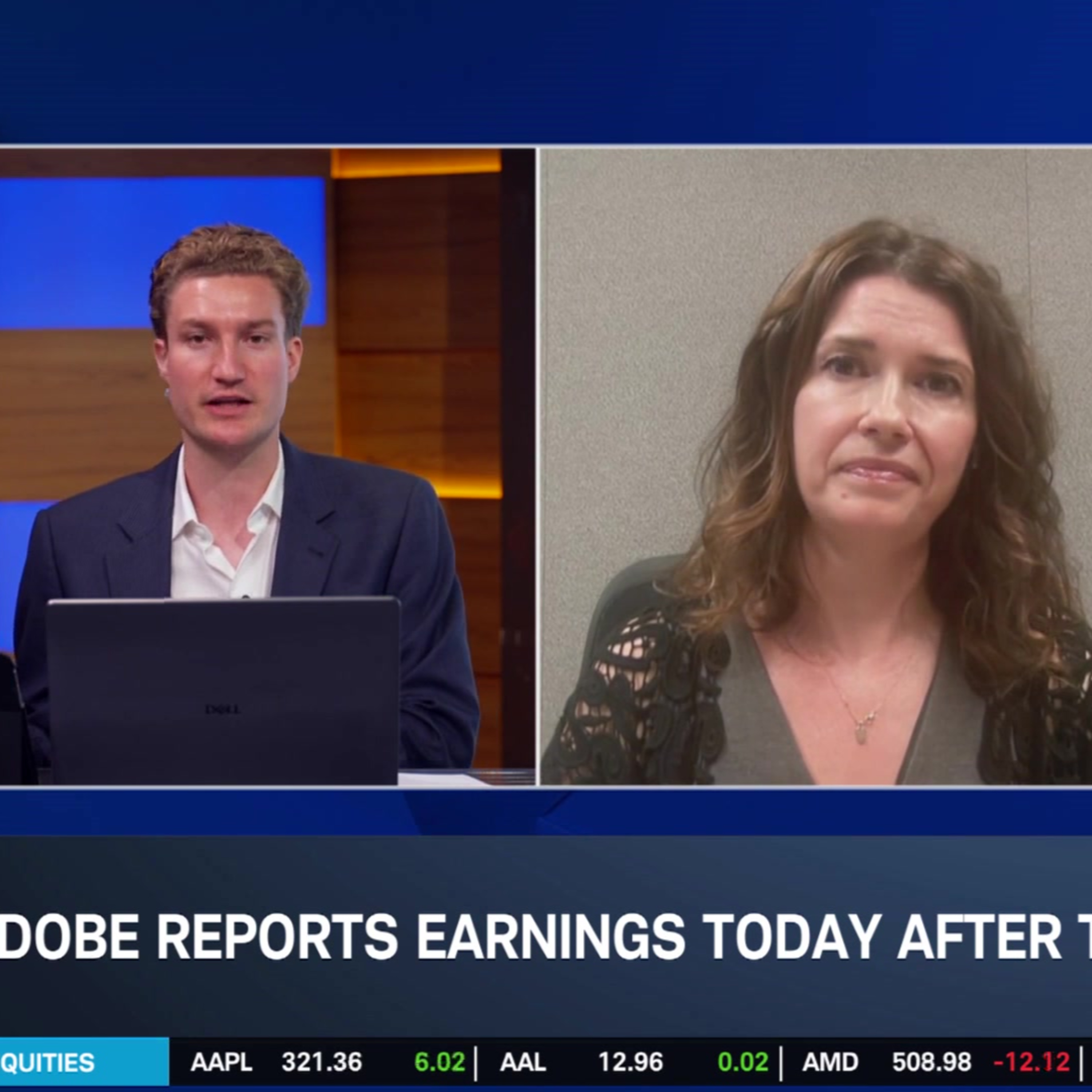
About this episode
Wall Street Horizon's Christine Short discusses Adobe's (ADBE) upcoming earnings report, focusing on the company's AI monetization strategy and the need to convert free generative AI users into paying subscribers. Tom White offers a neutral to bullish options strategy for Adobe, utilizing a four-legged spread to capitalize on implied volatility.
======== Schwab Network ========
Empowering every investor and trader, every market day.
Options involve risks and are not suitable for all investors. Before trading, read the Options Disclosure Document. http://bit.ly/2v9tH6D
Subscribe to the Market Minute newsletter - https://schwabnetwork.com/subscribe
Download the iOS app - https://apps.apple.com/us/app/schwab-network/id1460719185
Download the Amazon Fire Tv App - https://www.amazon.com/TD-Ameritrade-Network/dp/B07KRD76C7
Watch on Sling - https://watch.sling.com/1/asset/191928615bd8d47686f94682aefaa007/watch
Watch on Vizio - https://www.vizio.com/en/watchfreeplus-explore
Watch on DistroTV - https://www.distro.tv/live/schwab-network/
Follow us on X – https://twitter.com/schwabnetwork
Follow us on Facebook – https://www.facebook.com/schwabnetwork
Follow us on LinkedIn - https://www.linkedin.com/company/schwab-network/
About Schwab Network - https://schwabnetwork.com/about
Get every episode summarized
Each time Schwab Network publishes, we email you a written briefing from the transcript — the topics, who appeared, and any specific claims, with the ad reads skipped.
Email me new episodesFree for 3 shows. No card needed.
Transcript ready
136 searchable segments. Every word is indexed and playable.
Full transcript
Schwab Network — Christine Short on AI Monetization Moment for ADBE. Machine-transcribed; use the interactive transcript above to jump the player to any line.
Let's go inside out on Adobe and preview the upcoming earnings report. Joining us now is Christine Short, head of research at Wall Street Horizon, a TMX company. Let's talk Adobe. This has been like the representative of the SaaS apocalypse in terms of a name that's potentially being disrupted by AI, but trying to show that it's also benefiting from AI. So as you look for expectations, what we may hear from Adobe after the close today, I'm curious your thoughts. Yeah, I mean, look, the expectations heading into the print are pretty solid. Analysts are looking for about 15% growth on the top line. That's your year of course, or sorry, that's on the bottom line. And then 12% growth on the top line. And those would be great numbers for Adobe, but of course, as you mentioned, investors are really on a home in the AI monetization and the AI aspects of Adobe, because like you said, they've been able to integrate some of the AI tools into their existing enterprise
solutions. But now what investors are looking for is how they monetize that, right? Because we know in Q2, they're actually lowered annual recurring revenue expectations for the second half of the year because they were focusing on user growth through this freemium model. And they're trying to pull people in through Firefly, which is their suite of generative AI solutions. But how are they going to then convert those users into paying creative cloud users? Because we know the growth plan has been working. Monthly active users increased about 50% in Q2. But what's the path forward to actually get those folks starting to pay? I'm so glad that you highlighted this because I think this is maybe just a kind of quick misconception on what this sort of SaaS apocalypse may be, which is that maybe people won't use Adobe. But to the contrary, maybe more will use Adobe, but the margins that the company can charge
or the revenue that's pulling in for those users may plunge is the concern. What are we looking for as investors to maybe instill some confidence? Is there a metric that stands out to you that investors may focus on? Well, look, we know Adobe really focuses on their AI first annual recurring revenue. That's up to 500 million as of last quarter. Impressive growth, 300 million of that last quarter was Firefly. And again, there's winners and losers in this space, right? As you said, all of the fears are on the SaaS apocalypse. But I think what Adobe is doing by integrating these tools and making some really strategic AI acquisitions like of Topaz Labs, but also like I said, integrating through Firefly through Gen Studio. So they're tackling it from a couple of different angles. But what investors are going to want to hear is does that again lead to enterprise demand? Is that demand durable? And so we're going to be looking out for signs of that. And also CapEx, that's been the theme of tech earnings this whole season.
When it has an AI plan, well, how much are you investing in it? What are your capital expenditures like? Do we like that or not? And for every name, it's been a little bit different. Do investors think that's too much? And they're not seeing the ROI on that yet. So we're going to want to see, does it come at the expense of margins for Adobe and how much are they investing in AI? Christine, is there any chance that, I think looking back to Salesforce, my biggest takeaway is maybe both sides of this debate or a little bit, we're a little bit overplaying their position. And we saw a clawed in Salesforce combined. Maybe from the clawed side of things, they realized, hey, it's maybe hard to unseat the incumbent and from the Salesforce side of things. Hey, maybe it's hard to build some of these technologies. Is there a chance that Adobe maybe ink some sort of partnership? Yeah, who's to say? I mean, like I said, they've been making acquisitions in this space. Obviously, the initial fears were overdone and it's maybe more of a partnership model, as you say, with a Salesforce and a clawed.
So I certainly wouldn't take it off the table. Again, they have been looking for acquisitions and they are playing in this space. And the scenario has certainly improved since earlier in the year. And perhaps that's something they mentioned on tonight's call. Of course, the numbers are backwards looking. So we always want to see what the forward outlook is, especially we've got a new CEO coming to the helm December 1st. That was reported last weekend. The stock did take a bit of a tumble on that down about 7%. Because investors were hoping that an outsider would come into shake things up. Of course, the new CEO was the president of customer experience orchestration within Adobe. And so we'll see that we won't be likely hear from him until the first quarter in the new year. But it's something to keep in mind. Things are going to shake up a little bit there. And also, I always want to hear about Q4 guidance because they did increase full year guidance last quarter. They increased 2026 guidance. How are they tracking to either meet or surpass that guidance?
Yeah, really appreciated and some good call outs to the shake up at the leadership positions as well. Christine Short had a research at Wall Street Horizon. Thanks for the setup. Just traded now with Tom White, one of the hosts of Fast Market. We're just talking to Kev, looking at some of the sectors. But now, from your perspective, as we look at Adobe, this is the embodiment of the concerns around what AI is doing to unseat big time software players. Yeah. And one of the software names, Alex, that hasn't rebounded as much as others in the space. They've had solid growth. That earnings report last quarter was great. And then they made the announcement about the CEO leaving and the stock just tumbled. This has been a falling knife. I mean, it had all time highs in 2021. And it's been down about 63, 64 percent since those levels. Made a little bit of inroads on the bounce and software over the last few months. But as you mentioned, when they announced the new CEO just about a week and a half ago,
the stock has tumbled a little bit. Still under pressure down about 27 percent this year. Expectations of a move, the option market's pricing, about a plus or minus 8.3 percent move in either direction, about $21 in either way to the upside or downside. So I looked at a strategy that's bullish stance, but it's actually neutral to bullish stance here. And I'm collecting a credit on this customized four-legged spread, Alex. What I'm doing is I'm taking advantage of the higher implied volatility in the September 11th weekly options that expire tomorrow at the close. I'm selling the 2.35 put and buying the 2.30 put. So I'm selling a short $5 wide put vertical that's neutral to bullish to help finance the purchase of a one-week wide call calendar to the upside where I'm buying the September 25th weekly or the September 18th monthly options, the 2.75 call and selling that same 2.75 strike call in the near term September 11th weekly options that expire one day.
So one-week wide bullish call calendar financed by the sale of a $5 wide put vertical in the near term options. You're going to collect a credit of roughly about 30 cents on that. So what does that mean? Well if the stock explodes and goes to $300, I just get to keep that $30 that I collected. But you can see here from the risk profile, the apex of profitability is near the call calendar near the 2.75 strike, which is about that one standard deviation moved to the upside that the option of market price is in. Now because I'm collecting a credit and I'm doing a calendar, where is my risk? My risk is to the downside. My break even 234.70 to the downside, that's nearly 7% below the current share price in Adobe. So I've got that big cushion to the downside. That's why I say this is a neutral strategy also where my pain point is is below $230. That's where I'm losing about 470 per spread. But upside exposure on a neutral to bullish complex trade here, Alex. Good stuff. Make sure you stay tuned.
Tom White, Kevin Hanks coming up in about an hour from now.
More episodes
More from Schwab Network

Stock Market Today: ORCL & ADBE Earnings, AEO Plunges Near 52-Week Low
Schwab Network

Thursday's Final Takeaways: Crude Taps $103 & PPI Hotter than Expected
Schwab Network

Balancing High-Conviction AI With High-Dividend Diversification
Schwab Network

EARNINGS PANEL: ORCL, ADBE
Schwab Network