Loading...
About this Episode
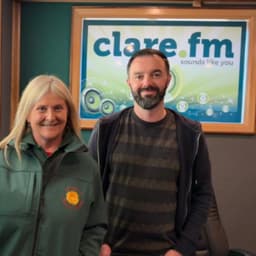
On Tuesday's Morning Focus, Alan Morrissey was joined by the Clare author, Karen Fitzgibbon.
Karen was back with her latest psychological thriller 'Tell The Truth', the third instalment in her popular Lana Bowen series, which promises courtroom drama, dark secrets, and plenty of twists along the way.
Hosts & Guests


Transcript
delighted to say now that I have another guest in studio. I'm joined by the Claire author
Karen Fitzgibbon. Karen's back with her latest psychological thriller. Tell the truth.
The third installment in our popular Lana Bone series.
Karen, very good morning to you. Good morning. I'm well. I'm well. I mean, look, it's
sun is shining. But yellow ball on the sky that we don't see
nearly enough of. So please stick around for as long as possible, if you can.
Tell the truth out. The third installment, as I say, in the Lana Bone series, I guess around
any official launch, the amount of blood spent in tears that goes as you well know, that
goes into writing and finishing and publishing any book is immense. So publication day must
be very satisfying. Yeah. And you know what, it's a long, it's a long time from, because
I first started writing this one in September 2022. And we're now in April 2026. So it's
a long time from the initial concept of an idea for a novel to getting it on a shelf. And
yeah, it does take a small army to get it there. It's not army. I just wonder on that.
Can that be frustrating in a sense, Carb? Because you know, we look at books that can take years,
clearly like tell the truth. And one hand, you think, well, the pros of that might be that
you give your allowing yourself enough room to flesh out an idea and the characters and the narrative
and so on. But I wonder in some cases, writing a book over that period of time can sometimes
be a worry that you lose the coherence of it. Because you know, what you start your mind set in
2022 as opposed to last year or this year might be might have changed to some degree. Oh,
yeah, it does. Absolutely. But I think like when you do write a book, well, for me, and everyone
has a different process, like completely different, I know I'm different to some of the writers
that I had to, but I'm writing it, it was about getting it down. So I took, it took about maybe
five or six months to write the actual first draft. So then you kind of leave it alone and then
you come back to it with fresh eyes and you go at it again. So, so that initial first draft
does happen quick enough, I suppose. And then you might give it to a couple of friends, make sure you're
careful with who you give it to that they're going to say nice things as well as be, you know,
give you some criticism, constructive criticism. And then, you know, by the time it's ready to go out
to an agent or a publisher, it's, it's been read by you and redrafted many, many times.
But then when you do get, if you do get looking off to get a publishing contract, you get to work
with an editor and that's an amazing experience. It has been for me because I thought it was great.
And the editor did not think it was great. It was just that they get the concept, the idea,
the whole art, you know, but it needed, it needed a good bit of work. Yeah, and any author
I've spoken on the show are always keen to give props to the editor. Yeah, they're amazing. And
they're attention to detail. And sometimes you're like kind of like, look, just let it go. No one's
going to notice that, you know, that there's this tiny detail, but no, this woman won't.
Someone else, someone else, you know, there's a lot of critics out there. Someone to pick up on us.
Someone will. Someone will. I mean, it must be, I'm talking about satisfying moments, you know,
when a book is published, but when you're initially trying to come up with an idea for a book or
like Lanabone, an idea for a character and a character that a series can be built around,
how do you know, like, for listeners on from either, because let's get them into the world of
Lanabone and picking up, tell the truth and the two preceding books in the series. How do you know
when you've hit upon a great character, a great narrative, a story or some element of book that
you know listeners with, our readers will be a champion of the bit for. Well, like, Lanabone was
never part of the initial plan. When I first started writing my first novel, The World's End,
it was sort of inspired by a ruin down in Quilty, in Seafield's Peer. I don't know if you know what,
and it's it's a, it's remote, but it's also quite beautiful and modern island is nearby,
and there is a ruin of a house there with the outline of a swimming pool, and I have this weird
obsession with empty buildings. They kind of come to life in my head. I try to imagine who lived
there, what kind of lives they led, and I always had this idea that I would bring a group of friends
to a luxurious holiday home by the sea in Claire, and that they would take a boat out to an island,
and that four of them would five would go out and then four would come back. So that was my
initial world's end idea. But then when I got to the, so it's in part one, part two, I got,
I tell someone has to solve this, you know, someone has to figure out what happened on that island,
and I like characters with struggles, and Lana Bonne has her own struggles, you know, she's,
she's made a mistake in her professional life, and not long after that mistake, she started to
suffer from panic attacks, and it's been, you know, it's like, if we have a perfect character,
they're not interesting, you know, to me anyway, they're not interesting. So I like when someone
is having a problem, but they'll still try to do the things they do with their everyday life,
but they have these other things going on, you know, so. I guess we all have problems in our lives,
so it's good to be able to connect with a character that you recognize a little bit yourself in.
Yeah, absolutely, yeah, but it's also, like I didn't know if you ever watched a drama called The
Night of, it was by James Galdorf Fini, there was only one ever series, but the detective in a
Tony soprano, by the way, for anyone else. Yes, he would go home every evening after a
grueling day in court, and he would just, he had a really chronic eczema, and he would start
this whole routine every night where he'd put this cling film around his ankles, and it was
silence, like a silent moment, every single episode, but they were just gripping for me,
because it was just, this is part of this man's life, but he just ignores it all day long, you know,
so that's why I just wanted to bring something into her character that would be, you know,
that shows that she just has this other part of her life, that she's not just trying to
go around playing Nancy Drew and solve problems, you know, solve crimes, you know, so.
And I suppose like thrillers, psychological thrillers, any book or story, kind of involving,
mysteries, or murder, or courtrooms, and so on, they're gripping.
It's gripping for an interesting for the readers. Is it fun for the authors?
It fun to write those, that kind of genre of book? Yeah, I mean, I'll read anything,
but my favorite would always be crime, psychological thrillers, and it's just I think readers,
and even people watching TV, we're just, we're always trying to figure out what happened.
We like playing those are mature detectives, you know, just, and we don't want anyone to tell us,
you know, if you're a few episodes ahead, or if you're a few chapters ahead of a book,
it's always like, don't tell me, I'm going to say this at my own, you know, so I think that that's
what we're like as an audience, and I like that as a writer to be able to almost not know what's
going to happen to my characters, like, where are they going to go, you know, because if I don't know
as a writer, so the reader won't be able to figure it out, that's the way I like to, that's my
process, and it's worked for me so far. And I don't write every day, but I am always thinking,
so when I'm writing a book, I'm always thinking about it, and I've seen something, or I over
hear a conversation in a supermarket, or be very careful, wait, is they around me? It just,
just, I take it down, or I, something comes to me then, you know, another idea for, oh, that's what,
that's what could happen to that character right there, you know, and it's about being able to,
like wanting to keep turning the page, I love it when readers tell me that, I couldn't put it down,
like, those are the, they're the magic words every writer wants to hear. You're the, you're the cause
of people getting to sleep at 2 a.m., rather than, apparently, which is a good thing. Well, it's
happened to me, Plenty of times. Yeah, me too. So, you know, briefly, can you give people a sense
with tell the truth? It's part of a series, but is it kind of a standalone story as well?
Where's Lana Bowen at? What's happening? Yeah, they're all standalone, and that the
crime is resolved at the end, to some extent. But Lana's the kid. Yeah, she's the thread. So,
you meet her in book one, and then book two, and book three again. And in book three, she's in a,
a really happy place. She's found love. And yeah, so she's, but her old colleague, next colleague,
has asked her to come in and help him with the case. He, there's a woman on trial for the murder
of her husband, and he feels that she's hiding something from him. And so he calls in Lana to see
if she can get her to talk. And so she ends up putting herself in, in danger, of course, because
it wouldn't be interesting if she wasn't in danger. And we also follow one of the, so that we've
also got 12 jurors. And I'm fascinated with juries. I think putting 12 strangers into a room to
solve something is like, it's an honorous task, isn't it? Well, 12 angry men is one of my favorite films
when we're talking, support room dramas, and in book or on screen are fantastic. They're, yeah,
and it's like, it's the dynamics inside in a jewelry room. You know, I was selected once,
and I spent an entire day in a jewelry room. Now, the case was thrown out by the end of the day,
but already in that short space of time, people were showing their personalities, and you had
the stronger, well, I'm going to be the four person. It is, you know, the, and then.
First, not even prejudices. It's just, it's kind of, it's kind of an honorous task, I think.
It's a bit big brother, but it's very serious. You know, isn't it? It's like, they've got to,
they've got to decide someone's faith, and they've got all got to agree to some extent as well.
So we do meet these 12 jurors, and it's told from one of their points of view. And she's,
she's having, she's struggling in her marriage. And she's also, there's one of the fellow jurors
who's giving her a lot of attention, which she likes. And yeah, so it's told from three different
points of view. Yeah. Okay, well, and obviously you want people to read all the books and series,
but if they're new to it, tell the truth, because they're standalone cases, they can read about,
start with that. They can absolutely, yeah. Okay, but do. But if they want to go back to that,
that'd be great. Look, it is called, tell the truth. The latest book in the Lanabone series,
the is out soon. When's the launch? So the official publication day is this Thursday.
Thursday. And the following Thursday, the 9th of April, I will be having a launch, you know,
Manny's bookshop in Unicarnal Street, Limerick City, and the whole world is invited,
if they'd like to come. There you go. Get down for that. I'm sure Karen will sign your book for you.
Karen, pleasure having you in. Absolutely. And hope to tell the truth, which I'm doing now,
does well for you. I really hope it does well for you. Thank you. And thanks for being with us on
Morning Focus.