Loading...
educationcoursessociety
Commentary on the Mass Readings: Thu, Mar 19 (Solemnity of St. Joseph)
About this Episode
2 Samuel 7: 4-5, 12-14, 16;
Romans 4: 13, 16-18, 22;
Luke 2: 41-51;
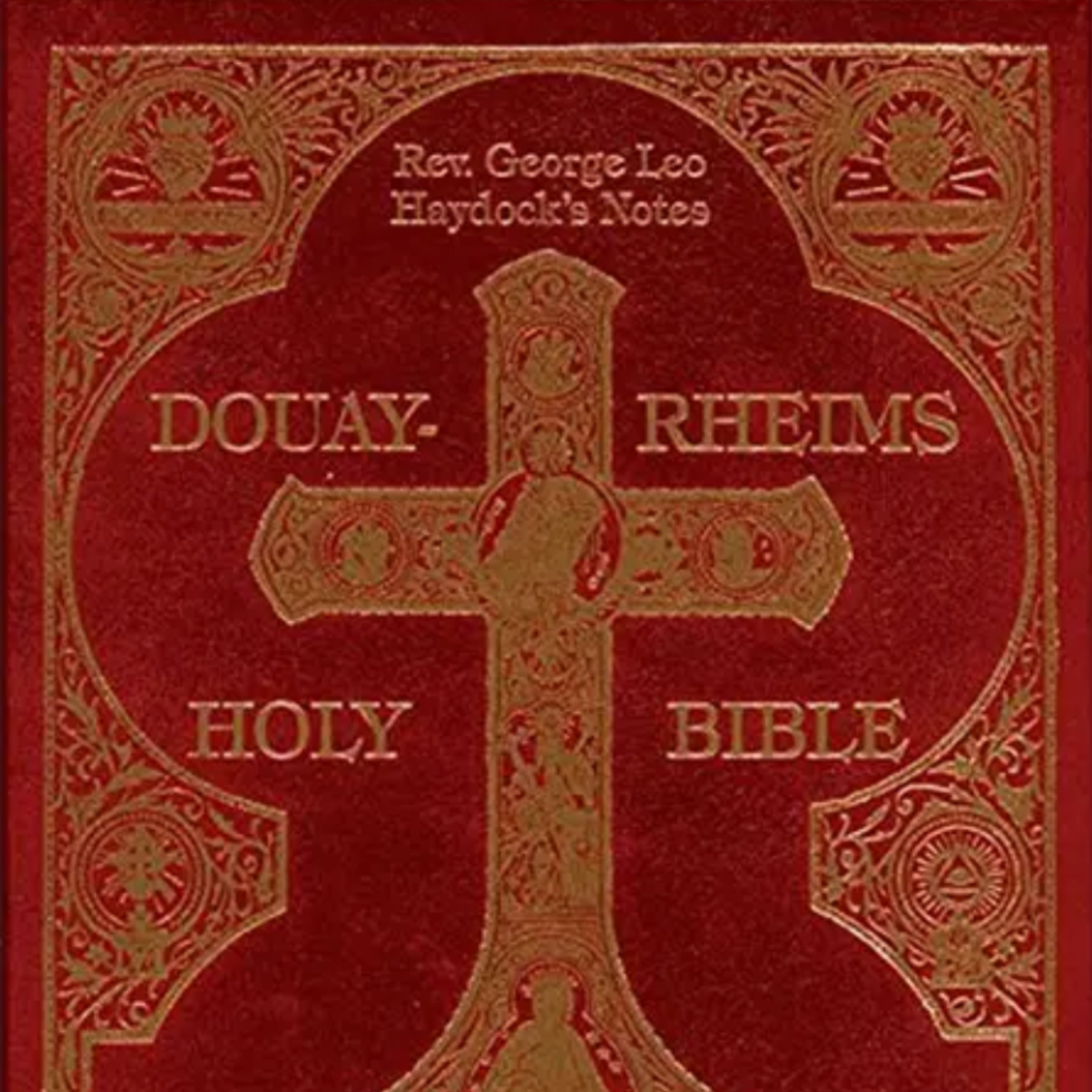
Haydock Commentary
Please consider donating to help keep this podcast going by going to buymeacoffee.com/catholicdailybrief Also, if you enjoy these episodes, please give a five star rating and share the podcast with your friends and family
Hosts & Guests

Transcript
There is day March 19th, Selenity of St. Joseph, spouse of the Blessed Virgin Mary.
The first reading from 2 Samuel chapter 7 verses 4 and 5, 12 through 14 and 16.
The Lord spoke to Nathan and said, Go tell my servant David, when your time comes and
you rest with your ancestors, I will raise up your air after you, sprung from your
loins, and I will make his kingdom firm. It is he who shall build a house for my name,
and I will make his royal throne firm forever. I will be a father to him, and he shall be
a son to me. Your house in your kingdom shall endure forever before me. Your throne shall
stand firm forever.
8.
Hey, not commentary. This prophecy partly relates to Solomon, but much more to Christ, who
is called the son of David in Scripture, and the builder of the true temple, which is
the church, his everlasting kingdom, which shall never fail nor be cast off for any iniquity
of her children. God passes over all the children whom David had already. The temporal kingdom
was enjoyed by David's posterity for a long time, sufficient to verify the expression
forever as it is often used in Scripture. But the spiritual kingdom of the Messiah will
last till the end of time and be perfected in eternity.
In these predictions we must always distinguish the type from the reality.
Where is the house of David, or how is this accomplished except in the church? David saw
Solomon on the throne and beheld the Messiah in Spirit. Souls departed still see what
regards them if they be happy.
The second reading from the letter of St. Paul to the Romans chapter 4, verses 13, 16 through
18, and 22.
Brothers and sisters, it was not through the law that the promise was made to Abraham and
his descendants that he would inherit the world, but through the righteousness that comes
from faith. For this reason it depends on faith so that it may be a gift, and the promise
may be guaranteed to all his descendants. Not to those who only adhere to the law, but
to those who follow the faith of Abraham, who is the father of all of us, as it is written,
I have made you father of many nations. He is our father in the sight of God, in whom
he believed, who gives life to the dead and calls into being what does not exist. He believed,
hoping against hope, that he would become the father of many nations, according to what
was said, thus shall your descendants be. That is why it was credited to him as righteousness.
Haydha Commentary
The promise was made to Abraham and his descendants that he would inherit the world.
By the world some understand the land of Canaan, which is sometimes meant by the whole earth,
particularly in the times of David and Solomon, when they ruled over the neighboring nations.
But others think that St. Paul eludes to the passage of Genesis where the Almighty promises
that in Abraham's seed all the nations of the earth should be blessed, which promise
extends much beyond the narrow limits of Canaan. It may be understood in a spiritual sense
of his dignity of father of all the faithful, which makes him in a manner master of the whole
world, since his spiritual children spread throughout the whole world, have the universe
for their inheritance. It was by Christ that Abraham was to be air of the world, in
as much as the spiritual kingdom of Christ should be spread over all the world. There are
two kinds of children of Abraham to whom alone these promises are made. The one is according
to the flesh, the other according to the Spirit. The former of these had no more part in the
promises made to him and his seed than the Gentiles, unless they imitated the fidelity
and obedience of their father. It is in this sense of spiritual father that the Catholic
priest at the altar, speaking in the name of the faithful, calls Abraham our patriarch.
Who, hoping against hope, that is, Abraham, against all probability of human hopes, still
hoped in God that he should have a son by Sarah, and in this he was not weak in faith. Therefore,
his great faith was imputed to him unto justice, and also our faith shall be imputed to us
unto justice, or make us truly just by believing in Christ.
The Gospel from Luke chapter 2 verses 41 through 51. Each year Jesus' parents went to Jerusalem
for the feast of Passover, and when he was 12 years old they went up according to
festival custom. After they had completed its days, as they were returning, the boy Jesus
remained behind in Jerusalem, but his parents did not know it. Thinking that he was in the caravan,
they journeyed for a day and looked for him among their relatives and acquaintances, but not finding
him they returned to Jerusalem to look for him. After three days they found him in the temple,
sitting in the midst of the teachers, listening to them and asking them questions, and all who heard
him were astounded at his understanding and his answers. When his parents saw him they were
astonished, and his mother said to him, Son, why have you done this to us? Your father and I have
been looking for you with great anxiety. And he said to them, why were you looking for me?
Did you not know that I must be in my father's house? But they did not understand what he said
to them. He went down with them and came to Nazareth and was obedient to them.
Hey dot commentary. How can we account for what is related here that his parents went up every
year to Jerusalem during the childhood of Jesus, when as we are taught in other parts,
his parents did not dare to fix their abode in Jerusalem for fear of Herod Archaleus.
But this says into gust and will not be very difficult to answer, for it might be easier for them
to ascend up to Jerusalem on these particular occasions without being noticed and so numerous a
crowd and privately return, though it might not be prudent for them to fix their habitation there,
lest they might be too much noticed. And as no one has yet informed us how long Archaleus
continued to reign, what Saint Luke relates might have taken place after the death of that prince.
It may be asked how the Blessed Virgin and Saint Joseph could possibly have come so far without
missing him, but we must take notice that when the people went up to the temple from remote parts
of Judea, the men went in one company and the women in a separate company, whilst the children
went in either company indifferently, so that Saint Joseph imagined that he was with Mary,
his mother, whilst she imagined he was with Saint Joseph. He went down with them and was obedient
to them. Estonishing humility, which the Son of God was pleased to teach by his example,
as also obedience to parents. The Evangelist relates nothing of our Savior from the age of 12 to the
age of 30, except that he was subject to Saint Joseph and the Blessed Virgin. The divine spirit
showing by this, that nothing is so great and amiable in Christians as ready obedience to the
direction of their superiors. All children are hereby taught what subjection and obedience is due
from them to their parents.


