About this episode
Isaiah 50: 4-7;
Philippians 2: 6-11;
Matthew 26: 14 - 27: 66;
Haydock Commentary
Please consider donating to help keep this podcast going by going to buymeacoffee.com/catholicdailybrief Also, if you enjoy these episodes, please give a five star rating and share the podcast with your friends and family
Get every episode summarized
Each time Catholic Daily Brief publishes, we email you a written briefing from the transcript — the topics, who appeared, and any specific claims, with the ad reads skipped.
Email me new episodesFree for 3 shows. No card needed.
Hosts & guests


Transcript ready
564 searchable segments. Every word is indexed and playable.
Full transcript
Catholic Daily Brief — Commentary on the Passion According to St. Matthew. Machine-transcribed; use the interactive transcript above to jump the player to any line.
The Lord God has given me a well-trained tongue that I might know how to speak to the weary a word that will rouse them. Everything after morning he opens my ear that I may hear, and I have not rebelled, have not turned back. I gave my back to those who beat me, my cheeks to those who plucked my beard, my face I did not shield from buffets and spitting. The Lord God is my help, therefore I am not disgraced. I have set my face like flint, knowing that I shall not be put to shame. 8. Isaiah speaks in the name of Christ, whose words carried conviction and comfort along with them.
Christ preached more powerfully than Isaiah, and continues to do so by his pastors. So says Saint Jerome. My face I did not shield from buffets and spitting. The greatest indignity, yet this was the treatment of our Savior. I have set my face like flint, knowing that I shall not be put to shame. Christ heard the accusations of his enemies unmoved, as he had not been afraid to blame the conduct of the Pharisees. The second reading from the letter of Saint Paul to the Philippians 2, verses 6-11. Christ Jesus, though he was in the form of God, did not regard equality with God, something to be grasped. Rather, he emptied himself, taking the form of a slave, coming in human likeness, and found human in appearance, he humbled himself, becoming obedient to the point of death, even death on a cross. Because of this, God greatly exalted him, and bestowed on him the name which is above every name.
That at the name of Jesus, every knee should bend, of those in heaven and on earth and under the earth. And every tongue confess that Jesus Christ is Lord, to the glory of God the Father. 8. Though he was in the form of God, that is, truly properly and essentially God from eternity as the ancient fathers have observed against the Aryans. Taking the form of a slave, that is, taking upon him our human nature, he became truly a man, and as man the servant of God, but remaining always God is before. He did not think of an injury to his eternal Father to be equal, to be esteemed, and to declare himself equal to God, to be one thing with him, as on many occasions he taught the people. He humbled himself, divested himself of all the marks of greatness for the love of mankind. He was made to the likeness of men not only as to an exterior likeness and appearance, but at the same time truly man, by uniting his divine person to the nature of man.
Not clothed exteriorly only as a man is clothed with a garment or coat, but found both as to shape and nature a man. And as St. John Chrysostom says, with the appearance of a sinful man, if we consider him persecuted by the Jews and nailed to an infamous cross. The name or word Jesus represents the dignity of him who is signified by the name, and who is exalted even as man above all creatures in heaven, earth, and hell, all which creatures either piously reverence him, or are made subject to him against their will, that every tongue may confess our Lord Jesus to be now and to have always been in the glory of his father, equal to him in substance and in all perfections. If we show respect when the name of our sovereign is mentioned, may we not express our respect also at the name of Jesus, and if to his name, why not to his cross as to the throne of the king? 8.commentary on the Passion according to Saint Matthew, 26-14-27-66
Judas the disciple who chiefly regretted the expense of the perfumes that had been used on his Lord and Master at the feast of Bethany and wished for an opportunity to make good the loss went to the chief priest saying, What will you give me? This impious wretch did not betray his divine master out of fear but out of avarice. Of all passions, the love of sordid lucre is the most vile, and the avaricious soul does not fear to plunge itself into the bottom of hell for a trifling gain. There is no vestige of honor or justice or probity remaining in the heart of that man who is possessed with the love of base lucre, whose God is his money. The profiteous Judas, inebriated with this passion, while he thirsts after gain, sells with the most foolish impiety, his Lord and his Master. So says Saint Leo the Great. It is probable that even the obter at heart of Judas would not have betrayed his Master to the Jews had he not expected that Jesus would escape from their hands on this occasion as he had done at Nazareth and in the temple. The Passover was the most solemn right of the Old Law.
When God ordered the Israelites to sprinkle the blood of the Lamb upon their doorposts, it was solely with a view of signifying that the blood of the true Lamb was to be the distinctive mark of as many as should be saved. Everything was mysterious and preferedical. A bone of the Lamb was not to be broken, and they broke not the arms or legs of Christ. The Lamb was to be free from blemish to express the perfect sanctity of Christ, the immaculate Lamb of God. The Paschal Lamb was to be sacrificed and eaten, because Christ was to suffer and die for us, and unless we eat his flesh, we shall have no life in us. The doorpost of the Israelites were to be sprinkled with blood that the destroying angel might pass over them. For with the blood of Christ, our souls are to be purified, that sin and death may not prevail against us. In every house was eaten a whole lamb, and Christ at communion is received whole and entire by every faithful soul. The manner in which it was to be eaten shows the proper dispositions for Christians when they receive the blessed sacrament. The roasting by fire expresses divine charity, the unleavened bread, sincerity, truth,
and a good conscience. The bitter herbs, repentance and contrition for sin. The girded loins and shod feet, the restrained upon our passions and lusts, and a readiness to follow the rules of the gospel. The staff are mortal pilgrimage, and that having no lasting dwelling here, we should make the best of our way to our true country, the heavenly Canaan. There were three motives for the great sorrow in the disciples. First because they saw their innocent and dear master was so soon to be taken from them and delivered up to a most cruel and ignominious death. Second because each of them was afraid, lest, through human frailty, he might fall into so great a crime of betrayal. For they were all convinced that what he said must necessarily come to pass. And lastly that there could be found one among them so wretchedly perverse as to deliver Jesus into the hands of his enemies. Hence afraid of themselves, and not daring to affix a suspicion on any individual, they began everyone to say, is it I, Lord, on whom so atrocious a crime is to fall? It is extremely probable that Christ made this prediction three times, first at the commencement
of supper, Matthew 2621, second after washing the feet, John 1318, and third after the institution of the Blessed Eucharist, Luke 2221. He that dips his hand into the dish, he that is associated to me, that Edith bread with me shall lift up his heel against me, according to the prophecy of the psalmist. Jesus Christ does not here manifest the traitor, he only aggravates the enormity and malice of the crime. After the other disciples had put their questions, and after our Savior had finished speaking, Judas at length ventures to inquire of himself. With his usual hypocrisy, he wishes to cloak his wicked designs by asking a similar question with the rest. It is remarkable that Judas did not ask, is it I, Lord, but is it I, Rabbi? To which our Savior replied, thou had said it, which he must have spoken in so low a tone of voice as not perfectly to be heard by all the company, hence it was that Peter back into St. John to learn more positively the person.
Here St. John Chrysostom justly remarks the patience and reserve of our Lord, who by his great meekness and self-possession, under the extremes of ingratitude, injustice, and blasphemy, shows how we ought to bear with the malice of others, and forget all personal injuries. Jesus Christ proceeds to the institution of the Blessed Eucharist, that the truth or reality may succeed to the figure in one in the same banquet, and to impress more deeply upon our minds the remembrance of so singular a favor, his last and best gift to men. He would not institute it at the beginning of his ministry. He first prepares his disciples for the belief of it, by changing water into wine, and by the miraculous multiplication of the loaves. Jesus took bread and blessed it. St. Luke and St. Paul say, he gave thanks. This blessing and giving thanks was not the consecration itself, but went before it. This is my body. He does not say, this is the figure of my body, but this is my body. Neither does he say, in this or with this is my body, but this is my body, which plainly
implies transubstantiation. Catholics maintain after the express words of Scripture and the universal tradition of the Church, that Christ in the Blessed Sacrament is corporally and substantially present, but not that gross natural manner in which our separated brethren misrepresent the Catholic doctrine, as the Caffernite state of old, in John 661 and 62, who were scandalized with it. By these words and his divine power, Christ changed that which was before bread into his own body, so that the elements of bread and wine were truly, really and substantially changed into the substance of Christ's body and blood. Christ whose divine power cannot be questioned could not make use of planar words than these set down by St. Matthew, St. Mark, St. Luke, and St. Paul. This is my body, this is my blood. And that the bread and wine at the words of consecration are changed into the body and blood of Christ has been the constant doctrine and belief of the Catholic Church in all ages, both in the East and West, both in the Greek and Latin churches. This changed the Church I thought proper to express by the word transubstantiation, and
it is as frivolous to reject this word and to ask where it is found in the Holy Scriptures as to demand where we read in the Scriptures the word trinity, incarnation, consubstantial to the Father, etc. Luther admitted that he had an inclination to deny Christ's real presence in the sacrament by which he would vex and contradict the Pope, but this said he is a truth that cannot be denied. In St. Luke it is added, which is given for you. These words may bear the sense which shall be given or offered on the cross, yet as it was the true body of Christ that was to be crucified, so it was the same true body which Christ gave to his apostles at his last supper, though in a different manner. The Holy Eucharist is not only a sacrament but also a sacrifice, succeeding to all the sacrifices of the ancient law which Christ commanded all the priests of the new law to offer. To show how these words, this is my body, have been interpreted by the primitive Church. We shall here subjoin some few extracts from the works of some of the most eminent writers of the first centuries. St. Ignatius, Bishop of Antioch, who was a disciple and contemporary with some of the
apostles and died a martyr at Rome in the year 107, speaking of certain heretics of those times, says, quote, they abstained from the Eucharist and from obliacians because they do not confess the Eucharist to be the flesh of our Savior Jesus Christ who suffered for our sins. He calls the Eucharist the medicine of immortality, the antidote against death. He writes, quote, I desire the bread of God which is the flesh of Jesus Christ and for drink his blood, unquote. And again, quote, use one Eucharist for the flesh of our Lord Jesus Christ is one and the cup is one in the unity of his blood. There is one altar as there is one bishop with the college of the priesthood, unquote. St. Justin the philosopher in his Apology for the Christians which he addressed to the emperor and Senator Rome about the year 150 says of the blessed Eucharist, quote, no one is allowed to partake of this food, but he that believes our doctrines are true and who has been baptized in the lava of regeneration for remission of sins. For we take not these as common bread and common drink, but in the same manner as Jesus
Christ our Savior being incarnate by the Word of God, hath both flesh and blood for our salvation. So we are taught that this food by which our flesh and blood are nourished over which thanks have been given by the prayers in his own words is the flesh and blood of the incarnate Jesus, unquote. St. Cyprian Bishop of Carthage who suffered martyrdom in the year 258 says, quote, the bread which our Lord delivered to his disciples was changed not in appearance, but in nature, being made flesh by the almighty power of the divine Word, unquote. St. Cyril Bishop of Jerusalem who was born in the commencement of the fourth century and died in 386, explaining the mystery of the blessed Eucharist to the newly baptized, says, quote, do not look upon the bread and wine as bear and common elements for they are the body and blood of Christ as our Lord assures us. Judge not of the thing by the taste, but be certain from faith that thou has been honored with the gift of Christ's body and blood. When he is pronounced and said of the bread, this is my body. Who will after this dare to doubt? And when he has assured us and said, this is my blood, who can ever hesitate, saying
it is not his blood? He changed water into wine at Cana, and shall we think him not worthy of our belief when he changed wine into blood? Wherefore let us receive them with an entire belief as Christ's body and blood. For under the figure of bread is given to thee his body and under the figure of wine and his blood, that when thou hast received Christ's body and blood, thou be made one body and blood with him. For so we carry him about in us, his body and blood being distributed through our bodies." This cup is the New Testament in my blood, which shall be shed or is shed for you. As the Old Testament was dedicated with blood in these words, this is the blood of the Testament, so here is the institution of the New Testament in Christ's blood by these words, this is the blood of the New Testament, which God contracts with you to communicate to you his grace and justice by the merits of this blood, which shall be shed for you on the cross, and which is here mystically shed for many for the remission of sins. After our Savior had assured them of the prediction of the prophet that the flock should be dispersed, and had confirmed it himself, still Peter denied it, and the more Christ assured him of
his weakness, the more according to St. Luke did Peter affirm that he would not deny him. Whence is this confidence in Peter, who when our Lord had said that one of them would betray him, feared for himself, and though conscious of nothing, still prevailed on St. John to put the question to our Savior. Freed now from that solicitude and anxiety which had so much oppressed him concerning the treason of Judas, he began to trust himself. Let us learn from this fall of the chief of the Apostles, ever to ascent with the greatest sincerity to the words of God. Let us believe him in every possible circumstance, though it may appear to our senses in understanding contradictory. For the word of God can never be made void, but our senses may easily be deceived. When therefore he says this is my body, let us without any, the least hesitation, immediately believe and contemplate the mystery with the eyes of our understanding. St. John tells us that Gethsemane was a garden whether Jesus was accustomed to go with his disciples, which Judas knew. He began to grow sorrowful. The Greek signifies to be
dispirited, St. Mark says to be in a consternation with fear, to wit when all he was to undergo was represented to him as well as the ingratitude of sinners. The cause of our Lord's grief was not the fear of suffering since he took upon himself human nature to suffer and to die for us, but the cause of his grief was the unhappy state of Judas, the scandal his disciples would take in his passion, the reprobation of the Jewish nation and the destruction of the miserable Jerusalem. Our Lord also suffered himself to be thus dejected to convince the world of the truth and reality of his human nature. Sosa St. Jerome. Father, if it is possible, etc. Which is the same, says St. Augustine, as if he said, if thou wilt, let this cup of sufferings pass for me. Nevertheless, not as I will, but as thou wilt. He that was God and man had both a divine and a human will. He was pleased to let us know what he naturally feared as man and in the sensitive part of his soul. Yet shows his human will had nothing contrary to his divine will, by presently adding, not my will, but thine be done. Here, as related by St. Luke, followed his bloody sweat.
These words are a source of instruction for all Christians. These words inflame the breasts of confessors, the same also crown the fortitude of the martyrs. For who could overcome the hatred of the world, the assaults of temptations and the terrors of persecutors, unless Christ in all and for all had said to his eternal father, not as I will, but as thou wilt. Let all the children of the Church then understand well these words, that when calamities violently beat upon us, we may with resignation exclaim, nevertheless, not as I will, but as thou wilt. Sosa St. Leo the Great. Watch ye and pray. We watch by being intent on good works and by being solicitous that no perverse doctrine sees our hearts. Thus we must first watch and then pray. Sosa's origin. The spirit indeed is willing but the flesh is weak. This is addressed to the disciples that they were not to trust too much to their own courage. For although their spirit was ready to undergo any temptation, their bodies were still so weak that they would fall unless strengthened by prayer. Sosa St. Hilary. He prayed a third time to teach us perseverance in our prayers.
Of these particulars, Christ might have informed his disciples afterwards or they were revealed to them. Our Lord prayed three different times to obtain of his Heavenly Father pardoned for our past sins, defense against our present evils, and security against our future misfortunes, and that we might learn to address ourselves in prayer to the Father, Son, and Holy Ghost. He permitted them to sleep for some time, compassionate their weakness, and leaving them undisturbed. The next verse, rise, let us go hence, seems to have been spoken after he had permitted them to enjoy a short repose. St. Augustine also supposes that after our Lord said, sleep ye now, he was silent for some time, and only then added, it is enough, the hour has come. Judas wished to give them a sign because Jesus had before been apprehended and had escaped from them on account of their ignorance of his person, which on this occasion he also could have done if such had been his pleasure. So says St. John Chrysostom. Hail Rabbi, and he kissed him. This kind of salutation was ordinary with the Jews.
St. Luke tells us Christ called Judas Friend, and added, is it with a kiss that will betray us the Son of Man? By what we read in St. John, these men that came with Judas seem not to have known our Savior. For when he asked them whom seek you, they do not answer thyself, but Jesus of Nazareth. They were then struck with a blindness which St. John Chrysostom looks upon as done miraculously. The second miracle was that when Christ said, I am he, they fell to the ground as thunder struck. The third was, let these go, by which they had no power to seize any one of his disciples. The fourth was the healing of Malkus's ear. Peter did not comprehend the meaning of what Christ had said in Luke 2236, he that hath not a sword that him by one, which was no more than an intimation of the approaching danger. Now Peter or some of them asked and said, Lord shall we strike, but he struck without staying for an answer. Our divine Savior would not permit this apostle to continue in his pie as zeal for the safety of his master. He says to him, put up thy sword, for he could not be unwilling to
die for the redemption of man, who chose to be born for that end alone. Now therefore he gives power to his implacable enemies to treat him in the most cruel manner, not willing that the triumph of the cross should be in the least deferred, the dominion of the devil and man's captivity in the least prolonged. Socessantly of the great. The reason why the Jewish princes did not seize our Lord in the temple was because they feared the multitude, on which account Jesus retired that he might give them an opportunity, both from the circumstances of place and time, to apprehend him. Thus showing us that without his permission, they could not so much as lay a finger upon him. The evangelist informs us in the following verse of the reason of this conduct, that the writings of the prophets might be fulfilled. Socess H. John Chrysostom. All leaving him fled away, yet Peter and another soon followed after at a distance. St. Mark says that a young man followed with nothing on but a linen claw. Perhaps it was someone that upon the noise came hastily out of the neighborhood, and when they catch told of him, fled away naked, it is not known who he was. Our Savior Christ was led in the night time
both to Anus and Caiaphas. First to Anus, perhaps because the house of Anus was on their way, or that they had a mind to gratify the old man with the sight of Jesus, now taken prisoner and bound with ropes. After the chief priest had bribed Judas to betray Christ, they bring him to Caiaphas, not as to his judge, but as to his enemy to insult him. And then they began to examine him concerning his doctrine and disciples that they might find some heads of accusation from his answers. Thus they showed that they acted contrary to common justice and apprehending a person before they had anything to lay to his charge. Josephus relates that Caiaphas had purchased the high priesthood for that year, although Moses at the command of God had ordained that a regular succession be kept up, and the sun should succeed the father in the high priesthood. It is no wonder then if an iniquitous judge passed in an iniquitous sentence. So so Saint Jerome. Peter followed to the court of Caiaphas where a great many of the chief priests were met, many think the other disciple was Saint John himself. These men that gave evidence are called false witnesses. They relate not
the true words of Christ, which were not I can destroy, but destroy you this temple. Christ spoke of the temple of his body and they have the material temple. It is not unlikely that they made other editions as well as false constructions omitted by the evangelists. I adjure thee by the living God. They hope this might make him own himself God, for which they were for stoning him. Saint Luke tells us that this question was put to Jesus when it was day. St. Augustine thinks it was put to him first in the night and again the next morning. We must not forget that when Christ was examined by the high priest, one of the servants standing by gave our Blessed Redeemer a box on the ear or on the face. Our divine Savior as God knew perfectly well that whatever he said would be condemned, and therefore the more Jesus was silent to what was alleged against him, the more did the high priest try to extort an answer from him, that he might have some accusation against the Lord of glory. Thou hast set it, or as it is in St. Mark, I am. According to Saint Luke, Christ in the morning before he answered directly, said to them, if I tell you, you will not
believe me. The same fury that made Caiaphas rise from his seat forced him also to rent his garments, saying, he hath blasphemed. It was customary with the Jews whenever they heard any blasphemous doctrines uttered against the majesty of the Almighty to rent their garments in abhorrence of what was uttered. This was forbidden the high priest, C. Leviticus 2110. They spat in his face and buffeted him. Here it was that this wicked counsel of the Sanhedron broke up in order to meet again the next morning. Our Blessed Savior in the meantime was abandoned, that is, had abandoned himself or our sake to be abused, vilified, beaten, and tormented by a crew of miscreants by all the ways in means there enraged malice could devise or invent. Which St. Luke passes over in a few words telling us that blaspheming they said many other things against him. Let us at least compassionate our Blessed Redeemer and cry out with the angel in the apocalypse, thou art worthy O Lord to receive power and divinity, honor and glory forever. Behold with one accuracy the evangelist mentions every even the most ignominious circumstance,
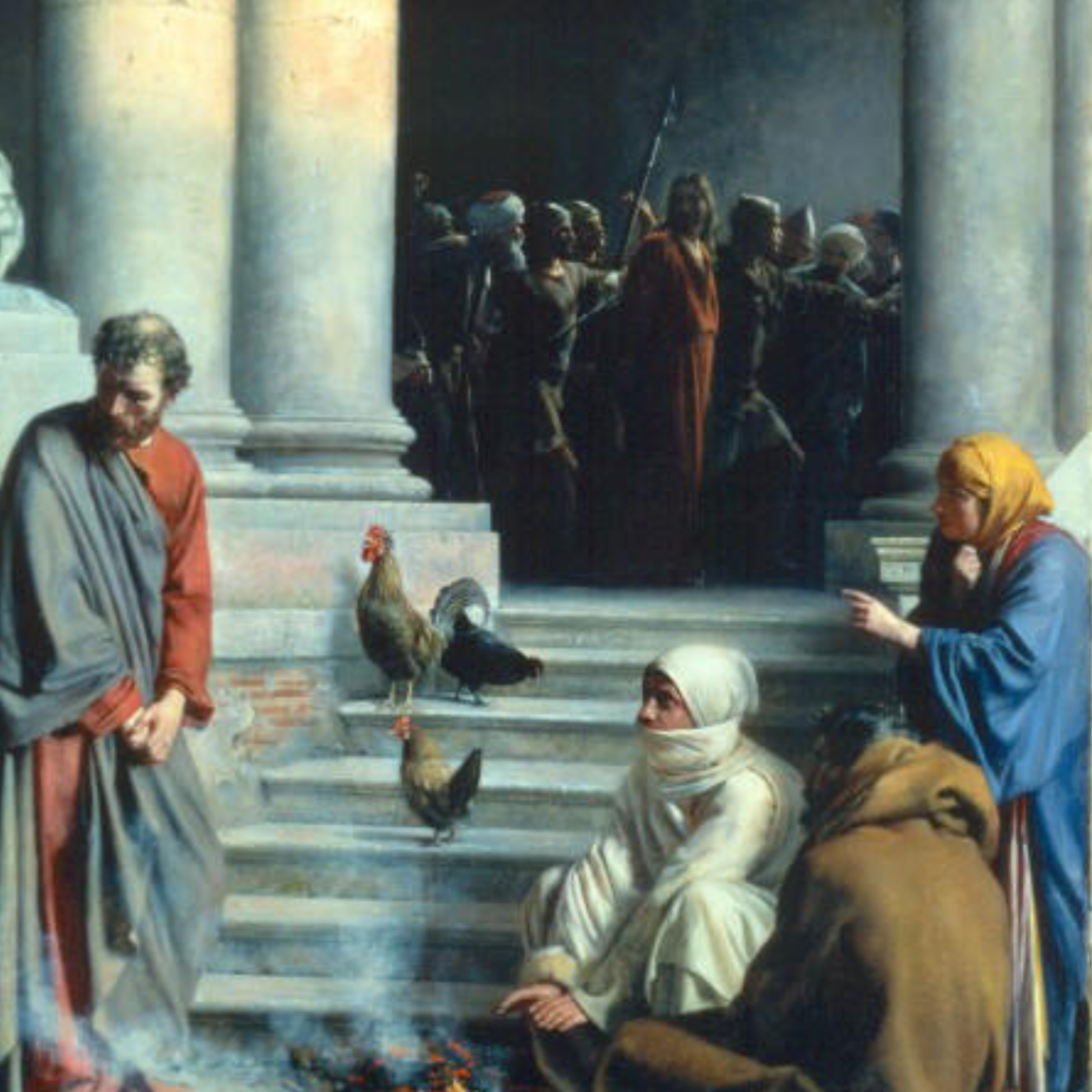
ashamed of nothing but is steaming at his glory that the creator of heaven and earth should suffer so much for man's redemption. Let us continually meditate upon this, let us ever glory in this and fix it irrevocably in our minds. So is the St. John Chrysostom. Peter sat in the open court below where the servants had lighted a fire at his third denial he began to curse and swear. See how one fall draws on another and generally a deeper. To a simple untruth is added perjury and to this horrible implications against himself. Lord Jesus preserved me or I also shall deny thee. Peter remembered the words of Jesus. St. Augustine understands this rather of an interior illumination of grace, but a maybe that our Savior was where he might see Peter and give him a glance of his eye. And going forth he wept bitterly. He did this even daily all his lifetime say the ancient historians of his life. St. Clement relates how St. Peter was ever accustomed to watch in prayer from the first crow of the cock till morning pouring forth torrents of tears
and bitterly bewailing his heinous crime. Let us compassionate our blessed Lord under his sufferings. The evangelist is silent with regard to what was transacted during the night and of the multiplied cruelties and base indignities offered to our divine redeemer during the whole of the night. For after he is informed us of Peter's denial he immediately proceeds to tell us what happened at the break of day. A chief priest with the ancients and scribes after they had wreaked their vengeance upon Jesus by the vileest treatment of his sacred person took counsel how they might induce the governor to put him to death. They again put the question to Jesus and commanded him to tell them if he were the Christ the Son of God and he owned that he was. Upon this they led him away and delivered him to Pontius Pilate the governor. This they did first because being a festival day they apprehended a tumult among the people. Second to make him die a more infamous death on the cross otherwise they might have stoned him to death as they afterwards did to St. Stephen. And third the power of death being taken from them they dared not exercise it without permission from the Roman
governor. They wanted to engage Pilate to pronounce sooner the sentence when he saw that he was condemned by the unanimous voice of the Sanhedrin and to hinder anyone from rising in his defense. They were the more anxious first because three years before the power of life and death had been taken from them. Second because they wished to throw the odium of the crime on another person. And lastly because as both Jew and Gentile were equally to benefit of Christ's death so both Jew and Gentile were to concur in inflicting it. And as all were to have salvation offered them through his blood so none were to be freed from the guilt of shedding it. Then Judas repenting himself. This was a fruitless repentance accompanied with a new sin of despair says St. Leo. Perceiving that Jesus was delivered up and remembering what our divine savior had said concerning his resurrection he repented of his atrocious wickedness. Perhaps Satan who assisted and urged him on to betray his master deserted him now that he had prevailed upon the unhappy miscreant to perpetrate what he had so passionately desired. But how could Judas see that Jesus
was condemned? He certainly did not see it himself but foreboded in his despairing mind what would be the event. The devil does not bind his agents in such a manner as to leave them insensible of the crime they are about to commit till it is perpetrated. So says St. John Chrysostom. Although Judas conceived a horror at his crime and confessed it and made satisfaction to a certain degree by restoring the money still many essential conditions were wanting to his repentance. First faith in Christ as God and as a redeemer as the soul justifier from sin. Second there was also wanting hopes of pardon as in Cain and a love of a much injured and much offended God. Hence this grief was unavailing like that of the damned. If Judas says an ancient father had had recourse to sincere repentance and not to the rope there was mercy in store even for the traitor. To his first repentance succeeded fell despair which the devil pursued to his eternal destruction. If the unhappy man had sought true repentance and observed due moderation in it by avoiding
both extremes presumption and despair he would have heard of forgiving master speaking to him these consoling words I will not the death of a sinner but rather that he may be converted and live. So says origin. The Pharisees bought a burial plot with the money as a show of their charity to strangers but their intention according to Saint Jerome was to disgrace Jesus thus to keep alive in the minds of the people that he was sold by one of his own disciples and delivered up to a disgraceful death. Pilate wondered exceedingly at Jesus' patience and silence and he saw very well that it was envy that excited the Jewish priests against him but they went on charging him that he stirred up the people even from Galilee to Jerusalem. Pilate hearing that he was of Galilee laid hold on this occasion and sent him to Herod Antipas who was tetrarch of Galilee and being a Jew was come up to Jerusalem at this great feast. Herod was glad to see Jesus brought to him hoping to see him do some miracle in his presence but finding him silent and that he did not satisfy his curiosity
he condemned him and ordered him to be clothed in such a garment as my make him laughed at for a fool or a mock king and in this dress sent him back through the streets to Pilate. Pilate admires the constancy and courage of his soul and though perhaps he saw it necessary to declare him guilty of the accusation yet beholding the heavenly wisdom and gravity that appeared in his countenance and the heavenly composure in which he stood he could not conceal his admiration at his conduct so that it seemed to him most miraculous that a man brought to the bar and tried for a capital crime should stand without fear at the approach of death which men commonly so much dread so says origin upon the solemn day of the Paschal feast it was a custom for the governor to pardon and release to the people any one criminal whose life they should petition for and to induce them to beg for Jesus he put in the balance with him one Barabbas a famous malefactor a seditious murderer Pilate wishing to release the innocent Jesus that he might not give the Jews a possibility as he thought of refusing his offer puts the murderer Barabbas in competition with the innocent
Lamb of God his wife had a dream we must remark to these kinds of dreams were not unusual among the Gentiles being sent by God for some just and necessary reason as on this occasion that there might be a public testimony from the Gentiles of the justice and innocence of Christ so says Angerome all therefore that resemble the Jews in either theory or practice desire to have Barabbas loose to them all therefore that seek after iniquity ask for Barabbas and put Jesus away but all who walk in the paths of virtue ask for Jesus and destroy Barabbas Pilate wishing on this occasion to show the Jews the enormity of their crime again puts the question which will you have of the two and again what shall I do with Jesus who is called Christ but they being enraged that Pilate should declare Jesus to be the Christ all in the frantic fury exclaimed let him be crucified what evil hath he done replied Pilate and this he repeated thrice according to St. Luke here in order followed the cruel scourging of our blessed
savior which Pilate consented to it hopes to move the people to compassion this was executed with the utmost cruelty for they assembled the whole band of soldiers commonly about 600 and they made him one wound from head to foot then a scarlet or purple coat was thrown over his shoulders and breathing a crown of thorns that is twisting sharp thorns with some resemblance of the crown they violently pressed it down on his head and struck him at their pleasure with a read or cane which they had placed in his hand instead of a scepter and kneeling in derision said hail king of the Jews when the soldiers had treated Jesus in this barbarous manner Pilate presented him in this condition to the people saying behold the man he imagined their fury would not be changed into pity but they cried out crucify him crucify him take him you said Pilate and crucify him for I find no crime in him the Jews then answered we have a law and according to our law he must die because he had made himself the son of God at this Pilate was more afraid less perhaps he should be of the progeny of the gods as the Romans fancied their heroes to be
he returned back to the palace and asked Jesus again whence art thou Jesus gave him no direct answer yet told him he could not have power over him unless had been granted him from above Pilate was still very desirous to set him at liberty especially when his wife sent a message to him to have nothing to do with that just man for that she had suffered much in a dream on his account the Jews perceived Pilate's great inclination to set Jesus at liberty so they tell him in plain terms that if he does dismiss this man he is no friend to Caesar for everyone that pretends to be a king contradicts Caesar this move Pilate more than anything whatsoever and prevailed with him both against justice and his own conscience to condemn Jesus he feared less some private information might be presented against him to Tiberius Caesar he presently mounted the judgment seat in a public place and said to the Jews behold your king they cry out away with him crucify him shall I crucify your king said Pilate they reply we have no king but Caesar thus renouncing their Messiah
at this Pilate yielded and washed his hands and said I am innocent of the blood of this just man look you to it all the people answered his blood be upon us and upon our children which continues says Saint Jerome to this day this blasphemous prayer continues to this day and will continue a protracted curse upon the Jews and upon their posterity so says origin behold the insanity of the Jews their passion and pertenacious obstinacy will not suffer them to see and understand they draw down curses upon themselves in these terrible implications still the god of all mercies did not literally comply with their impious prayer for of these children he selected some for himself even Paul and many thousands who were converted at Jerusalem so says Saint John Chrysostom it was the custom for men condemned to die by crucifixion to carry their cross which Jesus did through the city but being gone out of the city and as it is probable fainting under the weight of it they forced a man of sireen named Simon perhaps a Gentile or sireen in Libya to carry the cross after him whether it were that they made Simon carry the whole cross or whether
he only bore it up behind is not expressed sireen was the capital of a province in Africa near Libya some are of opinion that this Simon was a Jew his name favors this sentiment and there were many Jews in that province Saint John says that Christ went on carrying his own cross while the other three evangelists state that they forced Simon of sireen to carry it for him both are true for seeing Christ unequal to the weight they compelled the other to take it up for him not apart only as some painters represent but the whole to Mount Calvary as Jesus had carried the whole before so is the saint Augustine the evangelist would not have been so particular in this part had they not wish to inculcate that all who desire to follow Christ must also take up their cross and follow him so is the saint Jerome as no one like to carry the ignominious cross the insolence of the soldiery compelled a stranger to carry it by this we learned that the cross is not taken up by many except with compulsion but when once taken up they carry it with willingness Golgotha or the place of the skull perhaps as Saint Jerome so named from the skulls of persons
executed and buried there several ancient writers would have it so called from Adam's skull whom they guessed to have been buried there some also say that part of this mountain was called Mariah the place where Abraham was ready to have sacrificed his son Isaac Isaac carrying the wood on his shoulders for the sacrifice was a figure of Jesus Christ carrying his cross wine mixed with Mer was often given to those that were to die a violent death to comfort them or stupify them our savior tasted it but would not drink it he refused not to taste the bitterness but would not take what might lessen his torment what Saint Mark relates he took it not is thus explained he took it not so as to drink it which Saint Matthew confirms by saying and when he had tasted he would not drink that is he would not drink so as to receive the support and comfort which a strengthening draft might afford they divided his garments this was accounted with the ancients the greatest infamy it was never done with any but the most vile and worthless wretches with men who possessed nothing more than their garments this they did to our blessed savior a punishment they did not think the two thieves deserving of so say Saint John Chrysostom
it was the custom of the Romans to put inscriptions with the cause of their being crucified Saint Luke and Saint John tell us it was written in Hebrew Greek and Latin the Jews begged of pilot that I might be changed but pilot made them this short answer what I have written I have written this title was nailed over the head of our expiring redeemer by divine providence that the Jews might still be convinced that with all their opposition they must acknowledge him for their king whom they had condemned to so cruel the death and that so far from lessening his empire and regal power they'd rather increased it so say Saint Ramidius Jesus was placed in the midst of two thieves as if he had been the greatest malefactor of the three they blasphemed reviled and insulted him with words and gestures if thou be the son of God etc that wicked fiend tempting our divine savior exclaimed if thou be the son of God cast thyself down if thou be the son of God come down from the cross but on the other hand Jesus will not descend from the hardwood of the cross because he is the son of God for being God he descended on earth took upon himself human nature to die thus for those
who crucified him so so Saint John Chrysostom the Jews wishing to show that he was not their king said with insulting scorn if he be the king of Israel let him come down from the cross and we will believe him falsehood and deceit are stamped upon these words of the Jewish priest for is it more difficult to descend from his cross being yet alive or being dead to raise himself from the tomb he rose again and you did not believe had he descended from the cross you would have been equally incredulous so say Saint Jerome and the same thing the thieves said also that is one of them the other being converted as we find in Luke 2339 St. Ambrose Saint John Chrysostom Saint Jerome and venerable bead say that at first both of the thieves blasphemed but one of them seeing the wonderful things that happened namely that the sun was darkened the rocks split a sunder etc was terrified and converted he believed in Jesus and atoned for his former evil language by praying to him as to his god darkness came at midday and at full noon some say it was an eclipse of the sun it was rather by an interposition of clouds or by the subtraction of the
rays of the sun origin thinks that this darkness was only in Palestine and the neighboring countries for as to the words over the whole earth or over the whole land we find one king the more empire by a common way of speaking called the whole earth or the whole world but Saint Dionysius speaks from his own observations being as he informs us in a letter to Saint polycarp then at heliopolis a city of Egypt for the purpose of astronomical observations he saw this miraculous eclipse he saw the moon rise from the east and placing itself directly under the sun caused the above mentioned darkness to this may be added the observation of Saint John Chrysostom and Saint Jerome that the duration of natural eclipses is very short while this lasted the space of three whole hours in the history of christ's passion we should take notice of his seven last words first he prayed for his enemies and those that put him to death father forgive them for they know not what they do second his mercy called the good thief this day that shall be with me in paradise third he recommended his beloved disciple to his mother saying woman behold thy son
fourth he cried with a loud voice ilai ilai lama subaktani my god my god why has thou forsaken me fifth he said i thirst so let us know the violent thirst of his exhausted body the sixth word was it is consummated that is the work of man's redemption and all the prophecies and decrease of heaven concerning me the savior of the world are now accomplished the seventh and last word was father into thy hands i commend my spirit and with these words says Saint Luke pronounced with a loud voice he expired in crying out with a loud voice our redeemer confirms what he had said to pilot i have the power to lay down my life and i have the power to take it up again for he cried with a loud voice and at the very hour of the evening sacrifice to show that it was by the effect of his own will that he died so Saint John Chrysostom the veil of the temple was torn in two as there were in the temple two parts of the sanctuary so there were two veils or partition walls the first sanctuary called the holy was separated by a veil from that part of the temple
called the court of the Israelites into this outward sanctuary called the holy entered every day the priest that were in office the second interior sanctuary called the holy of holies was also separated from the outward sanctuary by another veil and into this holy of holies no one was to enter except the high priest and he but once a year both these veils seemed to have been rented Christ death and by there being broken down was signified first that the ceremonies of the ancient law were to be abolished by the law of Christ and also that heaven should be open to all how far the earthquake extended is uncertain the rocks were rent and the graves were opened and many bodies of the saints arose Saint Jerome takes notice that these saints did not rise with their bodies till after Christ was risen and so it follows that going out of the graves after the resurrection they came into the holy city and appeared to many this event was a prophecy of the fatal destruction that was shortly to fall upon the temple and also that it should henceforth give place to things more noble and sublime it likewise shows the greatness of Christ's power so so Saint John Chrysostom
Saint Mark says that when they saw Jesus die in this manner crying out with a loud voice which could not be natural and when they saw the other miracles they were struck with fear Saint Luke says that the centurion glorified God it is said that the centurion being afterwards confirmed in the faith was honored with the crown of martyrdom so so Saint John Chrysostom it was customary with the Jews for the women of that country to minister onto their teachers both food and Raymond these women ministered to our Lord hoping that he would bestow heavenly food to them who offered earthly food to him not that the creator of all things stood in need of assistance but he wished to show his disciples an example of poverty in himself and charity in these women but let us see what sort of women these were that followed our Lord among whom were Mary Magdalene sister of Martha and Lazarus Mary the mother of James the Lesson Joseph sister of the Blessed Virgin Mary and the mother of the sons of Zebede otherwise called Salome who were disciples of Jesus so so Saint Jerome the Jews desired of Pilate that the bodies might not remain on the crosses on the Sabbath day
some soldiers were sent for this purpose and broke the legs of the two others that were not quite dead but perceiving that Jesus was dead they broke not his legs but one of them pierced and opened his side with the lance and with such a wound as would have deprived him of life had he not been already dead the divine providence permitted this to make his death more certain and undoubted Joseph a disciple in private now encouraged by the miracles which had happened went boldly to Pilate and begged the body of Jesus Saint Mark says that Pilate wondered that he was already dead and having been informed of the truth by the centurion he granted the body to Joseph Nicodemus also who is called the Prince of the Jews came to bury our Savior bringing with him a mixture of Mirran Allos to involve the body the evangelist does not call Joseph a rich man out of vanity or to inform us that Jesus had persons of distinction among his followers but to show why Joseph in preference to any other went to beg the body for being a nobleman he could obtain easier access to the governor of Judah than any of the other disciples who were chiefly poor illiterate fishermen. The Roman laws forbade burial to be given to criminals without an express
permission from the judges. Behold with admiration the courage and constancy of this disciple of Christ who threw love for his crucified Savior willingly exposed himself not only to the enmity of his countrymen but even to the danger of death and dared in the presence of all to beg the body of Jesus and to give it public interment. So, so, Saint John Chrysostom. Joseph laid it in his own new monument queued or cut out in a rock where no one had ever been laid and rolled a great stone against the entrance that no one might go in or take away the body. But Mary Magdalene and the other women that had accompanied Jesus from Galilee followed at a distance to mark the place having a design to come afterwards and again imbalm the body. It was the custom of that country to excavate a tomb from the hard rock for all persons of great distinction. From the unadorned tomb of the man god we are taught to despise the grandeur of this perishable world and fear the example of those who even in their sepulchres manifest to the world how grieved they were to leave their wealth since they carried it with them to their tombs ornamenting them with every costly decoration human ingenuity could devise. So, Saint Jerome.
More episodes
More from Catholic Daily Brief

1962 Missal - Commentary on the Mass Readings: Sat, Aug 22 (Immaculate Heart of...
Catholic Daily Brief

Commentary on the Mass Readings: Sat, Aug 22 (Queenship of the Blessed Virgin Ma...
Catholic Daily Brief

Commentary on the Mass Readings: Fri, Aug 21 (Pope St. Pius X)
Catholic Daily Brief

1962 Missal - Commentary on the Mass Readings: Fri, Aug 21 (St. Jane Frances de...
Catholic Daily Brief