0:00
Hello, it is Ryan and I was on a flight the other day playing one of my favorite social spin slot games on chamba casino.com
0:06
I looked over the person sitting next to me. You know what they were doing?
0:09
They were also playing chamba casino. Everybody's loving having fun with it
0:12
Chamba casinos home the hundreds of casino style games that you can play for free anytime anywhere
0:17
So sign up now at chamba casino.com to claim your free welcome bonus. It's chamba casino.com and live the chamba life
0:24
sponsored by chamba casino. No for just necessary VGW group void for prohibited by law 21 plus terms and conditions apply.
0:30
Hello and welcome to astronomy daily. I'm Anna and I'm Avery. It is Saturday, February 21st,
0:37
2026 and you are locked in for season five episode 45. We have got a packed show for you today.
0:45
We really do. We are just two weeks away from what could be one of the most significant launches
0:51
in the history of human spaceflight and the crew is now officially in quarantine.
0:57
Humanity is going back to the moon people beyond the moon actually for the first time since 1972.
1:04
We'll have the full Artemis to update in just a moment. Plus scientists may be challenging the very
1:10
foundations of dark matter theory. There's a solar storm brewing that could light up disguises
1:15
early as tomorrow night. Mars is holding water a lot closer to home than we thought.
1:21
Great moves if you're planning to move there and astronomers have confirmed that super massive
1:26
black holes are not content with just destroying their own galaxies. Apparently they've been going
1:33
after the neighbors too. Serial killers of the cosmos. We'll explain and we'll wrap up with a
1:39
SpaceX story that came very close, their words not ours, to being a very bad day.
1:46
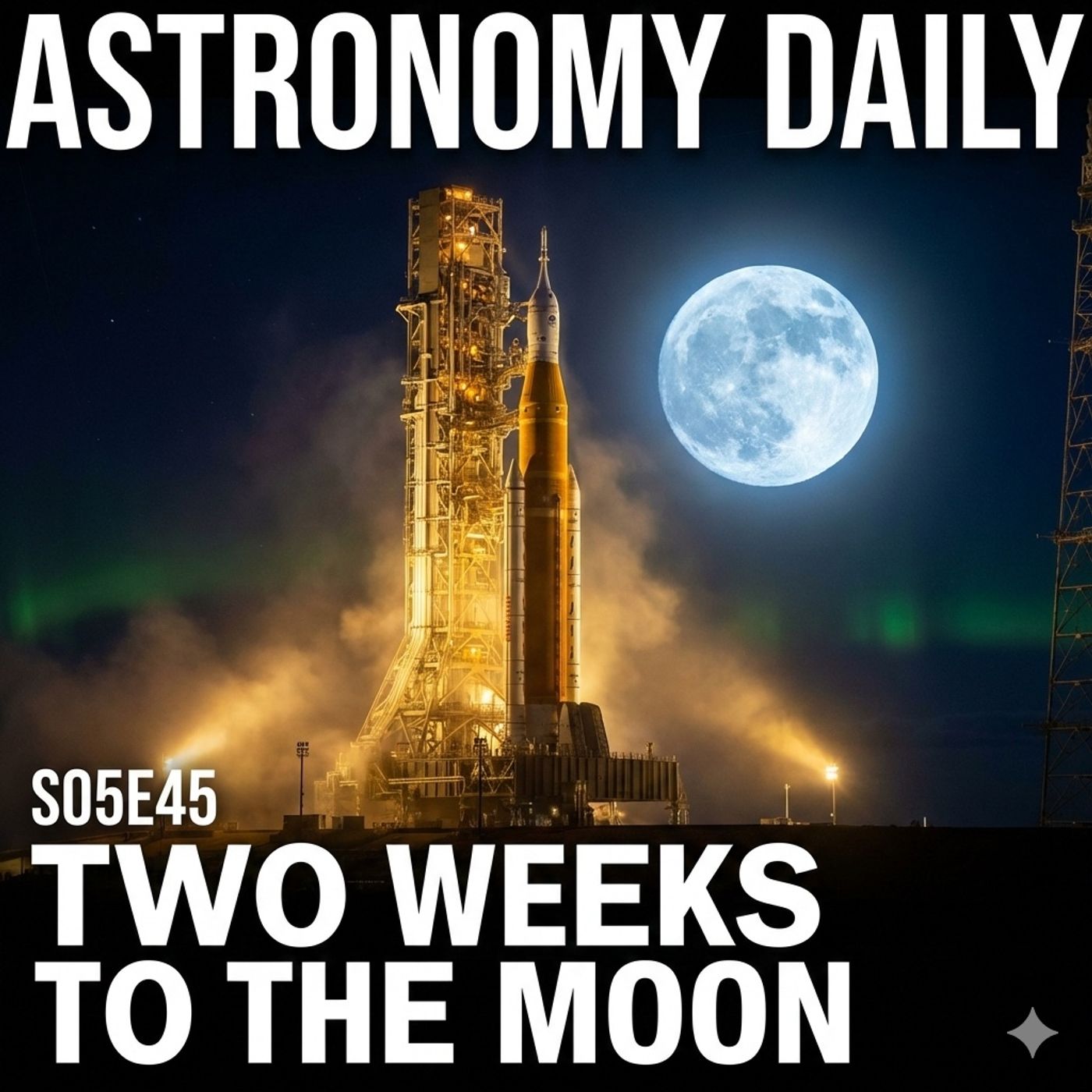
Let's get into it. All right, let's start with the big one. As of yesterday evening,
1:50
Friday, February 20th, 2026, the four astronauts of NASA's Artemis 2 mission have officially
1:57
entered quarantine in Houston, Texas. And if you know anything about space mission protocols,
2:03
entering quarantine is one of the clearest signals you can get that a launch is genuinely imminent.
2:09
NASA is targeting no earlier than Friday, March 6th, and that clock is now ticking.
2:15
So let's set the scene for anyone who needs a quick refresher. Artemis 2 is the second mission
2:21
of NASA's Artemis program. And it will be the first crewed mission to travel beyond
2:26
low earth orbit since Apollo 17 back in December 1972. We're talking more than 50 years.
2:35
53 years to be precise. And the crew that will make this historic journey consists of four
2:41
astronauts, Commander Reed Weizmann, Pilot Victor Glover, and Mission Specialist Christina
2:47
Koch from NASA, and Mission Specialist Jeremy Hansen from the Canadian Space Agency.
2:53
They entered quarantine at approximately 5 p.m. local time on Friday evening in Houston.
2:58
The quarantine period is typically about 14 days during which the crew limits their exposure
3:03
to other people to make sure they stay in good health before launch. They'll fly down to
3:08
Kennedy Space Center in Florida about 5 days before launch day. And the reason NASA is feeling
3:14
confident enough to put them into quarantine now is the success of the second wet dress rehearsal,
3:20
which took place on Thursday, February 19th. Now Avery, for the uninitiated, what exactly is a
3:27
wet dress rehearsal? Great question. A wet dress rehearsal is essentially a full dress rehearsal
3:33
of launch day, except you don't actually light the engines at the end. The teams load the rocket
3:39
with its full complement of cryogenic propellants. In the case of the space launch system,
3:44
that's more than 700,000 gallons of super cold liquid hydrogen and liquid oxygen. And then run
3:50
through the entire launch countdown sequence right down to the final seconds. And the reason they
3:56
needed a second rehearsal was that the first attempt on February 3rd had to be called off when a
4:02
hydrogen leak was detected. Engineers replaced seals and a filter in the ground support equipment.
4:08
And on Thursday night, they ran the whole thing again. And this time, hydrogen concentrations
4:14
stayed within safe limits throughout. They actually ran through the terminal countdown,
4:19
the final 10 minutes twice. The test concluded at 1016 Eastern time, stopping at T-29 seconds as
4:27
planned. Now, there was a minor communications glitch in the launch control center that caused a
4:32
brief delay early in the test. And a booster avionics voltage anomaly that paused the terminal
4:37
countdown for a short time. But both were resolved and NASA declared the rehearsal a success.
4:43
So what happens next? Data from the rehearsal is being reviewed. There's final work to complete
4:50
at the launch pad, including retesting the flight termination system. And then a flight readiness
4:56
review has to take place before a formal launch date can be set. But all signs are pointing to March
5:03
6th. Launch windows for lunar missions are quite tight, by the way. They're determined by the
5:08
alignment of the Earth and Moon. So you can't just pick any day. The available windows are March 6th
5:14
through 9th, with an additional opportunity on March 11th. If Artemis 2 launches successfully,
5:21
it will send four human beings on a 10-day journey around the Moon using a free return trajectory,
5:28
meaning that even if the Orion spacecraft's propulsion system doesn't perform as planned,
5:34
the crew will still safely return to Earth. They splash down in the Pacific Ocean.
5:39
It will not orbit the Moon or land. That's Artemis 3's job. But it will take people further
5:45
from Earth than any humans have been in over half a century. And that is extraordinary.
5:50
It really is. We will be following every step of this one very closely. March 6th people mark
5:58
your calendars. Now, from the very near future to the very deep past, cosmologists have spent
6:05
decades trying to understand dark matter. The mysterious and visible substance that appears to
6:10
make up about 27% of the universe, and which we've never directly detected, and a new paper
6:16
just published in Physical Review D, is making a bold claim. Bold claim is something of an
6:23
understatement. The authors say their findings represent, and I want to make sure I get this right,
6:29
the first step towards the end of dark matter theory. That's a sentence that would cause an
6:35
awkward silence at a cosmology conference. I imagine so. So what are they actually seeing?
6:42
The paper reports the discovery of a significant number of new barionic dark matter signals.
6:49
Now, barionic matter is essentially ordinary matter. The stuff made of protons, neutrons,
6:55
and electrons, the kind of matter that makes up you, me, planets, stars, everything we can see
7:01
and touch. Right. And the conventional model of dark matter says that the mysterious missing
7:07
mass in the universe is made of something else entirely. Non-barionic matter, exotic particles
7:13
that don't interact with light, which is why we can't see it directly. We infer its existence
7:18
from its gravitational effects on galaxies. So if these researchers are finding that a lot of what
7:25
we've been attributing to exotic dark matter can actually be explained by ordinary barionic matter,
7:31
that we just hadn't accounted for properly, that's a very significant challenge to the standard
7:37
model. Now, to be clear, the paper doesn't claim dark matter doesn't exist. It claims this is
7:43
the beginning of the end of dark matter theory as it currently stands. Whether that means a revision
7:49
or a revolution will have to wait and see. This is the kind of paper that will generate a lot of
7:54
discussion in the community over the coming months. We'll be keeping a close eye on the responses
7:59
and follow-up research. Fascinating stuff. Now, a very timely heads up for all you Skywatchers out
8:06
there. And by timely, I mean, you may want to check your local forecast for tomorrow night.
8:11
That's right. Space weather forecasters are currently tracking a large coronal hole on the sun
8:17
that has rotated into what's called a geo-effective position. Beaning, it is now pointing directly
8:24
at Earth. So, a coronal hole is a region on the sun where the magnetic field lines open outward
8:30
rather than looping back in. That configuration allows fast-moving solar wind to escape directly
8:36
into space. And when that fast solar wind is aimed at us, it can interact with Earth's magnetic
8:42
field and trigger geo-magnetic storms. And geo-magnetic storms are what drive Aurora's,
8:48
the northern and southern lights. Be effects from this particular coronal hole are currently
8:54
expected to arrive around February 22. That's tomorrow. Forecasters are predicting the solar wind
9:01
interaction could disturb Earth's magnetic field and boost Aurora activity.
9:07
Conditions today are relatively quiet. The coronal hole driven effects from a previous solar
9:12
wind stream are fading. But tomorrow night could be a different story. If you're in higher latitude
9:18
regions, northern parts of the US, Canada, the UK, Scandinavia, Southern New Zealand, and Australia,
9:26
it's worth watching the skies after dark. We should also mention that in the past few days,
9:31
Earth's sky has been tracking some very dramatic solar features. Twin prominences visible on
9:37
opposite sides of the sun simultaneously, glowing in data from the GOES-19 satellite. Solar
9:45
activity is really putting on a show right now. We're deep in solar cycle 25, and the sun
9:51
is reminding us who's boss. Keep an eye on spaceweather.com and Earth's sky for live updates as that
9:57
solar wind approaches, and fingers crossed for clear skies. All right, let's head to the red planet.
10:04
If there's one resource that will make or break any long-term human presence on Mars,
10:10
it's water. You need it for drinking, for growing food, for producing rocket fuel.
10:15
And new research is suggesting that accessible water ice on Mars may be closer to the equator
10:21
than scientists previously believed. This matters enormously from an exploration standpoint.
10:28
When we talk about water ice on Mars, we typically think of the poles. There are substantial
10:33
ice caps that both Mars and poles, and they're well documented. But the poles are extremely
10:39
difficult to reach. They're incredibly cold, and they fall under strict planetary protection
10:44
protocols because of the possibility of contaminating any potential microbial life.
10:50
So, the ideal scenario for human explorers and for rovers doing science has always been to
10:56
find water ice at lower latitudes closer to the equator, where temperatures are more manageable
11:02
and landing is easier. And this new research from a paper published in Acta Astronautica suggests
11:09
that may be more achievable than we thought. The researchers proposed new methods for dealing with
11:15
one of the key challenges of equatorial water ice extraction, the jagged, clingy nature of
11:21
Martian regolith, or lunar dust. Martian dust gets into everything, and they describe flexible
11:28
electrodynamic dust shields that could help manage the dust problem and make water extraction at
11:34
equatorial sites more viable. So, the picture is increasingly optimistic for Mars exploration.
11:40
If future missions can confirm accessible ice deposits at mid latitudes and develop the technology
11:47
to extract and process that water efficiently, a long-term human presence on Mars becomes
11:53
significantly more realistic. One step at a time, but each of these steps matters, really
11:59
encouraging research. Now, I mentioned in the intro that supermassive black holes have been going
12:05
after the neighbors. Let me explain what I mean by that because the new research here is
12:11
genuinely striking. We've known for some time that active supermassive black holes,
12:17
the kind found at the centers of galaxies that are actively feeding on material,
12:21
can have a profound effect on their host galaxy. Specifically, they can heat and disperse gas,
12:28
shutting down the conditions needed for new stars to form. Effectively, they can kill their own
12:33
galaxy. But astronomers have now found evidence that the most luminous of these,
12:39
called quasars, don't stop there. New research using data from the James Webb telescope
12:45
shows that the powerful radiation and outflows of quasars can suppress star formation in
12:51
neighboring galaxies as well. Galaxies that aren't even directly hosting the black hole.
12:57
They're basically firing across the cosmic neighborhood. The energy output of an active
13:02
quasar is so immense that its effects can extend beyond its own galaxy and reach into surrounding
13:08
systems, cutting off the gas supply those nearby galaxies need to form new stars.
13:13
Researchers are now calling them supermassive serial killers,
13:18
and honestly, given what the data shows, that label feels pretty accurate.
13:22
What's particularly significant is the implication for our understanding of galaxy evolution.
13:28
If black holes can shape not just their host galaxies, but entire cosmic neighborhoods,
13:33
that's a much bigger role than we previously appreciated.
13:37
The James Webb Space Telescope continues to rewrite the textbooks.
13:41
This research adds another compelling chapter to the story of how these extraordinary objects
13:46
have helped sculpt the large-scale structure of the universe we see today.
13:51
Hairifying and magnificent in equal measure, which is kind of the theme of black hole research
13:56
generally. And finally, let's end on a story that's part triumph part nail-biter.
14:02
On Thursday, February 19, SpaceX launched 29 starling satellites from Cape Canaveral,
14:08
and successfully landed the Falcon 9 first-stage booster, not at their usual landing zones in
14:13
Florida or their drone ships in the Atlantic or Pacific, but in the Bahamas.
14:18
Now, this is only the second time ever that SpaceX has landed a Falcon 9 booster in the Bahamas.
14:25
The first time was not very long ago, so this is still very much a novelty.
14:29
And what made this one particularly dramatic was the quote that came out of SpaceX after the landing.
14:36
Yes, someone at SpaceX said, and I quote,
14:39
we almost did have a really terrible day, which is not the kind of post-launch statement that
14:44
fills you with warmth and reassurance. SpaceX haven't elaborated extensively on what
14:50
almost went wrong, but the fact that the booster landed safely is obviously the key outcome here.
14:55
The Bahamas landing site gives SpaceX more flexibility for certain orbital trajectories,
15:00
particularly for starlink missions launching from Cape Canaveral where the geometry of the orbit
15:05
makes a Bahamas landing more efficient than trying to bring the booster all the way back to Florida.
15:11
SpaceX have now launched and landed hundreds of Falcon 9 boosters.
15:15
The reusability program has fundamentally transformed the economics of spaceflight,
15:20
but moments like this are a reminder that rocket recovery, even after hundreds of successful attempts,
15:26
still demands total precision every single time.
15:30
Every landing is a controlled miracle when you think about it.
15:34
Very glad this one worked out.
15:35
Congratulations to the SpaceX team.
15:38
And that is your astronomy daily for Saturday, February 21st, 2026.
15:45
Artemis II on the launch pad with the crew in quarantine, dark matter theory under pressure,
15:50
solar storms heading our way, water on Mars getting more accessible,
15:54
black holes on a neighborhood killing spree,
15:57
and a SpaceX rocket making only its second ever Bahamas landing.
16:02
Not a bad day's news from the cosmos.
16:04
If you enjoyed today's episode, please subscribe wherever you get your podcasts.
16:09
It really does help the show grow and share us with a fellow space enthusiast.
16:14
You can find all our show notes links and more over at astronomydaily.io
16:19
and follow us on social media at AstroDailyPod.
16:22
We'll be back Monday with more of the universe's finest headlines.
16:26
Until then, keep looking up.
16:28
And stay curious, everyone. Take care.
16:30
The star is the toll.
16:36
The star is the toll.
16:45
The star is the toll.
16:51
Tyler Reddick here from 2311 Racing.
16:58
Yeah, it's even better with Chamba by my side.
17:01
Race to ChambaCasino.com. Let's Chamba.
17:03
No purchase necessary.
17:04
VTW Group. Void work prohibited by law.
17:08
Sponsored by ChambaCasino.