Loading...
scienceastronomynatural
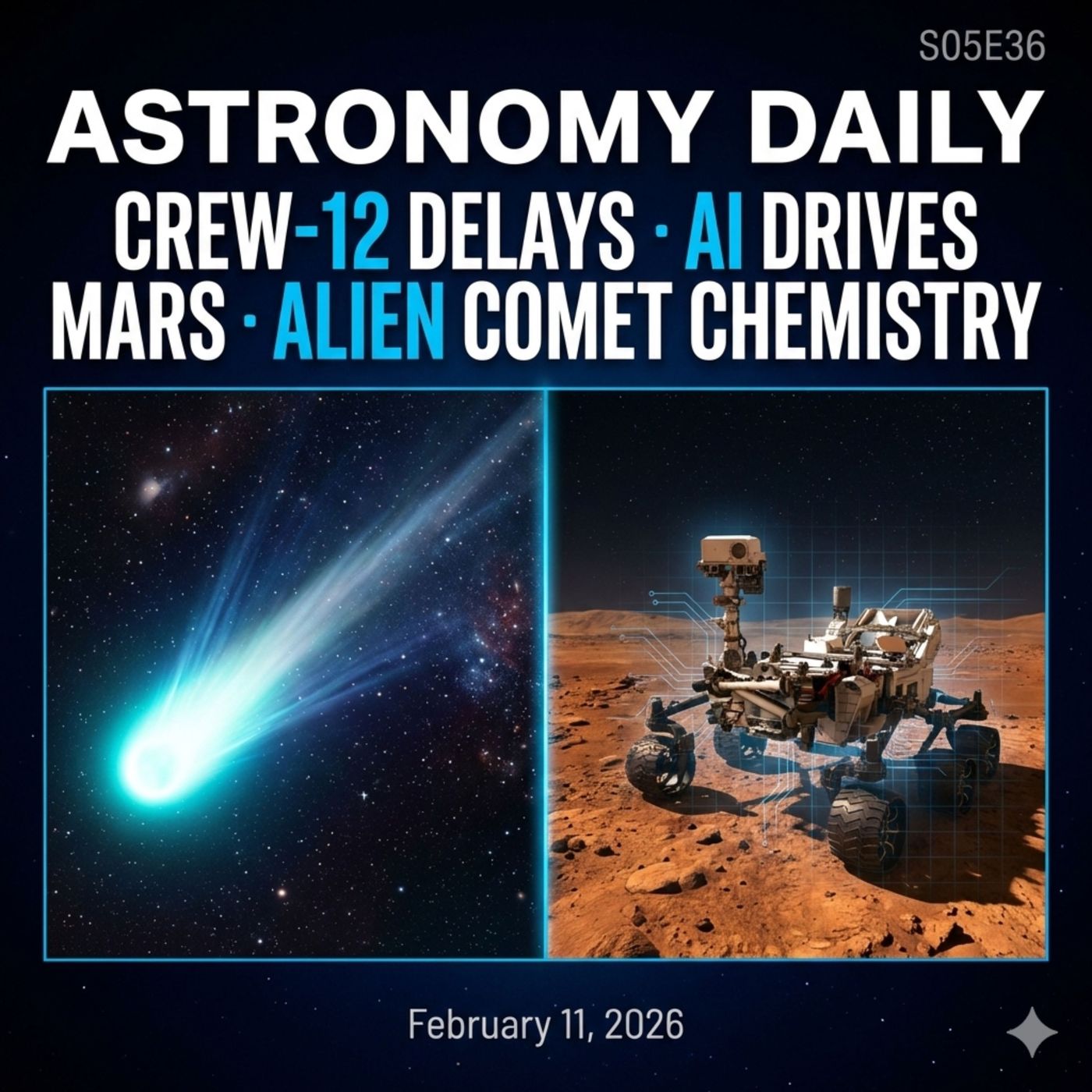
Crew-12 Spy Scandal, AI on Mars & Interstellar Comet's Last Secret?
About this Episode
Four astronauts are stuck in quarantine in Florida as weather keeps pushing back the Crew-12 launch — now targeting no earlier than Friday, February 13. We've got the full story, including the remarkable subplot involving a Russian cosmonaut who was quietly removed from the mission in December. Plus: interstellar comet 3I/ATLAS is on its way out of the solar system forever, but new data from NASA's SPHEREx and James Webb telescopes reveals it's been carrying a chemical cocktail from another star system — one that's unlike anything we've seen in our own comets. Also in today's episode: NASA let an AI drive the Perseverance rover on Mars for two days straight; new research suggests Earth may have hit a rare chemical jackpot during formation that made life possible; the Ring of Fire solar eclipse is just one week away; and Starship is back on track after the Booster 18 disaster, with Flight 12 targeting a March launch window. In This Episode • SpaceX Crew-12: Three launch scrubs, skeleton ISS crew, and the cosmonaut spy subplot • 3I/ATLAS farewell: SPHEREx detects alien chemistry; JWST finds record CO2-to-water ratio • AI drives Perseverance on Mars — 456 metres without human control • Earth's lucky chemistry: why phosphorus and nitrogen almost didn't make it to the surface • Ring of Fire annular solar eclipse — February 17 over Antarctica • Starship Flight 12: Booster 19 passes cryo tests, March launch window in sight Key Links • Full show notes & blog: astronomydaily.io • NASA Crew-12 mission blog: nasa.gov • NASA SPHEREx 3I/ATLAS data: science.nasa.gov • Universe Today — AI drives Perseverance: universetoday.com • Nature Astronomy — Earth habitability study: nature.com Subscribe & Connect Subscribe on Apple Podcasts, Spotify, or wherever you listen. New episode every weekday. Full transcripts, blog posts and show notes at astronomydaily.io
Become a supporter of this podcast: https://www.spreaker.com/podcast/astronomy-daily-space-news-updates--5648921/support.
Sponsor Details:
Ensure your online privacy by using NordVPN. To get our special listener deal and save a lot of money, visit www.bitesz.com/nordvpn. You'll be glad you did!
Become a supporter of Astronomy Daily by joining our Supporters Club. Commercial free episodes daily are only a click way... Click Here
This episode includes AI-generated content.
Become a supporter of this podcast: https://www.spreaker.com/podcast/astronomy-daily-space-news-updates--5648921/support.
Sponsor Details:
Ensure your online privacy by using NordVPN. To get our special listener deal and save a lot of money, visit www.bitesz.com/nordvpn. You'll be glad you did!
Become a supporter of Astronomy Daily by joining our Supporters Club. Commercial free episodes daily are only a click way... Click Here
This episode includes AI-generated content.
Hosts & Guests
Transcript
It is Ryan C. Crest here.
There was a recent social media trend,
which consisted of flying on a plane with no music,
no movies, no entertainment.
But a better trend would be going to chumbacacino.com.
It's like having a mini social casino in your pocket.
Chumbacacino has over a hundred online casino style games,
all absolutely free.
It's the most fun you can have online and on a plane.
So grab your free welcome bonus now at chumbacacino.com.
Sponsored by Chumbacacino.
No purchase necessary VGW group void
were prohibited by law 21 plus terms and conditions apply.
Four astronauts, one rocket and weather
that just will not cooperate.
The crew 12 team is in quarantine in Florida,
watching the forecast and waiting.
A visitor from another solar system
is heading for the exit and handing us
a chemical blueprint of its home solar system on the way out.
Plus, a rover on Mars just took orders from an AI
instead of a human for the very first time.
All that plus a rare solar eclipse just days away.
New research that could change how we search for life
and starship making a comeback after a dramatic setback.
It's a big day.
Welcome to Astronomy Daily.
Let's get started.
Anna, take it away.
Hello and welcome to Astronomy Daily.
Your daily guide to what's happening out there.
I'm Anna.
And I'm Avery.
It is Wednesday, February 11th, 2026.
We have six stories to get through today.
And honestly, it's one of those lineups
where every single one of them earns its place.
We're going to kick off with the ongoing crew 12 drama
at Cape Canaveral, then swing to deep space
for the latest from three-eye slash Atlas.
And then we've got a Mars AI story
that genuinely made me stop and think.
Some fascinating new science about why Earth ended up
being habitable at all.
A rare solar eclipse just days away
and a big starship update.
Let's get into it.
So Avery, as of this morning, the crew 12 mission
has now been pushed back to no earlier
than Friday, February 13th.
That is the third attempted launch date in less than a week.
It really is.
Whether has been the culprit each time,
the teams originally had a window on Wednesday, 11th today,
but conditions along the Dragon Spacecraft flight path
just weren't cooperating, so they waved it off.
Then Thursday the 12th got pushed.
Now they're looking at Friday morning
with a plant lift off at 515 Eastern.
And the reason there's so much urgency here
isn't just that people are impatient.
The International Space Station is currently running
on what NASA is calling a skeleton crew.
Crew 11 had to come home early back in January
following a medical issue with one of the astronauts.
And since then, the station has been significantly
understaffed.
Crew 12 is the relief team.
Which makes every weather delay feel
a little more loaded than usual.
The people up there are doing the work
of a full crew with a much smaller team.
So who's making this trip?
Well, let's run through them one more time.
Commander is NASA astronaut Jessica Meyer,
a veteran of a previous long-duration station mission
and well-known for conducting the first all-female
spacewalk back in 2019.
She'll be joined by pilot Jack Hathaway,
also from NASA on his first spaceflight.
And then there are two mission specialists.
Sophie Adnot from the European Space Agency,
representing France, and Andre Fedgyev from Russia's Ross
Cosmos.
This will be Fedgyev's second trip to the station.
Once they dock, they're looking at an eight to nine-month stay,
longer than usual, to cover the time lost
by crew 11's early departure.
Now, there is a subplot to this mission
that I think a lot of people may not have heard about.
Back in December, Russia's Ross Cosmos
quietly removed Cosmonaut Alleg Artemiev
from the crew 12 mission.
The official line was that he had transitioned to, quote,
other work.
Which is the kind of statement that immediately makes you
want to know what the actual reason is.
Right.
And investigative outlet The Insider reported that Artemiev
was effectively expelled from the United States
by a being accused of violating international traffic
in arms regulations, by allegedly photographing
SpaceX engines, documents, and other sensitive technologies
with his phone, and then exporting that information.
So he was allegedly taking photos
inside SpaceX facilities of proprietary rocket technology
and sending it out of the country.
That appears to be the allegation.
He was replaced by Andre Fedyev, and Ross Cosmos
has said very little publicly.
But it's a striking reminder that even in the cooperative world
of the International Space Station,
the geopolitical tensions of the wider world
don't disappear at the door.
And it raises interesting questions
about what access international partners
are given to commercial SpaceX facilities.
These aren't NASA government sites.
Anyway, the crew are in quarantine,
the rocket is on the pad, and all lies
are now on the floor to forecast for Friday.
We'll update you the moment there's news.
Our second story takes us to the outer solar system,
where interstellar comet Three Eye Atlas is continuing
its farewell tour.
And before it goes, it's been handing scientists
some truly unexpected data.
Just to set the scene, Three Eye Atlas
was discovered in July 2025 by a telescope in Chile,
traveling far too fast on a trajectory
that could impossibly have originated
within our solar system.
It's only the third interstellar object
ever confirmed to have passed through
after Oumuamua in 2017 and Borisov in 2019.
NASA's SpaceX telescope observed Three Eye Atlas
in December 2025, and the results have been remarkable.
The comet's coma has become dramatically more active
and chemically complex.
Burex detected water ice, carbon dioxide, carbon monoxide,
organic compounds, and rocky material being ejected
in chunks far larger than the fine dust grains
you'd normally expect.
The scientists described it as a cocktail of chemicals
that haven't been exposed to space for billions of years.
The James Webb Space Telescope added another layer,
finding that the ratio of carbon dioxide
to water in the coma is approximately eight to one,
which is one of the highest CO2
to water ratios ever measured in any comet.
In our solar system's comets, water tends to dominate.
So the implication is Three Eye Atlas
may have formed much further from its home star
than a typical comet would, near a CO2 ice line.
Its chemistry is essentially telling us something
about the architecture of the planetary system
that it came from.
There's also data on the comet's spin.
It rotates once every 16.16 hours,
and researchers found it had strange wobbling jets
in a rare, sun-facing, anti-tail.
Normally, comet tails point away from the sun,
but Three Eye Atlas briefly had one pointing toward it,
genuinely weird behavior.
As of today, Three Eye Atlas is in the constellation Gemini,
fading beyond naked eye visibility.
It's heading towards a Jupiter flyby in mid-March
before leaving the solar system forever.
And there's one more data released to watch for.
He says juice spacecraft observed Three Eye Atlas
back in November, but couldn't transmit the data
while using its antenna as a heat shield.
That data is expected to arrive here
on Earth anytime now in February.
So there could still be one more surprise coming.
When future generations ask what we learned
about other solar systems in 2025 and 2026,
Three Eye Atlas is going to be a big part of the answer.
Dave travels Three Eye Slash Atlas.
Don't be a stranger,
although I suppose by definition, you always will be.
Tyler Reddick here from 2311 Racing,
another checkered flag for the books.
Time to celebrate with Chamba.
Jump in at chambacasino.com.
Let's Chamba.
Don't purchase necessary, BTW Group,
Voidware Prohibited by Law, CCNC, 21 Plus,
sponsored by Chamba Casino.
Now, this next story is one I find genuinely fascinating
because it sits right at the intersection of robotics,
artificial intelligence, and the practical reality
of exploring another planet.
In December, NASA handed the wheel
of the Perseverance Mars Rover to an AI.
Not metaphorically, literally.
The AI generated the Rover's driving waypoints
and the Rover followed them without human control
across two separate days,
covering a total of 456 meters.
And just to be clear, this isn't NASA hopping on a bandwagon.
They have been working on autonomous Rover navigation
for years out of sheer necessity.
Mars is so far away that a round trip radio signal
takes around 25 minutes.
That means every driving instruction you send
has a built-in delay
and every unexpected obstacle requires
another 25 minutes to respond to.
Autonomous navigation isn't a luxury.
It's a practical requirement.
So in this demonstration,
the AI analyzed orbital images
from the Mars reconnaissance orbiter's high-rise camera
as well as digital elevation models.
It identified hazards, sand traps,
boulder fields, bedrock, rocky outcrops,
and then generated a path
defined by a series of waypoints to avoid them.
From there,
Perseverance's own onboard auto navigation system
took over to actually execute the drive.
And importantly,
before those AI-generated waypoints were sent to Mars,
they were tested here on Earth
using Perseverance's engineering twin,
a full-scale physical replica at JPL's Mars Yard.
So this wasn't a blind experiment.
There was a safety net built in.
The AI in question is built on Anthropics Claude,
which regular listeners may know as the same AI
that helps power this show.
So there's a certain pleasing symmetry and reporting on that.
That really is.
And the engineers are excited about what comes next.
One of the current limitations
is that the longer a rover drives
without human relocalization,
essentially humans checking in
to confirm where it is on the map,
the more positional uncertainty built up.
Over 655 meters,
that uncertainty can grow to around 33 meters.
The goal is to use AI to solve that relocalization problem too.
So rovers can handle kilometer-scale drives
entirely on their own.
And beyond Mars,
this matters for the whole future of deep space exploration.
NASA's Dragonfly mission to Saturn's Moon Titan
will rely heavily on AI for autonomous navigation
as it flies around in Titan's thick atmosphere.
The further from Earth you go,
the more critical autonomous systems become
because waiting 25 minutes for a signal is one thing,
but waiting hours or days is quite another.
The vision the JPL team laid out is compelling.
Intelligent systems not just at mission control here on Earth,
but embedded in the rovers, helicopters,
and drones themselves trained on the collective knowledge
of NASA's engineers and scientists.
The Mars rover of 2035
may look quite different from perseverance.
Our next story is one of those pieces of research
that sounds almost philosophical at first,
but turns out to have very concrete scientific implications.
A new study published in Nature Astronomy
has found that life on Earth may be thanks
to an extraordinarily lucky chemical accident
during our planet's formation,
nearly 4.6 billion years ago.
And when they say lucky, they mean it.
The research suggests that two elements
absolutely essential for life as we know it,
phosphorous and nitrogen only stayed accessible
on Earth's surface because of a very precise
and apparently quite rare balance of oxygen
during the planet's earliest formation.
Here's how it works.
When a young rocky planet forms, it's initially molten,
a churning ball of liquid rock
as heavy metals sink inward to form the core.
Later materials stay near the surface.
During this chaotic stage called core formation,
the amount of oxygen present determines
where other elements end up.
The researchers from ETH Zurich found that oxygen levels
need to fall within a surprisingly narrow range
for both phosphorous and nitrogen
to remain in the mantle and crust,
available for future life.
Two little oxygen and phosphorous bonds with iron
and gets dragged into the core,
taking away a key ingredient for DNA,
cell membranes and energy transfer.
Too much oxygen and nitrogen is more easily lost to space.
Either way, the chemistry needed for life
never fully comes together.
Earth hit this sweet spot with the researchers
are calling a chemical goldilocks zone precisely.
The lead researcher, Craig Walton, put it clearly.
If Earth had had just a little more
or a little less oxygen during core formation,
there would not have been enough phosphorous
or nitrogen for the development of life.
They also modeled Mars and found it likely
had the wrong oxygen balance,
more phosphorous in the mantle than Earth,
but less nitrogen, challenging conditions for life
as we know it.
This is a significant challenge
to how we've traditionally thought
about the search for life.
The habitable zone, the region around a star
where liquid water can exist on the surface
has been our go-to framework.
But this research suggests that even a planet
in the perfect orbital position with liquid water
could be fundamentally incapable of supporting life
if its internal chemistry didn't form correctly.
And here's the hopeful flip side.
The oxygen conditions during planetary formation
are linked to the chemistry of the host star itself
because planets form from the same material as their stars.
So in principle, by looking at stellar chemistry,
we might be able to predict which planetary systems
had the right conditions from the start.
Walton's advice for the search,
look for solar systems with stars
that resemble our own sun.
It makes the Earth feel even more special
and the universe feel a little more vast and empty.
All right, from the philosophical to the spectacular,
in exactly one week's time on February 17th,
an annular solar eclipse is going to sweep
across the southern hemisphere.
This is the so-called Ring of Fire Eclipse
where the moon passes directly in front of the sun.
But because it's at a slightly greater distance
from Earth than usual, it appears a little smaller
than the sun's disc.
The result is a thin, blazing ring of sunlight
surrounding the moon's dark silhouette,
stunning.
Though this is different from a total solar eclipse
where the moon completely covers the sun
and you get that eerie darkness in the middle of the day.
In an annular eclipse, the moon blocks about 96%
of the sun's disc, but that remaining sliver stays visible.
And the ring effect is only visible
for around two minutes and 20 seconds
at any given location in the past.
The path of annularity for this one is quite remote.
It runs primarily over Antarctica,
which means the full Ring of Fire experience
will be witnessed by the researchers
at places like Concordia Station,
the French Italian outpost on the Dome Sea Plateau
and Mirney Station, the Russian base on the Davis Sea coast.
We're talking about teams of maybe 50 to 200 people,
a very exclusive audience for one of nature's best shows.
For the rest of us, partial phases will be visible
from the southernmost parts of South America,
southern Chile and Argentina, and from parts of South Africa.
Not the full Ring, but still a striking sight
if you're in the right location with proper eclipse glasses.
And it goes without saying,
never look directly at the sun during an eclipse
without approved eclipse glasses.
The Ring of Fire does not mean the sun is safe to look at.
There's also something lovely about the timing
of this eclipse.
February 17th is the start of Chinese New Year,
specifically the year of the fire horse.
The new moon that causes the eclipse
is the same new moon that marks the beginning
of the lunar New Year.
And the present moon, visible on February 18th,
will signal the start of Ramadan.
So this one celestial event sits right
at the intersection of multiple major cultural moments
around the world.
If you're not in the past and want to watch,
there will almost certainly be live streams
from research teams in Antarctica.
We'll keep an eye out and link to any good ones
in the show notes.
And we're going to close out today's main stories
with a starship update because after a frustrating little,
things are very much moving again
at SpaceX's Starbase facility in South Texas.
To understand why this is significant,
you need a quick bit of context.
The last starship flight, Flight 11,
was the final launch of the Block II configuration.
SpaceX is now transitioning to Block III,
which is a significantly upgraded architecture
featuring new Raptor III engines,
enhanced performance, and improved reusability features.
But the development of Block III hit a serious setback
when Booster 18, the first Block III booster,
failed during cryogenic pressure testing late last year.
Its outer container cracked.
SpaceX moved fast.
Booster 19, the replacement, was stacked
and delivered to the test site in record time.
And in the first week of February,
it successfully completed not one,
but two cryogenic pressure tests.
The first was on February 2nd,
the second on the fourth, both passed.
Starbase Watchers described it as looking like
the entire booster had frozen solid,
as super chilled liquid oxygen entered it,
which is exactly what it's supposed to do.
Booster 19 has since been returned
to the production site for further work,
and all eyes are now on the flight stack.
Booster 19 paired with Ship 39,
which is being prepared for what will be the debut
of the full Block III vehicle.
The current target is a launch window
in the February to March time frame,
though sources familiar with the program
point to March as the most realistic date.
Flight 12 is a genuinely significant milestone.
It'll be the first flight of the Block III Starship,
the first use of the new pad 2 architecture at Starbase,
and the debut of Raptor III engines at scale.
The stakes are high.
NASA needs a successful Block III
to progress towards using Starship
as the human landing system
for the Artemis program's crude lunar missions.
That timeline is already under pressure.
Meanwhile, infrastructure work continues
at a remarkable pace.
Had one at Starbase is being rebuilt.
SpaceX's facility at Kennedy Space Center
at Launch Complex 39A is progressing
toward a first Florida Starship launch
in the second half of 2026,
and environmental approval has been granted
for a brand new Starship complex
at Space Launch Complex 37 at Cape Canaveral,
which would eventually give the program
five launch pads across Texas and Florida.
Five launch pads for Starship.
It's a lot to take in,
but after booster 18s failure and the testing low,
the fact that booster 19 has passed its cryotests
and flight 12 is back on track
is genuinely good news for the program.
We will be watching closely.
That is everything we've got for you today
on Astronomy Daily.
Fix stories, all of them worth your time
from astronauts waiting for weather in Florida
to a comet carrying four billion-year-old secrets
from another star.
A rover taking orders from an AI on Mars,
new science that makes life on Earth
feel like a cosmic lottery win.
A ring of fire one week away
and Starship dusting itself off
for another attempt at history.
A genuinely brilliant day to be following Space News.
Thank you so much for spending part of it with us.
If you enjoyed today's episode,
please subscribe wherever you get your podcasts.
And if you want to go deeper on any of these stories,
full show notes and our blog are over
at astronomydaily.io.
Until tomorrow, keep looking up.
Take care, everyone.
Astronomy day, the star is the toe.
The star is the toe.
The star is the toe.
Tyler Reddick here from 2311 Racing,
another checkered flag for the books.
Time to celebrate with Jamba.
Jump in at chumbacacino.com.
Let's jump.
No purchase necessary, BGW C R C F C T N C 21 Plus.
Sponsored by chumbacacino.
No purchase necessary, BGW C R F C T N C 21 Plus,
sponsored by chumbacacino.
No purchase necessary, BGW C R F D N C 21 Plus,
sponsored by chumbacacino.
More from Astronomy Daily: Space News Updates
View all episodes →
Artemis II Is Go — Humanity's Return to the Moon
Astronomy Daily: Space News Updates
Apr 2, 2026·13:09·failed

'Hey, Let's Go to the Moon' — Artemis II Launch Day
Astronomy Daily: Space News Updates
Apr 1, 2026·16:24·failed

