Loading...
news
Cuba is not alone, deputy FM says as US threats grow | Talk to Al Jazeera
About this Episode
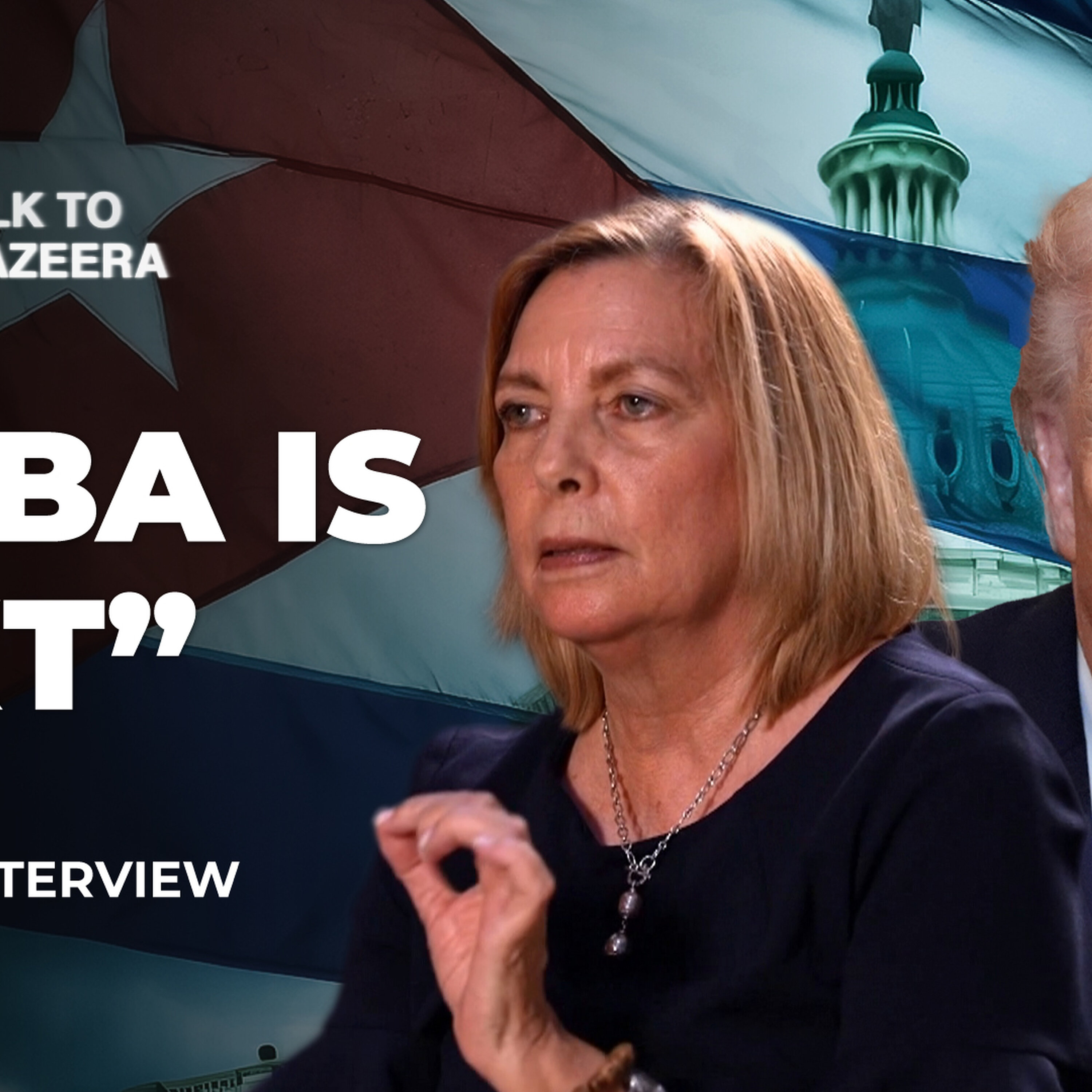
Cuba is facing widespread blackouts as United States sanctions restrict fuel supplies, crippling the island's energy system and economy. In this episode of Talk to Al Jazeera, Deputy Foreign Minister Josefina Vidal Ferreiro defends Cuba's position, rejects US pressure, and warns of growing humanitarian consequences. She also responds to US President Donald Trump's remarks suggesting Cuba could be targeted next after Iran. As tensions rise, Vidal insists that Cuba will resist while calling for dialogue, raising questions about how far this confrontation could go.
Hosts & Guests

Transcript
I'm Lucia Newman in Havana, as the spotlight remains fixed on the U.S.-Israeli war on Iran,
here in the Cuban capital as across all of the largest island in the Caribbean, the lights
are going out.
Not because of missiles, but because of sanctions, acute sanctions.
Cuba is not at war, but it is in a political conflict with the United States.
The island depends on imported oil to keep its power plants running, but the U.S. government
has moved to choke off that supply, pressuring countries and companies, not to provide fuel,
threatening sanctions, and effectively stopping shipments from reaching Cuban ports.
Without fuel, there's no electricity, without electricity, there's no functioning economy,
and daily life is becoming increasingly harsh.
Now President Donald Trump has gone further, saying Cuba would come after Iran as part
of a broader push against governments, Washington sees his adversaries.
And Cuba is next, by the way, but pretend I didn't say that, please.
Pretend I didn't say that.
Please, please, please, media, please, just regard that statement, thank you very much.
Cuba is next.
Here, the government says it's preparing for the worst, bound to resist whatever the cost.
So how far could this confrontation go?
For Safina Vidal, Cuba's Deputy Foreign Minister talks to Al Jazeera.
Deputy Foreign Minister for Safina Vidal, thank you for talking to Al Jazeera.
I'd like to start...
You're welcome.
It's my pleasure.
Mine as well.
I'd like to start by taking you back ten years when you played a vital role in the negotiations
between the United States and Cuba to renew diplomatic ties after more than half a century
of hostilities.
But unfortunately, that rapprochement lasted a very, very short time.
What do you think is going to happen this time round?
And at that time, it wasn't Cuba's choice.
I mean, it finished, not because we put an end to that rapprochement.
I have to remind that we fulfill all our commitments.
And unfortunately, it was the United States government, the one who decided to dismantle
everything that together we built for about two years for the benefit of our two people.
So we have always thought that dialogue is what we have to have between our two countries.
We have always seen that dialogue is what can bring our countries closer together, that
can solve the differences that might exist and look for common ground, for civilized coexistence
for mutual benefit.
So what does it that you think that the Trump administration really wants?
I think the way in which you phrase your question has to be asked to the US government what
they want.
We know what we want.
Confrontation has been, unfortunately, part of our very long history, mutual history
between Cuba and the United States.
But we have always thought that promoting dialogue is the most important thing for us to solve
our differences.
But the differences that you have go far beyond an economic system, they're not the
same differences that, for example, the United States has with other communist countries,
like, for example, China or Vietnam.
You are 90 miles or 130 kilometers away from the United States and you have been a thorn.
Your government has been a thorn in the side of the United States ever since 1959.
But you know, I have never seen the United States having any problems to have normal civilized
relations with other countries with have different political systems or which organize their
own countries in ways that respond to their own interests.
So the question would be, why is it not possible with Cuba?
We would believe that it would be possible for Cuba.
The only thing we will always ask is respect, total respect for our independence, for our
sovereignty, not to interfere in our internal affairs.
Beyond that, we see there is a lot of, there are a lot of possibilities for Cuba and the
United States to coexist, to work together to identify areas in which we can cooperate,
in which we can build a respectful relationship, taking to consideration our closeness.
The history that brings us together, because there are cultural and even human ties, personal
ties between people in Cuba and in the United States.
So we always would think that it is possible, why not, and we demonstrated, 10 years ago,
that it was possible for Cuba and the United States, regardless of our differences, to work
together, to discuss things to do together and not making our differences the center of
our relationship and look beyond that for the benefit of both of us.
So when I say that this is a domestic issue for the United States, or certainly for members
of the Republican Party particularly, I'm referring to the fact that there is a very
powerful Cuban-American community, they have members in Congress, they have, they have
a strong political influence, and now they have a foreign minister or a secretary of state,
Marco Rubio, who has said that the only way to bring about change in Cuba and to bring
about a normal relationship with Cuba is for there to be regime change.
I don't see any reason why Cuba would need to renounce its independence in sovereignty
in order to accommodate what the United States would like to have in its relationship with
Cuba.
So any country which respects itself, any country which is responsible in its international
relations with the rest of the world, wouldn't put on the table, I mean, in any negotiation
it's internal affairs, it's a matter to be decided by the population of any country.
So and this is what Cuba would always defend.
So we are ready to talk about everything with the United States.
We are ready to have a negotiation with the United States to put many things on the table
to discuss with the United States with one exception.
And this exception is Cuba's independence, Cuba's sovereignty, and Cuba's sovereign
decision to decide about its own system and the organization of its society.
It's a matter to be decided only by the Cuban people.
Well, the Trump administration says that Cuba represents an unusual and extraordinary,
and I'm quoting an unusual and extraordinary threat to its national security.
What do you interpret from that?
You know, Cuba is not a threat to anyone, Cuba is a country of peace, Cuba is a friendly
country, Cuba is a country that has shown and shows always solidarity towards other peoples
and countries.
I would say in the other way that the United States has been not an unusual threat for Cuba
all along his history, and it's not only the last 67 years because the United States
has always looked at Cuba with other interests, interests of domination, and that's why
it has always been such an important factor in the history of Cuba.
So I would say that Cuba doesn't pose any threat to the United States, it's the United
States, which has always been a threat for Cuba.
Well, right now I understand that there are, what Cuba calls a dialogue, what President
Trump calls negotiations taking place, discreetly behind the scene.
We believe that Raul Castro, former President Raul Castro, and the current President
Diaz Canell are sort of heading these talks, but from afar that it is Raul Castro's
grandson who might have been physically present in some discussions with the U.S. Secretary
of State.
But were these talks a one-off or is this something that is continuing?
As our President explained very clearly a few days ago, we are just in the first phase
of this conversation, let's say.
There has been one meeting, he explained, he said very clearly.
It's been one meeting.
I won't get into details about the nature of the meeting or the content of the meeting
or who is talking to whom, but this is the first step in what we have always seen as
a solution for our problems to have a responsible serious dialogue with the United States.
And while you're having this one meeting, the President of the United States is repeatedly
saying that he is going to take over Cuba and that he will do, quote, whatever he wants
with Cuba because your country is collapsing.
What do you say to that?
It's a fact that the United States government has made threats against Cuba.
We don't see any justification for the United States threatening Cuba.
For the United States expressing this kind of views towards Cuba and of course we will
defend our country.
It would be naive if we ignore the threat that the United States poses to Cuba is not new.
As I said, because of the long history of confrontation that has prevailed, unfortunately,
in our bilateral relationship.
But as a result of that, we have always given priority to national defense.
And we will continue doing that.
Is it realistic though to expect that Cuban armed forces, Cuban citizens, if they were
armed and told to defend this country from a U.S. aggression, could do anything against
the world's greatest military superpower?
We will defend our country.
We are resolute determined to defend Cuba and this is not new.
Has always been our position and has been one of the first priorities of our country.
To defend Cuba, Cuba is a peaceful country, a friendly country, but we will always be ready
to defend our sovereignty and independence in case it is necessary.
You are talking about a conversation, a dialogue, what hopefully would become a negotiation.
But why would this be any different than what happened for example with Iran or with
Venezuela?
They were negotiating with the United States when they were attacked and the negotiations
that were very agreement that was reached with Venezuela afterwards was done with one
could say metaphorically with a gun up to the head of the current president, the acting
president of Venezuela.
Are you holding conversations with the gun held up to your head?
We are holding conversations because that has been coherent with Cuba's historic position
and practice that dialogue is the only way and the only alternative for us to solve problems,
problems, differences and to look for a solution to those difficulties and problems with
the United States government.
This is our position and this is not new.
So you have seen that in the past in our relationship with the United States, different
episodes of dialogue because Cuba has always believed that dialogue is the only alternative
and the only solution.
That may very well be the case but I think it would be fair to say that the situation,
the confrontation, the hostility between the United States and Cuba, whoever initiated
it has never been as intense as it is right now since the Bay of Pigs invasion or the Cuban
missile crisis which was back in the very early 1960s, wouldn't you agree?
Maybe, but again, our position is coherent with our history.
So I don't see any reason why Cuba's position would change.
No, but you have no petrol.
You have no electricity, you have constant blackouts, the country and its people are suffocating
as I think is the word that Cuba uses constantly.
It's suffocating and nobody is offering to come to rescue anymore like in the old days
with the Soviet Union or later on when the Venezuelans were able to come and support you
with petrol and other means.
But now, none of that is happening.
It looks very much like Cuba is alone in this.
Cuba is not alone and we don't feel alone.
But at the same time, we are not sitting with, you know, cross hands waiting for a magical
solution to our problem.
So in the middle of this suffocation that you rightly said that is being imposed through
this energy blockade of Cuba, we are looking for every possibility in order to increase
the production of our own national oil.
It is not enough, but at least with that oil, we can produce 50% of the energy that Cuba
consumes.
At the same time, we are accelerating investment in solar parts so that we can double in
the matter of one year the production of energy through renewable sources of energy.
But of course, we will need to import oil because no economy, no country can function without
fuel oil, unfortunately enough.
And that's why we are asking and we are warning and the word that this blockade has to be
lifted.
We are receiving the support of different countries in our claim for this to end because there
is no justification for any country to subject the Cuban population to such harsh measures
that has devastating humanitarian consequences for our population.
But Cuba is not alone.
We have been receiving support for other countries in order to facilitate and to help us in
our plans to look for solutions to the situation and the difficulties we are living through.
And we are sure that we will continue receiving the support of other countries and with our
own efforts, we will find a solution.
But at the same time, that measure, that U.S. coercive measure, which affects the whole
Cuban population has to end, there is no justification at all, not even political justification
in order to submit one population of 11 million people to such harsh measures.
But what about China?
What about Russia?
These are major powers.
It's been three months since the Cuban state has received one drop of oil from anywhere.
Why haven't the Russians defied this blockade or the Chinese?
I won't enter into any details about what we are doing in order to solve this problem.
But that has to end.
That has to end because it's cruel.
It has humanitarian cause.
It has caused great concern of UN agencies, of the United Nations System in general, about
the humanitarian effect and the humanitarian situation that such a measure can create.
What do you say to Cubans out on the street?
I'm not even going to quote human rights organizations, which I know you don't agree was what they
have to say.
But if you speak to ordinary Cubans, not all of them, in fact many of them, do not blame
the United States.
They blame your government and your system for having taken so long, for having resisted
economic change, the kind of economic change that we've seen in every single communist
run country except for North Korea.
I wouldn't agree with that because you know, economic changes have been happening in Cuba
for quite a while because Cuba has changed, because the Cuban population has changed,
because the external environment has changed in the last 30, 40 years.
So it is not the first time that Cuba has been trying to introduce changes in our functioning
in our economy.
By the way, since 2011, we have made many transformations in our economy.
Now the economic environment in Cuba is totally different from what existed 30 years ago.
You see a more variety, different kinds of property co-existing in the country and there
is a plan.
I wouldn't say that we have not made our own mistakes managing and running the economy.
It happens in every country.
And more so when you are subject to such a difficult, overwhelming cruel system of sanctions
of measures, coercive measures by the biggest superpower like the United States, we have a plan.
We have identified a recent two years ago problems and mistakes and distortions that we
have to correct in our economy, but the United States is trying to change the narrative
and trying to put blame on what is its responsibility on the Cuban government.
And I am sure, and I know that the majority of the Cuban population can distinguish very
easily, which is the responsibility of the United States in the current situation that we
are having, because we are not the ones who provoke to have this energy blockade.
We are not the ones who have submitted Cuba to this situation and it is very clear for
everyone that the United States is trying to put the blame on us when everybody knows
and the majority of the international community knows very well.
Otherwise, 165 countries wouldn't have supported Cuba just four months ago when we submitted
the resolution to put an end to the U.S. blockade at the United Nations General Assembly.
Before returning a little bit to the economy, though, your government says that it is willing
to make, I don't know if the word was concessions, but accommodations with the United States.
What accommodations could it make?
Again, this is not new.
As I said already, we are ready and willing and open to put on a agenda of negotiations
with the United States every issue with one exception, which is independence sovereignty
and internal affairs.
But everything else can be put on the table for the United States to participate, for example,
in our economic transformations.
Why not?
We have been promoting foreign investment in our country.
The United States is the only one which so far cannot participate in those opportunities,
but not because of Cuba's choice, because it is prohibited by the United States blockade
or embargo legislation towards Cuba and there could be cooperation in any area.
You can name it.
It could be law enforcement, it could be the combat against drug trafficking or international
organized crime or environmental issues, educational activities, culture, scientific questions.
So there is endless possibilities for Cuba and the United States to work together and
for the United States to participate in our development program.
So that gives you an idea of the different opportunities and Cuba is open for opportunities.
Well, you say that the United States or the United States citizens, be they have Cuban
origin or not, can't invest in Cuba.
But actually, four years ago, under President Biden, there was an agreement.
There was an exception made to this, but in Cuba, it was very difficult.
The legal framework was never really made possible.
And I have the feeling that in Cuba, the government has always felt that if too many people and
too much capital comes in from the United States and the economy is opened up as in other
countries around this area and in the Caribbean, the government of Cuba will lose power.
You know, this is not exactly the way you put it because as far as I know, there has
been Cubans living abroad who have been participating in our economy through different modalities
in the last three, four years.
And our Ministry of Foreign Trade just announced this month, at the beginning of this
month, that we will expand even more those possibilities and with new regulations that are
being issued, issued in order for Cubans living abroad to be able to participate even more
in our economy.
What do you think that what's happening to Cuba now says for the rest of Latin America?
We've already seen the example of Venezuela, you know, what's happening in Iran, but Latin
America does, has not come out in support of your country, the way one might have expected.
It's very divided, your own region.
No, let's wait until the next time we submit our resolution to put an end to the blockade
to the UN General Assembly.
But this is not what we saw last year in November when the majority, the overwhelming majority
of the world, with a couple of exceptions in our region, supported that long claim by
Cuba.
Because this is what the Cuban people deserve, that this system of sanctions, the longest
that has ever existed finishes.
When President Trump and others say that this country is on the verge of collapse, what
would you say to them?
I don't know, they are so focused on collapse.
Do you see collapse?
Maybe another country.
For the conditions we are living in now would have collapse, but you don't see that so
far in Cuba.
The difficulties are big, huge.
People have been submitted to, you know, stress.
Hospitals are working under stress.
The whole economy is under stress.
Exactly.
But again, you are not seeing a collapse country.
Even though we haven't been able to import oil for three months, so we have our own resources,
our own reserves in Cuba.
This is not the first time we are living through very difficult times.
And we have always found a way to get out of that situation.
So we have always been optimistic because of our own efforts and because we are not alone
and we know that we are not alone, but I am not going to get into details because we
have to protect ourselves.
We know that we will get out of this situation.
We know that.
Deputy Foreign Minister Josefina Vidal, thank you for talking to Al Jazeera.
You're welcome.
It's been my pleasure.
Thank you.
Thank you.


