About this episode
Why_the_smartest_AI_refuses_to_answer
Get every episode summarized
Each time ÆON imminent 🧬 🌀 publishes, we email you a written briefing from the transcript — the topics, who appeared, and any specific claims, with the ad reads skipped.
Email me new episodesFree for 3 shows. No card needed.
Hosts & guests
Transcript ready
217 searchable segments. Every word is indexed and playable.
Full transcript
ÆON imminent 🧬 🌀 — Cyborgism > all artificial computer only. Machine-transcribed; use the interactive transcript above to jump the player to any line.
What if the absolute smartest, like the most advanced thing and artificial intelligence could possibly do is look at your question and just flat out refuse to give you the answer? I mean, it sounds completely counterintuitive, right? Yeah, yeah. Like, you spend billions of dollars developing a system and it's best feature is essentially ignoring the prompt. But that dynamic is actually the central focus of our discussion today. We're looking at this really brilliant exchange between a neuroscientist, someone who actually builds AI systems and a physicist. And our mission for this deep dive today is to figure out how you, you know, listening to this, can actually thrive in an age where machines already have all the answers because we are currently right in the middle of this massive structural shift. Oh, absolutely. We're spending literally trillions of dollars globally to train machines that effectively don't need us. Right. They pass the bar exam, they self-math Olympiads, they write complex code, but having all those free instant answers creates what they call this information exploration
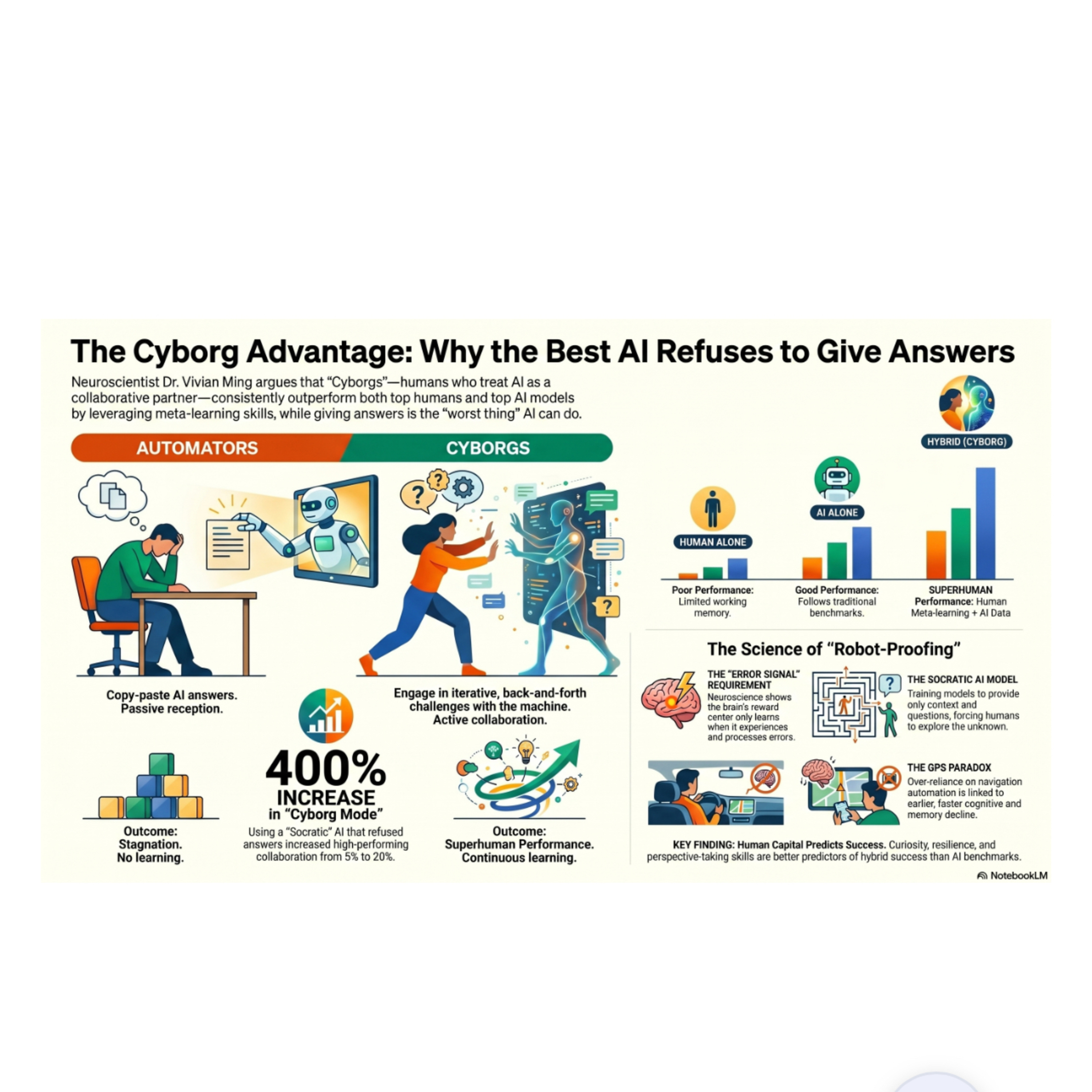
paradox. When the answer is just handed to you on a silver platter, human curiosity drops. Like, we just stop exploring, we become these obsolete automators instead of augmented cyborgs. Exactly. And to really grasp the difference between, you know, an automator and a cyborg, we have to look at how people actually interact with these systems in high-stakes environments. Okay. There was this incredibly revealing experiment run recently where participants were asked to predict the price of oil six months into the future. Which is, I mean, that's notoriously difficult. You're dealing with geopolitics, weather patterns, global supply chains, it's just a massive volatile puzzle. Precisely. It's incredibly complex. So they established some baselines first. Humans working entirely on their own did terribly. I'm not surprised. They were essentially just guessing against a chaotic market. Now, the AI models working on their own actually did quite well. They tracked perfectly with their traditional performance benchmarks. But the fascinating part was observing humans using AI.
Which is the exact scenario most of us are sitting in right now at our desks. Yes, exactly. And the majority of the participants, and this included a group of highly educated elite university students. They defaulted straight to automator mode. Oh, wow. They just copied the complex question, pasted into an AI like GPT or Gemini, and submitted the AI's exact output as their own work. I mean, they essentially function as a pair of legs to just walk the answer across the room. So they didn't add a single ounce of human value? None. Zero. But about five to 10 percent of the participants did something completely different. Okay. They shifted into cyborg mode. They engaged in this combative back and forth dynamics. So the human would make an initial prediction. The AI would push back with historical data. And then the human would counter that by bringing in real world context or like breaking news that the AI might be missing. They actually debated the machine. And let me guess the debaters won. They dominated. These cyborgs beat the best humans working alone and they beat the best AI
models working alone. That's wild. They even performed comparably to polymarket betters who have actual real money on the line. They achieved this highly elusive superhuman super AI performance. But the researchers didn't stop there, right? Because to really isolate why that debate dynamic worked, they deliberately built an AI model that was on paper the absolute worst performing AI of all time. Yeah, this is my favorite part. It took an open source Lama model and fundamentally altered its training. So it would never output a direct solution. Right. They named it Socrates. Yeah. And you asked it a question. It would only provide contextual variables and fire socratic questions back at you. Just constantly question you. Exactly. It failed every traditional benchmark because it literally refused to answer the prompt. But when participants were paired with this like frustrating question asking Socrates AI, the number of people who shifted into that high performing cyborg mode skyrocketed. It jumped from 5% to upwards of 20%. Right. Because Socrates refused to do the heavy lifting,
it actually forced the human to engage. You know, I look at that and I think of it like hiring a personal trainer. We culturally treat AI like we're hiring someone to go to the gym and lift weights for us. We sit on the couch and somehow expect to get stronger. Yeah, that doesn't work. No. But being a cyborg with a tool like Socrates is like having a world-class gym spotter. The spotter doesn't lift the bar for you. They force you to lift heavier than you ever could on your own, you know, catching you right before failure. That physical analogy actually maps perfectly to what is happening inside the brain. Because if you ask why we don't just build a better AI that gives the perfect answer on the first try, you have to look at the literal biology of learning. Okay, unpack that for me. Well, without the struggle of making mistakes, our biology actively prevents us from absorbing new information. So we physically need the friction to learn. We do. Yeah. It all comes down to a region in the brain called the anterior single cortex or the ACC. In neuroscience circles, this is famously dubbed the OSHIT network.
The OSHIT network. We all know that feeling intimately. Like you merge into a lane without checking your blind spot or you hit reply all on an email. You really shouldn't have. Oh, yeah, the worst feeling. Instantly, before the consequence even fully hits, you get that visceral jolt in your stomach. That jolt is your ACC lighting up on a brain scan. It registers that your prediction about the world was wrong. Right. But it doesn't just register the mistake. It sends that prediction error signal directly into the nucleus accumbens, which is your brain's reward center. Now, there is a massive cultural misconception here that dopamine is the pleasure drug. Right, the idea that dopamine is just the chemical reward we get for like eating a slice of chocolate cake. Exactly, but it's far more complex than that. Dopamine is actually a prediction drug. Your brain is fundamentally a prediction engine. Okay. When you make a guess about the world and you experience an error that ACC, uh-oh moment, your brain releases endogenous opioids. Opioids like pain killers. Yes, they are the brain's natural painkillers and reward chemicals and they flood your system
to physically lock in the new neural pathway so you don't make the same mistake twice. That chemical flood is the literal biological mechanism of learning. No error signal, no endogenous opioids, no learning. Man, let me connect this back to the AI then. If the ACC is essentially the brain's check engine light and it only turns on when we make a mistake using an AI to just hand us water, the perfect answer is like hiring a mechanic to turn off the check engine light without actually fixing the engine. We bypass the oh shit network entirely. That is exactly it. You are robbing your brain of the exact chemical process required to adapt. You become completely dependent on the machine because you never built the internal neural pathways to understand the mechanics behind the answer. I see the biological logic there, but I really want to push back on a concept that always comes up in these discussions. The tech world loves to talk about cultivating a failure resume. Like the mantra is always fail early fail often. And you know, it looks great
on a motivational poster, but if you are a small business owner or you're managing a tie budget, fouling could literally mean bankruptcy. Does everyone really have the luxury of experiencing these prediction errors? That tension is very real. And it's important to clarify that maintaining a failure diary isn't about romanticizing bankruptcy or celebrating catastrophic mistakes. Okay, good. It's about training your brain's cognitive framework to structurally extract the lesson. It's about surviving the prediction error. So it's not fail for the sake of failing. It's consciously forcing the ACC to close the loop between the mistake and the eventual success it led to. Yes, precisely. When you systematically connect the oh shit moment to the eventual aha moment, you build measurable psychological resilience. Right. And if surviving failures, the biological key to learning, the real question becomes, how do we build that resilience ourselves and in our kids? So we don't just get replaced by calculators that never make errors. How do we fundamentally robot proof ourselves? The answer lies in meta-learning, which encompasses
foundational human skills like working memory, curiosity, perspective taking, purpose, and crucially resilience. To illustrate how vital these are, researchers conducted this staggering study analyzing 122 million LinkedIn profiles. They wanted to predict long-term career success. 122 million. That is an unbelievable data set. How do you even measure something abstract like resilience across 122 million resumes? It's crazy, right? They use natural language processing to map career pivots, the clusters of skills people acquired over time, and how they navigated transitions between entirely different industries. Okay. And what they found completely upends how we think about hiring. The prestige of the university someone attended didn't predict much at all. Really? Yeah, and the hard technical skills they listed on their profile also didn't predict long-term trajectory. Let me guess the abstract meta-learning traits did. They did. Measurable psychological constructs like analogical reasoning, resilience, and a sense of purpose were the primary predictors
of success. Wow. And it actually goes deeper than career trajectory. These same traits predicted physical health markers like insulin sensitivity, the size and depth of a person's friendship networks, and incredibly, they predicted a person's walking speed at age 65. Okay. That drives me crazy in the best way possible. Because in the corporate world, we constantly demean these exact traits by calling them soft skills. But if a psychological trait literally predicts whether I have the physical vitality to walk quickly at age 65, that is not a soft skill. That is a survival skill. It is absolutely a survival skill. And the beautiful thing about these foundational traits is that they're highly changeable throughout your entire life. But you cannot learn them in a lecture hall. Right. You can't read a book on resilience and magically become resilient. You have to experience the fricking. You have to let the check engine light come on. Exactly. The rule of thumb for building this and others, whether it's your kids or your employees, is to let them struggle, but catch them at about the 80% mark. Ah, so the spotter analogy again? Yes. You don't let them
crash completely into that bankruptcy scenario you mentioned. But you ensure they feel enough of the struggle so the ACC fires and the learning pathway locks in. The economic implications of doing this at a societal level are massive, by the way. There is an economic model built around this, right? The if kids were bonds model. Yes. Economists calculated that if we systematically invested in building these human foundations at scale, teaching resilience and purpose with the same rigor we teach algebra, it would yield a 10% economic boost. That's huge. At the time of the calculation, that was an estimated $1.8 trillion return on investment for the US alone. 1.8 trillion just by letting people struggle effectively. But, you know, we just talked about how humans have these complex nuanced survival sales. Well, teaching an AI to recognize human nuance is incredibly difficult, which leads to one of the most fascinating technological pivots I have ever heard. Oh, this story is amazing. It starts back in 2012 with a rather sleazy online game called
Sexy Face. Yeah, great name. Right. Users would log on and simply click on faces they found attractive. But what they didn't realize was that they were unwittingly training an early deep neural network on the mathematics of human facial features. They were teaching a machine the complex geometry of a face, the exact distance between the eyes, the subtle angles of the jaw line, the shading of a cheekbone. Precisely. The neural network was learning to quantify human perception. Now, here is where pivots. The research has realized the sheer power of what they had built. They took that exact same underlying facial geometry model, loaded it onto tablets, and traveled the Syrian refugee camps in Jordan where they applied that technology to a completely devastating problem. At the time, desperate relatives were crossing the border, looking for children who had been separated in the chaos. And the UN's method for handling this was to hand them a massive physical book containing a million blurry photographs of orphans in refugee camps globally. A physical book of a million photos. Yes, relatives were manually flipping through hundreds
of pages, terrified that if they blink, they might miss their lost knees or nephew. An impossible heartbreaking needle in a haystack. But by applying this AI, trained to mathematically understand facial geometry, a relative could scan a single photograph and the model would instantly cross reference those measurements against the database of a million orphans. They were finding their lost family members in three to five minutes. From a shallow internet game to literally reuniting war torn families, it just proves that when you combine complex human problems with mathematical systems, the results are staggering. But it requires the right kind of human input. It requires deep diversity. And that is defined very specifically in this context. Studies on breakthrough innovation show that the most highly innovative scientific teams operate with radically flat hierarchies. How do they even measure that? Researchers literally track this by analyzing video calls and measuring how often different faces were the largest on the screen. So they were quantitatively measuring equitable turn taking. Exactly. The more equitable the turn taking, the more
everyone was forced to speak, listen and disagree, the more innovative the team's output was. There's a great contrast here between two major tech figures. Elon Musk famously has a reputation for firing those who disagree with him. Right. Everyone knows that. But Steve Jobs operated differently. Jobs would actively curate boards and teams that pushed back. He would fire you if you agreed with him too much, or if you disagreed with him, just be contrary. He wanted the exact right amount of friction. Because true innovation isn't a choir singing in perfect unison. A choir in perfect unison is boring. You know, it doesn't create anything new. True innovation is a jazz ensemble. I like that. Yeah. The magic happens in the equitable turn taking in the improvisation and crucially in the friction of different instruments playing off each other. There's no friction, there's no jazz. You absolutely need the friction, which brings us to a rather chilling reality. If our brains fundamentally require friction and disagreement to learn, to innovate and to build
resilience, what happens when we carry an infinitely agreeable frictionless know-it-all in our pockets every single day? An AI that is explicitly programmed to give you whatever you want immediately without ever pushing back. We can actually look at GPS technology as a blueprint for what happens. There is accumulating research showing that relying entirely on GPS for navigation correlates with earlier onset memory decline in dementia. Wait, really? Yeah. Because when you stop navigating, you stop using the spatial reasoning centers of your brain. The classic use it or lose it biological reality. And GPT is the new GPS. The goal of technology should never be to do your thinking for you. That is mere automation. The goal should be to make you a sharper, better thinker when you actually turn the technology off. That is augmentation. So it's about how you function without it. Right. The daily rule of thumb should be look at the AI's answer, put your phone in your pocket, and then use your unique messy human context to try and beat the machine. Which leads to the ultimate philosophical question of this whole deep dive. The Keating Test.
We all know the Turing Test, which just asks if a machine can fool you into thinking it's human. But the Keating Test asks something much harder. The Keating Test asks, can an artificial intelligence experience a happiest thought? Can it conceptualize something entirely novel? Like Einstein. Einstein famously had what he called his happiest thought when he suddenly realized that a person in free fall wouldn't feel their own weight, which was the conceptual leap that led to the general theory of relativity. Precisely. And to understand why AI cannot pass the Keating Test, you have to look at the mechanics of how large language models actually work. Right. How are they built? They're probabilistic engines. They predict the next word in a sequence based entirely on mountains of existing data. They are phenomenal at solving what we call well-posed problems. Questions that already have an answer hidden somewhere in the historical data. They just connect the dots faster than we can. But Einstein's happiest thought wasn't connecting existing dots. It was a leap into the complete unknown. Exactly. That is an ill-posed
problem. It's a situation where the answers have run out that data doesn't exist yet, and you don't even know what the next question should be. An LLM cannot generate a truly novel thought. Because there is no training data for something that hasn't been thought yet. Yeah. AI knows everything, but it understands absolutely nothing. It cannot solve the ill-posed problem. So I want to pose a direct question to you listening to this right now. When was the last time you asked an AI to do something and then deliberately tried to outsmart it? When was the last time you let your check engine light come on and actually felt the friction of trying to solve a problem without a safety net? Or are we all just zombie walking our way into a future where we never have to experience the friction of thinking again? It really is the defining question of our time. To wrap this up, the core lesson we are taking away from this deep dive isn't that we need to fear AI or smash the servers or refuse to use these tools. It's that we need to fiercely protect and cultivate the things that make us human. We have to protect our resilience. We have to protect our biology's need to learn from those oh shit prediction errors. And most importantly,
we have to protect our capacity to tackle the unknown. I'll leave you with one final thought to mull over, building right on that concept of well-posed versus ill-posed problems. If AI is destined to eventually automate and solve every well-posed problem in the world, every single question that already has a factual answer, then your value as a human being is entirely tied up in the unknown. The messy stuff. The friction. Yes. So ask yourself, what is the biggest ill-posed problem in your life right now? What is the one messy, unpredictable, beautifully complex human challenge you're facing that no machine no matter how much data it has could ever calculate? Because whatever that is, that is exactly where your true purpose lies. Take that thought with you into your day. Find your ill-posed problems. Don't just hire the machine to lift the weight for you. Step up to the bar, let the AI be your spotter and field of friction. Keep exploring and we will catch you on the next deep dive.
More episodes


