Loading...
About this Episode
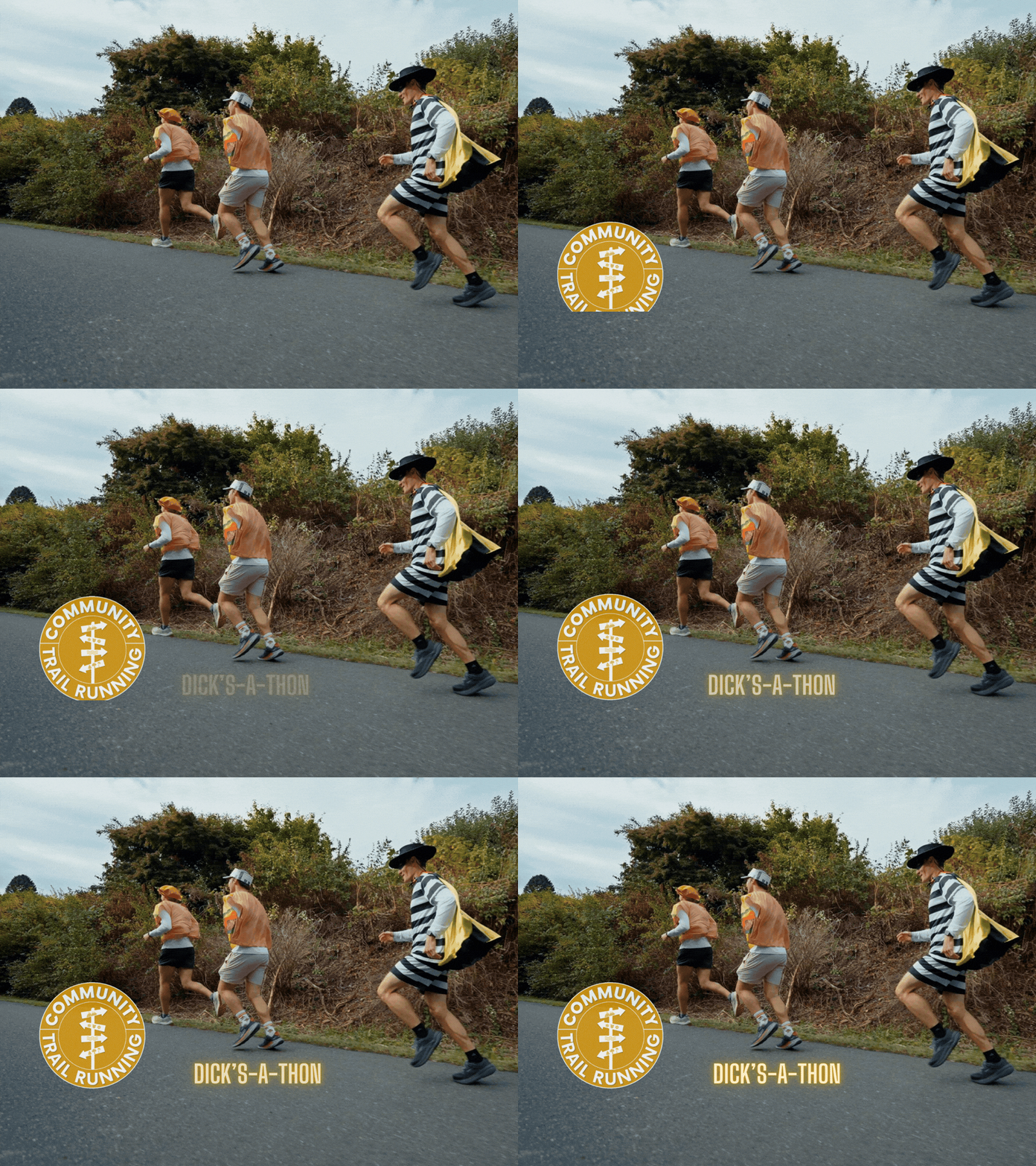
Dick’s is a burger joint in Seattle. One of those IYKYK burger chains, and the thought of running a marathon between their 5 locations while consuming something at each one is daunting. Dylan tells us why he wanted to tell this story and how it came together. It’s a silly run, but comes from a deep place of meaning, and it was great to hear more about the project.
Film Description:
26.3 Miles. 5 Dick’s. 5 Meals. 1 wild tradition to honor a friend, and give back to the outdoors. Learn about Seattle’s most unique marathon, and the touching story behind it.
Screenings:
The Last Episode:
The Miller Minutes:
Listen where you listen:
Spotify: Click Here
Apple Podcasts: Click Here
Music by Paolo Argentino from Pixabay
We’re on the journey to 2,000 subscribers. Please help us get there!
If you enjoy this podcast, I would really appreciate it if you could like, share, subscribe, or comment! I’m trying to make this the best trail running podcast it can be, and I certainly appreciate your time. Thank you all and happy trails :)
Get full access to Community Trail Running at communitytrailrunning.substack.com/subscribe
Hosts & Guests

Transcript
Hello and welcome, Bonjour et bienvenue, this is the Community Trail running podcast.
I'm your host, Adam Lee.
Thank you for joining me once again, so many podcasts out there and I so appreciate
you spending a little bit of your time with me.
This is episode 183, we're continuing Film Fest Week on the pod.
We have Dylan Young chatting about his production, Dixathon.
If you know Dix and Seattle, you'll love this.
And if you don't know Dix and Seattle, you're probably going to want to learn more.
I'm thrilled to be in the midst of Film Fest Week here on the podcast.
It's so fun highlighting all the great entries.
Love getting to share these episodes.
We started yesterday with Becky Bates, not a running story, so check that out if you haven't
already.
And yes, we will be back tomorrow as well.
So stay tuned.
Of course, we also launched the latest episode of the Miller Minutes last week.
That's where I work with Andrew Miller towards my goal of completing Fat Dog 120 in August.
That shows a lot of fun.
We show you what it's like to work with a running coach in each episode is less than 10 minutes.
So check that out if you haven't already.
And thank you for rating, reviewing, sharing, subscribing Community Trail running.
It means a lot to me growing this thing with all of you.
We have so much fun and I can't wait to see where we end up.
Get over to CommunityTrialRunning.com and subscribe if you haven't.
I greatly appreciate it.
And that is enough of the preamble today.
It's Film Fest Week.
Let's get to the Film Fest features.
Let's hear from Dylan Young.
Today's guest is the creator of the movie Dixathon, Dylan Young.
This is a Seattle based story.
We'll get into Dix and everything else today.
Dylan, thanks for coming on.
Thank you for having me.
It's a pleasure to be here.
I'm excited to hear more about everything.
I've been to Seattle and Dix once or twice.
So I'm very excited about the whole story.
But we're going to make you start at the beginning.
Just tell us about who you are and how running and filming and all of this is part of your life.
Sure. Adam, I got to be upfront with you.
I am not a runner.
I am much more of a walker, I'm more of a hiker, but it's still time on feet.
It's true.
Yeah.
I just don't, I like to go slow.
I can't really go fast.
I don't have the stamina for it.
And I know that's the part of like you could build it up, but I don't have the time.
So I come from a background in documentaries.
I'm an editor by train, but this is actually my first foray into directing.
Okay.
And yeah, I'm done with Los Angeles.
I'm not even up in Seattle.
It's a interesting story how this whole thing came about.
My, our DP on the project, Brain Leak is a friend of mine who lives up in Seattle.
He's got a background in film, but he works in video games now.
But he actually attended the trail running festival last year.
Okay.
And he's a runner.
Also as my producer, they're both marathoners.
But he went to the festival last year and was so inspired that he started calling me like
right afterwards.
And he was like, when are we doing a talk about when I was like, when we find a good story,
I'm in.
And he's like, cool.
I want to do a talk about running.
You just keep calling me like every week and like, when are we doing a talk about running?
And then he was planning on running the Dixathon last year.
He brought it to my attention and I was like, okay, yeah, actually, you found it.
This is the one we're going to do.
And then I had to convince him that he should run it, but while holding a camera.
So a little, a little extra work that he didn't actually end up running the whole thing,
but he did run probably about a third of it.
Well, while holding a camera, big steady rig, whole situation going, but yeah, do it,
do in the thing on course.
And then if you don't mind, tell us what Dixathon is before, before we get into the film.
Yeah.
So the Dixathon is a marathon in Seattle where you run to during the course of the marathon,
you run five locations of Dix, which is a local like driving burger joint.
And at each one of the stops, you have to eat something off the menu.
Where by the end of the race, you will have eaten three burgers of french fry and a milkshake.
And it's your choice and what order you eat those things in.
There's actually a lot of debate around, and the milkshakes are absolutely delicious, just
a heavy thing to consume while you're running.
But there's a lot of debate on when you should get the milkshake.
Some people say, do it at the end, save it for last.
Some people did it right at the beginning, which I thought was a choice.
And some people did it right in the middle because they were like, it's a good burst of
like, it's a good hit of energy, a good hit of sugar.
Keep you going, pick you up when you're starting to slip a little bit and just keep you
going through the rest of the marathon.
Was it sort of just the unique character of this race that drew you to it immediately?
Definitely.
That's what drew me in initially.
And then I started to do some research.
I started to figure out, I might have read like every page that they had on their website,
everything they had on their Instagram.
And I started to learn the story about how the marathon came about.
And it's a very moving story.
And I was like, it should be, it should be told.
And so sort of from that, I then reached out to the organizers and I was, I sent them
like a 10 or 11 page pitch that I had made and I was like, you got to let me come up.
I want to film the marathon.
I want to make the short film.
What do you guys think?
And they were like, yes, absolutely, we're, we'll be so happy to have you.
And they've been so grateful, they've been so helpful, they were so sweet.
But yeah, the, how this originally came about was that these two brothers for twins, Conor
and Ian did this in 2018 because Conor was moving down to Santa Barbara.
And he was like, I want to do one last very Seattle, like thing before I leave.
So they, he kind of came up with this idea of like, oh, we'll just, we'll do a marathon,
we'll run to all the dicks.
It's pretty much like marathon length and it'll just be a fun thing.
And the two of them did it together and I had some friends join for like sections and
maybe do a little bit, a little bit of run, a little bit of eating, whatever.
And then he moved on to Santa Barbara, didn't think about it much for a number of years.
Meanwhile, Ian is a big mountain climbing guy, he's a big mountaineer and a couple years
later, he had gone on a trip in the North Cascades to go climbing and no one heard from him
from a couple days.
So there was a big search to try and find him.
And after about a week, they did not, and they called it off.
And the family was texting with his friends and kind of keeping them all updated on the
situation, what was going on.
And at that moment, they, you know, people were sharing memories and stories about Ian
and his life and experiences that they had with him.
They realized that he had told this story a lot to his friends on climbing trips when
he was out in the mountains with his friends about this thing that he had done with his brother.
So it kind of became a like, oh, let's, let's do it again.
Let's do it again like as a memorial to him.
And I think that first year it was about a hundred people and it was all either people
that knew him co-workers, friends of friends, it was like a very, everyone was like tertiary
really connected to him.
And this was like, they had done that original one.
This is in 2022.
I think about two months after he had gone missing.
So it was very raw for everybody.
But everyone had such a good time doing this run that they decided that they should continue
to do it.
And now it's a nonprofit that raises money for the search and rescue teams in Washington
that went looking for him.
There's five different search and rescue teams.
They also raised money for the mountain years, which is organization up there that helps
train people to get prepared into going into the outdoors to go climbing as well as the
Washington National State Park Fund.
So all the money that they're getting from the marathon is getting donated to all these
causes that are really helping preserve the mountains for other people to enjoy.
But also adding resources to the search and rescue teams that are helping people should
they go missing.
And now it's at the point where last year there was about, I think just under 700 people
that ran it.
So it's getting bigger and bigger every year.
And part of what I felt was important was to to keep Ian very central to the story.
And to keep the heart of why this marathon exists and make sure that that message gets
spread out.
Because as it gets bigger and bigger, more people are just like, oh, I want to do the
fun burger run.
And they might not know the story and why it came about or who's the inspiration behind
all this.
So that was that was kind of the big drive in making this film.
Is it is it a challenge to to keep Ian at the center honor that memory and where it sort
of starts and then kind of blending that with sort of the silliness of what the event
actually is.
So the way that I approach that, yeah, it's interesting because they're very tonally
a little bit different.
The way that I approach that was that I went about it the same way I think most people's
experience would be of like learning about the Dixathon, which is like, oh, it's this
weird wacky thing.
What's going on?
Why are we like, what is this?
Why is this coming about?
And then learning about the story of Ian, about his disappearance, how that all played
out.
Realizing the social impact that it has now and all the good that it does.
So the film kind of plays out in those three acts where it's like good and fun for the
first bit.
We had a little emotional and sad in the middle, but then we had a good uplifting.
Hey, we're doing good things at the end.
So, but yeah, trying to, trying to balance it out where it wasn't was still capturing
the vibe of the event because being there, it's, it's so much fun.
Everyone's in great spirits, like it's such a, the atmosphere is just so fun.
Everyone's there to have a good time, but there is like, there is a little bit of this
melancholy that's existing at the same time.
And is it, you know, you mentioned too that you're not really a runner.
That's not how you find movement for yourself, but you're kind of coming into this race as
well that has its own sort of ecosystem and it's also your story.
So was his an adjustment sort of figuring it out or is it pretty straightforward?
Hey, they say start and everyone runs to where they're supposed to go.
Like how is it approaching something that maybe you're not intimately intertwined with
or something like that?
Oh, that wasn't too bad.
I mean, so yeah, the director of photography and my producer were both marathon guides.
So they were, they were both like, all right, here's how it's going to play out during
the day.
Plus I had had many conversations with the event organizers about like, what should I be
looking for?
Like, there also isn't like a really good, they have to sort of send people out in waves
because if everyone arrives at the restaurant at the same time, the restaurant's going
to be a little overwhelmed.
So they do release people in waves.
So there's not like a good, solid like, here's the start, but we did capture the first
couple waves and stitch that together into like a good like starting line moment to start
off the film.
But yeah, I think the most interesting thing was like trying to, because I'm not a local
to Seattle.
I flew up Wednesday night, was there Thursday through Sunday and tried to film everything
I needed in one weekend.
The event was on a Saturday, but Friday I sat down and did all the interviews with
Ian's family, with his friends, with the members, like some of the board members of the
Dixathon, some of the sponsors, I tried to get those all done the day before.
So even talking to them, they were also giving me a good lead in to what to expect the next
day and sort of the key things to look for.
So I had a lot of help at any, any project that needs a lot of help from the, from the
right people for sure.
So it's great that you had the right people around you.
Now you're involved with the trail running film festival after it started as the inspiration,
which is pretty cool or an inspiration, of course, maybe not the inspiration.
But what's it like to now be a part of that and have it featured going across so many
cities?
Uh, is an honor.
I will say it is the inspiration.
I'm, you know, I'm always looking for any, any sort of project, but Braden was pushing
really hard to do a running festival after seeing the trail running last year.
So it definitely is the inspiration for this project.
And I think to go from, I mean, I'll speak for him a little bit, but for him going from
seeing it one year to now being in it that next, he's overjoyed.
And it's also very fun for me because this is such like, it is such a big festival.
It's going so many places.
And I have a bet going with Brian Bickle, the president of the Dixathon that I can get
a thousand people to run the Dixathon this year.
So the more, the more cities of this goes to the more runners that watch this, the more
people that show up and do the Dixathon gets me closer to winning five bucks.
That's ultimately what matters.
That's really the big stakes for me and all of this is like, gotta win that five bucks.
Well, congratulations on your first foray into directing, making it into the film festival.
Are you going to be able to catch it anywhere?
Oh, yes.
I will be up there on March 28th for Seattle.
Brooks is hosting that event.
They're also a sponsor for the Dixathon.
So they reached out and they were like, we really want you to come to this one.
So I will be there as a guest of honor for the Seattle show.
Amazing.
Well, a huge congratulations on that people may want to check out you anything that you're
doing.
Can people follow you along?
Give us the goods on that.
Oh, sure.
Yeah.
Instagram, there's the Dixathon film account, which is where we're posting all the news
about the film festival that's getting into where it's going to be all that good stuff.
You can also check out Dixathon on Instagram as well.
If you're interested in joining the event, seeing what they got going on, maybe volunteering,
maybe running, however you wish to get involved, and then I am Dylan cuts things on Instagram
as well.
I'm posting a lot of the same stuff right now, but yeah.
Perfect.
A huge thank you to you, Dylan, and a huge thank you to all of you listening.
Shout out to Reese Volunteers everywhere, like all of those at the Dixathon.
And until next time, I'm Adam Lee, and this is Community Trailer.