About this episode
Get every episode summarized
Each time History Dispatches publishes, we email you a written briefing from the transcript — the topics, who appeared, and any specific claims, with the ad reads skipped.
Email me new episodesFree for 3 shows. No card needed.
Hosts & guests
Transcript ready
417 searchable segments. Every word is indexed and playable.
Full transcript
History Dispatches — Did Shakespeare Write Shakespeare?. Machine-transcribed; use the interactive transcript above to jump the player to any line.
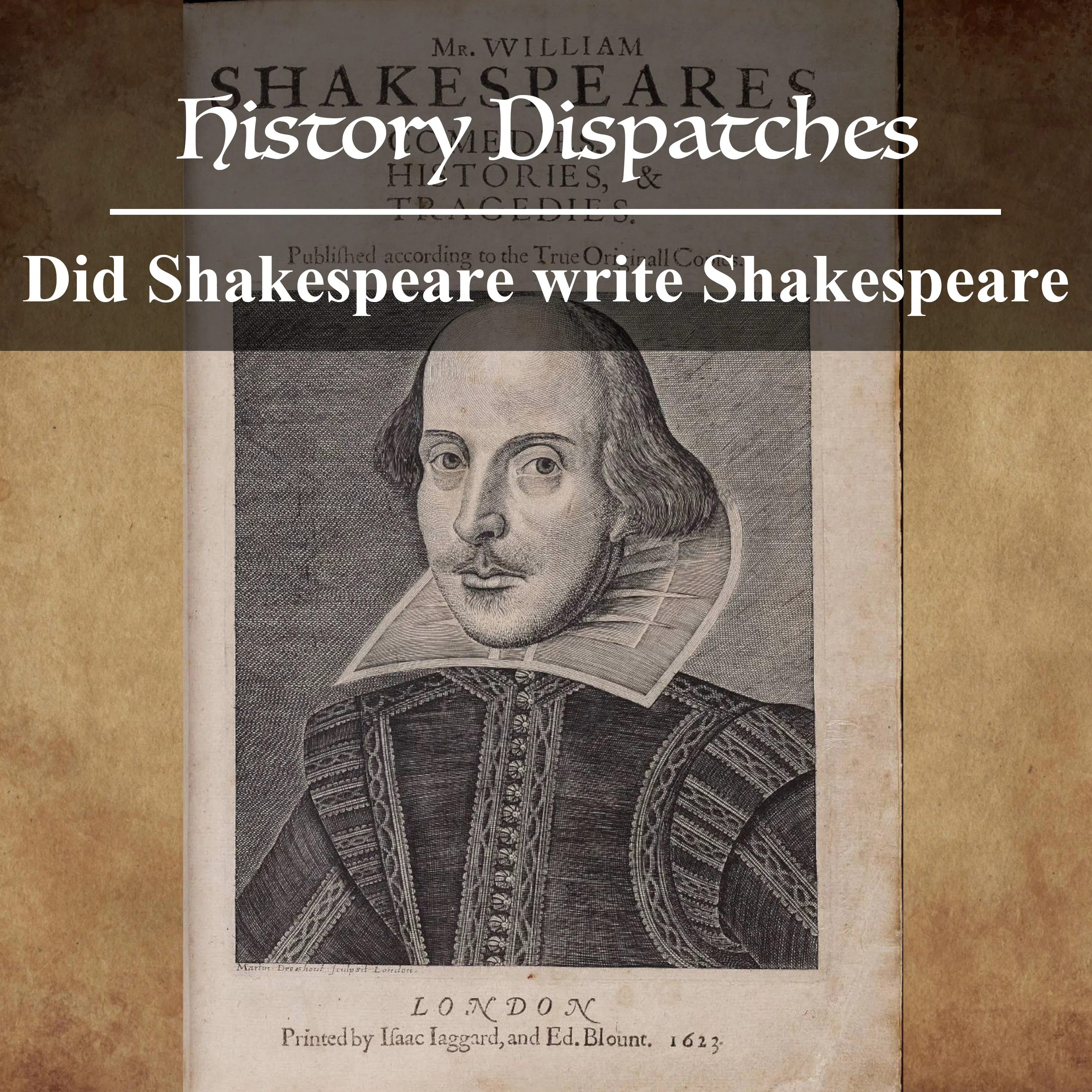
An all-new season of the Secret Lives of Mormon Wives is now streaming on Hulu and Hulu on Disney+. Mom talk has just been blowing up. Whitney and Jen are on dance with the stars, Taylor is a bachelorette, saying that out loud is crazy. Like that is huge. But all the cool opportunities could pull us apart, it's causing issues in everyone's marriage. My whole world is falling apart right now. It's chaos. Watch the Hulu original series, The Secret Lives of Mormon Wives, now streaming on Hulu and Hulu on Disney+. One of, if not the greatest author of the English language, is William Shakespeare. Renowned for numerous plays, poems, and more, he has given some of the greatest contributions to the English literary canon. But that begs the question, did he actually write his plays? Well, yes. But that doesn't mean the theory that he didn't doesn't have a pretty cool history. This is the story of the Shakespeare authorship question. Hello and welcome to History Dispatches.
My name is Matt. I am here with my son McKinley. Hello. How are you doing today, buddy? I'm doing great. We're talking Shakespeare. Yes, we are. And every weekday on History Dispatches, we do take on fun and sometimes not so fun. Three questions, including this one, which is something I know a little bit about, but if I go... But if I go... Yeah, I don't know the details. I just kind of know the general, it exists sort of thing. So you can take this one because this is yours. Thank you. First of all, I just want to say that we are not a conspiracy theory podcast or anything like that. What we do if we ever tackle a conspiracy theory is talk about the history of the conspiracy. And so right off the bat, I just want to say, I believe that Shakespeare wrote his plays I don't find any of the arguments very convincing and we'll go into some of them and stuff. It's the official position of History Dispatches that Shakespeare wrote Shakespeare. But it is not the less fascinating as well as the whole history behind it. Cool. Let's get into it. Who was Shakespeare?
Well he was a real guy. None of what are known as anti-stret ferdions or people who don't think Shakespeare wrote Shakespeare. Don't believe he was a real dude. We have plenty of historical evidence from the late 15, early 1600s that show that there was a guy named William Shakespeare who lived in Stratford upon Avon and was connected to the playwright world in some way. No one denies that. He was born and raised in Stratford upon Avon, which is basically smack dab in the middle of England and lived from 1564 to 1616. His playwriting was active from 1591 to 1613. Now there's a lot of scholarship and debate as to the exact order of when each play was written. Some plays were written earlier but weren't performed until after his death, so there's lots of lively debate in the Shakespeare community about when exactly each one was written. But in that time he wrote at least 38 plays. There are some that are thought to be lost, we just don't have them anymore.
Or there are some that may have been written by him, but the links are more tenuous if he actually wrote them or not. What we do know is that there are 38 plays without a doubt by good ol' Shakespeare. That includes our famous ones like Julius Caesar, Romeo and Juliet, and Hamlet. Some of the greatest works of the English language were written in this basically 20 year period, which is pretty cool, I think. What are the arguments of the people that don't think Shakespeare actually wrote his plays? First of all, his name. Their initial claim is that there's some discrepancy with his name, because if you look at documents from that time period and we're talking like playbills and stuff like that, sometimes a letter is omitted, an A or an E, sometimes there's a hyphen, there's numerous variations. So people are like, oh, maybe there's some weirdness there. However, this ends up bearing very little fruit, as 99% of all the times that his name was written is written in the way that we see it.
More than that in the 1600s, spelling wasn't necessarily codified as much as it is today. There are documents and letters where words are spelled differently in that document. He didn't have control of how his name was spelled if someone is putting a document together with his name on it. It's not like he can go, oh, no, spelled wrong, got to fix that. They just did it. Exactly. So another argument of, oh, Shakespeare couldn't possibly have written this, was his background. See, Bill was not some fancy schmancy aristocrat from London. His father wasn't a playwright or anything like that. His father was a Glover, a guy who made gloves in Stratford upon Avon, which a lot of anti-stratfordians like to characterize as some backwater. It was not a complete backwater, local town, but it was certainly not a cultural hub of England or anything like that. So people like, how could this guy write these incredible plays if he was from the equivalent of Nebraska? Poor Nebraska. Well, as I said, it was certainly not a place of high culture, but it had a bookshop and
bookbinders and stuff, so it wasn't illiterate or anything like that. It also had just had a grammar school built, and there's no evidence that Shakespeare went to the grammar school, but there's also no evidence that anyone went to the grammar school. The records just have not survived, so there's nothing to say that he could or could not have. It's very likely that he did. In fact, his father was one of the wealthiest men in town, so it's very likely that he could have afforded to send Shakespeare to school. It's also not unreasonable to think that Shakespeare, an intelligent young man, spends his allowance going down to the store and buying the classics and breeding the Iliad and the Odyssey and stuff, even if he didn't have a big fancy education, it's nothing to say that he couldn't still have had access to these classics to be inspired. He was also a documented actor originally. In his later years, he participated in many plays, he read plays, and he could have adapted and developed his skills there too, so there's lots of ways he could have learned instead of just a formal, fancy, fancy education.
Now my favorite argument, and that is, well, if he was a commoner, how could he have this intimate knowledge of the aristocracy? A lot of his plays, especially the histories, like Henry V, Henry VI, Henry VIII, are about the English royal court and stuff like that. And you might ask, well, how would he know what the court is like? Scholars have looked at how Shakespeare portrays royalty and how it actually functioned, and it's not accurate. It's much more like a middle-class person writing a story about how they think rich people act, which I just find really funny. And scholars have identified as his plays have gone on in years that they get more accurate. His earlier histories aren't as accurate as his later ones in terms of royal parlance and stuff like that. It's almost like he was developing as a writer. Oh, he learned. Yeah. Now, there are lots of other arguments. One, there's no eulogies for his death. No one eulogized him. Well, there weren't eulogies for any real playwrights at the time.
This wasn't the thing. He was considered a very good writer. He hadn't gone down in 1616 as the greatest English writer and history sort of thing. Exactly. He was like, oh, you're really good, but not incredible. The other thing, and this is the one that bears the most evidence, in my opinion, was that there's almost nothing physically written by him. No manuscripts, no letters. In fact, I think we only have six instances of his signature. People have seen that as, well, if he didn't have any manuscripts or anything, why couldn't he have written it? And an easy answer to that is 1650, when someone did find his papers, they didn't think they were very valuable until they threw him away. Just because there wasn't any, doesn't mean that he didn't do a lot of writing. Those are kind of the main arguments for it. As you can tell, I don't think they hold a lot of water. They're all easy to debunk. And not a single credible Shakespeare scholar believes this. Very fringe still. But the question is, if Shakespeare didn't write his plays, who did?
And the most common answer is a guy named Edward Devere, the Earl of Oxford. The people who believe it was Devere are so-called Oxfordians. Edward Devere was a favorite of Queen Elizabeth, so he would have had royal patronage, which was pretty critical for playwrights of the time. He was also a good playwright on his own. He wrote many plays that are considered very good. And so he had the skills to possibly be a Shakespeare. One problem. He died in 1604, before many of Bill's plays were written. Now, of course, they could have been written before and then put on posthumously, but nevertheless, we have evidence that many of Shakespeare's plays were actually written in the 1610s long after the Earl of Oxford died. Unlike what Oxfordians will claim, I was on some of their websites. It's just funny. If you leave their website and go to a different site, that actually is about Shakespeare. They grasp the thinnest of strands that they're just like, this is what you're going for. So I don't think it's a slam dunk like many Oxfordians claim. A few other people that have been put forward are Sir Francis Bacon.
He was a very good writer at the time. He lived during Shakespeare's time, so he does fit the chronology. There are a few spurious references in Shakespeare that kind of connect to Bacon. A few ciphers that people have tried to make from their works. All of those have been discredited, very reaching. There's also a few parallels on their philosophy, just as people, their style and, like I said, they were contemporaries. There are a few other suggestions. The main one that it was actually a group of people, instead of just one person. Main argument are that there are some stylistic differences throughout his plays. However, his style evolved over time and he was also a known collaborator with other poets. So nothing to say that stylish variations just are his co-authors. Yeah. If you can't tell, I don't give Andy Stratfordian's much credit and neither do any mainstream historians. However, this is not precluded a lot of very intelligent people from believing the Oxfordian theory or otherwise a few famous ones, Mark Twain, Sigmund Freud, Walt Whitman, and many, many
others, though again, no scholars. So now that we've kind of gone through the arguments, the question is, where did this whole conspiracy actually begin? McKinley, it's time to talk about Factor. I love Factor. And why is that? Well it gives you fast, convenient, delicious meals when I need them, which is important considering I'm a busy parent. The two things I love about Factor is that it's fast and tasty. Normally you can't get both from this type of meal. It's one or the other, but not with Factor. You get both. I love their huge selection with 100 rotating weekly meals. I recently got the queso poblano chicken and the smoky barbecue chicken and they were both fantastic. That is so awesome. Factor brings quality food to you. It's always fresh and always tasty. So check out Factor. I use it. My family uses it. I know you'll love it. And you know what, Dad? We got a great offer for our listeners. That's right. Head to FactorMeals.com slash dispatches pod 50 off and use code dispatches pod 50 off
to get 50% off and free breakfast for a year. Eat like a pro this month with Factor. New subscribers only varies by plan. One free breakfast item per box for one year while subscription is active. William Shakespeare died in 1616. You might ask when did these conspiracies start? Was it during his lifetime? Did people see this Glover Sun and say, oh, there's no way you could have written this? Maybe it was right after. He dies. People do some looking into his background. Be like, there's no way this guy could have done this. Maybe a generation or two later? Nope. The very first time we think that anyone brought this up was over 150 years after Shakespeare died in the 1780s. Before that, Shakespeare was well known, performed very often, and no one questioned it. It was Shakespeare. Though his reputation, while very good, would not achieve peak until about the mid 1800s.
In the 1780s, this guy named James Wilmont did a search of libraries and archives in the 50 miles surrounding Stratford, and concluded that there was not a single shred of paper that Shakespeare actually wrote. That goes back to the thing that we have no written evidence of him. He therefore concluded that there's no way that he could have actually written this. There's no way he was this writer. But James Wilmont feared ridicule, and so he destroyed all the evidence that he collected, and only told his friends. One guy he told, a guy named James Corton, wrote down what James Wilmont told him and published a manuscript. And this manuscript claimed that Sir Francis Bacon, who we mentioned before, was actually the real author. And this was a key piece of history for the anti-Stratfordians for years, except in 2010, it was proven that it was a forgery. In fact, it was a forgery probably in the mid 1800s. And so that 1780s, it's even worse.
It's not until the 1850s does any Shakespeare conspiracy even begin 200 plus years after his death. Outside of that forgery, this leaves our very first disputer, a woman named Delilah Bacon, who in 1857 published a book claiming that Shakespeare was, in fact, the brainchild of Sir Francis Bacon. And she also related it to the group conspiracy, including Sir Walter Raleigh as well as others. I thought maybe she was trying to gussie up her ancestor, Delilah Bacon, Sir Francis Bacon completely unrelated, which gives her some credit at least. Although maybe she was just a weirdo, and it was like, I like him because his name is Bacon, so I'm going to make him important. It's possible of all of the anti-Stratfordians, she's by far the one with the most credit, and what I mean by that is she really tried. She wasn't American, but she traveled to England for four years and did extensive archival research. She didn't just go on the internet like we do and read some websites to her credit she
tried. Again, I don't think she did very good, but in any case, she at least went for it. And to her credit, this was an era where what I call textual criticism, looking at specific words on the text and how it all relates, was really taking off. The idea was that it was showing that works were not by one person, but multiple authors. This was the same era that the Iliad and the Odyssey were determined that it wasn't actually a guy named Homer who wrote it, Simpson or otherwise, but it was an oral tradition that had been passed on and then eventually turned into one thing and attached to a guy. Also the Bible was determined that it wasn't one account, but various books from various centuries that were attached together. This was going on at the time. She wasn't pulling this out of thin air. I also want to mention that you find in some historical books that it was basically okay to just take something from someone else and put it in yours. I mean, it was a common thing. I get that with my explorer's podcast where you'll have someone write a book, Marco Polo,
for instance, there are whole sections lifted from other writers that Marco Polo puts into his book because you know what, he didn't go up to place A, B and C, but someone else did and you know what, he found a copy of that and just put it in his because he was going near there and he wanted to add it. So it was not uncommon for people to just add stuff to stories. So like you said, it wasn't an uncommon thing for this to be discovered that there were multiple authors of a source precisely. This was also a time that a term called Bardolatry came into effect or the veneration if not deification of Shakespeare. This is when his popularity went from a very good author to the best of authors. And whenever there's something really popular, there's always a pushback. I remember a year or two ago when Taylor Swift was all the rage, all of a sudden there was people coming out of the woodwork being like, ah, she sucks. No different here. People are saying Shakespeare is amazing and credible. People like, ah, he's actually not that good. And one way to discredit him is saying, well, it wasn't actually him.
It was this group of people. Nevertheless, Delilah Bacon's ideas hooked a lot of people, including Walt Whitman. And this started to really capture the public imagination. A lot of her philosophy was that there was this anti-monarch thread through Shakespeare that she was trying to develop. And many of the anti-stratfordians are American. And so trying to find anti-monarchy sentiment in Shakespeare was big because America didn't like monarchies, especially in the 1800s when the revolution was less than a century old. That's kind of where that started from. And it did capture the public imagination. And it would be cool to find a conspiracy that is two and a half centuries old and close a case. That would be really cool. Like I said, she actually did her research and tried. And not to say that other authors haven't tried. She at least had a fairly quote-unquote conclusive argument of Sir Francis Bacon led this group of other writers. And here are the other writers that I suspect. At that point though, it kind of opened the floodgates for people to accuse and people
could find any connection to any author from the time and establish this big corpus of people who people think Shakespeare actually was. And for a time there was over a dozen candidates. Then in 1920, a guy named Jay Thomas Looney wrote Shakespeare identified. It was a 1200 page book. And he was the one that posited Edward DeVier, Earl Locksford as Shakespeare. And that's by far now the most popular candidate. Although I think the group theory also holds a lot of water for a lot of people. From there, since the 1920s, people have spent the last century combing over every inch of Shakespeare's writings and all of the authors attributed to him. People have tried to find ciphers, connecting them. Most of those have been debunked as just coincidences. But nevertheless, it doesn't stop people from trying. Anti-strat firdianism reached its peak in the 50s and 60s and there were four books published in less than a decade about these theories, though it slowly declined after that.
However, the past few decades with the emergence of the internet has seen some decent growth in resurgence. With moderate growth, though it's still considered pretty small and not broadly considered by any mainstream academics, though there was a whole movie with very mediocre reviews that came out in 2011 directed by Roland Emreck, who made Independence Day. That movie was anonymous, right? Yep. So where does that leave us today? Well, the internet can now be used for ever quicker textual transmission and finding like-minded groups of people with more and more fringe beliefs. So it's unlikely that this conspiracy will die anytime soon. But without any more substantial proof, it is the official position of history dispatches that Shakespeare did, in fact, write Shakespeare and Bill, thanks for all the great work. Nice. The thing I want to mention is, let's just say that he did develop a group of friends and colleagues and so forth. I don't see it as a big deal or a hard leap to make that. Maybe they helped him at times. You know, he sat down around the table with some people and said, I'm writing this play
about X, Y, and Z, and oh, you know, let me help you with this. What if he changed this one? Yeah. Oh, here's maybe a couple of edits to the scene. You know, nowadays we obviously have copyright and people are very protective of creative work, which I understand. But I think it was a lot more Lucy Goosey back in the time. And so that he was the author, but he had other people piping in here and there, sort of like Thomas Edison, the inventor. Yeah. The many things that Edison supposedly invented were done by his subordinates, but that didn't stop him from saying that he did them, but he did do a lot of stuff, just like Shakespeare probably did. Do you have a favorite Shakespeare play that? Oh, I am very partial to the comedies. I love 12th night, much to do about nothing. Those are fun. I think the Scottish play is probably the one that I love the most. I'm not going to say its name. I don't want to curse us. One of the best renditions of the Scottish play was The Lion King, right? Yeah. I would say my favorite movie ever was Henry V. That's the Kenneth Branagh one. Kenneth Branagh film.
Absolutely. Just killer. Fantastic. I've seen that a couple times live. You need a really, really charismatic leader in that one, and I've seen it, and it's hard to beat Branagh's Henry V. But I love that one. Highly recommend though. If you ever do get a Shakespeare company coming to your town, and if you can get it, some tickets, they're really cool. And if the language turns you off, try and go into an open mind, and by the end of it, you'll understand every word they're saying the first five minutes are the hardest and by the end of it, you're laughing the whole time if it's a comedy. All right. Well, Mick, thank you very much for telling the story of the Shakespearean authorship question. Absolutely. Folks, we're going to leave you with our tidbit of the day. And that is that while we do have some questions about Shakespeare's true authorship, there is another author, who is around today, who was suspected to be someone else, and that was a guy named Richard Bachman. Bachman wrote five novels between 1977 and 1984, and no one really knew who he was until he was identified by a bookstore clerk as none other than the famous Stephen King.
Turns out that King had created the pseudonym to see if his success was actually because he was a good writer, or because his name was attached to a book. Turns out, he was a pretty good writer. So there you go. Mick, again, thanks very much for today's episode. Absolutely. And folks, we want to say thank you very much for hanging out with us. If you enjoyed today, please come back next time. We do this every single weekday, and we love doing this, so thanks so much for joining us. Otherwise, have a great day. We will see you next time. Bye. Rinse knows that greatness takes time, but so does laundry. So rinse will take your laundry and hand-deliver it to your door, expertly cleaned. And you can take the time pursuing your passions. Time one spent sorting and waiting, folding and queuing, now spent challenging and innovating and pushing your way to greatness. So pick up the Irish flute or those calligraphy pens, or that daunting beef Wellington recipe
card, and leave the laundry to us. Rinse, it's time to be great.
More episodes


