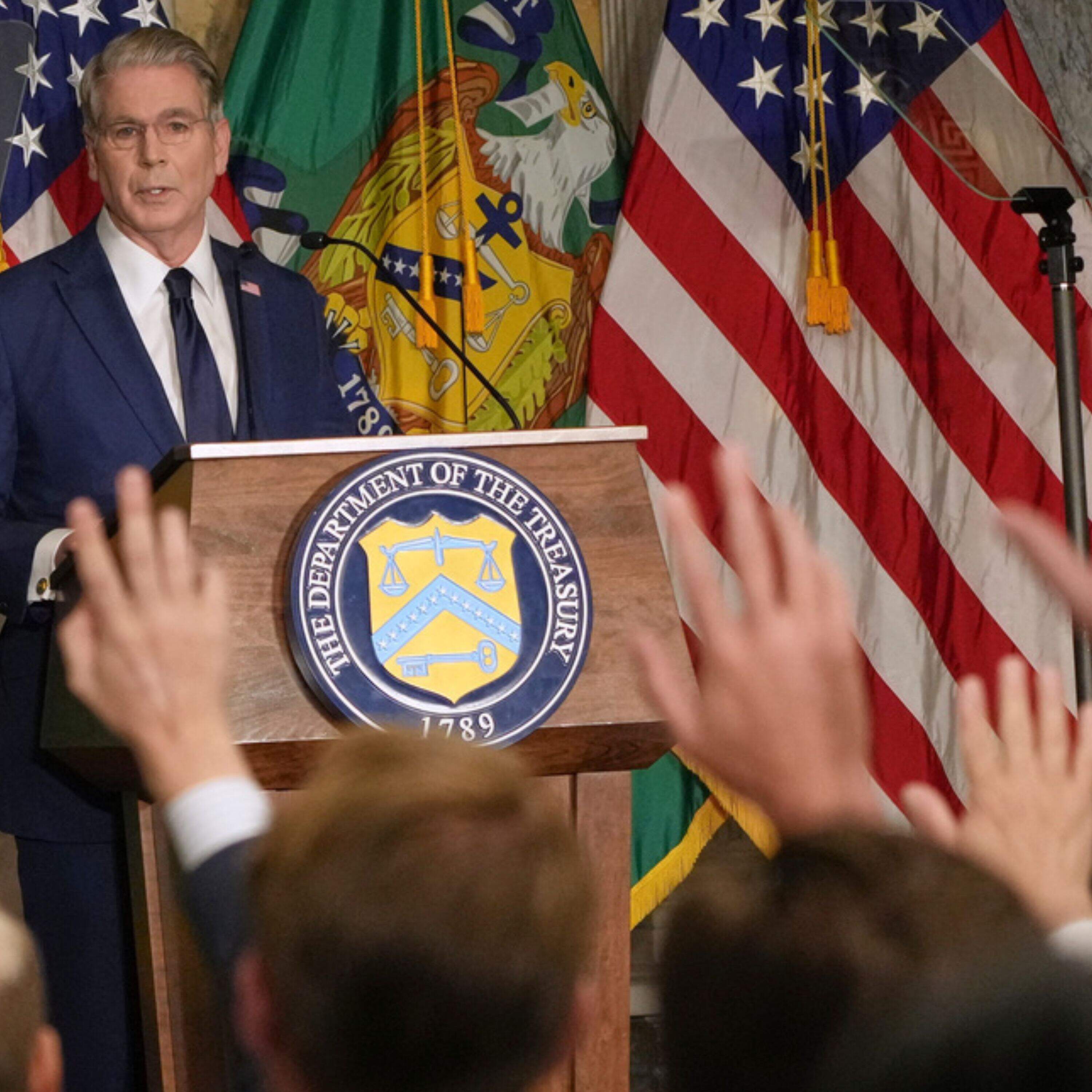
Did the Treasury just make it easier to launder money?
About this episode
The Treasury Department recently eliminated a rule that required American companies to identify their owners. The rule was intended to prevent money laundering. What’s driving the decision to drop it?
*** Thank you for listening. Help power On Point by making a donation here: wbur.org/giveonpoint
Get every episode summarized
Each time On Point with Meghna Chakrabarti publishes, we email you a written briefing from the transcript — the topics, who appeared, and any specific claims, with the ad reads skipped.
Email me new episodesFree for 3 shows. No card needed.
Hosts & guests

Transcript ready
871 searchable segments. Every word is indexed and playable.
Full transcript
On Point with Meghna Chakrabarti — Did the Treasury just make it easier to launder money?. Machine-transcribed; use the interactive transcript above to jump the player to any line.
Hey, it's Magna Chakrabardi. Before we get to today's episode, I wanna just take a second to encourage you to join the new on-point club. For just $7 a month, you get first access to the jackpot every week, other exclusive content like behind the scenes with our producers, and you'll be the first to know about special live events. And we have got some great ones coming up. That's all just for $7 a month. This is like a couple of cups of coffee these days. So to join, just click on the link in the episode description you're looking at, and it'll only take a minute to sign up. Okay, here's today's show. WVU Art Podcasts, Boston. This is on point, I'm Magna Chakrabardi. If you go to the FBI's website right now, and dig around a little bit,
you'll find a 2024 video of Kelly Smith, FBI ASAC. That's Assistant Special Agent in Charge. Smith served in the Bureau's Seattle office. And in this video, he describes why the FBI's anti-corruption investigations are so important. That's the program that looks at corruption within government, and that's federal, state, or local government. There's really nothing more offensive than someone who's been entrusted by the public with public funds who uses that for personal gain. And so that's a top priority for the FBI. And that is true. Corruption is a toxin that poisons the public's trust and drains the public's treasury. So I wonder how Kelly would have felt knowing that the FBI's Seattle division itself, the division where he served, was paying rent in its own headquarters to one of the world's most corrupt leaders.
This is a small story about large-scale corruption, about how money starts dirty and gets washed clean through the American financial system. It begins in the threatened forest of Borneo and traces its way through multiple shell companies and corrupt business deals, and lands finally at an address, 1110 Third Avenue in Seattle, the Abraham Lincoln building, which houses the FBI's Seattle division headquarters. Okay, so let's start in Borneo, the world's third largest island. It is home to some of the world's oldest rainforests and has long been famed for its spectacular biodiversity. But since the 1960s, industrial deforestation has raised the jungle there. In the 1980s and 90s, Borneo's forests were leveled at a rate unprecedented in human history. This is a clip from a 2015 BBC documentary,
and in it, you'll hear the devastation wrought on the indigenous panantra that lives in Malaysia's Sarawak State in northwestern Borneo. Over the past 40 years, logging has spread deep into Sarawak's primary forest. Once the canopy is removed, a dense, impenetrable secondary forest quickly takes over. Throughout their territory, there's a crisscross of old roads where nothing has grown for decades. For decades. Now over most of the most recent 40-year period, Sarawak State was ruled by one man, Chief Minister Abdul Taib Mahoud. He died in 2024, but before that, he sold off Sarawak's forests at an astonishing rate. Some environmental advocates claim that barely 5% of the state's primary rainforest has been left untouched. Through a series of corrupt connections, nested shell companies and barely hidden kickbacks,
Mahoud turned himself and his family into multi-billionaires. In 2013, the International Advocacy Group Global Witness published an investigation revealing exactly how Chief Minister Mahoud's scheme worked. Global Witnesses undercover operatives posed as potential buyers for thousands of acres of pristine Sarawak forest. And they first met with the lawyer of one of Borneo's most powerful tycoons, and you'll hear this in this video. He laughs about his big and well-connected family. Okay, they have a big family. But then behind that is Chief Minister, yes. Okay, and will he have a surface? Then, on Instagram, I have what you will list license. In return, you're critical to me, maybe you say I keep you for percentage. Okay, so the lawyer is saying there that in order for the sale to go through, the Sarawak government would have to issue a license. And Chief Minister Mahoud would grant it.
But only if he was paid a percentage up front. What kind of percentage would I look before? I think I know him per se. He's selling four, $250 million, up front, everything. Okay, it's hard to hear in that tape because it is undercover tape. But Chief Minister Mahoud, the lawyer says, expects 10%, a kickback of 10% up front on a sale price of $230 million. A cool $23 million just to grant one license. Okay, so you can imagine that over the years, Mahoud made his family billions of dollars, which they hid in shell companies in more than two dozen countries around the world. The activities didn't go unnoticed. Mahoud was under investigation by Malaysia's own anti-corruption office. The Australian government started looking into things. And as far back as 2006, even the US government knew something was up.
In October 2006, political section chief Mark D. Clark sent a confidential cable from the US Embassy in Malaysia to the State Department. It read, quote, the Sarawak State government remains highly corrupt and firmly in the hands of its Chief Minister. The $82 million state assembly building now under construction serves as perhaps the most obvious and extreme example of the self enrichment of the state's Chief Minister. End quote. So where did Taib Mahoud and his family put all that money? Well, they put a lot of it in US real estate. And that brings us to the FBI's field office in Seattle, the Abraham Lincoln building, 1110, Third Avenue. It happened to be owned by a company called Saki International. Saki had several shell companies beneath it, one of which was called Wallysons, which, as you can now guess, Wallysons owned 1110 Third Avenue in Seattle,
which meant that therefore, the United States taxpayer, via the Federal Bureau of Investigation, was paying the rent in one of America's most expensive cities to one of Asia's most corrupt leaders who was responsible for pillaging the forest of Borneo for his own personal gain. And this was all allowed because of the American financial system. So I want to bring Gabe Lezra into the conversation now. He's a policy and advocacy director at state democracy defenders action. That is a bipartisan group that advocates for the rule of law and against corruption. Gabe, welcome to on point. Happy to be here. Thanks for having me. You've been looking at corruption and the financial system in the United States for a long time. What do you take from this one tiny example of a Malaysian chief minister buying real estate in Seattle, Washington? I mean, it is a very common scheme for international corrupt actors to move money
and use their money and make their money work for the United States. It's not at all surprising to me that this happened. And it is certainly continuing to happen as we speak right now. But here's the thing. That's why I love this story is all of this predates a really important moment in American financial history that was just happened five years ago. And you were involved in this moment because Congress actually passed a law within which there was a simple rule that was designed to stop this kind of money laundering, right? That's right. It's called the Corporate Transparency Act. And essentially what the bill did was create a requirement that most US corporations had to report to the federal government, the ultimate beneficial owner of their corporation. So basically everyone, what a corporation simply had to tell the government who the human being at the top of that corporate chain who benefited from the money and from those corporations was.
It's actually a very simple concept. I love how elegant it is in its simplicity. I mean, every time I think about this issue, I keep thinking this is exactly what you want government to do. Right? To find clear, concrete, simple solutions that actually have large positive impact. So what impact did that have, Gabe? Well, unfortunately, we never actually got to use the registry because we pushed it back, you know, the implementing date back a couple of years and then as soon as the Trump administration took over, they began to make noises about rolling it back and then ultimately they did issue a rule that just came into force in August that actually just essentially demolished the entire thing. So it would have been a revolution in the way that we follow and protect our country from dirty money as it moves into and around the country. Unfortunately, we are back to square one right now. Because the idea is if we know who you are and you're doing illegal activities through your company,
maybe the United States government wants to know that we know about that and do something about it. Now, people actually had to fill out this a beneficiary ownership information form for a little while. I'd actually do it myself not that long ago. But you're saying that the registry that we were supposed to build up of this ownership information was never actually, was it never fully constructed or what? It so we actually did collect about six million entries into the registry of real people who own real corporations. So the registry was well on its way to being finalized. But what ended up happening is that when they rolled back all of that information that we collected, they actually are going to delete it. And part of the reason that this happened was that we did push back the implementing date so we never actually got that information fully from all 32 million businesses. And good corporate citizens like yourself did fill this out. But others, I think we're banking on some sort of delay. And ultimately, we never got to use the information.
Law enforcement never looked at it. We never ended up verifying anything. I mean, it was devastating. There is something powerful about the sound of the human voice. Beautifully produced audio has the unique power to connect and inspire. Tell your organization's story with a custom podcast from city-space productions, the Creative Studio from WBUR's Business Partnership Team. Become a thought leader. We're a Cretan New Talent. Reach new audiences. Whatever your goal, we can help. Discover how the magic is made at www.org-creative-studio. It's Ben Brock Johnson, director of Digital Audio at WBUR. You've probably been following our consistent coverage of the Lindsay Clancy case, along with people around the country and around the world.
Well, if you want to hear even more from WBUR's own veteran reporter, Deborah Becker, who has been covering the story for three years, we're putting deep dive podcast episodes and analysis about the Clancy case in a podcast feed. You can listen by searching Beyond All Repair, wherever you get your podcasts. Can you give us a little bit of a big picture in terms of, again, before 2020, and before the initial announcement of the first rule? Like, what kind of role did the United States financial and corporate system play in both domestic and international money laundering? We are now and have been for many years, either the worst or the second worst jurisdiction in the entire world for corporate secrets. We are, as we have begun to see, mostly through leaks like the Panama Papers, the Pandora Papers, the center of a kind of cast gating financial and corruption disaster.
Everyone talks about the Caymans, everyone talks about Cyprus and these other places. Wyoming is a bigger destination than those two places. Wow. And I have to say, this is one of those unfortunate outcomes of what I also think is a strength of the American financial and corporate system, which is in order to assist businesses, it's easy to stand up a business in this country. And by the way, folks, when I said earlier that I had filled out this form for beneficiary ownership information, I don't want you to think that I'm some kind of corporate titan. I actually was lucky enough to inherit one piece of rental property from my parents. So it's literally like a, literally my mom and pops rental property, which I inherited. But I still, I mean, I've built, I started an LSC in like five seconds and had to fill out this form. This happened a couple of years ago. Okay. So everyone hold that example in your mind for a moment. But Gabe, let me just play a piece of tape here. This is another voice who's describing the importance of the US financial and corporate system
to dirty money worldwide. So this is from April of 2024. And the Senate caucus on International Narcotics Control held hearing to talk about US shell companies and international crime. And Erica Hanachack, governmental affairs director with the Financial Accountability and Corporate Transparency Coalition, talked about the role of shell companies in opioid markets. These aren't crimes of passion. These are crimes of profit. And the best place that we can actually tackle the problem of drug traffickers is to go after their pocketbook. And so it truly is the role of many of these enablers to facilitate drug traffickers and other bad actors in bringing their money into global financial incentives, including the United States. I'm thinking of one example in particular from Texas that I was going through Department of Justice Press releases recently. And he was held guilty in 2020 of $1,000 nearly $500,000 a month on the behalf of a narcotics ring, particular on opioid trafficking. And in a conversation with an undercover agent,
he said of his lawyer, one of the dealers of the lawyer, he's a thug, he just got a law degree. So Gabe, here's another example that this Texas-based guy in filling out the beneficiary ownership information form would have ultimately had to put the name of what, the Narco guys who were paying him to start the company. Yeah, theoretically. Obviously people will lie. And if you're in a business like that, you will probably lie, but it would be a very serious crime to do so. That is another element of the Corporate Transparency Act, right? You don't just say you have to fill out this form. You say, OK, if you don't fill it out, seriously, you have to go to jail, because otherwise people will just lie. So let me ask you, when discussions were happening on Capitol Hill, that, hey, there is actually quite a simple, clean way to do a lot to shut down money laundering in the United States. And it just involves a form that takes less than 10 minutes to fill out. What was the response on Capitol Hill? Well, you'd be surprised.
It was actually, I mean, maybe not, but there was opposition to essentially anything that's new that the federal government tries to collect out of businesses. There's always going to be a huge level of opposition. But the coalition supporting the bill also included some strange bedfellows, everyone from any corruption organizations like mine, all the way to organizations representing law enforcement officers. And to international community, people like the folks who represent the Ukrainian diaspora and try to track, you know, Russian oligarch money. So it was a very broad coalition, which is one of the reasons we ultimately got it passed. Okay. I'm looking right at the press release from August 11th. Treasury Secretary Besant is quoted as saying, the Treasury is eliminating a burdensome reporting requirement for millions of law-abiding business owners without compromising our national security. The B.O.I. reporting website has disappeared.
But thank goodness for the internet archive. We dug it up so you can still find what it used to look like. And I have it right here in front of me. You basically say, what type of filing is it? It's your first ever or it's an updated one. There's a part that says, do you need help? What kind of business are you? What's your league business's legal name? What is its alternate name? What kind of identification are you going to provide? Like your company's EIN, for example. What jurisdiction are you in? These are things I think most business owners would kind of know. Then it says, who is making the application? Legal name and date of birth, address, blah, blah, blah. Okay, nothing we haven't filled out before a million times. How many minutes do you think it actually takes to fill out this beneficial ownership information report Gabe? It takes about 20 minutes at most. You could probably do this in five if you have a good sense of your business is address and stuff. If you know your business is address, okay.
But the Trump administration says this was burdensome and even a violation of sort of business owner privacy and that we don't want to put those kind of ownerless requirements on American small business here. Yeah, and I mean, look, obviously that's a massive overstatement. This is an incredibly simple form that is asking you for very simple information. And also note that when it comes to privacy, we actually designed the system so that it was very, very private, right? The only people who had access to these records were federal law enforcement officials. Banks couldn't even get it without your consent. State officials in various cases had to get a warrant to get it. We put huge numbers of blocks in the system to prevent this information from being released, even incorrectly releasing the information became a federal crime under the CTA.
Okay, so Gabe hang on here for just a second because I want to bring Gary Coleman into the conversation. He's executive director at Transparency International US. It's a nonpartisan group that focuses on combating corruption and he also runs the US chapter of Transparency International. That's in 110, has 110 chapters around the world. Gary, welcome back to OnPoint. Thank you, Magnus. Thank you for having me. Okay, I keep coming back to this and listeners, please forgive me, but I cannot get past the truth that this was a really simple idea. Just getting on paper, who actually owns a company, whether they're an international person or even any small, medium, large business owner or politician in the United States, it's a simple idea. But let me ask you, Gabe says we could not know how effective it was in fighting corruption and fighting money laundering because the B.O.I. information was never allowed to be used by law enforcement, didn't live long enough, but how effective do you think it might have been, Gary?
I think it would be enormously effective. And I think we also have evidence from other countries that implemented similar laws in the UK and in the EU, they have beneficial ownership information collection systems and it's helped them enormously with their anti-money laundering rules and laws and enforcement. I think we also have some test cases here. There's a little known rule called geographic targeting orders and that was set up to collect this information on real estate purchases prior to the CTA coming into effect. And in that instance, treasury found that they were enormously helpful. Not necessarily, as you all noted, criminals don't put their name on the form, but somebody who's connected to the criminal is and that's the thread, that is the link that they could use to actually follow the money. We always tell law enforcement to follow the money and yet we set these roadblocks up, this removed that roadblock and is enormously effective. Okay, so let me go back to what treasury says.
Treasury says it's eliminating the requirement for foreign companies to report a US person who helped the foreign companies register in the United States. Thoughts? Yeah, I mean, it is sort of bizarre that the administration says we wanna crack down on drug cartels, we wanna crack down on sanctions evasion. We wanna crack down on a lot of crimes in which the key benefit of these crimes is to access illicit cash. And so they say, well, we're gonna exempt everybody in the United States because the threat's really foreign. All right, well, we have dozens and dozens if not hundreds of examples of US companies using anonymous companies to launder money. But even then, as you just noticed, foreign companies with US owners, and so if somebody's connected to a drug cartel in Latin America or China or what have you, they too are exempt. And so they've undermined even their own rationale
for identifying risk. So Gabe, let me turn back to you because thus far, we have been focusing a lot on international dirty money being laundered through the United States. But I have to say that the Treasury says under its new final rule, foreign entities that are reporting companies. So if someone internationally hires another company outside the United States to create the US company, sorry listeners, if this gets a little confusing, but those foreign companies will still be required to report who they're working for. Is that a good enough stopgap, Gabe? Obviously not. If you look at the total numbers here, the registry was originally designed for the 32 million US companies that I mentioned. This will now apply to about 20,000, maybe more a little bit. And that's about 1 1 1% of the information that we would have originally obtained. Wow. OK. Now, the thing is, again, I started
by using international examples, but Gary, the registry, the beneficial ownership registry would have also applied to domestic money laundering, domestic corruption, right? I mean, even in politics, right, after Citizens United in 2010, that eliminated corporate spending limits, I mean, these kind of shell companies became the perfect tool for very, very rich people to hide how they were bankrolling US politicians. Now, ostensibly, the registry would have actually been it would have made it less easy to hide, Gary. Some in some, there are, there's a variety of vehicles that are used to move money through politics. It gets a little complicated. But the notion that a US company is not going to be used for laundering money, and the threat is only foreign companies. Let me say two quick things. One is we talked to some corporate attorneys
that looked at who would actually be required to report. And I think gave, used the figure 20,000 out of the 30 plus million companies. We actually think it's closer to 10,000. They said literally the way in which the new rule is structured, anyone who registers a company using that, it's probably a mistake. So nobody's using that structure, the first thing, the second thing is they exempted companies even if you have foreign ownership. And so let me give you an example. When we were in Afghanistan, the Department of Defense contracted with US companies that had service provision in Afghanistan, and they were providing services to the troops. It turns out that that US-based company was secretly owned by people who are affiliated with the Taliban. We were literally giving money to people who are buying guns and bullets to shoot at our troops. So the notion that somehow they're getting at the threat
is wrong. And the final thing I'll say, even US people operating US companies, most people are good people, right? I imagine the vast majority of the 30 million people are good people. But Medicare fraud and other scams are based in the US, and we have dozens of examples of that. It's Ben Brock Johnson, director of digital audio at WPUR. You've probably been following our consistent coverage of the Lindsey Clancy case, along with people around the country and around the world. Well, if you want to hear even more from WBUR's own veteran reporter, Deborah Becker, who has been covering the story for three years, we're putting deep dive podcast episodes and analysis about the Clancy case in a podcast feed. You can listen by searching beyond all repair wherever you get your podcasts. I want to give you a heads up about a special series
we're working on for a little later in the fall. It's about how boomers and those older, very, very large generation of older Americans are hoarding power and wealth in this country. And we're doing a whole week long series on this. And the first episode in the series is going to be about our nation's elderly political leaders. Our last two presidents, President Trump and President Biden are the oldest to ever be elected in Congress and more than 100 members of Congress are over the age of 70. You can probably think of a few who aren't even actually actively serving right now, though they are still elected members of Congress. So we want to know what you think about this. What are your thoughts about our aging political class in this country, whether it's at the federal, state, or even local level? People are serving far beyond traditional retirement ages.
Have decisions made by older politicians had an impact on you, your job, your family, or your future. What do you think the overall impact is of an aging political class when it comes to ideas, willingness to change, or actually also perhaps even preserving what's good? So it's all about a gerontocracy in this country. Pick up your phone and grab the on point Vox Pop app. If you don't already have it, go to wherever you get your apps and look for on point Vox Pop and send us your thoughts about aging politicians in America. You can also leave us a voicemail at 617-353-068-3. Okay, so back to our conversation today about this new rule from the Trump administration that rolls back an effort to fight money laundering and corruption. Gabe, I keep mentioning the Trump administration because this rollback has happened, obviously under the second Trump administration, but I understand that in Congress more broadly, there is quite a focused push
to repeal the Corporate Transparency Act as a whole, is that right? Yeah, that's right. Ever since basically we pass the CTA, there have been people who wanted to repeal the law entirely. And it's important to remember that the law actually still is in effect. This is good law on the books. And that's why they're trying to repeal it because a rule can always be rolled back with another rule as we just saw. Gary, tell me more. What do you think about that? Yeah, there's a fairly serious effort in the House to try and repeal it. However, because as Gabe had mentioned, the coalition supporting the law is amongst the most diverse coalitions that I've ever seen in my over 20 years in Washington. I mean, you're talking about law enforcement in the NAACP, you're talking about major polluters as well as friends of the earth, banks and consumer groups. And so we think we're gonna be okay. But there are opponents for whom this is gonna cost
a lot of money and they're trying to get rid of it. You know, both of you have mentioned very correctly law enforcement's long frustrations and trying to fight financial crimes when they can't even know who owns US-based or US registered companies. So let's listen to Elaine Dzenyski, senior director and head of the Center on Economic and Financial Power. She's at the Foundation for Defense of Democracies. She testified before Congress in 2024 and talked about the importance of law enforcement having access to beneficial ownership information. I think part of the challenge for law enforcement is that it just takes too long to get to the bottom of these financial transactions and following the money is just been too difficult and too time consuming and the resources have to go somewhere and they may go more towards the interdiction than spending the time. So this reinforces why the beneficial ownership information is so critical and why the information sharing across law enforcement also at the state and local level becomes absolutely essential to solving these cases quickly
and allowing for better interdiction sooner in the investigation process. Gabe, did you wanna add anything to that because I think this is a part of the issue that we actually haven't focused on enough? Yeah, I mean, it's not just that it's hard. I think that she mentioned that it is time consuming and time is literally money. I mean, we've seen these stories of oligarch stashing money through these complex structures and for instance, like I said, Wyoming and this can take or five, six more years to untangle and actually figure out where the money is going. There's a very famous example of a Russian oligarch owning a mega yacht and it actually took the government even though he was sanctioned about five years to figure out how to obtain that yacht and then move it out of his control. So would tell me, help me understand how the beneficiary ownership information registry would have made that process shorter.
So it would have done two things. First of all, it would have, like Gary said, allowed the government to see that there was someone who was tied to this person who was owning the corporation that owns the yacht. And then on the back end, it again, would have allowed the government to find that person very easily by a quick search in the registry. These are the types of pretty simple, like I said, minor changes that would have made a huge difference for law enforcement. Okay, at the risk of sounding both repetitive and just dumb. I just, man, I just don't get it. I really don't get it. This is a simple rule. It is not onerous to businesses. I mean, you kind of have to go through 20 minutes of pain once a year, but like, actually, go ahead, Gary. Not even once a year. Just once. Correct. My, let me give you a quick example. My dad owned a small business and like over 80% of these 30 plus million businesses in America,
it was a single person firm. He also, in his, the 25 years that he ran the business, we never moved. We lived in our house that I grew up in. So had this law been in place when he was in business, he would have one year gone on, put in his name, his address, his phone number, and his driver's license number, and that's it. So it would have taken him 10 minutes or whatever it is for the entire life of his business. I think that this burden issue has really gotten blown at a proportion. In fact, I would challenge anyone to find a rule that is less burdensome on a business than the corporate transparency. This is what I'm getting at. Exactly this. This is why I feel like this is a dumb question. I just don't get why this one rule, the Trump administration went out of its way to undo. Now, I desperately wish members of the administration would speak to us. They don't, because I know that's a question for them. But Gary, again, since you've been in this world
for so long, do you hazard to guess? Why a simple, effective rule that would both make the United States less a haven for corruption and money laundering and would also assist law enforcement is something that Treasury has just decided to do away with? Yeah, I mean, I think that there are some very wealthy, powerful individuals, some of which are doing illegal things and some of which are not, but they would prefer to not have that political activity known. I don't think it is the, you know, Cinell Loa cartel that's hiring lobbyists to go and try and repeal this law. I think that it is two things. One is they're more likely doing legal activity they would prefer nobody actually knows. And so this is a way of protecting themselves or people that are commingling with some safety characters. I mean, look, it took a very long time to go after the CEO of Binance, which is the crypto company. He was laundering money for drug cartels
and other illicit actors. It took a long time to find that because we didn't have sort of the ability to figure out who he was moving money for because we didn't know the beneficial owners of the companies who won the wallets, et cetera, et cetera. And that person is a good friend of political elites in this country, including the president of the United States. So we have sort of certain, I would argue wealthy individuals that have a vested interest in making sure this information is not anywhere in a federal database. Okay, so let's just get one more voice in here. This is Casey Michelle, who is author of the recent book The United States of Olegarkey. And Casey says the scope of how he thinks that this undoing of the rules gonna damage the United States can be seen in what he says the Trump administration has already done to undo completed work. To have the administration announced that it is not only going to stop enforcing these regulations but actually destroy all of the data
that they had already collected on something like 15 million companies in the United States was devastating. And a massive step backwards. And so even a future administration would no longer be able to just come in and be able to identify who's behind those companies themselves. So yeah, it wasn't just that they were no longer enforcing. It's also that they are destroying all of the data that the United States of America had already gathered. And Casey says he's also not surprised given President Donald Trump's own personal use of shell companies and the less than flattering things the president has said about the Corporate Transparency Act. But he says that he's worried the move to eliminate beneficiary ownership or beneficial ownership information will have an impact on American politics. Take for example, he says the case of the company called American Ethane. It doesn't get much more of an American sounding name than that. And it's not just a company that's registered in an existing the United States. It's also a company that has donated
significant amounts of funds to American politicians including some of those who are still in Congress. The reason that I wrote about this company is because a few years ago the FEC in one of its few investigations actually decided to look into this very American sounding company which had again donated to American politicians and they realized it was secretly being controlled by a number of Russian oligarchs. So again, in terms of highlighting the threats and the concerns and the realities of foreign actors including out of Russia, using American companies including American shell companies to get money into American politics. I mean, this is really the kind of perfect example. And he also says that given that it could reduce the power of everyday Americans at the ballot box. This is gonna accelerate all of the trends we've already seen over the last few years. Not only in terms of accelerating wealth and equality writ large in the United States, but accelerating the reality that American politics, especially federal politics in Washington,
seem open and available only for that wealthiest class of donors, those that can take advantage of these kind of financial secrecy tools, those that have the wealth and the resources to use to give to whichever politician they want. So that's Casey Michelle, author of the United States of oligarchy. So Gabe, let me turn back to you here. Barring some kind of regulatory resuscitation of the BOI registry. Is there anything that can be done say at the state level? I mean, I know this might be extremely polyanna-ish, but can we imagine a world where Delaware, South Dakota and Wyoming say, well, if you wanna create a company in our states, maybe you need to give us ownership information? I mean, we could imagine a world where they would say that, but they profit so much from being havens for secret money that it doesn't seem very likely.
I mean, they're raking in money when people move their assets into their states. But remember, corporations are creatures of state law. So any state can require information up front from someone who wants to create a state in their country. The federal government, you know, while, you know, it would be ideal that they would just resuscitate the law. And I think they will eventually states like New York or California or whoever can actually require this information to be given to them and create their own sort of mini-registries. Mm-hmm. Gary, I'm gonna give you the last word here. Have we really rolled back that far? I believe that the rollback is extremely serious. And I think it's going to undermine several of the priorities that I think the country may actually agree on. Sanctions of Asian, Iran uses anonymous shell companies to plant money in the United States. Imagine that. The safest place in the planet for them to evade our sanctions
is by hiding money in the United States. So I am hopeful, let me end on this, that a future administration is going to reinstate a strong rule as long as we preserve the law. And I believe we can do that. So I'm hopeful for the future. I am not hopeful for the next couple of years. Gary Coleman at Transparency International and Gabe Lezra at State Democracy Defenders Action. Thank you both so much for joining us and for walking through the short lived, the short life of the beneficial ownership information registry. I'm Begna Chakrabardi, this is on point. This Friday marks the 25th anniversary of 9-11. Today roughly 40% of the country is too young to remember the events of that day. That fear, that chaos, that confusion, that trauma drove the US government's response, that drove the American response,
drove the Western response. We'll talk about the nation we've become in the 25 years since 9-11. That's on the next on point.
More episodes
More from On Point with Meghna Chakrabarti
How 9/11 shaped America
On Point with Meghna Chakrabarti

Who's to blame when AI goes rogue?
On Point with Meghna Chakrabarti

How should e-bikes be regulated?
On Point with Meghna Chakrabarti

The teachers pushing back on screens in schools
On Point with Meghna Chakrabarti