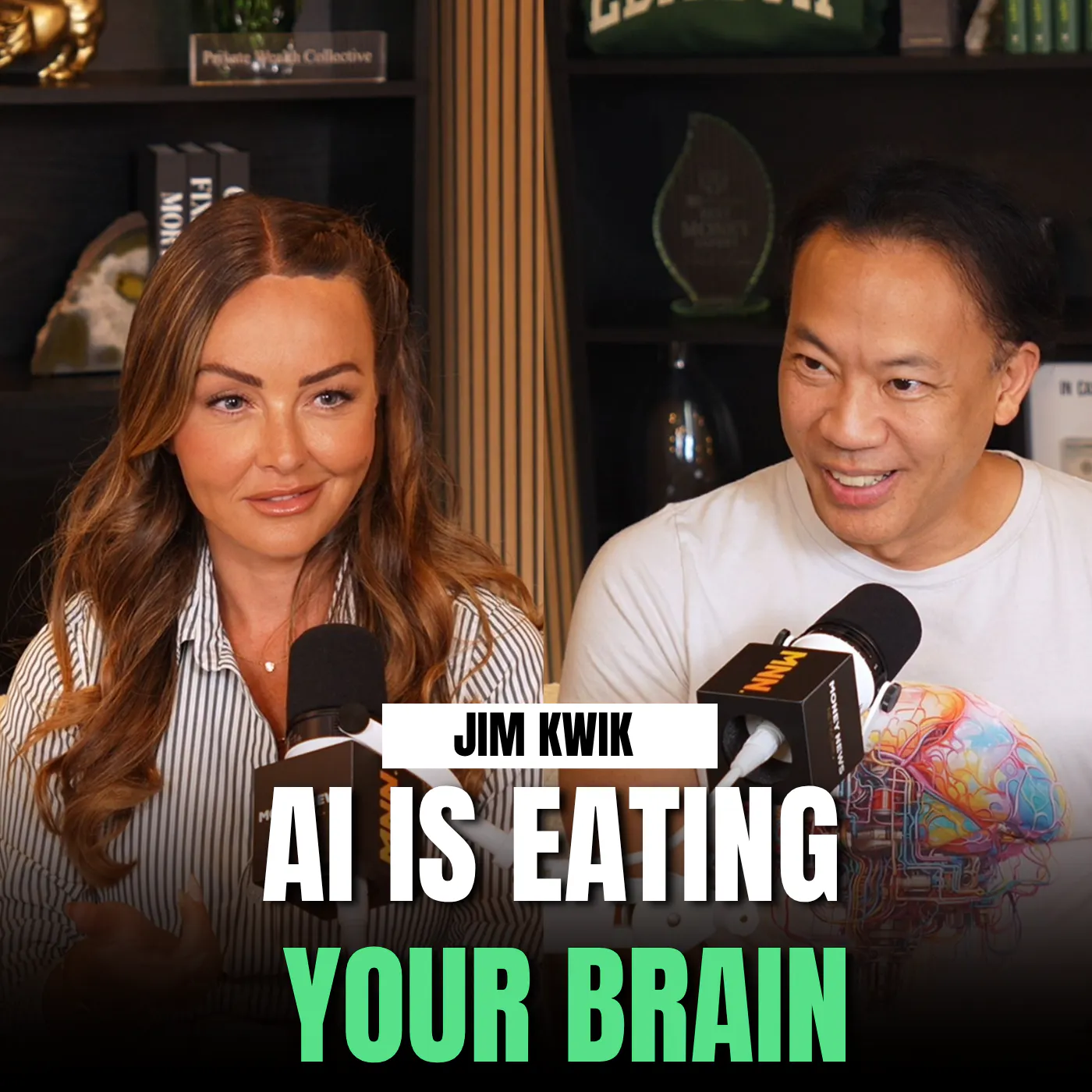
Digital Dementia, Biohacking, and Why Your Brain Is Your Biggest Wealth Asset | Jim Kwik
About this episode
Money Rehab with Nicole Lapin is made possible by:
Get every episode summarized
Each time Money Rehab with Nicole Lapin publishes, we email you a written briefing from the transcript — the topics, who appeared, and any specific claims, with the ad reads skipped.
Email me new episodesFree for 3 shows. No card needed.
Transcript ready
543 searchable segments. Every word is indexed and playable.
Full transcript
Money Rehab with Nicole Lapin — Digital Dementia, Biohacking, and Why Your Brain Is Your Biggest Wealth Asset | Jim Kwik. Machine-transcribed; use the interactive transcript above to jump the player to any line.
Do you know how many bitcoins have been lost? And I don't just mean that someone used them to buy a pizza as a stunt back in the day, I mean that the coins are in wallets that users can't remember the code for. Or they threw away the hard drive or are stored on a drive that is so damaged it can't be turned on. It's estimated that at least 3 million bitcoins are lost forever. 3 million bitcoin is currently valued at over $236 billion. That's a lot of lost money. But the true number is probably higher. If bitcoin is part of your long-term strategy, consistency matters. Cash app lets you set up automatic bitcoin purchases with auto invest so you can build exposure over time instead of trying to time every move. You can also use roundups or paid in bitcoin to make bitcoin part of your normal money flow. Download Cash app today, visit our link in bio, bitcoin services by block link, see the bitcoin disclosures at cash.app slash legal slash podcast.
Recently I went to Atlanta for a conference. Long time listeners will know that I got one of my first jobs as a baby reporter and anchor in Atlanta. A girl from LA completely on my own and it felt like the biggest adventure of my life. When I lived in Atlanta, I was a vegan. And one thing you don't know about Atlanta unless you've lived there is that it has some of the best vegan food in the country. Vegan soul food, vegan tacos, vegan sushi, they have it all. Whenever I go back, I can remember that time in my life when everything felt possible. I wish I could go back in time and give that girl the biggest hug and tell her how much I love her. I also remember how worried she was about money. I don't carry that same fear anymore, but some habits stick. And I still never turned down a little extra cash. That's why I list our space on Airbnb while we travel. It just makes me feel better to know that I am making a little extra money even while off-adventuring myself. And what makes that idea feel much more manageable now is the co-host network. You can connect with a local co-host who has
hosting experience and can help take care of the important details. A co-host can help create your listing, manage reservations, and make sure everything runs smoothly for guests during their stay. Honestly, it just feels like a practical way to make better use of our space while also bringing in a little extra cash from time to time. Find a co-host at Airbnb.com slash host. Football is back and the energy right now is everything. Teams are locked in and every fan is believing in a game plan. That's exactly the vibe I want us to bring to our money this September. And US banks, smartly checking and savings can help us get everything we need to get our financial goals into the end zone. With real people and smart tools to track our spending, we get the visibility to know exactly where we stand. So we're not guessing our way through Q4. Because the teams that win don't figure it out as they go, they come in prepared together. Head to usbank.com and let's kick this season off right. That's the power of us. Member FDIC copyrighted 2026 US bank.
Memory lapses, iterative, some business. I was in Miami because as somebody came to me in the hallway, he's like, I wish I didn't have to do like weeks earlier. He lost the $50 million deal. $50 million because he called this client the wrong name twice. Jim Quig is the brain performance coach who has worked with Fortune 500 companies and people like Oprah will Smith, Richard Branson and me. So today Jim tells us what we should all be doing to boost our brain health. I think there's a misnomer where people feel like I have to be motivated to take action. No, if you take a little bit of action and you get the dopamine which is the reward and encourages you to create more action with greater momentum. What AI is doing to form our brands. Digital dementia, the higher lives, the technology. Remember things for you? If it's thinking for us and we're not doing it, thinking we don't get the exercise. And biohacking trends that actually work. I think a lot of biohacking stuff out there just models nature. PMF, also electromagnetic field therapy which is an electron transfer. You get that by I'm Nicole Lapin the only financial expert you don't need a dictionary to understand.
It's time for some money rehab. Jim Quig welcome back to money rehab. And Nicole thanks for having me. Do you know that this is your third time? That's amazing. You never forget your third. I believe you get like a you know those SNL jackets or something for recurring guests. So why do you as a brain expert extraordinaire keep coming on a money show to talk about wealth? What's the connection between your brain health and your wealth? I mean I think everything in our portfolio came from your mind, right? Those are decisions that you decided, you know, things that you chose, things that you focused on. And I think our greatest wealth is between our years. You know, I think that your branch in our one wealth building asset, even in a world of AI and you know in great and great information because ultimately you know I could create a lot of data and a lot of information but we have to determine what's important, right? We have to be able to decide what to do with it. We have to be
able to think and solve problems. So yeah, mama, I think the brain is amazing. Well people, you have you have like this spectacular like financial wealth intelligence. Thank you. But I'm not a numbers person and people think that you have to be a numbers person to be really good with your money and finances. But you're saying that it's how you feel. I think people's wealth is a determinant of the choices they made up to this point. And I think we you know I think having good focus with your brain, be able to remember important information for your brain, be able to have endurance like it, even anti fragility with your brain, you can be in terms of just bouncing back from like pressure, be able to regulate your mood during you know hard times. I think all of that makes a difference and it all comes from our brain. Well pressure or tension because there's this idea in exercise, right? Time under tension. But with AI, have we become so lazy that we just asked chat you be here, cloud, any question and we're not putting our brains under enough tension or
pressure. Yeah. Are you and your team using a lot of AI? We are using it and trying to figure it out and come up with the right system, but also of course include the human component. Yeah. So how do you keep your brain active while also utilizing tools that you have to be competitive? Of course. Yeah, I feel like AI now is at the stage is not even a competitive advantage because everybody is access to it. I think it's what you bring to it. So if somebody is bringing chaos or confusion, I think it amplifies that. If somebody is very clear, more concise, then they're going to get it amplifies that. So I think AI could scale and amplify, but only scales and amplifies what the humans bring to it. I get to work with a lot of race car drivers and be at this multi-million dollar piece of technology, this race car. You can think about that like AI, but I would batch and like Lewis Hamilton will get a lot more performance out of that car than I would because he has intelligence there. So I feel like that while AI is exponential, that human mind is under
bandage, it's under protected, it's under trained. My big fear is that I don't know if AI will replace humans, but it would definitely reveal humans a lot. So does money. Yeah, very much. It's a magnifier. It's a multiplier. It makes you more of what you bring to it. The more money you get, the more you are, who you naturally are. It just amplifies and magnifies whoever that person is. It does. I think it's a tool. But if we are reliant on it all the time and we're not doing our own thinking, I think that's where the challenge is going to come in. Just like we talked about in the past, like digital dementia, the high relies on technology. Remember things for you? I feel like digital deduction. Like if it's thinking for us, that we're not doing the thinking, we don't get the exercise. So does outsourcing tasks to AI week in your brain? So the MIT study was interesting. The reason one that a lot of people heard about, where they took three groups of students, A, B, and C, where A, they're all the right essays and A, use chat G, B, T, write the essay,
B, use Google, and group C, no technology. They scanned their brains before, during, after, and then they tested also. Group A, they didn't remember anything that came out of those essays that used AI. That's not a surprise. Group C, who used just their brain, had the most recall, the most neural nets that were activated. I love technology. I use it. Our team uses AI. How are you guys using it? In Limitless, I wrote about how use AI didn't hand your HI, taking all our principles and practices for accelerated learning, speed reading memory, and using AI to help facilitate that. So AI could quiz you, which is a great way of learning, better testing yourself, right? Instead of rereading something, quizzing yourself to see where the gaps are of knowledge. You could find your desired learning channel and deliver information the way you prefer to learn it. It could space repetition, meaning if you want to consult, it's very important to some information, want to study, but you forget it like a day later. It could spread out, you know,
information and teach you in a way, like repeat it an hour later, a day later, a week later, depending on your personal learning journey. You can mind-matte, all the other things, you can make it big, you create conversations like a podcast, you know, there's so many ways to get to summarize, you know, enormous amount of information for you to consume. I did that actually when I was studying for the Series 65, which I passed last year. Congratulations. And had it just act as my tutor. And I think that's what it is. Our official intelligence, I think it's like more augmented intelligence, you know, augmentation, it's a partner for you. Like a creative partner, something to bounce ideas for, something to induce some introspection that asks you questions about what you're not seeing, you know, in terms of risk or downside, and it could point out your cognitive biases that you have. If you tell it to not be sick of panic, that's that's a big challenge, right? Where it tell it, it placates to you and tells you what you want to hear. And that's, and that's where the human intelligence comes in, your own judgment, your own critical thinking, your ability to even be curious and ask different questions and problems, because it's those questions
that are going to allow that to happen or not. Because there's a dark side of it too, like the flowers of Aldrin on vibes. And you've read, I don't even know how many books at this point. A lot. Are we, how many have you counted? For what's your book body count? Book count. For four years, I read a book a day. So that's that's so, carry the one. So yeah, it's a good amount. But I think that I think readers, you know, you need to read to succeed. It's it's almost cliche, you know, how much like more and buff at the 500 pages and other individuals. Because the idea here is like the more you know, the better you know, the better you could do, right? Yeah, but in the flowers of Aldrin on ideas, like you become isolated too. Yeah. Or ostracized. By knowing too much. Yeah, it's a curse. I feel like self-improvement is good until it's not. You know, like it depends with motivating people. Because self-improvement can lead to,
you know, self-rejection also. Like you're not good enough. And you know, you're always looking at all your stats. And like, are they achieving to create this wealth to feel worthy? Or is being worthy, you know, is is all this stuff and success more of an expression of them being worthy first? Yeah, are you happy because you whistle or do you whistle because happy? And I think both can be the case. Yeah. Why should we never be outsourcing to AI for our brain health? If you're someone's department or office is on the fourth floor, like, elevators at piece of technology, like AI, it's very convenient. But then we don't get the exercise. And if your brain is like a muscle, it's a user to lose it. You know, I think that's a challenge. So I feel like certainly use it for these, all these things. But I wouldn't not use our thinking or not use our remembering, you know, not use our own judgment because that would actually be over time for sure. What specific things can we use AI for to help with
memory and cognition and focus? So I use it like even for our podcast. If I don't get someone's book in time, I'll ask it to give me some, you know, background information on the book. I didn't have a chance to read it to propose some interview questions that I never use verbatim, but it's it's sparks ideas. Maybe I didn't think about it. I use it a lot to test myself. What I don't know. If Oprah is going to use Claude to ask for questions to interview Dario from Anthropic, we all can. There you go. You can analyze questions that's been asked publicly and, you know, I'm off for up some questions that maybe are unique, specific for a specific audience. Right. So I think that's where the human intelligence comes in. Since everybody has access to AI, there's infinite amount information. I think wisdom becomes more valuable in terms of the meaning behind that information, like what's most important, be able to filter out misinformation. Well, it becomes blurred because then you don't really know where the truth is at some point. And I think through experience, and I think that's what humans bring to something. But also,
you know, when we're talking about human beings, I feel like what's neglecting an AI as powerful as it is. It doesn't feel empathy. It could feign empathy artificially, but it doesn't know what it's like to be with somebody who had a breakup or to sit, you know, in the mud with somebody that's going through hard times. AI could do something medicine, but it doesn't have a bedside manner that's there also. But I think emotional intelligence is how it lean into. I feel like understanding and meaning is very important, critical thinking, because again, it can process a lot of data, but ultimately the person using it is determined what's important. I think it's also adaptability. I would lean into that a lot. Cognitive flexibility, like blockbuster didn't fail because it lacked intelligence. It was rigid, cognitively rigid. Kodak, right? Kodak created the the backbone technology for digital photography, but you know, it wasn't flexible in their thinking. I think one of ways of gauging someone's intelligence is their ability to change their mind based on new data,
you know, as opposed to some cost or something, you know, something that you're kind of committed to. You say the new wealth gap, though, is going to happen not between rich and poor, but between those who can adapt and those who can't. It's not no longer a knowledge gap, because then it's those who happen those who don't have or those who know and don't know, because those who know certainly can make better decisions than those who don't know what you know, right? You can make better decisions financially because you have such a wealth of information that you could make good decisions on, right? As opposed to someone who doesn't have that quality information or quality information, but I also feel like human beings are ultimately powers our ability to adapt. There are some animals that could fly, right? Some that could breathe under water, some that are super fast. We're not any of those things, but human beings can adapt, so we can fly. Using the power of our mind to create technology or we can go underwater or we can go super fast. The one constant in the world is change, right? I think like our ability to learn, to unlearn, to relearn is our greatest advantage in a world where we're drowning in information,
because everybody has access to all the information in the world now. It's not information, it's action, but then what differentiates someone who makes $50,000 and someone who makes $5 million when everybody has the same access information with AI. Yeah, that is interesting that somebody could use, have access to AI and somebody could use it to make a social media post. Another person could use AI to create the next billion dollar venture. It's what, it's what that human being, how smart they are, bringing to that that allows them to create that because everything around us, once started to create wealth, even in terms of physical things, started in people's minds, and they're thinking, they're ability to solve problems, they're ability to innovate. Like you like to Steve Jobs being creative, you look at a phone, and it's like your computer, and it's a camera, it's a calculator, and all those things, like their diversion thinking, be able to learn from other verticals, pattern recognition. You learn something really great on negotiation, and then asking yourself,
well, how can I apply this to my relationship? How can I apply this as a parent? And all of a sudden, you get a fourfold return on that information because you have the wisdom of asking more questions, and it ends in application because you know that knowledge is not power until it's applied. And then, Kelly, that's what we talk about all the time. There's so many financial podcasts and books and all the things, and we started private wealth collective because of that very pain point that it knowledge is not enough. You actually have to take action, you actually have to put this into play. And I think two of the keys for that is for motivation. I feel like it's not something you have, it's something that we do, so it's not a noun, it's a verb, and it gives us our agency. So I feel like if somebody is stalling and applying what they learn from you or anybody, I think purpose is very important because I feel like if they don't have a reason, they don't get the reward or the result. They have to feel it, right? Just like people know biologically, they buy, but emotionally, there's emotional creatures. Thanks, Daniel Connomen.
But if we don't feel something, we're not going to do it. And I feel like some people intellectually know they should do it, but they're not really feeling it. Meaning, they don't feel a pain, they don't feel the consequence and the cost. It's not the price of something, it's the cost of not doing it, right? But if, like if I thought about what motivates me, I'm like, who's counting on me to be at my best today or to make this decision? And I feel the heartbreak of not following through, then I feel something. So I think purpose is important. But I also think people get stalled or stuck, or they procrastinate, not because they don't feel it, because the thing's too big. And I feel like what's very important is that get people to make micro commitments like to break it down. Hello, that's why all my books are 12 step plans. I love that. Jam, because what's the best way to, I don't know, I don't like that how to eat an elephant. What's the better analogy than why don't we have to eat elephants here? Yeah. But that's the same idea of like one step at a time, one. Yeah. Like I got with my, with our three-year-old, we're, don't teach him the floss. And it's like,
probably gonna be flossing on teeth, it might be a big step as an example, but flossing one tooth. You know, if someone wants to be a better reader and read all your many books, maybe they just out of the habit, it's too big. But opening up the book is a small step. Reading one line is a small step, and no one's gonna stop it one line, right? And then what it does though, biologically, is when you take that small step, you get this molecule of dopamine, which is the molecule of motivation. I think there's a misnomer where people feel like I have to be motivated to take action. No, you take a little bit of action, then you get the dopamine, which is the reward, and encourages you to create more action, which creates momentum. So as opposed to cheap dopamine, which is social media, social media junk food, binge watching something, you don't have to earn it. There's no effort that's required. And so you get the satisfaction of that hit, that joy, that comes from it, but you didn't do anything. It's like when people post like, oh, I'm gonna write a book on Facebook, right? I see this all the time. Some, some, we'll go, right? And then everyone's like, oh, that's congratulations. That's so many. And people get all this satisfaction. They don't
even have to do it now because they're just feel their cup is full because they got all this like reinforcement, you know, all these great neurochemicals and just by saying they're gonna do it, but they didn't actually do anything. How do you get a 42 year old to floss? One, two, that a ton. Which is good for your brain too. Your own health is so good for your brain health. Inflammation, microbiome, all. Okay, so for anyone listening who wants a gem quick brain, what do you do for your brain health every day? Legit, just legit. We have known each other along. Yeah, yeah, yeah, yeah. I try to keep it simple nowadays. Maybe just because I'm traveling, and we have a toddler and a infant. So that's changed a lot. And I'm gonna be 53. So I try to keep it simple. Everything for me now, Nicole is like, if it doesn't, this is a quickism. But if it, I just, this is the honest truth now. If it doesn't help me grow, grow, or flow, I, I say now. So I am very rigid or I put my time, my attention. Like I'm here because I really want to be here,
and I can be present because I think our, I, we live in the age of attention. Like if you want to look at the map and pattern recognition of the most the highest achievers, they're very protective of their focus, you know, and includes their devices, obviously. I try to keep it simple. I do meditate once a day because my sleep is a little bit offset with the kids and travel. It isn't interesting like when you pause something, like you pause the computer camera, it just stops working. But you pause yourself. I feel like we start working. I say, I think we start recovering. We started being, we thinking things. We start recalibrating. So I think a pause is important throughout the day. Plus, you know, helps you reduce the little stress. Movement, really simple. But never regret pause or a workout. Yeah, never after you do it. And that's why it's better well, you know, well done and well said, you know, because you practice what you post, right? Like you're all your great content. There's things that you've learned and you're sharing with so many people. And that's wisdom for me. Like I'd rather learn it for somebody who's an expert at something because I
mean, making mistakes costs a lot of time, money, reputation. But do you really practice what you post? Do I? Do you? I do. Real talk. Real talk. Okay. So, so I exercise. I do mind my diet. I mean, every once in a while, I was sweet and stuff. I just, I stopped alcohol. I used to drink like every so often here or there. But then like how I felt the next day overall, so it's just easier for me. And it's not. It's probably not very popular. But um, and sleep. Everyone's obsessed with biohacking. Yeah. You're a rich dude. You have access to all sorts of shots and peptides and all sorts of stuff. What are you taking? What are you using? What are the best biohacking strategies out there? All right. So what I was recalling was my acronym meds. So meditation, exercise, diet, sleep. If we're going to add two to it, Rx, um, the XR, the XR, the XR, the biohacking. But I would put that last because I think a lot of biohacking stuff out there, just models nature. Like PMF, whole-selectromagnetic field therapy, which is an electron transfer,
you get that by walking barefoot, cheap, no cost, you know, red light. You get similar effects from sunlight. You don't have to buy the whole map. I have all this stuff. It just, it just, it costs money, it costs time to go into a hyperbaric chamber or a float tank or, you know, a sauna. It just takes time, which there's a lot of benefits that come from from all these things. But I think we can't do like everything, especially in my like travel. My, my morning routine has changed so much since kids, like it's 12 minutes long. It used to be like two hours. But now it's just, I go outside, finished the limitless when I was in Athens because there's a goddess of memory and memory is the big focus of it. And uh, in ancient Babylonian times and Greek times, everyone believed everything was made of four things, uh, four elements, fire, earth, water, and air. So that's all I want to do. My, my morning routine really is with my son, her three-year-old, we go outside, barefoot, get earth, we get sunlight, which is your eyes are the only part of your brain that's supposed to reset your circadian rhythm, obviously better at night. Um, not through a window, but outside,
even if it's foggy. Um, the, so the fire fires is sunlight. Um, I teach them some very easy breathing exercises. And I love it. Like, closes eyes look so cute and breeze through his nose and the long exhale, which has helped you kind of relax in that air. And then we drink some water put a little electrolytes into it. And so I got, I got four elements in 12 minutes and um, you know, I'm, I'm good to go. I did that this morning, you know, as I'm traveling, you know, because I don't have access to red light panels and hard hyperbaric chambers. But if you look at use as an advantage, that's great. I still think the foundational stuff is, is important. It's all free, right? Meditation exercise. So let's rate them. Let's do a quick lightning round of some brain hacks and rate them one to 10. Oh, fine. Okay. Reading. That's going to be a nine for me. I'd rather go day without eating than a day without reading. Honest to God, truth. Because I think once you start seeing yourself as a reader, like an identity, it's just what you are. Then I just, that's key. That also works with finance too. When you call in
yourself an investor, yeah, versus I just invest, you have more identity with it. It feels different. Does it matter if it's a physical book? When I travel, I'll read on the screen. That's only because I can't, I don't want to carry four extra books in my carry on. But I would always prefer physical books, even over audio books. And I do listen audio books. When people are tested, people tend to read comprehend and retain information better when they're reading physical books, then audio books. And I love audio. We have audio books and podcasts and everything. But I think when people are listening audio, they're doing something else, right? They're driving, they're working out, they're distracted. So they're not going to retain as much. But if I do listen audio books, do you listen on faster speed? Yeah. 1.3. Yeah. I have to do that. Yeah. Even to myself, my husband listens to my podcast, I think, very fast, consistent bedtime and wake time. One to 10. Oh my goodness. Your brain loves the rhythm even on weekends. Nobody gets as perfect. But I think having a alarm to wake up as most people have, but having a alarm
phase down, I think that's important. It'll help your overall call these sleep overtime. No doubt. Meditation. Meditation, maybe six, definitely more than the halfway point. But it's not my non-negotiable, depending on how I well I slept at night. Cool plunge. I personally like it, but I think for most people, it's closer to a three because it wakes me up more than coffee. And I like doing hard things. For me, it's more of a deliberate discomfort. So exactly like I get myself to do that. I get myself to make those sales calls or anything else like that. But I like Sonna's a lot more than both. Cool plunge. So, Sonna? Sonna, I would put it up there as a nine. I mean, all case, all case mortality, it goes down like 40 percent beyond regular usage. I don't know the difference between like an infrared sauna or a, I like traditional sauna. It's going to get higher hotter than an infrared sauna. It only gets about like 140 something degrees.
Not, and I'm very heat adapted. But we built out a traditional sauna and put red lights inside. So I'm just like, actually, all right. Walking 10,000 steps a day. Walking suits for the brain. I'll give that 10. Yeah, that's your first 10. Yeah, I would honestly like, I was walking this morning just because it helps me think. I also think it's important that side benefits of being in nature is huge, which we discount. So I'll take the dogs for a walk each morning. But your body needs to move. And there's so many benefits to walking for your brain and otherwise, no doubt. Jigsaw puzzles. Now, I mean, two, like there's so many other things you could do. We're at all. Two, three. Like I don't even luminosity. Like all these other titles and they're brand names, but a lot of them have been kind of debunked. And I like Sudoku and I like challenged myself intellectually. But I really have discourse and conversation with somebody like this or others that are reading or there's, I feel like more engaging for me at least the way I
read or a huge people out of read. Bottom dancing, racket sports, there's so many of, like, so many things you could do as activities or hobbies. And I like it better than not doing anything. About socializing. Socializing huge. And I'm an introvert. You know this. Like you can't get me out of like, yeah, I don't have FOMO. I do. I do. Yeah, I just extroverted introvert. I can't do it. But I would say like that's the R in meds Rx. You know, says meditation exercise diet sleep XR the biohacking extra the R's relationships. Like by far people are isolated lonely. They're their brain really suffers not just brain health and mental health. And when we socialize that's where we're meant to do is to connect. And so it's not just these brain networks is your social networks. I have to do more of that. It's hard to motivate when you're really in the hole because
you know that's going to make you feel better. But yeah, human beings are social creatures. 100% to do lists. Like for me, I don't think we get through our to do lists. And I think also it's not about managing your time with all the things you need to do. I think it's managing your priorities. Like what's most important on that list that can make everything else easier. I'd focus on the three things that would make you feel like you won that day. Or the lead dominoes that make everything else easier in your life. But if there's something that people are putting off over and over again, I really do believe that if we're talking about wealth that often the wealth that we're seeking is hidden things we're scared to take on or to do that we're putting off for whatever fear failure or success and self-worth or whatever it is. It's hard to outperform yourself image. Like I feel like we don't always hit our goals but we fall to the level of our standards, our systems, our stories, and our self-image. Like I feel like that's where it's at.
And we control all those things. So if we work on our brain health, will we become more wealthy? 100% because if you can focus better, if you can remember better, if you can learn faster, you can make better decisions. You have more wherewithal and endurance, you know, during when other people are doing their trading or whatever they happen to be doing, when other people are under pressure, you can manage your states. Like all that's a amplifier. Like it's just like if somebody's more physically fit, they're you know, they're just stronger and more flexible and faster. They're just going to endure just life better. You've coached billionaires and athletes and world leaders and all the people who are quite wealthy in the traditional sense. Is there a characteristic or a brain hack that they've used to unlock more well? They're they're average learners and growers. Then they do they do the work, right? When no one else is looking and maybe it's not reading but it's something. They are pouring themselves into something that they are excited about and
they always want to grow. And the only easy day was yesterday. I really do think they push themselves and it's hard, right? Like new things that scare they're scary and growth is hard growing a business, growing yourself, growing whatever. But I just want to remind people like nothing is as scary and hard as being stuck like where you don't belong. And I think most people are they're healthy. They they want to be more, do more, have more, share more with others. So I feel like they're very growth aren't you oriented? And also they they bounce back better. Like even golf, right? It's been metaphor for life and I'll play a lot of golf. But I feel like people take what happened on hole three and they take it to holy tea. You know what I mean? They made a mistake there and it stays with them. And I'm sure people do that in business. They take a loss by think. How do you shake it off? Yeah. So I think state regulation be able to manage your state and whatever happens to be people have certain ways of reducing their stress, kind of rebalancing. Whether it's a
breathing or some mantra or it's tapping or it's some song or whatever or saying in their head. Let me tell you how I do it with my 18 month old daughter. Okay. She shakes it off by this thing that I bought on Amazon called 30 second dance party. They do not sponsor us. By the way, they are more than welcome to sponsor us. But you push a button and there's music that plays for 30 seconds. And whatever she starts crying or has a little tantrum or things get stressful or rough, I just push the button and we all start dancing for 30 seconds. That's amazing. That's genius. How you shake off? And music is such a great way of changing how you feel. Yeah. I think I think at probably the best investments I've made. Yeah. I think athletes have something physical. They'll balance the ball every single time. They'll have it a routine that gets them back focused. Like they'll take the bounce of ball three times or they'll do some kind of ritual that kind of that takes a second or two that other people are necessarily noticed. But it helps get them back in the game
in present. You also work with people who just want to read more or improve their brain health. Have you seen that impact their financial health as well? No doubt. Because our financial situation or condition is a reflection again of how you feel and how you think and what you decide to do. So I feel like managing how we feel is very important and it's sometimes we don't we react and we all relate to the economy or how clients treat us or whatever. But I also feel that to the degree we could own and be responsible for how we feel. Not that we don't get thrown off tilts bad news or other people's expectations or opinions. But I feel like those standards of how we are with other people is very important. And I'm not saying it's easy. Something can be simple but not easy. So I think with practice like anything it gets a little bit easier. But yeah, I mean like they say like the metaphor of a storm like it's some storms you can only learn some things in a storm or some storms come to clear paths and people say I had this storm.
But I feel like we're like the atmosphere and we can just kind of watch people's opinions or storms kind of you know pass by and not kind of disassociate a little bit. But I don't know like how do you get out of a bad state besides your dance party? I really am. I'm so bullish on the 30-second dance party. Yeah. Because I also feel like if people are in survival mode or in their bad, like they're not going to make a decision, right? Because they're in a survival brain and they're like held hostage from like their intelligence. Like their ability to judge something or ability to solve problems. Like can you know what I'm going to say when you're angry don't send that email to the text. Hungry angry. I think it's all right. Hungry angry lonely or tired. Oh, I like that. I like acronym. You love acronym. I really love. I'm like I'm like trying not to give out. I told him before we started I was like you got to lay off the gym. But all those things like all those things when you are hungry or angry, right? Alone or tired whatever it's like you're not going to make great decisions, you know, and then you regret. And so I feel like before we do
anything we have to compose ourselves before we're with a client or a potential client or our kids because they deserve that, right? Because then more buses going to show up because when we're like until it's like we're never making good decisions. Is there an easy way that you jump out of fight flight? Is there an easy way to snap out of fight flight? Please. You know any of the the F word reactions that you have to what's perceived as crisis? Yeah, I mean I I I if I can and it's appropriate it would be moving my body and maybe not it's not a dance but I think that's the fastest way of changing your mood personally. I mean even putting a smile on your face kind of changes things and kind of fools you into thinking like something else. Yeah, there's one company that makes customer service. Smart. People smile before answering a phone call. Interesting. Which changes your physiology. I think also psychologically you get asked yourself another question like what else can this mean? Get curious like you're angry at somebody. It's not easy but if you condition
yourself saying get curious instead like I wonder what they're going through you know when we're happening in that person's life because we all probably know that everyone's fighting a battle that other people can't see right? Always be yourself right but unless you're jerk and don't be that person but I think some people are that way and it is what it is. Important advice. Yeah that's the best that's the best advice out of that. That I do think that if you train yourself to ask get curious and then I think it opens up to new possibilities and then I don't get angry as much like if I'm curious like I wonder why they are the like what they're going through what happens to them or you know what they're what their real intention is and whatever happens to me. I think of it as the birthday cake theory that I've just come up with. So instead of getting mad at somebody that's an annoying driver I think huh do they have a birthday cake in the back seat that they're bringing home for their three-year-old for you know their celebration and that's why they're
driving so cautiously maybe they just don't want to tip over the birthday cake. Yeah I don't know I'm just coming up with the best case scenario for why. So what happens if someone's like going really really fast and passing you or cutting you off? The drive from my house in the Poussays, may it rest in peace to the hospital when I was in labor, was the crazy drive ever. I was screaming I don't know what my husband was navigating like rush hour down sunset to get us to seaters. So I have no idea what people might have been thinking but yeah I was going through crazy labor where screaming and basically ripped out the seat belt so I don't know maybe the person that's driving crazy is taking their wife to the hospital to have their baby. I like that and then makes you feel that it you I even feel in the air it feels different lands different when you said that it's probably not true but it's like it's better than being angry and road rage and whatever it comes out of that. I find that when people are driving that if someone's slow then they're just like
people are calm and stupid if they're fast they're just reckless right. We're always the perfect driver. If they're slow they have a birthday cake in our back seat if they're fast they're taking their wife to the there you go to the maternity ward which we did not find even though we took a tour of the hospital we went to the emergency room instead because in that moment you absolutely forget. And that's what I'm saying like when people are on when they're in an agitated state they forget things they they make you know they don't see they don't see that's perceived as clearly as wild. And so how do you as a self-professed intern and I am as well even those the people get really surprised by that. I'm an extroverted introvert. How do you motivate yourself to come out do podcasts, do book tours, do speaking, go speak at all these cake make zillions of dollars speaking. I would say going back to the purpose and the energy and the small simple steps I really lived this like I I feel a more obligation to what I do. I can think of other ways of making money but it's just I haven't deviated this in 34 years so I really feel the suffering because of how
I struggle with these areas and I feel in other people and I've too many references and evidence like you do of people who are benefited from it and I feel like they came out there and I need to show up for them and that gets me on stage even if I butterflies or anything else like that. Some people could do little mental tricks and reframe fear and physiologically is the same as excitement and you know use a word exciting. Exciting instead of you know scared and stuff like that. And certainly that helps to reframe and give you some cognitive distance like distance from like what's going on in your body but I focus on the individual and my trick is I focus on specifically one person that I make sure I talk to before I go on stage so I feel a connection with that person and you talk to one person from the audience or you talk to someone person on the get from the audience generally before I go on stage I'll have met one or two people I search for them and then even how I don't I'll just hallucinate that I do but I don't do tricks and picture them naked or something like that that doesn't really work for me but I think about how can I serve this person while I'm here then then then I break it down to small simple steps I've a little like ritual
before I go on stage but but like it's a party everything else like I want to see people but I'm just better one-on-one or small groups I just have small little dinners that I put together I like your dinners yeah but I haven't gotten an invite recently but it's coming thank you but I do I do love people it's just for me it's very it's depleting and I just need my time I think an introvert is really an energy thing I feel like it's less personality I feel like I just need time to recharge so I could be better for people how do you do it or you just do it because I'm surprised also when you first told me that you're you're more introverted or ambivirt is things so we're like is that what it is ambivirt is like a mix it's like you're mostly introverted but then you can be more extroverted yeah I think it I think it does go down to purpose you know I feel like a lot of responsibility to show up and do the thing and I think there's a self-fulfilling prophecy once you just start doing it yeah you're into it oh I love it
and you act as if so you fake it or you face it to make it which will you make it I like it yeah I think human connection is very important to see and the other thing is a lot of people around a lot of people but they still feel lonely and disconnected so I think that's I think there is social you know the whole thing where like your your network is your net worth or whatever like I I can track most of my business more than half of it to like five people and where are those five people people that I met through people and yeah that they're like in nexus there's certain people kind of like tipping point you know they're certain connectors and mavens that are connected to other individuals because you're connected like to everybody or one or those five we'll bleep it out I want to know they're not anything special but they're special to me in terms of my impact and then they're very generous and you know like just in terms of connections and introductions I like connecting people but with you I feel like everybody wants you to a party trick and I almost wanted you to do one too like a memory party trick okay does that get annoying or people like remember
pie you know what's like pie or like what's my phone number or it would be the same or you know or a magician saying you know whatever or comedian tell me a joke or I'm I'm sure you're not annoyed by it no I I mean I don't think it's the best like even nice stop doing it on demos on stage because it takes like 10 minutes to do these things and do they rather spend the time you know connecting and sharing and teaching what what the effect is but once you've become this master memory man like you are is it hard to turn it off like do you know my phone number by heart I don't want to memorize 5,000 phone numbers I mean you should be concerning we lost the ability to remember phone number or pin number or seed phrase or something we just heard or read or whatever I think those are those memory lapses could get hurt us in business two months ago I was in Miami speaking out of memory training and somebody came me to me in the hallway and he was like really to show up he's like I wish I met you like weeks earlier he disguised in commercial real estate he lost a $50 million deal $50 million because he called this client the wrong name twice
and he said that's like so besides the financial and back he just spelled like the embarrassment of the shit what everything that came from it but yeah don't forget something his name because he was you yeah I mean do people like it at social situations put you on the spot and say like hey I have just no I wish I know please sometimes yeah but not in the same way I think also like I want I'm spending time researching now is like this identity shifts because I think like I work in military you know coming vet back and you know finding who the who are they after they spend so much time or sports figures and retire because they're not all of you know like a tombray or an a-roder whoever right skill acquisition and do all this stuff I'm interested with AI because I feel like when people's jobs are threatened like who are they you know they spend all this time studying law or visual design or whatever it is and if a machine could do a similar job 24-7 like you know who's so many people identified with what they do is my point so I feel there's an identity crisis that goes on with technology it's not just the
loss of works loss of who am I we end our episodes as you know by now since you've been here three times by asking all the reggae for a tip that listeners can take straight to the bank what's one hack that you haven't mentioned that can help listeners so with their net worth with their wealth yeah so beyond the remember names and read every day and all that stuff right um I spent the past two years researching a new book says soft love um limitless I wrote in six weeks which is kind of crazy but I had like 30 years of just like get it on my head limitless daily I wrote um I you write in the morning you have like a process or habit like you do sometimes gratitude journal yeah so I do gratitude or something like that like every single morning for years like 12 years right I was right just that case stuff out of my head or what I'm gonna do that day or whatever so my my my daughter came early um my wife's water broke when she was cooking Thanksgiving um so we had that same
rush to the hospital like totally get that I'm totally on plan house full of people like all that um in the in the hospital I had my journal with me guys carry with me and I started writing but said right away normally right about pocket whatever on some of my mind I started writing um uh emotional uh I started writing note to her and um and it was wasn't for her now obviously she's not a reader yet but she's a fantastic reader um with four inches older and specifically it was like if I'm not here how to deal with a hard day and um and I consistently did that every single day so took me a year to write limous daily it's like daily stoic but instead of playing stoicism it's one thing that teaches you something that will help you get through the things that I was going through with this frustration or procrastination or if you're a failure in posture syndrome or burnout like all the topics and it's science-based psychology like science of the mind psychology I reference or science of the brain neuroscience and then it has like one little thing to do like
that's most simple stuff in one minute and then a little affirmation to affirm like you are this person right and um I put it all together so to get year to write this book which seems like a long time but I wanted my son and my daughter to read it when you know when they're old enough I wasn't here that it would give him some guidance and it's not AI you know who of things that that really could work and the idea I'll actually use the hack so when I was doing research for when to read a book it's not just what you read it um it's or it's when you read so when you first wake up there's something called sleep inertia and sleep inertia is transitioning from sleep to awake and certain parts to come along your awareness your alertness your attention all this and your working memory is empty so it's empty cup you haven't filled it yet this is prime time so it's called intentional priming intentional priming states that the mental input you put in that small window has a disproportionate effect on the rest of your day specifically on what you focus on how you feel
and how you frame the day situations during the day is that wild and so that time is high leverage and most people what do they fill that time with? found and so when are they priming their focus their feelings and their frame in the day doom scrolling comparison depression you know distraction reaction all that stuff right get a message on your phone and then for the xp hour users like on tilt so I want people to read this book first thing so we created a 360-six day challenge and we all do it together it's free and it's just like every single day we build out and I'm so proud of this work yeah this special and I've been talked about it before so this is yeah I feel special you are special thank you thank you
More episodes
More from Money Rehab with Nicole Lapin

Maye Musk Couldn't Pay Rent at 50. Now She's a Full-Time Model at 77.
Money Rehab with Nicole Lapin

How to Invest Alongside the Most Successful Hedge Funds
Money Rehab with Nicole Lapin

I Put My Toddler on Payroll. Here's Why.
Money Rehab with Nicole Lapin

The Best (and Worst) Businesses to Buy in 2026
Money Rehab with Nicole Lapin