About this episode
If you like the finer details of grammar and punctuation, then you're gonna love this episode.
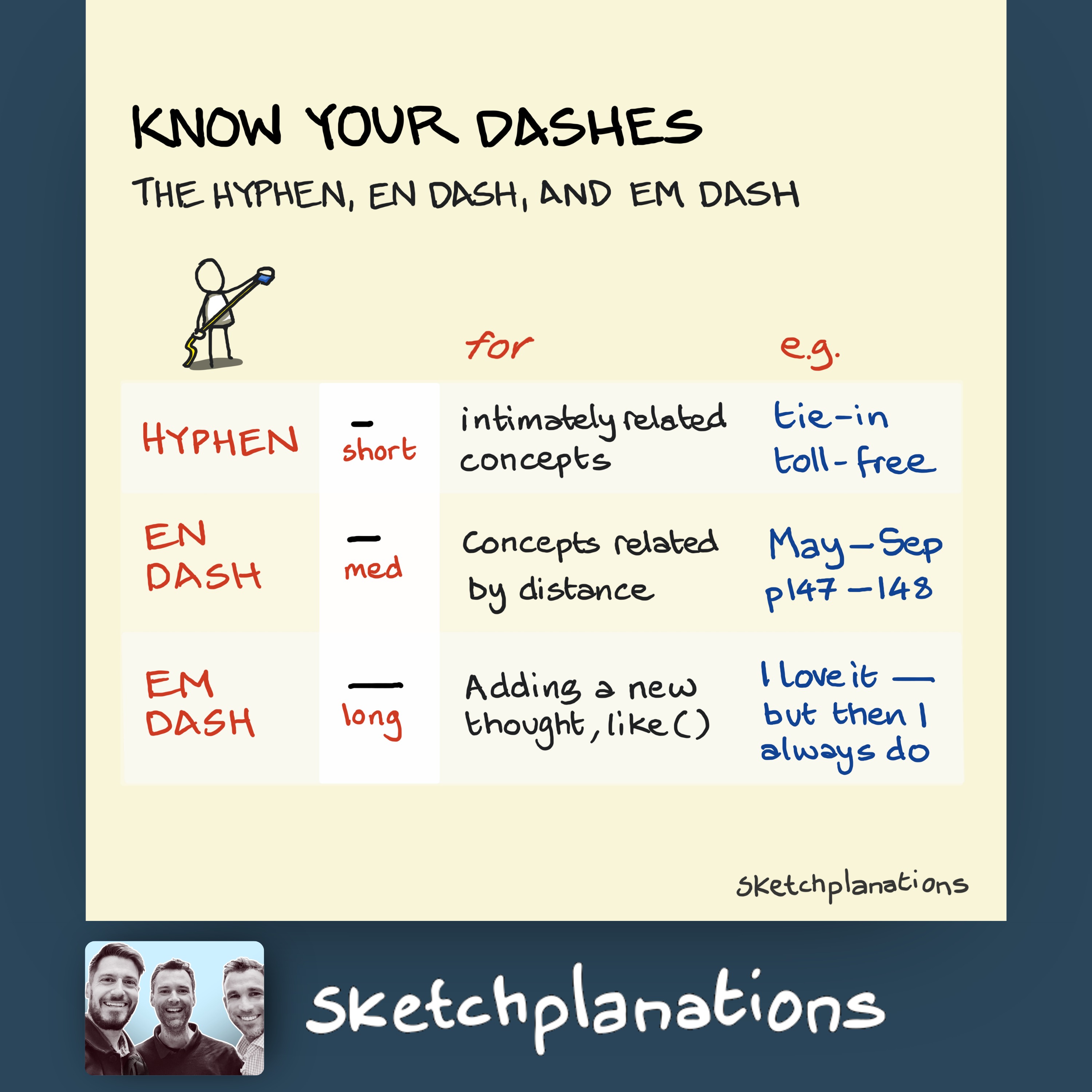
We geek out on the subtle, but incredibly important and occasionally crucial differences between three little horizontal lines: the hyphen - the En Dash – and the Em Dash —
Jono explains hyphens for line breaks and compound terms, how usage can evolve into single words (e.g., wildlife, wellbeing), and why hyphen placement can change meaning (e.g., five-dollar bills). The en dash is described as linking ranges and relationships (pages, dates, times, scores, routes, debates, partnerships, negotiations), with notes on how to type it. The em dash is framed as a stronger-than-comma interruption for added thoughts, with style cautions and typing methods. They discuss underscore origins from typewriters, punctuation differences across countries, and how AI popularized em dashes as a telltale sign of machine-written text.
Most importantly though, we discuss why this matters and that if used correctly, they can help avoid misunderstandings.
Episode Summary
00:00 Welcome to Sketchplanations
00:40 What Are Dashes
03:09 Hyphen Basics
04:32 Hyphenated Words
05:35 Language Evolves
07:00 Hyphen Pitfalls
07:31 Tom on Hyphens
10:38 Meet the En Dash
11:41 Typing En Dashes
12:32 En Dash Use Cases
14:47 Spacing and Style
15:30 Introducing Em Dash
15:33 Em Dash Basics
16:15 Style Guide Rules
18:08 Brackets vs Speech
18:57 Where Names Come From
20:32 Underscore Origins
22:05 Reading Dashes Aloud
24:39 Does It Matter
26:04 Oxford Comma Stakes
28:36 AI Em Dash Tell
29:59 Typing Em Dashes
30:32 Punctuation By Country
31:41 Morse Code And Minus
32:43 Final Sign Off
External Link
There's only one link this week:
- Jono referenced the book Strunk and White : The Elements of Style
All music on this podcast is provided by the very talented Franc Cinelli.
Hosted on Acast. See acast.com/privacy for more information.
Get every episode summarized
Each time Sketchplanations - The Podcast publishes, we email you a written briefing from the transcript — the topics, who appeared, and any specific claims, with the ad reads skipped.
Email me new episodesFree for 3 shows. No card needed.
Transcript ready
833 searchable segments. Every word is indexed and playable.
Full transcript
Sketchplanations - The Podcast — Do you Know Your Dashes?. Machine-transcribed; use the interactive transcript above to jump the player to any line.
Hello and welcome to Sketchplanations The Podcast. We discuss the big ideas and compelling facts explained within the enormous collection of sketches at Sketchplanations.com to help provide fodder for your own interesting conversations. I'm engineer and broadcaster Rob Bell, and with me in the studio are my friends of almost 30 years. Director of Sketchplanations, John O'Hay, and entrepreneur and past one of the apprentice, Tom Pellaro. Hello once again, dear fellows. Hello, 30 years old, yes indeed. 30 years old. Poster 30 years. Better than hospital. This time we're talking about knowing your dashes, which without any context I do appreciate is possibly quite a curious little collection of words, so let's turn straight away to the guy who sketches what he knows, or at least what he's recently learned through rigorous and punctilious research. John O'Hay, what's all this about knowing your dashes?
We're talking punctuation aren't we? Yeah, no, this is quite an old sketch for something I learned actually when I was doing all the typography on things on web pages primarily. Oh, okay. Yeah, yeah, yeah. Of all my sketches, this is the most tably. It's really a table. I'm introducing these subtleties in different concepts, which not everybody has come across, although some of them have more recently come to light, more widely. It's a four by three table. Yes, that would be it. But the different types of dashes, which is very subtle to the uninitiated, is a hyphen and end dash, spelt en, spelt en, and an end dash, spelt en month, spelt en. And I quite like it because the second column in my table is three different lines, which are, I mean, you can see that they're different, but you have to look closely that they're different. I already love the subtlety of this sketch, you know, sorry, carry on.
I am absolutely swimming in it, I love it. You could be forgiven for thinking that all dashes that you see in text are the same, but it turns out they are not all the same. And when you're responsible for writing that on a website that is going to be seen by thousands, tens of that, hundreds of thousands, millions of people, that would be nice. You want to get it right. Then maybe you should get it right. But more to the point, if you edit journals or newspapers or type set books, then you should know this stuff. And so, you know, I'm coming in from the uninitiated to the slightly initiated, there are some people for whom, you know, they take this very seriously, no doubt. Can you then explain the difference between when you should use the hyphen, the short dash, the end dash, the kind of medium length and the M dash, the longest of the three lengths? Yeah, yeah. And now, I could actually talk at length about each of these, so hopefully we get the option to do that. John, this is freeform. This is a podcast.
We go as long as we want, as long as we need. Yeah, so I don't know about you, but the first one that people are familiar with generally is the hyphen, right? You grow up with a hyphen, and you see it in books and a hyphen does a couple of things. One is if you've got a paragraph and your line wraps and you're in the middle of a long word, you can use a hyphen to indicate that you're still continuing that word and you're going to come round on the other side and carry on with your word. Can I make a point on that? Because when I was a kid and I used to write thank you letters, right? And you've not really... You don't do that now. Probably thank you emails more now. But when you're a kid and you're writing your thank you letters and you're not used to writing a letter. And so you'd start a word and you're writing it all over the shop anyway. And it would go towards the edge of the page. So not even at the end of a syllable, just at some point when you ran out of space on the page for that word, you'd do a hyphen and then finish it on the next, on the next word, which probably isn't the correct use. Do you not supposed to do it between syllables in a word?
Oh, that's a good question. I don't know. No, I just do when you run out of space. I mean, we're so used to working with computers these days. It all just happens automatically, doesn't it? It does, yeah, yeah. And in fact, you know, once you had them fully justified text, you tend not to run into it at all very often because you all have just the spacing of the words for you so that you never have hyphen. So you don't actually see it that much anymore. That's just one use of a hyphen, isn't it? There's other uses or at least one other. Yeah, and so the classic use of a hyphen is tying together two words that are intimately related. Classic. So you might have self-study. It's one thing. And I'm putting these together as one single concept. Can we think of some other? I mean, you've done some good examples in your, in the sketch there, tie in, toll-free. Yeah. They do come together. They're almost one word, right? Would you like some more? Yeah, go on. I do have some more. Because I really enjoy using this because I think I understand it quite well. So when I am writing, I do revel in the fact that I could use this.
I'll say, in inverted commas correctly. All right. You're right, Tommy. Time bomb, laughing stock, ice cream, crowdfunding, cross cell, aircraft carrier, call up, climb down, grown up, newfound, short-lived, war chest, witch hunt, anyway, we could get we could go on. Well, I'll probably fade that out in the end, that's perfect. That's perfect. Finish the episode with me reading this generally into the background. Yeah. It's lovely. So it's so horrific, I'd say. I thought, actually, because while we're on hyphons, there's, I think it's quite interesting. There's a little progression, I think, in concepts of how they get used. And so, for example, wildlife used to be wild space life. And then it was wild hyphen life. And now it becomes wildlife as one word, as these things become more and more well accepted. I thought, good example. This podcast is produced by Bellboy Productions. Bellboy used to be separate, and then it was hyphenated. Now it's acceptable as one word.
Right. Bellboy. Yeah. And actually, I think a really relevant one is well-being. So well-being used to be two words. And then it became a thing of its own right and was hyphenated together. And I think if you see, if you search for usages of well hyphen being versus well-being as a single word, well-being by itself is growing. As a concept, it gets more established. So there is. I don't need the hyphen anymore. There is this natural progression in language, is what you're saying. Yeah. I think so. Yeah. I'd agree with you based on those examples there, yeah. You can also have triple hyphons. You probably can have quadruples. I don't know. I was thinking of some triple hyphons like no man's land. Good. Or seconding command. Oh, that's lovely. Seconding command is one thing by itself. And so you hyphenate them all. You have two hyphons, yeah. So you have a triple word together. And then I read this great example on the website of where the hyphen is critical for understanding. So if I say $5 bills, yes, yes, bang, great.
You don't know if it's a $5 bill or it's $5 bills. Yes. And actually, you might be able to tell that if I say it, I say $5 bills or something or I'll say $5 bills. But if I just write it, I don't know what you're talking about. I've just been short-changed, mate. He said, hey, anyway, so that's hyphons. Tommy, are we used to, you still with us, where, how, how, how are you? So it might come as no surprise to you that I had no idea that there were three different types of dashes or hyphons. But nor did I, Tommy, before the sketch. Good. Excellent. I'm glad to hear I'm not that uneducated in these ways. And I am really not a fan. And I kind of deliberately never used them almost in any of the three different contexts. And I know you say, I quite a lot to help me draw things and write things. And I have to always put in my problem to where I don't use hyphons. Because I love using hyphons and these three different types the whole time.
And everyone knows that I would never use those. So it really, like, I mean, give away that it wasn't me who wrote that email if it's got hyphons and stuff like that because that's not sort of level of punctuation I'm able to articulate. That's what I have to say. Yeah. I like that draft. Please rewrite it without the hyphons and I even have it as one of my common prompts that's always always in there. And if he puts them in, I'm like, excuse me, I thought he was poor, remove those, probably still one of the best ever products that make up brush cleaner. Makeup, which is both, and has gone through probably this progression. And so I remember we had massive debates about whether it should be, you know, could be what on packaging, when we're printing at one stage or rather 200,000 pieces of packaging should it be make, bash up, should it be make up, because it was the make up brush cleaner. And it's like, oh, we don't want to get this wrong. We know that people take this. I don't think any of it like we'll face here. We just need to put them together because that seems to be more commonly how it's written. So just doing what other people do because otherwise we won't find you.
Yeah. Otherwise we won't find us. So we kind of went for what we thought was probably the simpler, but also had no idea that it seems progress through. I've just learned that as well tonight. What would be kind of observed that by giant observations as well? It's on the last place I worked. We had a lot of part-time, you know, forever in every page and bit of the app. We had part-time in all different places. And I just, my mission was to come through and be consistent. One of my favorite books about English is the book called Strunk and White, The Elements of Style. And I remember somebody in my design lab said, you have to have Strunk and White, which I thought was very strange because he was a designer and software engineer and so I went and got it. And it's really cool. It has all sorts of things about this and very opinionated about writing English. But he talks about hyphons. He had the wildlife and the Bellboy examples. But he also said, he had this passage. The hyphen can play tricks on the unwary as it did in Chattanooga when two newspapers merged. The news and the free press.
Someone introduced a hyphen into the merger. And the paper became the Chattanooga news-free press. No news, isn't it? Yeah. Dodgy News of our life and I'm not being careful about it. We've done the hyphen. Everyone knows when it's supposed to be used. Let's move on to the next one. The median length dash. This one's called the N. It's called the N-E-N. Right. I quite like this one. And actually, it comes up quite a lot. I put just here in the table that it's concepts related by distance. But it has quite a lot of use cases where you're basically you're connecting a range of things. So if you write pages 10 to 12 or page 147 to 148, you should actually be using an N dash instead of the hyphen. You're not connecting them as one thing. You're saying it's between this one and this one.
Yeah. Same with, yeah, May to September. You might have ages 8 to 11. If you had the restaurant meals are 20 pounds to 30 pounds, you would use an N dash. If you said the workshop is from 9 to 12 in the morning, you would use an N dash. Okay. If you said we're open Monday to Friday, you would use an N dash, not a hyphen. So if you could say like from X to Y, you would use an N dash. And how do we write an N dash in any program? If you're on a Mac, it's option hyphen. Try that now, which you can give a go. And Windows, this is, I don't know, it's a bit of a harder one. It's old 0150, 0150. How do you do, how do you do old 0150? I'm not, but I hold old for the entire 0150. I don't know, can you test it for me? And we'll cut this so that we have the right answer. Yeah, I didn't do anything. 0150. Yeah, what the heck is that? What was I supposed to say?
Yeah, so it's easy on the Mac. Option hyphen. I've just done it, it was delightful. Yeah, it was nice, yeah, yeah. I had to go through control, alt and command to find out which one is. Would you say option? Option, I think. Yeah. Option is old, I think, as it turns out, yeah, it is. Good, well, that's clear. Good listeners, I hope you're following along. It turns out there's a bunch of other places where technically you should be using an N dash. Yeah, go ahead. I've got connections. This is good stuff. So I gave the examples which I first learned it with, which is like May to September or page numbers. But also if you were doing a London to Paris flight, for example, or the North South divide, or a east-west trade route, you're going between these two things. I'd be really keen. I'd be really tempted to stick a hyphen in those, those last two, North South. Yeah, you would, wouldn't you? As with most of us. Especially as no one knows other type it, but we'll come. It's my now to type it, Tom. It's not on your computer. Also things like, I was told where you got two sides.
So as you might have a teacher-student relationship, it's not a hyphen, like it's a teacher-student, like a thing. Yeah. It's a, it's a relationship between a teacher-student student, or a parent-child, or a buyer-seller agreement. Gosh, you should use that in your contract, Tom. Nature, nurture debate, and a cost-benefit analysis. I was actually told that cost-benefit analysis should potentially be an end-ash, because it's between the two. Yeah. Should potentially. Yeah. Well, I'm not 100% sure about that one. That's right. We'll leave that one up in here. That's good. That's it. Let us know. Similarly, if you've got named partnerships, there are some examples of what's in Crick model, or a Lenin McCartney songs. You're not hyphenating them, or giving one of them precedents. You're just saying, like, it's belongs to these, between these two. Yes, it's between these two. I think that's a good definition for me, like, between these two. So scores and results, so if you've said somebody, one, three, one,
or that it was six, four, in a set. Yeah. And also, if you have things like, if you had EU-UK negotiations, you'd actually put it, these are between these two. Yeah. I'm in now. It's not EU-UK, as an entity by itself. This is great. That has lodged in my head, Jono. Thank you. You have a clear clarifying relationships. So all sorts of places you can actually use an in-dash, and nobody won't even know that you're doing it. I love it. Ah. Okay. There we go. So in word, if you type 10, one, zero, space, iPhone, space, 12, it will automatically then turn it into an in-dash. And that was going to be one. My next question is, should you have spaces to be either side? Good question. I heard that there was variations by country for that one. And so the US, UK, English, might do different things. And I think in the UK, we often set things with space, in-dash, space. Whereas in America, they tend to use that in-dash the longer one.
But I'm not type setting books on either side of the Atlantic. So I don't know. But I did use in-dashes in my book, which was by an American printer. Right. Come on. Let's keep moving. The M-E-M. Yeah. So the M-Dash is the longest. The longest. And it is like adding a new thought in a sentence. I heard a nice definition of it, which is kind of like interrupting yourself. Yeah. Stronger than a comma, less formal than a colon and more relaxed than parentheses. Oh, I love it. Or brackets in the UK. Yeah, or brackets. Sorry. So it'd be like, his first thought on getting out of bed, if he had any thought at all, was to get back in again. And that middle bit. Yeah. If he had any thought at all. Could you hear the M-Dashes? Yeah, I heard them. I heard them. They landed heavily. Lovely. Yeah, good. How does the M-Dash go before and off? It does. Yeah. And I also have my other style guide here. I have the economist style guide.
You have one on your desk, Tom. Yeah. It says you should only use like, ideally, no more than one in a paragraph. And definitely it gets really confusing if you use more than one set in a sentence, right? Oh, yeah, yeah. You don't know what's sort of parenthetical anymore. Yes. Or what's the side thought and what's the real thread of the sentence. So just just one set. But I quite like it. I had an English teacher in secondary school. And he said, at the time, he's called Mr. Broomhall. And he said, brackets are for maths, commas are for English. Did he say anything about the M-Dash? He didn't tell us about the M-Dash. But we were in his secondary school English. But I think I think commas, if you're trying to introduce sort of side thoughts like that, I actually can get what your sentence can get quite complicated because you're following this little thread and then you go to this side thread and then you come back to the main one. But you're also using the commas for like pauses and breaks and your breaths as you're reading. And so I think an M-Dash is a really nice way to say this is a slightly different
added or adjusted thought which relevant, but it's not part of the main thread of the sentence. So I use them if you've read my newsletter a fair bit. I've started using them and I don't know why, but I have started using them a lot in the last couple of years. I reckon in casual messaging, like emails or like what's that message is, although I'm not using the M-Dash, I'm using the iPhone, but I'm using that iPhone in place of an M-Dash to go into that secondary thought. I really enjoy using them. But what I often do by the end of that secondary thought, so I start it with the iPhone, which I should be an M-Dash. But then by the end of it, I've forgotten a night, I normally finish it with a comma and Gary, aren't you, Gary? I guess it's not clear. And then if I do remember, I go back and go, hang on, hang on, let's be clear. This is the secondary thought in here. It needs another M-Dash at the end of it. Yeah, I wanted to mention to somebody on my team, I was like, because sometimes in chat, things like Slack or Teams or whatever. Right, real casual, just casual stuff. Yeah, people would write a lot of stuff in brackets. And I was like, well, nobody speaks in brackets.
That doesn't make any sense. And it kind of bugs me when, in a book, if you're reading a book and you're reading a paragraph, and then there's this big bit in brackets. And to me, it's either important enough that you include it as the main bit, or put it at the bottom of the page where it doesn't get in the way. Because I'm going to read it regardless. So why put it in a, in a bracket? And I said to it was like, you know, nobody speaks in brackets, so don't, so don't, we shouldn't be messaging in brackets. And I think it's a petrified of every message that you sent me after that. That's very good. That's very good. Like writing these brackets and deleting them before you sent it, probably. I didn't mean that. I mean, people, you can send messages if you're like, can I throw something in about where I've understood the name's M-N-Dash come from? It's similar to what you said, John, but it's, it was from the printing industry and it refers to the width or the length, if you like, of that dash. And an M-Dash was the width of a capital M in printing. And the N-Dash is the width of a capital N.
M is wider than an N. Yeah, so I have read that too. And I don't think it's the real answer. I think it's not far off. And so, you know, an N is about half of an M lettered widths. I'd say it's like two thirds. Yeah, it's a little bit, it's a little bit more, but depending on the, on the font. And I think, yeah, you're right. Yeah, and I think that was kind of the idea also is that it was more about the height of the blocks when they were typesetting with their letters, and less particularly about the width of your M's and N's. But it is actually quite convenient. I mean, it's not a bad way to remember it, if you ask me like that. It's an M and an M is quite a bit wider than that N. I have read that, that explanation as well, but I don't think it's the real answer. Yeah, because actually M's as in an E-M is a unit of space in typography. And so you can actually, you can actually set a web page in M's instead of pixels, let's say.
And everything can be spaced proportionally in M's instead. So an M exists as its own measurement. Gotcha. Can I ask another question off the back of this? We've got the hyphen, we've got the N dash, we've got the M dash. What is the underscore all about? Fine question, a coding thing, right? I don't know why you have an underscore as well, but you know why not? I suppose somebody came up with it. Could have a top one as well. I did actually look into this. No, I've gotten them. Apparently it came about originally with mechanical typewriters, and it used to be used to go back and underline words that you'd, so you'd type them out, but then you'd just kind of slide your, your roll back, and then you'd get along to it to the words that you wanted to underline. And then you'd just use underscore, underscore, underscore, underscore to go underneath it. And it used to be known as a low line or a low dash. Yeah. That's apparently where it came from. And then with early computers came around. It was, you know, you didn't used to be able to save a file name with a space in it.
It got borrowed to go in place of a space. And I think in modern usage, we've just kind of sometimes we've carried that on. If you're a programmer and you've got a million variable names and you don't want to imply that they're the same concept, but you're going to separate these ones. Then you can use an underscore. Right. I used to have an underscore in my, uh, my first web-based email address. Rob underscore bell. No, captain underscore bell end. Is that paste still up? I think it's something, so I don't, I don't use it. So feel free to send me emails there. They won't get read dot com. Yes, we don't need to, we don't need to go into that anymore than we have. Rob, can I ask because I was curious about this as I was, I was thinking about dashes and various types of dashes and items. And when you're writing text on a page and you're using all the elements of grammar to try and get across how you're, you know, what it means and how you're supposed to say it. And you've done loads of voiceover work.
And it struck me when I was thinking of, you say, I don't, I don't say an endash. I just say the interceding thought, the thing that I just interrupted myself with. Because you imply it through speech, right? But how do you do that? Like if you're, if you're doing a voiceover for something for a TV program, let's say, you are presumably quite well trained at, like, looking at some text and going, oh, this one I need to say a bit differently, or this is, this is an adjoining thought and I'm going to, I don't know, raise my tone up here or inflect on this sentence. Yeah, I think the secret to that is many takes. Directional from me, I think so. Yeah, was as you, as you read through it, you probably get three quarters of the way, three go, hang on, I've read that wrong. Let's come back and have another run at that one. Yes, I don't feel like I use, or that we use different types of dashes, hyphen, endash or endash to imply different means of speech, I think. You know the subject pretty well because you're doing a voiceover on it
and you know where you're going and if you don't get it right, then you come back and do it again. Yeah, I guess what I meant was I was thinking about, I came up with an example. So if I was to say, endashers are a vehicle that I probably use to many of them that let you interrupt yourself mid-thought. Oh, did you? So that I probably used to many of them. As a written thing, I could put endashers around that. Lovely, but I think when I'm reading it, I said it differently, like I'm reading this sentence and then I can see that this is a different thought. Yeah, you changed completely. Yeah, I changed my, you know, how I'm saying this thing so that that thought is connected by itself and separate from the main sentence. So that is the performance of that piece of written prose that you've got in front of you, right? And that's endash, yes. Whether or not that endash helped you or because you wrote it, you know that. I'm not sure, but I have to say, Joe, that was a really well-performed piece of the piece of script. Yeah, well, I was trying to think about all the subtle ways that we actually do that all the time.
If I'm written on a page, you need to try and let's let people know that this is kind of how you would say this. Yes, yeah, yeah, yeah, and that's why these things exist. You're right, you're right, you're right. I think the big question for this episode, and it is a genuine question, is how much does any of this really matter? To me, I can be quite a pedant when it comes to grammar in certain senses, but obviously helping get in this wrong for ages, and I appreciate that I've been misusing the hyphen when I've should have been using different dashes, both N and M dashes. I guess it's interesting to know that there are these three distinct symbols for three distinct situations, but I'm trying to wonder now whether I will change my behaviors with it just because it's so easy just to pop in a hyphen. John, I think your example, you've written a book, you've had a book published, I'm printed, thousands and thousands of times over, so I think if I was doing that, I would want it to be grammatically perfect. Yeah, yeah, you do. Tom, your makeup example is quite reasonable as well,
you know, and we spoke with Mark Forsyth recently, and so Mark Forsyth is an etymologist. Yeah, and there's all sorts about language. Makeups are a great example. You can make up with somebody, and it's a completely different thing than make up, and I know that obviously you're using it in context where it doesn't make any difference, and the context about the fact that your applying makeup is obviously that's going to tell you what it is. But when it's really important, to make sure that something is really understood, it's probably worth using the right thing to get it right. Yeah. I think a good example, which we've not talked about before is the Oxford Comma. Oxford Comma is like the comma and the last one of a list of like three things, let's say. Which I think AI does quite a bit of as well, doesn't it, depending on your AI quiz? I could do. Yeah, I'm not sure. I mean, the classic example there was a dedication in a book, was like to my parents, Bill Gates and God. Yeah. To my parents, Anne Rand and God, was the example that I'd read. And obviously your parents are not those people. And so if you have a comma there,
it's like I'm dedicating it to three people. I'm dedicating it to my parents. I'm dedicating it to Anne Rand and I'm dedicating it to God. And there was a law case around that where in the benefits package or whatever, they didn't have a comma or they did have a comma and they had to do a $5 million overtime payment. So occasionally, if you're a lawyer, this stuff probably really matters. Yeah, yeah, yeah. And that I think in general, I think it's really interesting challenge. Like if you look at a page of text, it's really plain. Like a web page is interesting, right? Web page, it doesn't really matter whether I use an M- or an M- on a web page. Because you can see that I'm listing the hours of the shop. Because it's in the section called the hours of the shop. And I can have a title called the hours and I can lay it out in a table and all this stuff. The context is all there. Color, and size and layout and all these things. But in the page of text, you've only got a few grammatical tools to try and make sure that your message is communicated correctly. And hyphons, in dashes, and in dashes are a few of these.
You've got commas, colon, semi-colons, quotes. But you don't have very many. And we can say an awful lot of things and mean an awful lot of things. I think it's quite nice to get it right. But I'll see, I'm not going to come after you if you don't. No, please do. And my, oh, yeah, thank you. What's that sort of now on? No, but I said, John, I mean, I think as long as you understood, right? That's the main thing. But it's really lovely. And I've really appreciate this chat to know that you've got those tools in your toolbox is lovely. And, John, you've been able to give us examples showing why these things matter or why they are helpful. Matter is maybe a different thing. Why they are useful to be able to describe these in different ways or to be able to write a sentence more the way that you might speak. Yeah, I think so. I think the M dash is quite useful in text where I've got a range of things. I'll use an end dash, but I don't think the end dash, you know, that one is almost indistinguishable for my iPhone. I'll definitely give you that one. What else would anyone like to add before we round off
on knowing your dashes? It's really good that you bring up the AI example and you tell it that not to do hyphens because one of the reasons why I thought this would be a fun sketch to discuss is because M dashes, which would little known, I would generally say, suddenly came into prominence because AI would always do its responses using M dashes. Everybody was like, hang on, most people are not using M dashes in the text because not the father thing is most people A don't know exists and B know how to type it or where you should use it. But AI was essentially trained on, you know, huge corpus of text and very often it was edited text, you know, like just chats and emails and messages back and forth casual text. And it was taught these rules and how to imply them. Well, if you would want perfection, no doubt. Exactly. So it was doing what is good English, I suppose. But that was better English than most people were writing.
And so it was a sudden, it was a mega tell that people had used AI because it was using M dashes everywhere. And for someone like me, that was quite annoying because I was using M dashes and all of a sudden, everybody thinks I'm using AI. Now, you've lost your USP, Jolly. I have, it was all about the M dashes before, but now everyone is doing them. Give us a way, your secret. How do you type an M dash on a Windows or a Mac? This is a brilliant question, sorry, because like hyphen, easy. I can see it there right now. It's next to the zero, seven, eight, nine, zero, hyphen, bang, in it goes easy. So some programs, if you do exactly what you encountered time, if you do a double hyphen in a space, that will give you the M dash. Yes. If you're on Mac and I do this all the time, it's option shift hyphen. I can't be bothered with that. Are you kidding me? I'd just say that it does vary by country. And obviously, it also varies by language.
I was often quite surprised that text in different languages punctuate very differently. I just assumed there was always one wave punctuating. You're right, yeah, yeah. So if you read novels in French, they will always put quakes around the speech, for example, whereas you always do in English. And in France, you'll use a decimal point as the comma in a string of numbers, like a thousand, it would be one dot zero, zero, zero, instead of one comma zero, zero, zero, zero. It causes me massive issues when we get information back from our returns in Europe. We have to have code that converts it all back from dots to commas. Because don't they use a comma to go into decimal places? Yeah, exactly. So they're actually reversed. And you can look at a number and think it's a completely different one. My point about the hyphons and the end dashes and end dashes is it varies by country because countries and languages do very different things. Thank you. Good. Well, listen, personally, I'm absolutely delighted
that I now know which symbol is which. The one question I do have, though, is which one is used in Morse code? I'll leave that one out there. John, Tommy, thank you once again. And thank you all for listening. John, did you want to say something about that? Well, you know which one it is for Morse code? No, I don't know. It's a great question. This is a bit mad. But I did hear that a minus is maybe different from all of these technically speaking. Well, what? Because a minus has to be nicely in line with the equals and the times and the divide and is centered in its space alongside the width of the numbers. So you can potentially throw in a minus here as well. I don't even know how to type that. Well, now that I'm looking at it, the hyphen on my keyboard is right up there with plus and equals. Yeah. So it's probably a minus rather than a hyphen. I've been typing a minus all this time. I could be a couple of pixels out. Oh, my gosh.
It's EU minus UK relations. We'll leave it there. Tommy, Jono, thank you once again and thank you all for listening. Until next time, go well, stay well. Goodbye. Goodbye. All music on this podcast series is provided by the very talented Frank Chinelli. And you can find many more tracks at FrankChinelli.com.
More episodes
More from Sketchplanations - The Podcast

The Diderot Effect
Sketchplanations - The Podcast

Why Only 2 Countries Are Double-Landlocked
Sketchplanations - The Podcast

How To Become An Overnight Success.
Sketchplanations - The Podcast

Play Until Something Gets Broken
Sketchplanations - The Podcast