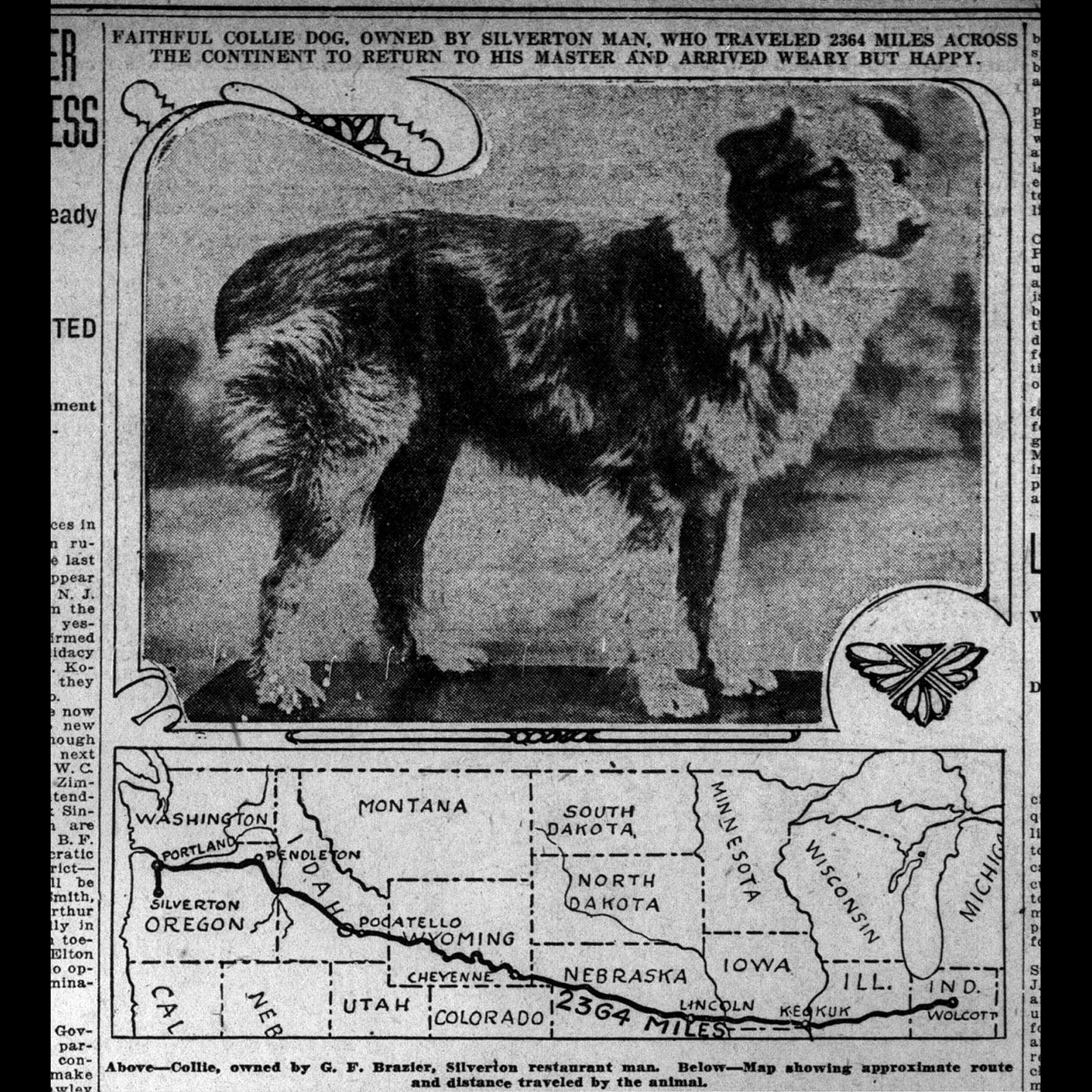
Dog's 2,500-mile walk home made Silverton famous
About this episode
Get every episode summarized
Each time Offbeat Oregon History podcast publishes, we email you a written briefing from the transcript — the topics, who appeared, and any specific claims, with the ad reads skipped.
Email me new episodesFree for 3 shows. No card needed.
Hosts & guests
Transcript ready
140 searchable segments. Every word is indexed and playable.
Full transcript
Offbeat Oregon History podcast — Dog's 2,500-mile walk home made Silverton famous. Machine-transcribed; use the interactive transcript above to jump the player to any line.
Good morning Oregon and happy Friday. I'm Finn JD-John, if J. Ed Offbeat Oregon.com and this is the daily Offbeat Oregon history podcast. Thanks for joining me and I hope you enjoy the show today. Today we are finishing up the story of Silverton's Bobby the Wonder Dog and Bobby's Odyssey. In the second and final part of this two-part presentation of his story, you'll recall when we last saw Bobby, he was high-tailing it away from a fuel station at which his owner, Frank Brazier, was gassing up the family's overland Redbird with a pack of local mongrels in hot pursuit. Frank wasn't too worried at the time. Bobby, he figured, could take care of himself.
Most likely he and the Indiana dogs would have a little tussle and become best friends and spend the rest of the afternoon playing and chasing cats. He figured Bobby would be back at the hotel where the Brazier's were staying later that night. But he wasn't. The Brazier's took an extra day or two to search for Bobby. They called around town, they advertised in the local newspaper, they drove around hollering for him still, no Bobby. So leaving instructions to hang on to him if he reappeared, they continued their road trip. They pick him up on the way home they figured. They figured wrong though. Bobby still wasn't around when they came back through. So regretfully the Brazier's continued on their way, leaving instructions to send him home on a rail car at their expense if he should turn up. This has to have cast a pretty awful paw over the rest of the Brazier's road trip. Anyone who's ever had a beloved pet disappear knows that feeling, hoping for the best, but fear the worst. And a week or two later, the Brazier family was back home, helping cook stacks of hot cakes and slabs of beef steak for hungry loggers and to millworkers at the Rio lunch.
Exactly six months later, daughter Nova, whose last name was Baumgarten, she was Elizabeth's daughter from a previous marriage, was walking down a silverton street with a friend when she suddenly seized the other girl by the arm. Oh look, she cried, isn't that Bobby? Sure enough, it was Bobby. Or a foot, madative coat, badly underweight, and his toenails worn down to the quick. Bobby had spent half a year walking, dog trotting, is it, or the 2,300 miles from Indiana to Silverton. Actually, if he'd had a weight count if dogs came with an odometer installed, his true mileage was probably closer to 3,500 miles, counting the time he spent casting around for the Brazier's scent and picking up their trail along the way. He'd crossed the continental divide in the dead of winter and he'd had to swim rivers and run from dog catchers in at least eight different states on his westward journey. Nova of course brought Bobby to the Rio for a joyful reunion with her sister, mother and stepfather. He was promptly furnished with a luxurious meal of serlo and steak and whipping cream.
This happened during the lunch rush and the place was packed with millworkers, possibly including clerkable who had not yet been, quote, unquote, discovered, and was working a shift in a local sawmill at the time. It was a matter of minutes before word of a Bobby's amazing journey was on everyone's lips all over town. Within a week or two, word had leaked out to the National Press, probably through coverage in the Silverton Appeal Tribune, friendly people with whom Bobby had stayed for a night or two on his journey started writing letters to tell their stories. Soon there was enough information for the Humane Society of Portland to piece together a surprisingly precise account of Bobby's journey. After coming back to Wolcott and finding the brazier is gone, Bobby first followed them northeast further into Indiana. Then he started striking out on what must have been exploratory journeys in various directions, probably trying to pick up a familiar scent to give him a sense of what direction he should take. Eventually, he found what he was looking for and struck out for the west coast. On the way back, Bobby visited every one of the service station com livery stables that
the brazier had graged their car in on the way out. He also visited a number of private homes. Along the way, he spent some time in a hobo camp, and in Portland he stayed for some time with an Irish woman who nursed him back to health after some sort of accident left his legs and paws gashed up. As a side note, this injury may be the source for two of the more far-fetched claims about Bobby, one that he actually rode the rails like a real human hobo, and one that his paw pads were worn down to the bone upon his return. Neither of these claims has seen any of the 1924 newspaper articles I found though. Poor Bob was almost all in, Frank Brazier said. For three days, he did little, but eaten sleep. He would roll over on his back and hold up his pads, fixing us with his eyes to tell us how sore his feet were. His toenails were down to the quick, his eyes inflamed, his coat uneven and matted, and his whole bearing that of an animal that has been through a grilling experience. When he first came back, he would eat little bit raw meat, showing he had depended for sustenance chiefly on his own catches of rabbits or prairie foul.
After the joyful reunion, Bobby's life stayed pretty exciting. The Humane Society gave him a medal in a sober ceremony in Portland. Silverton gave him the key to the city, along with special permission to walk at streets free from fear of the municipal dog catcher. Correspondence poured in, addressed to Bobby the Wonder Dog. He was honored as the star of the home-butifying exposition in Portland a few months after his return, and a miniature bungalow was built to serve his doghouse. For Bobby, the best was yet to come. He was featured in the Ripley's Believe It or Not comic strip, and, last time I visited, although it's been many years, his story was part of the exhibit at the Ripley's Believe It or Not Museum on the Newport Bayfront. He became a movie star later in 1924, starring as himself in the silent film The Call of the West. And of course, the brazier's made sure he never had to hunt for meals again. Oh, ass, Bobby had not much time to enjoy these perks. He died in 1927 after falling ill. Veterinarians suggested it might have been the strain of his journey catching up with him,
but this seems unlikely coming three symptom three years later. In any case, he was buried with maximum ceremony at the Humane Society's Pet Cemetery in Portland, and Rin Tin Tin, the first movie star dog of that name, was coached to Leia Rieth on his grave. In the year since, Bobby's story has only gotten bigger. It was the inspiration for the Silverton-Kawano's Club's annual pet parade, which has happened every May since 1932. Numerous children's books and grown-up books too have been published to tell his story. And of course, Bobby has been an inspiration for plenty of tellers of tall tales such as Half-Away Jones. But they've really had to bring their A-game to come up with a lie that's a bigger wopper than the real thing. I would argue that no one has yet managed it, not even the Great Half-Away Jones. Key sources in this story included, Silverton's Bobby, his amazing journey, a book by Judith Kent, 2004 Beautiful America, Wonder Dog, the story of Silverton Bobby, a book by Susan Stelius, 2005 for the love of
dog books. Bobby The Wonder Dog, column by Alan E. Hunter, April 28, 2018, Alan E. Hunter.com, tall tales from the Rogue River, a book by Stephen Dow Beckham, 1974, IUP. And of course, the archives of the Silverton-Apial Tribune and Portland Morning Organian, from 1923 and 1924. Well, that's our show for today. Thanks again for listening, and by the way, if you haven't yet, check out our offbeat Oregon books. They're a lot like these columns only expanded and updated to take advantage of a less restrictive format. We've got heroes and rascals of old Oregon, love, sex, and murder in old Oregon, bad ideas and horrible people in old Oregon, and eventually the plan is for eight of them to be out, although how many there are out right now depends on when you hear this. They're a lot of fun, and would look great on your bookshelf. This podcast is part of Offbeat Oregon History, a public history resource for the state we love.
Check out our hub page at offbeat Oregon dot com to explore all the other things we do or to find the full citations and visuals that go with today's show. Our theme music is by the Atlas String Band, and was written by Carmen Ficara. Listen and download more at Atlas String Band dot com. Offbeat Oregon History episodes are uploaded every weekday morning and around 6 a.m., so it'll be a couple of days before you get your next fix. But of course, Monday morning will be here before we know it. And that's the latest news from here in Offbeat Oregon's Sulphur Spring Studio. So now it's time for you and me both to go out there and fill up the rest of the day and the weekend with good stuff. Bye now!
More episodes
More from Offbeat Oregon History podcast
Luther Cressman was Oregon’s real-life Indiana Jones (Part 1 of 2)
Offbeat Oregon History podcast

Radical Wobblies found support among loggers
Offbeat Oregon History podcast

Shipwrecked fur traders walked from Oregon Coast to Louisiana
Offbeat Oregon History podcast

P-town ‘jitney wars’ were monopoly vs. small-biz
Offbeat Oregon History podcast