About this episode
Get every episode summarized
Each time History Dispatches publishes, we email you a written briefing from the transcript — the topics, who appeared, and any specific claims, with the ad reads skipped.
Email me new episodesFree for 3 shows. No card needed.
Hosts & guests
Transcript ready
323 searchable segments. Every word is indexed and playable.
Full transcript
History Dispatches — Dolly the Sheep. Machine-transcribed; use the interactive transcript above to jump the player to any line.
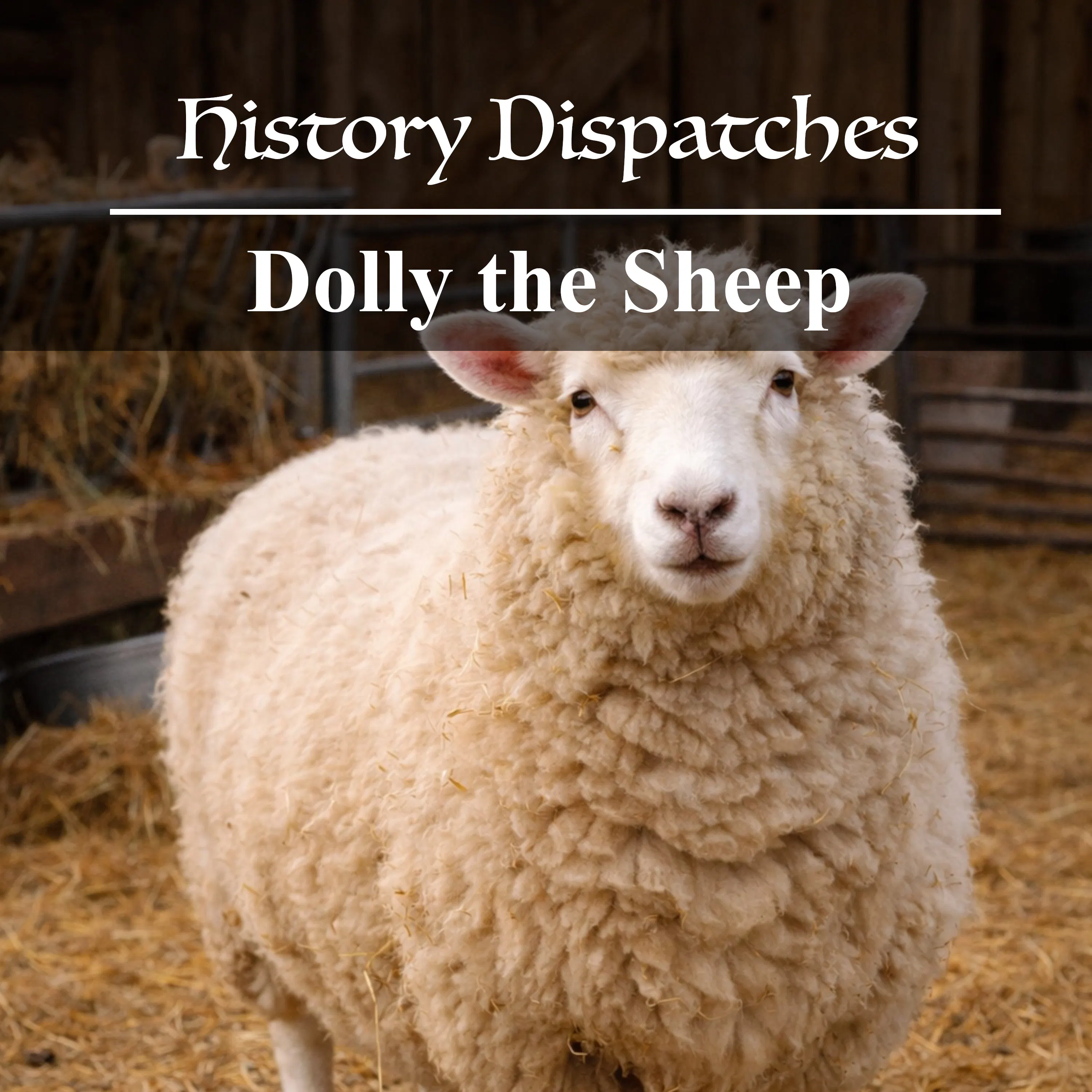
Don't chew on that, Max. Cooper loves that chew, too. Oh, now he's in a Cooper's food. Wow, he is loving it. What do you feed Cooper? Blue buffalo life protection formula? He never leaves a crumb. I love it because it's made with high quality protein, nutrient rich fruits and veggies, and wholesome whole grains. Looks like we're switching to blue. Blue buffalo foods are made with the superior ingredients your dog needs to thrive. Can your dog food say that? Visit feedbluefood.com to learn more. On July 5th, 1996, a thin dorset sheep was born at the Rosalind Institute in Scotland. The sheep's name was Dolly, and she was the first mammal ever cloned from an adult somatic cell. This is the story of Dolly, the sheep that made history. Mah! Mah! Mah! Hello, and welcome to History Dispatches. My name is McKinley and joined by my dad, Matt. Dad, how are you doing this fine afternoon?
I'm doing good. Thank you. Good. Here on History Dispatches, we cover anything and everything history, and today we're delving into a little bit of scientific history. Dolly, the sheep, probably the most famous sheep ever in history. I was trying to think if there's a more famous sheep. I don't think so. I know a little bit about this one. I was born in 1999, so all of my textbooks were young enough to include Dolly, so we learned about this one in six grade science, when we learned about cloning and stuff like that. She was only been like 10, 12 years old at that point, but still I do remember the bits and pieces of this one. But I don't know the whole story, so take it away. Yeah, and I just want to warn you, we are going to do a little bit of science, especially at the beginning of this episode, to kind of give you an understanding of why this is so important. But I may be wrong with the way I say stuff, or at least oversimplify too much here or something like that. Yeah, so forgive me if I make any mistakes, and McKinley will chime in if he catches any of my stupidity. Anyhow, first I want to say is that Dolly the sheep was not the first cloned animal. I know that is a common thing.
People will say, Oh, Dolly, she was the first cloned animal, but that's not the case. There are different ways to clone something, and this is significant because Dolly was the first use of an adult somatic cell as opposed to an embryotic cell. Let me explain that. Embriotic cells are what we would call unspecialized cells, meaning they are, for lack of a better term, generic cells that can become specialized cells. That means like, Oh, I want to be a skin cell. I want to be a brain cell, and you have these blank cells that essentially learn to be whatever they needed to be. I had a science teacher that explained it like this. Essentially, an embryonic cell has a bunch of light switches on it, every light switch corresponds to being a liver cell or a brain cell or a skin cell, whatever. And then as you're an embryo, and you keep dividing and you keep growing, then eventually each cell decides what light switch it wants to turn on, and turns into then a liver cell or a skin cell or whatever. That's kind of how I understand it. Thank you so much.
That was better way than me. I'm glad you remembered your science. Anyhow, somatic cells are obviously different than embryotic cells because they are from adults, and that means they've already had their light switch. They know what they are. Your cell is a liver cell, skin cells is a skin cell, a cell knows only what it's learned to know. I hope that makes sense. So the use of adult somatic cells instead of embryonic stem cells for cloning emerged in the 1950s underguy named John Gerden, who did the first cloning using somatic cells with African clawed frogs in 1958. So again, this is not, oh my gosh, we just figured this out. This is a science that has been around for decades. And the men who will be behind Dolly are two guys, Ian Wilmot and Keith Campbell of the Roslyn Institute, which is part of the University of Edinburgh in Scotland. So what they did is they started with a single cell from a six-year-old sheep's mammary gland. This other cell was inserted into an empty egg cell from another sheep, meaning the cell
had no genetic material to it. And then over six days, the team at the Roslyn Institute basically watched this cell in the test tube. They were looking, will this cell develop? When they made Dolly, this happened. They watched for six days and they were like, this is interesting. We think we have something here. So what they did was they transferred this new embryo to another sheep, this one named Ali. And Ali would become Dolly's surrogate mother. So in total, we basically have three sheep that would contribute to Dolly's creation. Because you have the empty embryonic cell, you have the adult somatic cell, and then you have the surrogate mother who develops and then gives birth. Yes. Fair enough. Now again, this is important because we're talking about an adult cell taken from a sheep's utter. This is a cell that already knew what it was supposed to be as we talked about. It's a guy that's light switched. And what we've done is we flipped off its switch. Now it's making more cells and it's flipping the switches back on, which in turn are helping
create Dolly. This had never been done in a mammal. And a lot of people did not think this was possible at all. But basically what these scientists have done is they had taken a cell and deprogrammed it, leaving just the DNA from one you. This was not easy. They did this 277 times until it worked. So this is not like we just went in, put a few things together, went, hey, look, it was a lot of work. Yeah. Ultimately, a sheep would be born. It was named Dolly after Dolly Parton and it was born on July 4th, 1996. Now the world would not know about Dolly and the unique circumstances of her creation until February 22nd, 1997, but quickly the world would get to know what is now the world's most famous sheep. McKinley, it's time to talk about Factor. I love Factor. And why is that? Well, it gives you fast, convenient, delicious meals when I need them, which is important considering I'm a busy parent. The two things I love about Factor is that it's fast and tasty.
Normally, you can't get both from this type of meal. It's one or the other, but not with Factor. You get both. I love their huge selection with 100 rotating weekly meals. I recently got the queso poblano chicken and the smoky barbecue chicken and they were both fantastic. That is so awesome. Factor brings quality food to you. It's always fresh and always tasty. So check out Factor. I use it. My family uses it. I know you'll love it. And you know what, Dad? We got a great offer for our listeners. That's right. Head to FactorMeals.com slash dispatches pod 50 off and use code dispatches pod 50 off to get 50% off and free breakfast for a year. Eat like a pro this month with Factor. New subscribers only varies by plan. One free breakfast item per box for one year while subscription is active. The reveal of Dolly's existence to the world ignited a firestorm. News stories, magazines, everything.
Science magazine featured Dolly as the breakthrough of the year, justifiably so. But I think the big thing, and I was around when this happened, it started conversations about the implications of what was happening here. Does this mean we can start making people? Things like that. And people are like on religious, on scientific questions where like is this feasible should we even be going down these paths? And the other thing it did is it opened up a whole area of stem cell research, which has its own controversies. The Dolly was not the first cloned animal. She did receive the big media attention because she was the first cloned from an adult cell. And I can't express how important that was because as soon as we hear that we cloned an adult sheep, everyone's mind jumps to humans. Humans. Yeah. Go back and get my embryotic state and clone it, you know, you just can't. But maybe I could do this. But again, then what's the ethics of that? Well, let me tell you, the world does not need more maverings.
What do you mean? I could make more podcasts. Anyhow, like I said, there was a lot of ethical scientific concerns. In fact, some of the initial reactions in the United States, President Bill Clinton banned the use of federal funds for cloning human beings, not that we were setting up facilities to do that. Yeah. You get the idea of legislation, not just in the United States, but around the world, basically saying, you know what, cloning human beings is bad. And some people did it with animals too. But again, it was a huge deal. The ethical and religious and scientific debate about cloning goes on to this day. Should we be doing it? How far should we take it? I'm not going to discuss those things. Yeah. That's a whole different subject. It's honestly things I don't have the scientific background to be able to really discuss that well. Yeah. But I do want to talk a little bit about our sheep, our star, Dolly, and tell you what happened to her and her legacy. So Dolly would live her entire life at the Roslyn Institute in Scotland, and she would
stay indoors basically for security. She would become a mother. They bred her with a Welsh mountain ram, and she would produce six children in her life. And we have their names, Bonnie Sally Rosie, Lucy Darcy, and Cotton. However, in late 2001, when she was only four, Dolly developed arthritis, and she started to have a trouble walking. They treated this with anti-inflammatory drugs. But the worst thing that happened was a couple of years later, she developed a progressive lung disease, basically a sheep retrovirus, which was common amongst the breed. This means tumors would start growing in her lungs, and that is incurable. And thus, on February 14, 2003, she was put down when she had trouble breathing in the arthritis. Got horrible. I do want to note that this lung disease was not some weird, obscure thing. This was very common amongst sheep, especially those who are kept indoors as Dolly was. And I also want to note, there is no evidence that Dolly being a clone affected her in any
way. Like, oh, clones are more likely to get this disease. It was a common disease from sheep, and it was not uncommon for her to only live six and a half years, even though the average age of a thin dorset sheep, they would live to 11 to 12 years. She just got unlucky. Now I do want to address speculation that was Dolly being a clone of a six-year-old sheep. Did that affect her genetic aging, shall we say? Was she already born essentially six years old? Well, no. That wasn't the case. They looked at that and was like, no, she just lived and died like a sheep does. In fact, there have been some long-term looks at Dolly as well as other clone sheep. In fact, there are four identical clones of Dolly that, as of 2016, when they were 9-10 years old, were still alive. They all lived normal lives. That is fascinating because when I was in middle school, first learning about this stuff, 2010, 2011, 2012, all of our textbooks gave it the caveat that this is new science and
more research is necessary. However, most of them said, there is evidence to suggest that her genetic age may have been older. So it's fascinating that less than a decade ago, we've now had some long-term data to show that, actually, no, the age doesn't really matter. Yeah. I do want to also put the caveat in there. There hasn't been that much research because we don't have that many clones. So maybe there is some stuff in there, but they have not found any correlation. Otherwise, when Dolly died, her body was preserved at the Ataxidermi and she is currently on display at the National Museum of Scotland in Edinburgh. And that's basically the life of Dolly, but her legacy lives on. How she was cloned, the way that the scientists did all this, using those same techniques they have cloned, horses, deer, pigs, bulls, many other animals. But I do want to stress, though, it doesn't work with every animal. Example of the Argali, which is a mountain sheep from Asia, they were never able to produce viable embryos. So again, you know, it's not perfect and we want to point out it's not necessarily efficient
what they're doing. 277 times it took the scientists to actually get one Dolly. But cloning, which is a business now, there are private cloning businesses. You can clone your cat and dog. They do have higher success ratios like 30 and 40 and 50 percent if you want to do that. By the way, regarding the cloning of people, Dr. Ian Wilmot, one of the people behind Dolly, he said in 2007 that he doubted that humans would ever be cloned. The reasons I don't exactly know, but that's what he said. And like I said, you can do cloning for your pets, things like that today. But the ethics aside, cloning does offer some really interesting things and this all starts with Dolly. It could be a viable tool someday to save an endangered species or to revive one. In fact, in 2009, scientists cloned a Pyranian i-bix, a mountain goat, which was declared extinct in 2000. The animal that was born from this would die shortly after it was born due to lung defects,
but it was the first time an extinct animal has actually been cloned. And if you're curious, there are projects underway to revive extinct animals, including the woolly mammoth, the passenger pigeon, and the Tasmanian tiger. And I didn't dive into this a lot, but I think it's because we have a lot more genetic material because those things have only been extinct in the case of the passenger pigeon in the Tasmanian tiger 100 and 150 years. The mammoth, 5,000 years, and we've got samples from frozen areas, which probably makes it more viable. Yeah, more viable. One of the interesting thing is Dolly, we think of the cloning, but Scientific American magazine makes an argument that cloning is not the big legacy of Dolly, but the advances in stem cell research that came out of this stuff. The idea, these sorts of things could potentially someday help with treatments for diseases like Parkinson's and diabetes and many other things. So Scientific American thinks cloning is cool, but you know what?
The research in stem cell work, it's going to change your lives much, much more than cloning ever will. Anyhow, that is a story and the continuing legacy of Dolly the sheep. That is fascinating because my knowledge of this stopped after about 2012. So it's cool to hear some more of the stuff that happened afterwards. It's very much a sci-fi concept that is run to life. We tend to think of that. I feel like we tend to think of that in more of the tech scene of phones and the internet, but this is an example of a living creature. It's just fascinating that what won the amount of effort going all the way back to the 50s that it took to realize it. And then now the potential implications like stem cell research, I actually have a buddy he's in his PhD program and they use stem cells all the time for their research. Humongous breakthroughs in medicine have been underway since then. Yeah, I can't imagine sci-fi writers when they first saw this story, you know, 30 years ago. Their brain's going crazy and I know cloning has been involved in sci-fi writing for
decade, well before Dolly, but this I think would have just given them so many ideas of how this could happen in the stories and I can even quote you plot lines of sci-fi shows. I think my favorite one was guy creates a clone of himself and kills the clone and tries to pass the clone off as him. So he can get away. He's ultimately caught and arrested because there were rules in the show. I think it was a Star Trek episode where you were not allowed to kill even a clone. Yeah, super cool though, Dad. Thank you very much. You're welcome. I'll leave you with our did bit of the day and we mentioned scientific American a few minutes ago and they are an extremely popular science magazine that was first published in 1845 over 180 years ago, making them older than the state of Wisconsin, which is just crazy. Some of its contributors have been small people you've probably never heard of like Albert Einstein or Nicola Tesla, also more than 150 Nobel Prize winners. It is still published to this day and it is the oldest continuously published magazine in the United States. That's some pretty good publishing history.
That's pretty cool. Alright, well that, thank you very much. You're welcome. Dear listener, thank you so much for spending some time with us. We really appreciate it. If you want to learn more, check out historydispatches.com and if you enjoyed the show, consider giving us a like or a review on Apple or Spotify, wherever you get your podcasts. It really helps the show out and we really appreciate it. Thank you so much and have a wonderful day. Welcome to True Spies, the podcast that takes you deep inside the greatest secret missions of all time. It's something out of the darkness of hip-hoping love. You'll meet the people who live life undercover. Do they know what are their skills and what would you do in their position? Fensions felt good seeing these people pay for what they'd done felt righteous. True Spies from Spicecape Studios, wherever you get your podcasts.
More episodes


