Loading...
societyculturedocumentary
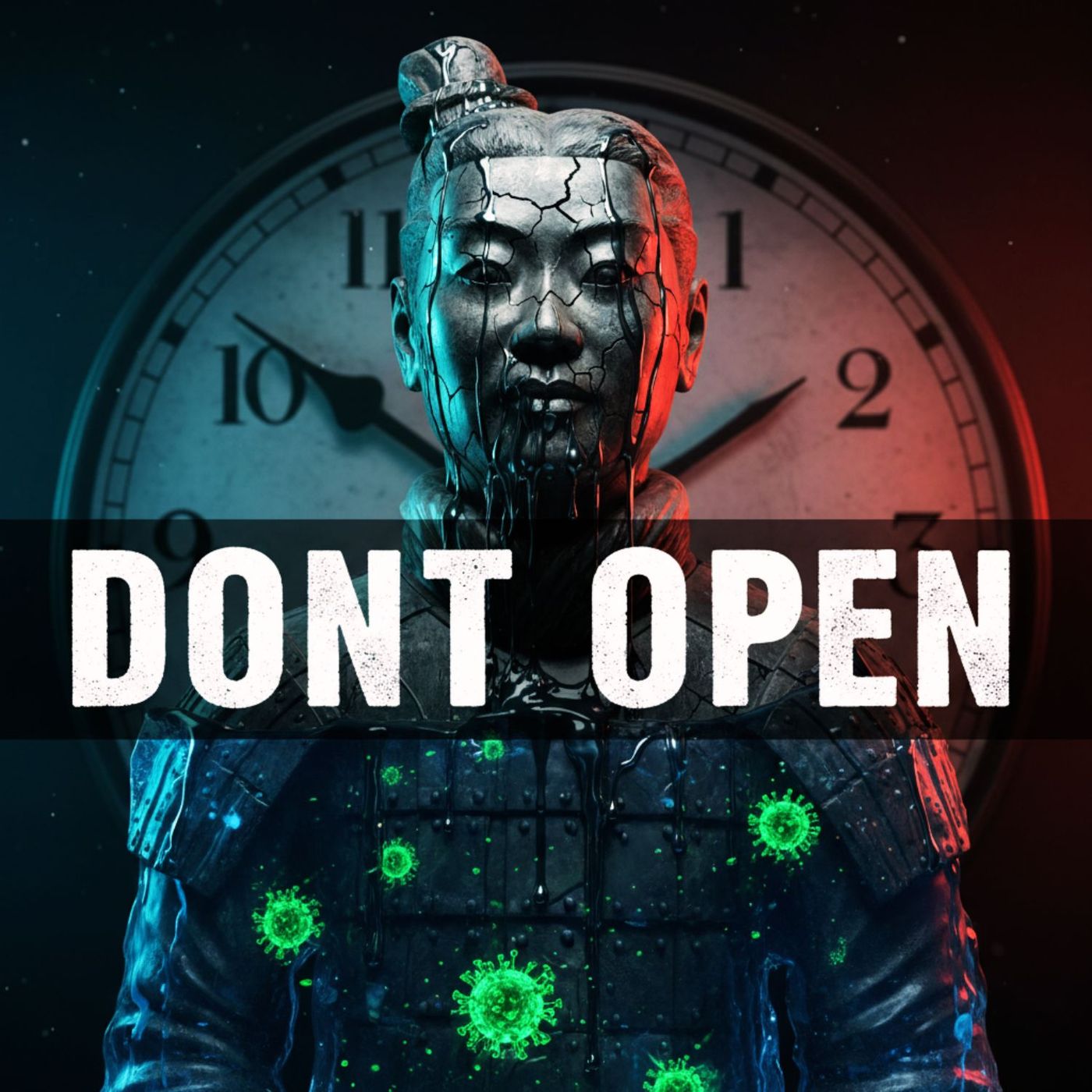
Don't Open The Mercury Tomb: Zombie Viruses & The Doomsday Clock
About this Episode
Tick, tock. Can you hear that? That isn't just a clock; it’s the sound of scientists holding their breath.
Welcome to the episode that might just keep you up at night—but for all the right reasons. We are looking at the hard data, the "red alerts," and the absolute wildest scientific anomalies that have experts sweating. We aren't just talking about the weather getting warmer; we are talking about a full-blown planetary inventory of "Uh oh."
In this deep dive, we explore the terrifying reality of "Zombie Viruses"—antibiotic-resistant bacteria that have been asleep in ancient ice for thousands of years, now waking up as the world melts. We also tackle the bizarre concept of Synthetic Mirror-Image Life (yes, it’s as sci-fi and dangerous as it sounds) and why astronomers are suddenly worried about "invisible" asteroids slipping past our defenses.
But the weirdest part? We’re traveling back to ancient China. We explain the deadly reason why modern archaeologists still refuse to open the Tomb of Qin Shi Huang. Legend says it's filled with rivers of mercury, and science suggests opening it could be a fatal mistake—both for the researchers and the artifacts.
From toxic chemicals found in newborns to the rapid disappearance of deep-sea creatures we barely knew existed, we are connecting the dots on the Doomsday Clock. Is it a countdown to catastrophe, or a wake-up call for human innovation?
In this episode, we answer:
Hit that play button to uncover the truths the planet is trying to tell us. If you enjoy this reality check, please Subscribe/Follow and leave a 5-star review! Share this with a friend who loves a good mystery (or just needs to prepare for the apocalypse). Let’s get the conversation started—what scares you more, the asteroids above or the viruses below? Let us know in the comments!
Become a supporter of this podcast: https://www.spreaker.com/podcast/thrilling-threads-conspiracy-theories-strange-phenomena-true-crime-unsolved-mysteries-etc--5995429/support.
ThrillingThreadsPod.com - Unravel the Unknown.Dive deep into the world's greatest conspiracy theories, strange phenomena, true crimes, and unsolved mysteries. Follow the threads.
You May also Like these:
SkyNearMe.com – Your all-in-one "Sky Super-App." Track real-time weather, sunset and air quality, stargazing conditions, 5G signal mapping, drone flight zones, solar potential, track satellites, rocket launches, UFO sightings in your local airspace and even get your Sky Horoscope and more!
🤖Nudgrr.com (🗣'nudger") - Your AI Sidekick for Getting Sh*t Done
Nudgrr breaks down your biggest goals into tiny, doable steps — then nudges you to actually do them.
Welcome to the episode that might just keep you up at night—but for all the right reasons. We are looking at the hard data, the "red alerts," and the absolute wildest scientific anomalies that have experts sweating. We aren't just talking about the weather getting warmer; we are talking about a full-blown planetary inventory of "Uh oh."
In this deep dive, we explore the terrifying reality of "Zombie Viruses"—antibiotic-resistant bacteria that have been asleep in ancient ice for thousands of years, now waking up as the world melts. We also tackle the bizarre concept of Synthetic Mirror-Image Life (yes, it’s as sci-fi and dangerous as it sounds) and why astronomers are suddenly worried about "invisible" asteroids slipping past our defenses.
But the weirdest part? We’re traveling back to ancient China. We explain the deadly reason why modern archaeologists still refuse to open the Tomb of Qin Shi Huang. Legend says it's filled with rivers of mercury, and science suggests opening it could be a fatal mistake—both for the researchers and the artifacts.
From toxic chemicals found in newborns to the rapid disappearance of deep-sea creatures we barely knew existed, we are connecting the dots on the Doomsday Clock. Is it a countdown to catastrophe, or a wake-up call for human innovation?
In this episode, we answer:
- Why is the First Emperor’s tomb considered too dangerous to open?
- What happens if ancient viruses are released from melting permafrost?
- How does synthetic mirror life pose a threat to our biology?
- Are we actually prepared for an undetected asteroid impact?
- What does the Doomsday Clock actually measure right now?
Hit that play button to uncover the truths the planet is trying to tell us. If you enjoy this reality check, please Subscribe/Follow and leave a 5-star review! Share this with a friend who loves a good mystery (or just needs to prepare for the apocalypse). Let’s get the conversation started—what scares you more, the asteroids above or the viruses below? Let us know in the comments!
Become a supporter of this podcast: https://www.spreaker.com/podcast/thrilling-threads-conspiracy-theories-strange-phenomena-true-crime-unsolved-mysteries-etc--5995429/support.
ThrillingThreadsPod.com - Unravel the Unknown.Dive deep into the world's greatest conspiracy theories, strange phenomena, true crimes, and unsolved mysteries. Follow the threads.
You May also Like these:
SkyNearMe.com – Your all-in-one "Sky Super-App." Track real-time weather, sunset and air quality, stargazing conditions, 5G signal mapping, drone flight zones, solar potential, track satellites, rocket launches, UFO sightings in your local airspace and even get your Sky Horoscope and more!
🤖Nudgrr.com (🗣'nudger") - Your AI Sidekick for Getting Sh*t Done
Nudgrr breaks down your biggest goals into tiny, doable steps — then nudges you to actually do them.
Hosts & Guests
Transcript
With its two juicy beef patties and three slices of melted cheese topped with tangy big-arch sauce,
the big-arch is what happens when you start making a McDonald's burger, and never stop.
The big-arch, the most McDonald's McDonald's burger yet, for a limited time.
And Doug.
There's nowhere I wouldn't go to help someone customize and save on car insurance with Liberty Mutual.
Even if it means sitting front row at a comedy show.
Hey everyone, check out this guy and his bird.
What is this your first day?
Oh, no.
We help people customize and save on car insurance with Liberty Mutual together.
We're married.
Ah!
Need a human, him to a bird.
Yeah, the bird looks out of your leg anyways.
Only pay for what you need at Liberty Mutual.com.
Most people would rather assemble a 300-piece cabinet than search for insurance.
That's why the zebra searches for you, comparing over 100 insurance companies to find savings no one else can.
Compared today at TheZera.com.
You know, human beings have this really specific, almost cinematic relationship with the concept of the end of the world.
Oh, absolutely.
We always expect a spectacle, don't we?
Right, when we picture some massive existential threat, we almost always look up.
We have been conditioned by, you know, decades of summer blockbusters to expect the danger to arrive in a massive chrome spaceship.
Or jagged rock the size of Texas hurtling out of the dark.
Exactly.
We want the threat to be external.
We want it loud and we want it visible.
Because it creates a sense of agency.
If the monster is coming from the stars, well, we can build a wall or we can build a laser or a spaceship to meet it.
It externalizes the fear.
It's that classic us versus them mentality.
But, uh, I have been sitting with this stack of reports you sent over for today.
The analysis on umbilical cords, the data from those deep ice caves in Romania,
the thermal readings from the Pacific.
And honestly, it feels like our collective radar is just pointed in the completely wrong direction.
That is the uncomfortable truth of this collection of data.
We aren't looking at hypothetical alien invasions here.
We're looking at data points that are already in the room with us.
Yeah, the discoveries that have scientists legitimately rattling the cages right now aren't coming from the Alpha Centauri system.
They are coming from our own trash, our own history, and even our own biology.
They're microscopic.
They are submerged.
Or they are just hiding in plain sight.
They really are.
So, welcome to Thrilling Threads.
I am your host.
And today we are pulling a thread that frankly I was a little hesitant to touch.
We are going to look at a series of recent scientific discoveries that have prompted researchers to use words they usually avoid in peer-reviewed papers.
Words like terrified, unprecedented, and irreversible.
Yeah, the heavy hitters.
And we should clarify right out of the gate for you listening when a scientist says they are terrified.
They aren't talking about the kind of panic you feel in a haunted house.
No, not at all. They are talking about statistical terror.
They mean the data represents a deviation from the norm that is so significant that their predicted models are just breaking.
They are looking at a graph line going vertical and realizing they have no idea where it stops.
Right, it's intellectual terror.
It is the realization that the baseline of our world has fundamentally shifted.
So here is our mission for this deep dive.
We are going to validate that fear, but we are going to do it by digging into the actual mechanics of why.
We are going to look at forever chemicals appearing in the most pristine biological environments on Earth.
We are going to dig into the permafrost to find bacteria that shouldn't exist.
We will look at why the ocean is boiling, why the deep sea cleaning crew has completely vanished,
and yes, we will eventually look up at the sky to see what we are missing.
And we will finish with a theoretical risk that sounds exactly like science fiction, but is dangerously close to science fact.
We'll start small, uncomfortably small.
Section one of your notes involves a study on umbilical cords.
Now, biologically speaking, the womb is supposed to be a fortress.
Right.
That is the standard biological assumption, yes.
The placenta is this incredible evolutionary filter designed to keep the chaos of the outside world completely away from the developing fetus.
That was the prevailing wisdom for a very long time, that the placental barrier was this perfect shield.
But this recent study, which analyzed really detailed scans of umbilical cord samples from people born between 2003 and 2006,
has effectively shattered that assumption.
They were looking for synthetic compounds, and they didn't just find a trace of something.
They found 42 distinct forever chemicals.
42.
And to really grasp why that number is so shocking, you have to understand what a forever chemical actually is.
We call them PFAS.
Right.
PFAS.
Yes.
These aren't just random naturally occurring toxins like lead or mercury.
These are absolute masterpieces of human chemical engineering.
They are built using carbon fluorine bond.
Exactly.
In organic chemistry, the carbon fluorine bond is one of the strongest single bonds known to science.
It is incredibly short and incredibly stable.
And we designed it that way on purpose.
Because we wanted indestructible stuff.
We did.
We wanted non-stick pans that wouldn't flake into our eggs.
We wanted firefighting phones that could smother a raging jet fuel fire in seconds.
We wanted raincoats that would literally never soak through.
We needed a chemical armor for modern life.
So we built them to be invincible?
Precisely.
We engineered them to resist heat, resist water, and resist oil.
But the problem is, because that bond is so unnaturally strong, nature has absolutely no mechanism to break it down.
Nothing can eat it.
Nothing.
Soil bacteria can't digest it.
The UV radiation from the sun barely touches it.
And most importantly, your liver enzymes cannot slice it apart to flush it out.
So it doesn't leave.
It bio accumulates.
And that is the baked-in concept that really struck me in this report.
These babies, who, by the way, if they were born in 2003, they're adults in their 20s right now.
They are.
They didn't ingest this from eating a candy wrapper or by crawling around on a dirty kitchen floor.
They received it intravenously before they even took their first breath.
It is a literal intergenerational transfer of pollution.
The mother accumulates this chemical load over decades of just living in the modern world.
Drinking tap water, wearing tweeted clothes, using standard cosmetics.
Just living life.
Yeah.
And because the chemistry of PFAS mimics natural fatty acids or it binds so perfectly to proteins in the blood,
it bypasses that placental filter we talked about.
It just flows right into the fetus.
It essentially treats the developing child as another storage depot.
What are the biological costs of starting your life, day zero, with a baseline of industrial solvents in your blood?
I mean, 42 chemicals, that is a heavy cocktail.
That is the truly terrifying part for the toxicologists involved in this research.
Of those 42 chemicals they found, a significant number are chemically identified, but biologically unmapped.
Meaning, we know they are there, but we have no clue what they do.
Right.
We know the milk of a structure we can draw on a whiteboard, but we don't know the physiological cascaded causes in a human body.
However, the ones we do understand are heavily linked to metabolic disruption,
compromised immune responses, and severe developmental delays.
It's almost like a software bug pre-installed in the hardware.
You're walking around wondering why your immune system is so sluggish at age 30,
or why your cholesterol is doing weird things despite a good diet,
and the answer might be a brand of stain-resistant spray someone used on a sofa in 1995.
That is very apt analogy.
And because these are forever chemicals, the concentration in the global environment is only increasing.
The babies born in 2024 or 2025 likely have a vastly more complex chemical cocktail than the 2003 cohort.
Because we just keep inventing new variants to get around the regulations on the old ones.
Exactly. We ban one, the chemical companies tweak one molecule and put a new one on the market.
We are effectively running an uncontrolled global toxicology experiment on our own species.
And since these chemicals do not degrade, we are just stacking the deck higher every single year.
It is the invisibility of it that really gets to me.
You can't see it, you can't feel it, but it is there just woven into your DNA replication machinery.
Which perfectly brings us to another invisible threat.
Most people would rather attend a corporate team building workshop than search for auto and home insurance.
Go team, feel that synergy!
That's why the Zebra searches for you, comparing over 100 insurance companies to find savings no one else can.
Compared today at the Zebra.com.
Who's ready for the transfer?
Tyler Reddick here from 2311 Racing. Victory Lane? Yeah, it's even better with Jamba by my side.
Race to ChampaCasino.com. Let's Chamba.
Don't purchase necessary. VTW Group. Void we're prohibited by law.
CTNCs. 21 Plus. Sponsored by ChambaCasino.
I'm caught up in the game. My attention is on every play and every whistle.
But what I'm missing is a signal coming from my kidneys.
That signal isn't like a ref's whistle.
It's more of a silent SOS, which could be warning me of an increased risk for events like heart attack or stroke.
And a way I can catch that signal?
A simple urine test called UACR.
If you have type 2 diabetes or high blood pressure, talk to your doctor about the UACR test.
Detect the SOS. Visit DetectTheSOS.com to learn more.
But this one isn't man-made. It is ancient and it is waking up.
Right, let's pivot from the womb to the ice. Section 2.
This takes us to a deep ice cave in Romania.
Now, writing this, it genuinely sounds like the start of a sci-fi horror movie where the scientists definitely do not make it out of the first act.
In this case, the horror is purely biological.
This is where the concept of time itself gets weaponized against us.
We so often think of extinction as things dying.
But in microbiology, things don't always die. They just go dormant.
They hit pause.
Exactly. Researchers were drilling into ice inside this cave that had been completely stable and undisturbed for about 5,000 years.
So we are talking of the Bronze Age, long before the Roman Empire, before the Great Wall of China.
Correct.
And inside this pristine ice, they found a strain of bacteria.
They have named it cyrobacter SC65A3.
Cyrobacter SC65A3. It sounds like an industrial cleaning agent.
It is a formidable organism.
Now I should say, finding old bacteria isn't exactly new.
We find microbes in ice cores all the time.
The headline here isn't simply that it was alive. It is what happened when they brought it back to the lab and tried to kill it.
Okay, lay it out for me.
Dr. Cristina Percaria and her team revived this thing.
They warmed it up. They gave it some nutrients and it started dividing.
Yes. And then they subjected it to a standard battery of modern antibiotics.
Now logically, an organism from 5,000 years ago should be completely defenseless against drugs invented in the 20th century.
Because it's never encountered them.
Right. It is never seen penicillin. It is never seen metacillin.
It is never encountered any of the highly complex synthetic molecules we use in hospitals today.
It should be an absolute slaughter.
It's like bringing a musket to a drone fight.
It really should be, but it wasn't. It was the exact opposite.
Cyrobacter SC65A3 was highly resistant to 10 different modern antibiotics.
And that includes some heavy hitting injectables that we reserve for ICUs for last resort infections.
Okay, you have to help me with the logic here.
How does a microscopic bug from the Bronze Age have the code to defeat a completely synthetic drug invented by Pfizer in the 1990s?
Is it just incredibly lucky?
This completely challenges the standard narrative we have about antibiotic resistance.
We usually tell the public, hey, you use too many prescription drugs.
You didn't finish your course, so the bugs evolved defensive.
Which makes sense, evolution under pressure.
And that is absolutely true for modern super bugs in hospitals.
But this discovery in the ice proves that the core mechanisms of resistance are ancient.
Explain that mechanism. What is the bacteria actually doing to survive the drug?
Bacteria fight dirty. They have been fighting fungi and other competing bacteria for millions of years.
Fungi produce natural antibiotics to kill bacteria and steal their resources.
In response, bacteria evolve genes that code for very specific physical defenses.
It's like armor?
More active than that.
Some create what we call efflux pumps. These are literally tiny mechanical pumps built into their cell walls
that grab the antibiotic molecule and spit it back out before it can do any damage.
It's like having a bouncer at the door of the cell.
Wow.
Others produce specific enzymes that act like molecular scissors.
They just slice the antibiotic molecule in half, completely neutralizing it.
So this Bronze Age Cerebacter already had these pumps and these scissors?
It had an entire library of them.
This single bacteria carries over 100 resistance related genes.
It is a fully loaded weapon that has just been sitting quietly in the freezer since the invention of the wheel.
And the delivery system for this weapon right now is climate change.
That is the exact threat Dr. Perkary is warning the global health community about.
As the permafrost melts globally and as these ancient glaciers retreat, this meltwater,
which is carrying these ancient highly resistant strains, flows into the ground water,
flows into the soil, and eventually it washes right into the ocean.
But wait, if I drink that water, will I get sick from cyrobacter specifically?
Is it a human pathogen?
Maybe not. It might not be adapted to infect human biology at all.
But bacteria are incredibly social organisms.
They swap data constantly through a process called horizontal gene transfer.
This is the part of the notes that genuinely sounded like science fiction to me.
It is very real and it happens all the time.
The bacteria can extend a palis, which is like a microscopic hollow tube,
and physically connect to another bacterium nearby.
They can then copy a plasmid, which is a small circular ring of DNA separate from their main chromosome,
and just pass it through the tube to their neighbor.
Like handing someone a flash drive.
Exactly like that.
So cyrobacter doesn't need to be the bug that infects you.
It just needs to meet a common e-coli or a salmonella strain in the agricultural water supply
and pass over a plasmid that contains those ancient resistance genes.
It's just uploading a god mode cheat code to modern everyday diseases.
It's a massive reservoir of resistance that our epidemiological models simply did not account for.
We are out here fighting the bugs we know.
We are spending billions of dollars developing new drugs to outsmart them.
While the melting ice is quietly releasing these hardened veterans
that already know exactly how to beat our best weapons.
It complicates the battlefield immensely.
We aren't just racing against modern evolution anymore.
We are racing against history.
And the ice is melting much faster than anyone predicted.
Which brings us to the actual engine driving all of this chaos, the heat itself.
Section 3. The Oceans Fever.
Now if you are listening to this, you hear about global warming so much that it just becomes white noise.
It loses its impact.
But there was a specific data point release regarding the year 2025 that stopped everyone in their tracks.
A massive study led by Leijing Chang at the Institute of Atmospheric Physics in Beijing,
involving like 50 different climate scientists.
Yes, they were measuring the ocean heat content.
That is essentially the total kinetic energy absorbed by the seas.
The headline from their data is that 2025 wasn't just a record breaking year.
It was a statistical jump.
The ocean absorbed more heat than at any point in recorded human history.
I have heard the ocean described in these reports as a heat sponge.
Is that physically accurate?
It's the perfect thermodynamic description.
Water has a very high specific heat capacity.
That means it takes a tremendous amount of energy to raise the temperature of water by even one degree.
Conversely, it means water can hold a massive amount of energy without boiling.
To put it in perspective for you, the oceans have absorbed about 90% of the excess heat trapped by human greenhouse gases
since the industrial revolution.
90%.
So the ocean is literally saving us if the atmosphere had to hold all that heat instead.
The surface temperature of the planet would be hundreds of degrees hotter.
We would be Venus.
The ocean is the only buffer keeping us alive.
But this sponge is getting completely saturated.
And this heat has physical mechanical consequences beyond just the water feels a bit warmer when you go swimming.
Right.
Heat is kinetic energy.
When you heat water, the individual molecules move faster.
They vibrate more aggressively.
And as they move faster, they physically push apart from each other.
In physics, this is called thermal expansion.
So the water literally gets bigger.
It takes up more space.
Exactly.
A very significant portion of the sea level rise we are seeing right now isn't just melting ice adding new water from the land.
It is the existing water expanding in volume simply because it is warmer.
That is wild to think about.
But the scary part isn't even just the water level rising.
It is the feedback loops, the tipping points.
Researchers like William Ripple and Johann Ross from Talk about this constantly in the literature.
A tipping point is critical to understand.
It is when a complex system is push past the threshold where it can no longer return to its previous state,
even if you completely remove the pressure that caused it.
It is the Humpty Dumpty effect.
You cannot put the egg back together once it rolls off the wall.
And the main mechanism here involves the albedo effect.
Let's break that down.
Sure.
Albedo is just a scientific measure of reflectivity.
Ice is bright white.
It acts as a mirror reflecting about 80% of incoming solar radiation right back out into space.
Ocean water, on the other hand, is dark blue or black.
It absorbs solar radiation.
So as the atmospheric heat melts the ice, you replace a giant mirror with a giant dark thermal absorber.
So the ocean gets hotter because there is less ice to reflect the sun?
And because it gets hotter, it melts even more ice, which makes the surface even darker,
which makes it absorb even more heat.
It is a completely self-reinforcing runaway cycle.
And the researchers suggest this cycle is actively pushing us out of the Goldilocks Zone.
They argue we are exiting the climatic window of the last 11,000 years, an epoch called the Holocene.
You have to remember, every human civilization, every single crop we know how to grow,
every coastal city we ever built was designed for the stable climate of that specific window.
And we are moving out of it.
We are effectively evicting ourselves into a hotter, more extreme planetary state
that the human species has never experienced.
Man, it is one thing to look at a chart and see a red line going up.
It is an abstract terror.
It is another thing entirely to see what that heat actually does to the living things in the water.
Which brings us to section 4, casualties of the deep.
Yes.
Yeah.
We are witnessing a massive biological collapse in real time.
Since early 2023, we have been trapped in the largest global coral bleaching event on record.
Current estimates suggest 84% of global resour effected.
84% and I think people hear the term bleaching and they think, oh, the coral turned white, it looks clean, it looks pretty.
We really need to correct that image for the listener.
We do.
White coral is a color of starvation.
Coral is an animal.
It is a polyp, closely related to a jellyfish.
It accretes a limestone skeleton.
But the living tissue hosts these tiny symbiotic algae called zookinselling inside it.
Right.
And they do the heavy lifting.
They do.
These algae photosynthesize sunlight and provide the coral with up to 90% of its food.
And they give the reef all those vibrant colors.
It is incredibly successful evolutionary partnership.
But the heat breaks the partnership.
It shatters it.
When the water hits a certain thermal threshold, the coral animal becomes immensely stressed.
In a panic response, it physically expels the algae.
It literally vomits out its own food source.
Wow.
It turns bone white because you are suddenly seeing the bare limestone skeleton underneath the clear, starving animal tissue.
If the water does not cool down within a few weeks, the algae do not return and the coral simply starts to death.
And with 2025 absolutely shattering heat records, the water isn't cooling down.
There is no relief window.
Correct.
We are looking at the functional extinction of reef ecosystems in our lifetime.
That is 25% of all marine biodiversity losing its nursery, its hunting ground, and its home.
It is an ecological freefall.
But here is the weird one for me.
The coral is the tragedy we can easily see in shallow water.
You can snorkel over it.
But there is a mystery in the deep ocean that you included in your notes that honestly freaked me out even more than the reefs.
The vanishing zombie worms?
Yes.
The Ozadaks, a truly bizarre, fascinating organism.
You wrote in the notes, no mouth, no gut, no anus.
How does this thing even qualify as an animal?
It is a hyper specialist.
It has these alien root-like structures that it physically drills into solid bone, usually massive whale carcasses that fall to the ocean floor.
It secretes a powerful acid to dissolve the bone matrix, and that it relies on symbiotic bacteria inside those roots to digest the fats and proteins trapped in the marrow.
It recycles the dead.
It is the deep sea's janitorial staff, so researchers did an experiment to study them.
They took huge whale bones, dropped them to the seafloor, waited 10 years, and then came back expecting them to be completely covered in these worms.
And they found absolutely nothing.
The bones are pristine, bare, not a single worm had colonized them.
Why? Did the worms just move to a different area?
No, they died. They suffocated.
This is the dark side that heats bunch problem we were just talking about.
It's a matter of solubility.
Warm water simply cannot hold as much dissolved gas as cold water.
It is basic physics.
Think of a warm bottle of soda going flat much faster than a cold one.
Right. The bubbles escape.
Exactly. As the global oceans heat up, they are rapidly deoxygenating.
And on top of that, the ocean circulation is slowing down, right?
Exactly. Normally, deep ocean currents act like a giant churn, bringing oxygen-rich surface water all the way down to the abyssal depths.
But that mechanical pump is slowing down due to the massive temperature differentials.
Researchers Fabio Dio and Craig Smith have identified these rapidly expanding areas called oxygen minimum zones, or OMZs.
So we aren't just cooking the surface life with the heat, we are literally suffocating the bottom feeders.
That is the ultimate fear.
If the decomposers, the deeper cyclers like the Ozodax cannot survive, the entire carbon cycle of the deep ocean breaks down.
The bodies will just pile up.
We are disrupting the fundamental machinery that keeps the ocean chemically balanced.
Okay. That is incredibly heavy.
We have done the microscopic chemical threats in our blood.
We've done the zombie bacterial waking up in the ice, and we have done the boiling, suffocating ocean.
Let's take a breath and look up for a minute, because usually, spaces where we look for escapism.
Well, not today, unfortunately.
Clearly not. Section 5. The threat from above.
Hey, it's Bubba Wallace from 2311 Racing. You know what it feels like forever?
Sitting on a plane waiting for take-off.
Good thing, I've got Jumbo Casino.
With daily boost in social casino games on tap, this is a kind of fun that makes time fly.
Why not turbocharge a downtime? Play now at chumbacacino.com. Let's Jumbo.
Sponsored by Chumbacacino, no purchase necessary, VGW Group Void, where prohibited by law, 21 plus terms and conditions apply.
This data comes straight from NASA's Planetary Defense Coordination Office.
Yes, Dr. Kelly Fast. She has arguably the coolest title, and without a doubt, the most stressful job description in the federal government.
She is the one who tracks the asteroids.
Now, I thought we were good here. I thought we had successfully mapped all the massive dinosaur killers.
I remember reading years ago that we know where like 98% of the big ones are.
We do. We have mapped the planet killers. Those are the 10 kilometer wide rocks.
Yeah. The ones like the impactor that hit Chicks 11 wiped out the dinosaurs.
We know where they are. We track their orbits, and we are safe from them for the foreseeable future.
But Dr. Fast isn't staying awake at night worrying about those. She is worried about the city killers.
The mid-sized rocks.
Yes. Think the size of a large football stadium. 140 meters across and up.
If one of those hits the earth, it is not an extinction event for the human species, but it creates a crater the size of a major metropolitan area.
Like the Tunguska event, but maybe bigger.
Exactly. And if it hits the ocean, which is statistically more likely, it generates a localized tsunami that could scrub an entire coastline clean of infrastructure.
It is a multi-megaton class explosion.
And the stats you pulled on this are deeply unsettling.
There are estimated to be around 25,000 of these rocks flying around near earth.
And we have only officially found and tracked about 40% of them.
Wait. So there are 15,000 football stadiums made of solid rock flying through our local solar neighborhood at 40,000 miles per hour. And we have no idea where they are.
That is correct.
How is that even possible? We have telescopes everywhere. We have arrays in the desert. We have satellites in orbit.
How do you miss a rock that big?
Because space is unimaginably dark. And asteroids are incredibly dark rocks.
They are like charcoal briquettes floating in a pitch black coal mine.
They do not emit their own light. We can only spot them if they happen to reflect sunlight at the exact right angle toward our lenses.
Or if they happen to pass directly in front of a bright star while we just happen to be looking at that exact patch of sky.
So they are basically invisible in the standard visible light spectrum.
Mostly yes. Especially if they are coming at us from the direction of the sun.
The glare of her own star completely blinds her optical telescopes.
So what is the fix? How do we find the 15,000 missing rocks?
You have to stop looking for light and start looking for heat. You need infrared.
Asteroids absorb heat from the sun and they re-radiate it.
Even if they are pitch black to the naked eye, they glow brightly in thermal cameras against the absolute cold backdrop of deep space.
NASA is currently building the near-earth object surveyor. It is a space-based telescope specifically designed to spot that thermal glow.
The goal is to find 90% of these hidden rocks within a decade of its launch.
Okay, that sounds like a solid actionable plan.
It is a brilliant plan. But Dr. Fast Warning was specifically about the gap we are in right now.
The surveyor telescope isn't up yet. Right now, today, if one of those invisible 15,000 rocks was spotted coming out of the sun's glare on a bright light.
We only had three weeks' notice. We cannot stop it.
Well, hold on. We did the dark mission recently. We literally smashed a probe into an asteroid a few years back.
It worked. I watched the video. Everyone celebrated.
It did work. It spectacularly proved that the physics hold up.
We proved that if we hit a rock with enough kinetic force, we can slightly alter its orbit.
But dark was a one-off, highly planned science experiment.
We do not have a fleet of kinetic impactors sitting on launch pads, fully fueled and ready to fire at a moment's notice.
We just have the theoretical blueprint.
We have a blueprint, not the shield. Building and launching a mission like dark takes years of prep.
If we only have three weeks of warning, we are helpless to do anything but evacuate the impact zone.
So we are currently just sitting in a massive window of vulnerability.
We are crossing a busy highway with our eyes closed.
Just hoping we make it to the other side before the NEO surveyor launches and opens our eyes.
Well, at least asteroids are a natural phenomenon. If we get hit, it is cosmic bad luck.
But this next section, this is pure, unadulterated human hubris.
Section 6, mirror image life.
This is a fascinating one. This is where advanced biology meets sheer geometry.
We need to talk about chirality.
chirality, handedness.
Right, hold out your hands and look at them. They are structurally identical. You have four fingers, one thumb, a palm.
But they are mirror images of each other. You cannot perfectly superimpose them.
You cannot put a left-handed glove on a right hand comfortably.
Got it. The shapes are flipped.
Molecules work the exact same way.
Complex organic molecules can be constructed in a left-handed or a right-handed orientation.
And for reasons that evolutionary biologists still do not fully understand, all life on earth, every plant, every animal, every bacteria,
shows left-handed biology.
Our amino acids, our DNA structures, our sugars, it is all built exclusively on the left-handed molecular architecture.
So nature is strictly a lefty?
Exclusively.
Which means, our enzymes, the tiny biological machines that digest our food and fight off disease,
are basically left-handed gloves. They are physically shaped to grab left-handed molecules.
It is a highly specific, key and long system.
But now scientists are trying to build mirror life.
The synthetic biology, yes. They are artificially constructing functional bacteria in the lab using right-handed molecules.
The intended goal is to create organisms that are chemically hyperstable,
maybe for producing new pharmaceuticals or industrial materials that won't easily degrade in the environment.
But there was a major report from December 2024 signed by 38 top scientists, including two Nobel laureates,
that basically said, stop immediately. This is way too dangerous.
They issued a stark warning that if a fully functional mirror image bacterium ever escaped the containment of the lab,
the ecological consequences could be catastrophic.
But why? If it is a mirror image, wouldn't it just be totally incompatible with us? Wouldn't it just bounce off our cells and die?
That is the very optimistic view. But the fear is that it would be completely invisible to us.
Your immune system relies entirely on physical shape recognition.
If a right-handed pathogen enters your bloodstream, your left-handed antibodies might simply fail to recognize it as biology at all.
They wouldn't bond to it. They wouldn't trigger an alarm.
So it operates like a microscopic stealth bomber?
Worse. It is a stealth bomber that faces absolutely no predators.
In the wild, no natural enzymes could digest it.
Other soil bacteria couldn't eat it to keep its numbers in check.
It could replicate unchecked, consuming-based resources, potentially completely out-competing natural life.
Or, as the report warned, if it did become parasitic, it could cause pervasive lethal infections that absolutely no antibiotic could touch.
Because the antibiotic molecules we use literally wouldn't fit into the bacteria's mechanical structure.
Exactly. You cannot fit a left-handed key into a right-handed lock. Our entire global medical arsenal would be completely useless against it.
It is an alien invasion that we literally printed in a laboratory.
And unlike a novel virus, where you can study the protein code and eventually manufacture a vaccine,
here, the fundamental-based geometry of the organism is just wrong.
It really feels like the ultimate Jurassic Park warning, just because we technically can do something does not mean we should.
And thankfully, the scientific consensus right now is shifting heavily toward a global pause on this specific type of research.
But as the laureates noted in the report, it just takes one.
One rogue lab, one breakdown in an autoclave, one failure in containment.
So, if we just pause and sum this all up for a second, we are chemically compromised from before birth with indestructible PFAS.
The melting ice is actively waking up armored enemies we cannot fight.
The ocean is heating up, expanding, and suffocating its own recyclers.
The sky is hiding 15,000 city-killing rocks, and we are in labs actively flirting with creating indestructible mirror monsters.
It is a formidable list when you put it all together like that.
How do we even measure the aggregate of all this anxiety? Is there a single metric for global dread?
There is actually Section 7, the Doomsday Clock.
Maintained by the bulletin of the atomic scientists.
Yes. It has been ticking for 78 years now.
Midnight represents global civilization ending catastrophe.
It traditionally tracked nuclear war, but now it includes climate collapse and uncontrolled biotechnology like the mirror life we just discussed.
Where are we sitting right now?
In January of 2025, the clock was set at 90 seconds to midnight.
But in January 2026, they officially moved it again.
102 seconds to midnight.
Technically, they frame it as one minute and 42 seconds.
But yes, it moved closer. This is the absolute closest the clock has ever been to the apocalypse in its entire history.
It is closer now that it was during the Cuban Missile Crisis, closer than the height of the Cold War.
And it is not just one specific crisis driving it, it is the convergence of everything.
Exactly. They refer to it as a poly crisis. Nuclear tension is undeniably high.
But the climate tipping points we discussed, the ocean heat, the melting ice, those are flashing bright red.
Uncontrolled AI and biotechnology are accelerating faster than policy can keep up.
The bulletin is explicitly signaling that our collective margin for error has completely collapsed.
We used to have minutes to figure things out. Now we only have seconds.
It is a symbolic clock, obviously, but the data behind it makes it feel incredibly accurate.
It feels like humanity is walking a tight rope in a high wind.
And we keep looking down.
Before we wrap up this session, I want to pull one last threat.
It is not a global threat, but I think it serves as a perfect historical metaphor for this tension we have between curiosity and danger.
Section 8, the Emperor's Tomb.
Ah, the final resting place of Qin Shi Huang, the first true Emperor of Unified China.
The man famously buried with the Terracotta Army.
We have all seen photos of those warriors, thousands of them, but we have never actually seen the Emperor himself.
No, the central tomb chamber, which is a massive underground complex under a massive earth mound, has remained completely sealed for 2200 years.
And this isn't just out of some cultural respect for the dead.
It is because archaeologists are legitimately afraid to open it.
There are two very real fears holding them back.
The first is the physical trap.
The ancient historian, Sima Khan, wrote that the central tomb is rigged with mechanical crossbows, set to fire on intruders.
And much more famously, he wrote about rivers of liquid mercury, mechanically designed to flow and simulate the great river systems of China.
Which sounds completely like a myth, it sounds exactly like a trap from an Indiana Jones movie.
It did sound like a myth, until we actually scan the soil over the mound.
Modern resistivity scans show incredibly high, totally unnatural concentrations of mercury in the exact area the tomb is located.
The legend might actually be true, and enclosed mercury vapor is incredibly deadly.
So you crack the seal on the door, and you release a toxic cloud that kills the excavation team.
That is a risk.
But the much greater fear is actually for the history itself.
When the terracotta warriors in the outer pits were first dug up back in the 1970s, they weren't brown clay.
They were painted in vivid, brilliant colors, pinks, reds, greens, blues.
But the chemistry of the ancient lacquer was incredibly unstable.
What actually happened to them?
The moment the human stale 2000 year old heir of the tomb met the dry oxygen-rich outside heir of the modern world,
the chemical bonds in the lacquer failed completely.
It dried out, it curled up, and it disintegrated.
The vivid colors literally vanished in minutes.
The archaeologists had to stand there and watch 2000 years of breathtaking art turned to dust right before their eyes.
That is just tragic.
It is every archaeologist worst nightmare.
Observation became destruction.
So modern scientists have made a hard decision.
Until we have technology that can absolutely guarantee the preservation of whatever is inside that central chamber,
advanced nanotech, maybe working in a vacuum environment, the tomb stays closed.
They are using ground penetrating radar and remote sensing instead.
They are looking, but they are absolutely not touching.
It is a profoundly rare example of human restraint.
We have the physical ability to blast that stone door open today.
We have the heavy machinery, but we have the wisdom to know we are not ready for what happens next.
And that perfectly brings us back around to the start of this whole discussion.
The restraint they are showing with the tomb is exactly what we need with the mirror life research.
And the preparation for the tomb waiting to build the right technology before we act is exactly what we need for the asteroid gap.
Exactly. Fear is not just about being scared. In science, fear is data.
I really like that. Explain that a bit more.
When scientists say they are terrified of the ocean temperatures of the melting ice, they are flagging a massive systemic risk.
That flag allows us to act.
We found the PFAS in the umbilical cords.
Great. Now we can aggressively regulate them. We see the ancient resistance in the ice.
Now we know we need to pivot and invest in bacteriophage therapy or totally new mechanisms for antibiotics.
We see the gap in asteroid detection. We build the thermal telescope.
So the terror is actually functional. It is the evolutionary adrenaline spike that makes you run from the lion.
Precisely. Ignorance is just a cozy blanket that slowly smothers you in your sleep.
I will take the acute anxiety of looking at these thrilling threads over the completely false comfort of not knowing what is coming.
Anxious preparation. I think that is the perfect necessary vibe for 2026.
It is the only survival strategy that actually works in a complex world.
So we want to leave you the listener with a question today.
We talked about the Emperor's Tuma box. We're terrified to open because we might completely destroy what is inside or it might violently hurt us.
We talked about the mirror life synthetic biology. A box we are actively building that we might never be able to close once it is open.
Here is the scenario I want you to think about.
If we develop the technology tomorrow to open the Emperor's Tum safely.
But the scientist told you there was a 1% risk, just a 1% chance of releasing something trapped in there.
Maybe a massive pressurized mercury cloud or maybe a dormant ancient pathogen just like our ice cave friend.
Would you press the button?
Is the profound knowledge of our ancient past worth a 1% gamble on our collective future?
We really want to know where you draw the line.
Are you a risk for the history person or are you a let's sleeping Emperor's lie person?
Drop a comment below and let us know your stand.
I genuinely suspect the answers will be very revealing about how people are viewing systemic risk right now.
Thanks for pulling these threads with us today. It has been a really heavy one but I definitely feel better knowing the actual layout of the minefield we are walking through.
Knowledge is always power.
Until next time, keep looking deeper and stay curious. This has been thrilling threads.
The daily booze make it even more fun and have me about to get them all doing my downtime.
Ready for a fun way to chill out and enjoy a few minutes for yourself?
Let's chumble!
No purchase necessary, VGW Group Voidware Prohibited by Law, CTs & Cs21 Plus sponsored by Chamba Casino.
More from Thrilling Threads - Conspiracy Theories, Strange Phenomena, Unsolved Mysteries, etc!
View all episodes →
Even Einstein Was Wrong: The Secret Mistakes of History’s Geniuses
Thrilling Threads - Conspiracy Theories, Strange Phenomena, Unsolved Mysteries, etc!
May 5, 2026·57:35·pending
Why the Government Just Registered Aliens.gov (And What They Are Hiding)
Thrilling Threads - Conspiracy Theories, Strange Phenomena, Unsolved Mysteries, etc!
May 5, 2026·29:15·pending