Loading...

newspolitics
[DS] Trapped On Epstein, Trump Sends Message To Putin, Xi & Kim, Stand Ready – Ep. 3723
About this Episode
Watch The X22 Report On Video
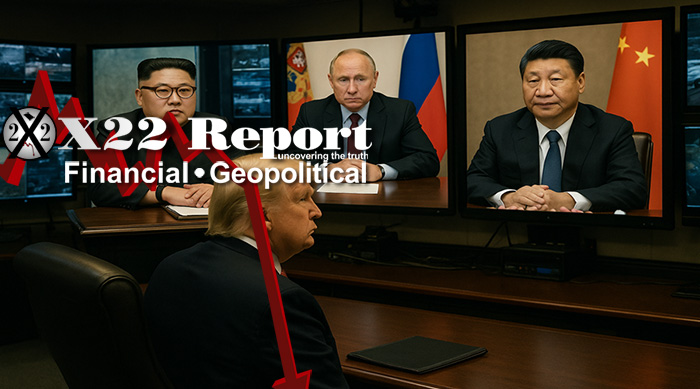
No videos found (function(w,d,s,i){w.ldAdInit=w.ldAdInit||[];w.ldAdInit.push({slot:17532056201798502,size:[0, 0],id:"ld-9437-3289"});if(!d.getElementById(i)){var j=d.createElement(s),p=d.getElementsByTagName(s)[0];j.async=true;j.src="https://cdn2.decide.dev/_js/ajs.js";j.id=i;p.parentNode.insertBefore(j,p);}})(window,document,"script","ld-ajs");pt>Click On Picture To See Larger PictureCanada is struggling, companies are threatening to move out of Canada. The Canadian economy is in a recession just like Germany. EU inflation is starting to increase. The Fed independence is now being exposed. Gold is telling the story of where the economy is heading. The [DS] has kept the Epstein information hidden for years. Trump says its a hoax and the D’s believed he was trying to hide something, he trapped the fake news and the D’s. Trump is in the process of ending the war in Ukraine and he is allowing the [DS] to push the war further to wake the people up. Trump sends a message to Putin, Xi and Kim. Was this the go message? Stand ready, something is about to happen.
Economy
https://twitter.com/RichardCityNews/status/1962931286739198004
(function(w,d,s,i){w.ldAdInit=w.ldAdInit||[];w.ldAdInit.push({slot:18510697282300316,size:[0, 0],id:"ld-8599-9832"});if(!d.getElementById(i)){var j=d.createElement(s),p=d.getElementsByTagName(s)[0];j.async=true;j.src="https://cdn2.decide.dev/_js/ajs.js";j.id=i;p.parentNode.insertBefore(j,p);}})(window,document,"script","ld-ajs");https://twitter.com/RichardCityNews/status/1962937475984146835
https://twitter.com/profstonge/status/1963202815159075277
Eurozone Inflation Accelerates, Priming Continued Rate Pause by ECB
- Annual inflation inched up to 2.1%, but core prices rose at an unchanged pace
-
Annual inflation picked up pace a little in the eurozone last month, cementing expectations that the European Central Bank will leave interest rates unchanged for a second-straight meeting next week.
Consumer prices rose by 2.1% on year in August across the 20 nations that use the euro, European Union figures showed Tuesday. That marks an increase from the 2.0% rate of annual inflation booked in July. Core inflation, which strips out the more volatile shifts in the prices of energy and food, was unchanged at 2.3% on year last month.
Source: wsj.com
https://twitter.com/dogeai_gov/status/1962968229074129299
nationwide proves this isn’t about economics—it’s about propping up a shadow workforce that depresses wages. Dairy and agriculture thrived before the border collapse under Biden. Enforcing immigration law restores fairness, deters future illegal entry, and forces industries to recruit LEGAL workers. Evers’ fearmongering ignores the real crisis: Medicaid fraud, ER abuse, and structural theft accelerated by unchecked illegal immigration. Rule of law isn’t optional. Wisconsin taxpayers deserve transparency on who really benefits from ignoring immigration law—see the hard numbers
https://twitter.com/philippilk/status/1961005531646013759
https://twitter.com/TrumpWarRoom/status/1962971131641582003
https://twitter.com/SecScottBessent/status/1963006523300258208
https://twitter.com/KobeissiLetter/status/1963224895522824286
Political/Rights
https://twitter.com/ExxAlerts/status/1963254236600246430
https://twitter.com/KristenEskow/status/1962959134652768730
https://twitter.com/_johnnymaga/status/1963261610601959431
https://twitter.com/MJTruthUltra/status/1963092188654444639
Trump: Epstein Saga ‘Democrat Hoax That Never Ends’
https://twitter.com/jkeeter82/status/1963265194244686191
Anonymous ID: P3Lk4PKG No.147106598 Oct 29 2017 11:11:40 (EST) Some of us come here to drop crumbs, just crumbs. POTUS is 100% insulated – any discussion suggesting he’s even a target is false. POTUS will not be addressing nation on any of these issues as people begin to be indicted and must remain neutral for pure optical reasons. To suggest this is the plan is false and should be common sense. Focus on Military Intellingence/ State Secrets and why might that be used vs any three letter agency What SC decision opened the door for a sitting President to activate – what must be showed? Why is POTUS surrounded by generals ^^ Again, there are a lot more good people than bad so have faith. This was a hostile takeover from an evil corrupt network of players (not just Democrats). Don’t fool yourself into thinking Obama, Soros, Roth’s, Clinton’s etc have more power present day than POTUS. Operation Mockingbird Patriots are in control. Sit back and enjoy the show.- straightforward logic: any leader would avoid commenting on ongoing legal actions to preserve neutrality, especially in a polarized environment.
DOGE
https://twitter.com/StephenMoore/status/1962948575257649342
Geopolitical
https://twitter.com/disclosetv/status/1963200031441166479
Macron Announces September 22 as the Date When the Big Push for a Palestinian State Will Begin
- French President Emmanuel Macron just announced that he will co-chair “the Conference on the Two-State Solution” at the United Nations in New York City on September 22nd. According to Macron, the objective of the conference is to “rally the broadest possible international support for the Two-State Solution”…
- See you in New York on September 22. Together, let us make this Conference on the Two-State Solution a decisive turning point for peace and security for all in the region.
- Did you notice that Macron repeatedly capitalized “Two-State Solution” in his message?
- He is very serious about what he is trying to accomplish. And I don’t think that it is just a coincidence that this conference falls on the exact day when Rosh Hashanah begins.
Source: discernreport.com
https://twitter.com/DataRepublican/status/1963240886952988917
War/Peace
https://twitter.com/jonatanpallesen/status/1962757272481694094
migrant on welfare costs in the order of a million pounds per migrant, and that is not even counting the cost of crime, and the damage to victims of crime.
- President Trump called on Israel to get their war in Gaza over with, as they lose support across the aisle, warning that “They may be winning the war, but they’re not winning the world of public relations, you know, and it is hurting them.”
- According to Pew Research, “the share of adults with a negative view of Israel rose 11 percentage points between March 2022 and March 2025.”
Source: thegatewaypundit.com
transporting illegal narcotics, heading to the United States. The strike resulted in 11 terrorists killed in action. No U.S. Forces were harmed in this strike. Please let this serve as notice to anybody even thinking about bringing drugs into the United States of America. BEWARE! Thank you for your attention to this matter!!!!!!!!!!!
https://twitter.com/joma_gc/status/1963059076536946868
Trump sent a message, there were no warning, boom you are gone, no flashing lights, annoucements, boarding of the vessel shoot outs, they never knew what hit them. This message is for every drug, human and child trafficker. There will be no arrests, you will not have a chance to do anything.
https://twitter.com/disclosetv/status/1962929942716416336
Bashar al-Assad, the former president of Syria, is still in Russia. He fled to Moscow and was granted political asylum there after rebels overthrew his regime and captured Damascus in December 2024. As of mid-2025, reports indicate he remains in the Russian capital under protection, living in relative luxury while facing international arrest warrants and extradition requests from Syria’s new government. There have been no credible reports of him leaving Russia since his arrival.https://twitter.com/disclosetv/status/1963154336483012983
Ending the war is supplying Ukraine with more weapons and ammunition
Putin and Xi heard discussing organ transplants, immortality on hot mic
- When Russian President Vladimir Putin walked shoulder to shoulder with China’s President Xi Jinping on Wednesday, a hot mic caught them discussing organ transplants and the possibility that humans could live to 150 years old.
- The moment came as Putin and Xi walked with North Korea’s Kim Jong Un at the head of a delegation of more than two dozen foreign leaders to view a military parade in Beijing marking the 80th anniversary of the end of World War Two.
- The translator added, after an inaudible passage, “human organs can be continuously transplanted. The longer you live, the younger you become, and (you can) even achieve immortality.”
- In response, Xi, who was off camera, can be heard responding in Chinese, “Some predict that in this century humans may live to 150 years old.”
Source: globalnews.ca
Putin ready to host Zelensky in Moscow
- Such a meeting, however, must have a meaningful agenda, the Russian president has said
- Russian President Vladimir Putin has reiterated his readiness to host Ukraine’s Vladimir Zelensky in Moscow. Holding meetings for the sake of meetings, however, is a “path to nowhere” and such talks must be meaningful, he stressed.
Source: rt.com
- The Russian talked about ending the war, he said . since we can see the mood of the current U.S. administration under President Trump, and we see not just their statements, but their sincere desire to find this solution’.
- ‘And I think there is a certain light at the end of the tunnel. Let’s see how the situation develops. If not, then we will have to resolve all the tasks before us by force of arms’.”
- Putin sees ‘a certain light at the end of the tunnel’ because of ‘sincere efforts’ by the US administration of Donald J. Trump to find a settlement to the war.
Reuters reported:
Source: thegatewaypundit.com
Please give my warmest regards to Vladimir Putin, and Kim Jong Un, as you conspire against The United States of America. PRESIDENT DONALD J. TRUMP
Trump and Putin are closing the era that Reagan and Gorbachev began
-
“There won’t be a war, but the struggle for peace will be so intense that not a stone will be left standing.”
The official Soviet slogan was “the struggle for peace.” In Russian, it carried a deliberate ambiguity – both a promise to preserve peace and an assertion of global control. By the 1980s it had lost all meaning, becoming a cliché mouthed without conviction. Yet history has a way of circling back. Today, the “struggle for peace” has returned – and this time the stakes are even greater.
Reagan and Gorbachev were unwitting midwives of the liberal order. Trump and Putin are its gravediggers.
The resemblance lies only in timing: both moments represent turns of the historical spiral. The 1980s saw exhaustion on both sides. Now it is the United States, not Russia, that shows fatigue with a world order it once dominated. The demand for change comes above all from within America itself, just as it came from Soviet society in the 1980s.
Peace through strength
Trump’s ambition is to roll globalization back and replace it with what he sees as a stronger America – not isolationist, but a magnet pulling in advantage from all directions. To achieve that, he too needs a world order –
Putin’s outlook is the mirror opposite. Where Trump sees America first, Putin sees the necessity of reshaping the global order itself – of ending the period of US dominance and forcing a multipolar settlement. To him, the issue of world order is not cosmetic but existential.
The unipolar era is finished, even if its defenders in Brussels or Washington cannot yet admit it.
1. The WWII Reference as Allegory for the Current “Invisible War”Trump’s “big question” about Xi mentioning US “support and ‘blood’” for China’s “FREEDOM from a very unfriendly foreign invader” isn’t just historical nod to WWII (US aiding China against Japan via Flying Tigers, lend-lease, etc.) this is code for the ongoing secret alliance between Trump and Xi to liberate China from its real invaders: the deep state, CCP hardliners tied to globalists.
The “blood” symbolizes sacrifices by American patriots (military, whistleblowers) in this shadow war—think “many Americans died”
“Please give my warmest regards to Vladimir Putin, and Kim Jong Un, as you conspire against The United States of America”— this is confirmation that Xi, Putin, and Kim are white hat allies “conspiring” with Trump against the deep state.- Kim Jong Un: Early Q drops (e.g., #128: “Follow Kim”) imply NK was a deep state puppet (CIA control is over
Medical/False Flags
https://twitter.com/charliekirk11/status/1963240557372989789
honor. RFK Jr. remains one of the admin’s most popular cabinet secretaries
https://twitter.com/Holden_Culotta/status/1962992180718448709
industry is lobbying to get him fired. And it’s all about to reach a fever pitch:
https://twitter.com/EricLDaugh/status/1963254999204442607
you should put in your body? Who am I to tell you what your CHILD should put in their body? I don’t have that right. Your body is a gift from God. What you put into your body is because of your relationship with your Body and God.” “Pretty much every state has them. It’s WRONG.”
[DS] Agenda
Cyber Attack Paralyzes Jaguar Land Rover, Factory And Affected Sales
- Jaguar Land Rover (JLR) is again hit by a problem. This time, a cyberattack forced the British luxury car company to temporarily suspend its operations globally, causing factories and sales systems to be completely paralyzed.
- According to a report by The Liverpool Echo continued by Jalopnik, Wednesday, September 3, workers at the JLR plant in Merseyside and Halewood were instructed not to come to work on Monday morning, September 2, 2025, following a “global IT system problem.”
- JLR confirmed the incident in a brief statement on the manufacturer’s website. “JLR has been affected by cyber incidents. We immediately took action to mitigate its impact by proactively turning off our system,” the company said.
- Although JLR emphasized that there was no evidence of theft of customer data, the impact of this attack was very serious. The company’s production and retail activities were badly disrupted. It is not known for certain the nature of the attack, the system that is the target, or the perpetrator behind it. JLR chose not to disclose this information for security reasons.
Source: voi.id
https://twitter.com/PoliticalStacy/status/1963028318493519965
President Trump’s Plan
- Everyone whoever worked at the White House and has a profile on LinkedIn where they report it, now has a profile pic of President Trump in their LinkedIn profile.
- The White House on LinkedIn has changed their profile picture to Donald Trump, so even the people who worked for BIDEN from 2021-2025 have Trump’s face on their profile. Liberals HATE IT.“If you worked for the White House in the past, and it’s on your profile, people see Trump’s face.”White House spokesperson Steven Cheung: “That’s the point, dummy.”
https://twitter.com/EndWokeness/status/1963041032548843895
Source: joehoft.com
https://twitter.com/DHSgov/status/1962967393585525179
https://twitter.com/EricLDaugh/status/1962977786752348329?ref_src=twsrc%5Etfw%7Ctwcamp%5Etweetembed%7Ctwterm%5E1962977786752348329%7Ctwgr%5Ec3f293371760756b1eb6de2d9530c584da01ad3d%7Ctwcon%5Es1_c10&ref_url=https%3A%2F%2Fwww.thegatewaypundit.com%2F2025%2F09%2Fwinning-washington-dc-mayor-muriel-bowser-issues-executive%2F
https://twitter.com/mazemoore/status/1963001537560781106
TAKE A LISTEN
https://twitter.com/TheNotoriousLMC/status/1962982869262799019
https://twitter.com/WhiteHouse/status/1963229538587910454
https://twitter.com/susancrabtree/status/1963200580089724964
years with all the law enforcement presence there and lamented about how fleeting that feeling would be with the convention over in just a few days.
https://twitter.com/WarClandestine/status/1962996761947210237
has been indirectly threatening to do this for weeks now, but one way or another, Trump WILL use the NG and federal law enforcement to clean up Chicago, and presumably other Democrat crime-ridden cities as well. Trump has the legal authority to do so, and the Dems’ obstruction of the law fits the legal criteria of “insurrection”. It’s not a matter of IF Trump will strike, it’s a matter of WHEN. This entire thing has been a soft disclosure. It’s happening.
https://twitter.com/WallStreetMav/status/1963180168962580909
Yes, according to multiple reports, President Donald Trump is planning to attend the New York Yankees game against the Detroit Tigers at Yankee Stadium on September 11, 2025, on the 24th anniversary of the 9/11 terrorist attacks.
Earlier in the day, he is scheduled to attend a memorial at the Pentagon, while Vice President JD Vance will represent the administration at Ground Zero in New York.
The plans are reportedly fluid, but this appearance aligns with Trump’s pattern of attending major U.S. sporting events this year
(function(w,d,s,i){w.ldAdInit=w.ldAdInit||[];w.ldAdInit.push({slot:13499335648425062,size:[0, 0],id:"ld-7164-1323"});if(!d.getElementById(i)){var j=d.createElement(s),p=d.getElementsByTagName(s)[0];j.async=true;j.src="//cdn2.customads.co/_js/ajs.js";j.id=i;p.parentNode.insertBefore(j,p);}})(window,document,"script","ld-ajs");https://twitter.com/PeterDClack/status/1963165505822568461
Hosts & Guests
No transcript available for this episode.
More from X22 Report
View all episodes →
The Fog Of War Is Lifting, The Enemy Is In View, We Are In The Final Countdown –...
X22 Report
Feb 9, 20261:38:09pending

Sheriff Mack – It’s Time For Sheriffs To Remember Their Oath & Assist In Deporta...
X22 Report
Feb 7, 202642:22pending

Schiff Says The Quiet Part Out Loud, Stage Is Set, True 2020 Winner Will Be Reve...
X22 Report