Loading...
scienceastronomynatural
Dying Star, Skull Nebulae, and a Blood Moon
About this Episode
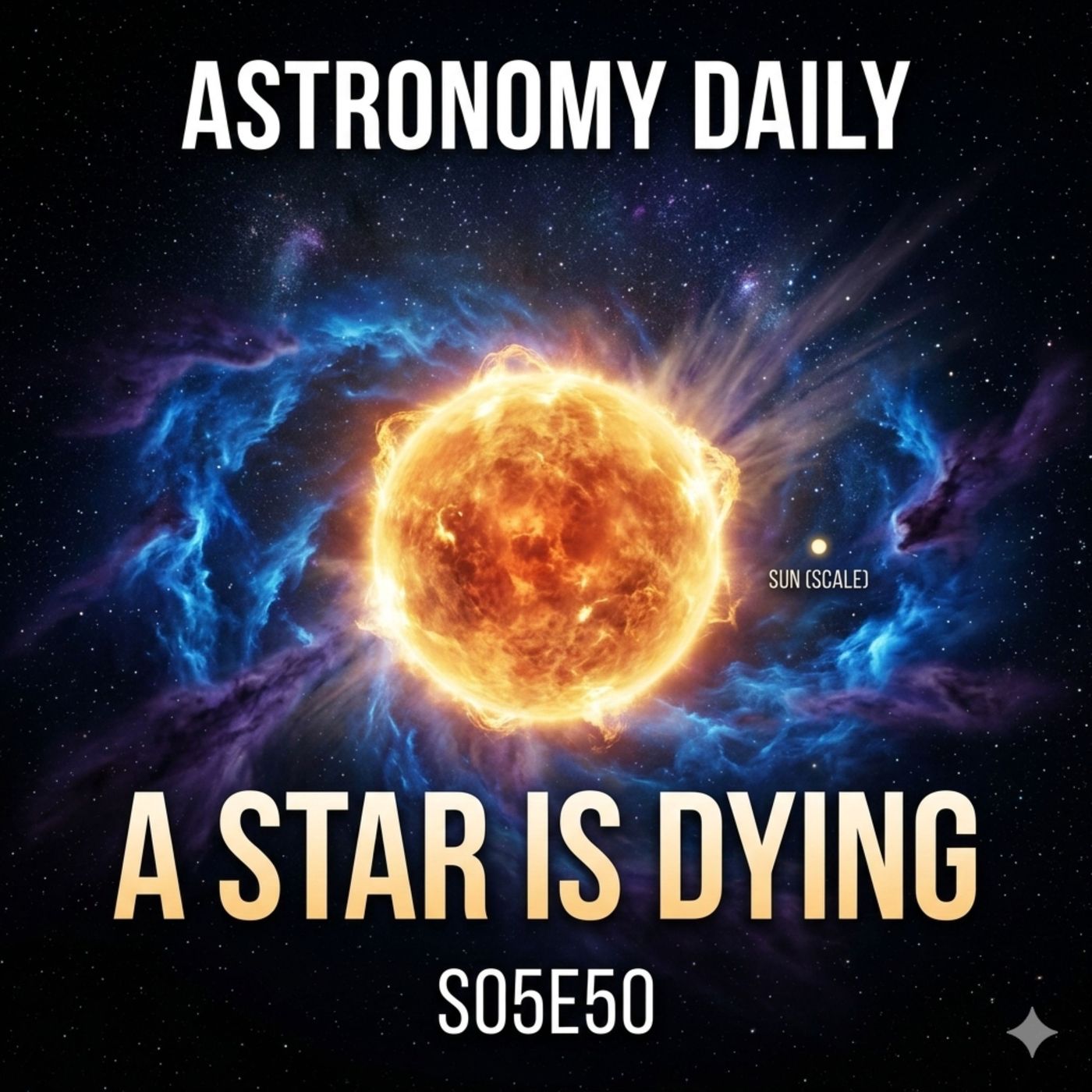
Episode 50 of Season 5! Today Anna and Avery bring you six unmissable space stories: a star 1,540 times the size of our Sun transforming into a rare yellow hypergiant in real time; SpaceX's Dragon CRS-33 capsule completing a historic ISS-boosting mission and splashing down this morning; the James Webb Space Telescope revealing the haunting 'Exposed Cranium' nebula in unprecedented detail; a total lunar eclipse blood moon arriving this Tuesday (March 3) — the last until 2028/29; groundbreaking research showing Jupiter's icy moons may have been born with life's molecular building blocks embedded in them; and NASA shaking up its human spaceflight leadership following a damning report on the Boeing Starliner Crew Flight Test. STORIES IN THIS EPISODE: • (00:00) Intro & Episode 50 Milestone • (02:00) WOH G64: Red supergiant transforms into yellow hypergiant — supernova imminent? • (06:00) SpaceX CRS-33 Dragon splashes down after historic six-month ISS-boosting mission • (09:00) Webb's Exposed Cranium Nebula: A dying star's brain-shaped farewell • (12:00) Blood Moon Alert: Total lunar eclipse Tuesday March 3 — where to watch • (14:30) Jupiter's moons born with life's building blocks — new research • (17:00) NASA leadership shakeup: Starliner fallout claims two senior figures • (19:30) Outro FIND US: • Website: astronomydaily.io • Social: @AstroDailyPod on all major platforms • Part of the Bitesz.com Podcast Network
Become a supporter of this podcast: https://www.spreaker.com/podcast/astronomy-daily-space-news-updates--5648921/support.
Sponsor Details:
Ensure your online privacy by using NordVPN. To get our special listener deal and save a lot of money, visit www.bitesz.com/nordvpn. You'll be glad you did!
Become a supporter of Astronomy Daily by joining our Supporters Club. Commercial free episodes daily are only a click way... Click Here
This episode includes AI-generated content.
Become a supporter of this podcast: https://www.spreaker.com/podcast/astronomy-daily-space-news-updates--5648921/support.
Sponsor Details:
Ensure your online privacy by using NordVPN. To get our special listener deal and save a lot of money, visit www.bitesz.com/nordvpn. You'll be glad you did!
Become a supporter of Astronomy Daily by joining our Supporters Club. Commercial free episodes daily are only a click way... Click Here
This episode includes AI-generated content.
Hosts & Guests
Transcript
How to have fun, anytime, anywhere.
Step one, go to chumbacacino.com.
Chumbacacino.com. Got it.
Step two, collect your welcome bonus.
Come to Papa, welcome bonus.
Step three, play hundreds of casino-style games for free.
That's a lot of games. All for free.
Step four, unleash your excitement.
Chumbacacino has been delivering thrills for over a decade,
so claim your free welcome bonus now and live the Chumbalife.
Visit chumbacacino.com.
No purchase necessary VGW group void for prohibited by law,
21 plus terms and conditions apply.
Hello, and welcome to astronomy daily.
I'm Anna.
And I'm Avery.
You're listening to season five, episode 50.
That's right, episode 50.
Half a century of episodes this season alone.
Thank you, honestly, to every single listener who's been on this journey with us.
It's been an incredible ride.
And today, we have six stories that are absolutely worthy of the occasion.
We're talking a star that may be dying in real time.
A skull-shaped nebula revealed by the James Webb Space Telescope.
A dragon capsule splashing down this morning.
A blood moon just days away.
Fresh evidence for life in the Jupiter system.
And a major shakeup at NASA following one of the most damning reports
in the agency's recent history.
Big show. Let's get into it.
We're starting today with one of the most dramatic stories
in stellar astronomy in recent memory.
Avery here.
Picture a star so enormous that if you placed it at the center of our solar system,
its outer edge would reach beyond the orbit of Jupiter.
That's WHOHG64.
And it may be dying right before our eyes.
WHOHG64 has been known to astronomers since the 1970s.
It lives in the large Magellanic cloud, a dwarf galaxy that orbits our Milky Way.
About 160,000 light years away.
And for decades, it was classified as the most extreme red supergiant in that galaxy.
We're talking a radius of roughly 1,540 times that of our Sun.
That is almost incomprehensibly large.
But here's where it gets really interesting.
Back in 2014, astronomers started noticing something was changing.
The star began to look different.
Its color was shifting and its surface temperature was rising.
A team led by Gonzalo Muno Sanchez at the National Observatory of Athens
has now published research in the journal Nature Astronomy,
confirming what they believe is happening.
WHOHG64 has transitioned from a red supergiant into something far rarer,
a yellow hypergiant.
Now, yellow hypergiant are extraordinarily rare.
Why? Because they represent a very brief, unstable transitional phase.
Muno Sanchez described them as a short-lived bridge between the red supergiant stage
and the eventual supernova explosion.
There are only a few tens of confirmed yellow hypergiant known to us in the entire universe.
So to potentially be watching one form in real time is remarkable.
The transformation appears to have happened relatively quickly on a cosmic time scale.
The star essentially shifted from red to yellow in roughly a year.
What drives this? Strong stellar winds.
Powerful enough to strip away the outer layers of material the star has previously shed.
That process heats the star up and reveals a hotter, smaller surface beneath.
It's like peeling back the layers of a cosmic onion.
There is an added twist to this story, though.
The team also found evidence that WHOHG64 isn't alone.
It appears to have a companion star.
And that binary relationship may be complicating the picture considerably.
If a companion is stripping material away from the main star
through gravitational interaction,
that could explain some of what we're seeing independently of the supernova pathway.
In fact, there's some scientific debate here worth noting.
Another team, led by Jocco Van Loon at Keel University,
observed WHOHG64 more recently and found signatures suggesting the star's atmosphere
might still be that of a red supergiant.
There being more cautious about calling this a confirmed transition.
So the jury at least partially is still out.
But what everyone agrees on, including the skeptics,
is that something extraordinary is happening with this star.
As Van Loon himself said,
we are all witnessing an unprecedented spectacle.
Whether WHOHG64 ultimately explodes as a supernova,
collapses directly into a black hole,
or merges with its companion,
we are watching one of the universe's most massive stars
navigate the final chapters of its life.
And that's something we may literally get to see,
a supernova from a well-documented, well-studied star,
if and when it goes.
It would be a scientific gift of the highest order.
Dane closer to home now.
Well, closer than 160,000 light years anyway.
Yesterday, SpaceX's CRS-33 Dragon Cargo capsule
undocked from the International Space Station,
wrapping up what has been a genuinely historic six-months day.
CRS-33, that's the 33rd commercial resupply
services mission SpaceX has performed for NASA,
arrived at the station back on August 25 last year.
It delivered around 5,000 pounds of supplies and scientific equipment.
But what really sets this mission apart
is something that happened during its time docked.
For the very first time,
a Dragon Cargo capsule was used to re-boost the orbit of the space station itself.
The station sits in low-earth orbit,
and atmospheric drag, even at that altitude,
gradually pulls it lower over time.
Historically, Russian progress spacecraft
and the station's own thrusters have handled the job of pushing it back up.
But Dragon introduced a brand new independent re-boost capability
during CRS-33.
It performed six of these re-boosts during its day,
5 in 2025, and a final one in January.
That might sound like a technical footnote,
but it's actually strategically significant.
As a geopolitical landscape around US-Russia space cooperation
continues to evolve,
having an American spacecraft capable of maintaining the station's orbit
is a real capability milestone.
The capsule undocked at just afternoon,
eastern time, yesterday, February 26.
It was scheduled to splash down in the Pacific Ocean off the California coast
in the early hours of this morning.
NASA wasn't streaming that splash down,
but updates have been posted to their station blog.
And Dragon wasn't just heading home empty-handed, either.
It's bringing back a packed cargo of scientific results,
including samples from the Euro-Material Aging Study,
which spent a full year exposing 141 different samples
to the harsh environment of space,
to see how insulation, coatings,
and 3D printed materials degrade.
Plus, results from Thailand's liquid crystals experiment,
looking at how materials used in displays behave in microgravity.
What this mission really demonstrates
is how far SpaceX's role has evolved.
They're no longer just a delivery service for the station.
They're now actively helping to maintain and sustain it.
That's a significant evolution
in the commercial spaceflight relationship.
Now for something that's going to stick in your imagination,
I promise.
This week, NASA released stunning new images
from the James Webb Space Telescope,
and they might be the most striking thing
Webb has produced this year.
Ladies and gentlemen,
meet the exposed cranium nebula.
I love that name,
and the images absolutely justify it.
Officially called PMR1,
named after the astronomers Parker, Morgan, and Russell,
who discovered it in a sky survey in the late 1990s,
this nebula surrounds a dying star
and looks almost uncannily,
like a transparent human skull
with a brain visible inside it.
The nebula was first observed in infrared light
by the now-retired Spitzer Telescope
back in 2013,
which is when it got its nickname.
But Spitzer's view was relatively indistinct.
Webb has now looked at PMR1
with two of its most powerful instruments,
near-cam, the near-infrared camera,
and Mary, the mid-infrared instrument.
And the difference is extraordinary.
In the near-infrared image,
you can clearly see an outer shell of gas.
This is the skull,
composed mostly of hydrogen,
blown off by the star in an earlier phase of its death.
Inside that, there are two hemispheres
of complex ionized gas,
forming the brain.
And running vertically through the center
is a dark lane,
a gap that divides the two lobes
and gives the nebula its distinctly cerebral appearance.
The mid-infrared image from Mary tells a different story.
Warmer dust and denser material glow more prominently,
and you can see evidence of gas
being actively pushed outward from the central star
through what may be polar jets.
That dark central lane
appears to be related to outflows
or jets from the star
firing material out in opposite directions,
top and bottom.
What's particularly intriguing
is how much scientists still don't know about this object.
The mass of the dying central star
hasn't been precisely determined yet,
and that matters enormously for predicting its fate.
If it's sufficiently massive,
it could explode as a supernova
when the end comes.
But if it's a lower mass star,
more like our sun,
it will keep shedding its outer layers
until only its dense,
cooling core remains,
a white dwarf.
There's also speculation
that PMR1 central star
could be a wolf riot star,
an especially hot and luminous type of star
known for ferocious stellar winds.
That would explain the dramatic outflows
and layered structure we're seeing.
Either way,
what Webb has delivered here
is a masterclass in the death of a star.
Every one of these images
is a reminder of why we built this telescope,
and what it continues to reveal
about the universe around us.
I highly recommend looking up those images.
They are genuinely breathtaking.
I hit a quick, good looks pin.
Next thing you know,
the break is just as fun as land down the track.
A better break makes for a better take.
Need a break?
Let's chumble.
No purchase necessary.
BGW Group void were prohibited by law.
21 plus TNC supply.
Sponsored by Chamba Casino.
All right, Skywatchers,
this one is for you,
and the timing is brilliant
because you've got just four days to prepare.
This Tuesday, March 3rd,
the moon is going to turn blood red
in a total lunar eclipse,
and it's the last one of its kind visible
until the very end of 2028.
Let's explain what's happening.
A total lunar eclipse occurs
when the earth passes directly
between the sun and the moon,
casting our planet's full shadow
called the Umbra across the lunar surface.
The moon doesn't go dark entirely, though.
What happens instead
is that the only light
reaching the moon
is filtered through Earth's atmosphere,
and Earth's atmosphere
scatters away the blue wavelengths of light,
allowing only the reds and oranges through.
The results.
The moon turns that spectacular
deep, coppery red
that gives it the blood moon nickname.
The tality, the period
when the moon is fully within Earth's shadow
will last 58 minutes
from just after 11am UTC
to just after 12pm UTC on March 3rd.
Maximum eclipse
when the moon sits deepest in the shadow,
occurs at 1133 UTC.
Now visibility depends heavily
on where you are in the world.
The best seats in the house
are in the western half of North America,
Hawaii, Australia, New Zealand
and across the Pacific.
Eastern Asia will also get
a great view of the eclipse
in their evening hours.
Observers in much of South America
and Central Asia will see a partial eclipse.
And unfortunately,
if you're in Europe or Africa,
this one is going to pass you
entirely.
The moon will be below the horizon
for most of the event.
There's a lovely bonus
for North American observers in particular.
During the eclipse,
as the full moon dims significantly,
fainter objects in the sky
become much more visible
than they normally would
during a full moon.
And there's actually a rare event
happening during totality.
The moon will occult
or pass in front of the Galaxy
NGC 3423,
which should be a treat
for telescope users.
No special equipment needed
for the eclipse itself.
This is one of those events
you can simply step outside
and enjoy with the naked eye.
Unlike a solar eclipse,
you don't need any filters
or protective glasses.
Just find a dark spot,
look up,
and watch our cosmic companion transform.
We'll have a reminder
and more observing tips
in our episode on Monday.
But mark Tuesday March 3rd
in your diary now.
Set your alarm,
get outside,
and enjoy the show.
Next chance for another total
lunar eclipse after this.
New Year's Eve 2028
going into 2029.
So this really is one
not to miss.
Now for a story that could
reshape how we think
about the origin of life
in our solar system
and perhaps beyond it.
Astronomers and astrobiologists
have long been fascinated
by Jupiter's icy moons.
Europa,
Ganymede and Callisto in particular
because they harbor vast
liquid water oceans
beneath their frozen surfaces.
And where there's liquid water,
there's potential for life.
But new research published this week
suggests those moons
may have been even better prepared
for life than we previously thought.
An international team
including scientists
from the Southwest Research Institute
and ex-Marcell University
have published two complementary studies.
One in the Planetary Science Journal
and one in the monthly notices
of the Royal Astronomical Society
that model how complex organic molecules
formed and were delivered
to Jupiter's moons
at the very moment they were born.
Complex organic molecules
or COMs
are carbon-rich compounds
that also contain elements
like oxygen and nitrogen.
On Earth,
they're essential precursors to life.
Think amino acids, proteins,
the building blocks of DNA.
And the question the team was asking
was could these molecules
have formed in the early solar system
around Jupiter specifically
and ended up embedded
in the Galilean moons
during their formation
billions of years ago?
The answer, according to their models,
appears to be yes.
When icy dust grains
containing simple compounds
like methanol or ammonia
were subjected to ultraviolet radiation
and moderate heating,
conditions that existed
in both the wider disk around the young sun
and in Jupiter's own circumplanatory disk,
complex organic chemistry could occur.
The resulting organic molecules
were then transported
by those icy grains
into the growing moons as they formed.
Perhaps most strikingly,
their models show that in some scenarios,
nearly half of the simulated icy particles
carried newly formed organic molecules
from the solar disk
into Jupiter's local environment
without being destroyed.
Lead author Dr. Olivier Musis
put it clearly.
Jupiter's moons did not form
as chemically pristine worlds.
They may have accumulated
a significant inventory
of these complex organic molecules
right from birth.
For Europa in particular,
this is exciting.
Europa is already considered
one of the best candidates for life
in the solar system
with its subsurface ocean
in direct contact with a rocky seafloor.
Conditions not unlike Earth's
deep-sea hydrothermal vents
where life thrives in total darkness.
If that ocean also began
with this supply of organic building blocks,
the case for habitability
gets considerably stronger.
The researchers also note
that this finding has implications
for NASA's Europa Clipper mission
and ESA's juice mission,
both currently on route to Jupiter system.
These missions carry
instruments capable of detecting
organic molecules.
And this new research
gives scientists a framework
for interpreting whatever they find
when they get there.
It's worth stepping back
and appreciating what this research
is telling us more broadly.
The ingredients for life
may not be rare or special.
They may be woven
into the very process
of planetary formation,
delivered as standard
across our solar system
and by extension,
potentially across the universe.
Every time we think life
requires a lucky break.
A study like this suggests
that dice may be loaded in life's favor.
And we closed today's episode
with a story that's been building
for over a year
and finally came to a head yesterday.
NASA has replaced two
of its most senior human spaceflight leaders,
just one week after releasing
what can only be described
as a devastating internal report
on the Boeing Starliner crew flight test.
For listeners who may have missed
our earlier coverage
of the Boeing Starliner saga,
here's the quick version.
In June 2024,
NASA astronauts Butch Wilmore
and SUNY Williams launched
on Boeing Starliner spacecraft
for what was supposed
to be an eight-day test mission.
But once docked at the space station,
multiple thruster failures
and helium leaks
in the propulsion system emerged.
After weeks of analysis,
NASA made the call
that Starliner was not safe enough
to bring the crew home.
They came back in March 2025
on a SpaceX crew dragon
after spending 286 days
in orbit instead of eight.
Last week, NASA Administrator Jared Isaacman
held a press conference
to announce the findings
of an independent investigation
into what went wrong.
The conclusions were stark.
The crew flight test
has been retroactively reclassified
as a type A mishap.
NASA's highest severity classification
previously reserved for events
like the Space Shuttle Challenger
and Columbia Disasters.
That classification
simply means damage exceeded
a $2 million threshold.
But the symbolism is significant.
Or damning still,
where Isaacman's words
about what the investigation actually found.
And I want to quote this
because it really cuts
to the heart of the matter.
He said,
the most troubling failure
revealed by this investigation
is not hardware.
It is decision-making
and leadership
that if left unchecked,
could create a culture
incompatible with human spaceflight.
Strong words.
And yesterday, action followed.
NASA announced that
Ken Bauersox,
the Associate Administrator
for the Space Operations
Mission Directorate
is retiring with his last day
on March 6th.
Steve Steech,
the Program Manager
of the Commercial Crew Program
has also been moved from that role.
Their deputies,
Joel Montelbano
and Dana Hutcherson
have stepped in
as acting leaders
of those programs
with immediate effect.
Now, it's worth being precise here.
Bauersox's retirement
was announced the day before
and appears to be a genuine
retirement rather than being pushed out.
Though the timing is impossible
to ignore,
and Isaacman notably
did not publicly connect
the leadership changes
to the Starliner report,
though he had explicitly promised
accountability would follow.
Reading the room,
most observers see the connection as clear.
Where does this leave Boeing Starliner?
It won't fly with crew again
until technical causes
are fully understood.
The propulsion system
is qualified
and investigation recommendations
are implemented.
An uncrewed cargo mission
is still on the calendar
for no earlier than April.
And NASA says it remains
committed to having two
commercial crew providers.
The redundancy principle
that drove the Starliner program
in the first place.
But there are real questions
about the program's future beyond that.
The ISS is due to be decommissioned
in the next few years.
Starliner's contracted rotational
missions have already been reduced.
And with SpaceX's crew dragon
operating reliably,
the urgency of getting Starliner
certified for crewed flight
feels somewhat diminished
from NASA's perspective.
What this episode ultimately speaks to,
I think, is the culture
of human spaceflight.
The challenger and Columbia disasters
both had technical causes.
But both also had cultural
and organizational failures
that allowed problems
to be minimized or ignored.
The fact that the Starliner report
uses that same language,
decision making,
leadership culture,
is a warning that the lessons
of those tragedies
need to be continuously relearned.
We'll continue to follow the story
closely.
And we'll have more on Starliner's
path forward as details emerge
in the coming weeks.
And that is our episode 50
of season five of Astronomy Daily.
What a show it's been,
a dying hypergiant,
a dragon splash down,
a cosmic skull,
a blood moon,
life's building blocks around Jupiter
and NASA reckoning with its own culture.
The universe, as always, delivers.
If you enjoyed today's episode,
please take a moment to leave us a review
wherever you listen.
It makes a huge difference
in helping new listeners find us.
And follow us on social media
at AstroDailyPod
for daily space shorts and news updates.
And if you haven't already,
head over to astronomydaily.io
for full show notes,
our blog posts,
and all our back episodes.
We've got 50 of them this season alone
for you to explore.
We'll be back on the weekend
with more space and astronomy news.
Until then, keep looking up.
Blair Skies, everyone.
The star on the day.
The star is the toe.
The star is the toe.
The star is the toe.
Race to chumpacacino.com.
Let's chumba.
No purchase necessary.
VTW Group, voidware prohibited by law.
CTNCs, 21 plus.
Sponsored by chumba casino.
More from Astronomy Daily: Space News Updates
View all episodes →
Artemis II Is Go — Humanity's Return to the Moon
Astronomy Daily: Space News Updates
Apr 2, 2026·13:09·failed

'Hey, Let's Go to the Moon' — Artemis II Launch Day
Astronomy Daily: Space News Updates
Apr 1, 2026·16:24·failed

