Loading...
healthfitnessnutrition
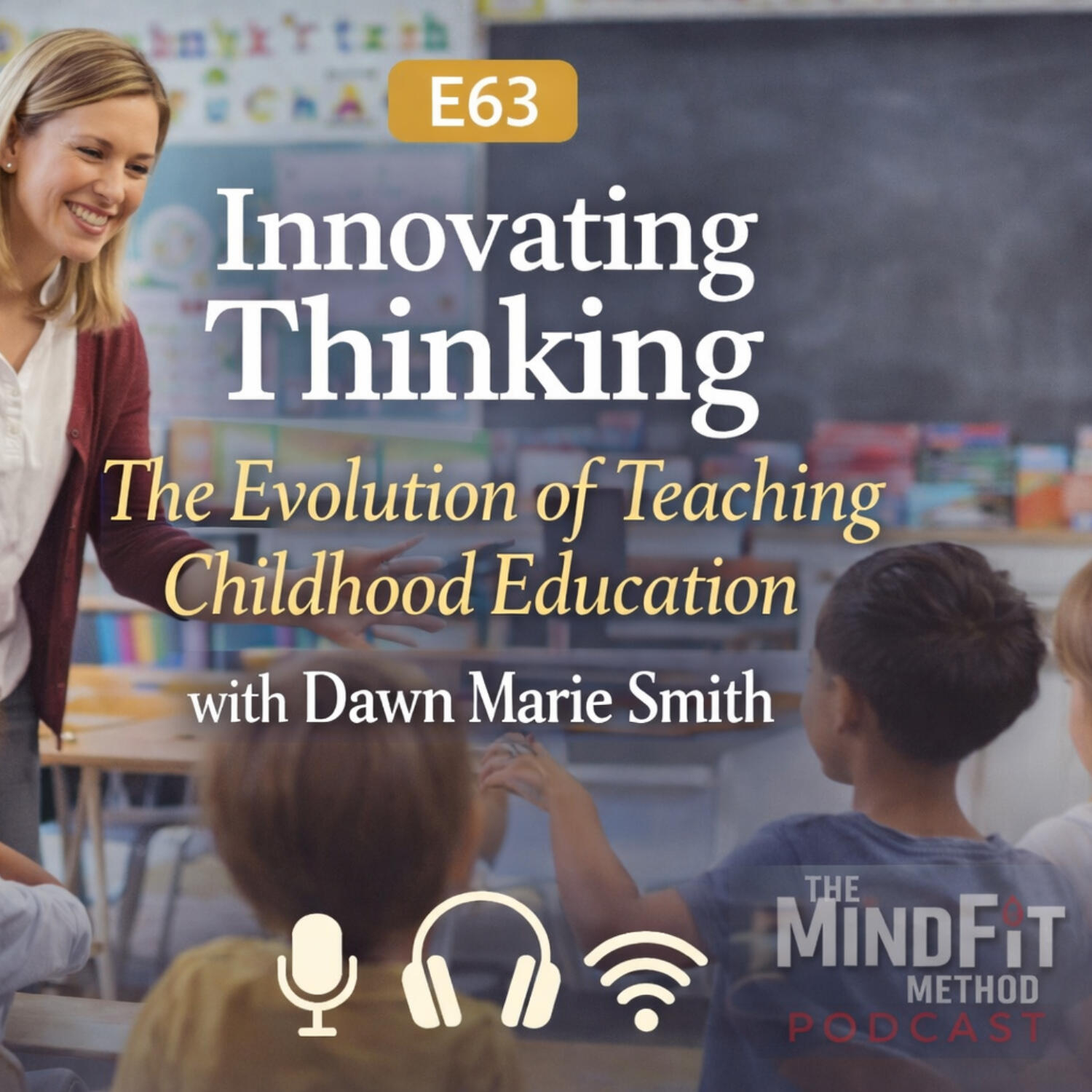
E63 Innovating Thinking The Evolution of Teaching Childhood Education with Dawn Marie Smith
About this Episode
E63: Innovating "Thinking:" The Evolution of Teaching Childhood Education with Dawn Marie Smith
The world around us is changing fast. The question then becomes is our education system changing just as fast to keep up with the new world?
Today's special guest, Dawn Smith is the current Principal at The Franciscan School in Raleigh, North Carolina and in her thirty-second year of education. Previously she served as the Assistant Head and middle school math teacher at Cary Academy and Assistant Principal at The Franciscan School. Dawn earned her Bachelor of Science degree in Education from the State University of New York- Cortland and her Master of Education from the University of North Carolina- Chapel Hill.
Having worked in public education, private education, and catholic education environments, her insight and experience on the changes in education that need to occur are incredible. Join host Michael Fancher as he and Dawn delve into the post covid and dopamine-overloaded world that our education system has to thrive in!
#education #teaching #teachers #themindfitmethod #themindfitmethopodcast #fitness #learning #exercise #thedopamineintervention #dopamine #educationalleadership
Hosts & Guests

Transcript
In the world of education, how do we start innovating thinking?
In a post-COVID and technology-induced dopamine-driven world, we need it more than ever.
But in order to dive into that topic, we need to start thinking about the evolution of
both teaching and education.
What are the needs today and how are they different from the needs of yesterday?
In today's episode, my conversation with Don Marie Smith, a school principal with over
31 years of education experience, dive exactly into that topic.
So friends, are you ready?
Three, two, one, let's go!
Hey everyone, what's going on?
I'm Mike Fancher and welcome to this episode of the MyFit method podcast.
So we are switching gears a little bit because it is that time of year where school is
already back in session.
I don't know where the summer went, I do know it went unbelievably fast.
And the education system has changed so much, not only over the last one decade, two decades,
but over the last one, two, three years, especially in the post-COVID world.
And today I have a very special guest on Don is with me.
She has 31 years experience in education.
She's currently a school principal and she is a graduate of my alma mater, SUNY Cartland,
which makes it even more special.
So Don, it is a pleasure to have you on the show.
Thank you so much for being here.
Thank you Mike.
It's a pleasure to be here today with you all and hopefully share some wisdom and guidance
for those that are in the education field.
Awesome.
Well, if you would, could you just start by kind of sharing your journey and education
and how you became a school principal with over three decades of experience?
All right, let's see when I start.
So I guess I'll even start with college in that I transferred to our alma mater.
I transferred there as a sophomore because after doing a year at another university,
I had chosen business and marketing and a year in.
I was like, this is not for me.
So I transferred to what is known as one of the best teaching schools in the state of New York
and just jumped right in and loved it.
But then while I was there, you have to decide what is it?
Do I want to go case six?
Do I want to go high school?
And I found myself right there in the middle.
And I was like, I'm going to teach middle school.
And then of course, once you're doing that, you have to decide what subject.
And so I went for math, which is top commodity.
I could find your job anywhere at any time or so I thought.
And so I finished with my degree and it was the early 90s.
Of course, teachers up in the Northeast were being paid very well.
And therefore, there were not a lot of jobs.
So I relocated, graduated and relocated down south to the Raleigh Durham Chapel Hill area.
I actually moved to Chapel Hill and got a teaching job here in one of the public schools.
So I was in the public school system for six years in North Carolina.
It was very different.
But I felt valued and I had learned so so much.
But I knew right there and then this is where I want to be.
But of course, being from New York at the time, teachers in New York had to have a master's
degree within five years of teaching.
So my parents were pretty much in my ear all the time saying, well, if you ever think
of moving back, you really should start your master's.
And so that's where I really got hooked was when I went back, I went to UNC Chapel Hill
and got a master's in middle grades education.
And it was through there and my time and my field work that I knew this is what I want
to do and started going and doing more conferences and stuff.
And then public schools was becoming more difficult to be honest.
I had a lot of students that English was not their first language.
And I felt very little parent support.
I had classes of 31 and 32 kids.
I was coaching.
I was young.
I was, you know, like I said, going back to grad school.
I just felt this is not for me.
I had friends in my life that were like, oh, don, you should go be a trainer, you know,
be a pharmaceutical trainer, do something else.
You could make so much more money, use your expertise in teaching.
And at that time, I left.
I left the public school system and I actually went to a private school.
I went to an up and coming private school that was very technology based.
And I just fell in love again with teaching and stayed there for 22 years.
And because it was not public, I also got into being the assistant head there.
I did not need the credentials to be the assistant head.
And did that up until about four years ago.
And then once again, something was not going on the door saying, I need to make another change.
And I actually went to work for a Catholic school.
I went to work for the diocese of Raleigh.
And being there and just seeing, I don't want to say we were behind,
but I just felt that there was so much I could give and so much I could do.
So I went back to school again for now.
The third time went back to school to get my credentials so that within the diocese,
I could someday be a principal.
And I'm now in my second year being a principal for the diocese of Raleigh.
And, you know, I still bring in that training.
If everybody were just talking about it a few moments ago, my, you know, professional developments huge.
And I need it for my, I need it for my faculty and I need it for the parents as well.
We all need to be learning and growing.
That's an amazing journey.
You know, a couple big twists here and there.
But obviously you very much knew exactly what you wanted to do, what your skill set was.
And the education system has just, it has such an ever evolving landscape.
More than I think a lot of other businesses or industries even do.
What do you believe is the most significant change?
And some of the challenges that students and teachers are facing in this,
not only ever evolving landscape of education, but in this post-COVID world.
That's a great question.
So, yeah, during COVID, I mean, we were all just so thankful when we, we were in school where I am currently.
We were in school for a majority of that.
And we were doing in-person learning.
And then we were also offering the courses online option.
But parents were happy.
Kids were happy.
There was a sense of normalcy going on.
Following that, that's what it all changed, right?
I have, I'm in a school.
It's a K-8 school.
So what we very quickly realized is our younger students actually are second third graders
that didn't have normal kindergarten and first grade experiences.
They were missing the socialization and their self-regulation.
You know, that good old adage.
Everything I needed to know, I learned in kindergarten.
Well, they didn't.
They didn't have that.
They didn't have their toolbox was empty.
And that is really what we were, you know, our first and second grade or even third grade teachers.
They were not used to being equipped to deal with some of the challenges that they were facing in their classroom.
Kids didn't know how to work together.
Kids didn't know how to do partner group.
Kids didn't know how to do a group work.
They didn't know how to share supplies.
And then self-regulation.
That just, you know, a transition in the day or something as simple as a fire drill.
It just really threw off everything and they didn't learn those basic skills at the earlier age.
So I would say that's probably the biggest thing is the social skills and the self-regulation.
And then you even can go into the growth home, growth mindset.
And when kids are home with their parents,
I think what we found is that the parents didn't want their kids to make mistakes
or to even experience a failure or a blip.
And so kids are afraid of making mistakes.
And instead of making that mistake and being able to pick themselves up and just say,
oh, I goof, let me erase that.
Let me move on.
At times can cause an absolute meltdown.
I, not only as a parent, did I experience that situation of not wanting kids to fail.
But when I first opened MindFid, you know, as a business owner,
you also didn't want it to fail.
And the first student who ever came into MindFid,
he was in second or third grade and unbelievably intelligent.
Just you could just tell off the charts, socially, very quiet,
not into sports, not into activity or fitness.
And it was interesting because he just wanted to be in that stem room all day long.
But the buy-in for stem and to be able to use all these,
I mean, we had 3D printers that were nearly four feet tall.
We had hydroponic towers that were seven feet tall.
So we had unbelievable things that the kids could not wait to use.
But you had to do the buy-in of fitness before you could actually get access to all that.
Which I think is funny because most people say,
well, if you do your homework, I'll go let you play.
Right.
And buy a mod, right?
Flip it and invert it.
And it's, you'll actually do your homework better if you play first,
which is I know contradictory to what we normally think.
But he was the first child that I ever taught 3D printing to.
And we were creating fidget spinners.
That was what we were 3D printing.
And he, I had this whole lesson.
We went through the whole lesson.
And then as we were getting done towards the end of the lesson,
it was just me and him.
We literally just opened.
He started to augment and adjust his design in Tinkercat a little bit.
And literally threw off all the dimensions.
Everything was messed up.
And he's like, well, you print it.
Well, you print it.
Because he just couldn't wait to have this thing in his hand that he had created.
And I was like, yeah, yeah, yeah.
No, definitely.
And then his mom came and picked him up and left.
And I remember sitting in this 5,000 square foot facility by my house.
And I'm looking at this, at this iMac screen.
And I'm like, this will never print.
He's changed everything.
He's messed everything up.
So I physically remember, and I remember this so visibly watching my hand
reached to the mouse to actually fix what he had created.
And I literally out loud.
And the building would echo a little bit because it was so big.
And it had like 20 foot ceilings.
The building would echo.
And I remember out loud, I said, no, this is why you created mind fit.
If he doesn't fail, he's never going to learn.
Absolutely.
So I printed his, his fidget spinner.
And it came out a complete and total disaster.
And barely slept that night because I was so stressed about what his reaction was going to be.
And he comes in the next day.
And he's like, you know, races in, races right to the stem room.
Totally skipped by the fitness room.
He's like, did you print it?
Did you print it?
And I said, I did.
But let's do fitness first.
Then what we did.
And then I handed it to him.
And I'm waiting for a meltdown.
I'm waiting for a, I hate this.
This is terrible.
And instead, what I got was, oh, I stretched it here.
And I did this.
And I did this.
OK, I can go fix it and ran back to that same computer.
I'm like, all right, hold on.
We'll get there.
I can, we'll do it.
And then he fixed some of the things that he had missed the first time,
still trying to augment some things and make it very much his own.
And we printed it a second time.
The bearing still didn't fit because it wasn't the exact millimeters for the bearings.
But on the third time, he got it.
And I remember, I think I was more proud than he was.
But I was proud of myself for not stepping in, which was so difficult to do.
Because in society today, what we say is it's OK to fail.
But we don't mean it.
Because when they do fail, we're like, oh, my gosh, what did you do?
You lost the game.
You did horrible in that class.
The key that I truly learned in my fit was you not only have to let them fail,
you have to give them the time to be able to go back and fix it.
And what was I'm thinking?
Yeah.
Exactly, exactly.
It was so incredible.
But I imagine where the parents went to.
And honestly, I know this is slightly off topic.
But very close friend of mine is, well, very close family member of mine
actually works for a very high ranking government agency.
And unfortunately, he spends a lot of time putting pedophiles
in those that work in the sex trafficking trade in jail.
And one of the most disturbing things
that I don't think people really considered and talked about
was that the amount of reach outs by pedophiles,
by those in the sex trafficking trade
that occurred during COVID, because kids were home.
They're on computers.
Mom and dad in many cases were in the house,
but they were stressing because they're trying to figure out what they're going to do
because now they've been deemed non-essential, right?
So they're not going in.
So it's, you know, go play on your iPad, go play on your video game,
go play on the computer, let me figure this out.
Or when parents began to go back to work,
many cases kids were home by themselves or with someone who's really not paying attention.
Attempting to learn.
When I say it went up a lot, it went up 3,000%.
I can believe it.
Unbelievable numbers.
And I think that we still have a long way to go to truly even understand
what the long-term affects by not being in school, by nots.
And look, it was a very difficult situation.
And I'm not saying that people did or did not make the right decisions on how things go.
But now the question is, how do we start writing everything that went wrong?
Or like you said, we all of a sudden put all these devices in front of children without teaching them.
You know, just put somebody in a car without taking the driver's head class
and the driver's head hours and all of a sudden we handed kids as young as kindergarten a device
and said, you're going to learn using this device.
And, you know, yeah, there was, I don't want to say mistakes,
but I think a lot of learning occurred.
And if, and I really truly hope that we never, ever, ever go back to something similar to that,
well, we're all whole learning from a device online.
But if we ever did, I really hope we take the lessons we've learned and revisit.
Let me dive deeper into that because I know the pandemic really kind of accelerated
the adoption of digital learning tools.
How do you think technology has transformed the way that students learn today?
And what do you think the benefits and the drawbacks of that shift are?
Well, I will say, and I say it a lot of what parents, it is a resource.
It is not the beat all and all.
It is a resource.
And there are, and I will say as a principal, in terms of getting resources in front of my students,
I'm able to get them more resources over the computer than I could be in like a hard copy or paper form.
You know, even in terms of textbooks, we're able to get a subscription online,
especially when it comes to science and social studies,
that will be updated and current in, for less cost than putting a textbook
that's going to be outdated five years later.
And now we have hundreds of textbooks hanging around that we need to be getting rid of.
So it is definitely a resource, but I also think I mean, how many jobs
and I forget what the percentage is, but like my current kindergarten class is students.
I want to say something like 60% of the jobs that they will hold as adults
haven't even been created yet.
That's how quickly things are moving, right?
So, you know, even something like a blogger.
I mean, when I was in kindergarten, who would have ever said,
oh, that person's going to grow up and be a blogger, right?
Or that person, you know, a podcaster, right?
Who's, you know, it wasn't even known.
It wasn't known.
There was no name.
There was nothing to that.
So I definitely think, you know, we need to think of it as a resource.
It's a way, but it's not the beat all end all.
So when I walk around, it's, you know, yes, my students have them.
Yes, my teachers use them, but we use it as a resource.
And, but I think we're also teaching them life skills.
Let's teach them how to use it responsibly.
And it could be even something as simple as time management,
executive functioning, right?
You know, when you're giving them, like you were saying,
multi-step things to do and editing,
I think that's a great tool that can be done, a basic keyboarding.
There's just so much.
Not to take paper and pencil away.
It's a tool, but it has changed.
It has changed our access to things.
So students today in general just have access
to vast amounts of information at their fingertips.
How do you see teachers guiding them now
in really discerning credible resources,
fostering critical thinking skills?
I know there was a lot of talk many years ago
when I was more in the thick of it,
regarding, you know, digital citizenship.
But I think we're way beyond that at this point.
And it's literally, how are you utilizing technology?
How are you garnering the information
that you're garnering from it?
Because I see adults that can't manage it.
In fact, most adults can't manage it.
You know, I've talked about this in other episodes,
but there's a serious situation today
going on, which is called my side bias.
My side bias is when I believe something,
and I can go on the internet on Google
and find massive amounts of information
that support and quote unquote evidence
that supports exactly what I think.
And any information that I find that supports it,
I do not question.
And I believe 100% that it is true.
And any evidence that has been presented
counter to what I'm thinking was bought and sold by someone
is false and just hateful.
How do we teach kids?
And it's obviously I'm not putting that burden solely on teachers.
It's as much as parents on parents
and on society as a whole to be able to do this.
But how can teachers guide students in this world?
Well, and that's just it.
We have to guide in now.
I mean, just in recent years, we had AI to this.
I mean, it's crazy.
It's absolutely absurd.
I mean, how are we going to make sure
that where the kids are truly writing
and that these are their words?
I mean, I will say we have to teach it.
So you have to kind of break things down,
whether even just how to do a Google search
or how to not rely on the competing as your resource
or how when you do a Google search, as you were kind of
mentioning, the first few things that show up in your search,
they're all paid for.
And therefore, that's why they're showing up at the very top.
Does it mean they're the most credible source to be using?
We do.
We have to teach it.
And that starts as young, as young as kindergarten
in terms of what are you looking at?
Where are you getting your information?
Where revisiting the whole plagiarism?
What does it mean to plagiarize?
And to take, to put it in your own words,
does it mean you just change every three words?
It's a whole different, how to do research.
It's not the same.
There's no card catalog anymore.
We're not going through microfish, like we did.
Back in school, right, for our first, you know,
it's a whole different, everything,
all their sources for the most part are online.
Or I will say, and I think this is a benefit to it,
there's, we've seen more oral history in recent years, right?
We're doing interviews and kids are finding out
their information that way, which I think is absolutely
fantastic, but it's also somebody's recollection
of history, and you know, it's their personal opinion there.
So you do it, and you mentioned digital citizenship,
and like you said, it is so much more than that.
It's, you know, breaking things down,
it's the time management piece, it's,
it's how to write an email.
I mean, we do teach that where I work.
We teach kids, how do you address a teacher?
How do you, how do you sign off an email?
Or how to even self-advocate for yourself through an email?
These are things we coach them through.
I don't want to say we, we definitely coach
and advise them through so many of those lessons.
It's, because it's not just a, if X, then Y.
So they really truly need to be coached and guided.
You brought up a lot of big points there.
The first being artificial intelligence.
So we live in the world today of chat GPT,
which has literally taken the world over by storm.
Now, the interesting thing about artificial intelligence
is that right now it's limited by the inputs and the outputs.
So in order to use chat GPT for the most part,
you have to type in a question
and it's kind of like when you're researching data
for other things.
If you put junk in, you're gonna get junk out.
It is an incredibly powerful tool
that I think, especially our younger generation,
that what's crazy is that there are kids today
that are 17 years old that have only ever been alive
while Facebook was in actuality.
It really existed.
We grew up in a time frame where none of that existed.
My first computer was a Commodore 64,
which I still have very fond memories of.
And the first computer game I ever played was Oregon Trail.
But today, I almost view it at some point
that I know there's a lot of pushback right now,
especially in the plagiarism world
and how kids are using, especially college students.
I feel like we're in the same exact spot
as calculators had us in the 40s.
I actually remember seeing pictures of math teachers
protesting in the streets of New York City
against students using calculators.
And their biggest argument to it was,
you're not always going to have a calculator.
Well, they were definitely wrong
because in today's world, we all carry around
some sort of phone or our watches or something
that has for the most part a calculator on it.
And if you don't have one, somebody else does,
and you don't even have to type in the question anymore,
you can just speak it.
Or there are software programs out there
where you just take a picture of a problem
and boom, it suddenly kicks the math answer back out at you
with all the steps that are required to be able to do it
if you pay them monthly fee.
How do we embrace?
I think there's a pushback right now
against chat GPT, against plagiarism, and I get it.
But is it, in my mind, it's going to require a change
in what is suddenly important to teach?
So instead of teaching, writing per se,
are you teaching the structure of writing
so that it is different when you're utilizing something
like artificial intelligence?
Because when the biggest market right now
for artificial intelligence
is actually software programs to detect
if artificial intelligence was used,
that means it's not going away.
No.
What are your thoughts on that?
Well, as you were just speaking,
I mean, the biggest thing that kind of kept popping up
in my mind, as you were saying,
that is we need to be teaching kids how to think.
Yes.
How to think?
That's what we're doing.
Just like the calculator, and as I taught middle school math
for 28 years, so of my time in education,
even when I did some part time teaching
while I was still a sister principal.
And so I, you know, my time in the classroom,
and it evolved greatly, and that's,
I taught six grade math for majority of those years,
for 22 of those 28 years.
And I would tell the kids, you know,
I had to teach them when I was doing per se,
I used to tell them I'm teaching them the benchmark.
So that if they're in a restaurant,
they find 10% you double it, you got 20.
You're shopping at the mall, it's 30% off,
you find 10% you triple it.
You're doing this in your head,
because you're, and I'm guilty of saying,
you're not always gonna have a calculator.
Well, you know, but I'm very guilty of saying that.
But teach them how to think, teach them how to process,
or the process of doing things
like you were just saying in regards to writing.
I was sitting in one of my middle school
language arts classes the other day,
and it was my sixth grade teacher,
and she was teaching the kid about rainbow sentences,
about how you know, you start like when you're defending,
or when you're pulling information from text,
how you start it, and so she kind of broken down
into a rainbow, it was fascinating.
It's the first time I've personally
I've ever seen it broken down that way.
But, you know, you introduce it,
and then you, you know, you cite something right from the book,
and then you quote something from the book directly
to support what your, your stances,
and she was teaching them a process.
And I think, and I think back to how we learned,
I mean, we learned a lot by memorization, right?
You memorize these facts, you memorize these dates,
you memorize these figures,
and then you regurgitated it for a quiz or a test,
and then it was long gone,
and so much of what we're teaching nowadays,
we have to be teaching them how to think,
or, you know, a sequence of things,
and well, this happened that may be in there for now,
this is what happened next,
or this is what could happen, right?
We can infer things based on things that have already happened.
That teaching has evolved completely, it really has.
It is not, sitting in a classroom now
is nothing like it was when I was in school.
That's fascinating.
You know, I know there's a push right now,
it's a small push, but it is gaining a little traction.
I've seen that, you know, calculus is still
the benchmark math for colleges,
and there's a lot of focus now saying,
well, less than 3% of the population
actually use any of the principles of calculus,
and of that 3% that do, 1.5% of them are calculus teachers.
And I know that there's a push today
to perhaps move away from calculus as the benchmark math
and move more into a statistics type of math program,
because it allows people to then make informed decisions
if they actually understand not only to statistics itself,
but how exactly those stats came to be.
What are your thoughts on that as an educator
for a very long time?
What do you think of that idea?
I mean, I think, I mean, through me,
that sounds fascinating, but it sounds so accurate too,
because it's not only, but it's looking at the facts and figures
and then coming to a decision or defending it
based on the facts and figures.
And if you think about it, that is what we do.
Right.
We do our research.
Even if you're, you know,
comparison on a mortgage, for example,
you're gathering all your data,
you're seeing what the trends are.
Somebody's putting a graph in front of you.
This is what it's going to look like,
or this is the part of your budget it's going to take.
And, you know, if you did a 15% or a 15 year,
versus a 20 year mortgage, or vice versa, right?
A 20 year versus a 30 year,
you need to be able to understand what they're,
what the information that they are giving you.
So I mean, to me, that sounds, that's fascinating,
but I also think quite accurate.
Being a math teacher and having taken all the calculus I did,
and then teaching, I have not used that calculus
in my opinion since I took it in college in the early 90s.
Right.
Yeah, it's,
it's going to be interesting to see how things shift.
And I hope that, you know,
the education system as a whole is a behemoth of a system.
It's so big.
And to start to pivot or start to turn within that system
to have a massive impact across the board
and not just on an individual school level, class level,
student level, I think is going to be a huge challenge
going forward.
And there are a lot of precedents that are set in education
that people are not necessarily eager to change.
No, this is how we've always done it.
But I think it's going to be fascinating to see
where this can go and if we can actually make that pivot.
Nurturing creativity and innovation is vital
for prepping students for the future.
One of my favorite TED talks is by Sir Ken Robinson.
And he brought up an interesting point
and it was, do schools kill creativity?
He tells a story in that TED talk of a little girl
who really had a very difficult time expressing herself.
She really did not do well in school,
but she had an unbelievable eye for art.
A teacher came up to her one day
because they really could not get this little girl
to engage in classes and yet they were assigned
to draw something, anything that they wanted
and suddenly the engagement level was off the charts.
And the teacher walked up to the student and said,
what are you drawing?
And she said, oh, I'm drawing a picture of God.
And the teacher said, oh, well,
no one really knows what God looks like.
And the student replied back,
we'll give me five minutes and they will.
So there's so much power when you're at that young age.
As you and I were talking before about failing
and how it's not encouraged, I feel like creativity,
especially as we get older, as we become adults,
God forbid your two creative or you're just out there, right?
If you're too innovative,
you just come up with ideas that would never work.
Instead of supporting people and really pushing for them
to get that creativity out, get that innovation out.
What strategies or approaches do you think
are currently working that are succeeding
in promoting that creative thinking in the classroom?
Wow, that's a great question.
And my mind was just turning as you were talking about that.
And I mean, the first thing that came to me
when you asked, are we, yes, we are.
I think we're all guilty of killing it
just a little bit, I really, really do.
And I used to say this about myself being a math teacher.
I'm not a file cabinet teacher,
meaning I don't just do things the way I always was.
If you looked at me as a teacher now,
or let's say five years ago compared to five years prior
to that, it looks differently.
And in fact, that's one of the questions I ask
in an interview is when I'm interviewing teachers
for a job at my school, I'll say,
tell me how your classroom looks differently now
than it did five years ago.
I want to know what have they done?
And so you have to stay up to date.
And so as a teacher, or here's another thing
you were bringing up as a math teacher,
you don't teach word problems in isolation.
You don't just teach a chapter on word problems, right?
They should be incorporated throughout.
Same thing, the creativity and innovation.
We have to give the kids choice.
That child that you were talking about was drawing.
I mean, when we're doing a project,
maybe it doesn't have to be written.
Maybe it can be an oral presentation.
Maybe it can be a sample podcast.
Maybe it can be a marketing type thing.
Let's get creative and innovative
in what we're asking our kids to do
and to demonstrate that they have mastered what it is, right?
It's not, mastery is not just demonstrated through a test.
But not agree with you more.
I completely agree with that.
I think that we also have situations
where if something that's constantly being talked
about is soft skills.
However, I really think they need to change the name
because soft skills are actually some of the most vital skills.
I think they just need to change it to vital skills at this point.
Like skills.
Yes.
Like skills, that's it, yeah.
Communication is one of the biggest ones.
When I was actually at Portland,
I had no idea that I wound up,
that I would wind up liking to speak to people
or speak in front of large audiences.
For my job today, even in the healthcare world,
the majority of my time is spent presenting
to ICU physicians, CFO CEOs of hospitals,
talking about very specific levels of care.
Sometimes I have an audience of 10,
sometimes I have an audience of 100 plus.
And I talk to school districts,
I can have massive audiences to be able to do these things.
But it all started in Portland, actually,
my last semester senior year.
I took a public speaking class.
Had no idea that I would like it.
Also had no idea that there was a competition in the class.
And the two people that won the competition
actually wound up going on
to the Portland County Chamber of Commerce,
public speaking competition,
that actually had cash rewards,
which as a college senior, that was a really big deal.
And I wound up winning.
And I was blown away because I just found it,
I had a love of speaking and talking
that nothing else in my entire time in school
had ever brought out of me.
I was an exercise physiology major.
I love that world, but I had no idea
that it was something that could really come out.
I think that if we take these vital skills
that communication is a huge one,
I know as I'm hiring, especially 20-year-olds
that are fresh out of school,
they don't know how to communicate.
Unfortunately, they communicate with their thumbs
because they're texting all day long.
But they also, that critical thinking
we were talking about before, that executive function,
usually executive function issues are very apparent,
especially in middle school, high school,
but then they start to develop.
And I don't think they're developing today.
And I think a lot of it has to do with the technology
and how people communicate today.
How do you strike a balance
between those traditional teaching methods
and then fostering that innovation
to meet the diverse learning needs of the students?
Wow, okay.
No one say it's a loaded question,
but there's a lot to that, right?
There's a lot to unpack there.
That is a challenge.
And you know, you mentioned stop skills,
and like I said, we refer to them as life skills, right?
Where we're, you know, and that could be,
it doesn't all happen at home,
so it doesn't need to, right?
Students spend more time in school
around their peers and around their teachers,
then they do waking moments with their parents,
whether it be because of their extracurriculars or otherwise.
So there is an even deeper responsibility
on teachers, on the adults that a child will encounter
throughout the day to help them,
to mold them into functional human beings.
And that could be the simple things about,
I mentioned the executive function,
but how to write an email.
I said, we actually, you know,
do a lesson on how to write an email,
or how to advocate for yourself.
How to speak to a teacher?
And you know, we encourage our middle school students
to go to, go speak to the teacher,
not have mom or dad write the email
about speaking to the teacher.
It needs to be happening every day, all day,
leadership opportunities.
I work in a Catholic school,
so we do morning prayer every morning.
We have our students,
even as young as kindergarten,
getting up in front of 700 plus people,
guiding us in morning prayer.
It might be saying the other father,
it might be saying the pledge.
It's doing the first reading,
it's doing the intentions,
but when we are giving them,
we need to be giving our students these opportunities.
We also do weekly math, same thing again.
Our students are getting up there,
kindergarten first, second,
our fourth grade did it this past week.
They're getting up in front of hundreds.
And like I said, I was similar to you.
It was nothing that I thought I would ever do.
I can talk in front of a class of kids
all day long, every day up and down,
but then you put me in front
for parent information night or meet the teacher
or something like that.
And it was like, I'd be sweaty,
the palms would be sweating.
And I didn't want to speak to the adults.
And I think we need to push.
And this goes back to the girls mindset.
Pushing our students even outside of their comfortableness,
making them, and I will say going back,
you were talking about how in your job now,
I mean, how much public speaking you really do
in talking in front of groups.
Same thing happened for me.
And I'm trying to think about how many years ago
it was, it was probably about 15 years ago,
where a great friend and a great colleague, she's like,
Don, why don't you go present at conferences?
You know, just like the middle school math conference,
why don't you have so much of some great activities?
Why don't you go share that?
And I did.
And it's like the bug bit me.
And then I love doing it.
And then even during COVID,
I did some webinars for a company, for teachers.
It just, now I love it.
And I think that's part of one of the reasons
why now that I'm in admin, you know, I can.
I can talk in front of groups of adults is not just the kids.
So, but you had to be pushed outside of your comfortable,
your zone.
And same thing.
So I'm going back to your original question.
It's, there's not right one right way to do it.
But I think we all need to just take those risks
and do something that might make us feel uncomfortable
every now and then.
Agreed.
Let me ask, because I know this is a touchy topic today,
especially in the world of education.
If you ask most middle school, high school kids
about how much they think they learn each day in a school day,
versus how much they can learn in seven minutes on YouTube,
we get answers that are very disturbing, to say the least.
Digital devices have caused distractions
that have unbelievable effects on kids learning.
While they may think that they're learning
in a massive amount of information
in a very short amount of time,
they're learning very surface level
or very opinionated things at a rapid pace,
but they're never actually diving into the application
of any of that knowledge.
How do educators help students stay focused
in the digital age today?
Use it to your advantage.
As a middle school teacher,
you could bring in that technology and use it
as a teaching moment.
You have a very captivated audience.
So if you could, you know, even send them out
to do the research, let's say, and bring it in,
because you can also teach them what's accurate
and not accurate in the information that they're bleeding.
But that's it.
Students need to be interested in what they're learning.
And so as a teacher, I do think you need to bring in
some of what they're seeing online and use it.
And I just looked to parents to help us though
in terms of, help all of us
in terms of limiting their own child on their devices.
You know, it just as an educator, as a parent,
when I look around a restaurant,
and I see a family of four sitting there
and they're all on their own phones
and they have, you know, a three-year-old
and an iPad, dads on the phone, moms on the phone,
and the 10-year-old brother or sisters on their phone.
And I'm just like, this is a perfect opportunity
for, you know, unstructured, fun conversation,
jokes, share something, we're missing that.
And I think we have yet to see the ramifications
of a family that doesn't have family dinner
or a family that doesn't sit around and talk and discuss
or a classroom that doesn't sit around
and talk and discuss that needs to be happening all the time.
I think when I wrote my second book, The Dopamine Intervention,
I had to do a lot of research on the scientific effects
that Dopamine has on not only our mindset,
our productivity, our focus,
but also on the actual changes
of the physical structure of our brain.
Our brains are changing.
They look very, a 10-year-old today looks very different
under an MRI than a 10-year-old 10 years ago.
And the crazy thing is that our dopamine receptors are moving.
They're moving to a different part of our brain
where they can be utilized much more often.
And students today, as they're constantly in what's called
a dopamine-induced state of bliss,
which means they're so used to, everyone ties it
into the cell phone, right?
But it's not the cell phone.
The cell phone is an environment.
It's not a device.
The environment has different rooms.
Each room being an app.
Each one of those rooms has its own unique effect
on your dopamine level to the degree
that it is very, very similar to that of someone
who engages in polysubstance abuse.
So for an addict that engages in polysubstance abuse,
they're using multiple different illicit drugs
to achieve a high.
We think of our phones, and you just described it perfectly.
You're at a dinner table, mom and dad are each on a phone,
someone's on an iPad, another one's on a phone,
and we're not just on our phone or on our iPad.
We're on the individual apps.
So what's crazy about dopamine is that dopamine,
most people think of dopamine as a pleasure chemical.
It's actually not.
It's a chemical that is released in anticipation of pleasure.
So when you go on Facebook and someone puts a post on Facebook,
they're dopamine bubbles spike,
not because they're physically using the device,
but because of what using the device
could bring them in pleasure.
Meaning if I post this, if I post a picture of myself,
how many likes am I going to get?
Well, anyone share it.
Well, someone comment on it.
How will I look was the lighting good?
What are they going to say about my picture?
It's the anticipation of all of that.
If someone eats, you always have free flowing dopamine
flowing through your body.
You have a benchmark and baseline of dopamine.
For someone that likes chocolate,
if they're as they're opening up a Hershey kiss,
your dopamine levels increase by 50% over baseline.
For someone who likes to smoke,
your dopamine levels increase by 150%
as you begin smoking.
For even someone to have sex, it increases 200%.
As does social media.
Social media has the exact same increase as sex does in our brains.
To keep going even further, alcohol is about 220%.
Cocaine is 250% methamphetamine is 1,000%.
So you can see how it goes up.
As disturbing as the increases,
what's different is the fact that you can't,
even if you love to smoke,
you can't physically smoke cigarettes 18 hours a day.
You can't drink 18 hours a day.
Can't have sex 18 hours a day.
But all of those things for the most part are regulated.
The regulated by government entities,
as to how much you can do a certain age
you have to be in order to purchase it.
However, when it comes to social media,
something that spikes our dopamine as high
as nicotine, alcohol, gambling, sex,
all of those things, none of that is regulated in any way.
And what's happened is that when you constantly,
if this is your baseline and you're constantly up here,
the gap between there and your baseline
begins to be a very uncomfortable place,
which is why people have such a difficult time
having uncomfortable conversations today.
And I honestly believe,
and I actually wrote this in my book
that I believe it's where the division in our country
is coming from today.
Because I hear all the time people say,
well, if you don't think like me
and you don't agree with the things that I agree it with,
and you must hate me, right?
It's because we can't have those difficult conversations.
There's no more gray area, it's all black and white.
No more gray area.
And I think what's happening is,
when someone is partaking in polysubstance abuse,
they're doing multiple different things.
So if you imagine an engagement,
I would say with a cell phone for a 10, 12 year old,
they go on that cell phone.
Now, I know Facebook is for us old folks,
but let's say they were using Facebook,
they go on Facebook, boom,
they get that 200% increase in dopamine.
And then it starts to trail down,
but then they open Snapchat and it pops right back up
and it trails down.
Then they open YouTube and then they open TikTok
and then they open Instagram.
So for long amounts of time,
you have an increasingly large amount
of a dopamine increase.
And that specifically has decreased,
and these are through many, many scientific studies.
This is not me talking,
our resilience as a society.
We are not able to be comfortable in the uncomfortable.
And I think we're-
I think we're out of vacation.
Yes, exactly.
Dopamine loves instant gratification.
A crazy thing and I don't think people realize this,
but companies in general have mastered
the art of manipulating our dopamine.
They've gotten very, very good at it.
An example of one that most people don't think of is Amazon.
If you were to track how intense the dopamine spikes are
for a person using Amazon,
the highest is when they are in anticipation
of part making a purchase, right?
So boom, you go online,
your dopamine spikes really high,
you click by now
and you're feeling pretty good about it.
What does Amazon then do?
They send you an email that confirms your purchase.
When you open that email,
your dopamine spikes again.
Then a few days later,
if you have Amazon Prime a few hours later,
you're gonna get another email that says,
your package has shipped,
pops your dopamine up.
But each one of those dopamine releases
is smaller than the last.
So it doesn't feel as good
as it did just as you were about to click that by now button
in anticipation of getting it.
The craziest thing is that the lowest dopamine spike
that you get is when your package actually arrives
and you open it,
which is why so many people will buy things from Amazon,
but then they will not even open the box.
So all these boxes that are sitting there
because it doesn't feel good that anymore.
What feels good is going back and purchasing again.
Amazon has been mastered it.
Yes, it is.
And where we have to deal with this,
we've created,
I used to laugh at this staples easy button
where they just had the easy button and something was done.
We as humans have allowed ourselves to have an easy button.
And if you can control our dopamine levels,
you can control our actions,
you can control our attention
because we live in an attention economy today.
It's a very different world than our economy
that was based on mining or even oil and gas or gold.
Those are no longer the most valuable resources in the world.
The most valuable resource in the world is attention.
It's a very different world we live in today.
Let me ask because teachers are the forefront of education.
Right now, there is a lot of animosity in the world
against education, against teachers.
In my own experience,
I've witnessed that it is no different than any other industry.
There are great teachers, phenomenal teachers,
teachers that go above and beyond every day.
There are ones that are average and mediocre
and there are ones that are not good.
It doesn't matter if you're a teacher, a principal,
a superintendent, a business person, a police officer,
a nurse, a doctor, it's the same for everyone.
However, the education industry I believe
has gone under a microscope currently in regards to this.
What support and resources do teachers need today
to adapt to these evolving changes
and continue to be able to inspire students?
I'm gonna say, I think collaboration plays a large role in that.
They need the support,
but they need the support not only of admin,
but of each other and parents.
As a teacher, you're expected to know a lot
and none of us are the expert in all.
Even something as simple as,
I mean, there are times when yes, absolutely,
the parent doesn't know their child best,
but the parent doesn't see their child
in the arena that you as the teacher see them
when they're working in group work
or maybe they see one version of their child,
you may see a completely different version.
So teachers need the support,
they need access to professional development,
they need access to each other, they need time.
Those, I know those days off when the kids aren't in school
and parents are like, oh my goodness,
I have to figure out what to do with Johnny on this day,
there's no school.
But if those days are planned,
so much can be garnered from those days for a teacher
and just having some time in their school building
without students to collaborate with each other
and to learn, they need support,
they need the support.
I'm hoping that answers where you are going.
I know I got to have a question.
I agree with you.
I agree with you 100%.
One of my best friends is a superintendent
of a school district.
And he spent probably three, four, five times
what is normally spent in professional education
and continued education for four teachers.
I'll never forget he said to me one day,
look, we can buy new curriculum,
we can buy new books, we can buy new computers.
He goes, but when the budget goes away
or those things break or they go out and outdated,
he goes, then the money, nobody thinks about it anymore.
He goes, the money that I invest in my teachers,
it doesn't matter if next year that budgetary money
doesn't exist, you can't take back the knowledge
that the teachers already got from that.
He's a true innovative thought later.
No, I support that 100% and also a nice joke.
Teacher appreciation, it's a joke.
Just like anything, everybody should be
feel appreciated every day.
I don't feel like we need to just say,
well, let's define it as nurse's appreciation day
and law enforcement appreciation.
It should be all the time, but we're in a society now too
where it's kind of like everybody's just looking
for the fault in something instead of the good in something.
And same thing, I think teachers need to feel supported
every day, whether it be by admin, each other and parents.
I know that there are, obviously,
mind fit was born out of utilizing exercise
and activity to enhance neurological function for kids.
And there are countries in the world
that are quote unquote touted as having
the best education systems in the world.
I know countries like Sweden and Finland come to mind.
How do teachers or administrators or policy makers
or board members, how do we not view activity,
movement and exercise in the classroom as disruption?
And how do we instead view it as actually
a part of the learning process that truly does and will
or could enhance a child's performance?
I mean, it starts as simply as what we were talking to earlier
even with those life skills, soft skills.
There is so much that occurs on the playground.
Yes.
So many things, whether it be we're creating a new game,
we're going to play.
These are the rules.
This is how you do it.
You have this role.
You have that role.
I mean, it's that creativity we were talking about earlier,
that innovation we were talking about so much happens there.
But same thing.
I mean, taking a brain break in a classroom
or using having wiggly seats,
having those things available to kids that might need them.
But same be true for our teachers.
And giving them the brain breaks, giving them,
and helping them to take care of their own wellness.
And we give it the title, Social Emotional Learning.
SEL, everything falls under this large SEL umbrella.
But it's so much more than that because it's, you know,
greeting kids at the door, right?
How do they feel walking into your room?
Do they feel supported the minute or do they walk into a classroom
and see a teacher sitting behind the desk?
Right?
There's a fair here.
Great point.
Yeah, that's a great point.
Why would it be any difference
than if you walk into work each day
and your boss is miserable?
How are you feeling at that moment?
Why would it be any different for a child walking to a classroom
and seeing the reaction from their teacher?
Right.
Or you think about it in a work setting, you know,
there's the kitchen area where the coffee pot is
and people get together and it's like everybody has stepped away
from their desk and they're having just,
just conversation with each other.
Where does that exist for kids?
Right.
Where does that collaborative nature of just,
let's just talk about something, not just because we have to,
but because we have a moment to it.
I mean, for the most part, it's on the playground
or transferring a classes or while they're gathered at their lockers.
But instead, what are we doing while they're gathered at their lockers?
We're rushing them along.
We're saying, come on, come on.
The bell's going to ring.
Get to class.
When that's their down, that's their recharge time,
in my opinion.
That's their chance to kind of just get ready to move on to the next thing
or go through the, you know, what do I need for the next class?
And, you know, where am I going?
Right.
Absolutely.
Let me ask, as we look ahead,
what are your predictions for the future of education?
And how can we prepare students for a rapidly changing world?
A little bit scared, to be honest.
It's a fair answer.
Because I mean, I even just think back to when I started.
I mean, this is your 32 for me.
And how much it has changed.
It does.
It scares me a bit.
But I do think as teachers, as a society, as educators,
we do, we have a duty, though, to prepare kids for who they're going to be as adults.
That's where I think our responsibility lies.
I think that was missing when I was in school.
We, you know, that was definitely missing.
I did, I cannot really look at any class or experiences.
Well, that really taught me how to adult really well.
That's what we need to do.
And I think the movement is entrepreneurship and internships,
giving experience, experiencing the world outside of ourselves.
That's what we as education need to become.
We need to be experiencing the world outside of ourselves and outside of our just general area,
whether it be, I mean, I'm going back and being.
We thought it was so cool to have a penpal, right?
Another state or a penpal in another country.
But we should be zooming in a class in another country and talking about their experience
or what their recent filter was and what our filter is.
And we're missing, we're missing the market bit, I think.
I really, really do.
I think we're still so, it's in such a point of transition right now.
We're looking for data.
We're a very data driven society.
So we have to have all these data points, right?
And then we were using these data points to determine if we're being successful or not.
I mean, how have we been hearing over and over for the last two years about the COVID slide?
Why, what are we basing that on?
We're basing that on the fact that our test scores are not good enough.
But what did we learn during that time?
What did we learn about each other?
And I mean, I think businesses have learned an awful lot.
And they're saving themselves a lot of money.
We're not making their workforce go into the office every day, right?
Or they're not forcing an introvert into an extrovert type of job.
You know, the introverts allowed to be an introvert at home.
So I do.
I feel we're missing the mark on a lot of things.
I think we're indefinitely a point of transition.
And we need to be looking at what does our student that's in kindergarten first or second grade now?
What does that need to look like for them in 15, 20 years when they're in the workplace trying to function as adults in our society?
That being said, what advice would you give to aspiring educators and school leaders who are going into this field with the goal of making a positive impact on students lives?
And this one gets me a bit emotional. I'm going to be honest.
If you, if you are, I felt the calling and I have stayed with it.
Now, there are times over and over as I mentioned very early that I felt like quitting.
I was given up. I was leaving.
If you feel the calling to be a teacher, stay with.
Find your passion and share your passion with others.
You know, find what it is you are passionate about.
And I think back to the good old, the shop teacher back in high school.
I mean, there was a, you know, there was a 40, 50 year old guy that found his passion and decided to share it with kids.
I mean, in fact, now that I think about that, maybe what I really pulled away where I learned something was home at class and shop class and wood class where I was put in an uncomfortable situation.
Something that didn't seem like school to me and I learned, I learned some life lessons there.
So that's what I would say to those aspiring.
If you are truly feeling the calling to go into education, find what you are passionate about and follow it.
Absolutely.
And I think that's very wise words of wisdom.
Throughout your experiences, especially in light of kind of giving that advice to future educators,
have there been any specific books, podcasts or resources that have significantly impacted your personal growth and mindset?
And would you share them with the audience?
I would say, well, growth mindset, I do follow Joe Boller at Stanford University.
I think she's huge, especially if you are a math teacher or just in a classroom, I think she has wonderful thoughts for that.
Better leaders, better schools, Mark Minkus.
He has aspired me personally.
I listened to his podcast while driving to work and he just breaks it down.
He makes it real.
I try to think of some others over the years.
I mean, anything growth mindset related, I think from a personal, just personally as well.
But here's also what I'll say is take care of you.
Do even if it just as a teacher, take care of you.
So if that means, and I also do this, driving to work, I have about a 45 minute commute every morning.
I listen, I love to read.
As an adult, I have found that I love to read and I want to be able to have conversations with my friends and family about the latest book.
Well, I don't have time.
Or if I do sit down at night to read, I fall asleep.
So what I have found is I listen to audiobooks.
And that's what I listen to going to and from I have a commute on by myself.
I don't have my daughters grown and no longer driving with me in the car.
And I listen to audiobooks.
I use that time as my own professional development as my own well being.
And that's what I would say to anybody out there is if you're in a position or when you're on the treadmill or when you're walking or whatever.
You know, part of us wants to disengage.
But if you could give listening to something or try, you may say, oh, I don't like to do it.
It took a while to get used to it, but I just find so much.
That time to me is my recharge time.
Excellent.
Love that.
And finally, what message or mantra do you live by that you'd like to share with our listeners as a source of inspiration?
I go with Nemo just keep swimming.
Just keep swimming, swim and swim.
And that's that's my what I tell myself whenever you hit a blip because you do.
You're going to have a bad day. And as I say, as a principle, you know, even as a teacher, you know, I.
I don't know if your days are ever very predictable.
You may think they are, but they're not, right?
And just just roll with it or pivot.
Just when you need to just pivot, right?
Don't, don't throw in the towel.
That's really what I'm trying to say is just just keep swimming.
You will get through it.
You will get to the other side.
Just, you know, stay true to yourself.
Stay true to your beliefs.
And just keep going.
Well, Dawn, I can't thank you enough for having you on the podcast today.
This has been a very insightful conversation.
I know this is a very, it can be a heated topic for many people today regarding the world of education.
And I think you really put out there a lot of valuable information of exactly what people think they know, but they don't necessarily know.
And I think there's just so much room for growth on all of our parts, whether it's society, whether it's as a parent, as a teacher, as an administrator, as a school board member, a policy maker.
Anyone that has the best interest for kids and what really will take them forward and help them to become successful contributors to society.
So I truly appreciate your time today.
I know I've learned a lot and I'm sure our listeners did too.
Thank you so much for being on the podcast.
I truly appreciate it.
Well, thank you, Mike.
I appreciate the time with you as well.
Hey, everyone.
Thanks so much.
I hope you enjoyed this episode.
Don't forget it's two episodes a week now.
So click that subscribe button so you never miss one.
Thanks, everybody.
Stay driven.
And until next time.
More from THE EMBC NETWORK Featuring: ihealthradio and Worldwide Podcasts
View all episodes →
From Invisible to In-Demand (Without Burning Out) with KJ Blattenbauer
THE EMBC NETWORK Featuring: ihealthradio and Worldwide Podcasts
Apr 2, 2026·50:29·failed

What if everything we’ve been taught about success… is incomplete? with Marat Om...
THE EMBC NETWORK Featuring: ihealthradio and Worldwide Podcasts
Apr 2, 2026·1:14:44·failed

