Loading...
sportskidsfamily
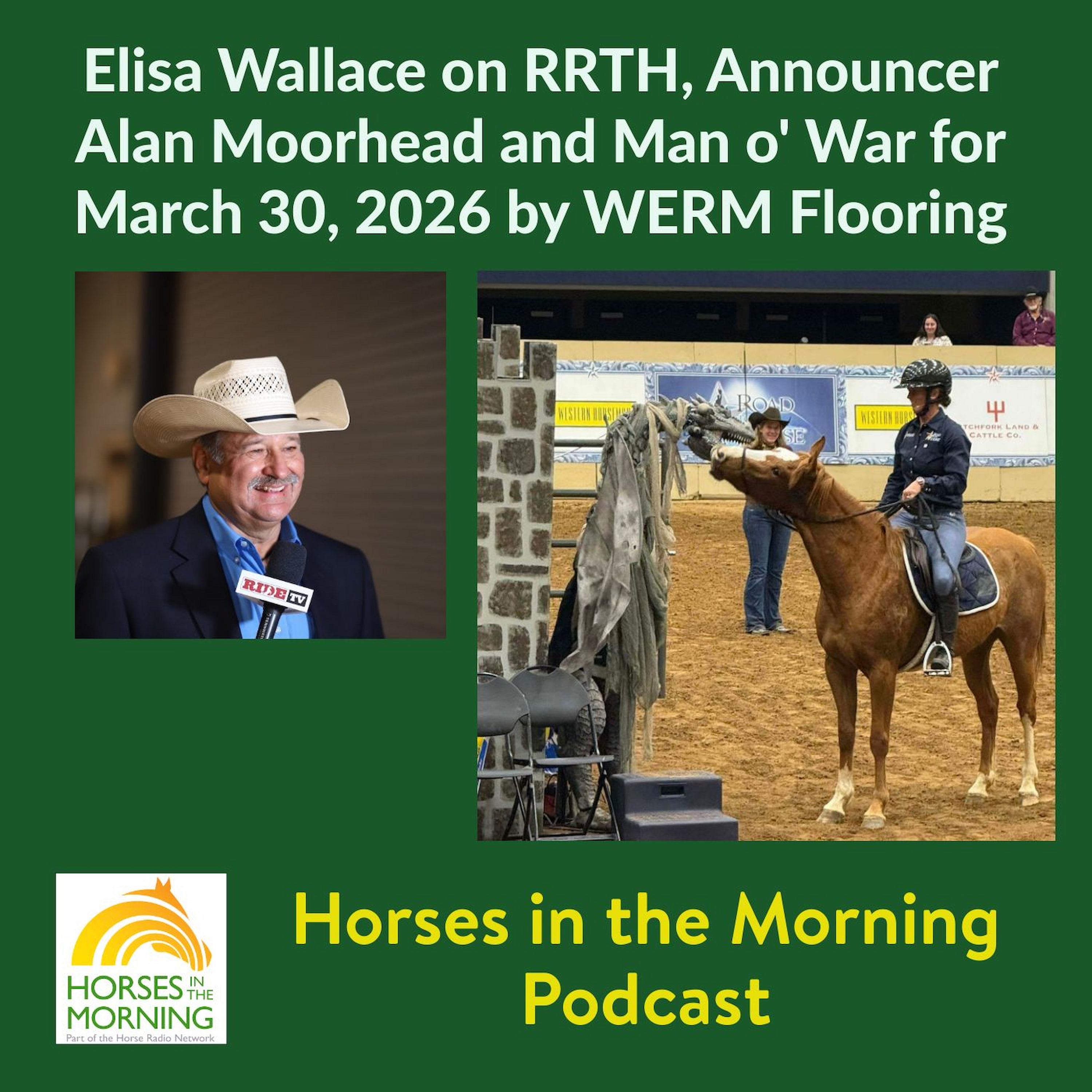
Elisa Wallace on RRTH, Announcer Alan Moorhead and Man o' War for March 30, 2026 by WERM Flooring
About this Episode
Elisa Wallace tells us all about her recent competition at Road to the Horse. In the “Where are they now?” segment we catch up with host of the Western Radio Show, Alan Moorehead. Plus, This Day in Equine History brings us to 1917 and the Nursery Stud in Lexington, KY. Listen in….
HORSES IN THE MORNING Episode 3915– Show Notes and Links:
- Hosts: Jamie Jennings of Flyover Farm and Glenn the Geek
- Jamie and Glenn's Amazon Store
- Title Sponsor: WERM Flooring
- Pic Credit: Road to the Horse and Alan Moorhead Facebook
- Guest: Elisa Wallace from Elisa Wallace Eventing
- Guest: Alan Moorhead
- Additional support for this podcast provided by: US Rider, Equine Network and Listeners Like You
Time Stamps:
- 02:32 - Daily Whinnies
- 06:37 - Chad trail ride adventure
- 09:45 - Elisa Wallace
- 35:25 - Elisa’s plans for Windy
- 39:08 - “Where Are They Now” with Alan Moorhead
- 52:12 - This Day in Equine History
Transcript
You are listening to the Horse Radio Network, part of the Equine Network family.
You are listening to the number one horse podcast in the world.
Here's your entertaining look at the horse world and the people in it.
Good morning, everybody. I am Glenda Geek and O'Cala, Florida.
And I'm Jamie Jennings and Norman Oklahoma.
You're listening to Horses in the morning on the Horse Radio Network from Monday, March 30th, Episode 3915,
brought to you by Worm Flooring. Good morning, horse people.
Good morning, everybody. We have a fun show planned for you today.
Lisa Wallace is going to join us and tell us about her recent competition.
It wrote to the horse. We're excited to hear about that.
And in where are they now? That segment that we're doing all this year.
We're catching up with host of the Western Radio Show.
Now we're going back into the old days of the Horse Radio Network.
Alan Morehead is going to join us.
Plus this day, an Equine History brings us back to 1917 and the Nursery Stud in Lexington, Kentucky.
In the auditor post show, we're going to review the shocking things auditors have said as horse people
that others that are not horse people didn't quite understand.
And I looked through the list. There's some very funny ones in there.
So we're going to review those.
The latest United States Census Bureau just confirmed that Ocala is the number one fastest growing metro area in the country.
Of all of the places in the entire country.
Lucky you.
No, this is not good.
You know, it's just, I went to town the other day.
We live further out of town now. So I don't go into Ocala proper very often.
It's like, oh my god, it is worse traffic.
The whole thing is just worse than it was when we lived, moved here 12 years ago.
But Ocala was number one.
Murtle Beach was number two.
Another one of my favorite places actually.
And then there are of the top 10 three of them are in Florida.
So all of those Florida man stories apparently is not discouraging people from moving here.
I'm doing my best.
We try.
Florida gets so much hate and so much arousing about things that happen to Florida yet.
Everybody still wants to move here apparently.
By the way, Norman Oklahoma was not on the list.
Oh, thank god.
But they still feel they need to make lots of turnpikes.
They're counting on the day when you are number one on the list.
They're planning for that.
Alright, let's do some daily monies.
From the podcast to the farm.
Here's some hidden birthday wishes to keep you warm.
Oh, but last all year long.
Happy birthday, friends.
We have one order to birthday today.
Paula Hansford.
Happy birthday, Paula.
Have a great day.
Well, I got a couple things.
First of all, I have to mention our friend Brandy Burrows and her new horse Bonita.
Congratulations, Bonita and Amigo need to hang out since they speak Spanish.
And also I wanted to give a shout out to TJ from the Maytag Ranch came out to pick up this weekend.
Auditor Shelley.
Okay, our auditor Shelley had a horse named Diamond.
And she opted to have Diamond go to the Maytag Ranch.
And so TJ came and picked Diamond up.
And true, true awesome business person's fashion offered to give me a finders fee.
And I refused.
And I was like, no, no, no, no, I'm just helping Shelley get her horse a great home at the Maytag.
And I hope in the Maytag get a great horse.
So of course he brings an entire case of Tito's handles.
Like six giant handles of Tito's vodka because somebody in the Tito's corporation has a place at the ranch.
So they provided me with that.
And I hope that lasts you more than a week, Jamie.
I hope you're good for a little while now.
I'm working hard. Glenn.
So anyway, so anyway, I just want to let Shelley know that they got Diamond back to the ranch.
And they were like, oh my god, this horse knows everything.
And I rode the horse a few time. I rode Diamond a few times while she was here.
And I'm like, oh, he was here, excuse me.
And it's such a such a great horse.
And they're super excited to have him.
However, unfortunately, Diamond is not being called Diamond anymore, Shelley.
They changed Diamond's name because of the finders fee.
Diamond's name is now Tito.
He said, he said, I sponsored that horse.
So I have named me that horse.
I love that.
It's great name for a horse.
No.
If I were to thought of that, my end illusion would be called Tito right now.
Well, enjoy that.
Enjoy that case.
And you said it's the large bottles too.
Oh, yeah.
Handle.
Handles.
That's a lot.
That's a lot of.
Yeah.
It's a lot.
To be fair, the finders fee would have been more.
But I was like, this is way better.
It's way better.
Also, I did go on a trollard with Chad.
And I wanted to mention this to you, Glenn, because.
Did you have to do this after imbibing in some Tito's?
No.
No.
No.
And I had this.
This idea.
I think you feel sorry for me because I don't have.
Barrett anymore.
I think I'm really happy.
I'm going to try and find one.
I don't really care.
I want to.
I've got to go and find out the word of my.
I have a recipe, a set of dishes for panties.
I'll have a party swim or something, like and where the thing about water.
I want to see our kids,
the little thing about water.
I don'tvent want one with my friends.
I don't have a need for.
I'm like, we're going to go into the house.
I'm like,
I've gonna go in a try hard for a distance.
I got to go in the house and get them out in the woods.
I was like, I'll tack up Carl.
And so he got a Craigslist Carl
and we got into the woods.
And the little track that I usually take
is about, yeah, like a little 20 minute loop.
But we use our neighbor's property.
He let us put a gate in and we ride through his property.
And he's cut all these new trails.
So I was like, let's explore.
I got lost in like a third acre plot.
Had no idea.
Ace was like, not happy with me.
I couldn't just drop the reins
and he got me back.
We rode in the woods.
And then I finally got out of the woods,
but like on the other side of the property.
So we ended riding around like on streets and neighborhoods.
That man will never volunteer to ride with me again.
Do you know how long our ride was?
No.
An hour and 53 minutes.
Oh, yeah.
That's about an hour and 40 minutes too long.
I wouldn't have like, I had burned it all in one day.
Yeah.
He's not walking today.
He's like, how about new trails?
I was like, let's go this way.
And I'm like, oh, God, where are we?
And then of course, he's like, well, that's obviously Southwest.
And I'm like, what do you mean that's Southwest?
He's like, look at the sun.
I'm like, where in the woods?
He's like, you can't tell by the sun.
I'm like, I'm sorry.
I'm not a pilot.
It was a more navigation.
He's like, well, obviously, I don't even know what time it is.
I don't know where we are.
It was like the biggest fight we've had in like a year
because I didn't know what direction that was
and how could I not know that that was Southwest?
So what was supposed to be a relaxing ride
in the woods didn't turn out that well, yeah?
And you know what, it ended up great.
We had a great time and it was fine.
But yeah, I was shocked.
I'm like, what do you mean that's Southwest?
He's like, we just have to go northeast,
or our house, I'm like, how do I know that?
How do you not know that?
And look at the sun.
I'm like, where in the woods?
I can't see the sun.
How do you, is that why he texted me?
He wanted to put an ads on Craigslist and he was asking me.
He wants to put an ad on there.
He wanted to say, my wife needs a play buddy.
My wife needs a friend.
Anybody that knows about riding horses
can please come over and play with my wife.
It's really, it's like exhausting me.
Yeah, I got back and I was like,
oh, that was a really fun way to explore so much.
And he's like, yeah, it's great.
It's all really cool.
And then I got off and I looked at my thing
and I'm like, oh my God, we've been riding for an hour
and we've been three minutes.
He's a three minute walk today.
He's living to the airplane.
It's all good.
All good.
Everything is fine.
I had a blast.
You know, beyond the worm floor, your trailer has a roof.
And they also have a thing called seal and chill roof coating.
Springtime sunshine can quickly turn your trailer
into an oven, especially where Jamie lives.
On a trailer.
On a trailer.
I slept in our trailer where your house
in 130 degrees.
But worm specialized roof application
can reflect 90% of the UV rays,
potentially dropping the interior temperature
by up to 60 degrees.
This high performance coating does more than just beat the heat.
It creates a protective barrier that seals seams
and prevents minor leaks from turning into major problems.
Start your season right by protecting your investment
and your horse's comfort.
From the roof down to the floor, down to the road,
you can accomplish it all at worm flooring.
Find a dealer near you at worm flooring.com.
Let's start out the day with somebody who just got back
from competing in Kentucky.
So cool.
Time to welcome friend of the show, Alisa Wallis.
She is home from competing at Road to the Horse
and is here to tell us about it.
She came from last place after the first two rounds
to reserve champion at the end after an amazing obstacle
course the final day.
Alisa Wallis, hello.
Hey, thanks for having me on.
Is it true that you're currently on a horse
like as we're talking?
Yes, I am riding Gugatti as we speak.
We love that.
Yay.
I love it.
I love it.
Well, getting to the, let's focus on the remuda
and your first day, I'm curious to know why you picked
windy out of the remuda.
So she was actually my top pick.
We were given the horses short video clips
and their bloodlines and everything back in December.
So I did kind of like a deep butt dive, like studied
all of the bloodlines kind of like, we had 11 horses.
So it's almost easier to figure out ones
that you don't want versus ones that you want.
If that makes sense, but I was able to chat
with Stacy Westfall, which was really nice.
And she's like, you know, at the end of the day,
you want a curious horse, but you want a hot horse too,
like you want a very forward thinking horse.
So when I watched the videos,
windy had, she was like the biggest mover.
A lot of them are nice movers.
They're daisy cutter type movers, but she's different.
She had a lot of freedom and movement in her body.
And, you know, she's, if you had to pick a more English one
out of cowbred horses, that I think would be the one I went to.
So it was kind of nerve wracking because I had last,
I was last draw.
So I got the highest number.
We had to pick chips out of a hat.
And lowest number goes first and highest goes last.
And I was last and it was so nerve wracking because it's like,
like don't pick or don't pick or don't pick her.
And you're trying to be like, like, oh, look at that band.
There he is so nice.
I was trying to like keep people around.
Yeah, and she was so curious like she was, she's like,
hey, how is she's very gregarious?
Like, how's everybody going?
And, and there was other little snippets that I really wrote
to the worst of a good job.
Like they showed us the horses loading up and shipping our way
and stuff like that.
And windy has some very unique hind leg markings
because there's like six chestnut fillies with blaze and chrome.
But I was able to recognize she was one
of the first ones to walk on the trailer.
And I was like, noted, like she doesn't mind going up
into that trailer, you know, so that that's something that I liked.
And then the other thing I really liked is we got to see them move
around.
And she was, she was either and she was always like first one out.
But like she didn't mind being in the middle, the outside,
the front, the back, like she didn't care.
And she was very inquisitive in like looking up a lot.
So those are all.
And she would also like walk up to the wranglers to the flag.
So I was like, OK, well, she's pretty balsy little thing.
Like, all right.
But yeah, it was so nerve-wracking after Ryan went
and I was like, oh my god, don't, please don't, please don't,
please don't, when he didn't pick her, I was like, OK, all right,
I'm going to go walk through like I knew she was not the my pick.
But then she kind of like sealed the deal
when she like sniffed my face and stuff.
So I was like, well, I guess it was meant to be.
So yeah.
So you mentioned that you were sorting
through a quarter horse bloodlines.
If I was told to sort through quarter horse bloodlines,
I would have a zero idea about that at all.
But talk to me about thoroughbreds or warm
bloods, I might have a better idea.
Were you like that too?
Did you have to take a crash course on quarter horse lineage?
I have some friends that are have bread
quarter horses and do barrel racing.
And so like, you know, I chatted with them.
And I mean, I'm kind of a bloodline geek anyway.
So any time I get to go and learn about horses,
and I mean, any tire you pull up on her bloodline
is like a million dollar sire in cow or raining.
So she comes, you know, a pitch fork doesn't breed a slouch.
That's for sure.
They breed really nice horses.
So and then also going and seeing
his road to the horse is kind of a thing of its own.
So you've got, you know, to train a horse in that kind
of time for you, you need kind of a busy body horse.
And so seeing, you know, the relations, I actually went
and I hung out with tick and I met his two horses
that he won previously won with.
And because there were two fillies
that were related to both of his sires.
So, you know, I was just trying to get as much information
as possible, which I think the filly number eight,
which was sunny lucky cat, which who Tiffany had,
was the full sister to tick horse last year, the buckskin.
Suncat, I believe is his name.
So not to remember all these things.
It's amazing my brain did that.
But what's interesting is that we can't like touch them
or do anything with them in the pins,
but you are all week.
You can see them in the pins.
There's kind of like a buffer for us.
So you can kind of see how they interact.
And in my filly, Wendy was definitely not the boss.
She was getting whooped up on by Tiffany's mare
and Ryan's mare was the big boss.
So that one, the gray mare was very much like,
she was the boss, no one told her what to do,
but Tiffany's mare was like vying for that spot a little bit
and she just went to whooping on Wendy.
So I think Wendy was relieved honestly
when she got to come to the round pin with me
and got scratches.
So, you know, in my mind frame,
yeah, like my mind frame going into it,
knowing that I have mares like mares are,
you gotta make them feel good.
So I tried to make sure that all of my sessions,
I started off in a nice place and I ended in a nice place.
And just so that she would think that,
like I said, the juice is worth the squeeze a little bit.
Now, when you start training them,
did you have some specific goals for each round
or did you just kind of go with the flow
and see where you went?
We're given like a rubric,
like we're given what the judges are looking,
what we're scored on.
So me and my pin Wrangler, Kevin Graham,
like I knew, you know, you have preparation for haltering,
preparation for saddling, like groundwork,
how the horse moves forward, like all these things.
So, but then I went in
and I started off the very first day
because what we had noticed is the mares were handled with flags.
So like the Wranglers moved them around with flags.
So they already had that point of communication.
So I figured, okay, well, I'm not gonna go in there,
first with the rope, I'm gonna go in there with the flag,
move her feet and get that little bit of communication.
And I had practice roping, you guys, like.
I saw you do it, I was like, damn girl.
Yeah, like I have a rope to him.
Is that how you practice?
Well, I have a friend who's a ropper
and so he gave me some good pointers
and it's always been a skill, like we're training Mustangs,
like you gotta, it's a good skill to have.
And so the joke was I was able to just walk up
and put the loop on her and I was like, well, go figure.
I practiced roping and I didn't have to ropper.
But I still used a preparation there,
like even though I put the rope around her neck,
I still wanted her to get like pressure off the rope
and I really liked that part in the beginning stages
before I put a halter on them.
So, and I found if you can get a horse to soften
that neck pressure a little bit,
they tend to move off the halter a lot better
because you already have their feet kind of engaged
with their brain.
So long story short, and I just kind of went to work.
Like she's giving me all the green lights
and the Wrangler told me about her.
He's like, you know, these types,
you know, if you go to pick in a fight,
they're gonna buck you off and I was like, noted.
So, you know, I wanted to make sure that,
you know, she'd get frustrated.
She'd get a little bit upset
that I tried to give her tools for those moments.
But in the beginning, and I've done this with my Mustangs
before where I hopped on them kind of halfway
and kind of used that as a building of trust,
but everyone got all excited that I got honored
in like the first five or six minutes.
And I was like, oh, okay, didn't think.
I mean, that's preparation for saddling, I don't know.
Like, I was told that I was so different,
but I was like, I don't know, I just do things.
I do, I'm doing all the same things.
It's just might be in a different order, right?
Because like, every horse is a little different.
But in my mind, like, I mean,
I grew up watching Chris Cox and all those guys.
Sorry, we spooked.
Be careful.
Yeah.
And so like, in my mind, I wasn't really,
I don't really do anything.
It's all pressure release, the timing and all that stuff.
So, but what kind of word on the street was,
is that on the first round, I went too fast.
And I think a little bit of it was,
if you weren't watching me the whole time,
because things are pretty subtle,
even though I think that it's obvious,
that if the judges were like looking back,
they'd be like, oh, she didn't have a halter on it.
Oh, she's sitting on it now.
Oh, it's jumping a barrel now.
Oh, wait, what?
You know, it didn't really make sense,
versus like, if you were watching me,
the whole time pretty closely,
but, you know, it's not easy to judge.
There's four round pins, like, there's no way
they're going to be able to see everything.
Like, it's, that's, that's really hard.
And the thing is, like, you're doing all of this,
but at no time, did your mayor seem stressed about it?
And I think that is the biggest tell
as to whether you're going too fast,
if your horse is reacting in a way that is not,
for thinking, you know, like, hey, we're going to do it,
you know, be it sneaker, stress, and bugged out about it,
then yeah, you've gone too fast,
but I never saw that from your mayor.
Right, and that was, I mean, yeah,
she got a little bit uncomfortable on parts,
like, when I put on the, she was,
she was protective about her belly,
which, you know, they are going to be,
they might be a little ulcerier, what have you,
but, you know, I, she,
she seemed like she liked to softer,
girse like around her belly,
because when I had my sister single honor,
that was a little stiffer.
She was uncomfortable.
She was like, she, she pulled some moves out,
and I was like, okay, I, I see that,
but I, I made her, you know, go forward,
so she understood to go forward through it,
because I knew, like, they're going to have responses.
They're going to, to do bucks,
but is it going to be a scared buck,
or is it going to be like,
well, this is a little irritating, I'm going to crow,
and I would rather go with the,
this is a little irritating crow,
then get the heck off with me, you know.
And that's what I meant.
I mean, obviously, we're pushing these horses,
because we're getting so much done,
and such a short time, but to me,
like, she just never appeared that angry buck, you know,
although you did, it a rear that, oh my gosh,
woo, girl, that was amazing.
And your bear back, that was incredible.
Yeah, that was the second day,
so she did come out,
and she was even more improved from the second day,
but this is how, and I don't know,
because people accused me of having an easy horse,
and I was like, all right, she's not easy, you guys,
like, no way, Jose.
Let me stop you.
Okay, as a trainer of these kinds of horses,
when people tell you you got the easy horse,
it is the greatest, take it as the biggest compliment,
even though they don't mean it as a compliment,
because that means you made it look easy.
And that's the things like you,
see if they're easy horses, you got to judge them,
but like the first second they come out,
because you get to work, and yeah, you got the easy one.
You know, you achieve things to say you go run
a cross country course for the first time,
oh my god, that horse was so easy.
Thank you, because I love easy.
That's a super buzzword for me.
Sorry, go ahead.
Oh, well, it was funny, because she was so sensitive
that I accidentally grabbed her little goat hairs
when I was putting my leader up on her
to pop on a rider, and she was a little anxious
about when I was getting on her, which is fairly common,
but I tend to take that because it's forward movement.
You can always go back and teach a stop,
so it's easier to teach a stop than it is,
necessarily, getting them to move forward when they're tight.
So, and I had a for-not halter on her,
and I just went to ask her, and she was being a little fussing,
and she's like, I'm mad, and she reared,
and I was like, oh, we're going up.
And then I was like, are you getting to do anything else?
And she's like, no, and then I,
because people were like, oh, you've rewarded the rear.
I was like, well, if you saw, it's very subtle,
but I asked her to keep turning left,
and she did, and then I rubbed her,
and I was like, okay, well, I'm gonna change the halter out.
So, I switched to like a rope, kind of hack,
and more, it's pretty soft,
which generally horses tend to like.
And she was better, but she's still a little fussy in it,
and so then I switched her back to a softer,
two-not halter that they actually gave us,
which is very pretty navy,
and that was what she seemed to like the best.
So, and again, we are scored on adjusting to the needs
of the horse, so I'm like, heck yeah, man,
I'm like nailing it, like check marks,
like I'm doing all the things.
Like I'm getting her to move forward.
And on the second day, we knew that she would be happier
going outside out of the round pin.
And, you know, she's still a little fussy,
but every time I could get her,
I added more pressure by the gate
where they would go back to their pins,
and then when she got going forward,
I would release her and have her just hang out and chill,
like up at the top,
like as to the middle of the round of the arena as I could,
and just had her like chill.
And I think that made it like a big difference
in her mindset in being relaxed in that arena.
And then also with the crowds,
like there's so much clapping sometimes
for other people,
that when I was in the middle of something like swinging
my leg over, I really had to stay focused
and not be like, oh gosh.
Ah, like my legs going, you know what I mean?
Cause like it could be hard to get distracted
and be like, oh, heck, everyone's clapping.
There's energy, I'm about to swing my leg over,
she's gonna break into,
but I had to be like blah, blah, blah.
And I think she really learned to not feed off of,
cause she really didn't, like the energy
in that arena on the third day was insane.
And she was like, besides her little spookin.
Yeah, did that surprise you, by the way,
cause you know, I used to announce that show
for many, many years.
And I don't think the competitors,
unless they've been down there,
realize how loud I can get when you're down in that arena.
Yeah, well, you know, like what did my fall
or was the loudness of it?
Just what did it, did it, did you,
were you able to tune it out?
Oh, yeah, it makes it, it makes it feel good,
especially when your horse is like totally fine about it
because when they, when they don't really respond to that
and they're just in sync with you,
then it just, it makes you happy and more relaxed.
It makes everything better.
So it, that really didn't affect too much.
But, um, you know, the second day,
and we could go back like me and my pin ringler,
cause we were like, okay, well,
what did they not like about round one?
Like, why was I scored so low?
And we were like, okay, I guess it was cause I went too fast.
So round two, I tried to make sure I showed my transitions
and went slower.
But again, like I, I always, it was funny too,
because, you know, everyone's like,
it's not a lot of time.
But honestly, every time we walked in that round pin
with her, I felt like I had a ton of time.
I was like, I don't even need to be in here this long.
I could be here for 20 minutes.
You know, I don't need to do all, all the things
that I could have gotten accomplished for her, for her,
she's so smart.
Sometimes with the smart ones like that,
the more you do, the more they feel like they're being
punished in some spots.
So that's where I really tried to focus on changing things
up for her and, and on that second day,
she really liked when we had the obstacles put in there.
And once she started to understand what I asked,
she was like, oh, this is so much fun.
And I ended that day, I think at two minutes
and just took all of her tack off and spent massaging her,
making sure I checked her back, wasn't sore,
like just going through all the checks.
So I kind of knew where her body was at
and, you know, with that amount of work that we did,
just, you know, doing checks on her
and making sure she always felt good at the end.
And then, you know, round three was,
it was a really great feeling
when she trotted up to me in the round pick.
I walked in with the flag and,
cause she was pretty, I mean, anytime you have a horse
that gets separated, they come into a new environment,
they're in a round pin.
Their energy is up really high, their emotional.
So I tried to be really consistent on getting her
to like center herself and take a deep breath
before I ever started really any work.
And she really responded well to that.
And she was so good, I'm so proud of her and the round pin,
cause she was so soft and she walked trot and cantered off
of my voice cues and I'm like,
look, I'm checking all the boxes for getting her to go forward.
Like, I don't even have to put pressure on her.
And like my knee had been bothering me a little bit
because I had a bad fall in November.
I had a horse kind of fall on me
and I broke three ribs and pissed off my MCL.
Geez.
So I had my stepblock in there and I was like,
you know, she's pretty smart.
I have interviews getting her on from the stepblock,
but I think she's gonna appreciate me not jabbing my toe
into her ribcage, cause I couldn't quite like,
manipulate my body in the right way.
And she was, she was like perfect for me to get on her.
And you know, it was the funniest feeling
when being on a green horse and you'll get it every now and then.
Like when I was like, okay, we're gonna leave the round pin,
let's go up to the gate and she sucked up to the gate
like a broke trained horse knew how to open the gate
and I was like, oh, that's gonna be fun.
She is, she is ready to play the game.
And I knew on day three, like game plan,
she's not the type to practice, cause again,
she, if she does it good and you keep going,
she's gonna think that you're punishing her in a way.
And the feeling I had, like, you know,
come across many young ones that are that secure and brave,
but like I was like, oh, she's not even spooking
to get down to the bottom of the arena.
Like she doesn't care.
So I knew I could go kind of quickly
through the rail work and let her just move along
instead of trying to pick an attire if that makes sense.
But that did bite me because going to the right,
she did spook and got a little insecure in that one spot.
And in hindsight, like she told me,
like she crowed a little bit and that canter
and I was able to like bring her back down, she felt fine.
And then when I picked up the canter again
and I should have just waited it out.
But because I declared it and cause I was like,
oh, she picked up the canter right away.
One, two, three, four, five, strides felt great.
And then I was like, oh, no,
we are cutting an invisible cow right now.
And there is no stick in that.
And I mean, I figured I was gonna hit the dirt at some point.
I mean, she's so quick.
But I knew like the minute I got up
and then I just whistled to her
and she kind of met me at the mounting block
and I was like, all right.
And then picked up the canter
and this is how I know it wasn't like her
like trying to buck me off because she was upset
because the minute I was able to pick up the canter again,
she felt very, you know, you know,
when they are scared when that happens,
you have to kind of go and reassure them.
But she picked the canter right back up
and she was like, oh, yeah, I'm fine.
And yeah, I just let her do all the obstacles.
She had a great time.
She really did.
Like she just, and she just understood it.
And again, you're lucky you got the easy horse
because all that work I did before
had nothing to do with her behavior going into the last day.
It is interesting to me.
Like, you know, you post training stuff on Facebook
and I know you get this like so much
but where people comment on your training
by looking at a video and oh, you did this
or they love to tell you what you did wrong.
That's got to be so hard to have it just live.
Like people are judging your every move live
right in front of you.
And then they want to tell you all about it.
Is that true?
Well, I mean, that is the insecurity
going into this thing, right?
Like that is you don't, you don't want to make mistake.
You don't want to feel like you're incompetent.
You don't want to do wrong by your horse.
And that, when I, I just made sure that,
you know what, I can read Mustangs,
if I can train a Mustang, I can train this one
and I can read this one.
And at the end of the day,
like if I don't feel like it's right, okay,
well, last place is five grand, it's fine.
Like that's kind of my mind that now,
I do go in there.
It's more than you make a banding most times.
Exactly, you know, like you do your best.
And it was interesting because
you know, again, people are like,
oh, she went, she was going too fast,
she did her done on round one.
But it was really interesting after my round three,
because again, I did so much prep work with that mayor.
You know, I had her dragon stuff.
I was throwing a rope on her.
I made sure that she started to understand
what the click sound meant
and then building on the reward of her doing a good thing
for me.
And so it was really cool to have
your old cowboys and come up and cow women too,
like that said, you know,
I did not understand what you were doing on the first day,
but I understand now.
Oh, yes.
And I learned so much from watching you
and they were like, how to tear in their eye,
which was so heartfelt and the fact that, you know,
Wendy was able to bring that type of emotion to people
was very special.
Absolutely.
Now, now that you have her,
which by the way, I've loved following along
with all your videos,
with shipping her home and getting her home
and she's loving on you,
what are your plans with her?
Is she going to be your eventing quarter horse?
Are you turning Western?
Yeah, you bringing her into Kentucky the end of the month?
What's the story?
Oh, no.
No, Fledgy will come to Kentucky.
Good old Fledge.
You know, I don't know, we'll see.
I was very blessed to be able to go into a partnership
to get her because she is a very well-bred quarter horse
mayor, so they did not give her away.
And so I was very thankful to the pitch fork for allowing me
to figure out a way to go into partnership
and be able to bring her home.
You know, it's kind of like a little bit of an open door
with her.
I think she is going to make a nice little event horse.
I think she'll be able to do that pretty successfully.
However, she is bred really well
in the cow, cutting and raining.
And so I think it would be really fun
to learn another discipline.
And I have a really nice well-bred horse for that.
So, and not to detract also from the Mustangs either,
because I've been able to work on cows
and learn roping and stuff with my Mustangs.
So it's another ball to juggle.
Here's the thing, I just bought a horse
and it was like, what are you going to do with it?
I'm like, I just want to have fun.
I'm just going to have fun with it.
And that's like me when you bought her,
I'm like, yes, she just wants to have fun.
I mean, like you have with the Mustangs,
you're watching you with your Mustangs
is like watching a mom play with her kids out in the yard.
You know, like it's just such a loving
and touching and sweet way that you come to this.
And that is what I saw with you and Wendy.
So I'm super excited you have her.
I'm super excited to follow along.
Are we going to see you in Kentucky next month?
I think you're across.
But yeah, the list of work quality,
AKB is feeling really well.
And she's been doing really good.
We've been in the top lately.
So I feel like she's come out swing in this year.
And I'll have Fletch there doing the demo.
And yeah, so yeah, we'll see.
Wendy, I think she'll actually be fun to learn
and a little bit do a little bit more
liberty work with her too.
And it's funny that you said the whole mama thing
because we were asked, what word would your horses call you?
And for all the competitors.
And I was like, the only thing I could think of
as I might say, mama, like whatever my old Mustang
see me, it feels like they're like mama.
And so it kind of felt like that a little bit.
It's going to sound easy, but honestly,
on that third day when she saw me and she tried it up
and she's like, hey, he's probably the mama's like,
hey, friend, let's play, you know, type of thing.
So anyhow, it was a pretty amazing experience, yeah.
That's what we want.
That is what we want.
We want our horses to see us and turn around
and come towards us and not be like, oh, God,
then walk away.
So you're really something right.
I've had my horses turn around and go, oh, God, she's here.
Yeah, but this one didn't so perfect.
Well, Lisa, it has been just awesome having you on.
And thank you for walking us through
while you're sitting on a horse.
I appreciate it and we'll come watch your demo
in Kentucky.
And good luck.
Awesome.
Yeah, thank you guys so much.
Even under the best circumstances,
travel is stressful for horses.
We've all been there.
Stuck on the side of the road in the middle of nowhere.
You can make the journey knowing that US rider
is there for you.
Get peace of mind on the road with US riders
nationwide 24-7 roadside assistance coverage
for both you and your horse.
Join today at usrider.org.
Well, I know some of you were remember
and many of you were not listening in 2010.
But before I started this show,
I added one to the network called the Western Radio Show.
It was hosted by Tammy Swrance,
by the way you now runs road to the horse.
And Alan Morehead, it ran for four years.
But the Western world, I think we can safely say,
Alan, it wasn't quite ready for podcasts yet back in 2010.
More so now, Alan Morehead is here.
Hey, Alan.
How you doing?
Good.
And we had listeners, some of our auditors said,
what's Alan up to?
You got to have Alan back because we're doing this segment.
And where are they now?
So Alan, where are you now?
Well, right now, this weekend, I'm
happening to be in your home.
And just kind of having to fund doing what it takes
to get down the road, still rodeo and announcing
rodeos, a lot of barrel futurities and bullriding and stuff
like that, was it a bullriding in Ohio a couple of weeks ago
and have a barrel race down in Unidilla, Georgia,
this last weekend and this master's weekend.
So I'll head over here and watch him hit a few golf balls
this weekend.
Then I go to Madison, Wisconsin for their Midwest horse
fair.
And then out to get three Oklahoma for the first of three
of the Ruby Buckle programs as a study and incentive
program in barrel racing that pays a lot of money.
And it's really cool to be a part of that.
You know, Alan, I looked you up on AI.
I don't know if you've ever looked yourself up on AI.
But I looked you, has you been doing this for 40 years?
Easy that.
Yeah.
Oh my God.
And you've been, did you announce all those 40 years?
How'd you get into announcing in the first place?
Well, just out of high school, I worked at Little
A in Country Radio Station for a while and that studio just
got kind of small on the guy that's kind of ADHD
in the first place.
And way back in the day, I had uncle that had some ponies
and horses and stuff and kind of rode like that.
And after I, well, when I was dating my wife, now Angie,
she had Tennessee walking horse, a couple other deals.
And and after we got married, we just kind of started
getting into the horse deal.
And I was running a horse show facility
there in North Augusta, South Carolina called the Hippodrome,
which was the housing facility for the Augusta Cutting
Futurity for many years, which I guess that's kind of
where I kind of got started announcing.
But working that, I was booking shows to lease the facility
for shows and stuff.
And South Carolina Palomino Association was having a show
and that Friday morning, the producer came to me and says,
because you know how it is when you're talking to somebody,
you talk about your background, I told him I was in radio
and stuff and we had horses and my wife was
showing some paint horses at the time.
And he came to me and says, my announcer just called
and they had a death in the family.
He can't come.
Could you announce my show for me?
And I did and got kind of started from that.
And Lord, I don't know exactly what year that was.
That would have been 98, well, 88, 89 and 90 somewhere in there.
Do you know how many thousands of shows
you've announced over the years?
No.
Don't you wish you'd come back to that number?
By the way, AI Gemini said, more ahead is arguably
the most prominent announcer in the barrel racing world.
Oh, wow.
I don't know about that.
I just like to have fun at it.
And you know, you mentioned that folks might not have been
listening in 2000 and what do you say, Dan?
There's probably a lot of people now that listen to you guys
that weren't even alive in 2010.
Oh, thanks for that.
Just so you know, Jamie, we do get to go for the problem.
We hear about teenagers listening to the show
and we're like, oh, no, they really shouldn't.
And you know what?
So funny, you did that show with Tammy all those years.
And now she's the big boss over at Road to the Horse.
I mean, how cool is that?
I see Tammy quite a few times during the year
because she also Mars publications, Billy Mars,
the man who was manager in Chairman of the Augusta Cutting
Futurity Creek Plantation, a lot of great cutting horses,
newspaper man, he has purchased Road to the Horse.
And with that, Tammy was already tied into it
with Tudy and that kind of thing.
And she kind of held on to her job.
She's really production manager for it.
And she also does a lot of the media work
for the National Barrow Horse Association,
which I still work for and announced.
And I've been doing that since 1994.
Um, taking it back a year or two.
So yeah, I see Tammy quite a bit.
And we have chuckles and fun and all that kind of stuff
because we would always argue on the show about
who had the better horse.
I'm announcing horse Monty or her shooting horse.
And are you still living too?
I talked to her about him the other day.
Well, I didn't realize that.
So, you know, when you, we asked this, John Kyle was,
I don't know if you know who John Kyle is,
but he's a big announcer in the show jumping
and eventing world around the world, British guy.
And we asked him, he's been on the show number of times too.
But we asked him, do you do, do you look up?
Do you just know these competitors now
that you don't have to do any background?
Do you just walk into a show and announce
or do you still do background?
It's a combination of some of that.
And somebody told me one time that they kind of misused the word.
You know, you talk about a photographic memory
or something like that.
And somebody said, photostatic.
And I said, you have stuff kind of sticks to me.
And sometimes the things you remember
are things you can't really talk about.
But yeah, it's a little bit of that.
One time I was at the bar with her.
And we got so drunk.
Yeah, I can't always talk about everything.
Yeah, that never happened.
But yeah, it's just that kind of a deal.
But there are a few people now who specialize.
Barb Dugan, good friend of mine from Texas
as a rodeo secretary.
And I mean, she's able to gather some stats for me.
And a lot of the guys that announce,
this was within the professional rodeo
Cowboys Association that ends up at the National Finals rodeo.
And for, you know, a little bit of monetization to her,
she can go in and get my draws,
which is Cowboys in live stock.
And I can get information on each Cowboy,
what they've done in that season up to where we are.
And I can go as far back as five years with her on that.
And it's really a help.
And I still have to look up some standings and things like that
and that kind of a thing to make sure we're accurate
on that kind of stuff.
But to be able to tell,
and I guess that's kind of telling the secret,
but be able to tell, you know,
what they've done previously in the season
without having to get into the weeds
and spend a whole lot of time on that.
And then of course you have to study sponsors
and stuff like that, but yeah, that does make it easy.
And then the more you travel, the more you know,
that kind of thing.
Yeah, and you know, it's the good announcers also,
you know, about some of the fun personal stuff
of the riders, is that you just keep your ear open
at the shows for that kind of stuff?
Or do they just tell you or just hear through the grapevine?
Well, let's just have in conversations,
whether it's two or three guys in Gal,
standing around before the rodeo,
barrel racers break away ropers,
brunt riders or something like that.
And start telling stories of the road and things like that.
And it always ends up finding out what their favorite place
to eat is and things like that.
It's just, you know, you kind of try to make it personal
as well.
And a lot of it with the guys and what Barb does,
there's also a little profile in there as well.
They kind of fill out through the PRCA
and we have their education for the most part,
family background.
You know, dad was a failure,
or dad was an XPRCA bonk rider or something like that.
That's what got him into it in the first place.
But yeah, the interpersonal relationships
that you have, just from conversations and going to get something
to eat, waffle houses are main deal after a rodeo, you know?
You know, I wanted to ask you two about the Yellowstone effect.
What did you see with crowds after Yellowstone became Yellowstone,
you know, really popular?
Did you see an increase in crowds?
You know, not really.
But there has been some of an impact of that
and it's trying to overcome what the real life is
about cowboys and cowgirls as to the way a lot of the stuff
is depicted on that show.
It's just, you mean there's not been 100 murders in every farm
and branch in America?
No.
No.
I mean, you just have to be able to disseminate truth
from the fiction and the fantasy of it all and the kind of thing
and any kind of sales, but no, I mean,
everything you see on the Yellowstone is not real.
What did, what did happen though,
coming from the retail and wholesale side is sales
of merchandise hats and boots and buckles quadrupled
after Yellowstone.
Oh, yeah.
Oh, yeah.
We did see a huge change there.
You know, the other thing, team panning
and a couple of those other sports
since we talked last have just taken off.
I mean, just crazy.
Yes, they have.
What's the reason for that?
What, why do you think those,
even Jamie tried sorting cattle and loved it?
I mean, loved it.
Well, because it's easy to do,
you, it helps to have a horse that comes from open
or raining or cutting or something like that.
And sometimes with the cutting horses,
you have to overcome the fact that they're trained
to lay back off the livestock.
You have to teach them to drive back in to them
and whatever, but sometimes you want to lay back
anywhere that cattle's going to get scattered.
But it's just that it's an easier kind of thing
to get into, you know, and it's just,
it's just a luring for people to get in
and then it's fun to watch.
It's fun to do too.
Well, yeah, and Jennifer even tried it.
She loved it too.
I think everybody that tries sorting loves it.
And partly, go ahead, Jamie.
To be fair, I did not actually get to try
the sport of sorting.
Like, and I'm dying to, I'm trying to find somebody
close to me to teach me how to do it.
I actually had to like, really sort cows, like on a,
on a ranch, like, yeah, right.
I think it's the time around, you know, kind of thing.
And so it was that kind of sorting,
but I got like the taste of it
and why that sport would be so fun
because you just get to, from up above,
just kind of being charged and moving some feet
and it was just a blast.
And it just takes a kind of horse that just,
I mean, I've never been on a horse
that would just walk into a herd of cows.
You know, like, it just takes a special kind of horse to do that.
Most of our horses don't do that, Alan.
They don't really want to talk.
We've cows next door, months still spook when they ride by.
Oh, my goodness.
Do you still have some gophers around your place, Jamie?
Well, you know, gophers are an eternal issue everywhere,
but I moved out of that farm in Arizona
and now I live in Oklahoma.
So it's a little more under control here than it was there.
God, I forgot about that.
Alan, the fact that you remembered that's crazy.
Yeah, because where I made up that little fake Facebook thing
about the coalition for gophers or something like that.
Oh, you know, I was about that.
Alan, Alan, I was going to ask you.
Now, apparently it's not a problem.
I think we're about the same age, maybe, but I'm on Medicare.
My, your older, so your older, my memory's going.
Your memory must be really good if you're remembering the gophers
from Jamie's house 15 years ago.
Well, to be fair, he had a whole lot of fun,
poking fun at me, so I really, yeah, I did.
And I'm just kind of surprised that you would give up gophers
over tornadoes.
I mean, it really wasn't my choice.
I'd probably take the gophers.
Alan, I'm going to put a link to your website in our show notes.
We appreciate you stopping by and letting everybody know how you're doing
that you're still out there doing the rodeos.
And probably if you head to a barrel race somewhere in this country,
you're going to hear Alan.
Oh, yeah, absolutely.
And it's just a fun kind of deal.
Both Alan, thank you for joining us.
We appreciate it.
Not a problem.
Thanks for having me.
All right, take care.
What's time for this day and equine history in today?
It just makes me dance.
I just move.
We're going back to March 28th of 1974, not too far back.
And that's the day that they discovered the terracotta horses in China.
It was the most significant horse tomb in history.
The farmers digging a well near Zhiyan, I don't know how to say that.
In China, discovered the first fragments of the terracotta army.
I knew about the terracotta army.
You've seen pictures of it.
It's 8,000 soldiers statues.
But I didn't realize there were also 500 life-sized terracotta horses.
And one thing.
I don't know anything about this at all.
I'm not going to go up.
You need to look it up.
It's incredible.
And they found 130 chariots as well.
They're statues.
And they represent the heavenly horses of the, I don't know how to say any of the Chinese
words.
One of the dynasties, and they estimate that this was done in honor of the horses and the
army that was about 221 before Christ.
So 221 BCE.
So did they pluck all these statues out and move them?
Or they just, like, unearthed?
I think that's where they found them.
Yeah.
And there's tons of them.
And you see the pictures that's incredible.
I see people, but I don't see horses.
I didn't see the horses either, but apparently there's 500 of them there.
And I didn't know that.
And look, I have this now.
Next story.
I love it.
I love it.
I love it.
I love that way.
This next one's for you, especially.
On March 29, 1917, the legendary man of war was fooled at nursery stud in Lexington,
Kentucky.
You're hitting me right in the chest right now, man.
I have four books about him on my shelf right now.
He is by far, I mean, I'm going to go ahead and say it.
He's a great source of all time.
Come at me.
What was the name of the horse that beat him and his only loss?
Listen here.
Metal War was carrying a hundred and thirty pounds.
And the upset was carrying a hundred and fifteen pounds.
That's the first thing.
And then that was back in the days where they had the barriers.
And at that point, the God wasn't pulling the barrier, wasn't pulling the barrier and
Metal War plunged.
And he had to turn them around.
And so Metal War's butt was to the barrier when the barrier went off.
It was BS.
And so here we go.
He lost by a nose.
What was the nose?
The horse name.
You must have read all those books.
So you know about his win at the Lawrence, Lawrence realization, which was the name of
a race.
I had to look it up.
It was a stakes race at Belmont Park.
But it was a 1920, do you know about that race?
I don't.
Tell me about it.
He won by a hundred lengths.
Of course he did.
Yep.
It was at the Lawrence realization.
I know he didn't want to.
I couldn't have named that race.
For sure.
I don't know if that was...
I don't know if that was...
I don't know if that was...
I don't know if that was...
I don't know if that was...
I don't know if that was...
Horses today don't carry a hundred and thirty pounds.
And...
Man, what race?
Like every other week.
Like it's crazy.
It's crazy.
It was the other horse.
You're still mad.
She lost once.
Listen.
I think lame.
That horse blame can just suck it.
And the whole thing.
Don't get me started.
Where are you pushing buttons in the end in the show?
I'm done.
Men of war.
Anyway, that's it for today.
I have a quote for you.
I want you to guess who said it.
Is this quote called Glenn as a jerk?
And he tries to fire me up before.
It'll then leave me to my own devices.
I'll just hang on.
She oughta be going to rare for it for the show.
Who said the quote?
A horse is a dangerous.
It both ends and uncomfortable in the middle.
Do you know who said that quote?
Either Chadder Glenn.
I don't know if he was a horse husband.
But that quote was by Ian Fleming.
James Bond.
The writer James Fleming.
Ian Fleming said that quote.
He hated horses apparently.
It was known to just despise horses.
So there you go.
There's a there's a line in Ted Lasso where it's these.
She's like, it's kind of like writing.
Oh, Ted says it's kind of like writing a horse.
If it's comfortable, you're probably doing it wrong.
I'm like, you're all going to get wrong.
Pain yourself.
Don't not forget.
More from Horses in the Morning
View all episodes →
Horse Husband Ben, Shy Boy and Realli Bad Adz for March 26, 2026
Horses in the Morning
Mar 27, 2026·1:00:10·completed

What Actually Makes a Great Equestrian Destination for March 22, 2026
Horses in the Morning
Mar 26, 2026·36:19·failed

