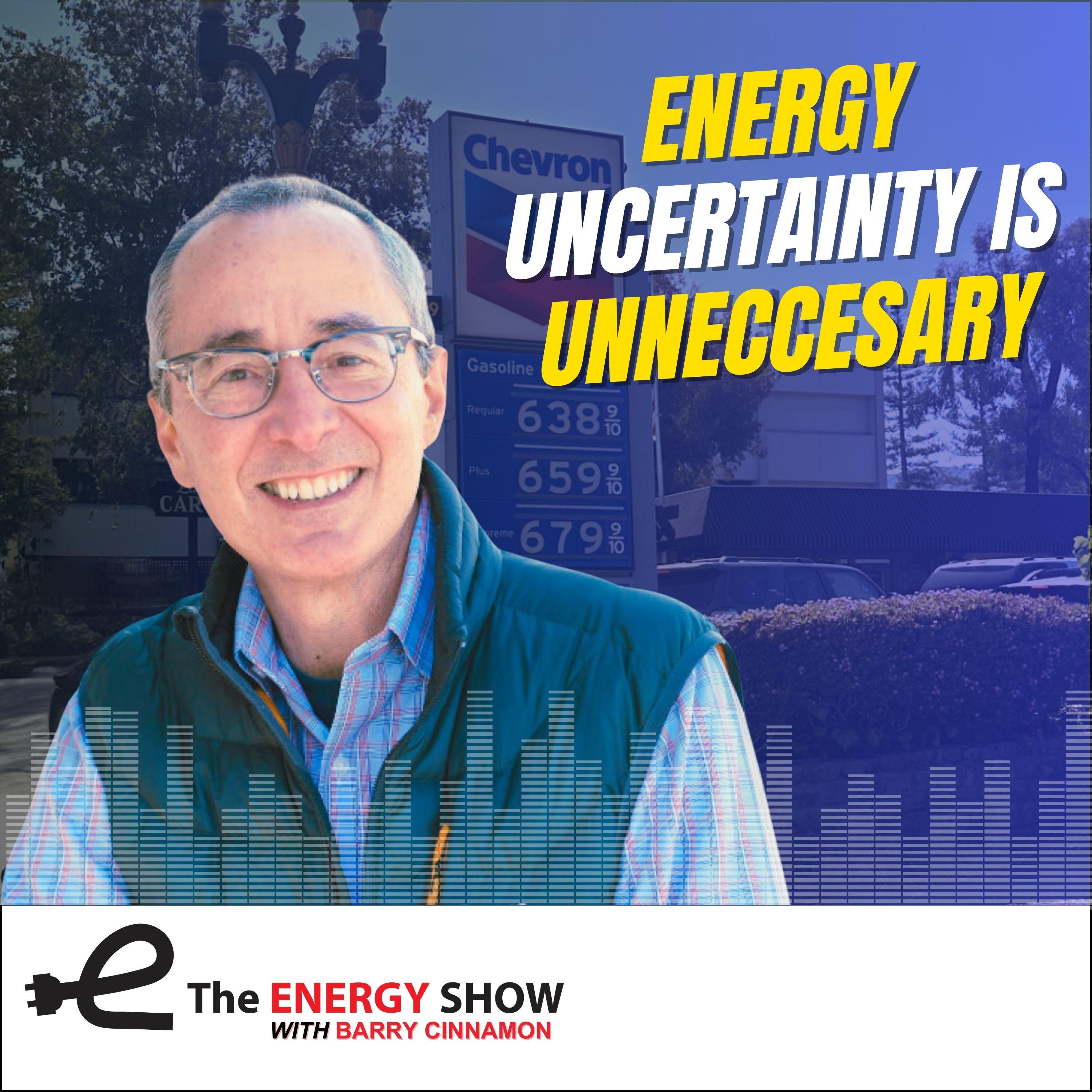
About this episode
Since our worldwide economy depends on a steady supply of fossil fuels — oil, gasoline, natural gas, LNG, jet fuel — even the mere threat of disruption can cause a large and long-term increase in energy costs. Especially energy that is generated from burning hydrocarbon molecules, which have to be physically transported in pipelines and tankers. But not so much for energy that is generated from photons (I bet you know where I’m going with this).
During the first two weeks in March, 2026, Iranian drones set ablaze four oil tankers with a combined total of about 750,000 barrels of petroleum products. That’s less than 1% of the world’s daily petroleum consumption. Nevertheless, the price of oil went up by 40%. Not because of a real supply shock, but because of the new uncertainty about future oil supplies and prices.
No one really knows how long Iran will be able to threaten shipping and energy production throughout the Persian Gulf. Until there is peace in that region there will be uncertainty about fossil fuel energy prices. But there are ways to reduce this uncertainty and avoid energy price spikes.
In this episode:
• Why U.S. fuel prices rise in the U.S. even when we are the biggest oil producer in the world. Hint: the solar and battery tax credits (still available) were a quid pro quo for fossil fuel exports.
• How global oil and natural gas markets determine prices — not political jawboning.
• How rising natural gas prices affect electricity and food costs.
• Why solar, batteries, and electric vehicles reduce exposure to fossil fuel volatility.
To cap it all off, we’ll explain what you can do to isolate your home and business from skyrocketing energy costs.
Get every episode summarized
Each time The Energy Show publishes, we email you a written briefing from the transcript — the topics, who appeared, and any specific claims, with the ad reads skipped.
Email me new episodesFree for 3 shows. No card needed.
Hosts & guests
Transcript ready
330 searchable segments. Every word is indexed and playable.
Full transcript
The Energy Show — Energy Uncertainty Is Unnecessary. Machine-transcribed; use the interactive transcript above to jump the player to any line.
So, you want to save the world with clean energy? Make money doing it? Confused about the economic and technical realities of residential and commercial solar? Batteries, heat pumps, EVs? Want the real-world scoop on new energy technologies not manufacture hype? Then tune in to the weekly energy show hosted by Barry Cinnamon. Insights from Barry's 40-plus years in the solar and energy industry will help you understand the future ways we'll generate and consume energy. And now, here's Barry. Welcome to this week's energy show. It's towards the end of March. The entire world right now is embroiled in the worst energy crisis since the 70s. Oil prices have shot over $100 barrel. Gasoline prices are nearing $4 or gallon. They're already over 5 here in California. And natural gas prices are nearing $4 a term. These prices went up really fast. And they may also go down, not as fast as they went up.
And when they're going down is a big question. Maybe soon, if the Iran war is completely over, maybe drag on for months if shipping is in any way threatened in the streets of Hormuz. But really, nobody definitely knows. You hear rumors going around that the drive oil spikes up down 10%. It's a craft shoot. Now, we're in the odds of March. They were a bad time for Caesar. And they're likely a bad time for anybody using fossil fuels for transportation, electricity or heating. And especially anybody who's trying to predict these fuel prices. The price spikes right now are purely the result of war in Iran, specifically the closure by Iran of the straight of Hormuz. They didn't run a chain across it, but they're threatening shipping at that narrow gap. So 20% of the world's oil and 20% of the world's liquefied natural gas goes through the streets of Hormuz. The majority of these fossil fuels are from the companies in that Gulf, Saudi Arabia,
Iran, Iraq, Kuwait, Bahrain, Qatar, UAE, and Oman. They have to cross a 25 mile wide body of water. That's the narrowest part of the street. And actually, that's the width of the street, but the shipping channel is quite a bit narrower. So it's not really too hard to close that off if you have drones, if you have boats are going to shoot, if you have submarines, if you have mines. So but you may wonder, it's kind of unplexing. Why do we in the US really care? We produce all the energy we need in the US. We're told that the US is energy independent, and I don't doubt it. We produce net, all of the oil, gasoline, natural gas, all the fossil fuels call that we need. Now, we still import some and we export a bunch. But our supplies of these fossil fuels in the US are unaffected by the closure of the straight of Hormuz.
Now, I'll give you a little bit of background. Here's a little remembered fact. Only people that are really battling the solar industry for 20 years remember this. There was something called the Consolidated Appropriations Act of 2016, and it had two directly related changes. First, it allowed oil and gas companies to sell their products overseas. And second, it extended the solar investment tax credit until 2021. So basically, US Hormuz and businesses got a 30% discount on solar, and oil and gas companies could sell their products on the world market. Because previously, oil and gas companies could not export their products, which kind of makes sense, because then we would use what we need. And at the time, also, there was some shortages. But it's a real bizarre coincidence in retrospect, because it has an enormous impact on our US fuel costs. The fact that oil and gas companies can export their product.
Now that oil and gas companies can sell their products overseas to the highest bidder, our prices here in the US are affected by worldwide supply and demand. So as you know, economics, when supply goes down, or supply is even threatened like now, world prices of that commodity go up. And oil and gas are commodities that trade on the world market. Now the interesting is, anytime you sell something for more money, you make more profits. So the oil and gas companies can make way more money by selling their products overseas. Why should they sell oil in the US to a refiner for $60 a barrel? When they can sell that same oil to countries in the world, around the world, that at one point this last week, we're willing to pay $120 a barrel. It's the same thing for natural gas. Why should they sell their natural gas for $2.5, $3 a term? When there are countries all over the world that are dying to get natural gas and liquefied
natural gas for over $4 a month. The oil and gas companies won't admit it, but closing the straight of hormones meant billions of dollars more profits. These companies don't care if prices go up in the US. In fact, they actually want these higher prices, because it's great for their bonuses and stockholders. All right. So that's the background. That's why we're seeing $5 gasoline. Now, even if the war in Iran is over, quote, soon unquote, God knows how it was soon. It could be a few weeks. It could be a few months. It could be six months. Or if the straight of hormones is suddenly guarded by the United States and people say it's wide open, the conflict's likely to persist in the Middle East. And the conflicts are persisting, obviously, in Ukraine and Latin America. It's not really hard to have a drone shoot down or attack ships in the straight of hormones. It Iran is very good at shooting those drones out. And they're hard to shoot down. And so even if we have, if we're guarding all the oil tankers with US ships, it's not
inconceivable that one or two are going to get blown up with a round drone. And as soon as that happens, the shipping companies are going to say, hey, wait a minute, we're not going through that narrow channel. We're going to ship our oil in some other way or just not pump it out. And so result, even if we can do something, there's going to be worldwide energy uncertainty. And I think that's going to keep fossil fuel prices relatively higher. They're going to be up around $125 a barrel. I don't know. But Iran has shown that it's very easy to disrupt the world by blowing up a few tankers. All right. So I was discussing the war in Iran with my wife and the impacts on our budget, the impacts on us. And we kind of look at each other and we're like, we're kind of oblivious because unless we actually look at the news or we pay attention to gas stations that we pass on the way to work, we don't go to the gas station anymore. We don't buy natural gas because for our heating or our cooking, we have EV chargers at the office. We have an EV charger at home. The electricity we're using for those at the office at home comes from solar.
And we also have heat pumps at home. So we don't even look at the price of natural gas. That's fluctuating widely. James Carvel, a democratic strategist, and he's still on TV all the time, coined the famous phrase, it's the economy stupid during Bill Clinton's successful 1992 presidential campaign against George W. Bush. Now, when it comes to energy prices, I'm going to paraphrase James Carvel. It's the uncertainty stupid. It's not the actual actions. It's the uncertainty. Boy, that topic was just pounded home again today when one of the US cabinet secretary said that we're escorting successfully a ship through the straight of foremost, and then that turned out to be not true. Oil prices went down as soon as he sent that text out, and then oil prices bounced back up like within hours when that text turned out to be not completely true. So right now, the reality is the gas stations in the US have plenty of gasoline.
The refiners have plenty of crude oil. There's adequate natural gas and storage tanks around the country, and there's plenty of natural gas and oil being pumped out of the ground. But because of the uncertainty, oil, gasoline, diesel, jet fuel, and natural gas prices right now are spiking. My wife was going to make reservations to travel, and a flight that used to cost us like 800 dollars yesterday now costs us almost 3,000. So the airlines are dramatically raising prices because their fuel prices have spiked. So people freak out immediately, and logically so, when they see gas prices at the pump every week. It's like a big bulletin board right in front of your face saying, hey, wow, gas is really expensive. That's obvious. And those bulletin boards at the filling stations are like over $5 now and even more for diesel. People don't see their electric and heating bills for a few months, and those are going
to reflect higher natural gas prices. Certainly around the country, a lot of electricity is generated with natural gas. It's mostly transitioning to solar. But the heating is very popular throughout the US using natural gas. And that the price of natural gas is shown on your gas and electric bill in terms of thermos. I think the last time I looked at it was like between $2.5 and $3. Now I'm reading that it's closer to $4. That's going to be a problem for heating and electricity bills. But the other thing, especially with regards to natural gas, is we use a lot of natural gas to make fertilizer. We use it because the fertilizer allows us to grow crops more effectively. So it's likely that we're going to see food prices go up due to higher fertilizer costs. It's not, it's a secondary effect, but that's what people are predicting. Now what's also interesting to me is the natural gas prices are rising faster than the oil prices. Even though we produce lots and lots of natural gas in the US, where the biggest producer,
much of it is for export. But once again, natural gas prices are set by the world market. The natural gas companies are saying, hey, do I want to ship it onto this thing called the Henry Hub, which is how it's distributed throughout the US, or do they want to send it to one of the overseas terminals, like in Louisiana, which puts it on giant, liquefied natural gas ships, they liquefied it, and then they can ship it around the world, tremendous demand for natural gas around the world. So speaking of natural gas. One of the biggest facilities in the world is Qatar's LNG facility, and that's in the Persian Gulf. It's very vulnerable to attack. It's just kind of right on the water side. It's with an range of drones, and I wouldn't be surprised if Iran makes a big effort to target that. Now, it's not good for Qatar, but it's going to create tremendous ongoing uncertainties. Now, maybe the Iranian government, if or how it changes, is going to say we're not going to attack any of our neighbors, but I believe that it makes a lot of sense for Iranian government just because of the way they are to continue this high price.
It hurts everybody around the world, and it gives them leverage. The thing about natural gas is it's harder to move than crude oil. Crude oil is easy to put on a tank, it's easy to pump. Natural gas, you need the pipelines are a little bit more complicated, they need compressors, and liquefying that natural gas is very complicated because you need refrigeration systems, and that's giant equipment. I believe that those natural gas prices are going to go up, they're going to stay up, and gradually we're going to see some increases in our food prices. I don't think natural gas is going to go down as fast because it takes a long time, like more on the order of a month, to start up these natural gas plants. Even if, say, by the end of March, everything's hunky-dory in Iran, and there's no longer a war there, prices will come down gradually, but we're not going to see a significant reduction in oil or natural gas prices, probably until the end of April, at best. They're all closed down to this uncertainty, and that uncertainty is a leverage that bad actors have, like Iran, over the straight-of-formose, that we've identified.
We've seen it happen. It's not a surprise. One drone hitting an LNG terminal or hitting a tanker just literally blows up the prices of fossil fuels around the world. Let's take a look and say, hey, what can we do? The obvious, and this is quite a bit self-centered, but the obvious is, let's look at what the cheapest energy source is right now. It's actually solar coupled with batteries. That's solar and batteries on a home, solar and batteries on a business, solar and batteries at a number of huge utility-scale solar and battery forms. It troubles me that this cheap, clean, easy-to-ramp-up energy source is called the Green New Scam. That's insulting. The real scam, in my view, is calling global warming a hoax and renewable energy systems inadequate. I think I was looking at statistics, something like over 60% of the electricity capacity they was added in the U.S. last year is solar. Obviously, the majority of new power plants are going to be solar.
They're fast to deploy, and they're really, really cheap. It makes logical sense that the deploy clean energy systems everywhere, homes, businesses, parking lots, solar forms. The alternative is, and we've talked about this before, the alternative is installing more natural gas generation systems, keeping all plants running, making gas cars instead of EVs. We have this whole data center emergency in the United States right now trying to find ways to power data centers. The obvious way to do it is with solar and batteries, and that's also a fast way to do it. But the federal government really prefers a drill-baby drill, natural gas. There's a tremendous demand for natural gas turbines going in locally at every data center around the country, because that's the way the data centers could kind of with this administration. Guarantee that they're going to have power, instead of getting that power from solar and wind. Candidly, I'm really concerned that the U.S. auto manufacturing business is doomed. The transition to EVs is inevitable.
Yes, there's a lot of circumstances where maybe you need a big pickup trucking or doing long distance trucking or something where it's nice to have a gas or diesel engine. But the vast majority of vehicle trips are perfectly addressed and fine with electric vehicles. Now, I get it from the automaker standpoint that big pickups in SUVs are more profitable than EVs. But from a worldwide standpoint, the world is getting away from internal combustion engines. EVs are getting to be cheaper. Every prices are coming down, they're plummeting, and yet at the same time, with $5 gas prices, the sales of large vehicles, large pickups, diesel trucks, SUVs, they're going to literally take. And in spite of efforts by the administration to stop or slow down the EV industry, making it difficult to make batteries, convincing the automakers to close down the EV plants, there's going to be a spike in demand without a doubt for EVs.
Kind of taking a step back. Here's what we as a country could do. This is what I would do if I were in charge. It might be a dangerous thing, but I don't think I can do any worse. I change our federal policy back to quote, all of the above energy policy, not just fossil fuel, not just renewable energy, but all of the above, nuclear, fusion, whatever, geothermal. Let's keep doing R&D, but in the meantime, let's make sure we're deploying technologies which are ready to go and fast and that are going to meet our immediate short and medium term needs. The result is putting in secure, reliable, and affordable energy with a diverse mix of both renewables, solar, wind, geothermal, hydro, I don't know where nuclear fits in in there. It's not necessarily renewable, but it's clean. And then also non-reduable sources of energy, like oil, natural gas, and coal. A mix. Don't just put your thumb on the scale and say, hey, we're going to keep all the old coal plants open and pollute the hell out of the environment and those areas.
That's what we're cutting back on wind turbines. That doesn't make sense. We want to do everything. Now, how to do that? Well, it's not just a matter of declaring it, but we have to restore and simplify the incentives, the tax credits for all types of solar. We have to restore and simplify the tax credits for heating systems, heat pumps, terrific way of heating at home. We should restore and simplify the tax credits for electric vehicles. And when it comes to renewable energy and solar in particular, we want to rationalize our batteries. We want to rationalize our clean energy manufacturing policies to cover the entire supply chain. If we build a big battery factory, but we put a tremendous tariff on certain cathodes, or if there's a huge tariff on solar cells, then it doesn't make as much sense to manufacture in the U.S. And I've watched this happen for 20 years in the solar industry, where we say we want to manufacture solar panels, but we put a huge tariff on the main components that we need.
No surprise, things don't really take off. The right way to do it is gradually build the entire supply chain. Companies have started to do that. It's terrific. And then a new administration comes in and pulls the rug out from under them. I think about all the huge battery factories that were already in progress here in the U.S. And then they're shutting them down. So that's what the country should do. But here's what we as individuals could do. We should vote for politicians who want a diverse mix of energy resources. I'm not saying no fossil fuels. I'm not saying only renewables. I'm not saying only nuclear. We want diversity and we want to support everything. But we want to focus on the technologies that are ready to deploy fast, because we did this energy really fast. We need to continue our energy efficiency efforts. That really helps. We want to install, obviously, my take, we want to put solar and storage on all available buildings, all available rooftops, parking lots everywhere we can. And we want to encourage people to buy electric vehicles.
And that's going to mean making sure that it's a charging infrastructure. That may mean making sure that we've got the supply chain growing. And that may mean re-incentivizing the U.S. manufacturers to manufacture those things domestically. To wrap up, I hope that the war in Iran is over quickly. And I hope that worldwide energy supplies become more certain. I expect that the federal energy policies will eventually change just because you can't fight against the superior economics of solar and wind. And eventually they're going to become, again, more balance between renewable and fossil fuels. But I don't expect the current administration to switch away from their emphasis on drill baby drill. It's too bad, but they're very, very stubborn. They're totally committed to that. And that's where they're getting a lot of their money. So in the meantime, I'm confident that homes and businesses will do what they can to reduce energy costs that are under their control. And I hope that people will vote for politicians that have an energy plan that makes good economic sense.
That's all the time we have on this week's Energy Show. Thanks for joining me. And thanks to all of our listeners for tuning in. If you missed any of today's show, you can go to our website at EnergyShow.biz and listen to the podcast. Thanks for tuning in to this week's Energy Show.
More episodes
More from The Energy Show

Raghu Raps on Rising Sun Opportunities
The Energy Show

No Tax Credit, No Problem. The New Math for Home Solar.
The Energy Show

VPP: Your Battery's Side Hustle?
The Energy Show

DIY Home Energy Hacks That Slash Electric Bills
The Energy Show