Loading...
societycultureplaces
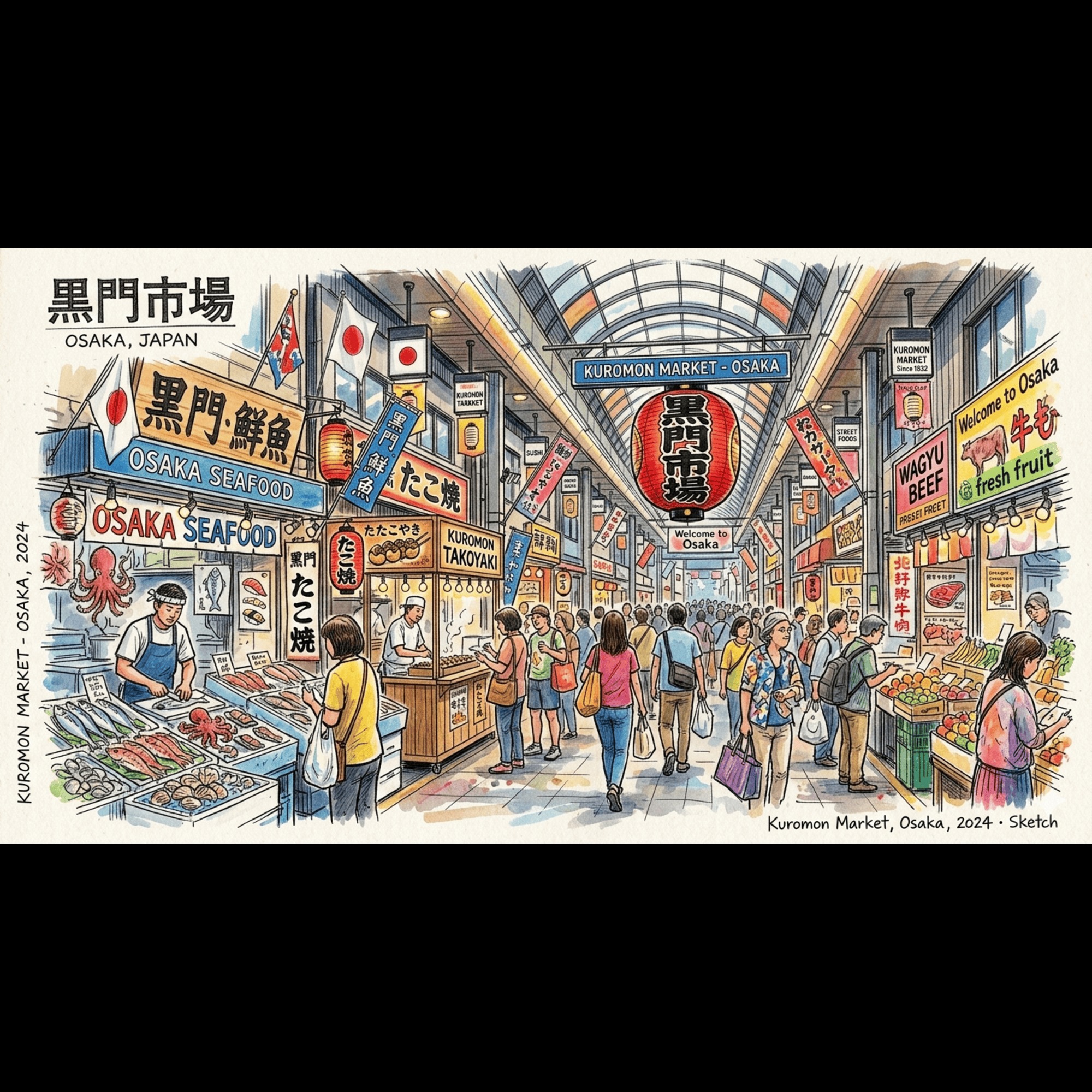
(ENG) Evolution and cultural significance of Osaka’s Kuromon Market
About this Episode
This comprehensive research report explores the historical evolution and cultural significance of Osaka’s Kuromon Market, famously known as the city's kitchen. It traces the market's origins from a nineteenth-century religious gathering spot at Enmyo-ji Temple to its reconstruction following the 1912 Namba fire and World War II. The text highlights the market's specialized pufferfish (fugu) culture, its essential role in supplying high-end traditional restaurants, and the expertise of its professional merchants. Finally, it analyzes the modern transition of the district into a global tourism hub, addressing the resulting tensions between commercialization and local heritage.
The Unwritten Pages of Yesterday 細 聽 長 風 說 舊 河
Hosts & Guests
Transcript
Welcome to The Deep Dive.
Thanks for having me.
So today we're talking about Kormon Market.
It's famous worldwide as Asakas Kitchen.
But what looks like this bustling Polish tourist hotspot today
is actually the product of two devastating fires
in illegal pufferfish black market
and just centuries of relentless urban survival.
It really is a remarkable piece of research
we're looking at today.
Yeah, we are getting into some incredibly fascinating material.
We're looking at a comprehensive academic
and historical research report
that unpacks over 200 years of this market's evolution.
Two centuries, that's a lot of ground to cover.
It is.
And our mission for this deep dive is to explore
five captivating historical stories of resilience.
We want to uncover how these stories created hidden gems
that you can still visit today as a tourist
and reflect on what this means for the modern evolution of cities.
Right, because when you look closely,
Kormon Market ceases to be just a place to buy food.
It reveals itself as a living laboratory of urban resilience.
We're going to see how an informal gathering of fish mongers
adapted to sweeping governmental changes,
wartime destruction, and, well, the intense pressures of modern globalization.
Okay, let's unpack this.
To really understand the DNA of this market,
we have to go back to its origin.
The early 1800s.
Yeah, roughly the early 1800s.
What's known in Japanese history as the Bunse era
between 1818 and 1831?
The sources describe a spontaneous morning market forming.
Just completely organic.
Right, fresh fish merchants just began gathering and setting up shop
right outside the western gate of a large temple
called in Muyoji Temple.
And I'm curious why there was it just a convenient open space
or was there an economic reason they chose a temple gate?
That is a great question and it's crucial context for understanding
the urban landscape of the Ido period.
Back then, temples were not just quiet,
religious sanctuaries.
They were busy.
Very busy.
They functioned as highly active nose
for population movement and commerce.
The space right in front of the temple gates,
often called the Monsamachi or Temple Town,
was primary estate.
Ah, so the merchants wanted the foot traffic?
Exactly.
But also, temples offered a protected sacred space
where merchants could operate with a degree of implicit shelter
from the chaotic, highly regulated secular city.
Like a safe zone.
Essentially, yes.
Which allowed these merchants to form a natural organic community.
Initially, this gathering was just called the Muyoji Market.
And the defining feature of this temple according to the research
was its massive, famously painted black gate.
The black date, yes.
Which is interesting because that physical structure
doesn't even exist anymore.
This brings us to a massive turning point in the market's history.
The Namba Fire.
Right.
In January 1912, the Namba Fire ripped through the southern part of the district.
The numbers in the reporter staggering.
It destroyed around 5,000 homes.
5,000.
That's just catastrophic.
And tragically, it burned in Muyoji Temple right to the ground,
taking that famous black gate with it.
What's fascinating here is how the aftermath of that disaster
played out.
The temple itself never rebuilt in that location.
Really?
Where did it go?
It actually relocated far away to what is now the,
he got Shishumiyoshi Ward.
So physically, the black gate was completely wiped off the map.
Just gone.
But the physical absence of the gate
birthed an incredibly powerful enduring brand.
The local people, the merchants,
they simply refused to let the name die.
They just kept calling the area Kuremon.
Which literally translates to black gate.
Exactly.
The symbol of the market outlived the physical structure
that gave it its name.
Wait, so the government is dealing with this massive tragedy.
5,000 homes gone.
Did they just let the merchants rebuild their old,
organic temple market in the ashes?
Not at all.
The city government actually used the blank slate
left by the fire to execute a massive
top-down urban reorganization.
Okay, so they took control of the layout.
They initiated a land improvement project
that effectively swept away the old,
messy, narrow alleyways of the Ido period.
They replaced them with a much more modern grid system.
Oh, that makes sense.
Yeah, they built the wide Sunnichmadori avenue,
complete with a tram line.
This wasn't just about paving roads.
It was about modernization.
Right, integrating this once isolated temple market
directly into Osaka's modern transit grid.
And perhaps most importantly,
in that exact same year, 1912,
Kuremon was officially recognized by the government
as a public market.
So it transitioned from an informal gathering of stalls
into a legitimate, modern, commercial entity.
Precisely.
It's wild to think about how a disaster
essentially forced the market into the modern era.
And if you are walking through there today,
the physical evidence of this reorganization
is all around you.
It really is hiding in plain sight.
Yeah, so when you visit Kuremon market today
and walk under that massive 580 meter arcade,
noticing how neatly organized the grid layout is,
you aren't just walking through a standard shopping street.
No, you're not.
You were walking in the direct architectural aftermath
of the 1912 Namba fire.
And when you look up at the main entrance,
it proudly displays the Kuremon brand.
You are literally staring at a monument
to a ghost gate that hasn't existed for well over a century.
It is a striking example of how spatial memory works in a city.
The physical gate is gone,
but the cultural capital of the black gate is stronger than ever.
They harnessed a memory to build a brand.
An indestructible identity, really.
While that fire fundamentally reshaped
the market's physical footprint,
the research highlights that an even bigger rebellion
was happening underground.
With the food.
With the food itself.
I saw on the notes that Fugu Pufferfish
was actually illegal for centuries.
Highly illegal.
The sources mentioned that back in the late 1500s,
the warlord Toyotomi Hideyoshi
noticed his soldiers kept dying from eating it
during military campaigns.
Because of the poison.
Right, so he strictly outlawed it.
How in the world did Kuremon market get away
with selling something so lethal
if the bands were that strict?
It is a classic tale of folk expertise
outsmarting official regulation.
The bands were incredibly severe.
By 1882, the government was enforcing
explicit fines and detention
for anyone caught eating or serving Fugu.
Wow, detention.
Yeah.
There was a brief exception made in Yamaguchi prefecture
in the city of Shimonoseki in 1888.
Why there?
Well, as the story goes,
the Prime Minister visited a restaurant there,
the owner bravely served him Fugu
and he was so moved by the taste
that he lifted the ban locally.
Okay, but in Osaka.
It remains strictly illegal,
operating in a very murky,
unacknowledged gray area for decades.
But the people of Osaka clearly didn't care about the law.
Because the research notes that by the 1940s and 50s,
a staggering 60 to 80% of all the Fugu
in the entire country of Japan
was flowing directly through Osaka.
It's amazing.
That is absolute black market mastery.
How do they pull that off
without a massive public health crisis?
Because Shimonoseki didn't yet have a mature auction market,
the national supply naturally flowed
to where the true expertise lived.
That was Kuraman Market.
The experts were there.
The middle men there, known as Nakagai,
possessed the most advanced,
meticulous preparation techniques in the country.
Because the laws were so strict
and the fish so lethal,
they couldn't afford a single mistake.
One mistake meant death.
Exactly.
Which would bring the police,
which would shut down the entire elicit operation.
So they developed an intense,
rigorously disciplined apprenticeship system.
You had to earn your way in.
You didn't just learn to cut fish,
you learned a life-saving surgical technique
passed down from master to student.
This specialized underground knowledge
effectively neutralized the danger of the fish itself.
I just love the visual the source material provides
for this era.
Picture this.
You're walking through the market in the 1950s
and you see bicycles zooming around the narrow streets
completely stacked with these specific wooden boxes
called Toro Bako.
All filled with Fugu.
All filled with Fugu.
This bustling, incredibly well organized open secret.
And because of this intense history,
you can still see the remnants
of this culinary rebellion today.
Right now, about 10% of the fresh fish dolls
in Kormon market are still Fugu specialists.
That's a huge concentration.
It is.
And many of these are not new pop-up shops
catering to tourists.
They are historic institutions
that survive that gray area era.
That's the real hidden gem for a tourist.
Yes, exactly.
If you visit, you can look for historic spots
like Kormon Minami,
which was founded way back in 1875.
Or Nishikawa Singyoten, founded in 1956.
Right.
When you order a plate of
expertly prepared Fugu from these vendors today,
you are just having a nice meal.
You are partaking in what was once a deadly
illegal act of culinary rebellion.
It perfectly illustrates how a market can act
as a technical fortress.
They professionalize something the government deemed too dangerous.
And by doing so, they preserved a cornerstone
of Osaka's culinary identity.
Here's where it gets really interesting, though.
Because these high-level skills
weren't just for everyday folks wanting
to risk their lives for dinner.
The research details how Kormon market
acted as a literal combat supply base
for professional chefs.
Yes, the Edame.
The elite chefs working in the high-end
Minami district, which was famous
for its highly exclusive
traditional dining and entertainment houses.
Those chefs had practically
unreasonable standards for their ingredients.
After the match.
They needed the absolute best summer
hammer-pipe conger
and the most perfect winter Fugu.
They didn't go to the market looking for a bargain.
They went looking for perfection.
And they went every day, right?
Every single morning.
They personally visited Kormon to source it.
It was a daily battle of widths and quality
between the chefs and the fishmongers.
That brings up a huge question for me.
In 1931, the city of Osaka opened these massive
modern central wholesale markets.
Right.
Logically, a smaller private market
like Kormon should have been absolutely crushed
by the scale and efficiency of those new
state-backed giants.
Why did Kormon survive that?
If we connect this to the bigger picture,
it comes down to a fundamental business logic.
Artisanal curation versus mass supply.
Quality over quantity.
Exactly. Central wholesale markets are designed
for volume, homogenization, and logistics.
They move massive amounts of standard goods efficiently.
Kormon survived and thrived
because it operated on hyper-specialized
quality and deep personal trust.
The chefs trusted the Nakagai.
It was a rigorous business to business
or B2B relationship built over decades.
The Nakagai and Kormon were curating
the absolute top-tier individual items
that the central market simply couldn't
consistently provide to an elite chef.
They weren't just selling fish.
They were essential partners in the restaurant's success.
Without a doubt.
And the physical evidence of this deep B2B symbiosis
is another thing hiding in plain sight for you today.
While most tourists are understandably distracted
by the flashy street food and giant crab legs,
you really want to look closely at the dry goods stores.
The dry goods stores are fascinating.
There are shops like Haseya founded in 1897.
Historically, stores like this
didn't just sell standard ingredients off the shelf.
No, they offered bespoke services.
Right.
They created highly customized secret ratios
of bonito flakes and kelp for specific restaurants.
So those chefs could make their signature dodgy.
Their soup stock.
That is a phenomenal example.
A specific ratio of kelp to bonito
literally creates the foundational flavor profile
for a restaurant.
It's the DNA of their menu.
The dry goods merchant wasn't just a supplier.
They were a co-creator of that restaurant's culinary identity.
So if you want to see the real heartbeat of the market,
look past the crowds taking selfies
and spot the professional chefs
who are still quietly sourcing their elite
custom ingredients in the exact same way they have
for over a century.
It adds a layer of professional authenticity
that persists just beneath the surface
of the modern tourist experience.
Speaking of that modern tourist experience,
we need to talk about how Kuruman transitioned
into the global hub it is today.
And that transition was born out of yet another total destruction.
The war.
Yeah.
We talked about the 1912 fire.
But in March 1945 during the World War II fire bombings,
the market was turned to absolute ashes again.
Almost all of the wooden structures were obliterated.
But the recovery this time wasn't driven
by a government land improvement project.
It was the locals.
It was astonishingly fast
and it was driven entirely by the Kuruman Nakama,
the market comrade.
The Kuruman Nakama.
These surviving merchants rapidly banded together,
set up temporary stalls in the burned out ruins
and essentially built a massive life-saving black market.
Out of sheer necessity.
They leveraged their old pre-war supply networks
to pull desperately needed food
into a starving post-war Osaka.
By 1948, this raw survival effort had formalized
into an official union.
They literally fed their community back to life.
But survival in the mid-20th century
didn't guarantee survival in the 21st.
Things changed again.
As we moved into the 2010s,
Kuruman faced an entirely new kind of existential threat,
one that couldn't be fought with a rebuilding effort.
They were hit with a rapidly aging local population
and the sheer convenience of modern supermarkets.
People just stopped shopping locally as much.
The traditional customer base,
the local housewives,
and the sheer volume of neighborhood chefs
was shrinking rapidly.
To survive, Kuruman had to adapt once again
and it pivoted heavily.
To tourism.
It transformed itself into a destination
for inbound global tourism.
And that pivot,
birth, the massive Taburiki culture you see today,
the culture of walking and eating.
As a visitor, you can enjoy this incredible fusion
of historical resilience and modern convenience.
It's very vibrant now.
Very. You can look out for Nikuno Kobayah
founded in 1930,
which evolved from a neighborhood a wholesale butcher
into a place serving incredible Kobe beef skewers
right on the street.
Or New Dalney?
Oh yeah, New Dalney
founded in 1948 where you can taste the exact style
of post-war Osaka curry
that helped comfort a rebuilding city.
The market has even built an 80-person
rest center with multi-language support
to handle the massive international crowds.
However, it is crucial that we look
at this modern evolution objectively
as the researchers do.
Our sources provide a very necessary
critical reflection on this 21st century pivot.
It wasn't entirely smooth.
Academically, this transition is viewed
as a sharp conflict between the marketplace
as life space versus the marketplace
as consumption space.
That sounds a lot like the classic
gentrification controversy we see
in major cities all over the world.
What does that actually mean for the locals
who have lived around Kurum for generations?
It means a profound disruption of their daily lives.
The transition to a tourism-focused model
has brought undeniable economic prosperity
to the stall owners,
but it has also led to skyrocketing prices
often referred to as tourist prices.
Right, the locals get priced out.
Think about it from a local perspective.
When your neighborhood butcher
pivots from selling affordable cuts
of pork for a family dinner
to selling high-margin wagyu beef skewers
to tourists,
way do you buy your groceries?
You have to go somewhere else.
The sources highlight that this shift
has alienated the traditional local housewives
and the local chefs who can no longer
afford to treat Kurum as their daily supply base.
That makes sense.
There is a tangible documented friction
between preserving a local lived-in community
and catering to a transient global consumer base.
We aren't here to judge
which economic model is right or wrong,
but the research makes it clear
that this tension is a very real,
very complex part of Kurum's current identity.
It is a messy reality.
And honestly, the history itself is messy.
The sources even point out
that historians debate the true origins of the market.
There's some disagreement, yes.
Well, the official brand's story focus
is heavily on the and Mugee temple in the Black Gate.
Some academic researchers analyze old maps and argue
the market actually started in the neighboring Nagaracho area.
And the wartime records are sparse.
Exactly.
Because of the 1945 fire bombings,
there is a massive lack of official records
from the WWE I.I. era,
leading parts of how the market operated
during the war, a total mystery.
We are really dealing with the space
where memory, myth, and commerce all blend together.
Which is exactly why this kind of deep historical research
is so compelling.
It forces us to look past the glossy tourist brochures
and grapple with the fascinating reality
of how urban space is actually evolved.
So what does this all mean?
When we look at 200 years of devastating fires,
illegal puffer fish, intense chef rivalries,
and modern gentrification,
what is the ultimate takeaway?
The researchers synthesize this incredible history
into what they call the Kurumon model.
It rests on three core pillars.
Okay, what's to them?
First, the inheritance of spaces and symbols.
A market can lose its physical landmarks
like a giant black gate,
but if it harnesses that memory,
it can build an indestructible brand.
The ghost gates.
Exactly.
Second, professionalism as a moat.
Kurumon survived against massive,
state-backed central markets
because of its specialized elite knowledge.
The Fugu masters and the Dashi experts.
They had skills you couldn't mass produce.
Their artisanal skill was an economic shield
that volume couldn't beat.
And third, pragmatic adaptation.
The pivots.
From a quiet temple market to a chaotic black market
to a highly polished global tourist hub,
the market's survival relied on its willingness
to shed its old identity,
the moment it no longer served the present reality.
And why should you, the listener, care about this?
Because the next time you visit a bustling tourist market,
whether it's in Osaka or London or Mexico City,
you'll realize that you aren't just looking at food stalls.
There's a whole world underneath.
Beneath the skewers of meat,
the bright signs and the matcha ice cream,
lies a hidden, deeply layered architecture of survival.
You are walking over the ashes of old fires,
passing through historic legal loopholes,
and witnessing centuries of urban history
hiding in plain sight.
Understanding those layers completely
changes how you experience travel.
It absolutely does.
And this raises an important question,
something for you to consider long after this deep dive ends.
I love a good thought experiment.
Think of the philosophical concept of the ship of Thesius.
If you replace every single wooden plank on a ship over time,
is it still the same ship?
If a physical market loses its original landmark,
burns down completely to the ashes not once, but twice.
And entirely replaces its core customer base
from local chefs and neighborhood families
to a revolving door of global tourists.
At what point does it become an entirely new entity?
Is it still Kuraman?
Exactly.
Is Kuraman market genuinely still the same 200-year-old market?
Or is it a brilliantly modern commercial invention
simply wearing a historical memory as a mask?
Oh, man, that is such a phenomenal question to chew on.
I love that.
Thank you so much for joining us on this incredible deep dive
into Kuraman market.
It has been an absolute blast unpacking this history
with you today.
Until next time, keep exploring, keep questioning,
and we will catch you on the next deep dive.