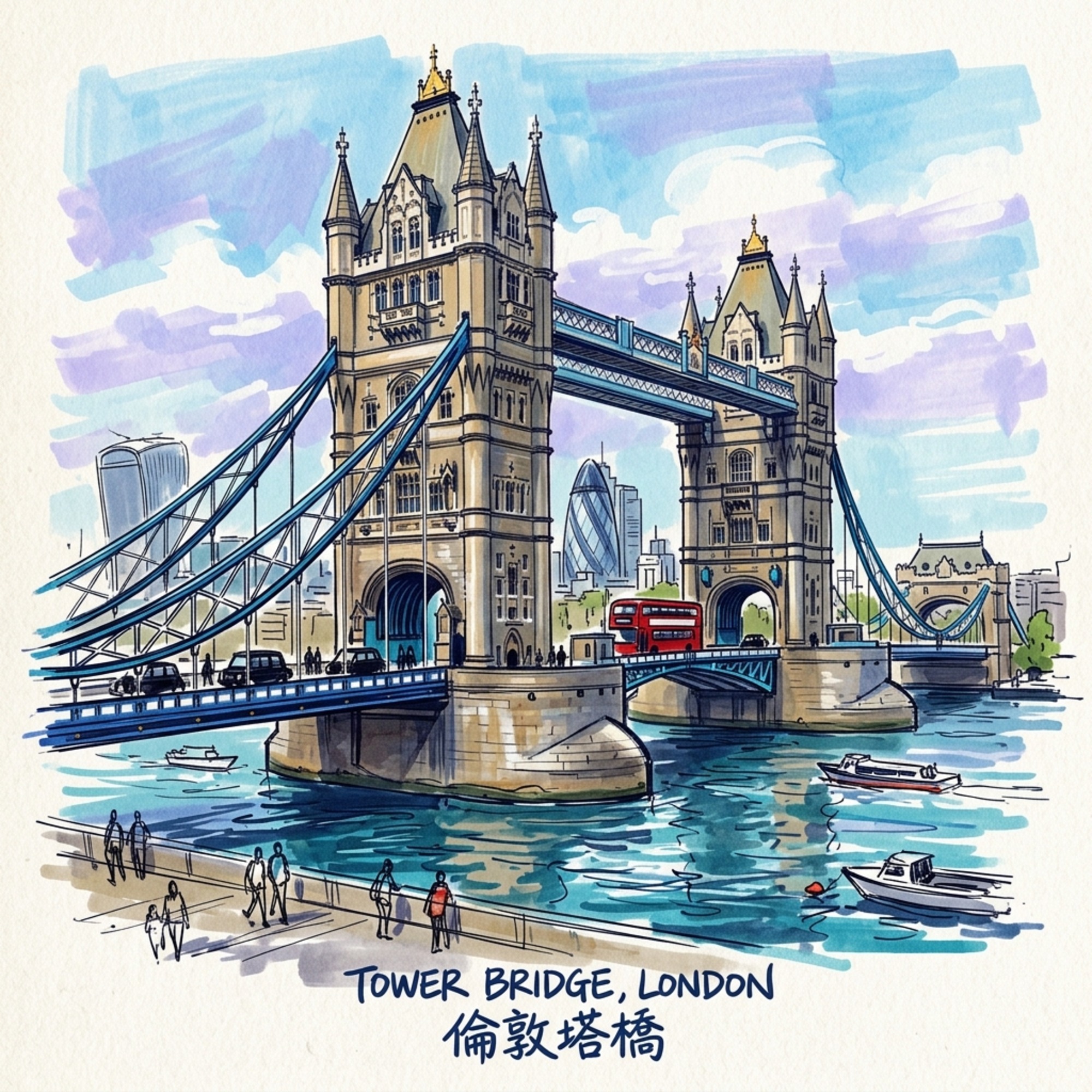
ENG-London’s Tower Bridge Spans Millennia of Sacred Geography and Culture
About this episode
These documents provide a specialized historical dossier and a corresponding narrative protocol centered on Tower Bridge in London. The dossier analyzes the bridge as a multidimensional threshold, tracing its significance through pre-Roman sacred geography, Roman hydraulic engineering, and medieval maritime law. It specifically rejects speculative ley-line theories in favor of documented archaeological and cultural patterns, such as the ritual deposition of artifacts in the tidal Thames. The accompanying writing protocol instructs researchers to synthesize this archival data into immersive, sensory-rich stories that honor the location's native cosmological framework. Ultimately, the sources aim to reframe the landmark not just as a Victorian feat of engineering, but as a site of persistent collective trauma and historical resonance.
The Unwritten Pages of Yesterday Listen carefully to the long wind and speak of the old river
Support this podcast at — https://redcircle.com/shows/cfc0e32d-c1fc-435f-8d4b-b3f5fb352872
Read the full story with photos and day itinerary on my website⬇️
🔗 Website – Historical Travel Stories (5 languages): https://www.lawrencetravelstories.com
- Japanese historical travel stories: https://www.lawrencetravelstories.com/japanri-ben/
- Hong Kong historical travel stories: https://www.lawrencetravelstories.com/hong-kong-xiang-gang/
- Taiwan historical travel stories: https://www.lawrencetravelstories.com/taiwan-tai-wan/
- The UK historical travel stories: https://www.lawrencetravelstories.com/united-kingdom/
The Unwritten Pages of Yesterday 細 聽 長 風 說 舊 河
Get every episode summarized
Each time Historical Travel Stories💕旅行の歷史故事 publishes, we email you a written briefing from the transcript — the topics, who appeared, and any specific claims, with the ad reads skipped.
Email me new episodesFree for 3 shows. No card needed.
Hosts & guests
Transcript ready
643 searchable segments. Every word is indexed and playable.
Full transcript
Historical Travel Stories💕旅行の歷史故事 — ENG-London’s Tower Bridge Spans Millennia of Sacred Geography and Culture. Machine-transcribed; use the interactive transcript above to jump the player to any line.
You know, you look at a standard tourist map of London and everything just looks so perfectly resolved. Yeah, it really does. You've got the neat, clean blue ribbon of the river Thames winding its way right through the center. You know, you've got the little cartoon icons for the Tower of London. And right there, straddling the river is the ultimate symbol of Victorian engineering. Tower bridge. Exactly. You look at that map and it just looks like a completely closed case, like a problem definitively solved by, you know, steel and stone. Right, because it projects this illusion of total civic control. The whole idea that the modern city has completely conquered the raw nature of the river. But then you actually go down there. You stand on that muddy foreshore when the tide pulls back and you smell the silt, you see the currents churning against the banks. Yeah, it's a completely different vibe. And suddenly that neat little map feels like a complete lie. Because what you're actually looking at is a geographic boundary that is honestly anything but
resolved. Oh, that's a loop. And that is exactly where we are going today. Welcome to the deep dive. We are throwing out the tourist map today. Love it. We're looking past the rivets and the postcard views of Tower bridge. And we are going to explore a hidden 3,000 year old cosmological pattern right in the middle of London. So to really grasp what's happening here beneath the surface, we need to introduce this specific concept. It asks what historians and geographers refer to as the Lehman perpetuous. Okay, the perpetual threshold. Exactly, the perpetual threshold. Because for three millennia, successive civilizations have tried to manage this exact geographic boundary. Because it's the spot where the river changes, right? Right. This is the precise spot where the tidal tems separates the inner protected harbor from the wild open sea. It is literally the boundary where order meets disorder. And every single civilization that is set up shop on these river banks has had to figure out what on earth to do with that chaotic energy. Yeah, they really have. So let's wind the clock way, way back to start.
We're talking about roughly 1500 BCE moving into the iron age. Way back. Right at this specific bend in the tems near where Tower bridge sits today, archaeologists have been dredging up just thousands of artifacts from the mud. And you know, we're not just talking about ancient trash that fell off a boat. No, not at all. We are talking perfectly intact bronze age swords, intricately decorated iron age shields. Ceremonial helmets. Yeah. And yes, human skulls. Lots of them. And we know this was an accidental loss. Either this was highly deliberate. Okay, so why were they putting all this stuff in the river? Well, to the pre-Roman Celtic Britons living there, the river wasn't just a body of water or a shipping lane. They worshipped a river goddess, Tameza. And she was essentially a boundary keeper. Wow. Now the key physical fact about the tems at this specific location is that it's title. It physically reverses its flow twice a day. The ocean pushes in and then the river pushes out.
Exactly. And in their cosmological framework, this reversing current wasn't just the title cork. It was viewed as a bidirectional conduit to the underworld. Which they called dub-nose, right? Right, dub-nose. So depositing these pristine weapons wasn't accidental. It was a highly structured, votive offering to manage this permeable boundary between the living and the dead. Okay, let's unpack this. Because my first thought when I hear about people throwing things into water is, you know, tossing a penny into a wishing well. Sure, yeah. A little token for good luck. Right. But when you think about the sheer value of a pristine bronze age sword, I mean, the amount of heat, labor, and rare materials required to forge that, this is way beyond a penny in a fountain. Oh, absolutely. This is a massive wealth transfer. Why were they throwing their absolute best technology into the mud? Was it like an astronomical toll to the underworld? That's actually the perfect way to look at it. A bronze sword in that era represented immense wealth, status, and military power.
Right. By taking that item at the absolute peak of its value and giving it to the river, they were actively acknowledging the overwhelming power of the threshold. They were paying tribute to the guardian of the boundary. The logic is that you have to surrender something of immense value to ensure safe passage across the water. Or maybe to send those objects to the dead. Exactly. The mud and the reversing water physically carried the offering into the supernatural realm. That completely changes how you look at the water. And honestly, for you listening, next time you're in London, don't just look at the artifacts behind glass in a museum. You can actually feel this history. You really can. Yeah. You just head to the Burmanzee foreshore at low tide, specifically near Chambers' Wharf, which is just a bit downstream from Tower Bridge. I highly, highly recommend doing that. The sensory experience down there is just profound. It was like, well, when the time goes out, you experience this sudden, steep drop of, you know, two to three meters. And you are stepping right onto the prehistoric riverbed.
Oh, wow. Yeah. And you could literally smell the oxidizing organic sediment. The mud is thick and dimpled and just ancient. That is incredible. By stepping down onto that foreshore, you are physically stepping into that ancient cosmological threshold. You are standing in the exact mud where those vote of offerings were made. It's like a time machine hidden in plain sight. Exactly. But of course, the Celts aren't the end of the story. Because history doesn't just stop. It gets built on top of. Right. So, let's say we move forward to around 43 CE. The Romans arrive, they conquer, and they found Londonium. But they don't just pave over this pagan idea of a sacred river, do they? No, not at all. They actually engineered into their own city. The Romans were incredibly pragmatic about religion. They didn't want to upset the locals too much. Right. Exactly. They utilized a process called interpretatio Romana. Which basically means translating Indigenous gods into Roman ones.
That's spot on. Instead of destroying the local belief systems, which tends to breed rebellion, they would recognize the sacred energy that the Indigenous people had already assigned to a location. And then just rebrand it. Basically, yeah. They would seamlessly layer their own Roman religious practices right over it. They translated the sacred geography into a vocabulary they understood. And that brings us to this fascinating little buried river called the Wallbrook. Yes, the Wallbrook. This was a tributary of the Thames, flowing into the main river about 500 meters west of where tower bridges today. And the Romans essentially turned this stream into the sacred hydraulic axis of their new city. We really did. Now, fast forward a couple thousand years to 1954. London is still heavily scarred by World War II bomb damage, their clearing rubble, and construction workers unearthed something incredible on the banks of this buried stream. The Temple of Mithras. Yes, a Roman Temple of Mithras. And the public response was absolutely wild.
Tens of thousands of Londoners queued up for hours, winding through the bombed out streets just to look at these ruins. Yeah, it was a huge deal. It was like they desperately needed to see this proof of ancient continuity amidst all their modern destruction. What's fascinating here is how deliberate the Romans were in choosing this exact spot. The mystery cult of Mithras was incredibly popular with Roman soldiers, right? And it required flowing water for its initiatory rights. So by engineering their temple directly on the banks of the Wallbrook, they were synchronizing or blending their own theology with the pre-existing sacred nature of the Thames and its tributaries. So the river was still this magical threshold. It was just functioning for a different god now. Exactly. It just blows my mind how quickly a city can bury its own history. I mean, think of the Wallbrook, like a hidden nervous system running under London. It was the sacred axis of the Roman capital. Yeah, it was everything. But by the year 1800, that entire nervous system was totally erased by urban infrastructure.
It was forced underground enclosed in brick sewers, literally paved over so people build more streets. It really raises an important question about what civilizations choose to build over and what we choose to remember. Because the stream itself never actually stopped flowing. We just stopped looking at it. Right, we just built a new reality on top of it. But the coolest part is that you can still experience it today. If you go to the city center, you have to visit Bloomberg Space at 12 Wallbrook. Yes, definitely. The modern Bloomberg building was constructed right over the Temple Ruins, and they did something brilliant. They preserved it. They built around it. Yeah, so you get to experience what archaeologists call reverse stratigraphy. Okay, what does that feel like? Well, you enter this modern sleek building, and then you descend a ramp in a darkened room, going about seven meters below modern street level. You're literally walking down through the centuries. Exactly. And when you reach the bottom, you're standing on the original 1800 year old Roman Opusignanum floor.
And just to clarify for everyone, Opusignanum is that incredibly durable, waterproof concrete the Romans made, right? Yeah, the one they made by crushing up terracotta roof tiles and mixing it with lime mortar. Right, it has this distinct pinkish hue. That's the stuff. And the atmosphere down there is striking. The air is noticeably cooler, mimicking the feeling of a mithraya cave. Oh, that's awesome. But the most incredible part, if you stand quietly enough in that reconstructed temple, you can still faintly hear the Walbrook stream. Oh, way. Yeah, it is still flowing right behind the modern basement walls. You're standing on Roman concrete listening to a buried river that the Keltz worshiped. It is just magic. It really is. But of course, the river isn't just about sacred offerings and subterranean temples. The threshold has a much darker, much more brutal side. It does. Moving into our next era, we pivot from sacred Roman temples to the cold, hard reality of maritime law.
Because centuries later, this exact same title river was once again used to transition bodies from the world of the living to the dead. But this time, it was at the end of a rope. Yeah. We are moving into the 16th to 19th centuries now, the era of British naval dominance. The High Court of Admiralty held its maritime executions at a place called execution dock in Warbing. Which is just a slightly downstream of Tower Bridge, right? Right. This is where notorious pirates, including the famous Captain Kid, met their end. But the Admiralty didn't give them a standard quick hanging. No, they didn't. They were hanged at the low tide mark with a deliberately shortened rope. Which means no quick drop to break the neck. It was death by slow strangulation. Precisely. It was designed to be agonizing. And after death, their bodies were coated in tar to preserve them, placed in custom-made iron cages called gibbets. Oh, man. And left suspended on poles right at the water's edge. This was for all the inbound maritime traffic to see as they sailed into the pool of London. It is so incredibly grim.
It's like a literal billboard made of human remains. It really was. But the truly crazy part to me isn't even the gibbet. It's the bureaucratic rule they followed for the execution itself. The three tide rule. Yes. The Admiralty legally required that the condemned body be left hanging on the rope until it was washed over by three successive tidal cycles. Only after three tides could the body be cut down. It's wild. I mean, hold on. They left them for three tides. That's not just a public execution. That's a bizarre bureaucracy of death. Why three tides? Well, if we connect this to the bigger picture, it is astonishing. The secular, highly legalistic admiralty of the Tudor and Georgian eras unknowingly perfectly replicated the ancient Celtic river ritual. Wow. They used the tidal threshold, the reversing water, to physically and legally transfer a person out of the social world. So what does this all mean? Were these stuffy Tudor lawyers secretly practicing pagan rituals in their spare time? Unlikely. Or does the specific geography,
this literal tidal line in the mud, just forcefully compel human beings to invent rituals about crocking over? It's definitively the latter. The geography itself is just that imposing. The shift from the chaotic, dangerous, unregulated open sea to the highly regulated, safe, law-abiding city is so extreme that humans instinctively require a ritual to manage the psychological transition. It's like a decompression zone. Exactly. Yeah. The admiralty needed a terrifying way to say to a rising sailors, you know, you are now leaving the chaos of the ocean. You are entering the strict law of London. Behave. Right. The water physically claiming the body three times was their way of secularizing the boundary. But they relied on the exact same spatial logic as the Druids thousands of years earlier. It has the exact same script, just a different cast of characters, and you can actually go stand at this exact boundary today. Yes, you can. Down in Ropping, there is a narrow little alleyway right beside the historic prospect of Whitby Pub.
You just walk down it, and it leads you to Wapping Old Stairs. You're a remarkable vantage point. When you walk down those stone stairs and stand at the tide line, you have a direct, unimpeded visual line to Tower Bridge, which is about 800 meters away up the river. Just looming there. Right. You can stand exactly where those pirate jibits used to swing in the wind, look at the bridge, and perfectly understand the entrance to the regulated zone of the city. Wow. Tower Bridge today marks the exact threshold that those gruesome pirate displays were meant to protect. Which perfectly sets up our next shift in perspective, because for thousands of years, civilizations were dealing with the boundary at the water level. Right. In the mud. But in the late Victorian era, the 1890s, the Victorians decided that wasn't enough. They wanted to conquer this boundary vertically. They wanted to soar over it. So they built Tower Bridge in 1894. And to understand Tower Bridge, we have to look at the social geography of London at that time. It wasn't exactly pretty. No, it wasn't. There was a pioneering social researcher named Charles Booth who created these famous,
color-coded, poverty maps of London. He went street by street. Wow. And the areas on both sides of where Tower Bridge was built, Burmese, Southwerk, Tower Hamlets, were heavily coded, dark blue, which meant very poor, and black, which meant semi-criminal and destitute. Wait, I'm confused. If Booth has poverty maps clearly showed this area was incredibly destitute, why did the Victorians decide to build this massively expensive, high-tech, jewel of the Empire Bridge right on top of it? Weren't they just asking for trouble? Well, they built it because the commercial docs demanded it. The port was choking on its own traffic. Oh, so it's about money. Always. Yeah. They needed a bridge to move cargo across the river, but it had to be a bridge that could open to let tall-masted ships pass through. Hence, the massive steam-powered baskets, the drawbridge arms that swing upward. Exactly. But this created a problem for pedestrians. If you are a dock worker trying to get to your shift and the bridge opens for a ship, you can be stuck waiting for an hour.
So the Victorian engineers came up with a quote-unquote solution. They built two high-level glass-paneled walkways spanning between the two towers, 42 meters up in the air. Quite the climb. Yeah. The idea was that when the drawbridge was raised, a pedestrian could just walk up the stairs in one tower, cross the high-level walkway and walk down the other side, which was a beautiful engineering concept on paper. Right, on paper. But it introduces the phenomenon of architectural displacement anxiety. The engineers completely ignored human nature. To use the walkways, a pedestrian had to climb 206 stairs. Which if you've just finished a 12-hour shift doing manual labor at the docks, is not happening. You're not climbing 200 stairs. Exactly. The public entirely ignored the stairs. They preferred to just stand at the bottom and wait for the bridge to lower. I don't blame them. Right. So almost immediately, these high altitude and closed glass corridors were abandoned by commuters. And nature of whores of vacuum. Right. Very quickly, they were colonized by the extreme poverty
they were built directly over. Oh, wow. Yeah. They became hidden hotspots for pickpockets, for sex workers operating out of sight of the police, and tragically a favored spot for suicides. It got really dark up there. It did. The situation became so dangerous and unmanageable that the city was forced to completely close the walkways to the public just a few years later, around 1910. Here's where it's really interesting to me. Look at the design of the towers themselves. They are covered in this grand ornate, gothic stonework, right? Yes. It was a political argument in stone. The Victorians are trying to project this illusion of medieval permanence of total civic order. Absolutely. But it failed instantly, because you cannot just build a fancy glass roof over systemic poverty and expect the poverty to magically disappear. The destitution didn't vanish. It just climbed the stairs. Precisely. The Victorians trying to aestheticize the boundary. They tried to dress the threshold up in a costume to make it look noble and governed.
Right, covering up the mess. But the social reality of the city simply occupied the architecture. The threshold asserted itself again, just in a vertical dimension. It couldn't be contained. No, think about it psychologically. The walkways were suspended between the gritty city below and the open sky above. They belonged to neither realm, which made them a magnet for people who felt they had no place in the rigid social order down on the ground. It's a really tragic space, but today you can actually visit those high-level walkways. You can, yeah. They reopened in the 1980s as part of the Tower Bridge exhibition. You buy a ticket, you take a comfortable modern elevator up, and you can walk across them. And when you do go up there, I want you to look for the modern glass floor panels they've installed in the walkways. It's a little terrifying. It is. But step out onto the glass, look straight down, 42 meters past the road deck, past the cars, all the way down to that sacred, churning river below. Wow. And while you were standing there, notice the temperature. Because it is fully enclosed in glass,
it gets quite warm and stuffy up there on a sunny day. Like a greenhouse? Yes. Feel that greenhouse warmth. Because that is the exact atmosphere condition experienced by the desperate marginalized Victorians who originally populated that space before they were locked out. Hmm. You are physically standing in their suspended reality. It is genuinely haunting when you frame it that way. And that towering, unmistakable visibility, the grand, gothic towers meant to project British imperial power to the world. Well, that leads us right into our final chapter. It does. Because 50 years later, in the 20th century, that grand visibility completely inverted. The bridge's greatest aesthetic triumph became its greatest vulnerability, leading straight into the fires of World War II. Yes. During the London Blitz between 1940 and 1941, the German Luftwaffe relentlessly bombed the port of London. It was devastating. Truly. The East End and the Bermann Zee Docs surrounding the bridge were utterly destroyed. We are talking about whole neighborhoods, generations of communities just wiped off the map
in firestorms. Yeah. Yet remarkably, tower bridge survived largely unscathed. Okay, let's unpack this. Churchill is out there ordering fire watchers and sandbags to protect St. Paul's Cathedral at all costs. But tower bridge, which is arguably the biggest, most obvious target on the river, somehow survives when everything around it is turning to ash. How does that happen? Well, it comes down to the psychogiography of survival. It survives specifically because it was useful to the people dropping the bombs. Wow. The Luftwaffe navigated at night using systems like NikaBine. Okay, let's explain NikaBine for a second, because it's a fascinating piece of tech. Right. NikaBine translates to crooked leg. It was a radio navigation system where the Germans had broadcast two invisible intersecting radio beams from continental Europe over Britain. So like a massive crosshair in the sky. Exactly. Where the two invisible beams crossed in the night sky over London, that was the X marking the spot to drop the bombs. Right.
But technology being what it was, the bomber crews still needed visual confirmation from the air to ensure they were actually hitting the port. They needed to see it. Yes. And the distinctive, sharp bends of the river Thames, combined with those highly visible twin gothic towers of Tower Bridge sticking up into the moonlight, created the perfect visual crosshair. So it wasn't that the British were defending it better. Tower Bridge likely survived simply because the Luftwaffe pilots needed to see it to know where they were. That is the tragic irony of the bridge. The monument that was built by the civic authorities to supposedly serve the local and povrish communities was less standing by the enemy. While the community was destroyed. Right. While the very people it was built for burned in the streets below. It's such a brutal transaction when you look at it that way. The architecture literally traded the lives of the locals for its own survival. It really did. It's height made it iconic. Because it was iconic, it became a perfect map marker for bombers. Because it was a map marker,
the pilots didn't want to destroy it. And because it was a center of the map, it doomed everything in its immediate shadow. That's exactly it. And if you want to observe this physical living memorial to the Plytz's bomb damage map, there is a specific spot you should find. Okay. Where is it? Go stand at the junction of Burmese Street and Long Lane on the south side of the river and look north toward the bridge. What exactly are we looking for there? You will see the untouched ornate Victorian Gothic bridge rising completely anomalously above a sea of very plain utilitarian 1950s and 60s brick housing estates. Oh, wow. So the contrast. Yes. The original Victorian terraced houses that used to surround the bridge where the dock workers lived are completely gone. Replace by post-war concrete and brick. So you can literally see what survived and what didn't. Right. The visual contrast between the surviving ornate bridge and the rebuilt brutalist housing is stark. Is the clearest architectural evidence
you will ever see of who survived the blitz and who didn't? Okay. So let's tie all of these threads together because it is quite a journey we've been on. A lot of history. We've gone from pre-Roman Celtic warriors throwing bronze swords into the mud to Roman initiates worshiping in buried temples. To tutor Admiralty executioners hanging pirates on the tide line. To Victorian engineers building last walkways in the sky all the way to lift off a pilot using Gothic towers to navigate fire bombers. Right. And if you read a traditional history book it treats these as five completely separate unrelated eras. But they're not. Yeah. If we look in the spatial reality they're all connected. There are five different civilizations trying and ultimately failing to resolve the exact same spatial problem. The Lyman perpetualist. Yes. The perpetual boundary between order and disorder. The Celtic druids, the Roman soldiers, the tutor lawyers, the Victorian architects and the German navigators all converged on the exact same geographic fact. They all brought their own cultural vocabulary to the Thames
desperately trying to govern and control the crossing. Exactly. And so here's our ultimate recommendation for you. If you really want to experience the true genius the real spirit of this place you don't need a guidebook and you don't need a museum to get. Definitely not. You just need to check the Port of London authorities website for the daily title schedule. That's right. Find out the exact minute of low or high tide. Go stand on the pedestrian walkway of Tower Bridge or go down onto the whopping or Burman Z-Forshore and just watch the water. Just stand there at the exact minute the tide is scheduled to turn. Watch the massive current stop flowing toward the sea. Watch it pause, hold its breath, and then start flowing backward, pushing its way deep into the heart of the city. It happens twice a day, every single day with immense force. It's wild to see. It is. And this raises an important question and it's the thought I want to leave you with today as you plan your travels. Okay, what is it? Well, for 3,000 years powerful empires have built temples,
gallows, and massive gothic towers to claim ownership of this crossing. They have layered concrete and maritime law and tons of steel right over the mud to prove they are in control. Right. But if the title river beneath all of that still reverses direction twice a day, completely indifferent to human infrastructure who was actually in charge of the city. It turns out that neat, resolved little tourist map you started with. The one with the clean blue river and the pretty bridge icons. It's really just the latest layer of paint on a wild threshold that absolutely refuses to be closed. Beautifully put. Thank you so much for coming along on this multi-dimensional journey with us today. Keep questioning the map, look for the boundaries, and we'll see you on the next deep dive.
More episodes
More from Historical Travel Stories💕旅行の歷史故事
JPN-数千年にわたる神聖な地理と文化にまたがるロンドンのタワー・ブリッジ
Historical Travel Stories💕旅行の歷史故事
FRA-Le Tower Bridge de Londres embrasse des millénaires de géographie sacrée et...
Historical Travel Stories💕旅行の歷史故事

SPA-El Tower Bridge de Londres abarca milenios de geografía sagrada y cultura.
Historical Travel Stories💕旅行の歷史故事

CAN-倫敦塔橋橫跨數千年嘅神聖地理同埋文化演變(廣東話)
Historical Travel Stories💕旅行の歷史故事