Loading...
societycultureplaces
(ENG) the historical evolution of Nakanoshima, an island in Osaka
About this Episode
This research report examines the historical evolution of Nakanoshima, an island in Osaka that transitioned from a feudal trading hub to a modern civic and cultural center. It highlights the area's pioneering role in global finance, specifically through the development of the world’s first organized futures market at the Dojima Rice Exchange. The sources also trace the rise of modern education and Western medicine at the Tekijuku school, which cultivated leaders of the Meiji Restoration. Furthermore, the text illustrates how private philanthropy from wealthy merchants and industrial families funded iconic landmarks like the Nakanoshima Library and Central Public Hall. Ultimately, these records depict a profound shift in land use, where former samurai estates were repurposed into public parks and democratic spaces. Through these narratives, Nakanoshima emerges as the intellectual and economic heart of Osaka’s transformation into a cosmopolitan city.
The Unwritten Pages of Yesterday 細 聽 長 風 說 舊 河
Hosts & Guests
Transcript
Imagine for a moment that you're just you're standing on a narrow three kilometer long sand bar right and it's right in the middle of a bustling
Metropolis right all around you. You've got these sleek skyscrapers rivers reflecting neon lights the whole hum of modern city life. Yeah, the classic Osaka vibe
Exactly, but beneath your feet on this this little sliver of land in the middle of Osaka lies a history that
Quietly birthed modern global finance. It's incredible. It really is. It dismantled a centuries old social hierarchy and it hides these really heartbreaking
personal tragedies behind some of the most striking architecture in all of East Asia.
So welcome to the day's deep dive our subject is Nakano Shima the true heart of Osaka's water capital and it is such a remarkable
Geographical space. I mean most people looking at a map. You know, they just see an island. Yeah, just a strip of land in the river. Right
But diving into the historical record Nakano Shima functioned as this intense highly compressed historical laboratory. It was the the exact friction point where in
French traditional power structures violently collided with the chaotic rapid rise of early capitalism and intellectual rebellion too. And the
Guide us through all that friction today. We are pulling from a massive comprehensive source. It's the historical research report on
Nakano Shima Osaka. It's a fantastic dossier. It really is. We are totally throwing out the glossy tourist brochures for this one. Our mission today is to dig into five pivotal historical events that
It occurred right on this specific sand bar. And we're going to uncover the hidden physical artifacts you can actually go see right now. Yes, and reflect on how this tiny stretch of land
Fundamentally shaped modern East Asia. Okay, let's unpack this. We're starting in the 17th century with our first story, which revolves around the Dojima
Rice Exchange, the absolute economic powerhouse of the era. Right. The research dossier paints Nakano Shima as the central nervous system for the national economy at the time. But I was reading this and wondering how did one single island handle the sheer physical volume of all that tax
Rice flowing in from the domains. Well, the short answer is they couldn't. Yeah, and that bottleneck was actually the catalyst for an incredible leap in economic thinking. The dossier details how the
Doja merchant family who essentially dominated the Nakano Shima area hit this massive logistical wall because moving thousands of physical bags of rice around a three kilometer sand bar every single time a trade happened. It became impossible. Literally
Impossible. So the merchants had to innovate. And what's fascinating here is the sheer level of abstract economic logic they deployed. They realize pretty
quickly that trading the physical commodity was wildly inefficient. So they created rice tickets. So instead of handing over a ton of rice, you just hand over a piece of paper representing a claim to that right. Exactly. But the dossier mentions they took this step further into something called
Choi my book entry trade. How exactly did that work? That is where the true revolution happened. These merchants weren't just trading tickets for rice currently sitting in the Nakano Shima storehouses. They started trading tickets representing the future
harvest. Wow. Yeah. By 1730, the system was officially recognized by the authorities at the Dojima rice exchange. Economists globally recognize this as the world's first organized futures market. That is insane. They beat Western financial markets to this innovation by over a century, right. Easily over a century. And it wasn't some primitive ad hoc system either. The historical records show they had centralized clearing houses, standardized contract sizes and even margin trading.
Margin trading in the 18th century. Yes. You could leverage your capital, just like a modern hedge fund manager, all happening right there in 18th century Osaka, which naturally leads to the merchants getting unimaginably wealthy. Oh, beyond wealthy. But the dossier focuses heavily on the fate of that Yodoya family in 1705. If they were the architects of this brilliant financial system, why did the government suddenly turn on them and confiscate absolutely everything they owned? It really comes down to the fundamental paradox of the era.
The merchants controlled the entire economic reality of the country. They were literally bankrolling the highest political and military classes who were while they were chronically short on cash. Right. Land rich, but cash poor. Exactly. But under the rigid social hierarchy of the time, merchants set at the absolute bottom below artisans below farmers. Right. So the authorities looked at the Yodoya family, saw them living in these extravagant estates with gold leafed roofs and decided they had to
cross an invisible line. It was a threat. It was. The confiscation was a brutal unilateral demonstration of political power over merchant wealth. In a single day, the government erased the wealthiest family in the country under the pretext that they were just living beyond their designated social station.
That clash between wealth and power leaves such a profound legacy. And if you visit Nakano Shima today, there's actually a brilliant physical marker of this financial revolution that you can go see. Oh, the ando piece. Yes.
If you walk to the north side of the Nakano Shima garden bridge, you'll find this massive, highly polished, stainless steel sculpture. It was designed by the world renowned architect, Tadau Ando. It's stunning. It is, but tourists constantly walk right past it. Assume it's just, you know, abstract modern art, but it's actually a monument called a grain of rice. It marks the spiritual epicenter where global financial futures were born. Next time you're there, stop and look at that giant
metal rice grain and realize you're standing at ground zero for modern finance. And that transition from physical commodities to abstract thought. It sets the stage perfectly for the next major shift on the island, because just as Nakano Shima revolutionized commerce, it was about to revolutionize the intellect of the nation. Let's move to 1838 then. The rebellion of knowledge at a school called Tiki Juku. Yes. The dossier highlights a doctor named Ogata Kuan opening this private academy right near the Nakano Shima area. Now during this period of strict
national isolation, Western science, which is mostly called Dutch learning. Yes. Medicine, chemistry, physics. Right. It was slowly leaking into Osaka via texts from Dutch traders. But my question reading this was, how did a school setting foreign concepts survive? Let alone thrive in such a tightly controlled society. It survived because it offered something the rigid class system desperately lacked pure unfiltered meritocracy. Wow. The research report notes that outside the walls of Tiki
Juku society was entirely dictated by your birthright, your clan, and your rank. But inside Ogata Kuan's academy, none of that mattered. Check your status at the door. Exactly. The only currency was your intellect and your relentless dedication to translating and mastering these rare Western texts. It was this high pressure incubator that essentially bred the absolute titans of the Meiji Restoration. And the dossier specifically quotes Fukuzou Yukichi's autobiography here. He was actually born right there and in Nakano Shima's storehouse.
And he wrote about how studying at Tiki Juku made him acutely aware of how absurd and arbitrary the hereditary class system was. It opened his eyes completely. Yeah. You also had students like Omura Matsushiro, who took the engineering and tactical knowledge from those Dutch texts and essentially designed the nation's modern military structure. They were taking foreign data and weaponizing it against the old regime. And their primary tool for this intellectual rebellion was a single, incredibly precious book, the Duff Hauma Dictionary.
Right. The dossier describes this not just as a book, but as the holy grail for these students. It was a comprehensive Dutch Japanese dictionary. And copies were so incredibly rare that the students at Taki Juku had to set up a strict reservation system to use it. It's like fighting for a library book during finals week, but life or death for the country's modernization. Literally, they were pulling consecutive all-nighters in a dedicated translation room, physically fighting sleep, copying thousands of words by hand just to decode treatises on a lecture.
They were desperately trying to catch up with a rapidly industrializing outside world, and that dictionary was their only key. And you can actually feel that desperation if you visit the preserved Tiki Juku building today. There are two incredible hidden gems the dossier points out. First, head up to the second floor and look closely at the central wooden wall pillars. The sword marks. Yes, you will see deep jagged sword marks hacked right into the wood. The students were under so much academic
stress in this hyper competitive meritocracy that they would blow off steam by furiously sparring with real swords indoors, which is terrifying and amazing. Totally. You're literally looking at the physical manifestation of academic anxiety etched into the architecture. And second, look for the display of that famous Dove Hauma Dictionary. The pages are worn to absolute shreds. They're dark and almost completely black by the oil from the hands of exhausted students. It's an unforgettable visual of their hunger for modern knowledge.
The sword intense drive for progress eventually fundamentally changed the cityscape itself, which brings us to our third historical phase. Let's jump ahead to the year 1900. Okay, so the modernization has happened. Yes, Osaka has industrialized at a breakneck pace, and the city is just booming. And the wealthy merchant families of Osaka, the ones who survived that chaotic transition are facing a profound new question. What do we owe to the society that allowed us to amass this fortune?
This fortune leads directly to the Sumitomo Library and the concept that dossier calls aesthetic governance in 1900, the 15th head of the massively wealthy Sumitomo family, Komodune, pledged 200,000 yen to build a sprawling European palestial library entirely at his own expense. Right. And he simply handed the keys over to the city of Osaka. What was the driving philosophy behind giving away such a staggering amount of personal wealth?
If we connect this to the bigger picture, this marks a monumental psychological shift. For centuries, merchants were viewed strictly as wealth hoarders, like the Idoia family. Exactly. But Tom O'June had traveled extensively through Europe and America. He observed Western industrialists funding massive public works, embodying the spirit of mesinat or corporate philanthropy. He famously stated that architecture is the personality of the donor.
The research dossier posits a brilliant, almost defensive strategy at play here as well. A defensive strategy. You mean protecting themselves from the government? Precisely. Remember the trauma of the Idoia family's complete confiscation in 1705? Yeah, losing everything in a day.
That event left a deep psychological scar on Osaka's elite. Even centuries later, the fear that extreme wealth could be arbitrarily seized still lingered.
The dossier suggests that by pouring their vast fortunes into beautiful, permanent, public architecture, specifically institutions of learning that benefited the entire populace, they were weaving their family legacy into the untouchable civic fabric of the city.
Oh, that is incredibly smart. Right. A government can easily confiscate a private bank account. It is much harder to confiscate or erase a family name when it is carved into the stone of the city's most beloved public library.
It was a calculated move to turn private wealth into public heritage. And the physical execution of that strategy is just stunning. When you visit the Osaka Prefectural Nakanoche Memorial Library today, the building itself is a master class in blending cultures.
It really is. The dossier highlights the exterior, which features these massive, imposing Greek Roman Corinthian columns and a giant bronze dome. It projects the authority of a classical Western temple.
But the moment you walk through the doors, the aesthetic shifts, the grand sweeping curve staircase is purely baroque design yet is constructed out of incredibly warm domestic Japanese wood.
The craftsmanship is unbelievable. And my absolute favorite detail up on the wall of the main hall, there's a copper plaque listing the eight sages. It features a mix of intellectual giants placing Confucius and Socrates side by side.
It is a literal physical embodiment of a city absorbing the wisdom of the world and the best part. It's not a museum piece. You can walk in today, sit at a desk and study. It is still a living breathing public library.
It's a triumphant legacy. But as the dossier's fourth major story reveals, the desire to build a grand public legacy can sometimes be deeply entwined with profound personal tragedy.
Yeah, that brings us to Iwamoto, Anasage. He's often referred to as the tragic hero of the red brick hall. The dossier paints Iwamoto as this legendary stockbroker operating in the early 20th century.
This was a period when Osaka's massive industrial output earned at the nickname the Eastern Manchester. It was a gritty, hardworking city. Very much so. But Iwamoto wasn't just a ruthless trader. The record show he was incredibly chivalrous.
He frequently took massive personal financial hits just to bail out his fellow brokers and stabilize the market during panics.
He commanded immense respect in the financial district. And in 1909, he joined a commercial tour of the United States. Much like the head of the Sumitomo family, Iwamoto was deeply moved by the American philanthropic model.
Seating people like Karni. Exactly. He saw Andrew Karni funding libraries and grand concert halls. Iwamoto returned to Osaka convinced that his rapidly growing industrial city desperately needed a world class public gathering space.
So he made a staggering personal donation of one million yen, which translates to billions in today's currency to construct the central public hall on Nakano Shima.
The architectural plans were drawn up. The red bricks were ordered, but the timing was disastrous. What exactly happened to Iwamoto's fortune before the building could even be completed?
The outbreak of World War I in 1914 sent global stock markets into a tailspin. Total chaos. Right. The massive fluctuations triggered brutal margin calls. And Iwamoto, despite his brilliance as a broker, was caught heavily over leveraged in a collapsing market. He lost absolutely everything. His entire personal fortune evaporated in a matter of days.
And the dossier highlights the incredible heartbreaking irony of the situation here. He is sitting there entirely ruined, facing bankruptcy. While just down the street, the city government is sitting on his one million yen donation actively laying the bricks for his grand public hall. Why didn't he just ask for a fraction of it back to save his firm?
His peers practically begged him to do just that. They argued that the city would gladly return a portion of the funds to save the man who had done so much for Asaka's markets.
But Iwamoto's pride and his strict adherence to the merchant code of honor wouldn't allow it. He couldn't go back on his word.
He firmly believed that taking back a public gift once it was freely given to the citizens would be a permanent, unforgivable stain on the honor of an Asaka broker.
So at the age of just 39, Iwamoto sat quietly in his home, wrote a hauntingly beautiful haiku about the inevitability of falling autumn leaves and shot himself.
It's devastating.
He never lived to see his masterpiece completed, yet his gift endured that gorgeous neo renaissance red brick hall survived the heavy bombings of World War II.
It went all the host international historical figures like Helen Keller and Yuri Garen. It truly became the grand civic living room he envisioned.
His ultimate personal sacrifice literally cemented the cultural infrastructure of the city.
To really grasp the weight of that sacrifice, there are two distinct experiences you need to have when visiting the Central Public Hall today.
First, go down to the basement. Tucked away is the Iwamoto Inazik Memorial Room.
It's incredibly sobering. You can read his actual handwritten diaries detailing his market strategies and displayed right there in the glass case is the very pistol he used to end his life.
It's a very heavy room to stand in.
It really is. But then to see what that heavy price bought, you have to walk upstairs.
Go out front and look at the roof line to see the newly restored statues of Minerva, the goddess of wisdom, and Mercury, the god of commerce.
It is the ultimate architectural statement of Osaka's dual identity.
And inside the special room, there is a breathtaking ceiling painting depicting the creation myth of Japanese gods.
You really feel the enduring weight of Iwamoto's gift when standing under that ceiling.
The sheer scale of these architectural marvels, the library, the public hall, brings us to the fifth and final transformation detailed in the dossier.
Because none of these magnificent public buildings would have been possible without a radical physical shift in how the very land of Nakano Shima was controlled and utilized.
Let's talk about the creation of Nakano Shima Park.
Early in the dossier, we noted that during the Edo period, Nakano Shima was packed shoulder to shoulder with storehouses, the Kareishiki.
Over 130 of them.
Yeah. The text describes them as miniature, walled-off, sovereign territories, each strictly controlled by a different domain.
The general public was completely locked out.
So how did the city manage to reclaim all that highly contested real estate by 1891?
Executed a systematic democratization of the space.
Following the collapse of the social hierarchy, those walled storehouses lost their political and economic purpose.
The city government seized the opportunity to tear down those walls entirely.
Just leveled them.
They reclaimed the land on the eastern tip of the island and designed Osaka's very first public park.
The dossier stresses that this wasn't just some urban beautification project.
This was the ultimate physical victory of public accessibility over entrenched exclusive power.
Taken it back for the people.
Exactly. Land that was one strictly guarded samurai story was handed directly over to the citizens.
It rapidly evolved into a vibrant space for newly established public schools, the headquarters of major national newspapers, and a lush public oasis.
The overarching narrative of Nakano Shima is fundamentally a story about the liberation of space.
And the visual contrast you get as a visitor today perfectly captures that liberation.
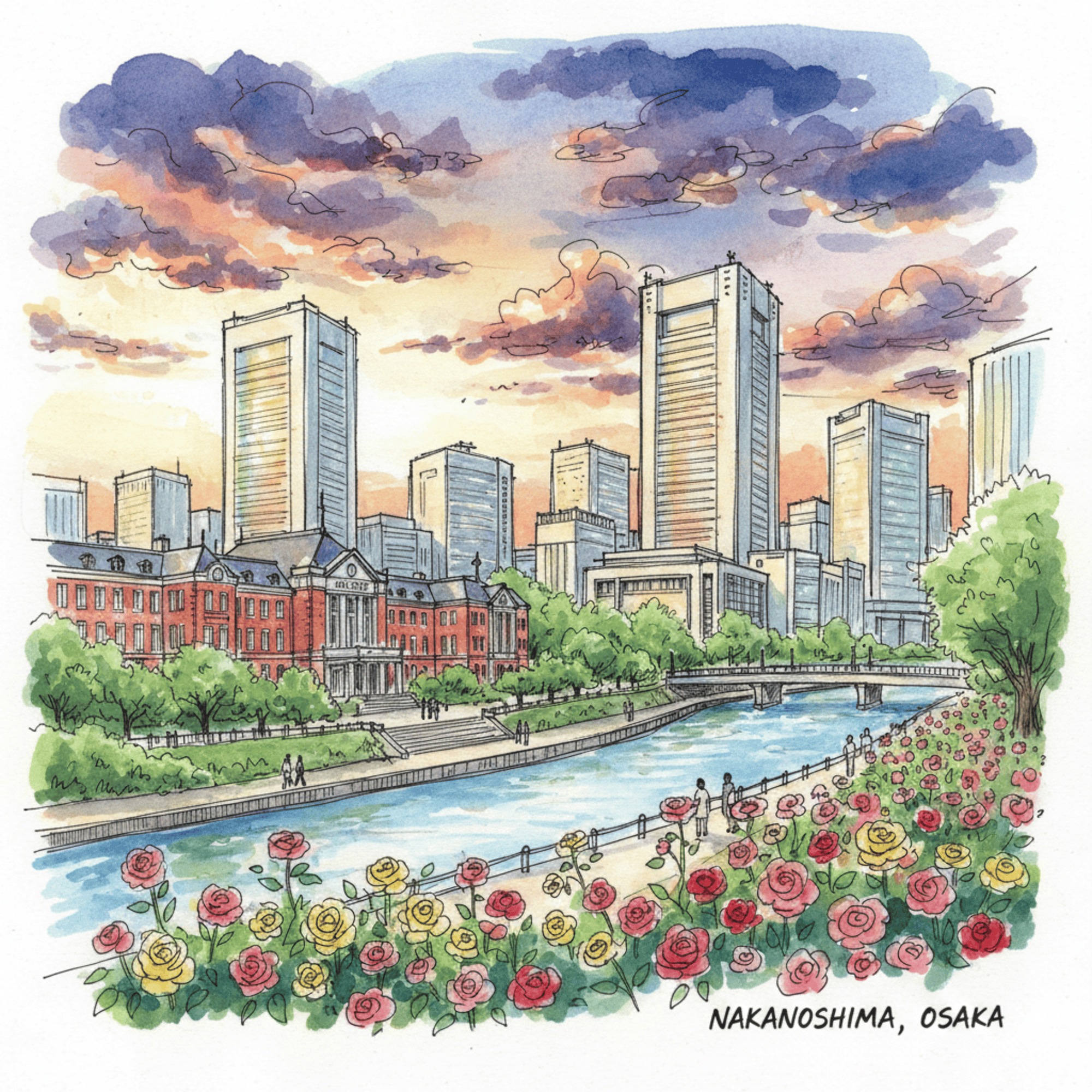
You can stand dead center in the beautifully manicured rose garden surrounded by brilliant soft floral colors and looks straight up to see a jagged imposing skyline of hyper modern glass skyscrapers framing the island.
It's a gorgeous juxtaposition.
It is. And while you're walking the paths, keep a close eye out for these small, easily missed stone markers embedded in the ground.
They quietly indicate the exact historical borders of those old walled off domains right where you're freely having your afternoon picnic.
And the dossier reveals one final hidden secret about the ground you're picking on.
When you look at Nakano Shima, it appears to be a naturally occurring river sand bar, but it is highly artificial.
Right. The urban rockery.
Yes. The research describes it as an urban rockery.
There are centuries through intense dredging of the surrounding rivers, continuous landfill projects and layer upon layer of architectural foundation work.
Human hands and massive civil engineering have entirely shaped and reshaped the physical borders of that island to serve whatever the era demanded.
Okay, let's unpack this. So what does this all mean?
We've traced the journey from guarded rice vaults to a high stress translation academy to grand libraries and tragic acts of philanthropy all layered on top of one highly engineered strip of land.
If we synthesize the vast amount of data in this dossier, a few profound meta patterns really emerge.
First, the speed of commerce and economic innovation on Nakano Shima consistently outpaced government regulation and law.
The merchants were executing complex futures trades long before the authorities even had the vocabulary to regulate them.
They were always one step ahead.
Always. Second, knowledge, once introduced into a society, functions like water.
It will inevitably find a crack in the most rigid social structures, exactly as we saw with the meritocracy at Takajuku.
And finally, we see a fascinating evolution in the wealthy elite who learn to utilize aesthetic governance deploying art, architecture, and philanthropy to transform private vulnerable wealth into an untouchable public good that outlasts any single government or generation.
It fundamentally changes how you experience a modern city.
The next time you find yourself walking through a beautifully landscaped municipal park, or sitting down to read in a grand public library with towering columns, I want you to think about the invisible historical currents that made that space possible.
Think about the fierce political clashes, the brilliant, desperate intellectual innovations, and the individual sometimes tragic sacrifices that had to occur to turn exclusive hoarded wealth into the public heritage you get to enjoy for free today.
Thank you so much for joining us on this deep dive into the hidden layers of Osaka's water capital.
And I want to leave you with one final provocative thought drawn straight from the conclusion of the research dossier.
Throughout this discussion, we've focused heavily on the magnificent monuments, the statues of Minerva, the brick halls, everything visible above the surface.
The things we can easily point a camera at.
Right. But historians and modern civil engineers are still actively trying to solve massive mysteries that lie buried below ground.
The dossier emphasizes that we still barely understand how Nakano Shima's complex hidden historical underground water systems interacted with those early massive civil engineering project, which is wild to think about.
It is. Furthermore, during the 1920s, a booming period known as the Great Osaka era, the extreme volatile fluctuations in land prices right here on this tiny island quietly dictated the massive sprawling urban development of the entire modern city you see today.
The immense wealth generated on that small sand bar literally pushed the city limits outward into the surrounding geography.
So the next time you stand on an island in the middle of a river and a bustling metropolis, look down and ask yourself what massive city shaping secrets are still buried in the mud beneath your feet.


