Loading...
societycultureplaces
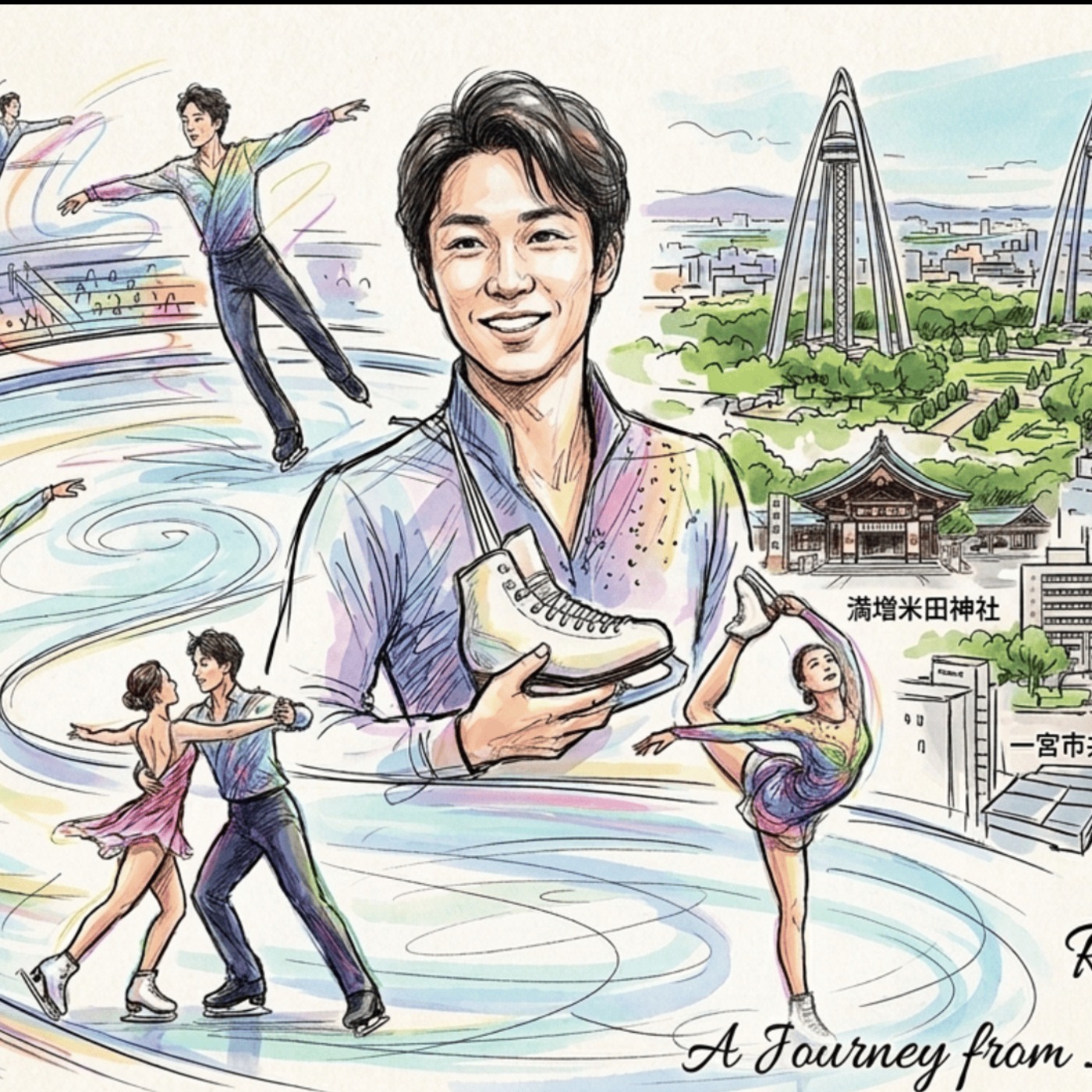
(ENG) The historical heritage of Ichinomiya City and the athletic achievements of Ryuichi Kihara
About this Episode
These sources provide a comprehensive cultural and historical analysis of Ichinomiya City in Aichi Prefecture, framing its heritage through the lens of figure skater Ryuichi Kihara’s athletic achievements. The text explores the city's identity as a spiritual center anchored by the Masumida Shrine and its evolution into a textile manufacturing powerhouse known for its unique "morning service" cafe culture. Historical narratives detail the area’s strategic military past and the engineering marvel of the Kiso River floating bridges used during the Edo period. Furthermore, the records highlight a legacy of resilience and modernization following the devastating 1891 Mino-Owari earthquake. Ultimately, the collection illustrates how the city’s craftsmanship and tenacity are mirrored in the precision and grit of its modern sporting heroes.
The Unwritten Pages of Yesterday 細 聽 長 風 說 舊 河
Hosts & Guests
Transcript
Welcome to The Deep Dive, where we're looking at a pretty fascinating stack of materials today.
They really are. Yeah, we've got urban planning journals,
local historical archives from iichi prefecture, architectural blueprints, and some really
detailed sports interviews. Which is quite the mix. Right, usually when you pull together a city
study like this, you're prepping for a seminar on zoning laws or maybe civic engineering,
but our mission today is to explore a much more thrilling question. Exactly. We want to know
how the invisible DNA of a city, its geography, its past disasters, its ancient history,
how all of that physically manifests in the body and the mindset of a modern world class athlete.
It's a lens we rarely use in sports analysis. I mean, we spend so much time looking at an athlete's
daily training, regimen, their diet, you know, their coaching staff. Yeah, the day-to-day stuff.
Right, but we rarely step back to look at the centuries of historical and cultural pressure
that actually forged the community they grew up in. It's so true. And our case study today is
Ruiichi Kiara. He's a native of Ichinomiya city in Japan. And alongside his partner Riku Miyura,
he achieved something almost unheard of in 2023. The career golden slam. Exactly. A career golden slam
and pair figure skating. They captured Grand Prix gold, World Championship gold, and Olympic medals.
Which is just a massive milestone. So to figure out how a city builds a champion like that,
we're going to walk you through five distinct historical chapters of Ichinomiya. We'll uncover
some incredible spots off the beaten path that you can actually visit if you go. And we'll see how
this city's specific blend of hyper precision and profound resilience created the perfect environment
for an elite athlete. It's quite the journey. It really is. So let's start by looking at the map.
Ichinomiya is right in the heart of the Nobi plain, which was carved out by the Kiso River.
And the name of the city itself is a massive clue. It translates literally to first shrine.
Right. Because the entire city revolves around Masumeda shrine. And we're talking ancient history here.
How ancient? Very. This site was the ceremonial heart for the powerful Oawari clan.
Well before, the Ritsuri Olegal system took hold in ancient Japan.
Okay, let's pause there for a second. For those of us who aren't experts in ancient Japanese
law, what exactly is the Ritsuri system? Fair question. Think of it as ancient Japan's first real
attempt at a centralized constitutional government. Got it. It was heavily influenced by Chinese legal
codes around the seventh century. And Masumeda shrine predates even that. Wow. Yeah, it honors the
deity of pioneering and land cultivation. But what you really need to understand about this place
is its architectural style. The Oawari is a kuri style, right? Exactly. Oawari is a kuri.
Instead of a wide open courtyard, which is what a lot of people picture when they think of a shrine.
The design emphasizes a deep, highly symmetrical and solemn path. It's very linear. Very.
You walk through a towering gate and you pass a screening wall called the Bampei.
And that actually blocks your view of the outside world, right? It physically blocks it. Yeah.
Then you move through the worship hall, the prayer hall, a connecting corridor, and finally,
you reach the main sanctuary. So it's almost like walking through a spiritual
telescope. It forces your perspective inward and creates this tunnel of intense focus.
That is exactly what it is. It's a space designed specifically to cultivate a quiet micro focus
state of mind. But the shrine we see today isn't the ancient original, is it? Because I was
looking at the civic records and this national treasure was completely burned to ashes during the
air raids of World War II in 1945. Yeah, it was completely destroyed. So how did they approach
rebuilding something with that much historical weight? I mean, that's a huge undertaking.
It sparked a massive debate in the post-war years. The community was totally torn.
Do you painstakingly recreate the old traditional wood structures exactly as they were?
Or do you fully modernize? Right. The classic preservation dilemma. Exactly. But the architect
brought in for the project Takeshi Sunami. He found this incredibly elegant middle ground.
What do he do? He retained that deep, focused,
awari-zukuri layout. But he built it using modern functional architecture.
He even designed the connected spaces with a wavy, unilating roof line that mimics the flow
of the nearby Kiso River. That's brilliant. And if you ever visit
Ikinomiya, the shrine is absolutely a must-see. But here's the thing. Most travelers mispay attention
to the street layout when you walk out. Oh, this is fascinating. Yeah. The central shopping street,
Ponmachi, uniquely faces the shrine's main gate head-on. Most modern Japanese cities radiate outward
from their central train stations, but Ikinomiya develops straight out of the shrine's gate.
It's a literal landscape of faith-driving commerce. Exactly. You walk out of that sacred,
focused space and step immediately into the city's economic engine. Oh, and if you visit in the summer,
they hold the massive Tannabata festival right there, which honors the local gods of weaving.
Which is our first major clue about Kihara's skating. Well, the city worships the gods of
weaving because of its deep textile heritage. When commentators talk about Kihara's movements on
the ice, they constantly praise his micro-precision. He skates like an artisan perfectly guiding a
loom. That's a great image. But beyond the precision, look at his career arc. Kihara faced severe,
potentially career-ending injuries. Yet he rebuilt himself, just as Masumeda Shrine rose from the
ashes of 1945. He kept the traditional foundation but upgraded the mechanics. Precisely. That transition
from the sacred to the commercial brings us right into the second chapter of the city's DNA,
the sheer noise of that economic engine. Following World War II,
Ikinomiya became the undisputed core of the Bishu textile region. Right. By the 1950s,
the global demand for wool fabrics triggered an era of explosive, unprecedented economic growth.
And the locals had a brilliant nickname for this era. They called it the Gacha Manboom.
Gacha, let's break that down for everyone. Sure. Gacha was the onomatopoeia for the loud,
violent, clacking sound the mechanical looms made. Gacha, gacha, gacha. And a man means 10,000 in
Japanese. Exactly. The going rule was that every single time a loom made that Gacha sound,
the factory owner made 10,000 yen. That is wild. The sheer volume of wealth pouring into the city
must have been staggering. It was. But looking at the urban planning notes, that wealth created a
massive environmental headache. Because of the factories themselves, they were built with these
very distinctive sawtooth roofs. If you picture a factory from an old cartoon, you know,
with that zigzag roof line, that's what we're talking about. Yeah. And there was a highly
specific reason for that design. Those steep, angled roofs were built with windows facing dead
north. Why north? Because north facing natural light is consistent and glare free throughout
the day, which is absolutely crucial if you were trying to precisely match dye colors for luxury
wool. Oh, wow. So it was an architectural marvel for quality control. It really was. But inside,
it was a nightmare. I can imagine the noise from hundreds of mechanical looms was just deafening
and the air was thick with wool dust. The factory owners, they called them the Hataya,
they couldn't even hear themselves think, let alone host a quiet business meeting with clients
to negotiate complex contracts. So they fled. They fled. They left the factories early in the
morning and took over the local cafes. It's so funny to think about today, right? Because modern
remote workers will leave their quiet apartments and go to a loud, bustling coffee shop just to
feel some energy while they type. Right. But in 1950s, academia, the businessmen were fleeing the
noise of the factory to find peace in the cafes. And cafe owners are incredibly shrewd business
people. They realized pretty quickly that they had a captive audience of very wealthy daily patrons
who are basically holding informal board meetings in their booths. So they started catering to them.
Exactly. To win their loyalty, the cafe started offering what they called morning service.
If you ordered a basic cup of coffee, they would throw in a free-boy leg and some peanuts.
Just as a perk. Right. But as the cafes competed for these businessmen, the service escalated
into lavish spreads. They cut toast, fresh salads, sometimes even small noodle dishes, all included
with the price of your coffee. Which is amazing. And if you are planning a trip to Japan,
you have to know that Ichinomiya is now famous nationwide as the breakfast city. You really have to
go. Experiencing this morning service is a cultural requirement. They even hold annual morning
breakfast expos now. Plus, many of those old noisy sawtooth factories have been beautifully
preserved and repurposed into quiet art galleries and creative studios. It's a great revitalization
story. It is. But what does this breakfast culture have to do with producing a world-class
athlete? It's all about the psychological environment. This informal economic space created
a culture of intense time as money discipline. You woke up at dawn, you hammered out your deals
over coffee and toast, and you got the looms running before the competition did.
Growing up in a culture steeped in that high pressure, highly efficient environment
leaves a permanent mark on a community psyche. Because the adults around you are operating with
this hyper-efficiency. Exactly. Today, when we see Kihara's intense self-management and rigorous
discipline on the world stage, we're seeing the downstream cultural echoes of that 1950s work ethic.
And the city completely embraces him for it. When Kihara wins a major international title,
the local cafes actually celebrate by serving a golden slam memorial breakfast.
Which is just a brilliant, localized way to honor a hometown hero. It really is. But beneath
the coffee shops and the repurposed art spaces, there is an older layer to the city's history.
Let's move into our third chapter. Let's do it. This takes us right into the middle of each
Namiya's modern financial district. If you stand outside the local branch of the Mitsubishi
UFJ bank, you are standing directly on top of a vanished coordinate of power. The ruins of
Hichinamiya Castle. Exactly. It's a fascinating urban layer. This wasn't a towering castle built
on a mountain peak to survey the land. It was a flat land castle, strategically built to protect
the sacred shrine grounds we talked about earlier. It was ruled by the Sekiklan, who claimed direct
descent from the legendary Tira family. But looking at the historical archives, this castle
didn't survive into the modern era. What actually happened to it? It fell victim to the absolute chaos
of the Sengoku or Warring State's period. Imagine a massive corporate power vacuum, but with armies
instead of lawyers. That's a terrifying thought. Following the death of the Great Unifier Odinobunaga,
warlords were scrambling for control. In 1584, the castle's lord Sikinagiyasu made a fatal gamble.
What did he do? He allied with Toyotomi Hideyoshi, and participated in a highly secret flanking
maneuver. The plan was to launch an ambush and strike the rear of the legendary Tokugawa
Yiyasu's forces. Okay, that sounds like a terrible idea. Yasu is arguably one of the greatest
military tacticians in Japanese history. It was a terrible idea. Yasu saw right through the maneuver.
Nagasu was killed in the ensuing battle, and his forces were routed. By 1590,
Ichinomiya Castle was completely abandoned. Wow. And over the centuries, city planners
entirely erased its physical footprint to make way for the roads and buildings that eventually
modernize the city. If you love history, you can walk right up to the bank entrance today,
and there is just a small quiet stone monument marking the site. It is such a striking
juxtaposition. You have this vanished brutal military stronghold sitting right next to modern
glass and steel financial power. And this history bleeds into the modern perception of the city's
athletes. Japanese sports media frequently refers to Kihara as a modern samurai.
Okay, I have to play devil's advocate here. Isn't calling a figure skater a modern samurai a bit
of a media exaggeration? I mean, one was a warrior fighting on a battlefield, and the other
is an athlete performing in a sparkly costume. Is the danger really that comparable?
It's a fair question, but if you look at the actual physics of parachuting, the comparison
starts to make terrifying sense. Read it down for me. In parachuting, the male skater is performing
maneuvers like the twist lift. He throws his partner high into the air, she spins multiple times,
and he has to catch her by the waist before she hits the ice. While moving. Exactly. They're doing
this while gliding on a thin metal blade at 20 miles an hour. It requires an absolute unwavering
focus. There's a zero tolerance policy for failure. Because a single miscalculation doesn't just mean
losing a point. It means catastrophic, potentially life-altering injury for your partner.
That psychological state that absolute life or death resolve directly mirrors the martial
hyperfocus of those Shingoku era warriors who fought and died defending the very ground Kihara
grew up on. When you put it in terms of the sheer physical risk, the warrior comparison really
holds up. It really goes. And that need for absolute trust brings us perfectly to our fourth chapter.
We're going to travel to the western edge of the city to the Okoshi area.
Centuries ago, this is a vital crossing point on the Mino road right over the massive
Russian currents of the Kiso River. And is the site of a logistical marvel from 1682?
Set the scene for us. During the Edo period, crossing this river was a massive bottle neck for
travelers and merchants. But in 1682, the Tokugawa Shogunate faced a unique diplomatic challenge.
They were hosting the Hoseaantong Sinsa. And who were they?
They were elite Korean envoys. Think of it like a massive high-stakes state visit today,
with hundreds of foreign diplomats assessing the strength and wealth of your nation.
So the pressure was on. Huge pressure. The Shogunate needed to project absolute power and
engineering prowess. So they ordered the local population to construct a temporary,
massive pontoon bridge across the Kiso River. Wait, how do you even build a bridge
over a raging river in the 1600s? They didn't have steel cables or modern cranes.
They didn't. Instead, they forced the local fishermen and farmers to commandeer 270 civilian boats.
270? Yeah. They lined these boats up end-to-end and
chain them all together with heavy iron links to span roughly 850 meters across the Russian water.
That is insane. They essentially built a floating highway.
The Korean envoys were completely blown away. They rode in their official journals that
the bridge looked like a dragon lying on the waves.
It's an incredible image, but reading through the historical research on this,
the reality for the locals was pretty grim, wasn't it?
Very grim. We have to acknowledge that this was a crushing burden on the local population.
They had to give up their fishing and transport boats, and they were forced to maintain this
massive structure without pay, often during crucial agricultural seasons.
So it was a massive sacrifice.
But what it proved is that the people of itchanemia possessed pureless engineering skills
and profound adaptability. They managed to perfectly link hundreds of moving parts over a
dangerous, shifting current to safely carry precious international cargo.
And if you want to connect with that history, the city has preserved the Okoshi boat crossing ruins.
You can walk through the stunning post-town architecture and literally stand where Japan's
premier, Edo period logistics hub used to operate.
It's a great spot.
But how does this specific story connect back to Kihara on the ice?
It comes down to the core mechanic of pair skating connection.
Just like those civilian boats had to be flawlessly linked to keep foreign diplomats
from falling into the river, Kihara and his partner Mura have to maintain a high-speed,
dynamic, physical connection.
Right.
The local ethos of adaptability, of bearing the weight of international representation,
is woven into his performance.
Just as that bridge served foreign dignitaries, Kihara serves as a cultural ambassador
for Japan on the global Olympic stage.
He bears the weight of his country's expectations by maintaining perfect connection
under immense pressure.
That adaptability under pressure is definitely a recurring theme here.
But it was tested to its absolute breaking point in our fifth and final chapter.
Yes.
We have to look at a much darker moment in the city's history, the 1891 Nobi earthquake.
This wasn't a minor tremor.
It was a catastrophic 8.0 magnitude inland earthquake.
In the southern Haguara area of Economia, the destruction was apocalyptic.
80% of the buildings were instantly leveled followed by massive fires.
It was a generation-defining tragedy.
The sociological impact of this disaster fundamentally altered the trajectory of the city.
If you're traveling through the area, you can visit the Hokoji Temple,
which houses the earthquake memorial monument erected in 1903.
And what strikes me about this monument is that it isn't a standard,
comforting memorial offering platitudes.
No, not at all.
It is brutally honest.
The inscription describes the earth violently splitting open,
the sky turning completely dark with dust and the ensuing fires.
It also meticulously documents the national relief efforts,
noting how the emperor sent funds and the Red Cross rushed in to help the survivors.
And the reason that brutal honesty is so important is because it forced the city into a state of
creative destruction.
Creative destruction.
Explain that.
Before 1891,
Ichinomiya's weaving industry relied almost entirely on older wooden hand looms.
The earthquake destroyed nearly all of them.
The local industry was essentially wiped out overnight.
Just gone.
Gone.
But rather than trying to painstakingly recreate the past,
the locals took a massive calculated leap forward.
They used the disaster as a catalyst to import the newest,
cutting-edge iron and electric looms from overseas.
Wow.
The earthquake actually forced a technological upgrade
that launched their massive modern industrial boom.
So the trauma of the earthquake
birthed a completely new business mindset.
Exactly.
It created a local culture of hyper-vigilance.
The community internalized the knowledge that disaster can strike at any moment,
wiping out everything you've built.
To survive, you can't just maintain the status quo.
You must constantly be innovating.
You have to be ready to rebuild stronger from the rubble.
And we see that exact mindset
that cultural trickle-down effect in Kihara's own career.
Let's fast forward to 2022
right before the Beijing Winter Olympics.
Kihara suffered a horrific concussion.
We're just terrifying that sport.
Exactly.
For a pair skater, a serious head injury
is often a career-ending event.
The physical mechanics and the absolute trust
required to perform throes and lifts
are just too demanding
if your equilibrium or focus is compromised.
Retiring would have been the completely
understandable standard choice.
But Kihara didn't retire.
He channeled that specific historical DNA of his hometown.
He used the forced downtime to deeply analyze
and completely rebuild his technique.
He didn't just heal.
No, he didn't just try to get back to where he was.
He upgraded his mechanics,
coming back stronger to win his greatest titles.
The parallel is remarkable.
In 1891, the city rebuilt his looms from iron.
In 2022, Kihara rebuilt his technique
with unshakeable resolve.
So what does this all mean for us?
We've traveled from ancient, deeply-focused shrines
to roaring, dusty textile mills.
We've uncovered vanished Samurai castles,
iron-linked river dragons,
and earth-shattering natural disasters.
When we pull all these threads together,
we see two dominant cultural forces
that make up Hichinomi's DNA.
First, there's the micro precision.
You see it in the obsession with millimeter-perfect details,
born from the textile weavers matching dies
and the intricate-focused architecture of the ancient shrines.
And second, there's a profound social resilience.
This is a community defined by its ability to face
World War II air raids, massive economic shifts,
and devastating 8.0 earthquakes,
and continuously adapt and upgrade.
Kihara embodies both of these forces.
He skates with the precision of a master weaver
and the resilience of a city that simply refuses to stay broken.
But there is a really poignant footnote to this story,
a reminder that cities are always evolving.
Hichinomi's landscape is changing yet again.
In 2022, the exact same year,
Kihara was reaching global fame and rebuilding his career.
The local ice rink where he first learned
to skate was permanently closed.
It had been open for 56 years.
It's a very physical, undeniable symbol
that the city is shifting away from its older industrial
and sporting past.
And that reality gives Kihara success
and even deeper cultural meaning.
He currently serves as a home-caliant ambassador
for a neighboring city, Tokai, where he also trained.
But his roots, his fundamental DNA,
are firmly planted in Hichinomiya,
because the physical landmarks of his past are disappearing.
He acts as a guardian of the city's memory.
Every single time he steps onto the ice,
his skating serves as a living, breathing archive.
Through his resilience and precision,
he periods the memory of those noisy factory floors,
the ancient, quiet, shrine paths,
and that closed-down childhood ice rink into the future.
Thank you so much for joining us on this deep deck today.
It really is amazing how taking the time
to understand the multi-layered history of a place
transforms how you see it.
Absolutely.
Hichinomiya isn't just a dot on a map or stop on a train line.
It's a living text of resilience, commerce,
an incredible human ambition
that continues to produce world-class talent.
Which leaves us with an important question
for you to take away today.
If you were to look closely at your own hometown,
the forgotten industries that used to boom,
the local disasters that completely reshape the street layouts,
the vanished architecture you might drive past every single day,
without noticing,
how much of that hidden history
is secretly dictating the way you work?
That's a great question.
How much of your city's invisible DNA
influences the way you overcome failure
and the unique skills you bring to your own life today?
It is definitely something to think about
the next time you walk down your own main street
or visit a local cafe.
Keep exploring the history around you
and we wish you the best on your own journey of discovery