Loading...
societycultureplaces
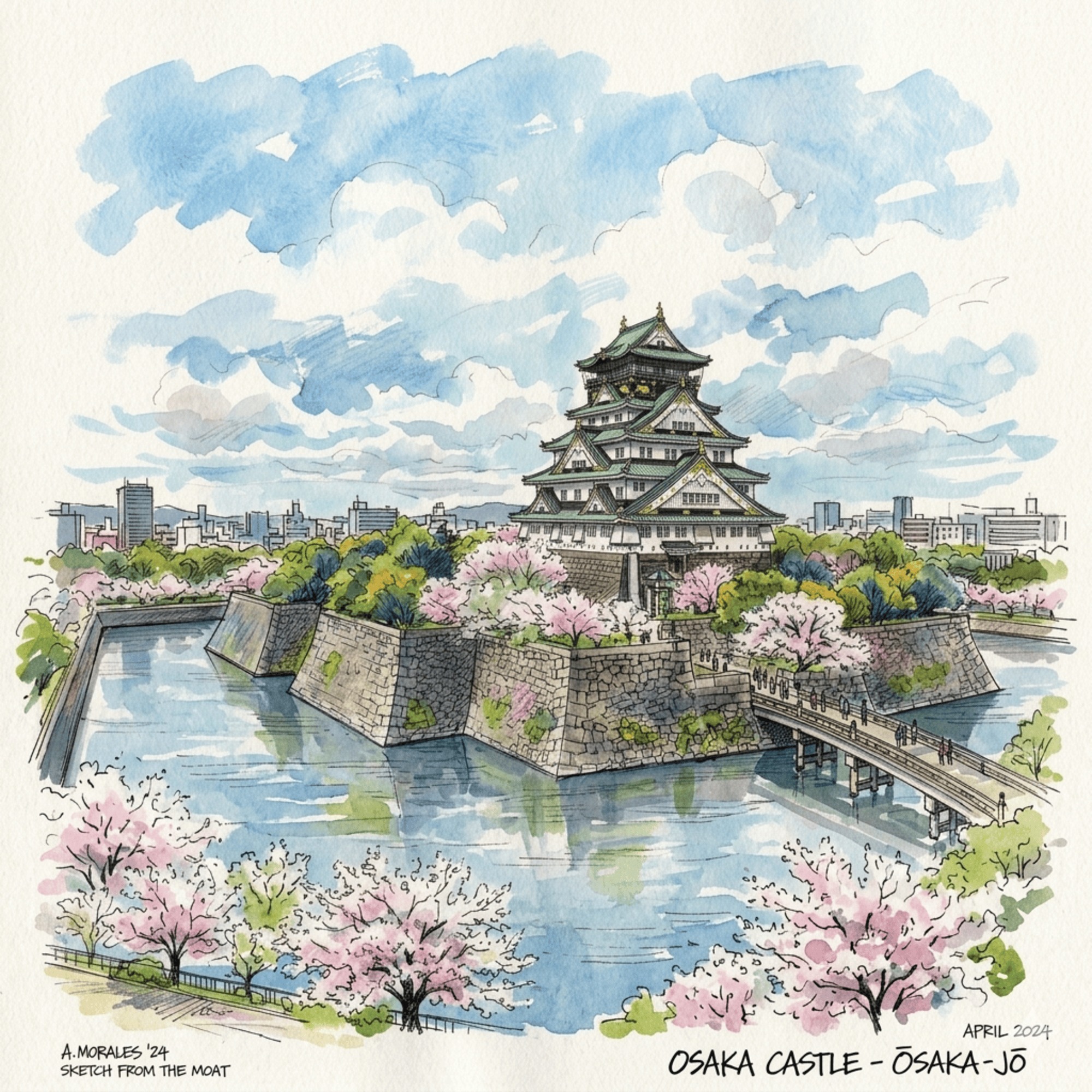
(ENG) The multi-layered evolution of Osaka Castle
About this Episode
The provided text chronicles the multi-layered evolution of Osaka Castle, framing it as a historical site shaped by shifting political power and social identity. It begins by detailing the site’s origin as the Ishiyama Hongan-ji, a religious stronghold whose defeat marked the end of medieval autonomy and the rise of centralized authority. The narrative highlights the deliberate burial of the original Toyotomi foundations by the Tokugawa Shogunate, a political erasure only revealed through modern archaeological excavations. Furthermore, the sources examine the castle’s transformation into a military-industrial hub during the late 19th century, housing the massive Osaka Artillery Arsenal. Finally, the text emphasizes how the current 1931 reconstruction represents a civilian-led effort, shifting the site’s legacy from a fortress of dominance to a public symbol of civic pride. These sources ultimately present the castle as a historical palimpsest, where each physical layer reflects a distinct era of Japanese development.
The Unwritten Pages of Yesterday 細 聽 長 風 說 舊 河
Hosts & Guests
Transcript
If you stand in the main plaza of Osaka Castle today, taking photos of that
gleaming golden white tower, you are probably completely oblivious the fact that exactly seven meters
beneath your feet lies a totally different, fully intact, buried fortress.
Yeah, it is the ultimate historical illusion. We, well, we like to think of history as a straight line,
like you build a monument, preserve it, and then go visit it.
Right, a nice neat timeline.
Exactly, but physical space rarely works that cleanly in reality.
Welcome to another deep dive. Today, we are looking at standard tourist brochures. We are unpacking
an extensive multi-tiered academic historical research report detailing five distinct
historical realities of Osaka Castle.
And the really crazy thing is, when you walk through that beautiful park today,
you are actually walking on top of five completely different, violently conflicting versions of history.
Yeah, it's wild. Okay, let's unpack this, because the mission of this deep dive is to explore
these five incredible historical stories, uncover the hidden physical gems that you can actually
visit today as a tourist, and reflect on what this all means for how we remember history.
Because the most famous castle in Japan, well, it didn't actually start out as a castle at all.
Right. If we jump back to the mid-16th century, the land where the castle now sits,
the Uemachi Plateau, was occupied by something called the Ishii Mahunganji.
Yeah, which is the headquarters of a major, highly influential Buddhist sect.
But I want to make sure you, the listener, don't picture a quiet, peaceful monastery on a hill
with chanting monks. Oh, definitely not.
This was essentially a fiercely independent religious city-state. I mean, it was run by monks,
sure, but also armed followers, merchants, and commoners.
They had their own justice system, their own tax system.
Right. I look at this setup and it reminds me of an independent, heavily armed Vatican
sitting right in the middle of a major vital trade route, which inevitably put a massive target
on its back. Yeah. What's fascinating here is the ideological clash that ensues.
You have this religious stronghold sitting on the absolute most strategic piece of real estate
in the region. High, stable ground. Exactly, bordered by rivers controlling the shipping lanes
of the Sido-Inland Sea. And then you have Oda Nobunaga.
The warlords desperately trying to unify Japan.
Right. Under a secular military government. So Nobunaga's logic of secular unification
simply could not coexist with this Buddhist kingdom's logic of self-governance.
The ultimate unstoppable force meeting the immovable object.
Precisely. And this ideological friction sparks the Ishii Mahungan War, running from 1570 to
1580. It actually becomes the longest single siege in all of Japanese history.
Ten years. And I just have to ask how that is even mechanically possible.
How does a religious sect hold off the most powerful warlord in Japan for a full decade?
I mean, they weren't just throwing rocks over a wall, you know.
Right, I would assume not. The geography itself was a massive defense mechanism.
They were surrounded by these complex river networks that function as natural moats.
Which makes moving in armies super difficult.
Extremely. But beyond that, they formed alliances with groups like the Syka Iki.
This was a mercenary group that possessed the most elite core of matchlock musketeers in the country.
Yeah, firearms had recently been introduced by the Portuguese.
And these more scenarios had essentially reverse engineered them and were mass producing them.
So Nobunaga's forces are trying to cross these muddy rivers and are just
getting completely decimated by organized, disciplined,
volley fire from the temple walls.
Exactly. They even wounded Nobunaga himself in battle, which was practically unheard of.
That's insane. Plus, they were getting constantly resupplied with food and weapons by sea
through their naval allies.
Right. So how do you break in unbreakable seas? You have to fundamentally change the technology
of warfare. Okay. Well, in 1578, Nobunaga ordered the construction of something truly terrifying
that took us in or ironclad ships. Wait, ironclads in the 1570s?
Yes, these were massive wooden warships, but Nobunaga had them coded in thick iron plating.
That is way ahead of its time.
The mechanism was simple but revolutionary.
The monk's naval allies relied on getting close, firing muskets, and throwing incendiary
arrows to burn enemy ships. But with iron plating.
The musket balls just bounced right off, and the fire arrows couldn't ignite the holes.
So these ironclads sailed into the bay, completely destroyed the supply fleet,
and initiated a brutal slow strangulation of the temple, which finally ended in 1580,
with the emperor stepping in to mediate. The monks withdrew, and the entire temple complex was
burned to the ground. The medieval religious era literally goes up in smoke.
And if you visit Osaka Castle today, you can actually find the traces of this. It's one of those
hidden gems. South of the main tower, there's a very unassuming stone monument,
marking the presumed sight of the Isha'a Mahanganji. But even better than that,
between 2021 and 2023, archaeologists digging at a nearby junior high school had a massive layer
of burn soil and shattered roof tiles. The literal ashes of a 10-year war,
right under the modern pavement. It's incredible. But you can't build a new national identity
on top of a scorched religious site without fundamentally changing the architecture of power.
And that is exactly what the famous warlord Toyotomi Hideyoshi attempted to do when he built
the first Osaka Castle on those ashes. He built a fortress designed to just overaw
anyone who looked at it, the grand golden castle. But here is the massive historical
misconception we need to clear up for everyone listening. The castle that everyone associates
with Hideyoshi, the one at all the samurai dramas, it does not actually exist above ground today.
No, it doesn't. After Hideyoshi died, his clan was completely wiped out by the rival Tokugawa
clan in 1615 during the summer siege of Osaka. And the castle was burned down? Burnt to the ground.
But the Tokugawa Shokunate didn't just rebuild over the ruins, they physically buried them.
Wait, I have to challenge this because logistically it sounds insane. Why go through the immense
physical labor to bury an entire castle under up to seven meters of earth? It's a massive
undertaking for sure. Right, why not just knock down whatever is left, sweep it away,
and build your new castle on the same ground level? Well, it comes down to a concept called
Demnotio Memorial, which is the complete political erasure of memory. The Tokugawa Shokunate didn't
just want to defeat the Toyotomi clan militarily. They needed to visually and spatially dominate
the landscape to force a new political legitimacy. But why leave the stones intact underground? Was
it just too hard to break them apart? Actually, it served a dual purpose. First, leaving Hideyoshi's
massive stone foundations in place provided a ridiculously strong structural base for the new,
even heavier castle they were going to build. Oh, that makes sense. But pouring seven meters of
earth over it was pure psychological warfare. It was a clear message to the surviving populists like
your old master is literally beneath our feet. Wow. And as for the logistics of where that dirt
came from, right, to build an impenetrable fortress, the Tokugawa needed much wider, deeper
moats than Hideyoshi had. Yes, exactly. So they excavated millions of cubic meters of earth to create
these new moats, and they just dumped all that excavated dirt directly on top of the old castle.
Two birds, one megalithic stone, and the wild thing is it worked. For hundreds of years, people
just assumed the castle they saw was built on Hideyoshi's original foundations. Until 1959. Right,
in 1959, Osaka was preparing for the 70th anniversary of its modern city and corporation,
and the Crown Prince's wedding. So they sent out geological survey teams just to check
the stability of the ground under the main plaza. And their drill bits are going down through the dirt,
one meter, two meters, and suddenly seven and a half meters down, they hit solid granite.
Just a total surprise. Completely. They dug a vertical shaft to investigate, and they found
perfectly preserved three-tiered stone wall. But it wasn't the smooth, perfectly fitted
stone of the Tokugawa era, was it? Nope. It was rough-hewn, unpolished natural stone,
a style called nozerzumi, the undeniable signature of Hideyoshi's era.
For you listening, if you want to experience this hidden gem today, go to the plaza south of
the main tower. Look for the special archaeological shelter they've built to showcase the Toyotomi
stone walls. It's super cool to see in person. Even more wild, look for the specific markings on
the ground in the plaza. When you stand on those marks, you are standing exactly seven meters
directly above the very golden fortress. It's a very visceral way to experience how power
physically lairs itself over time. But the Tokugawa Shogunate needed more than just a mountain of dirt
to bury the past right. They needed a monumental amount of stone to build their new reality,
which brings us to the logistics of the new fortress. Yes. To construct this new dominant castle,
the Tokugawa initiated a system called Tinkafushin. Essentially, they ordered 64 different regional
lords, specifically the ones from Western Japan who might still have had loyalties to the old regime
to provide the labor, the logistics, and the funding for the construction. Here's where it gets
really interesting. Yeah. This wasn't just about building a wall. Not at all. This was a brilliant
ancient form of taxation by public works. You force your potential enemies to spend all their
money and manpower dragging giant rocks across the country. So they literally cannot afford to
finance rebellion against you. Exactly. It's the materialization of power. Every stone brought to
Osaka was essentially a hostage, a physical proof of a lord's submission. And the technical
execution of this was staggering. The core engineering was handled by the Anushu, right? Yeah.
An elite guild of stone masons from only province. That's them. I read about them.
The sources mentioned they possessed an oral tradition of listening to the voice of the stones.
But what does that actually mean mechanically? Well, it wasn't magic. It was profound structural
engineering listening to the stone meant understanding its natural center of gravity and internal fault
lines by tapping it with hammers. Okay. So feeling the vibrations. Yeah. And instead of cutting stones into
perfect rigid squares, the Anushu used natural, unpolished stones in that Nazura Zumi style.
They would fit these irregular shapes together, creating a wall that sloped inward at the top,
a curve called Musugashi, which makes it significantly harder for ninjas or samurai to climb.
Exactly. But more importantly, this interlocking, irregular structure creates internal fiction.
For earthquakes. Yes. When a severe earthquake hits, a perfectly rigid wall of cut stone
will crack and collapse. But a wall made of irregular natural stones can subtly shift and
absorb the seismic waves. The friction between the stones actually dissipates the energy of the
earthquake. That is incredible engineering. It really is. But the regional lords providing these
stones turned it into a massive ego contest, didn't they? Oh, absolutely. They wanted to prove
their loyalty and their wealth by bringing the biggest rocks possible. The logistics of moving
these are almost hard to comprehend. We're talking about stones quarried on islands in the Sedo
inland sea. They had to specially engineer reinforced barges just so the ships wouldn't sink
under the weight. And once they crossed the water, they pulled them over land using massive y-shaped
wooden sleds called Shura, which rolled on logs and required hundreds, sometimes thousands of
men pulling on roofs at once. Just staggering amounts of labor. And the ultimate hidden gem for
this era is staring everyone right in the face today. Oh, the octopus stone. Yes. If you walk
near the Saccharigate, look for the Taco Ishi or the octopus stone. It is a single solid block of
rock with a surface area of almost 55 square meters. It weighs an estimated 130 tons, one stone.
And when you look at the wider walls around the castle, you'll see thousands of little symbols carved
into the rocks. These are the cocoon, the family crests of the rival lords. They were carving their
logos into the stone as proof. Like, I paid for this. I did the work. Please don't destroy my family.
It's a visual receipt of submission. Truly. So we had the ashes of a religious city, a buried
golden castle, and a megalithic fortress of submission. But as we move into the late 19th century,
the era of the samurai completely ends with the Meiji Restoration. Right. Huge turning point.
Usually when the samurai age ends, castles become static museums, tourist spots.
How does turning this feudal castle into a massive munitions factory completely change the city of
Osaka itself? If we connect this to the bigger picture, the Meiji Restoration of 1868,
when just a political shift, it was an aggressive industrial revolution. Okay. In 1870, the new
modern government looked at Osaka Castle and didn't see a historical relic. They saw a perfect,
ready-made military compound. Right. Think about the geography we just discussed. Exactly.
Why build a new secure facility when you already have incredibly thick, earthquake-resistant
defensive walls to prevent espionage? And the moats. Yes, deep wide moats that can contain accidental
chemical or gunpowder explosions. Oh, I hadn't even thought of that. Plus, you have direct access to
major rivers and railways for transporting heavy artillery. So they made it the Osaka Army
Arsenal. And not just a small workshop. It became the largest armor in all of Asia. They called
Osaka the Manchester of the East. The scale was just staggering. At its peak, the arsenal employed
over 60,000 workers. It took up the entire northern and eastern sections of the castle grounds.
So to answer the question about how it changed the city, it essentially birthed the new social class.
Definitely. You had the rapid rise of modern technocrats, engineers, and a massive influx of
skilled laborers. But with industrialization comes industrial friction. Right. You have 60,000
people working in incredibly dangerous conditions, making artillery shells and chemical weapons.
Exactly. The castle grounds became the birthplace of early Japanese labor movements. Really?
Yeah. In 1919, a labor organization called the Kojokai, or the Improvement Society,
led massive strikes demanding better treatment. Wow. A profound clash between the absolute authority
of the military state and a newly budding civil society. The castle walls that used to keep
samurai out. We're now trying to keep labor strikes contained. That is fascinating. But this
massive industrial military machine met a very sudden, very violent end. Yes, it did. On August 14,
1945, literally the day before Japan surrendered in World War II, allied B-29 bombers
targeted the arsenal. It was a devastating, highly precise air raid. 90% of the factory facilities
were completely destroyed in a single day with hundreds of lives lost. The military era of the
castle was reduced to rubble overnight. And yet if you walk through the park today, the ghosts of
the arsenal are still there. These are some of my absolute favorite hidden gems for you to track down.
Over near the north outer moat, there is a beautiful, albeit slightly eerie, red brick building
from 1919. Oh, it looks like it belongs on a European university campus. Really does. That was the
chemical analysis lab where they developed advanced munitions. You could also find the old water gate
along the Niagara River, which was the logistics hub for moving those heavy artillery shells out
to the front lines. And the most haunting detail, if you walk along the northern paths, you will see
these bizarre, giant, twisted chunks of rusted metal sitting in the grass. That is melted iron.
Literal debris from the destroyed furnaces of the 1945 bombing just left there as a silo witness.
It's very sobering. Oh, and if you grab a coffee or a souvenir at the Mariza Osaka Joe building,
you are shopping inside the former headquarters of the Imperial Army's Fourth Division.
The transformation of a space of absolute military power into a space of public leisure.
It's quite the pivot. But here's the craziest part about that 1945 bombing.
The arsenal was vaporized, but the main central castle tower survived.
Yeah, which raises a massive question. Why was there a traditional castle tower
standing in the middle of a 20th century munitions factory in the first place?
To answer that, we have to look at what the citizens of Osaka did about 15 years before the war.
Right. Let's flash back to the late 1920s and early 1930s. This is the great Osaka era.
The city is booming as an economic powerhouse.
And the mayor at the time of visionary named Sikihageme proposes something radical.
He wants to reclaim the core of the castle from the military,
turn it into a public park, and rebuild the main tower as a symbol of the city.
It wasn't audacious plan, especially considering the timing.
He proposed this right as the Great Depression hit in 1929.
And this is what blows my mind. The mechanism of how they got this built.
The city didn't use public tax dollars. They crowdfunded it.
During the Great Depression, how do you convince starving citizens to pay for a monument?
Well, you've tapped into their civic identity.
The people of Osaka had always viewed themselves as fiercely independent merchants,
slightly at odds with the political capital of Tokyo.
Okay, I see. Mayor Seki pitched the castle not as a military asset,
but as a monument to their own resilience and history.
The civic pride of Osaka is legendary.
And it worked within just six months, 78,250 citizens.
Everyone from the wealthiest industrialist down to elementary school students
donating their pocket money raised 1.5 million yen.
Which in today's money, that's roughly 60 to 70 billion yen.
It's unbelievable. But the building they designed was incredibly controversial.
Highly controversial. The architect, Nemi Tetsuo,
didn't build a historically pure replica he built a hybrid.
It was a modern steel reinforced concrete structure.
It even had elevators, which was, you know, unheard of for a castle.
Visually, the bottom four floors featured the Stark White Walls characteristic of the Tokugawa era.
But the top fifth floor was painted in the black lacquer and gold leaf tigers
of Hideoshi's Toyotomi era.
Based on a famous historical folding screen, right?
Exactly.
It's like taking the foundation of a Soviet brutalist government building
and capping it with the ornate roof of Azaris Palace.
It's an architectural Frankenstein designed to force a unified identity.
It is, but it was a very conscious choice.
It was an architectural compromise that blended the two
historically opposed identities of the city
into a single civic symbol.
It wasn't about perfectly recreating the past.
No, it was about serving the present psychological needs of the citizens.
So what does this all mean?
The ultimate irony of Osaka castle.
And the thing I really want you to think about the next time you see a picture of it.
Is this?
Glad on us.
The original Toyotomi castle stood for about 32 years.
The massive Tokugawa replacements stood for 36 years before it burned down.
And this 1931 concrete, crowd-funded elevator having replica.
It has stood for 94 years.
It has outlasted both of the authentic castles combined.
The replica has existed for so long
that it has become an authentic historical artifact in its own right.
It truly is a masterpiece of historical irony.
When we synthesize these five historical realities,
the religious autonomy, the political cover-up,
the megalithic force labor, the industrial war machine,
and the crowd-funded citizen monument,
we see that Osaka castle is never just one thing.
No, it's a constant cycle of physical erasure
and competitive covering of history.
It's a polemcyst, written in earth,
stone, iron, and blood.
And that's why the next time you visit Osaka castle,
you can't just look up at the beautiful golden tigers on the roof.
You have to look down at the dirt covering the ashes of the monks
and the buried golden walls.
You have to touch the 130 tonne stones
and trace the carved crests of exhausted lords.
You have to look in the grass for the melted iron of the 20th century.
Because the physical space is a record of who held power,
the specific mechanisms of how they held it,
and how they eventually lost it.
And this raises an important question for us to consider today.
What's that?
The current concrete tower is almost a century old.
Concrete doesn't last forever.
Eventually, it will face structural obsolescence.
Oh, wow.
I hadn't even thought about the lifespan of the concrete itself.
We've seen five historical realities,
each violently or purposefully covering the last.
So when the time comes that the 1931 tower can no longer stand safely,
what will the sixth layer of Osaka castle look like?
That's deep.
Will the citizens of the future try to preserve the 20th century concrete replica
because it has its own history?
Will they finally dig up the buried 16th century ruins of Hideyoshi?
Or will they do what history has always done here
and build something entirely new over the top of us all?
That is an incredible thought to leave on.
Thank you so much for joining us on this deep dive.
Keep questioning the ground you walk on
and keep looking beneath the surface.
Catch you next time.


