Loading...
societycultureplaces
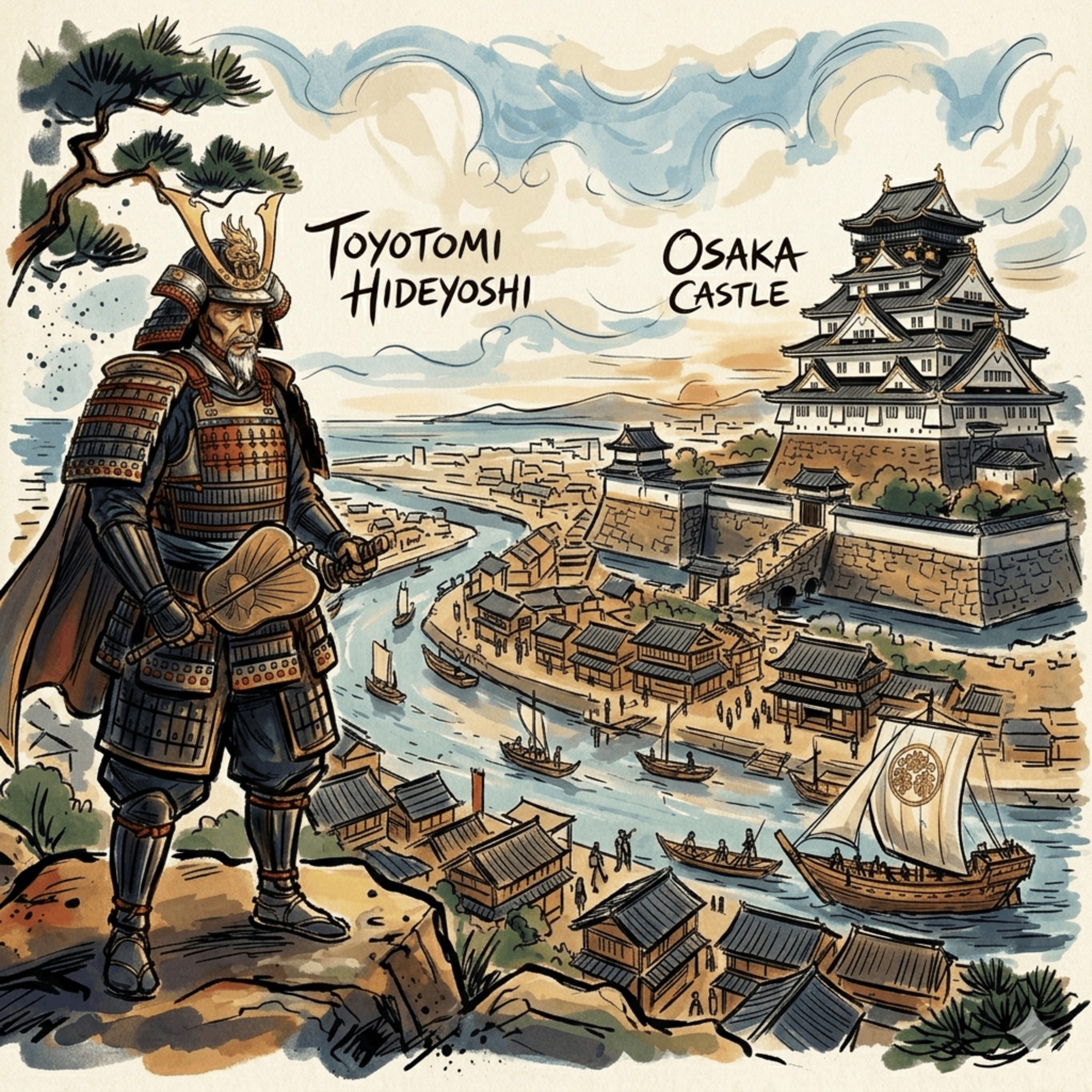
(ENG) What did Toyotomi Hideyoshi do for modern Osaka?
About this Episode
This historical report examines how Toyotomi Hideyoshi transformed the city of Osaka into a centralized center of power through radical urban planning and social engineering. The text highlights major infrastructure projects, such as the advanced "Taiko" sewage system and the strategic redirection of the Yodo River, which established the city’s economic and logistical foundation. It also describes the forced relocation of merchants from Sakai to consolidate commercial wealth and the restoration of sacred sites like Shitennoji to legitimize Toyotomi’s rule. Furthermore, the sources reveal a dramatic "memory war" where the subsequent Tokugawa Shogunate physically buried Toyotomi’s original castle beneath layers of earth to assert their own authority. Ultimately, these records illustrate that Osaka’s modern layout is a direct legacy of sixteenth-century political ambition and sophisticated civil engineering. These narratives provide a deep academic look at the material heritage hidden beneath the modern streets of Japan's commercial capital.
The Unwritten Pages of Yesterday 細 聽 長 風 說 舊 河
Hosts & Guests
Transcript
If you take a selfie in front of the massive ancient walls of Osaka Castle today,
you are actually taking a photo of a 400-year-old crime scene cover.
You really are, yeah.
Welcome to The Deep Dive. Today, we are exploring this really fascinating historical research report
titled, The Reconstruction of Toyotomi Hideyoshi's Osaka.
And honestly, it just fundamentally shatters the way we think about historical cities.
Oh, absolutely. I mean, usually we treat these places like museums.
Right, exactly. We look at the castle, read the little bronze plaque,
and just assume the city sort of, I don't know, grew there organically,
just a messy accumulation of people over centuries.
We assume it's just a byproduct of time.
But when you look at Osaka through the lens of 16th century Japan,
that organic city looks more like a massive, highly engineered circuit board.
Yeah.
Hideyoshi chose the ruins of the Ishiyama-Hunganji temple to build Osaka Castle.
But he wasn't just constructing a military fort.
He was deliberately shifting the entire center of power in Japan.
Get away from the old guard.
Exactly. Pulling it away from the ancient aristocratic capital of Kyoto
and away from the fiercely autonomous merchant hub of Sakai.
Okay, let's unpack this.
Because we aren't just looking at a standard tourist guide here.
We're looking at how a peasant turned warlord didn't just build a city.
He, well, he weaponized urban planning to mine control a nation.
That's a great way to frame it.
Yeah, Osaka wasn't a natural settlement.
It was a piece of ruling technology.
And over our time together today, we're going to uncover five hidden historical narratives
deeply embedded in Osaka's DNA.
And we're going to reveal the secret physical remnants of this absolute mastermind
that you the listener can actually go out and visit today.
Which is the best part.
It really is.
It is a journey from the sewers below the streets all the way to the temples
reaching into the sky.
And, you know, to understand how Hideyoshi projected his power upward,
we really first have to look at how he controlled the ground
but near everyone's feet.
Right, because you can't build a massive empire if your city is a mess.
Exactly.
You have to manage a massive population boom.
You've got samurai, artisans, and merchants all suddenly cramming into a brand new city.
And with that kind of density comes the immediate deadly threat of disease.
It's like playing some city, but instead of just drawing residential zones,
you force everyone to share a backyard drain so you can like regulate their private lives.
That is exactly what he did.
Hideyoshi implemented what the locals called the Taiko-Kazui Taiko being his retired
region title.
Right.
He mandated this incredibly rigid grid for the city,
dividing it into blocks of about 40 kin.
Which is roughly 72 meters square, right?
Yep, 72 meters.
And he took that grid and applied it directly to the sanitation system.
Instead of putting sewers out in the street, he built these back-to-back
stone drainage ditches right down the property lines behind the houses.
Okay.
So every house had to drain its wastewater backward into this shared,
stone-lined trench.
Wait, wait.
If the state forces your plumbing to be carved in stone exactly 72 meters apart,
they're permanently locked in your property lines.
Yes.
You've just used sanitation to secretly rewrite the tax code.
If we connect this to the bigger picture,
that is exactly the genius of it.
You've hit the nail on the head.
Yeah.
Because in the medieval period before this, land rights were incredibly chaotic.
Just overlapping and constantly disputed, I imagine.
Total nightmare for a ruler.
So this was spatial standardization.
Hideyoshi physically broke those old chaotic land rights.
He forced the citizens into a measurable,
taxable, surveable system.
You cannot hide your property size from the tax collector
when your boundaries are literally carved in stone by the state.
That is so brilliantly evil.
And the engineering behind it was brilliant, too.
He used a technique called nosura zoomi,
which involves stacking unhune natural stones without any mortar.
Wait, that sounds incredibly unstable for a sewer system.
Why wouldn't you want perfectly fitted sealed stones?
Because of hydrostatic pressure,
if you seal a wall completely, the water building up in the soil behind it
during a massive typhoon will eventually just push the wall over.
Oh, sure.
The pressure has nowhere to go.
Right. So by using uncut stones,
the tiny natural gaps act as a built-in drainage system.
The water seeps through without blowing out the trench.
That is why these structures survive for centuries.
I mean, Osaka had these highly functional
physics-defying stone sewers
while cities like London and Paris were still.
Imping chamberpods out of second story windows into the open street.
Exactly.
And for anyone listening who wants to see this engineering marvel,
you're actually can.
If you go to the non-in-bosh areas,
this is right next to Minamiyo Elementary School in Osaka.
There is a special glass viewing window set right into the street.
It's really cool.
Yeah, you can literally look down and see the 400-year-old
uncut stone sewers.
And the best part is,
they're still actively training Osaka's water today.
It's not some dead ruin in a museum.
It's a living piece of Hideyoshi's machine.
It truly is.
But once Hideyoshi had the physical health
and the geographical lair of the city under his thumb,
he faced the next hurdle of state building.
Mine.
He needed capital.
You cannot run a unified national empire
without a thriving economy
which brings us to the ruthless absorption of Sakai.
Yeah, I read this part of the research
and I have to say,
the historical narrative feels a bit sanitized to me.
Oh, how so?
Well, Hideyoshi fills in the defensive modes of Sakai,
which, by the way, was known as the Venice of the East
because of its immense wealth and independence.
Right.
He strips them of their physical defenses
and then just forces all these wealthy merchants
to move to his new city in Osaka.
And the way it's often framed is like,
they just agreed to pack up and leave.
It sounds a bit too polite.
Yeah.
It sounds less like a migration
and more like a mafia protection racket
disguised as a corporate buyout.
Well, consider the alternative from the merchants perspective.
They had watched other autonomous cities
try to resist warlords
and literally get burned to ash.
Oh, true.
No bunaga did a lot of that.
Exactly.
So for the merchants of Sakai,
trading a physical moat for a guaranteed monopoly
in a unified national market
wasn't just yielding to a mob boss.
It was a highly rational, bloodless business merger.
Hideyoshi offered them a compromise
they couldn't refuse.
By creating the Semba District.
Right. He gave them the Semba District in Osaka
and granted them Rakuichi Rakuza status.
Meaning tax-free, deregulated trade zones, right?
Along with massive land grants.
Exactly.
So they lost the political independence of their city,
but they got the keys to the entire national economy in return.
That forced migration is what birthed
what we now call Osaka's merchant soul.
It cultivated this pragmatic business first attitude
that honestly still defines the city today.
But Hideyoshi didn't just want their money, though.
He wanted their cultural capital, too.
Yeah, right.
He relocated major cultural figures,
most notably the legendary team master, Senorikyu.
Because the tea ceremony wasn't just a nice cultural hobby
for a warler to unwind with, it was deeply political.
It's extremely political.
Think about the mechanics of the traditional tea room.
Hideyoshi and Riku popularized the use of the Nijiriguchi,
which is this tiny crawling in entrance.
Oh, wow.
Yeah.
So you take a powerful, heavily armed samurai warlord,
force him to leave his swords outside
and make him crawl in his hands and knees
through a tiny door into a silent austere room.
That is the ultimate psychological power play.
You strip them of their defenses
and force them into absolute vulnerability.
And in that state of vulnerability,
in a highly exclusive, intimate setting,
national policy was dictated.
The tea ceremony was completely transformed
from a spiritual merchant class practice
into a highly effective tool of state craft.
That's wild.
You know, if you're visiting Osaka today,
you really have to walk through the Samba district.
The grid of the north-south streets,
which are called Suji and the east-west streets,
called Dori,
is the exact layout Hideyoshi forced upon those merchants.
It's unchanged.
And a real hidden gem there is Do Shomachi,
the historical medicine street.
You can visit the Kunishi family residence there,
which perfectly preserves that wealthy merchant legacy.
And I highly recommend taking a short trip south
to the Sakai Plaza of Riku and Akiko
in modern Sakai as well.
Oh, why is that?
It offers a profound, almost melancholic contrast.
You can explore the ghost of the magnificent independent city
that Hideyoshi methodically dismantled
to feed Osaka's rise.
Wow, that's a great tip.
But, you know, wealth buys you monopolies and merchants,
but it doesn't buy you divine right.
No, it doesn't.
In a 16th century society obsessed with aristocratic bloodlines,
a peasant-born warlord with a fat wallet
is still, at the end of the day, just a peasant.
Hideyoshi had a glaring hole in his resume.
He really did.
To be the undisputed ruler, he needed a spiritual rebrand.
Here's where it gets really interesting.
It's like a modern tech billionaire
buying a legacy newspaper to look dignified.
That's a perfect analogy.
Hideyoshi had to hack Japan's religious history.
And he did exactly that with Osaka's sacred geography.
He poured unprecedented funds into rebuilding Shitanoji,
which is a temple originally founded way back in 593
by the legendary Prince Shitoku.
Okay, so a very ancient, very respected site.
Yes, but he didn't just fund a standard renovation.
He mandated restoring the exact ancient Asuka style layout.
Which means the gate, the pagoda, the main hall, and the lecture hall
all had to be perfectly aligned in a single straight line,
completely surrounded by a corridor.
Right.
Sourcing the massive timbers and engineering
in exact 6th century replica in the 1500s
must have been a logistical nightmare.
Oh, it required an astronomical amount of labor and wealth.
But the aesthetic choice was totally deliberate.
This was pure cultural hegemony.
Right. He's making a statement.
By painstakingly resurrecting the architecture of Japan's
most revered ancient figure,
Hideyoshi was positioning the upstart Toyotomi family
as the ultimate protectors and inheritors of ancient tradition.
And doing this in Osaka was a calculated insult
to the Emperor sitting over in Kyoto.
Oh, I see.
He's effectively building a second capital.
He has the raw, secular military power
projecting from Osaka castle.
And he's manufacturing this sacred historical power
radiating from the temples he controls.
Exactly. He completely undercut Kyoto's monopoly
on ceremonial authority.
And tourists walk through Shitnoji
or Sumiyoshi Tai Shita today.
Look at these beautiful structures
and just assume they are a standard ancient relics.
They completely miss the propaganda hiding in plain sight.
Well, if you want to see this propaganda for yourself,
look for specific pieces.
At Shitnoji, seek out the Ishibutai, the stone stage.
Yes, definitely.
And Tsumiyoshi Taisha
look closely at the base of the Sori Bashi,
the famous arch bridge.
Both of those were donated directly by
Hideyoshi's son Hideyori and his mother.
And they miraculously survived the World War Two
fire bombing that destroyed all the wooden buildings
around them.
And they survived modern concrete renovations too.
Yeah.
Touching those stones means touching a political narrative
that has endured for four centuries.
It's incredible, but, you know,
Hideyoshi's ambition inevitably spilled outward
beyond the city streets and temples
into the natural world itself.
Yet to control everything.
Everything.
Osaka is famously a city of water.
But in the 16th century, the Yodogawa River Delta
wasn't this neat navigable harbor.
It was a chaotic, flooding,
extremely dangerous wetland.
Which is a problem.
Because if you want ships to sail smoothly
from the inland capital regions
right to your new economic hub,
you can't rely on a swamp.
No, you cannot.
So the report notes,
he launched the Tyco Sumi Mega Project.
He decides to just like manually reroute
three major rivers, the Yodogawa,
the Kizugawa and the Katsurugawa.
Yep.
How do you even accomplish river engineering
on that scale in the 1500s without heavy machinery?
And how do you enforce a toll booth on a raging river?
You do it with sheer staggering human labor.
Hideyoshi mobilized his subject warlords
forcing them to foot the bill naturally.
Classic move.
Imagine thousands of laborers standing
way steep in freezing mud.
They constructed massive stone dams
called Ishidashi to tame the rapids.
Wow.
And they did this by weaving giant bamboo baskets,
filling them with massive boulders
and dropping them from boats
into the raging currents
just to break the water's force.
It sounds incredibly dangerous.
Yeah.
And then they drove thousands of wooden piles
of Kyuchi into the soft mud
to build up the artificial banks.
Picture teams of men lifting massive wooden mallets
on rope pulleys, dropping them
repeatedly in the mud, all by hand.
Just back breaking work.
They physically walled off the rivers
from the massive ogre pond,
funneling them into artificial,
strictly controlled channels.
And by doing so,
he turned a natural disaster zone
into a golden waterway.
Because once the river is in an artificial channel,
you control the poets.
Right.
Suddenly every single boat carrying tax
rice, timber or trade goats
from the interior of Japan
had no choice but to sail down his monitored canal
right past his tax collectors to reach the sea.
He transformed a chaotic swamp
into a forced toll road.
If the river only flows where he wants it to,
he effectively controls the entire logistics network
of western Japan.
Precisely.
And that massive infrastructure project
allowed Osaka to become the booming
economic center known as the nation's kitchen.
To see the sheer scale of this human labor,
you should actually leave central Osaka
and head to UG City.
Go to the Chizuna Museum where they actually excavated
the ruins of this 400-year-old embankment.
It's a great exhibit.
You can see the stones and the wooden stakes.
But there is an even cooler secret
for when you were walking around Osaka itself.
If you stroll along the modern Yodogawa River,
you'll notice some of the old traditional streets
are elevated higher than the surrounding areas.
Yes.
You aren't just walking up a hill.
You were walking directly on top
of Hideyoshi's buried levees.
His infrastructure literally still dictates
the topography of the modern city.
And this actually brings us to the climax
of our historical dive.
It's full.
Hideyoshi built a perfect machine of a city.
He controlled the earth,
the economy, the gods, and the rivers.
But then he died.
And things went downhill very fast for his family.
Yeah, in 1615, the Tokugawa Shogunate
besieged Osaka Castle.
Hideyoshi's air-committed suicide
as the castle burned
and the Toyotomi clan was completely wiped out.
The Tokugawa takeover Japan,
but they're left with a glaring problem.
What do you do with the ultimate monument
of your vanquished enemy?
I mean, the entire city was built in his image.
Right.
What's fascinating here is they utilized a concept
of the ancient Romans called
Daim nacho memoria,
the condemnation of memory.
They didn't just erase Hideyoshi from the history books.
They applied that erasure physically
to the landscape itself.
They buried his legacy alive.
Wait, wait.
I've seen photos of Osaka Castle.
It's massive.
You're telling me the castle tourist flock to?
Is a giant fake out?
It is entirely a Tokugawa creation.
And we are not talking about sprinkling a thin layer
of topsoil over the ruins, either.
They brought in tens of meters of earth.
The logistics of that must have been insane.
Almost incomprehensible.
The Tokugawa mobilized fleets of ships
and thousands of hand-drawn carts
hauling millions of tons of soil
just to entomb this structure.
They dumped meters of dirt
directly over the scorched ruins of Toyotomi's castle.
And then right on top of that artificial mountain of dirt,
they built a new perfectly symmetrical,
aggressively larger castle.
So when millions of tourists go to Osaka Castle today
and take a selfie in front of those massive,
perfect sheer stone walls,
they were looking at a 100% Tokugawa construction.
Let me get exactly right.
The Tokugawa built those walls
specifically to physically suppress the memory of Hideyoshi.
They wanted people to look up
and only see Tokugawa power.
And it was an incredibly successful campaign.
I mean, for centuries,
everyone assumed the original castle was completely gone,
pulverized into dust.
That changed in 1984.
Oh, wow.
What happened then?
During an archeological dig near the main keep,
researchers dug down through meters of dirt
and suddenly hit something incredible.
The wild uncut stones,
the original Nizurizumi walls of Hideyoshi's castle.
Yes, still standing, hidden in the dark
and still bearing the black scorch marks
from the fires of 1615.
That gives me chills.
It is a profound physical manifestation of history.
And by the way, there's a new Toyotomi Ishigaki exhibition facility
opening in 2025,
where you'll be able to go underground
beneath the current castle
and actually stand in the dirt
and look at those original scorched stones.
Oh, that is an absolute must visit.
Definitely.
We can look back at everything we've discussed today.
The stone sewers locking in the tax grids,
the displaced merchants building a national economy,
the replicated ancient temples,
stealing divine authority,
the hand-driven wooden piles,
rerouting rivers,
and finally, the buried castle.
Osaka is a physical record of Japan's transition
from the chaotic, warring medieval period
to a highly controlled, engineered modern state.
It is a theater of power
where every single street corner and stone wall
was a calculated political move.
So what does this all mean for you?
We've spent this deep dive talking about the rulers.
We explored Hideyoshi building the machine
and the Tokugawa burying it.
But cities aren't just made of stone,
dirt, and warlords.
They're made of people.
Absolutely.
So here's my challenge to you.
Do some sleuthing on your own.
Go down the historical rabbit hole
and look into how the ordinary citizens of Osaka
reacted to living
on top of their beloved founders buried city
during the Edo period.
That's a great question.
Did they just accept the Tokugawa's memory oration?
Did they leave secret codes in their woodblock prints?
Did they pass down subversive folklore,
whispered in those tiny merchant tea rooms?
How does a population resist
when their history is literally buried under their feet?
Find out for yourself.
It is a deeply compelling question.
And, you know, the answers are out there
for those willing to dig into the local archives
and folk histories.
Remember how we started today?
Looking at a city like a museum,
assuming it just grew organically,
I don't think you will ever look at a street grid,
a sewer drain,
or a castle wall the same way again.
I know, I don't.
That organic landscape is a highly engineered circuit board.
And now, you know how to read the wiring.
Thank you for joining us for this deep dive.
Keep diving deep.


