Loading...
education
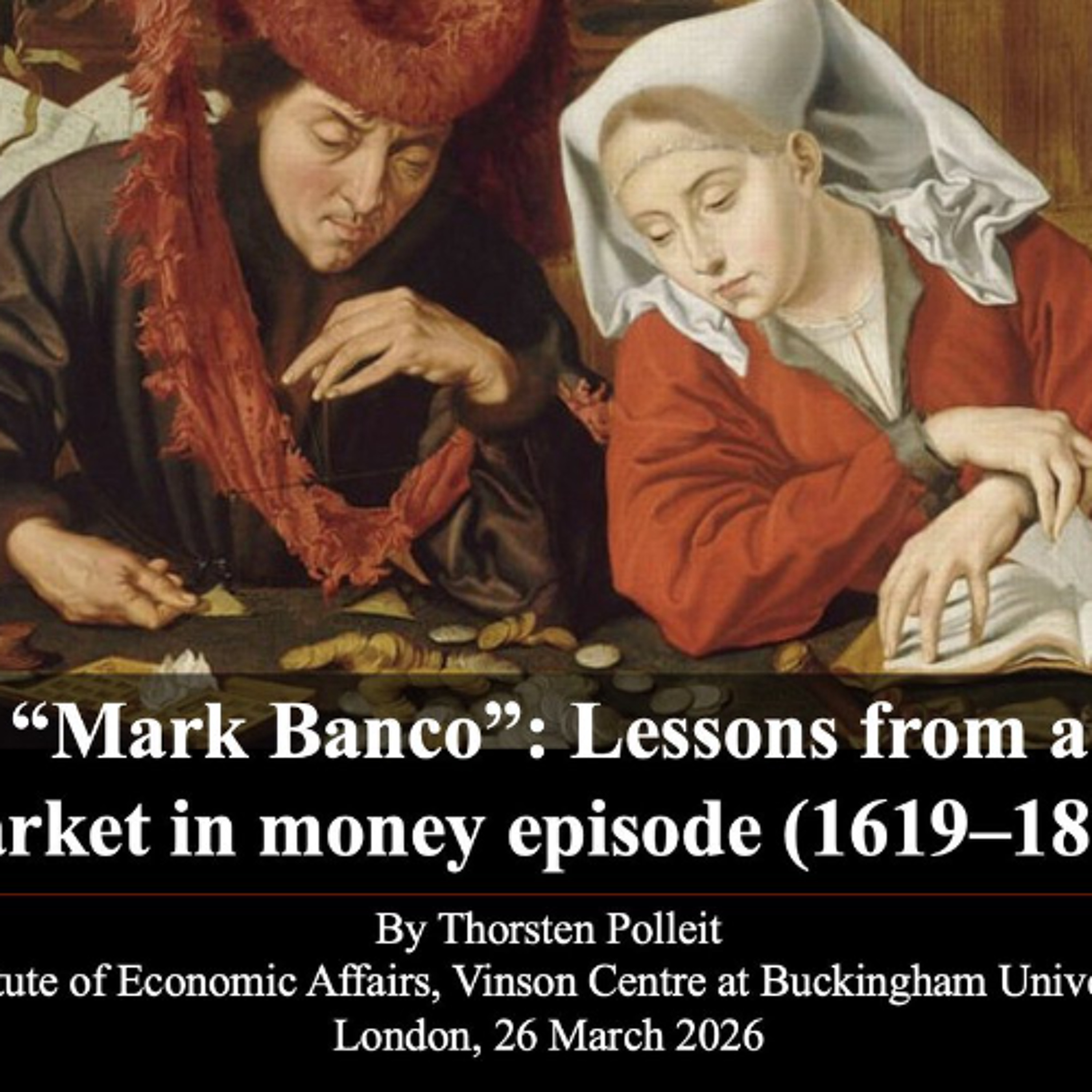
Ep. 449 | THE "MARK BANCO": LESSONS FROM A FREE MARKET IN MONEY EPISODE (1619-1873)
About this Episode
A presentation held by Thorsten Polleit at the Institute of Economic Affairs (IEA) in London, 26 March 2026.
💡Wenn Sie mehr über Dr. Polleits BOOM & BUST REPORT wissen wollen, dann besuchen Sie:
https://www.boombustreport.com
💻Folgen Sie Thorsten Polleit auf social media:
Telegram: https://t.me/freemarketinmoney
GETTR: https://gettr.com/user/thorstenpolleit
X: https://x.com/ThorstenPolleit
Facebook: / thorsten.polleit.1
Linkedin: / dr-thorsten-polleit-046765a8
🌐Besuchen Sie die Webseite von Thorsten Polleit:
http://www.thorstenpolleit.com
📚(Einige) Bücher von Thorsten Polleit:
📕"DES TEUFELS GELD - Der faustische Fiatgeld-Pakt"
https://amzn.eu/d/7BamgzN
📗"LUDWIG VON MISES - Der kompromisslose Liberale"
https://amzn.eu/d/1YitYhO
📘"DER ANTIKAPITALIST - Ein Weltverbesserer der keiner ist"
https://amzn.eu/d/dMd415U
📙"DER WEG ZUR WAHRHEIT - Eine Kritik der ökonomischen Vernunft"
https://amzn.eu/d/6qEbaFB
📕"MIT GELD ZUR WELTHERRSCHAFT - Warum unser Geld uns in einen dystopischen Weltstaat führt"
https://amzn.eu/d/7qlS7zS
📗"MISES FÜR JEDERMANN - Der kompromisslose Liberale"
https://amzn.eu/d/5ixEClj
📘"VOM INTELLIGENTEN INVESTIEREN - Zeitlose Prinzipien für erfolgreiche Investments"
https://amzn.eu/d/8ZmxKKE
📙"LUDWIG VON MISES - Leben und Werk für Einsteiger"
https://amzn.eu/d/9dteIiC
📕"GELDREFORM - Vom schlechten Staatsgeld zum guten Marktgeld"
https://amzn.eu/d/48qP1on
“So act that your principle of action might safely be made a law for the whole world.”
| Immanuel Kant (1724–1804)
Hosts & Guests
Transcript
Thank you very much, Sam. Ladies and gentlemen, thank you very much for the invitation and
thank you all for coming. And I'm not talking longer than 20 minutes. So we have plenty
of time for your criticism and remarks. And let me say it is a great honour to be here
today and to have the opportunity to talk about the Mark Banco, a remarkable example of
a free market in money episode from 1619 to 1873. And to set the ball rolling, let me
remind us of Friedrich August von Hayek's Seminal book, The Dignationalization of Money
that he published in 1976, that is 50 years ago, by the Institute of Economic Affairs in London.
A refined and large edition was published in 1978, again by the Institute of Economic Affairs.
And in his book, Hayek proposes abolishing governments monopoly on issuing currency.
Hayek calls for the privatization of money because he thinks that governments would deliberately
abuse the authority of a money and devalue or debase money's purchasing power for their own benefit,
thereby causing enormous economic and social damage, such as boom and bus cycles, inflation
and deflation, high unemployment, plundering the people. Hayek argues that allowing private institutions
to issue their own competing currencies would result in better sound money eliminating all these
problems that come with state controlled money supply. Hayek certainly has a point, hasn't he?
Just think of the last hundred years as a century of state controlled money, which saw numerous
episodes of very high inflation, even hyperinflation. In the 1920s, for instance, in Austria and Hungary,
most prominently, in Germany in 1923, or more recently, Brazil, Argentina, Turkey, Zimbabwe.
How does Hayek envision the privatization of money? Well, he recommends the freedom of choice in money.
Everyone, you and I, should have the freedom to demand and use the money that best suits our purposes.
And everyone should be free to offer his fellow people a good that they voluntarily accept as money.
Can a free market in money work? Well, from a theoretical perspective, I would argue there's hardly any doubt that it wouldn't.
For it is the people who would decide what serves as money. And they would demand good money, not bad money.
Just as they demand good food, good cars, good shoes, and not bad food, bad cars, or bad shoes.
Hayek's idea of a free market in money is by no means fiction. In fact, if we look at currency history,
we find many examples of free markets in money. One example is the Italian flooring.
It was a gold coin minted in Florence in Italy from 1252 until 1533.
Originally called the Fiorino de Otto, it waited 3.54 grams of pure gold.
And thanks to the economic strength of the city of Florence, the flooring became Europe's most important trading coin in the 13th and 14th century.
Perhaps comparable to the status of the US dollar in today's global economic and financial system.
Perhaps a more striking example of money chosen in the free market is the Mark Banco.
The Mark Banco served as money for nearly 250 years from 1619 to 1873 in the Holy Roman Empire of the German nation and beyond.
And it proved to be an exceptionally reliable currency.
Let me tell you a bit more about the origin and development of the Mark Banco.
In the Holy Roman Empire of the German nation that was from 962 to 1806 following the so-called Augsburg imperial coinage ordinance of 1559,
the silver Reichstahl, that was the imperial silver coin, was the monetary standard.
It was a silver coin with a pure weight of 29.23 grams.
Back then, local rulers were allowed to mint their own coins, which were valid only in their territory.
These small fiefdoms actually had the authority to produce their own silver coins with a lower alloy.
These were so-called token coins.
Their nominal value was higher than the coin's metal value or the market value of the metal, as opposed to full value coins whose metal value at least matches their nominal value.
At the beginning of the 17th century, Europe experienced significant coin debasement.
It was the time of the so-called Whippers and Clippers, which peaked in 1620 to 1622, roughly during the 30 years war, which reached from 1618 to 1648.
Whipping referred to identifying heavier coins on a quick scale.
The subsequent clipping of coins meant that lighter coins were produced from heavier good coins.
There was a strong temptation for people to reduce the metal content of coins while keeping the imprinted nominal value of the new coins unchanged.
The debasement primarily affected smaller denomination of coins, which were significantly multiplied.
Whipping and clipping thus led to inflation, a devaluation of the purchasing power of the coins through an increase in the nominal stock or quantity of money.
The debasement also triggered the so-called Gresham's law, which states that money that has been overvalued by the state drives out money that has been undervalued by the state.
In practice, it meant that people conducted business transactions in inferior coins while good coins, the heavier coins, were either halted or melted down to produce, as I said earlier, more coins with a lower metal content.
And I would like to give you a better understanding of how Gresham's law works.
Suppose the free market exchange ratio between gold and silver is 1 to 16, and that means one ounce of gold exchanges against 16 ounces of silver in the free marketplace.
Now assume that the state of royal mint sets an exchange ratio of 1 to 15 and a half.
At this rate, silver is overvalued vis-a-vis gold, and accordingly gold is undervalued vis-a-vis silver.
What happens?
Well, market participants exchange 15 and a half ounces of silver at the mint and receive one ounce of gold.
With that one ounce of gold, they fetch 16 ounces of silver in the free market.
They then take the 16 ounces of silver and take it to the mint and receive 1.032 ounces of gold.
The gold holder can now exchange his gold this 1.03 ounces of gold for 16.51 ounces of silver in the free market.
The silver is taken back to the mint and exchanged against gold and on and on.
And the result will be that silver, which has been overvalued by the royal mint, is used as money by gold undervalued by the statement,
disappears from circulation and is halted.
And to be sure, Gresham's law does not say good money drives out bad money, as you find in many textbooks,
it says that money overvalued by the state drives out money that has been undervalued by the state.
Let us return to the inflation problem in the early 17th century in Europe.
The chronic currency debasement increasingly became a problem for the population.
As goods prices rose, people could buy less with their money.
And by no means less important, the inflationary coins disrupted national and international trade.
So the Dutch founded the so-called Amsterdam whistle bank in 1609 to address the severe monetary chaos that was hindering the city's booming international trade.
And only a little later, the free city of Hamburg in the northern part of Germany and its merchants established the so-called Hamburg Bank in 1619.
The city of Hamburg bestowed its reputation on the newly founded bank and assumed liability for potential bank losses due to fire or theft.
And like the Amsterdam whistle bank, the Hamburg Bank was a deposit bank and it began its operations in March 1619.
The so-called Mark Banko mandate from February 1619 had instructed the Hamburg Bank to accept precious metals,
credit their value to customers' accounts and redeem them upon request.
The major innovation really was that the Hamburg Bank created its own unit of account, the Mark Banko, its own unit of account, the Mark Banko.
When customers deposited a full-value silver Reichstahl, so that was the monetary standard at the time, they were credited with three Mark Banko.
In 1622, one Mark Banko corresponded to a silver weight of 8.67 grams, corresponding to the fine weight of the silver imperial coin of 25.98 grams.
The Mark Banko was deposit money, used exclusively for cashless transactions.
It was an accounting unit, there were no Mark Banko banknotes, as the merchants of the city of Hamburg rejected banknotes as being unreliable.
The hamburger commerce deputation regularly issued priceless quoting commodity prices, coin exchange rates and insurance premiums in Mark Banko, documenting that the Mark Banko was actually used as money,
as a unit of account for transactions, for the pricing of goods and services, fulfilling all essential functions of money.
The Mark Banko proved to be solid and reliable, even during the turmoil of the 17th century, a period, as I said, plagued with whipping and clipping and their consequences.
However, after the Seven Years War, which ranged from 1756 to 1763, the following problem became acute.
The coin standard of the silver imperial coin, which was actually the backing of the Mark Banko, had been debased progressively.
While the Mark Banko was still defined in terms of the full-value silver Reichstahl, that was still minted in Hamburg.
Again, Gresham's law kicked in customers with drew heavier silver coins and deposited debased silver coins, thereby undermining, threatening to undermine, the value of the Mark Banko.
It was the architect, Ernst Georg Sonin, who built Hamburg's most prestigious cathedral, Bimikellis Church, who came up with a brilliant idea.
So it was not an economist, it was an architect. And according to some sources, Sonin said the following quote, here's the translation.
My, my, how clever the Chinese are. They care not for coin imprints, but take all silver by weight and purity.
If only we did the same, we wouldn't have to wreck our brains, but could calculate most simply and safely, quote ends.
Sonin effectively advocated, ending the Mark Banko being an equivalent of the nominal value of silver coins, and defining the Mark Banko by the weight of un minted silver.
In 1770, Sonin's proposal was implemented through a reform of the Hamburg Bank, and the silver coins stored at the Hamburg Bank were melted down into bars.
The Mark Banko was redefined in terms of the weight of pure silver bars, bars not imprinted with any nominal value.
And the German economist, Ernst Levy von Haller, wrote in 1891, excuse me, that this very old fashioned German.
I tried to translate it as best as I could in English. He said, by basing itself on fine silver, the bank, he means the Hamburg Bank had,
by the end of the previous century, acquired throughout the world a reputation for extraordinary and unshakable security.
In particular during the period from 1797 to 1819, and respectively until 1821, that is during the English Bank restriction period, the time when the Bank of England had suspended the redemption of its notes,
its currency, the Mark Banko, served as the measure and standard for all currencies, exchange rates, and precious metal prices.
So the Mark Banko basically outperformed in this critical period the world's leading currency, and that was the British pound.
Let us very briefly consider how banking with the Mark Banko actually worked by inspecting some balance sheet transactions.
Assume you see three balance sheets on top, you see the balance sheet of Mr. Smith, and he has got 100 silver bars, and these silver bars are shown on the left-hand side of his personal balance sheet.
Now Mr. Smith deposits his silver bars with the Hamburg Bank, that is the second balance sheet you see on this chart, and he gives up 100 silver bars and receives, say, 100 banko.
The Hamburg Bank records the 100 silver bars on the left-hand side of its balance sheet, and credits 100 Mark Banko to Mr. Smith's account, shown on the right-hand side of the balance sheet.
Now let us assume Mr. Smith can trade his Mark Banko against goods and services, and let us assume he buys some apples from a fruit dealer.
In the balance sheet of Mr. Smith, the Mark Banko amount declines by 100, and the stock of apple increases by 100.
The fruit dealer who originally had 100 apples now has got 100 Mark Banko held in his account at the Hamburg Bank.
Of course the fruit dealer can, at any time, redeem his 100 Mark Banko in silver bars.
The Mark Banko was 100% backed by weight of silver, and the Hamburg Bank did not operate with fractional reserves.
And this surely made the Mark Banko into a respectable sort after currency.
The Mark Banko was perhaps the first pure stablecoin to use a modern phrase, and I would say, in fact, it was a really stable stablecoin.
In terms of monetary theory, you may call the Mark Banko even money substitute or money certificate.
The end of the Hamburg Bank and its Mark Banko came with a government imposed monetary reform at the beginning of the 1870s.
The German Empire was founded in January 1871, and the idea was to make the Empire a unified currency area.
In December 1871, the German Empire introduced the Mark as the official currency.
As from January 1st 1876, the Mark was introduced throughout Germany.
On February 15th 1873, customers Mark Banko accounts were converted into Mark accounts.
So silver backed money became gold backed money.
The Hamburg Bank was closed at the end of 1875 and integrated into Germany's new central bank.
I should note that at that time, silver was actually demonetized in many other countries around the world.
For example, in the US, the Coignage Act of 1873 defined the US dollar solely in terms of physical gold no longer in silver, as was originally the case with the Coignage Act of 1792.
And some people call this decision the crime of 1873.
The demonetization of silver had far reaching consequences.
First and foremost, it caused the silver price to fall.
You can see on this chart, the price of silver in US dollars per ounce from 1833 until 1933.
The silver price was around 1.3 dollars per ounce until 1873 and thereafter it fell to 0.3 dollars per ounce in the early 1930s.
So when the Great Depression was about to unfold, those who had unmented silver, of course, suffered losses.
However, silver coins with their nominal value imprinted retained the exchange value, but they had become token money.
So their market value exceeded their metal value.
The politically-induced demonetization of silver meant that the silver money supply was no longer expanded and it is hardly surprising that this decision led to a liquidity squeeze contributing to the financial market panic in the early 1870s.
But coming back to the MacBanco, we can see that this silver-backed accounting unit, or as I called it, a stable coin, had served as reliable money for roughly 250 years.
No central bank, no politics involved.
The experience gained with the MacBanco, I think, is highly instructive and relevant today, especially in view of the immense monetary problems in virtually all economies around the world.
I think there's good reason for monetary theorists to revisit the MacBanco concept as it corresponds in the best way possible to Hayek's idea of denationalizing the currency, an opening up a free market in money, where people have freedom of choice in their monetary affairs.
I would like to conclude with two lessons. The first lesson, a free market in money, as proposed by Friedrich Auguston Hayek, is theoretically speaking feasible.
And there's quite some empirical evidence demonstrating that a free market in money produces sound money.
Historical examples include, and there are certainly more examples than I presented today, the gold flooring and, of course, in particular, the silver-backed MacBanco.
And the second lesson, I would argue that from an economic and ethical perspective, a free market in money outperforms government-fiat money systems.
That said, the MacBanco concept offers a compelling alternative to centralize government-run-fiat money production.
And before I finish, I would like to invite you to stay in contact. You can find my work on X-Linked in Facebook, Telegram, YouTube, and SoundCloud.
And as I assume that you are serious about your personal monetary affairs, I warmly recommend my bi-weekly boom and bust report. All information is available at boombustreport.com.
Thank you very much for your attention.
Thank you.