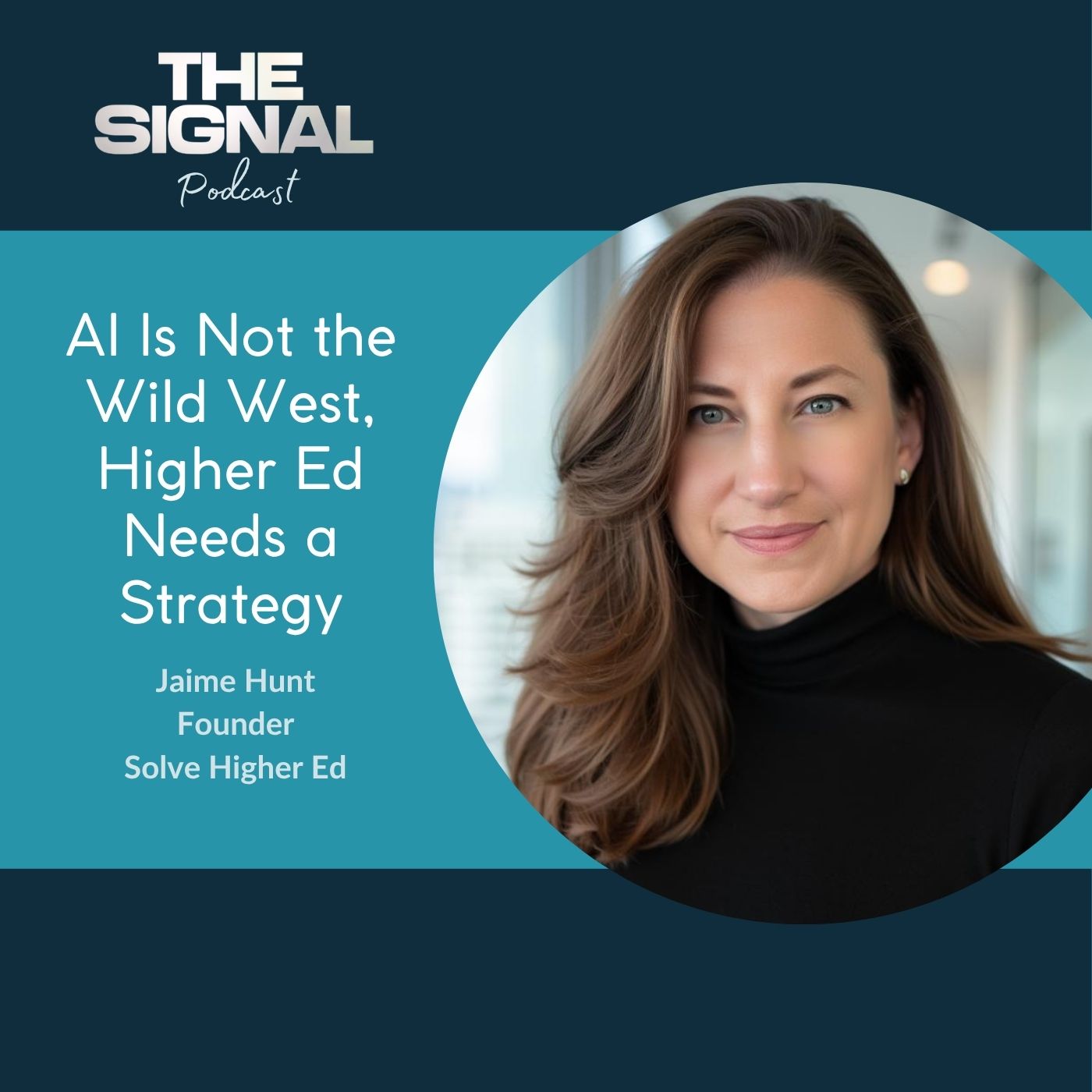
Ep. 82 - Jaime Hunt: AI Is Not the Wild West, Higher Ed Needs a Strategy
About this episode
Jaime Hunt is the founder of Solve Higher Ed and host of the popular “Confessions of a Higher Ed CMO” podcast. She unpacks the evolving landscape of higher education marketing. Jamie shares decades of experience – from her time as a Chief Marketing Officer at institutions like Old Dominion University, Miami University, and Winston-Salem State – offering brutally honest insights into the challenges and opportunities facing colleges and universities today. This is an honest conversation about enrollment strategies, brand building, crisis communications, and the surprising universality of higher ed’s struggles.
Join Jeff as he delves into Jamie’s unique perspective on leadership, risk-taking in education, and how institutions can truly differentiate themselves in a competitive market. Discover why many colleges are facing similar hurdles despite seemingly disparate circumstances – and learn how to break free from short-term thinking.
Key Takeaways:
- Universality of Challenges: A startling number of higher education institutions face remarkably similar challenges regarding enrollment, brand perception, and strategic direction – regardless of size or location.
- The Importance of Risk-Taking: Traditional, campaign-focused thinking is holding back progress. Institutions need to embrace calculated risk and experimentation to truly innovate.
- Beyond the "Me Problem": Leaders often get caught up in their own institution's issues, overlooking broader trends and systemic challenges within higher education.
- Selling Futures: Jamie’s personal motivation – a desire to help students achieve brighter futures – is a powerful driver for effective higher ed marketing.
- Looking Ahead: Institutions need to be thinking strategically about the next 2-3 years, anticipating technological shifts and evolving student expectations.
The Signal Newsletter:
https://edtechconnect.com/newsletter
Find Jaime Hunt:
https://www.linkedin.com/in/jaimehunt/
Solve Higher Ed
https://www.solvehighered.com/
And find EdTech Connect here:
Web: https://edtechconnect.com/
Chapters
- (00:00:00) - The Signal: Higher Ed Marketing and Transformation
- (00:01:36) - In the Elevator With Higher Ed Marketing's
- (00:02:47) - Former CMOs at Universities and Colleges
- (00:05:06) - What are the biggest misconceptions people have about marketing leadership in higher ed
- (00:10:01) - Where are marketing institutions getting it on AI?
- (00:13:47) - AI and Marketing: The Strategic Implications
- (00:16:47) - Common themes in higher ed's AI implementation
- (00:20:04) - Why Empathy is so critical for higher ed leadership
- (00:21:28) - How to Stay Innovative With a Limited Budget
- (00:23:01) - Getting to the Cabinet: Marketing Leaders
- (00:25:09) - What are some of the most surprising insights from your
- (00:27:56) - Talking Higher Ed: Confessions of a Student
- (00:28:26) - The Signal: Higher Ed Tech Insights
Get every episode summarized
Each time EdTech Connect publishes, we email you a written briefing from the transcript — the topics, who appeared, and any specific claims, with the ad reads skipped.
Email me new episodesFree for 3 shows. No card needed.
Hosts & guests
Transcript ready
466 searchable segments. Every word is indexed and playable.
Full transcript
EdTech Connect — Ep. 82 - Jaime Hunt: AI Is Not the Wild West, Higher Ed Needs a Strategy. Machine-transcribed; use the interactive transcript above to jump the player to any line.
And then I've seen teams where it's like everybody's using a different tool and there's no cohesion and there's no clarity about what's appropriate use and there's no guidelines and there's no guardrails. And I think that's where the risk lies. I mean, you talked about being a webmaster in 2000. It was the wild rust and we do not want AI to be the wild rust like that. Welcome to another episode of The Signal. Today's guest is someone who has spent more than two decades at the center of higher education marketing, leadership, and transformation. Jamie Hunt is the founder of Solve Higher Ed, boutique consultancy she launched in 2024 after two decades in higher education marketing, including nine years as a chief marketing officer. He's also the author of Heart Over Hype, transforming higher ed marketing with empathy and host of enrolifies confessions of a higher ed CMO podcast. Her work spans brand strategy, enrollment marketing, storytelling, crisis communications
and digital strategy. She's held executive leadership roles at Old Dominion University, Miami University, and Winston Salem State University with earlier stops at Radford University, the University of Wisconsin, Oshkosh, and Northwestern Health Sciences University. She also teaches graduate courses in higher education marketing and emerging media at Westford J&N University. So welcome to the show Jamie, I am so excited to have you today. I'm so thrilled to be here. Thanks for the invitation. Let's start by talking about how you got here, a little bit about your background. You've spent more than two decades inside higher ed leadership. What first pulled you into higher ed marketing and what's kept you there? Yeah, I was a first generation college student and I had no idea that there were jobs for people on campus that weren't faculty and maybe like administrative assistants. So I didn't really understand that you could make a career of this until I had been a journalist
for about five years and I saw a posting for a university, a small private, really specialized university in Minnesota and I was like, wait, you can do these kind of jobs at a university and was so excited and basically instantly knew that that's what I wanted to do for the rest of my career because it's just, it's something you can look in the mirror and feel good about selling, right, you're like selling people futures that are brighter because of the quote, quote, quote, product that you have and that has been what's kept me is having that ability to like look at myself in the mirror and know that I'm doing something that matters. Yeah, exactly. You've worked at institutions like Old Dominion, Miami University, Winston Salem State, what lessons from those roles and you're currently interim, right, interim CMO? Yep. At Agnes Scott College. Agnes Scott, what lessons have shaped you the most on how you're approaching the leadership
today? I think you have to understand sort of the trajectory of those to understand that. So I started at Winston Salem State as a CMO, it was my first CMO VP job and it's a historically back university and it was such a lesson in leadership for me. I had to learn a totally different culture to me. I'm from the North. This was in North Carolina. It's an HBCU. I'm not African American and that was such a lesson in just being humble and understanding you don't know all the things and I think that was a great first lesson because I think sometimes when people start working in leadership, they immediately feel like they have to posture as knowing everything and I was smart enough to know that that would be a good idea. So from there, I went to pretty much the exact opposite which was Miami University in Ohio and from that, it was a much bigger school, a more selective school. It wasn't a perfect fit for me and that's when I realized that I really like institutions
that are more focused on access. I loved the people I worked with at Miami. I think it's a fantastic school but I fit best in schools that are about access. And then Old Dominion is an R1 with a medical school so I was very, very different but it has a strong access mission. And so from there, it was like understanding how to lead a really broad, decentralized group of people in a way that makes the institution really sing. And then now at Ignisco, it's a small private women's college and again, it's like very different opportunity to really see how a woman's college and when women are leading everything what that looks like and that has been a real pleasure as well. I think we talk a lot about strategy and brand and enrollment, all the visible pieces. But the reality of leading marketing and setting universities often a lot more complex than people realize I think. So what are some of the biggest misconceptions we think people have about marketing leadership
in higher ed? This has been an interesting phenomenon to watch over the last two decades. So I started in higher ed in 2004 when I was 10. So I started in 2004 and at that time branding was kind of a bad word on campus. People thought that like calling things marketing, calling things branding was sort of not something that higher ed needed. It was taking away from the academic mission and that's really shifted over the last 22 years. But I think the misconception that people who don't work in marketing have are a couple of things. One, marketing can solve all problems. I often say you can't communicate your way out of a problem you manage yourself into. People think we'll just communicate around this problem and it will be solved. People think it's magic, we can put ads in the market today and we'll have growth and enrollment tomorrow. And people think it's easy. And I see that a lot from people who want to move from the corporate world into higher
ed marketing. I can't tell you how many people I've talked to who've done that exact thing. And I thought this was going to be a cushy job. I did not know this was as complicated. I think that's a huge misconception that leads people into the field with sort of a lot of cited ideas about what it's going to be like. And then they have to kind of figure out what's shared governance and what do you mean? I have to get approval from faculty senate to do this or that. Whereas if you've been baked in that, it just seems normal. You reminded me of a story I have to tell you that's going to date me, really date me here. But the year was 2000 and I had my first job in higher ed as a webmaster and the job was pulled out of IT into marketing. I was the webmaster on the marketing team had to deal with IT people who just lost the control of the website. It was someone's side job. So that was there. And there was a webmaster email on the website and it would go to me. And so I started getting all these questions like, what are your chem pre-rex athletic questions? Half my job was routing these emails and I told the marketing people and I don't think
I think it was called comms. It wasn't marketing. The communications and PR team. I'm like, I think we have something here with this website. I think we should be doing more like, this is a tool for us here. This email. I kind of was ignored a little bit. So I had to build a drop down form that had like 20 departments tied with email addresses to just get them out of my queue and then I can handle the ones that didn't fit. But it was just funny how far we've come that that's where I started. But one of the patterns you see across a lot of campuses, I think is the fragmentation and different teams, different tools, different priorities, they're all pulling slightly different directions and it shows up in the experience. So what does a truly aligned marketing organization look like in higher ed, Jamie? I think if you're truly aligned, there is a sense of communal ownership of a strategic objective. So everything really needs to tie back to your strategic plan or a strategic objective
that the institution has and everybody who does comms and marketing needs to understand what that is and how they're contributing to it. And a lot of institutions struggle with this because they see each silo. So it's like, oh, I'm in the college of business. And so that's my biggest priority is working towards the college goals and not thinking about how those ladder up to institutional goals. And if it's truly aligned, I think you're having people meet really regularly. You have shared KPIs that everybody's reporting on the same sort of KPIs and you all understand like what is the ultimate objective that we're trying to accomplish in the next year, in the next three years, in the next five years and how is the work that every communicator is doing on campus feeding into that. It's rare to see that, especially at larger institutions, but it's really possible. And when I was at Miami, we pulled together every single director of communications on campus every other week and built out this massive document that tied everything back to each
other. And people could see how, oh, this person's doing this. I can connect pieces of that to my strategy here. And when you do that, suddenly you're all speaking from the same stage. You're all singing from the same sheet of music and it creates a much more cohesive student experience, which is, I think, essential because that's what students expect and want and what they see outside of higher ad. You don't see Starbucks or Target or whatever giving this really fragmented experience. You have a really unified experience when you're dealing with these companies and that's what they expect from us as well. I love that point. You talk a lot about moving from activity to strategy. What does that shift actually look like inside a marketing, university marketing team? This is something that I've been talking about for like 10 years, maybe longer. A lot of institutions have forms on their website where they're asking, what do you want?
So when a department comes to the marketing office, they say, I want a fire. I want to brochure. I need a billboard. I need a video. And instead of starting with what is their goal and how can we leverage our expertise to come up with a plan that accomplishes that goal? And so I think it requires a really big mindset shift in departments to stop thinking about checking off tactics and instead focus on solving problems or achieving goals. And I see a lot of people report, I'm going to put air quotes around KPIs that are actually just a checkbox. It's not something that actually you're measuring how it moved the needle or you're measuring it, how it worked towards accomplishing the goal. Instead, it's like we launched a faculty database or we pitched 10 stories. And I think when you shift to thinking about it as like, but what did that do? How did that move you forward? How did that help you accomplish a goal?
That's when you have that mindset shift that allows you to be a lot more strategic and actually accomplish things. And in my experience, when I've been able to demonstrate this work that we've done resulted in these concrete steps, these concrete outcomes, I've gotten more budget, I've gotten more resources, I've gotten more credibility and there's nothing wrong with that. That's what we all want, right? That's exactly what everyone's asking for. And right now, everyone's talking about AI, investing in tools, launching pilots, but there's a big gap between experimenting with AI and actually being ready for it in a meaningful, operational way. So let's separate the signal from the noise here. Where do you see institutions getting AI right now and where are they getting it wrong? I'm seeing institutions get it right when they are thinking about it more as a AI first approach. So maybe I should say AI-centric approach. So they're looking at problems and they're figuring out how AI can solve those problems.
Instead of, we're just going to give you tools and work it into the work that you're doing. But I think a lot of institutions are doing the, hey, everybody now has XYZ AI tool. Versus, we have this problem. What tool will help us solve it and what to solving it look like? And I think if you approach it from that perspective, you're going to have a much more holistic and fulsome result. I've seen institutions do really cool things with their teams, particularly in the marketing space with AI. And then I've seen teams where it's like everybody's using a different tool and there's no cohesion and there's no clarity about what's appropriate use and there's no guidelines and there's no guardrails. And I think that's where the risk lies. I mean, you talked about being a webmaster in 2000. It was the wild rust and we do not want AI to be the wild rust like that. I found a page. I talk about this often. When I was at Radford University, there was one website we never migrated.
It is still out there as not having been migrated. It still looks like 1998. It's terrible. And that's what we're heading towards if we don't have a much more intentional adoption of AI. We're so reliving that. You're so right. You start twitching. Oh my gosh. When a lot of leaders here, I think they hear AI and marketing, I think the conversation really goes to automation, faster emails, quicker content doing more of it's less. But I think that framing can be a bit limiting. So I want to push that a little bit. What are the deeper strategic opportunities institutions might be missing? I think automation is easy and fantastic and all of that. I think that where I see a little bit of a disconnect is in the personalization space. So we have the technology and the ability to create extraordinarily personalized experience for students based on what we know about them based on what's in the CRM.
And we are not doing that because we don't have our CRM set up necessarily the best way to be able to like gather and collect and take action or people don't know how to leverage those technologies to be able to do that. And so I think that we could be looking at really hyper personalized experiences for students if we leveraged AI in the right way. I also think I've seen some marketing teams using AI to do some more sophisticated research into which programs they should be prioritizing, marketing, pulling from all these different data pools, federal data pools, iPads, all over the place to be like, there's a lot of growth opportunity for this program. Can we market this and grow that program? And that stuff is really, really neat. I think a lot of people are like, oh, we're just repurposing content using AI or we're just, we can automate a few things. There's some really sophisticated stuff. I was talking to a school about building a custom GPT that could scrape their whole website
every weekend and pull in all the news stories. Any department has posted anywhere on their website and then span through those identify reporters that might be good to pitch the stories to and write a pitch and in your inbox on a Monday, you would have pitched the story to this out list, this to this out list, this to this outlet. And that's not even that hard to do. I don't know. It sounds so in the future, but we're there. That's what's happening right now. That's so possible. I've actually talked to a company about a similar idea, well, not similar, but they're concerned whether they're positioned with certain programs like they just launched a new MBA. What about all these schools in our area that are doing that, what do we stand like? Well, let's build something that checks weekly and checks all your competitors kind of a brand rep, you know, it wouldn't be that hard. Tell us who your competitors are and let's, let's keep track of that. That's something we take forever for someone to do manually, you know, but if you, if you strip away the hype, like most institutions are still trying to figure out where to actually
start with AI in a way that really drives the impact. And I think that's where things usually stall. So let's, so practically, if university, present, ask you tomorrow, where should we start with AI? What would you be your first recommendations? I wish that I got this call more often, and probably going to have some enemies for saying this, but I think they have to separate it from IT. It can't be an IT-driven exercise. And I know I'm going to have some enemies for that, but I think that what I see is when IT drives it, co-pilot ends up being the choice for campus. And I don't think that's the best choice for campuses. And I think that they need to really have like a task force or, you know, some sort of group that's really saying, these are our use cases with the best tool for it versus this is our tool. Let's figure out some use cases for it. And then get your campus some level of universal AI understanding training, whether that's
something that you produce in house that you bring somebody in for, that you like sign up for Coursera or whatever, but having everybody have sort of the same fundamental understanding of how it works, how you might be able to leverage new work with the ethics are of it, et cetera. And I think that really helps an organization build a more sophisticated usage of AI. You have a front row seat. You work across multiple campuses, seeing how different institutions are trying to modernize at the same time. Your company is called a Solve Higher Ed, right? That's your consulting firm. Usually, that's where the patterns start to show up pretty quickly. So I'm curious what patterns are you seeing across campuses right now? In the AI space or more broadly? AI would be great. If you see other broader ones too, let me kind of up to you. So I'm seeing a lot of institutions are struggling with what to do. They're just really like, we know we need to do something. We don't know how to get started. And it's that starting step, that sort of first action that I'm seeing sort of stymying
a lot of institutions. And I also think that there's a big, I'm seeing a pattern of amount of fear about AI implementation, particularly among faculty. And as someone who also teaches a course each semester, I have the same concerns. I want to be sure students are using AI ethically and in ways that enhance what they're doing and not replace what they're doing. But I think there's this sort of knee-jerk reaction of like, students can't use it. So we can't talk about it. And that's just, they're using it. They promise you they're using it. So I see that as a big pattern of like, there's not enough training happening for faculty and staff on how to leverage these and how to teach with these tools. And I think, I mean, we're three years in, we need to get that together. Yeah, I feel like we have moved the needle sums since 2022 when it was complete, like faculty, like, no, we cannot be using this down, it's like, well, we better figure it out. They've not all come on. But like, there's not much denying that like, we can't really get rid of these tools.
You know, there's a lot of noise out there and higher and market right now, new tools new tactics, constant pressure to move faster. Your book, heart over hype, really points to a different direction, something a bit more human at the center of it all. So why is empathy such a critical leadership skill right now? So I wrote my book and it came out almost exactly a year ago when empathy had become sort of a bad word in the public consciousness. And that was somewhat intentional. I want to reclaim it. And I think empathy, particularly for marketers and higher ed leaders, is really important because it's not this sort of soft lack of accountability. It's really understanding the perspective of the people that you're speaking to and being able to shift your communications in a way that responds to that. And that's just good marketing. That's just good communication. Understanding somebody's needs and motivations and fears and anxieties and all of that make you a better marketer and a better communicator and a better leader.
And I think it's something that we tend to communicate from our institutional perspective versus communicating what a student needs to hear. So we communicate what we need to say, not what they need to hear. And that creates this sort of this fractured experience for them where they're not hearing what they need to hear. I do a lot of audits of comp flows and it's like this is beautifully written and this is conveying everything you need to convey. But it's not addressing the type of anxiety a student is having in this moment. And I think we need to get that more embedded into the work that we do. You know, every marketing leader I talk to is feeling the squeeze right now. Expectations keep climbing budgets, budgets aren't. Their teams are being asked to deliver more impact with fewer resources. So that's I think where things can really stall or get creative. How can marketing leaders build teams that state innovative despite resource constraints they have? The most innovative work I did was when I had the smallest team and the smallest budget
because you don't have a choice. You have to do things in new ways or you're out of luck. And I actually think empathy plays into this a lot. So I think if you are resource strapped and you're trying to figure out how to be more innovative, I think taking a look at what of people actually need and rebuilding what you do, what you provide, the work that you do around what people actually need will allow you to drop stuff that you've been doing for years just because you've always done it and implement new things that are more responsive to what people need today. And I think that really requires you to listen and take the time to listen and talk to actual human beings. I have found that doing that lets you say, you know what, nobody is reading this thing that we send out. We're going to stop doing that and we focus our energy on this thing that solves the actual problem. Why is it hard for hire to stop doing things sometimes? Right? We've always done it.
We have to keep doing it. Always. A lot of marketing leaders want a stronger voice and institutional strategy, but getting to that cabinet level isn't automatic. I think it usually comes down to how the roles received, who that person is in that role, and how that value has really demonstrated. So what advice would you give marketing leaders trying to get us seated at the strategic table? I think that there's a couple ways to approach this. I think you need to make your voice matter. So when you do have the opportunity to have a say in things, actually providing a ton of value in that, providing that value will make people come to you again and again. Building relationships with other people who are on the cabinet so that if you're not in that room yet, they're thinking of you and think, hey, you know what? Who would be really helpful here would be Jamie? Can we bring her into this conversation? I also think there's a lot of data out there right now about what other institutions are doing. And as much as I hate, let's go look at what our competitors are doing and doing the
same thing that does sway a lot of leaders. So if you're able to say, you know, hey, 72% of institutions have a cabinet level marketing leader. And here are the ways I think that would benefit us. I think that can be really helpful. I mean, honestly, in the UNC system, there was one vice chancellor before me within the system. And that was at Chapel Hill. And then I got made a vice chancellor and suddenly like all the schools got vice counselors. So if you can be that like here, I'm making the case. And then maybe you'll be able to point to the school down the road like, hey, they just made a device chancellor. Another way you could do it, and this is a little sneaky, is get an offer to be at a cabinet level position at another institution and see if your institution will, you know, air tactics sometimes works pretty well. Yes. Yes. I've seen that happen for other people. We've had a chance to sit down with a lot of CMOs on your podcast, conventions of a higher ed CMO. And here, here what they really think behind the scenes, not just the polished version.
And that's usually where most of the interesting insights come out. What are some of the most surprising insights you've learned from your guests? Yeah. It's been a little surprising. I don't know why. I'm 100 episodes in. And I think the universality of some of the challenges that higher ed faces, I think a lot of folks think like, this is a me problem or a my institution problem. And it's like, no, every institution is struggling with basically the same things. So that, I would say that's a aggregate insight that I've gotten from all of these conversations. I also see that a lot of these leaders are really, really, really bright and sometimes they're stuck in environments that don't let them do things to their full capacity or their full potential. And I really wish that higher ed would realize that sometimes a little bit of risk taking gets us to that next level, sometimes taking a chance on something you need to really evaluate is this actually risky?
It's usually not and try something new, do something different. You know, everyone's focused on what needs to happen this year, this cycle, this campaign. But institutions that really are going to separate themselves, I think are already thinking a few moves ahead, like, when it comes to marketing and storytelling and how the tech comes together, looking ahead, and like, let's say two or three years, what do you think the most successful educational institutions might be doing differently? I think institutions need to create much more integrated marketing teams, having your teams work without the silos of like, this is PR, this is news, this is the magazine, this is marketing, this is digital, and have teams that are pulled together that are cross-functional for projects. So it's not like an assembly line, this team touches it, and then it gets to hand it to this team. You worked in web, we were the caboose. We would be given a pile of stuff at the end that if we'd had the opportunity to speak into earlier, it would have been better for how it worked out on the web.
I also think institutions, I did this at Miami. We created a storytelling team where we had everybody who was part of actually telling the institutional story in one team, brainstorming together, working on visuals, moving images, all of that. I think that teams that do that are going to be really well positioned. Then on the technology side, I know a lot of institutions like to do homegrown technology, but I think that the out of the box stuff that a lot of tech companies are doing some really big investment and research and development into products that solve common challenges. Let's do that instead of homegrown technology. It's hard to keep those people on staff anymore, anyone that can do, that can build things. Well, Jamie, this has been a really great conversation. I think what stands out to me is your practical approach in a space that can get pretty abstract very quickly. If people want to go deeper into your thinking, I'd point them to heart over hype, your
book, your podcast, Confessions of a Higher Ed CMO, and the work you're doing with Solve Higher Ed to help institutions actually put this into play into practice. So Jamie, I really appreciate you being on today. Thanks. Thank you. Have a great rest of your day. Bye-bye. That's a wrap of this episode of The Signal. If today's conversation sparked a new idea or challenge your thinking, that's exactly the point. This show is about cutting through the noise and helping you see what's actually shaping higher end right now. Please subscribe so you never miss an episode. If you found this valuable, leave us a quick review. It helps more higher leaders find the signal. For deeper edtech insights, news, and trends delivered monthly, subscribe to the Signal Monthly newsletter at edtechconnect.com. Thanks for listening. We'll see you next time.
More episodes
More from EdTech Connect

Ep. 86 - Arjun Arora: From Enterprise AI to Education—Why the Best Tech Solves H...
EdTech Connect

Ep. 85 - Jay Gonzalez: Guaranteeing ROI — How Curry College Is Reinventing the C...
EdTech Connect

Ep. 84 - Betheny Gross: The Real Opportunity for AI in Higher Education
EdTech Connect

Ep. 83 - Mitchell Borges: Why Students Trust Strangers More Than Your University
EdTech Connect