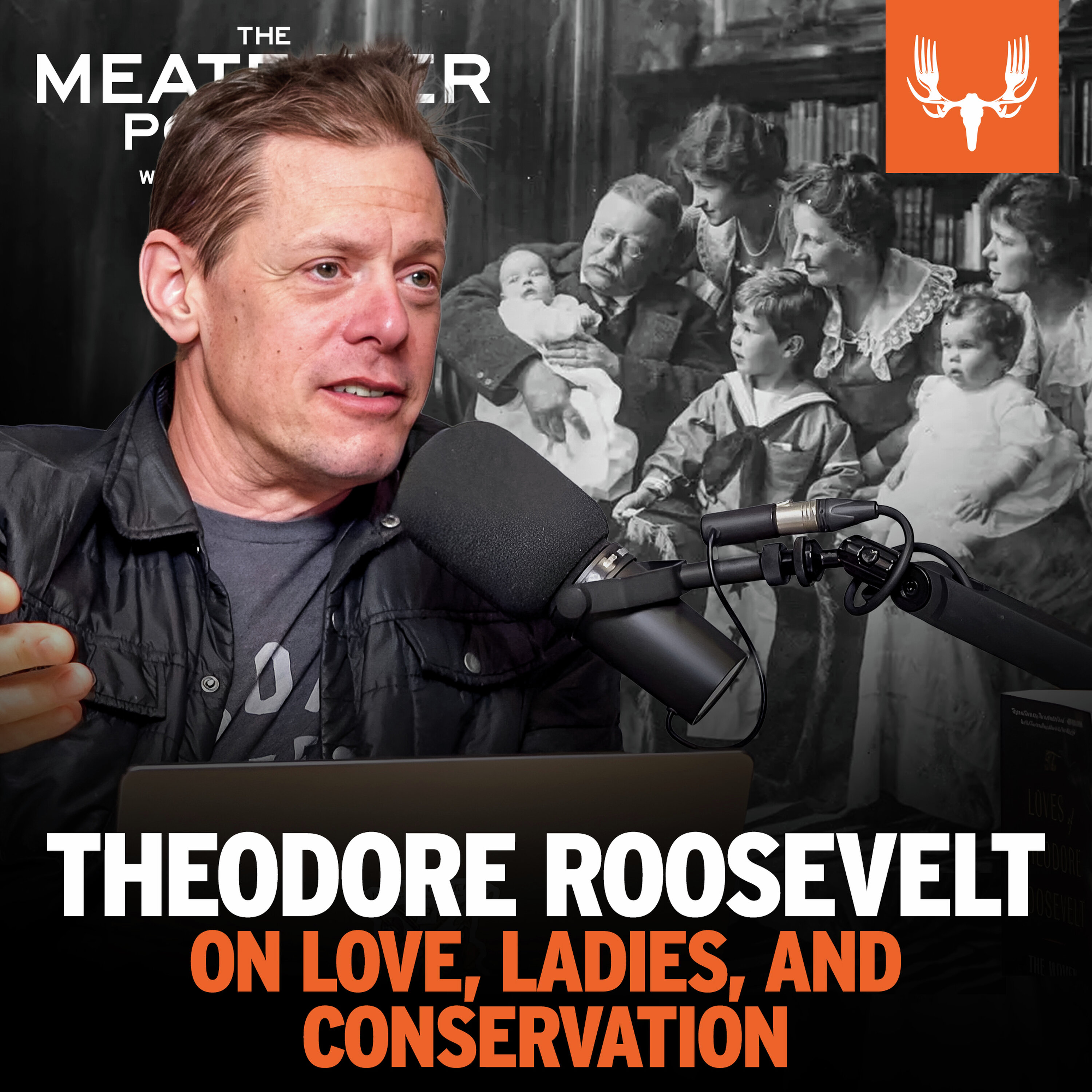
Ep. 841: Theodore Roosevelt on Love, Ladies, and Conservation
About this episode
Steven Rinella talks with author of The Loves Of Theodore Roosevelt and CEO of the Theodore Roosevelt Presidential Library, Ed O'Keefe. Joined by Randall Williams, Phil Taylor, and Corinne Schneider.
Topics discussed: The ladies in Teddy's life; being a sickly child and powering through pain; hunting to study; a tremendous taxidermy collection; a family that founded so many museums; sisters as advisors and confidants; a life-altering Valentine's Day tragedy; when a thick manuscript in your front jacket pocket stops a bullet and saves your life; being the first president to embrace women's suffrage and the right to own property; one of the most beloved in American history; and more.
Connect with Steve and The MeatEater Podcast Network
Steve on Instagram and Twitter
MeatEater on Instagram, Facebook, Twitter, and YouTube
See omnystudio.com/listener for privacy information.
Get every episode summarized
Each time The MeatEater Podcast publishes, we email you a written briefing from the transcript — the topics, who appeared, and any specific claims, with the ad reads skipped.
Email me new episodesFree for 3 shows. No card needed.
Hosts & guests

Transcript ready
1,477 searchable segments. Every word is indexed and playable.
Full transcript
The MeatEater Podcast — Ep. 841: Theodore Roosevelt on Love, Ladies, and Conservation. Machine-transcribed; use the interactive transcript above to jump the player to any line.
This is an iHeart podcast, guaranteed human. Welcome to Meet Eaters 12 and 26, presented by Moltremobile and OnXMaps, 12 of Meet Eaters biggest and baddest hunts from the last year released throughout 2026. These are long form episodes so you get more of what you love. The first one up is my baited bearhunt in Manitoba. If you've ever wondered what a baited bearhunt is like, you'll love this episode. My favorite part was watching a younger bear spend an hour trying to figure out how to get a creatively hung beaver carcass down from a tree. Check it out now on Meet Eaters YouTube channel and be on the lookout for more 12 and 26 in the coming months. This is the Meet Eaters podcast coming at you shirtless severely boat bitten in my case underwearless. You can't predict anything.
Brought to you by first light. When I'm hunting, I need gear that won't quit. First light builds, no compromise gear that keeps me in the field longer. No shortcuts, just gear that works. Check it out at firstlight.com, that's F-I-R-S-T-L-I-T-E. Alright man, we're joined by Ed O'Keepe who's got a new book The Loves of Teddy Roosevelt. We're going to get into Teddy as a ladies man and a mama's boy. Yeah, that would have been a much better son-tiver ladies man, mama's boy, instant best seller. No, The Loves of Theodore Roosevelt, the women who created a president and so everybody knows Theodore Roosevelt as the swashbuckling, you know, adventurer, which is a little weird like, you know, he went all over hunting, hunted in Africa, hunted across the west, became
a rancher, wrote a book about ranching, like people know him as this sort of like the most macho of presidents, the manly mannest of presidents, right? You know, you think of like, you think of like, President Trump growing up, you know, he's got like, gold stuff everywhere and this guy was kind of comfortable in the cabin at times. But what you lose sight of, there's companies you lose sight of with Roosevelt one, extraordinarily wealthy. Like in today's world, him as an outdoorsman will be like a rich kid, like goes to boarding school and gets into nobles, gets real into like nobles and like spends his summers in Alaska. Yeah. Do you know what I mean? That's like the contempt and then you know, eventually he's like a fishing guide or something but he didn't really actually have to like redneck stuff. Yeah, he doesn't depend on the guiding income. Yeah. It's just a lifestyle. Yeah. And like that would have been Roosevelt, but he did it so well. And because of his conservation record, he's sort of held as this like rugged individualist.
But he has this very confusing background and like one of the things that we're going to talk about is this is a guy not shaped by grizzled old hunting and fishing uncles that live out in a shack somewhere. He's like shaped by women in his life and like huge impactful relationships with his mother. So we're going to dive into that Ed O'Keefe, Edward O'Keefe, if you want to be official. The first thing we're going to talk about, since I do his intros, we're going to talk about this. So Edward O'Keefe is the CEO of the Theodore Roosevelt Presidential Library Foundation. So we're going to kick off by talking about that because this is a big deal over in North Dakota, the presidential library, O'Keefe recently previously spent two decades in broadcast and digital media at ABC News, CNN, and now this thing, which time he received a primetime Emmy award for his work with Anthony Bourdain to Webby Awards, the Edward R. Murrow Award.
What was that documentary about him? No, the movie Good Night and Good Luck. Yeah, George Clooney and a play in a George Foster P body award for ABC's coverage of 9-11. So all that said, if he bombs today on the show, it's been good. It's been good. It's not that he didn't have the training in the media to pull off a podcast appearance. He should kill a former fellow at the Harvard Kennedy School. He graduated with honors from Georgetown University all from all out of North Dakota. North Dakota. That's right. Born and raised. Born and raised in North Dakota. When I had to do all that, so currently lives in New York with his wife, daughter, and son. All right, tell us about the library. Well, before we get into the book, let's talk about the library. Yeah, yeah, great. I mean, the Theodore Roosevelt presidential library opens on July 4th, 2026, 250th anniversary of America. Was that just like a coincidence? You know, I mean, I started in this job October, 2019, and yeah, yeah, and so it's been
a six year effort. We've raised almost $400 million to get this baby constructed. Oh, man. Yeah, it's a, it's going to, it's 93 acres. It celebrates Theodore Roosevelt's conservation legacy, so looking, you know, he looked a hundred years into the future. And conservation wasn't even a concept, right? I mean, it was an academic concept, but no politician had paid attention when TR proposed his first conservation bill. The speaker of the house literally said, there will not be one dime for scenery. That was, that was the attitude, right, serious? Yeah, I've never heard that before. That was the response. Right. Because if scenery was like, what are you talking about? I don't know. That's 100% true. I feel like I ought to have heard that. That's 100% true. The speaker of the house, when he proposed his conservation bill said, no way. I mean, I didn't, well, there wasn't a counter argument. It was just, that doesn't make any sense. What are you talking about? Yeah. So I mean, this, when he's talking about the creation of the U.S. Forest Service, when he's talking about national doubling the park's size, when he's putting 234 million acres
of land into the public trust, he is not just ahead of his time. He's light years ahead of his time, easy. And so what we want to do at the TR library is, you know, work with the local ranchers to graze the land on the 93 acres. We have a walkable roof where you can go 38 feet tall and look out at the 65 million years of geologic history in the badlands. And it's filled 400,000 native plants all from, yeah, all from 40 miles around. We've been working on it for years, you know, working with North Dakota State University to bring those plants back, bring the pollinators, bring the bees, bring the birds back to this area, you know, and so, you know, you want families to come and to hike and to bike and to horseback ride to the, to the presidential library, you know, it's really a place where we want kids to drag their parents. I mean, to get out in nature and do what TR did, you know, to, to find nature as your classroom, to be together as a family, to, you know, celebrate the wondrous beauty of this national park,
Theodore Roosevelt National Park, the only one named for a person, let alone a president. You know, you know, everyone else's name, how close was the library to the park? Stone's throw. I mean, you can, so there's two, there's a West Wing and now the only East Wing that for, we thought that was going to be a clever ode, but the only one now, and it's, perfectly framed view of Theodore Roosevelt National Park. So you can literally, you can see the park from us and us from the park, 74,000 acres of backyard to go explore. And does that board, so it borders the park? It does. Yeah. It'll, it's the largest private philanthropic project adjacent to a national park in history. The previous was St. Louis Arch. So we're, it's, it's a big effort, you know, it's, North Dakota is not a huge state. We've got people from all over the nation, all over the world, who've contributed because TR, I like to say he's like a Rorschach test.
What, what you see in him says more about you than it does about him, right? And so Republicans, Democrats, Independents, people from all 50 states, 12 different countries, you know, we've, we've been really blessed to have incredible support because of this person who's so universally beloved for different reasons. This thing I've, I've mentioned a bunch of times is in given talks is there's not a politician today that wouldn't like to be favorably compared to Roosevelt. Absolutely. Absolutely. I mean, Josh Holly and Elizabeth Warren's favorite president find me one other thing they agree on. I mean, he's Barack Obama and Mitt Romney's favorite president as impossible to find another thing that they agree on. Yeah. I mean, at the theater Roosevelt presidential library is we don't want to tell you which version of TR you should love. We want you to get out in nature with your family. Well, I tell people what version you can, but, you know, I'm the head of a non-profit. So I can't, inside we have an immersive, almost theatrical experience.
I mean, every chapter of TR's life is crazier than the last. I mean, if you, if you wrote this story and submitted it to an editor, they'd reject it. All right. Okay. I mean, we can charge up San Juan Hill and we can have the adventure in the Elcorn. But really, we're going to go to Africa and the Amazon. I mean, these are both going to happen in the same life. It's just ridiculous, right? So we want people, especially kids, to immerse themselves in these stories. You know, when you're in Roosevelt's childhood, you want to reach inside a tree if you dare. You want to open a book and a distinct species of bird will fly out and join a wall of wonder. You want you to feel curious when you're, when you're doing these things. When I feel courage, we want you to feel the things that TR felt so you can get in the arena of your own life and be the change you want to see in the world. Because that's ultimately TR's message is that if you want to be a part of a successful democracy, you have to participate. You have to be in there. You have to, you have to fight for it.
It's not just going to happen. And whether that's being on the school board or running for a local election, you don't have to be president to the United States to make a difference. But you do have to get involved and that's the ultimate message of the TR library. How did they find you to do this because you were in North Dakota guy? It was crazy. How did you go from media to doing that? I'm still trying to figure that one out. So I was 20 years in the media as you mentioned. I worked at ABC News. I worked with Tony Bourdain at CNN. Sadly, after Tony died, the show ended and I went to Harvard to basically try to figure things out. And I thought, I want to do the types of programs that we did with Tony in streaming. What was so powerful about working with Tony Bourdain is that he could go to West Virginia and have a conversation with people who are totally and completely different than him or he could go to Mumbai and gather them around the table, have a meal in a conversation and bring people together.
I had more people talk about what they learned about the world from watching that parts unknown than practically anything else I did in media. So I was really curious, like how can we take that, you know, and at the time in 2019, Netflix, Amazon, Hulu, Apple, et cetera, you know, they said, we're not going to do any news. We're not going to do any live. We're not going to do any sports. I also said they're not going to do any podcasts. They're not going to do any, right? Not going to do short form video, right? They're doing all of it now in 2026. But in 2019, it was like, nope, they're not going to do that. So that's what I was at Harvard to kind of explore. When we built this studio, we were never going to record. We were never going to do podcast. Never never, right? For both. No video. He's talking over between two cameras. No, that's strict. Yes, well, you, you stuck to it. Steven, that's what I admire about you. When you make a proclamation as a, you, you stick to it. So, yeah, so I, I, I meet this group who's trying to raise money for the TR library.
It's been an idea for a hundred years since his death and fits and starts in New York and North Dakota and other various places never succeeded. And, you know, I'm from North Dakota. I'm thinking about what to do with the rest of my life and my professional career. And I was researching a book which became the loves of theater. I was wondering, okay, so I was wondering, chicken or the egg kind of deal. Yep. That's not the perfect analogy, but yeah, I didn't know if, if your book came out of, so you were already getting into TR land intellectually. When you grow up in North Dakota, you're just in TR land. TR is your hero. All right, I mean, we, we got Roger Maris. We got, you know, we have Lawrence Welk. I mean, come on. We gotta give it out. You got some ahead of you. Phil Jackson. We have Phil Jackson. Oh, yeah, okay. All right, there we go. We tried to get him on the show, remember that? Yeah, yes. Yeah, he looks fish. Hey, he looks up and, uh, I guess he lives around here. Right. He's part of the time, I think. Well, if you're listening, Phil, yeah, this is probably is, he's been following me pretty closely for 25 years.
So this is probably his problem. Yeah, probably. I mean, he's like, well, that dude's doing it. I'm doing it. I'm doing it. Now that Ed has done it, you know, I feel Jackson will do it too. Oh, that would be great. Yeah, that would be. I hope that happens for you. Yeah. So, yeah, so I, the book came before the library. I mean, I was, I was in two very different mindsets. I'm in the 21st century, you know, looking at, could we do shows like Tony Bourdain and parts unknown in the streaming universe? And I'm sneaking away to the Houghton Library where a big part of theater Roosevelt's collection is held. And I'm exploring this story. And I, you know, I, I know the TR that you all know, right? From Mount Rushmore and this kind of chiseled masculine crazy, you know, adventurer. And two things can be true at the same time. That exists, right? That is him. But what I found remarkable is I'm looking at all these letters and every single decision that he ever makes.
He's asking his sisters or his mom or his wives for advice. And I'm like, what? Where's, I mean, like, I didn't, he's kind of the quintessential self-made man. I mean, the person who has no doubts, who asks nobody else for their opinion on anything. Yeah. Not true. It was fun to think like, like, Trump being like, I don't know, Melania. What do you think about Greenland? All right. I mean, who knows? History will show us. History will tell us some reason. I mean, I don't know. I don't know. Maybe Sunday there'll be a book. Maybe Greenland really pissed her off, you know? So yeah, maybe she plans that. Get him. Yep. Yeah, so that's what that was the origin is I was thinking about what to do next. I'm researching the book on Theodore Roosevelt. And I've got this, these roots in North Dakota. And North Dakota stepped up by offering a $50 million endowment contingent on the foundation's ability to raise $100 million by the end of 2020,
which seemed like a daunting task, but it got a lot harder when the pandemic. Yeah, you know, so, but I always like, oh, look, is they have no money, no architect, no land. What a great prospect. I think I'll dive in. My New York wife was really happy with me. She really thought this was a good career move. Good. Yeah, she was. So, but you guys haven't, you guys haven't moved. Do you still have family in North Dakota? I do. Yeah, my cousins, my brother, my uncles, yeah, my parents are there most of the year. Yeah. So do you, do you rent a place there now? So you can be out for your work? I mean, since it's a national pride, we like to say it's a global project with proud North Dakota roots. I mean, I'm everywhere all the time talking to people about the project and doing a lot of fundraising. I mean, 400 million and five years, you got to talk to a lot of people about what you're doing and how you're doing it. And all this is going to, um, July 4th, 2026.
So, yeah, so your question about was that intentional? I don't think in 2019, we thought, oh, you know, what would be a great day to open this. But at some point, yeah, that'll buy some time. Randall, you know, you know, fundraising and construction. Yeah, exactly. Yeah, no, at some point, we said, hey, wait a second, you know, if we can be a part of America's 250th celebration, that will bring a national attention that we wouldn't otherwise get. But also, think about this. So, Theodore Roosevelt was president at the nation's 125th birthday. He is exactly between the Declaration of Independence at zero and where we are now at 250th. Oh, wow. So, once again, TR makes you think about where are we going to be at America 500? Because right now, the midway point, we are the midway point of that point in our distant future. Yeah. And I'll tell my kids something similar, man.
I'll tell them like, if the Earth's cross solidified four billion years ago and the Sun's going to burn out in four billion years, like, it's just the Earth's in a midlife crisis right now. This is halftime. This is just the crazy midlife crisis. Exactly. And that kind of messed them up, because they couldn't really conceptualize four billion years. So, then there are some by one that they're like expecting any second. Expect any second offer to Sun to go, well, they can go on Facebook and find a lot of people who believe the same. They're going to have some real good friends soon. That's a good point, man. Like, yeah, you hit the halfway point. He's the halfway point. Right on the nuts. And think about this, right? Like, I never thought about that. So much is eerily similar to where we are now, right? The economy is changing. You're going from an agrarian to an industrial society. They think about men's worth. I mean, the value of a man to a family was how much they could hunt, how much they could gather, how much they could farm, and right. And that suddenly becomes, well, how much are you worth?
How much are you making? Or you have an industrial job, right? You're moving from a rural area to an urban area. Cities are developing. So, immigration was a huge issue in TR's time, right? And then it was Irish and Germans and Italians and Chinese. And, you know, at least to one of the largest crackdowns in immigration in US history. It right after TR's time, where he's a very welcoming presence. And then there's the crackdowns. They'll never integrate. They're always going to put family in front of nation. Yeah, I mean, Irish need not apply, right? I mean, this was a very, this has happened so many times. You'll never overcome the clan mentality of the Irish. And technology, think about technology. I mean, theater Roosevelt's born in 1858. There's no electricity. There's no cars. There's no airplanes. There's no submarines. He's the first president to travel abroad while in office. He's the first president to send a telegraph by wire. He's the first president to use a telephone in the White House,
first president in a motorcade, first president in an airplane, in a submarine, and on and on and on and on the list goes. So, technology is uprooting the way people feel about life. They're scared because it's moving so fast and so changing so quickly. What does this get to mean? And here's this person who says, I'm embracing this, it's going to be okay. And he's also one of the great naturalists of our time. So, he knows to get out of the car and get on horse and get out into nature and have a tonic to all this technology that is changing everything in every way of American life. So, he, I mean, it's all happening again. History doesn't repeat. It rhymes. Totally off. So, I want to get back into this, but just it's just popping in my head. Where was he at in his career when he got shot? He was the ex-president. Okay. It was like the bull moose era.
Bull moose, definitely. He's running against his successor, Taft and Wilson. He's an independent, bull moose progressive. And that's when he got winged, yeah. Or not winged. I mean, have you ever seen, like, we're going to have those pieces. They've never been. We got them. We got them. We got them. So, I've got. So, the only thing that saved TR's life, and he took a point blank shot right in the chest. And it was, he had a double-breasted suit. He had a speech about 50 pages long, doubled over in his breastcoat pocket. And then the thing that really saved him, he had his eyeglass case that was still reinforced. And that's the, that's the one. Seriously? Yep. I don't know about the eyeglass. The eyeglass. I just thought he had like a book or something. No, no. It was all three items really combined to save his life. See, that had been Lincoln, because the Gettysburg address was so short. Yeah, he did. It punched right through it. And I threw it. Right. That's why you should write long-ass speech. That's right. That's right. It's so crazy. So, we're reuniting these items for the first time.
They've never been on display together yet. You guys got the eyeglass case? The eyeglass case. So, the bullet. Who had that? The diameter of the bullet hole going in the front part of the case is very wide. I mean, you like, oh, he's dead. And then it narrows. You could see how much it narrows out the other side. It slowed it down. I mean, had it gone through at the velocity that it was intended at point blank range, he's dead. Did you, oh, Randall, don't bullshit me. Did you know about the eyeglass case? I did. I couldn't have described the whole to you, but you got to come to the door in North Carolina and said, who had that? So, the National Park Service had the eyeglass case. Another park had the shirt. So, it all got separated through the years. And the revolver, the gun, is gone. And by the way, the assassin was stocking Theodore Roosevelt through several different speeches and looking for the opportunity to shoot him at point blank range. He had a dream, a vision, that William McKinley, the president
who was assassinated that allowed TR to ascend to the presidency, had spoken to him and told him that he needed to prevent Theodore Roosevelt from seeking a third term. Then he was an illegitimate president and then he had to be killed. Makes sense. I mean, they recently... They can't human a vision. A dream. I can't human a dream. I mean, but think about this too, political violence. Right? Another thing that was a hallmark of TR's time that we're experiencing again. I mean, this is three presidents were assassinated in TR's while he's coming up through the system. I mean, including his, the McKinley, who leads to him becoming the youngest president in history. I mean, this was unfortunately routine. You know what the dude that killed Lincoln? Shot Lincoln in a theater. Yep. And then went and hit out. No, John Wilkes Booth. He went and hit in the book depository. The renowned actor. Now we're combining two different assassinations. Hear me out. Okay, all right. Okay. The dude that shot Lincoln. Shot him in a theater.
And I think they caught him in a book deposit. I'm not joking. Look at that. Oh, and you're saying... The guy that shot Kennedy. The guy that shot Kennedy shot him from a book depository. They caught him in a theater. You know that Lincoln's secretary was named Kennedy and Kennedy's secretary was named Lincoln. Didn't know that. Back me up. Where's your computer, man? I'm flying blind. Someone looked at me. I already knew about the glasses. Go Booth, you... Look up. Where did Booth get caught? I thought he was a barn. I could be strong, but check this out. When we were on, we were just on live tour. Oh, yeah. And we're doing a show in Dallas. And none of us knew this. Like, we had like booked the venue. One of our guys. He's hanging around somehow. He's going to get a cup of coffee or something. What's up out in front of the venue? And he's reading some sign and he comes back. He's like, this is where... This is where it happens. Oswald... Like, we're in the building where Oswald got caught. Yeah. Yeah. And it's right next to a dispensary called Dubies. Which everything changes.
Every Lincoln was a big Dubie brother. And you brought a Dubie brother. A Dubie brother, right? Yeah, he was in the text. He shot him from the sixth floor of the Texas book depository. I think he was caught at a theater. So that's probably what you're, right? Yeah, he was caught at the theater. He was caught at a movie theater. Yeah, that's why we were. By Tippet, Oswald was caught in a theater. Oswald was caught in a theater. Lincoln was shot in a theater. And if I'm not mistaken... He's trying to know Booth. The part that needs... Where'd he catch Booth in a movie theater? To a rural, a farm in rural North Virginia. Yeah, well actually the Booth didn't have a lot of books in there. Yeah. Was I a storing book? No, I get where he's going. It's a thing. Well, I'm going... I mean, symmetry. I think I'm just wrong. No, no, no. Lee Harvey Oswald shot... Kennedy from the book depository. I think that it was pretty close. Oh, barn. Well, things are stored there. I think they must have been having a lot of books. Just trust me listeners. That barn packed full of books. Great bookboss.
Maybe they started the fire with books. They were getting... Yeah, that's what I remember. I'm going to give you that one. It's a cow depository. It was full of... They called about that book. I hate it. It was a cow depository. Oh, that's... Okay, the book... No. We're on track. No, we're on track. There's a great book about that. By the way, manhunt. James Swanson. Twelve-day manhunt. Never read it by a scene. I think it was turned into a series too. Yeah. On... I don't know. I have to remember that. I can visualize the burning of the barn. Yeah, and the series on Garfields. Oh, that's amazing. That's Candace Mallard, who also wrote the river of doubt, which page for page. That is... I mean, that reads like a novel. And who was Hellhound on his trail was the guy that was the king assassin? Was that what that book's about? Yeah. Hellhound on his trail or something. Yeah, you're right. Either way, I want to get into our body here, T.O. Oh my god. Welcome to Meet Eaters 12 and 26, presented by Mulchrey Mobile and ONX Maps.
Twelve of Meet Eaters biggest and baddest hunts from the last year released throughout 2026. These are long-form episodes so you get more of what you love. The first one up is my baited bearhunt in Manitoba. If you've ever wondered what a baited bearhunt is like, you'll love this episode. My favorite part was watching a younger bear spend an hour trying to figure out how to get a creatively hung beaver carcass down from a tree. Check it out now on Meet Eaters YouTube channel and be on the lookout for more 12 and 26 in the coming months. Sickly hit. Yeah. Yeah, beyond sickly. Okay, let's get into it. This forms like his, like he has an intense relationship with his mom. Yes. The very first words of the loves of Theodore Roosevelt are from the beginning. Theodore Roosevelt survival was very much in doubt. And I think this is the part that a lot of biographers miss is you okay, he's an asthmatic sickly kid, but it led his mother to be extraordinarily protective of him to to keep him from going
outdoors. It wasn't just the asthma and the smog and the environmental devastation of New York in the 1860s. It was her really thinking that legitimately he could die if if he were exposed to much. And so, you know, here's a one because of like a bygone thinking like the the measma or is that like or is that a legitimate thing? It was legitimate. I mean, he the doctors did not think he would live beyond four or five years old. I mean, he he from the beginning of his life learned that you need to will yourself through physical and emotional pain. And his mom, who's often derided as having no influence over him, she is a charismatic southerner, right? She she's from the Bullock family. She's the inspiration for Scarlet O'Hara in Gone with the Wind. I mean, she's a character. Yeah. Randall says she dressed him up in little dresses. I mean, they did that in the eights. That was Victorian. She that was that yes, you would you would yes, but that was not uncommon. That's fair. It was not uncommon. He put it all like it was
uncommon. But no, it's I mean, I always thought it's it's this interesting. He's not like growing up wearing Buckskins. And oh, no. Yeah. No, no, no, he's used me. You said it Stephen. I mean, he's from the elite of the elite society. He's rich. There's no reason for him to go into politics or to go out into nature other than at the time, the doctors would give two different cures for women. They would say you need the rest cure, right? If you're afflicted by something, go lie down in bed. For men, they would say you need the West cure. Go West. Go hunting. Get out into nature. Do something that will revive your spirits. But as a child, I mean, Mitty, his mother would literally massage his chest when he was having as asmatic attacks and blood would come out. I mean, that's that's how often that bad. I mean, she he would have these recurring. He remembers. He are remembers as a child having recurring nightmares where the devil would come in the middle of the night and steal him away. And I mean, in the devil, he's like contemplating his own mortality. Yes. Yes. And even
when he gets, when he's 20 years old, he goes to a doctor at Harvard and the doctor says you have, you will not live past 60 and he doesn't. I mean, so he decides at that moment in his life, he is going to live to the hilt. How old was he when he died? 60. He had just turned 60. I don't know. Is that young, right? I mean, it, you know, he hit me with all kinds of T.R. and that's that I didn't know about. That's what I'm here for. 60 years old. I never really like yeah, that young. Yeah, it's kind of crazy to think of all the accomplished. Now my hair is super young, you know, yeah. Yeah, it is. What do you expect, dude? Yeah. I mean, right, you have a good long life. Yeah. Yeah. So I mean, Mitty, let's start with mom, because you always have to start with mom, right? She is a, she's a southerner. She grew up in Georgia. She's willful. She's got this incredible personality. Everybody, she's a great storyteller, right? So everybody knows that, like, Mitty's the one who will entertain you. And she's got an incredibly refined taste. She marries a New Yorker. And she is in New York during the Civil War and brings her mother and her
sister up from Georgia to live with the Roosevelt. So it or Roosevelt, she an abolitionist. Oh, no, no, she was a deep. She was a, she believed in the Confederacy. She would fly the Confederate flag. She refused to have her husband fight for the Confederacy because she feared he'd meet her brothers on the field of battle. Yeah. Yeah. Yeah. Yeah. And she, I mean, she, okay, she didn't want her brothers to do what? So Mitty, Roosevelt, theater Roosevelt's mom and Eleanor Roosevelt's grandmother was a Confederate thrown through. Yeah. And unreconstructed. But she, it's so she forbade her husband. Okay. Theater Roosevelt's father from fighting for the union. Okay. All right. So instead, what he did is he would be he would fight against her family. Exactly. Exactly. And so dastardly were his, were her brothers deeds that they were not granted general amnesty after the Civil War. Oh, really? Yes. Yes. They lived the rest of their life in Europe
in London and in Liverpool. They were forced bed for types. Yeah. Exactly. No, they, they, they were the ones that figured out how to run the blockade. So they would get supplies because the South didn't have steel and didn't have some of the things you'd need for munitions and creating rifles and bullets. And so they were sneaking all of that in very effectively from London to the South. No kid. And then one of them was thought to have been part of the financing of Lincoln's assassination. Really? Yes. So I mean, they weren't just Confederates. They were devout Confederates. I mean, one of her brothers tombstones in Liverpool says an American by birth and Englishman by choice. Really? Yeah. Yeah. The T.R. ever addressed that kind of stuff later in life? Yeah. I mean, you know, this he, he was a northerner who had his identity in the east with a southern mother who had this political identity in the west because of his cowboy and ranching days. He was,
he was the all American quintessential perfect candidate to kick open the door of what would become the American century because he had something for everybody, right? However, his mom died then. His mom died on the same day as his wife, February 14, 1884. So did she? 19 years after the Civil War, what was her attitude at that point? I mean, she was according to her son, an unreconstructed remained. Yeah. That she whole life and think about it. So I mean, again, I break up her mother and her sister both lived with the Roosevelt's. So he's growing theater Roosevelt's growing up in a house with one brother, two sisters, his mother, his grandmother, and his aunt. He's got a lot of feminine influences in the house, right? And his dad is off with Lincoln often because he can't fight for the union. He's decided to lead an effort to take part of soldiers' earnings and convince them to send them back to their families because they would
get paid and they were the primary earners. They were away from the house and a lot of them would blow it on. Just part you with the booze and exactly because they could die at any moment. But he was trying to convince them to send this back. So this is amazing. I found what a complex scenario though. I was like, like, put a finer point on it. What a complex situation for TR's mother? Yeah. Where she's got relatives trying to violate the blockade. Yep. And then she's got other close family members, like, run around, involved at an administrative level with running the union war effort. Theater Roosevelt grew up in a house divided, in a nation divided. And he learned from his parents that you can disagree without being disagreeable. You can be vitriolically opposed to one another. But you at heart need to love one another. And it's a message he'll carry his whole life. He really does learn
that you need to find a way to bring people together to get the best political result that you want. He's not a divisive figure. In part because of his mother. I mean, when his father dies, so theater Roosevelt's father dies when TR is a sophomore in college, he's only 20 years old. What killed him? He had cancer. And they didn't know necessarily if it was going to be deadly. And so theater Roosevelt didn't make it home in time to say goodbye. What kind of cancer? He had stomach cancer. And it was excruciating. His brother Elliott, which is a whole another fascinating thing. Like Elliott in the competition that they had, Elliott is handsome and dashing. And at first shows a lot more promise than TR and academically. He's a fabulous hunter. I mean, Elliott is he's like a sharpshooter. There's stories of him shooting elk from 200 yards away without, I mean, and TR couldn't do this. I mean, TR had terrible eyesight. He had to practice. He had to work at it. He had to, like, fight his way through everything he ever did.
And so all these family dynamics add up to who he really is. And, you know, MIDI, his mom teaches him two really important things. One, how to tell stories, and how to connect with people with empathy. Big, big part of how why he's successful as a politician. And after his father dies, she sits him down, sits all the kids down and says, you need to live for the living and not for the dead. And you do not live a life of purpose. You will dishonor the memory of your father. There it is. I mean, willing himself through physical and emotional pain. And this great big personality, both of those things come from his mother. His father is a great man. It can't be denied. But the fact that he died at age 20, when TR was 20, really gave this outsize importance to his father in theater Roosevelt's memory. Because his whole life, he was trying to, you know, honor him and be better than him in many ways to fill the life that he didn't get to
live. Now, when he was a kid, if you read about, if you read about TR from, as a conservationist, a big part of that narrative is that he developed this fascination with wildlife as a kid. Where he's, he kind of becomes a hobbyist, taxidermist. He's a naturalist. He's engaged in study of wildlife. What, like, what, to what extent is that going on under, you know, to what extent is that going on with the awareness of his mother and what does his mother's take on that? Is she supportive of that or does that stuff bugger? She's extraordinarily supportive of that. She likes it. I mean, even though she's a bit of a germaphob, she, you know, he stores mice in the refrigerator. And, you know, he, he's got Roosevelt Museum of Natural History in his room. This is what we're doing at the TR library. We're actually recreating his boyhood room like his imagination. So,
taxidermy, you know, going to, he does these, I've seen the collections at this Smithsonian. It's extraordinary to see, you know, because he's really a dedicated scientist. I mean, conservationists, then and now, he's hunting in order to study them, to understand. He's always creating a series, right? So, it's not just, you get this thing like, he, he hunted so much like this ridiculous amount to the volume of his hunting. He's doing it for scientific purposes, right? He needs one of each time in order to see the variations in them. Yeah, there was like, he was like in an era of, of, of cataloging. Exactly. And you could see that throughout his whole life. I mean, he's a very serious naturalist, even as a young child. You know, he's, he's not just, you know, he's not just hunting. He's then doing the taxidermy, putting the scientific explanations. There's another source of tension with him. His brother, his brother would say, good lord, like we're on the hunt. Can you just live? Can you just have some fun? Instead, he, you know,
Duke catalog and the scientific names and the variations of the species and, you know, he's a really, I think, but for meeting Alice Hathaway Lee, he probably would have become a naturalist or a scientist. I mean, there were, there were two reasons he didn't in college. One, natural sciences were, were shifting from the outdoors into the laboratory. He didn't want to be in a laboratory. He wanted to be out in nature. And two, he met Alice Hathaway Lee. Did he have a lot of girlfriends like when he's a kid? Did he have, did people have girlfriends? No, he did not. He did not because he was a geeky naturalist in whose wake for Meldehyde lingered. I mean, he had specimens. He had a for Meldehyde sticks too. He had a stench. He had, he was an oddball. I mean, the recollections of his college friends are pretty harsh. I mean, his first biographers literally just ignored all that and kept it out of the record because they would call him eccentric, half crazy. I mean, he lived alone in an apartment because who the hell
would want to live with him? Well, he's got taxidermy and, and for Meldehyde and all these dangerous chemicals that you'd use at the time. I mean, no, he did not have a lot of girlfriends up until, up until he went to Harvard. That was, that was this first time in a classroom, right? I mean, he had his private tutors up until then. Did he have, as a kid, did he have much exposure to people outside of his family that were his, of his cohort or his, or his, his experience in Harvard sort of his first. It's a good question. I mean, because his uncles, his mom's brothers were overseas. They take these great trips to Europe, right? And to, to, you know, to Egypt. Yeah, he did some collecting there. And he did a lot of collecting there. And his father would give him rifles for his birthday and for Christmas. And then they'd go on these, I mean, these long, they were gone for a year, 18 months. And that was his first exposure to the larger world.
And certainly the natural world. He meets, he's got, he's got this extraordinary relationship with Henry Davis, Minot, who would be considered sort of his best friend in college. And actually, the namesake of Minot, North Dakota. And they're, they're constantly talking about like, how to, how to be a man, like, how, how to show your manliness. And in this Victorian era, you know, and, and they go out and they, they, they, his first book, it's not really a book, is the, the birds of the Adirondacks. So they spend the entire summer cataloging all the birds of the Adirondacks and then publish a book of, of their summer studies. I mean, not, you know, it's not, not exactly your normal activity for a wealthy, a feat person of the time. Did, did, where did the primary, what was the primary wealth on his father's side or on his mother's side? They were both wealthy, but the big bulk of it came from his father's side. So his father,
so he was more loaded than his wife. Yeah, he was, he was a partner in Roosevelt and sons, but his real focus was philanthropy. He was the founder of the American Museum of Natural History. He was the founder of the Metropolitan Museum of Art. He founded the first orthopedic hospital. He's old man. His, yeah, yeah, this is what he did. His, his grandfather, Cornelius Van Chack, Roosevelt, was the, you know, I do loaded man. Well, this is the only one that my kids remember because his initials are CVS. They're like, CVS, the money came from CVS. I'm like, yes, it did, but not the CVS you're thinking of. That's not where he got his money. He was one of the founding directors of Chemical Bank, which then became, Chase Manhattan, that became Chase, that's JP Morgan Chase today. So the Roosevelt family fortune still lives on in the form of JP Morgan Chase, with whom he had all kinds of battles and is another great story. Okay, so get into the woman you met. So he's 18 and there's a really
consequential year in Theodore Roosevelt's life, 1878. February 9th, 1878. He's in his first year in college and his father dies. Someone unexpectedly, he doesn't make it home to say goodbye. He never forgives himself and he never forgives his brother Elliott for not telling him that dad was going downhill. Yeah. Then he goes home and to your earlier question about, did he have any girlfriends? He had one that he had was very close with who was Edith Corot, his childhood neighbor and his homeschooled playmate. So his mother brought Edith into the fold of the family and she's three years younger, same age as his younger sister and everyone thought they were going to get married. Everyone thought inevitably when Edith comes of age at 17, which in the Victorian times, you were eligible to wed, they were going to get engaged. Her birthday comes around. That wouldn't have been unusual in those days. You would marry someone you were brought up around. No, very common, very common expected. Because there was like family connections. Yeah. But Edith came from a family whose fortunes were falling and the Roosevelt's were
incredibly rising. So there was some tension and Edith's father was an alcoholic who lost control the family business. She was a real independent, tough-minded, not going to suffer fools, gladly woman. And so August 22nd, 1878 comes and they go for, they go out picking water lilies, they go for a robot ride, noister bay, and something happens. They have an explosive fight and break up and they never tell anybody what happened. They only talk about it twice the rest of their lives. I think you should have put the moves on her. I could be. We need the Netflix adaptation of the Loves of Theodore Roosevelt to really speculate here. Really find out what happened on August 22nd, 1878. He loses his father. He breaks up with his girlfriend and then he goes back to college. It's the sophomore year and he meets Alice halfway Lee and Alice and him and Edith are just done. He's like who's Edith? Where's Edith? Like gone. Like he meets Alice. He goes on a mad two-year pursuit. I mean imagine being the object
of Theodore Roosevelt's affections and he determines I'm going to marry you. That's what it was for two years. He gets a horse and it puts a horse in the stable. He rides the horse so often. He lames the horse because it's 12 miles to her home at Chestnut Hill from Cambridge. He gets a horse and buggy once he lames the other original horse so he can go there once he breaks the buggy. He walks. He walks over 50 times, 12 miles round trip to her house to see Alice. He thinks that a fellow classmate Charlie Ware is trying to make the moves on her so he challenges him to a duel and calls for French dueling pistols. Really? This is my red flag today. I want to see the comedian. I want to see the comedian Joey Diaz in years ago. He was talking about how kids got it so easy now like dating so easy now with phones. He's like when I was a kid if you wanted to
get you you know get a hold of your girlfriend you had to sneak under your window and throw gravel at it. That's right. Theodore Roosevelt had to walk 12 miles round trip to see his girlfriend. So he finally relents she agrees she was being resistant at first. She's the most eligible bachelor at in all of Boston. I mean to set the stage right she comes from the Lee and Salt and Stahl family. There's this old Boston toast and this is good old Boston the home of the bean in the cod where the lulls talk only to the cabits and the cabits talk only to God. She's a cabit right. So like the geeky naturalist in whose way to melda hide lingers going for the most eligible bachelor at in Boston. No way. Like not going to happen. And she really I mean she puts them off for two years. And her family probably has a big saying is too. That's where the sisters come in. That's where her mom the TR's mom comes in. He he decides I'm not going to win her unless she falls in love with my family. She they have to find they have to see that the Roosevelt's
are pretty awesome. So he brings his sisters and his mom out to Cambridge throws a party. They all love each other. Then they invite the Lee's back to New York. And again that's where it turns. She I think that Alice had the way Lee fell in love with his sisters and his mom as much as he did TR the idea of being a part of this incredible family. And she's a Spitfire. I mean Alice is almost the same height as him. Very athletic. Loves to hike. Loves to play tennis. You know like imagining what his life would have been like. And in the four years that they're together six years total. He writes his first major book The Naval History of the War of 1812. He's elected to his first public office. He goes to but quits Columbia Law School. If you've ever quit law school, you have something in common with TR. He too did not finish. In his own words, he rose like a rocket. So there's a lot of historical speculation about would he ever been president had his first wife lived. And I think unquestionably. So here's a stunning one. I don't get what you're
saying. Well because she was written off in history as inconsequential that the best thing she ever did for TR was die. I mean that's really literally been written like that like she was sort of from the elite society. She wouldn't have, you know, would he have ever gone west. I mean there's all kinds of counterfactuals about what he would have settled into this like patrician right. Right. Which doesn't it's not true. It's all time. So I mean two two facts. Yeah. So they are she's expecting their first child when he first comes out to the Dakota badlands. I mean that's that's basically his trip before the babies born. And that's when he invests $14,000 half of his inheritance in cattle in everyone's land because it's open range. But he invests a huge amount of money in cattle and then how's that how's that lining up with the idea that if she hadn't died, he wouldn't have gotten into all this stuff. It doesn't. But that is a new
take that the loves of theater Roosevelt is the first book that really says Alice Hathaway Lee made TR part of who he is. And you have to in order to appreciate what he later off. Yes. Or she's been generally written off historically. Yes. Yeah. Very written off. Yes. Like didn't matter speed bump on the on the road to his inevitable success. I think losing her played an incredible role in him understanding the fragility of life that that you know I'm rich and I've been elected to the New York State Assembly. And yet you know my father, my mother and my wife have all died in six years. Yeah. I that is the moment it turns. He's 25 years old and all of a sudden he has a life wish. He starts doing things that you might think are crazy or I got to have you back up. Yeah. At this point in his life, he's already done all that
like main stuff. Right. Yep. Like hunting Maine all the time. Yep. So when he gets married to Lee. And during that marriage, he does his big trip out to North Dakota. Correct. Shoots the first Buffalo. We shoot. Correct. Invest in cattle. Yes. As like an absentee cattleman. Yes. Right. Yep. Okay. And then but line all that up with her death and explain how she comes to die. Okay. So this is this is an important part of the story. I'm glad you asked us to back up. So he got engaged on February 14th, 1880 Valentine's Day. They announced it to the world. Four years later, they're expecting their first child. And theodore was a he was into numerology and things. He was a bit of a super he was superstitious. And he so he believed that the baby was going to be born on the anniversary of their engagement February 14th, Valentine's Day. So he goes back to Albany where he's a New York State Assemblyman on February 11th
and he gets a telegram on February 12th the next day saying the baby has been born and Alice is only fairly well. But it's too late for him to go. So he makes arrangements to leave Albany and return to New York on February 13th. He gets a second telegram on February 13th. We don't know what the telegram said, but his face goes ash and white. And he drops the telegram and literally runs from the New York State Assembly to the train station in Albany. Normally this trip would take two to two and a half hours. There's a thick dense fog that has descended over New York City. So thick that you cannot get a handsome cab from Grand Central Station. It takes five and a half hours for him to take the trip from Albany to New York all the while not knowing what awaits him on the other side. He walks the 15 blocks through this fog to six west 57 street where he's told there is a curse on this house. Mother is dying and Alice is dying too.
He runs up to the third floor. He holds Alice his wife in his arms and tells 130 in the morning when he's called to the second floor. His whole family is there and his mother Midi dies of typhoid fever. He goes back up to the third floor, holds Alice in his arms for 11 straight hours until 230 in the afternoon on Valentine's Day when she two dies of brights disease, a kidney disorder that was exacerbated by the childbirth. He is devastated. He writes an ex in his diary and says the light has gone out of my life. And the next day he makes plans to not run for reelection and to head out to the Badlands of North Dakota where he says to his family, I'm going to I'm going to I'm going to the Badlands. What I shall do after that I do not know. And what kid was that? That was Alice. They named her after the mom. So she's the first born and the last to die, born in 1984, dies in 1980. And she was left in the care of his older sister,
Bami. So this is where Bami comes in. Bami, his older sister, is like the political Sven Golly. She's the one who she takes care of the baby for almost three years while he's in North Dakota. She's the one that reunites him with Edith and ensures he'll get married again. She's the one who sells the home at 6 west 57th Street. She oversees the construction of Sagamore Hill. It's Bami that that arranges for him to have a role in the Harrison administration as civil service commissioner. Bami says, you know, maybe it would be a good idea to come back to New York and be New York police commissioner. Bami sets up the meeting that leads to him becoming assistant secretary of the Navy. I mean, it's like in those days, a woman wasn't going to do those roles. Correct. And you had to like be like, she's like fronting a guy. Yes. Because she I can't do it. She put it all I would never be able to do it. All her efforts, all her energy. So think of this. Eleanor Roosevelt said of theater Roosevelt's two sisters, Bami and Connie that if you wanted
advice, you went to Bami. If you wanted sympathy, you went to Connie because they were to very personalities, very, very different. Bami was the one who like she saw the political chess board. I mean, TR was impetuous, emotional, very intelligent, but he could make missteps. You know, he could piss people off. Bami was the one who's like, you know, who you need to talk to is this person or that person or this is the job you need to go into next. She's the strategist. You know, she's the one convincing him, she's convincing the McKinley campaign that he's not a hothead. I mean, they don't want to put him into the role of assistant secretary because he of what exactly what happened that is soon, you know, that war came. He left and became the hero of the war. You know, I mean, when he's governor of New York, his sister Connie holds these breakfast and they invite the political bosses in and they've arranged this in advance. At some point, the boss is going to say, all right, everyone get out. I want my time with the governor. And they
say, well, certainly my sister can stay. I mean, she is but a woman and she takes such an interest in my affairs. And so Connie would knit in the corner, listen to everything that they were talking about. And when they left, T.R. had somebody who'd heard everything and he could talk it all through. It's clearly on plot. Exactly. I mean, so involved with Connie in his governorship that Theodore Roosevelt said to his sister, haven't we had fun being governor of New York? Man, it's crazy. Welcome to Meet Eaters 12 and 26 presented by Moltremobile and ONX Maps. 12 of Meet Eaters biggest and baddest hunts from the last year released throughout 2026. These are long form episodes so you get more of what you love. The first one up is my Bated Bear Hunt in Manitoba. If you've ever wondered what a Bated Bear Hunt is like, you'll love this episode. My favorite part was watching a younger bear spend an hour trying to figure out how to get a creatively hung beaver carcass down from a tree. Check it out now on Meet Eaters YouTube channel
and be on the lookout for more 12 and 26 in the coming months. This is something that's always, I mean, it's really, this is fascinating because I've always had this curiosity about he's such a headstrong individual and I don't really, there's so many aspects of his life where you think this guy's not really thinking beyond what's in front of his face. And he's just like, yeah, punching at that, whatever's in front of his face. But then this chapter of his life where he rises to the presidency, it's like he checks all these boxes and rises, you know, like it's it's a it seems like a very different mindset is guiding him at that moment as opposed to the guy who just goes out west to to forget about and Randall that the secret sauce is really interesting. It's his sisters behind the scene saying, hold on now, now you got to be here, now you got to be there, now you got to do this, now you got to do that. And they support him and Edith comes back into the picture. So the girlfriend that he broke up with on August 22nd of 1878, after putting the moves on her probably, we don't know, you know,
longer smells like formaldehyde, he's so yeah, by the way, just because I think you're in your audience will appreciate this when he marries Alice, the one thing he's not going to be as a naturalist. I mean, she didn't mind that he went hunting and was outdoors, she would go hiking in such with him. But that's when he donates all of his childhood specimens. That's to the yeah, you say she's so I can only I can only imagine the conversation. Be like, hey, you know what's not coming with us to the new house. The taxidermy. The all the taxidermy's got to go. But the bison interestingly, there's only three photographs of six west 57th street, which was technically his mother mother and father's home. But he lived there for a while. And that's where the bison ended up. It was you can see it clear as day that that's the bison that he shot in North Dakota. And then it some at some point moves to Sagamore Hill had to be bamy. I mean, it's in Sagamore Hill to this day. You guys can't get your hands on that one. I,
you know, I feel like it maybe we could for a bit. It would be nice to bring it back home for a for a bit. But it's such a who's the owner of it? The National Park Service. Yeah, so short version of a long story. Edith outlives TR by 30 years. Several of her kids have died in World War one and World War two and Kermit is dead by that point. So there's only two three if you include Alice or stepdaughter. And so they convince her to one dies in the war and then later one kills himself. Yep. Theodore is the only president to have a son or daughter die in combat. Only president to have a son or daughter die in World War one and World War two. Only one of two fathers and sons to be awarded the Medal of Honor. I mean, his like the record of service and sacrifice in this families. They all did. Ethel was part of the American Red Cross. I mean, the boys all fought, but the I mean, the girls were involved too. Anyway, so they convinced mom,
Edith, they were a long way from that kind of stuff nowadays. I mean, well, the noblesse oblige, they they had an obligation to fight. They actually felt, you know, what's interesting about TR's rise backing up as a rough rider is it's the first time that the country fights as red, white and blue again. It's the first major battle after the Civil War. And so you think about like how did he, I mean, yes, it was heroic and he became the hero of that story. But it he became the hero of the biggest war since the Civil War. He became the symbol of American unity. And again, has this northern father, southern mother, eastern political identity and western ranch cowboy image. He's like perfect. He's central casting. By the way, the journalist who documents all of TR's exploits in Cuba, Richard Harding Davis introduced to TR by Bami. Oh, really? Yep. Says, you know, what would be
a good idea is your kid. She's like his PR agent. Yeah. Yeah. And Connie will do the same. Connie, when he's in the White House. So Edith is very private. You know, she's more circumspect. She's universally known as a better judge of character. He doesn't make a single appointment without talking to Edith. She redesigns the White House puts her office next to his. I say in the loves of theater Roosevelt that he's in she's in the room where it happened because she designed it that way. So she's involved, but she doesn't love the personal side of politics. Actually, she doesn't have politics at all. I mean, when it's over, she says, I'm so glad it is all over. The presidency, but but Connie knows that if the American public falls in love with theater Roosevelt's family, he'll be more successful politically. So she's the one that leaks the stories of, you know, uh, uh, uh, uh, uh, uh, Gankwyn the pony coming up to the second floor. The wrestling matches at four o'clock, the jujitsu in boxing in the White House. Um, you know, she's the one she knows people are going to eat that stuff. They're going to love it. I mean, it
makes him personable. It's like a crazy menagerie of a zoo and this big family and they're fun and they're active and their adventuresome and she knows. I mean, she's the one that leaks the story about Emily the snake. Um, you know, she's the Alice, the daughter famously wears a green snake around her neck. And when they ask like, what's with the snake? She says, well, this is Emily Spinach. They said, well, who's Emily Spinach? She said, well, I don't like my aunt Emily and I don't like Spinach. So it's Emily Spinach. So you were saying the e to the minds of being a good judge a character. She is better judge a character than TR 100%. 100%. He's exactly as Randall said, like if he has a fault, it's that he's what serves him so well. His instincts can turn on him and not serve him well in a political arena because he's very trusting of people. He likes everyone. He generally feels that people have good motives. And he, um, he's impetuous. He makes quick decisions
and doesn't think about necessarily the consequence. You know, eat it is the opposite, right? She's slow. She's plotting. She's calculating. She's, um, I like it. She's described as parched. Um, he has a, he has a valet. I know. Well, that's the best. The people that quotes the people really love is as she, um, she describes, um, she describes her grandchildren. She says, I love to see their little faces, but I prefer to see their backs. You know, I don't know why I make a think of this talk about like your, uh, someone's wife as a judge a character, uh, years ago, I used to hang out a lot of like, I used to hang out with more writers than I do now. Yeah. Um, like I used to hang out with all writers almost. And, um, one time I, there's, I'm not going to say his name, but I had to certain writer over my house and we had dinner together. And he leaves my wife's like, that guy's never come back in this house again. And I kind of sat on that forever. And the other day, I told a mutual friend that story. And I told my wife, you know, I was telling him about what you said about
his body. She was just not happy. But I share. But maybe she was right. Right. I thought, yeah, coming that story was going to be an invitation. That's the only time. Dude, we've had some crazy people over our house, you know, that's the whole time she's ever said, no, no. Well, that's kind of what he wrote. That's kind of the dynamic with Edith and T.R. Like she gave him a long leash, but when she pulled it in, she was serious. Right. Like it was like, hey, this, I'm not kidding about this one. For example, 1912, he's contemplating running for president again. He's constitutionally able to and he's pissed that he gave the reins to, to William Howard Taft. Everybody's like, oh, T.R., you got to do it. You got to do it. You got to do it. You're going to win. Oh, you got to do that again for people that don't know this whole history. So, Theodore Roosevelt in 1904, when he wins election in his own right, makes one of the biggest political McKinley dies. Yeah,
okay. Well, you want to back up there? Just so you don't get bored. McKinley dies. McKinley dies. And in Roosevelt comes into office off the like that he's the vice president. Yep. So unexpectedly, boom, there he is. And says that turns around and earns it on the zone. Yep. He wins elected office in his own right, which was his goal. I mean, he really felt like he was walking in a dead man shoes. Sure. And he made a lot of change. And that was very risky. He was convinced he was going to lose. It turns out to be a route, one of the biggest political victories in US history in 1904. Same for Johnson, right? Like Johnson comes in. Yep. Yeah. Yeah. Exactly. Exactly. I mean, so he comes in with the, he's got the wind at his back. And he's not restricted to two terms. And technically, he's picked up part of the term of another president. So because because that wasn't, it wasn't in the constitution. This wasn't codified yet. No, it was a tradition, but it wasn't exactly. So like FDR did three. So without consulting his wife, Edith, who's in the room, we're not ready. FDR do three. FDR did four, but he died very early into his four
term. So he won four. Yeah. FDR over learned the lesson that T.R. didn't learn. He made up for his, his distant cousins decisions. He's not bound by term limits. He's got like a term limit under McKinley. He's got McKinley. He picked up a three and a half years. Does his own term. Yeah. So he's been president. He's going to be president for seven and a half years, but close to two full terms. It wouldn't have violated the norms to, to, he would have been the first president to run for a third term. And he could say I didn't have a full first term. Absolutely. Yeah. Yeah. Okay. And everybody thought he would. He gets up on election night and announces I will not stand for election in 1908. He makes himself a lame duck. I mean, every, and Edith was seen to win. And Bami was like, well, you got to take it back. I mean, you got to, you got to say you, that's not true that you, maybe you will, maybe you won't. Well, what, what year did he make that announcement? The election night, 1904. So 1904, he says in eight,
this will be my last term. Same thing. Kind of. Well, and how'd that work out? Well, he tried again. And did that work out? I mean, you know, you generally don't make pronouncements that you're not, I mean, I think the thing about TR is he says what he means, and he means what he says. Right. He's a straight shooter. And so he's, he's, he's observing the tradition. His heroes are Washington and Lincoln. Right. I mean, he recalls as a child watching Lincoln's funeral in New York, like he wants to emulate Lincoln. He's going on that big ass Africa hunting trip. Well, he did. He did want that too. That's true. And let me tell you why. He's pretty, he's pretty excited about that. Yeah. Yeah. So he says he's not going to run for reelection. All of the women in his life say, this is a disastrous decision. And it was, it was the worst political decision he made in his life because he regretted it. 100%. Yeah. He, because he was a reformer. He was a progressive. And I don't mean progressive in the sense of politics. I mean, he was outside the system. Right. He was pushing change. I mean, he was pushing the boundaries
of what was and what could be. I mean, he, he, so once an agitator is out, they ain't never let them back in. I mean, Edith knew this. Bami knew this. Like once you give up power voluntarily, you are never going to get it back. So he sits by, he goes on the African safari for over a year, he's getting reports about what's happening back home. They're not following your agenda. One of the big things was conservation. Did he, did he pick? Was he successful in picking his successor? Yes. Okay. So he handhand picked endorsed and that carried the weight. 100%. I got it. Yes. And it was a odd pick. So he could have won. Absolutely. I got it. I mean, it's not even a entertaining counterfactual. Like if theater Roosevelt had run in 1908, he wins. He wins. That's a tough beat. Taffed. Oh boy. So I'm not a, not a, not a, not a name brand. Yeah. No. I mean, he, uh, we'll see against William Jennings Brian. I'm trying to remember Brian.
Anyway, he, but not someone that became president. No, no, no, it wasn't close. And, uh, TR regrets it. So fast forward. One of the issues being conservation, right? He, Taff doesn't do anything on conservation. He decides like, what are we doing this for? My, we're, I mean, he undoes a bunch of some of the things that TR's record includes in the 234 million acres, part of them where coal reserves. He says, we're going to keep the coal reserves. We're going to use them right now. And I mean, so these things start being undone immediately. And they irritate TR. He comes back and there's a whole group of people saying, you know, progressive governor is saying you should run. Edith is the only one who comes to him and says, put it out of your mind, theodore. You will never be president of the United States again. Ouch. I mean, but she, she saw it. She saw the chessboard. She saw the political way the machine works. Yeah. They weren't going to let them back. I mean, we're going to, the two parties, the sitting president was going to just step aside and you were going to get the Republican
nomination again. So he runs a primary campaign. He, he is the first, if you don't like primaries, you got another thing to blame TR for because he invents them. He says, let the people rule. I know the political system won't give it to me. So I'm going to go out to the people and he starts campaigning and he wins enough delegates to have the nomination, the Republican nomination. They get to the convention and just as Edith predicted, they deny him the nomination. They give it to Taft. He challenges his own hand picked guy. Correct. Yes. In a primary thing. Yes. Beats him in a primary. Yes. So here he is campaigning against the guy. Like he hasn't followed through my right. Which has never been done in history. Right. So this is very unusual. This is strange. But then the conventioneers revolt in hand to the sitting dude. And part of the problem not to get to arcane is that there are other candidates running in the primary. There's fighting Bob LaFallet from Wisconsin who's more progressive than TR. And so the decision is like theater Roosevelt doesn't
win the state of North Dakota in the 1912 primary. You know, he like he so his his strength is in the west. And in the battlegrounds of the east. And you know, the battlegrounds are New York. Right. Hard to imagine today. But that's the battleground. He never won another southern state in his political career after having Booker T. Washington to the White House. He was the first. Yeah. Serious. Yeah. He's the first president to have a black man dying at the White House. There were threats on his life. There was a senator who said nothing bad would have happened. If a bomb would have gone off under the table, killed the president and killed Booker T. Washington. There was a fight that broke out in the senate floor when that senator made those remarks. TR banned that senator senator Tillman of the racist from the south from ever coming back in the White House again while he was president. I mean, you know, so I talk about political violence like it was real at the time. And so TR knew he couldn't win the south. He had to win a combination of the
east and the west. And so then he is the first president to embrace suffrage. He makes suffrage a part of his 1912 platform. I was going to mention it earlier just quickly, reminding one of the biggest influences Alice had is his senior thesis in college. So Theodore Roosevelt writes a senior thesis when he's graduating. He endorses suffrage. He endorses a woman's right to own property. He endorses the idea that women could be doctors, lawyers, and judges. He says women shouldn't necessarily take their husbands name upon marriage. That should be their choice. Very progressive for 1880. That's all Alice. And then when she dies, that kind of that light. He's like, what's my next paragraph? You're going to marry me, right? I can keep some of the taxidermy. Maybe my favorites, then keep the bison, right? Anyway, so he's this very progressive platform when they pass when they pass and buy and give it back to Taft. Yeah. He then says
screw you all. Yes. And does his independent bid, the bull moves party and all that. Yes. So here's the key moment, right? So Edith has said, no way. This is not going to happen. They go out for a horseback ride in Oyster Bay. A car starts and startles her horse. And she was a very accomplished horsewoman. I mean, she was a good rider. She gets bucked from the horse. She lands on her head unconscious. I mean, she has undoubtedly what today would be a traumatic brain injury. She is out cold for several days. Yes. Yes. That is when Connie and Bami work with seven progressive governors to publish a letter that encourages TR to run as an independent as a bull moose. And TR says, I'll throw my hat in the ring. My hat is in the ring. When his wife and his ears is out going to see the wicks up. This is what I miss. He's like, oh, what else have you? You signed off on this right before the horse. Right. You were saying something. It's the horse
was bucking you off. I think it was run. I think it was run. That's what I heard. I heard run. Run is an independent. That's what I heard. That's good to be sure. So that tells you anything about their dynamic, but he had to wait till she was out cold to make the decision to run as a bull moose progressive. She's so pissed that she gets on a trip to the Caribbean with her daughter Ethel. And there's reporters gathered where they're bringing on their luggage. And they say, you know, the reporter says, you know, is, is the president with you? No, he's not coming on this journey. You know, is that a, is that a hat box? And they say, yes, that's a hat box. They said, well, is, is that hat going in the ring? And she says, no, we left that one at home too. I don't understand. He said, I throw my hat in the ring. That was his famous club. I got it. So they're basically saying, like, you know, that one, you want to go, go talk to Teddy about hats in the rings. We're going to go to the Caribbean and cool off. She was, she was not happy. And she was, and she eventually came around. I mean, they all came around and helped him. And, you know,
then you have the assassination attempt. And for a brief moment, it kind of looks like holy cow, because he, I mean, the man knew how to create a moment. He knew how to create a spectacle. And so he is shot. He delivers the speech for over an hour. He begins by saying, I don't know if you know, but I have just been shot and opens his coat. And it is caked in blood. Oh, I mean, to this day, when you see the shirt at the theater Rosvo presidential library, like the outline of the blood, he was bleeding, but he coughed into a, you know, he coughed and he didn't have any blood coming out of his lungs. So he said, you know, I'm going on stage. And they were like, this is, you got to get off stage. I mean, several times they tried to interrupt him and get him to the hospital. People thought that that the, the fist pump after Trump got shot through the year was bad. This is, this is that in 1912 level bad. And then he's in the hospital speech still. And he says, and he says, you know, the thing that killed all these prior presidents who got shot was not the bullet.
It was the surgery. It was the exploration looking for the, you know, then they get gangrene. Are they getting? All right. So he's like, leave it in there. It's fine. If it didn't kill me, it ain't going to kill me. And so he doesn't have surgery. And two weeks later, he gives a big speech at Madison Square Garden. And it's like, oh my god, he's going to win. You know, he could, he could do it. And there's like a brief flicker of hope, but they split the vote, you know, Taft and Roosevelt split the vote. Woodrow Wilson, the Democrat is elected. I mean, you think if he, if TR is elected in 1912, there's a decent chance. United States does not get into World War One. I mean, he, he knew all of the leaders of all the countries that eventually got into World War One. God, imagine we would be stuck in this bullshit to party system that we had live under. Yep. He would, I mean, he's the most successful third party candidate in US history. Yeah, imagine if that had happened, you wouldn't have to do this dumb thing that we have to do.
Well, it's another reason I think he's popular across the political spectrum is, you know, when his own party betrayed him or he felt they weren't doing what he thought should be done, he left it. And he ran as an independent. And then you know, I just found out, dude, it was kind of surprising. It's, um, excuse me, not opportunity to bring up my honorary PhD. Oh, you noticed over my shoulder there. Oh, wow. He's got the big one in the frame. It was out of the screen that the president's mind is below that. Is it? It's the small one. The president of the university. Yeah, Randall's that little geeky thing. Anyhow, I'll just like a way that I could flex. Yeah, please. When I was there doing that, I had dinner a couple times with the president of University, Montana, got him Seth Bodner, who's a green break. I was just reading, I had no idea. I was reading last night. Bodner is resigning from, is resigning from being the president of the university, Montana
to launch a third party bid for Montana's Senate seat. Wow. Wow. Well, you know, it feels like, I can't, which is a death sentence. Well, because because you can't, but you don't have to win. You don't have to win a majority. No, that's right. I mean, that's the difference with the presidential election is like, there's a structural obstacle to a third party winning. But I think like a third party senator could. Oh, 100%. I mean, there's several. It's more plausible, but it's just, we just don't play that game. I feel like we're going through a political realignment. I mean, what we knew as a Republican when we were kids is now a Democrat, what a Democrat was is now more of a Republican. And it feels like the Republicans like you, when I was a boy, you were free trade. Yeah. Right. You were hawkish. Now it's like you're sort of like a
protect, you like protectionist. So there's a fat, there's a pacifist wing, you know, and this, this is what happens throughout US history is. And it happened during TR's time, right? There was a change in what a Republican was. And whether the Republican party wanted to be that and what the Democratic Party, who was, you know, aligned with with slavery, right? I mean, they didn't hold office for on the federal level for, but I mean, until it was 25 years, you know, I mean, so they were in the wilderness for quite a long time, trying to restore their identity. And it's really until FDR comes along and sort of steals the playbook from theodore Roosevelt and says, hey, you know, all those ideas that he was trying to convince Republicans to do, why don't the Democrats do them? I mean, you think about the history of conservation, right? I mean, it's fascinating. It's almost like there's four phases. You've got this first phase where theodore
Roosevelt, the first politician to really appreciate what academics were talking about in conservation, then put it into legislative action. The federal government, state governments are going to do something related to nature and lands. And then you have FDR, who picks up that baton and puts it on steroids. I mean, right? I mean, the CCC and the works progress administration and that's just explodes into me. He's probably one of our most underrated conservation presidents because so much help taking, taking unemployed people, putting on big camps to do conservation work. Exactly, right? And so that's TR's idea manifold 40 times, right? And then you, now you've got these lands, now you've got these agencies, now you've got these rules and laws and regulations. And then there's kind of an era of regulation, right? There's awareness of environmental protection and degradation and pollution. And that's kind of your endangered species act and Nixon,
Nixon, another great conservationist. It's almost over observed. We talked about it all the time, but like EPA, NEPA, NEPA, Danger species act, NEPA, what else came in under Republicans? All those in the, in Nixon's time, I mean, it was, that was a flurry of, I mean, pretty much, all the federal regulations that you're still dealing with. And so it kind of begs this question. It's why I love the timing of the Theodore Roosevelt presidential library. It's like, what's old is new again. We're at this crux point. We're at this inflection. We're at this midpoint where what is that fourth stage of conservation? What is the future of that conversation? It's one of those issues that shouldn't necessarily be partisan or political. So it gets that way, often, but you've had throughout history, Republicans, Democrats, independence, embrace this idea.
And that's one of the, I mean, I think like what the Reagan library has done on defense. I feel like TR library can do in conservation, right? Create a place of convening and civic conversation to bring people together to talk about these things, to have a, I mean, every, I've talked to so many different people of different political backgrounds from different states and countries, rural, urban, you name it. And they all say kind of the same thing using different words. It's the words that put them in different camps or sides or parties. And I don't know, maybe it's naive, but that thought of like an independent, just he's somebody that brings people together. Welcome to Meet Eaters 12 and 26 presented by Moltremobile and ONX Maps. 12 of Meet Eaters biggest and baddest hunts from the last year released throughout 2026. These are long form episodes so you get more of what you love. The first one up is my baited bear hunt in Manitoba. If you've
ever wondered what a baited bear hunt is like, you'll love this episode. My favorite part was watching a younger bear spend an hour trying to figure out how to get a creatively hung beaver carcass down from a tree. Check it out now on Meet Eaters YouTube channel and be on the look out for more 12 and 26 in the coming months. She say that the eaters live 30 years longer. Yes. He died in 1990. What did 30 years look like for her? Fascinating. Because she never wanted to be at Saga More Hill on the anniversary of his death January 6th. She did more. She was a lot of eerie parallels here. I'm going to get that wrong in the future and make it seem more like you're going to get you're going to get a Kennedy Oswald like Nick Lincoln that thing. You know, he died in a book deposit. It was driving in Dallas. There was a book depository and there's riots. It was crazy.
She lived her best life. Was she public? She tried not to be. She would gather with, you know, a lot of people would come up to Saga More Hill, want to talk with her, want to remember TR. She would go. She went on her own adventures. She wrote this fabulous book with Herbert. And her chapter is Odyssey of a grandmother. And I can't remember the, I know, right? Well, she, but she kind of goes to that quote, like I love to see the little faces, but I prefer to see their backs. She traveled the world. She went to 30, 40 different countries. She kind of became this global ambassador. She lived, she, it's interesting because she lived as long, you know, she knew him for 57 of his 60 years. They met when he was three years old. And they were married for about 30 years. Okay. So she lived without him as long as they were married. And, and kind of had this amazing
life and adventure. I mean, her sad, thought of sadness too. I mean, Quentin, her youngest son died in World War One. He's the only World War One soldier now buried at Normandy alongside his brother Ted Jr. who died in World War Two. Kermit, as you mentioned, died by suicide, but they didn't tell her they lied. They said, you know, he died of a heart attack because I didn't want, I mean, so three of her sons died before she did. You know, she did endorse. So then you have FDR who comes along and he runs for governor in New York. Then he runs for president in 1932. And Edith comes out of her self-imposed isolation and endorses Hoover. She, and there's a big split in the family. Connie. Yep. Yep. So Bami had died by this point. She died in 1931. I was going to ask if they remained like operatives, like political operatives. Or if that, if that passion was just under there was a really fascinating dynamic between Connie, the younger sister and Ted Jr. So, I mean,
imagine being Thedar Roosevelt Jr. Yeah. Like almost impossible. But he has a remarkable life. I mean, he runs for governor and he is unsuccessful. He's taken down by the T Pot Dome scandal, which it's involved the Department of Interior speaking of conservation. It was bait. I mean, oil down and its greatest simplicity. It was the Secretary of the Interior selling oil leases illegally. And T Pot Dome was a place in Wyoming that had oil leases. And he was doing it off the books and somehow Ted Jr. Even though he really didn't have anything to do with this gets embroiled in the scandal. Eleanor Roosevelt campaigns against him. So the Hyde Park and Oyster Bay branches of the family really begin to divide after the death of TR. FDR emulated TR loved him. I mean, really modeled his whole career on his distant cousin. I mean, he was assistant secretary of the Navy. He was governor of New York. He was in the New York State Assembly. He of course ran
for president. I mean, there's a direct line. He even FDR cast his first vote for president for TR in 1904. And when he asked, well, you know, because he's a Democrat, why'd you vote for the Republican? And he said, well, I thought he made a better Democrat than the Republican. Pretty good, right? You can. Yeah. Yeah. So, so there's a split in the family. Connie really becomes a public figure. She's publishing books. She's giving speeches. She's she becomes the first woman to speak at the Republican national convention in 1920. A lot of people thought that theater Roosevelt was going to be the presidential nominee. He'd sort of made amends with the party. He said, if I've he declined to run for governor of New York again, because he said, if I've got one last fight in me, it's going to be for the presidency in 1920. I mean, he knew he was sick. And of course, the family knew he was sick, but it was a stunner when he died. I mean, he he was the
leading candidate for the presidential nomination and the Republican party when he died. And I mean, to so much so that they were trying to soften his support out West and running hits running, negative campaigns already on him, trying to make sure that he wouldn't succeed. It's it's imagine what happens where he to live and and win in 1920. Again, a whole different world. He gives us the last speech theater Roosevelt ever gave in his life is on November 2nd, 1918. It's a Carnegie Hall in front of a mixed race audience. W. E. B. Du Bois is on stage, the educator. And theater Roosevelt says that that he endorses equality amongst black and white and says, justice with me is not a mere form of words. I mean, they had he won in 1920. He was going to take aim at Jim Crow 45 years before the Civil Rights Act. I mean, this progressive TR again, I don't
mean it politically. I mean that he saw black soldiers fight alongside white soldiers in World War 1. And it changed he evolved. It changed his outlook. He was constantly like, what's next? What's the next battle? What are we as a country going to face? And he thought racism. I mean, he was always anti-Pinage. He was anti lynching. He was very, you know, he made some mistakes, some big mistakes. But the NAACP on his death ran an incredible memorial talking about how we have lost a friend. He was on the board of the Tuskegee Institute. He was on the board of Howard University. I mean, you know, these are like things people don't even like, how do you? But it's because he was so, I don't know, he's like a man from the future sent back in time. You know, how he saw what our next battle was going to be. It's interesting. It's like during the height of the wokesters. I remember like I sit on the board of the theater Roosevelt Conservation Partnership and like at the height of the wokesters power, they were like pushing TRCP like disavow him. Yeah. What's interesting you get
into what some of his stances were in the 20s. Well, I mean, we took possession of the equestrian statue that stood outside of the, yeah, the, yeah, more you've got that. Yes, yes, it is in a safe and secure location in North Dakota. On to what? Well, it the trick, it's 168,000 pounds. 16 pieces of fruit. Yeah. Yeah. No, it's not an easy object to move. So by the time we took possession, our plans were well in motion. We will do something with it. We will have it on public display. It's a boy from here. I think it's you're not the first person to offer that. Just get a dolly and you all should be a big deal. It was that's kind of the quintessential example, though, Steve. It's, excuse me. It is bronze. It's hollow bronze. And the pedestal is enormously heavy. I mean, that's a granite from Connecticut that's considered part of it outside. Yeah. I wish it were that simple, but, but it's the I, but it's a quintessential example of understanding
the complexity of the weight. And it's bisected. It's actually so in order to move it out of the, move it into the city in 1940. It had to be bisected along the saddle. Let's say. Yeah. So there's some pieces that need to be there. You don't even tell me the number, but has it been appraised? There was an appraisal. Yes. Before we come in it. Significant. Significant. Yes. Not insignificant. But it was a, it's a perfect example of what you're talking about, right? So Theodore Roosevelt dies in 1919 that there's a, there's a fierce competition between Albany and New York City to be the site of the official New York State Memorial to TR. And by this time, there is a undoubtedly racist head of the American Museum of Natural History. I mean, he's, he's working with Addison Grant, who's talking about, you know, the theories that will eventually
inform Hitler. And it's not, he's not talking about our body. Horn today. Are you? No, no, no, I'm not talking about Horn today. No, no, no, not Horn today. No, Horn today. There's a great book by Darren Lund. I shouldn't say our body, but no, no, but he doesn't. Horn day did have a couple little. Well, not like this. This was, this was, yeah, this was like convening people to talk about racial hierarchy in, let's see, AM and H, right? And so he pitches the idea that the front entrance, this new entrance, let's build a new entrance. If you bend to the American Museum of Natural History in New York, you know, the entrance is on 70, 77th, right? So if you go, there's an old entrance, it's been there forever. And the pitch was, let's make a new entrance on Central Park West. And this, and it is, it's Boone and Crockett and how the others four figures up top. There's quotes from TR. There's quotes on nature and conservation. The families very involved in this. They win the competition to basically make the American Museum of Natural History, the New York State Memorial
to Theodore Roosevelt. And what's fascinating about it is when they're working with their family, Bami, Connie, and Edith in particular, what do you want to be remembered? We want to remember him as a naturalist. We want to remember as a conservationist. And we want this entire memorial to reflect who his heroes were. So, you know, it's Boone, Crockett, Lewis and Clark. Boone's not so good. There is. Yeah. He's up. I mean, way up on the top, you really got, but this is what slave owner. Well, I mean, so then later, the president of AM&H says, let's, I want, we're going to commission this statue. Theodore Roosevelt explicitly said, statues do not test last the test of time. If there's one thing I don't want, it's a statue of myself. I mean, it's like one of the few things he didn't want of all the honors that he got. And so it's not, I mean, that it doesn't live the test of time. Exactly what happened. I mean, that some time at some point in the future, there's going to be an interpretation that doesn't meet the intent of its original
creation. And that's what he was getting at. Yeah. His that his legacy would be intertwined with something that he never had any part of. Yeah. And that's true. I mean, that's what happened. That's what I find. Like again, he's like a man from the future sent back in time to say, don't do this. Or this is what the next fight will be. I mean, yeah, it's eerie when you think of, I mean, you know, 1907, the economy collapses. He works with JP Morgan to create what will become the Fed football is in danger. He calls the presidents of elite universities to the White House. They create what becomes the NCAA and save the game of football. You know, meet packing and meet inspecting or killing people. He's the one who's reading Uptans and Claire and others. And he creates the FDA. Right. I mean, it's on every last shorebird. Yeah. Yeah. He creates pelican island. He creates pelican island. You'll you'll love in the theater Roosevelt presidential library. There's a special section in the presidency on his conservation legacy. And it talks about,
you know, of course, the land and the waters and the irrigation projects and everything. But there is a statue, a bronze statue that we are creating of TR. And it's a recreation of the famous image of him with his hand on the globe. And then we have a pelican, but he said he don't want statues. I know, but we cheated. We put we we did one that is a recreation of his of a photo. And then I think the grace note here is the pelican because, you know, if you know, you know, and if you don't, that's pretty good. And then it'll be kind of a cool to see who who discovers that. You're you're a literary man. You might know the answer to this. What was Philip Roth's novel? Was it the plot against America? Does he do a novel where he imagines that Lent Charles Lindbergh wins his presidential bid is so popular. He runs in 1940 and wins. And basically basically says, let's make peace with Germany. Let them take what they like. And that's the plot against America. Yes. There should be there should be a novel.
There should be a novel that the theater rolls about wins in 1920 at fabulous, right? It's a it's you know, he was tired. He looked like a real happy now. Let's cut this out. You know, it was a it was a strange life. Yeah, it was just, you know, I don't think he had the fight and the energy left in him. Obviously, since he was very close to death, but it is pretty extraordinary to wonder what would have happened. I mean, that's the TR that I know. I mean, that's in the loves of theater Roosevelt, I'm discovering this person that had great instincts and could make mistakes, but the real takeaway for me was if we are all fortunate in life, we have mother, brother, sister, a friend, a colleague, somebody who picks us up and pushes us forward when we're really down. And well, I have someone that kicks me forward. Well, that's what you need sometimes, right? And TR was no different. I mean, he's up there on Mount Rushmore. He seems kind of,
I don't know, inaccessible. He's he's larger than life. You can't you can't meet these feats of strength and adventure and accomplishments. And I think what what I appreciated in doing this research and building this library is that he's he's a little more like all of us than we realized. And maybe that's a good thing. It makes you think you can do that too. You know, he had struggles. He had pain. He had setbacks and there was an infrastructure. There were people there to keep him moving and make the right decisions and keep fighting for what he saw as right in the world. And you know, that's what I think the ultimate lesson. He he he never deferred a problem to tomorrow, right? He talks about this, especially with regard to conservation. This is for our children and our children's children for all those who will come after us. Well, there are a lot of problems
that we're kicking the can down the road on in America today. And I think what if you can take one lesson from this person who attracts Republicans, Democrats and independents alike, it's that you got to sit down and deal with the problems that are in front of you, or they are just going to reverberate through the generations. It's one of the big lessons of his life. Man, you're the right man for the job to run that library. Hopefully, though, give me a chance to have like a you know, when you walk around, there's like an old man like doing interpretive stuff. That's my future. Yeah, they dress up like T.R. Dackle. You're like, I'll just wander around and you're going to see that story by 1912. He's unbelievable. Total Dr. Rinella about it way back in 2026. If you just wanted to say for 20, that president, Rinella, I saw it coming before you did. Yeah, but like in all seriousness, man, what a situation you
landed in though. Like, you know, I mean, I don't know, I mean, to have the book and to have the position and just be like, bring all that. And the moment, yeah, the moment I think I didn't necessarily anticipate. No, but I mean, it's yeah, I mean, I think we could all use a little more T.R. Right now. You're giving it, you're bringing it right now. You're going to bring it. And I think the nation needs it. I think the world needs it. Needs reminding of, you know, do what you can with what you have where you are. You know, it's a person is the best thing. You know, in a moment of decision, the best thing you can do is make the right decision. The next best thing is the wrong decision and the worst thing is nothing. Like again and again, his philosophy just reverberates in a way in the arena. I mean, one of the special experiences of the T.R. library is going to be surrounded by that incredible paragraph in the arena speech, you know, it is not the critic who counts and and it's 15 feet tall. It's nine feet, you know,
it's nine feet high. It's we're going to have different voices, different, you know, one time you walk in, it'll be President Clinton or Bush. And the next time you walk in, it'll be, you know, Leonardo DiCaprio or LeBron James. And and the whole idea is that, you know, you then are asked, what what do you want to dare greatly to do in this life? You know, this one chance that you have to make a difference in the world. What do you care enough about to commit to action? So I've always thought that, you know, the past really teaches you about the present in order to make a better future. And so if we can look back to T.R. and understand a little something about our world and maybe just maybe bond together and make something better, then this will all have been worth it. You know, this is really inspiring too, because like me and Randall have been really struggling with whether we want to take on the task, trying to learn how to make gas station hot dogs, a deer meat. And sometimes it seems too daunting.
And you're going to do it. But after you're here in this, you know, what? Be the difference you want to see in the world. You're going to be the man in the arena. You know, these past six years just came to full fruition. Yeah. That you can get deer meat hot dogs and gas stations is. It's not what I envisioned in 2019. But here we are. So someday when we figured out recipe out, you'll be like, I'm like me. I mean, that happens. We have a Wyoming based company who is going to send us a sample. Oh, I guess we can just kick it. Never mind. Don't come out. They were inspired. They were inspired by your show. Turns out, Phil, there's already someone in the arena. It's not on the market. It's just for us. They're fans of the show. So are you going to be there? I mean, you'll obviously be present for the grand opening. I'm taking my head into the grand opening. What's the grand opening look like? Is there like a week of activity? I mean, where's everybody should stay? Should people
put it on their calendar? Well, we have invited all living presidents to join us at the grand opening. If they all join us, we won't need fireworks. So that'll be fun. We are. Well, let's see. We've got Clinton, Bush, Obama, Biden. This is four, and then the current president five. There's a normal amount of living presidents. That's about, I think I feel like that's about what it is. It's five to six. That's a great. A year, every year, going back to the beginning, and how many were alive at that time. Okay. So we're going to be Washington zero. Yep. And then you'll be like, you know, on down the line. Yep. Nobody came to his party. He was the only. Yeah. I've invited all four. I've been watching all the ex presidents, and they're all here. Yeah. Here, since you, since you clearly assassination conspiracy line, every president from 1840
until Reagan in 1980, either died or was killed in office, every 20 years. So every 20 years, from 1840 to 1980, the president died or was killed in office. So 1840, 1860, 1880, 1900, 1920, 1940, 1960. Yeah. And Reagan was shot, but did not die. So he brought the curse. I'm going to hit you with a weird one. Okay. I'll start into the writer Selena Zito. Yeah. She just wrote that book, Butler. Yeah. Well, the assassination attempt on Trump. She was like, she we're talking and she said, he's not the first president to be shot in Butler. Oh, that looks like what? Seriously? Well, during the French, like, in the sort of like, out, like in the complications of the French Indian war, George Washington, as a British right now military guy. Right. He was shot there. He was shot. Like right in that county.
So I would not have put that together. It's good. I'm going to get that one. And I believe, like you could, the clothes that he was wearing, you could see where the bullets went through. I think that they were preserved. And there's a crazy story of it, like just how close he came to being killed. That was in that county. They had a meeting. You come in and try to tell the French what's up. Yep. And they had a little meeting. And then they take off and they sent an assassin in his wake. I think I could be screwing it up. They sent an assassin in his wake to go take a pot shot at him. Yeah. Yeah. I think it's how it went. And that was a nice. That's crazy. So where's everybody? Where the hell's everybody going to stay? Well, because you guys are on the middle of nowhere. We're in the middle of everywhere. Steve, I don't need to tell you. I don't need that. I don't need that. I don't need that as an airway. They've got a gene that's a negative center of North America. It looks absolutely stunning. But it's gorgeous. That wasn't meaning it as a hit. But there's just not like a huge there's not a huge urban area with 30 hotels. So there are 700 hotel rooms in Madora itself. And then in Dickinson 30 miles away, there are
over 3,000. And there's camping RVs and clamping and all the things that have now become very commonplace. Well, we're going to hit a max for sure. I mean, so if the president visits likely to be early in that week of festivities, then we hope to have a couple of days where we're really focused on a lot of the people that have made this possible. I mean, $400 million raise. We've got a lot of benefactors. We want to honor and we hope that July 4th will really be an incredible celebration of community day. You know, we want as many people as we can to get up and see the site and see the museum. Sure. It's going to be pragmatically challenging, logistically challenging, but we're going to do we can. We also, I think I want to take my kids out there. I think I'm going to be. Oh, yeah. Yeah. I mean, it's fabulous. It's it. If not for the opening, then shortly thereafter, because it's a great place to get out into the national park. You don't touch off couple fireworks, huh? So we are going to do a drone show. We've got, so the folks that did,
I don't know if you saw this grace for the world on Hulu. They did an amazing concert and then above the Vatican, they recreated Leonardo da Vinci's works as well as several images in drones. It's stunning. Yeah, stunning. So we're going to do like a 14 to 18 minute life of Theodore Roosevelt in the sky as a drone story. Really? Well, yeah, because in part, we don't want to burn down the building that we just built. But July, July and the northern plains. I mean, I don't need to leave it. We have had rain in a month. Let's start to fire. Let's see what happens. Hey, we get to do it all again. Maybe we will inspire another deer meat. We're discovery. Yeah, I do want to go to that. I mean, I've been kicking around going to my head and thought about the possibility of bringing my kids. But I go reserve me a hotel room, man. I, you know, a guy, we can help you out. Dr. Rinella, we'll make it happen. I'll sleep a broom closet.
Man, it was great having you on. That's wonderful to be with you. Thanks for all you do. Yeah, you're good. You're a good kind of gas for you. Just kind of know the story in and out, dude. Well, I've been living it for six years. So, you know, it just, I got it. I got to warn your listeners out there. They go down the TR rabbit hole. It's very hard to get back out. Oh, it's deep pit. It's deep. That's a deep one. Well, again, everybody, the lives of Theodore Roosevelt, the women, the loves of what am I saying? The love like me. I mean, I had like an arguably, you know, different facets of life. The loves of Theodore Roosevelt, the women who created a president Edward O'Keefe writer. And what is the president CEO of the Theodore Roosevelt presidential library opening soon? Thanks for coming out, man. Great to be with you. Great. Appreciate it. Thanks so much.
If you love high stakes competition and incredible food, don't miss America's culinary cup, premiering Wednesday on CBS. Sixteen of the most decorated chefs in the country go head to head for an unprecedented one million dollar prize hosted by Emmy nominated food expert, Pod Malakshmi. This is a high pressure arena where every dish matters and one mistake sends you home. America's culinary cup premieres Wednesday after survivor on CBS and streaming on Paramount Plus. Welcome to Meet Eaters 12 and 26 presented by MulTreeMobile and OnXMaps. 12 of Meet Eaters biggest and baddest hunts from the last year released throughout 2026. These are long form episodes so you get more of what you love. The first one up is my baited bear hunt in Manitoba. If you've ever wondered what a baited bear hunt is like, you'll love this episode. My favorite part was watching a younger bear spend an hour trying to figure out how to get a creatively hung beaver carcass down from a tree. Check it out now on Meet Eaters YouTube channel
and be on the lookout for more 12 and 26 in the coming months. This is an iHeart podcast. Guaranteed Human
More episodes
More from The MeatEater Podcast

Ep. 931: Eating Rotten Mammoths
The MeatEater Podcast

Ep. 930: The Helicopter Elk Hunt Debacle
The MeatEater Podcast

Ep. 929: Game On, Suckers! MeatEater Trivia CCXXXIII
The MeatEater Podcast

Introducing: Gunfighters, with Bryan Burrough
The MeatEater Podcast