Loading...
leisurehomegarden
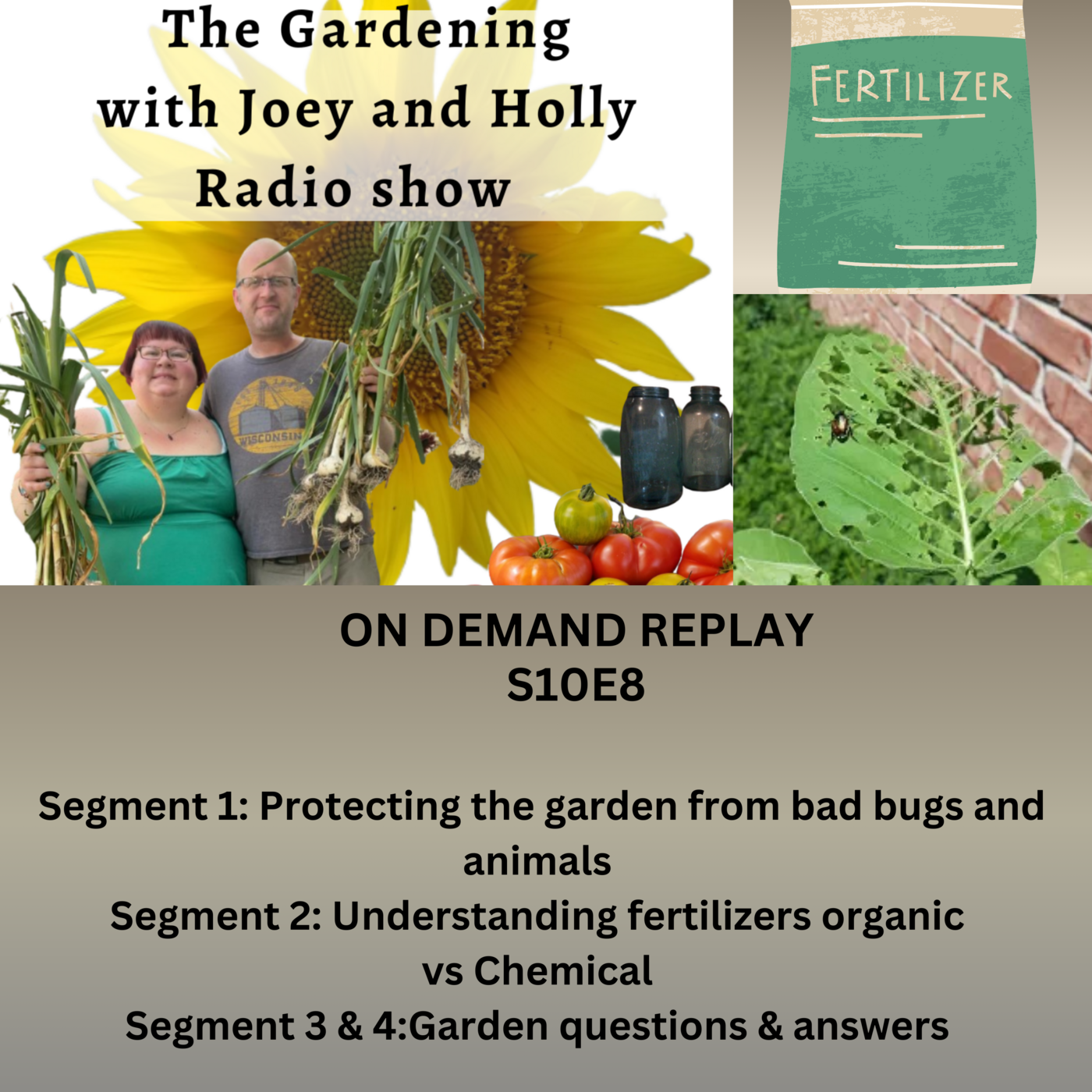
Episode 1542: S10E9 Protecting the garden from bad bugs & animals, understanding fertilizers Garden Q&A - The Gardening with Joey and Holly Radio Show
About this Episode
#gardening #podcast #gardentalk #vegetablegarden #radio #influencer #gardentip #gardentalkradio #backyardgarden
Email your questions to [email protected] Or call 1-800-927-SHOW
Segment 1:protecting the garden from bad bugs and animals
Segment 2: understanding fertilizers chemical vs non chemical
Segment 3: Garden questions & answers
Segment 4:Garden questions & answers
Sponsors of the show for 2026
Beetlegone of https://beetlegone.com/
Pomona pectin of https://pomonapectin.com/
Dripworks of https://www.dripworks.com/
Natural green products of https://www.natgreenproducts.com/ use promo code freeship4me
any size No More Bugs!
Rescue of https://rescue.com/
Jung Seeds of https://www.jungseed.com/category/talk-gardening use code 15GT26 to save 15% off orders
Wind River Chimes of https://windriverchimes.com/
Wisconsin Greenhouse Company of https://wisconsingreenhousecompany.com/
Summit Chemical of https://summitchemical.com/
Iv organics of https://ivorganics.com/ Use radio10 to save 10% off your order
Soilmoist.com of https://www.soilmoist.com/products/soil-moist.php
David J Frank of https://davidjfrank.com/
Timber Pro Coatings of https://timberprocoatingsusa.com/products/internal-wood-stabilizer/
Azure Standard of https://www.azurestandard.com/ Use code Use Promo Code: JOEYANDHOLLY15 applied at checkout to get 15% off for new customers who open an account for the first time and place a minimum order of $100 or more, shipped to a drop location of their choice.
Durable green bed https://durablegreenbed.com/
Corba head hand tools https://www.cobrahead.com/ use code soil for 10% your order at checkout
valid once per customer
Soil Savvy https://www.mysoilsavvy.com/
Weed Wrench https://www.weed-wrench.com/home us code JOEYat check out to save $10.00 on your order
MYRootmaker of https://myrootmaker.com/ Us coupon code Radio26 at checkout and save 10% of your order
Harney & Sons Fine Teas of https://www.harney.com/
Soil Diva of https://soildiva.net/ use code Use code radio15 to toget 15% off your order
Scrusher of https://www.scrusher.com/ Use code nomoredirt5 to 5% off + Free Shipping at checkout
Scrubby soap of www.scrubbysoap.com Get 10% off your order by using code SOAP at check out
Janco green house of https://jancogreenhouse.com/index.html
Fleximounts of fleximounts.com Use code “C730” to get $30 on C7MAX chair Use code "YTE730" for $30 off E7 Pro deck
Digzs of https://www.digzgardening.com/
Neptunes harvest of https://www.neptunesharvest.com/
Rubio Monocoat USA of https://www.rubiomonocoatusa.com/ Get 10% OFF DuroGrit when using code JOEY at checkout
The Green Gro of https://thegreengro.com/
Brome of https://store.bromebirdcare.com/
Mrs. wages of https://www.mrswages.com/
Mantis of https://mantis.com/products/tillers/
Milkweed balm of https://milkweedbalm.com/ use code Gardening at checkout and get 20% off your order
Biogents of https://us-shop.biogents.com mosquito trap systems
Amazon #Influencer page with products we use and trust from gardening to camping, household goods and even cat stuff. Over 500 items list https://www.amazon.com/shop/thewisconsinvegetablegardener?ref=ac_inf_hm_vp
Transcript
The following is an exclusive presentation of W.I. Garden Media, celebrating 10 years
of being the voice of Garden Talk Radio.
Coming up on the program today, we're going to be discussing how you can protect your
garden from bad bugs and animals, as well as understanding fertilizer.
You also answer your garden questions, the hours full, so join us.
You are listening to the most informationally packed hour of Garden Focus Radio in the
country and on the internet with your host, husband and wife team Joey and Holly Baird.
This is the Gardening with Joey and Holly Radio Show.
And welcome to another edition of the Gardening with Joey and Holly Radio Show, so happy to
have you along and thank you for taking a little bit of your time out of your day to join
us.
I'm your host, Joey Baird.
Beside me is my wife, co-host, best friend and garden partner.
Hi, nerd.
This program is for you about you to help your garden grow better, to maintain your landscape,
grow healthier trees, make your grass look greener, as well as preserving what you grow.
Happy your tuning in, whether you're doing such in one of the multitudes of AM and FM
frequencies broadcasting our program here in 2026 through a radio app, through our parent
website, though Wisconsin Vegetable Gardener, dot com underneath the season 10 tab at the
top of the page, podcast, replay or in-studio video, replay.
Thank you so much.
You want to be part of the program, you certainly can do that by giving us a call, toll free,
coast to coast at 1-800-927 show, that's 1-800-927-7469, or garden talk radio at gmail.com,
send their email over to garden talk radio at gmail.com, we'd like to know, and here
where you're listening to us from, before we get in the program, Holly, it's time for
this week's joke of the week.
Okay, so how do you fix a broken tomato?
Broken tomato, you heal it with, no, for life, no, no.
Tomato paste.
Okay, this is garden joke is brought to you by rescue.com, American made rescue products,
keep your family home, and you are protected from pests, such as wasps, hornets, yellow
jackets, fives, ants, and more learn more at rescue.com, that's r-e-s-c-u-e.com.
I really didn't know, I didn't look, so I really didn't know, I think it had some correlation
with like a cucumber or something that would be growing next to, but, okay, you're thinking
too hard.
You got to think less.
Think less, well that's never been a problem for me.
As the gardening season begins to develop, we're going to have problems with animals and
insects in our garden to some variation.
The realization of, oh, bad bugs in the garden.
The realization is 1 to 3% of all known species are considered harmless, pests in your garden
or benign.
1 to 3% is considered harmful, 1 to 3% harmful, yeah, 97% of them are fine, right, or have
no effect whatsoever.
Right.
So what I think is, if I were to be, if I was a new gardener, I would think that's good
news because-
Well, we're always taught, bad bugs, bad bugs, so you would think, you know, a new gardener
going, well, I've got to fight things off of the fly swarter because the way I hear
people talk, everything is bad and everything's out to kill my point.
But I think it's like, it's kind of like sometimes when you look at people post reviews
online, you're going to hear from the people who have the problems more than the people.
Well, first of all, you take the review and you take half, you just, if there's 80 reviews,
you just take 40 off the top right away because you know those are fake.
Right.
Well, then also, like, people will threaten people with reviews.
Oh, yeah.
You know, because they-
Oh, I don't get this free.
I'm going to tell you.
Yeah.
I'm going to leave a bad review.
And so it's like-
And half of that is made up, too.
And now there's like, people who get paid, too, they don't get, well, they don't necessarily
get paid, but they get given the product-
Influenced.
Yeah.
And so-
But they do have to disclose that.
Anyway, people aren't being influenced to have bad bugs.
I hope not.
So, yeah.
There are things in which we can do to-
Okay.
When we say bad bugs, that does not mean that we have to eliminate all the bad bugs that
one to three percent in our garden.
Most times, in most situations, on most years, you do not have to do a thing about removal
or extermination of bugs in your garden.
It is called an eco-balance system, ecosystem that's balanced.
And that's where something like the fact that there is 97 percent good bugs and maybe
three percent of bad bugs, because a lot of times those good bugs will keep the bad
bugs away.
Ladybugs.
That's pretty ladybugs.
Eating aphids.
Yeah.
Exactly.
Or, isn't-
Don't pray mantises in the-
Yeah, pray mantises is a-
No.
A big contributor to-
Here are our home-states-
The extermination.
We don't have pray mantises.
We're too far north.
Yeah, we're too far north.
Back where I'm from in southern Illinois, it was a very common thing to see pray mantises-
You can see them all.
Oh, yeah, yeah.
They're all weird looking.
If you don't know what they are, they're going to make you step back and make-
Yeah.
You're probably making-
Three inches.
Three inches, yeah.
Yeah.
That freaked me out.
They're in great benefit to the-
Did you really go-
Absolutely.
I don't remember.
But they're a very beneficial-
Yeah.
Bug in the-
Insect in the garden.
So anyway, yeah.
So that's, as Joey mentioned, there's eco-balancing and a lot of times that is something
that's simple as those good bugs keeping the bad bugs away.
But then there's also things that you can do or there are some natural things like trap
plants.
Right.
Now, there are occasions where you get a over-abundance of population of aphids or stink
bugs or whatever the case is that a human influence has to be done.
You have to go in there and do something about it.
Trap plants.
This is something you can do even prior to you planting in the garden.
You plan this out of trap plant is a designated sacrificial plant that is planted in the
general area of other plants that will typically or commonly be attacked by a bad bug, but they
will attack and do away with the trap plant and lay their eggs there or infestate it versus
the plant in which you are trying to produce for consumption.
Right.
So then we can talk about things that you can do that are not spraying chemicals, working
with your ecosystem, like for example, tomato hornworm.
So tomato hornworm, they live on, they eat your tomato plants, they're not your plants.
They overwinter in the soil and then a moth develops and lays the larvae and creates
the worm and yeah.
And so what we've learned is to feed the birds.
And so this is working with your ecosystem and you're like, what is feeding the birds
have to do with the tomato hornworm is when you put bird food or peanuts or whatever you
have in little containers that are eye level with those tomatoes.
Or just a bird feeder in general, inside of the garden, inside of the perimeter.
But closer to tomato plants could be more helpful.
Those birds are keen, they're going to start feeding at the bird feeder and they're keen
to see the...
They want the juicy stuff.
Yeah, they want like the meaty bug, right?
So they will eat those tomato hornworms and that they're feeding the birds.
You are keeping the hornworms out of your garden.
It's a nice ecosystem.
If you've got some old seeds, you know, like old seeds, eight, nine years old, we've all
got some of them.
Incorporate dump those in the bird feeder too because they're not going to germinate.
Right.
Absolutely.
We went through like, this was years ago, like half, almost three quarters of a gallon
of old seeds.
Like we would collect, you know, all the pumpkin seeds out of a pumpkin or two or three,
we had, you know, a ziplock bags full of old pumpkin seeds that were past viability that
we included into bird seeds.
So that's not mean you can do with your old seeds instead of throwing them away or putting
them in the compost pile.
So let's switch gears here and talk about animals.
There is no 100% way of protecting the garden from specific animals.
We're going to target three to day groundhog, rabbit, and deer.
Right.
So rabbit, the best thing I think is to use the two foot, at least two foot tall, chicken
fencing, poultry fencing, chicken whey or whatever you want to call it around the permanent
of your garden.
And you might be like, I don't believe that, you know, that's an investment.
I don't have to do that.
But plants grow a whole lot better when they're not getting eight down every evening when
they come out to feast.
Right.
And that's, and we had to do that.
We've experienced it ourselves.
It worked even better if you have like a raised bed that's 12 inches off the ground.
And then you put your raised, your poultry fencing inside the perimeter and then stake
it down because if it is puckered out a little bit, the rabbits will slide in between the
fencing and the board and they will consume whatever's in the raised bed.
Yeah, rabbits are cute, but they like to eat your garden.
So just keep that in mind.
So yeah.
That's a good one for rabbits.
Now deer, deer or whole other thing.
A lot of people deal with deer, especially if you are in an area that is away from the
city, typically, but now these deer, you know, they're getting driven out of their homes.
They're urban nights.
Yes, they are becoming more urban.
So there's a few things you can do, which is a deer fence.
Now deer deer can jump up to eight feet high.
They can run up to 40 miles an hour and they can swim at up to 13 miles an hour.
So keeping them out of your garden is a challenge, especially in, like you said, suburban
rural areas, you want, you can do two things.
You can one fence the garden in, which that can be an extremely expensive proposition
to.
There are sprays in which you can spray around the perimeter or on certain plants to keep
them away.
You can do what is called a double fence or use fishing string in order to create an
invisible fence where they will walk up to it and they'll touch it and they don't know
what it is and they'll back away.
The downside to that is if you've got a whole herd of deer, three or four, and they're
just coming at your garden.
They don't carry what's in the way.
They can't see it.
It's going to be a tangled mess and now you've got wildlife tangled up in fishing line,
dragging it through whatever, catching on everything else.
Now we have heard of people and we don't know how effective this is, but doing things
where they take like pie plates and hang them up and then the noise hears the deer.
I think in certain instances that could work, it just really depends on...
If the deer is consistently accustomed to that noise, every time I stand here I hear
that, but they don't see anybody, I'm going to go devour the piece.
It's kind of like, you know, a house pat, you have a cat, and at the same time of day,
this noise makes, something makes a noise your cat eventually is going to ignore.
Right.
Yeah.
Additionally, what you can do is put things around the perimeter of the garden like rose
bushes or Mexican sunflowers, things in which deer are not likely to consume, and it creates
kind of a barrier in which you're preventing them from getting the candy.
Yeah, keep the deer candy away, so things like tomatoes, peppers, the really, you know,
high value...
Green beans.
Items that deer want, and then put the things like Jay mentioned, rose bushes, Mexican
sunflowers, Mexican sunflowers have like a rough texture, and the deer don't like that
on their tongue or their mouth or whatever.
So you do have options, and you can always try different options.
Motion sensor sprinklers is another one.
Now, if you prevent, if you take a little bit from all of these different, how to prevent
the deer from getting, there are way, the deer is going to go somewhere else.
If they're going to go to your neighbors, they're not going to continue to fight to get
in, if they're consistently on edge, thinking that something's going to attack them, or they
can't get out of where they're getting into, they're going to go somewhere more relaxed
or more safe for them.
So you just have to be able to just hear them enough to get them to go to your neighbors,
and you have to just hear them more than your neighbor just hears them.
Groundhogs, there are sprays in which you can apply in order to keep them away.
Or fencing in which you can bury beneath the perimeter of your property.
That's a whole nother investment.
And or if you see them on your property, you can continue to fill the holes in, or there
are, if you want to go a chemical way, there are ways of poisoning them to rid them of
your property.
Now, some people, like my friend's mom, she plants just like twice as much because
she has so many groundhogs, and then she just lets the groundhogs eat whatever.
And it's just, she's a lot nicer than I would be, I know, I know.
And that's okay.
But you know, it's her mom, like, my friends parents are retired.
They're not trying to necessarily feed an entire family.
They kind of just garden because they can, it's relaxing or whatever to them.
So, and she just is like, well, I'll just plant some extra carrots or whatever the ground
hogs like.
And then she just kind of deals with it.
So that's an option too.
If you, maybe you want to live peacefully with the groundhogs, they're cute.
Yeah.
Until they destroy everything.
Exactly.
Well, when we come back, we're going to discuss the understanding of furlizer.
You're tuned in to the Garden with Joey and Holly radio show.
Got a question for Joey and Holly?
Send it via email anytime to gardentalkradio at gmail.com.
Hello, gardeners.
It's Ann from Neptune's Harvest Organic Fertilizers in Gloucester Mass.
If you're planting flowers, vegetable shrubs, or just trying to keep your lawn healthy
and green, then you should know about Neptune's Harvest.
Neptune's Harvest fertilizers come from the mineral rich, North Atlantic Ocean, which
contains all the nutrients plants and soil need.
Flower growers, get your sunglasses out, you'll want to use them when you're looking
at how bright those colors are.
With Neptune's Harvest, you can achieve the amazing results you deserve for all your
efforts.
You'll have the most abundant, sweet tasting supply of organically grown produce, and
there's nothing like the taste of a fresh garden tomato you grew yourself.
Neptune's Harvest works so great, whether you know what you're doing or not, you'll
look good, and you'll feel good because you're doing the right thing for the environment
and your health.
Try Neptune's Harvest products from the ocean to set your plants in motion, available
at your local garden center, and to learn more, go to Neptune's Harvest dot com.
Transform your exterior wood surfaces with Rubio Monaco's new DuroGrid.
DuroGrid delivers rugged protection and rich color for decks, siding pergolas, planter
boxes, and all outside wood surfaces.
Say goodbye to multiple coats thanks to DuroGrid's incredible patented one-layer technology.
Enjoy a vibrant, durable color that won't peel or flake even in the harshest conditions.
Rubio Monaco's DuroGrid is tomorrow's UV protection for exterior wood.
For every order, Rubio Monaco's USA will plant a tree at a US planting site.
Get 10% off DuroGrid when using Code Joey at checkout.
Learn more at RubioMonacoUSA.com.
Say goodbye to weeds, easily remove them roots in awe with the unique design of the
Cobra Head Hand Cultivator, recognized as the world's leading hand-weeding tool.
Simple design, light weight, made from forged tempered steel for easy extraction of weeds,
plant seeds, rows, and more.
Visit Cobrahead.com and use coupon code soil for 10% off your order at Cobrahead.com.
Cupon code valid one per customer.
Mantis Garden Tiller Cultivators are the perfect solution for any garden.
With their gas powered two cycle or four cycle engine, these powerful machines can till
nine or sixteen inches of land without you breaking a sweat.
And it doesn't stop there.
Mantis's optional attachments allow you to aerate, plow, and more with a snap of a finger.
Nailed with durability in mind, Mantis Tiller Cultivators will be your Guaranteed Garden
Companion for a long time.
You can find more out and details at Mantis.com.
Junk Z Company is a family-owned and operated gardening company since 1907, with the largest
selection of seeds and plants online.
Use coupon code 15tg26 to say 15% off your order at Junk Z dot com.
That's J-U-N-G-S-E-E-D dot com.
Welcome back to the Garden with Jordan Holly Radio Show.
Happy to have you along.
Thank you so much for taking time out of your day.
Want to find out more information about those companies you heard and all their coupon
availability.
You can find them at our parent website, the Wisconsin vegetable gardener dot com, underneath
the money tab for coupon codes and the season 10 tab for all sponsors.
We are going to talk about understanding fertilizer.
Now we've always been told in the organic realm, organic fertilizer good, chemical fertilizer
bad, keep them apart, don't use either or the other and your garden is going to be happy
and healthy.
Not necessarily true.
No.
And this is something that I also believe for a long time and after doing some research
and we actually had a guest last year, two years ago.
He spoke on this as well and he's written several books about it.
So chemical, so just understand the difference between chemical or synthetic, whatever you
want to call it, versus organic is chemical is synthetic, which means manmade and then
organic is essentially from the earth so that can include like compost, manure, kelp.
You could even consider something like bone meal, blood meal.
It's basically anything that's from the earth.
So a lot of times we're going to kind of reference nitrogen here, but this can apply to any
sort of NPK situation, NPK is the three, the three main components of fertilizer.
And as a nitrogen, P is the fastest in case, the potassium.
So just kind of a breakdown there in case you always see those numbers on fertilizer
bags, if you're new to gardening, you're defertilizing, you're like, what is 10, 5, 8s
or whatever?
It's the NPK.
So it's the nitrogen, phosphorus and potassium, but we're not going to get into the depths
of that.
We're going to talk about the difference between the chemical and organic and how that can
impact your garden or how it might not make a difference.
So people are often told that chemical fertilizer is best, especially for vegetables, but that's
not exactly true.
It's a big important thing, and I'm going to say this again, is to make sure you're following
the directions of the application.
So don't think, okay, if one cup per square yard is good, two cups is better.
One, because in organic, you can burn your plants, and then also, or you could just waste
money.
Right.
Yeah.
In both situations.
Right.
There's P-A-V-I-L, I think that's, I'm saying it incorrectly, Pavley, is the, I don't know,
is the individual.
He also said that putting thums underneath your tomato plant for blossom in rot does work,
but you need 80 thums to have their per plant, to have the correct amount of calcium for
the uptake when you just really need to walk, but that's the side.
I wonder if plants like, like the fruity thums, I don't think it's irrelevant because it's
not effective, back with the understanding of the fertilizer process here.
All right.
So, so basically, you want to make sure you are following the application rates.
So the chemical fertilizer, when you sprinkle it on your plants, the weight works is any
sort of fertilizer, they're usually granular, but you know, there's liquid fertilizer, but
you're sprinkling it on the plants for watering it, and what happens is chemical fertilizers
it feeds the microbes, and then it feeds the plants.
Pretty simple, most chemical fertilizers are granular, and that's what happens.
Organic fertilizer can be anything from, again, manure, compost, kelp, et cetera.
A lot of times, it's a little bit of a slower process, so chemical typically does work faster.
Organic, if you are just using like maybe your own homemade compost, it might take longer
because the microbes may have to break down things further.
Say you're putting your own compost in, and the banana peels aren't broken down all
the way, it's going to take a little bit longer for the microbes to break it down.
It's got to break down the material, and then break it down to a usable form for the plants.
Yeah.
So, if that is the point, if that is the process, once they are broken down, then they are
going to feed the plants.
So, if you are using maybe a granular organic fertilizer, that's going to work faster than
compost, whatever.
And liquid fertilizer is going to work even quicker because liquid is in the form of
the uptaken which the plant can utilize right away than a granular.
And with the liquid organic or inorganic, it's a diluted, you got diluted to a certain
ratio per gallon or x amount of gallons, and synthetic fertilizer is the application
may need to be applied more frequently than in the organic method.
So scientifically speaking, when you are looking at the chemical elements, you think about
the periodic table elements, when it comes to organic versus an organic or synthetic
where we are going to call it, the nutrients aren't the same scientific makeup.
So nitrogen is nitrogen, phosphorus is phosphorus, potassium is potassium.
So, there is no difference there.
So those plants are getting the same nutrients, they are just getting it a different way.
It's kind of like...
The origins of that nutrients is coming from a different means, but the end result is
still the end result regardless of which way you go with it.
It's kind of like, everybody is all about drinking electrolytes these days.
It's kind of like whatever brand, right?
You might drink X brand, I'm going to drink Y brand, we're still getting...
When you break it down to the raw form, there are still 75 electrolytes in both bottles
in the same fluid ounces.
Or maybe just adding salt to your water, whatever.
And that's one of the big keys is salt.
You're right.
Yeah, so fertilizer is...
Is fertilizer, basically.
It is food for microbes.
Nitrogen is one of the main foods out there, especially when it comes to large-scale agriculture.
There's a lot of nitrogen that is being applied to the crops.
So...
When you look at corn, corn is extremely heavy feeder, whether in big ag industry or backyard gardening,
the nitrogen amount is tremendous because you've got to get that plant to grow all the waste,
5, 6, 7, 8-foot tall, put on all the green foliage and then it starts developing the ear.
In lawn care, the fertilizers are like 90-0-0.
It's all nitrogen because you're wanting that green, green, green to make it look pretty.
Exactly.
So, there's been a number of studies done within the past five to ten years,
so not like super-old, but in the past five to ten years, where a large-scale agricultural
sexual farm crops that there's no significant difference in chemical versus organic,
and even when it comes to the bacteria or the fungi that grow as the things that break down,
those microbes that break down the chemicals, there's no large significance difference either.
But, there is one difference, is that when you use the synthetic fertilizer,
it'll cause, and this is not a difference in how the plants get their nutrients,
but it is a difference in how it applies.
So, the synthetic fertilizer will cause a spike of micro-production and then it'll even out,
but there is no harm or harm to the plants from microbes in that process.
So, synthetic fertilizer gives it a boost, but then eventually...
Balance is back out.
Balance is back out.
Organic fertilizer is more of like a...
A trickle.
Oh, yeah, a trickle.
Yeah.
So, is there one better than the other?
Is there a long-term environmental disadvantage to using a synthetic fertilizer
versus a chemical fertilizer?
So, long-term, no, there is not a large impact, but the way I look at it is that
I will forever, ever, ever be an organic vegetable gardener because I think about things like
the soil.
I also think about things like possible runoff, what's it called, erosion, things like that,
not saying that synthetic fertilizer causes more erosion or anything like that,
but I think to myself what is my long-term impact, am I feeding the soil,
or am I feeding the plants from microbes?
Well, you look at the long-term effect in the big ag industry, and this is more towards
the glyphosate rather than the synthetic fertilizers is the dead zone at the Gulf of New Mexico,
or Gulf of America, whatever you want to call it, because there's hundreds and thousands of acres
of all that glyphosate and chemicals that have flushed down there that has killed all that vegetation.
Now, that's not directly related to all that synthetic fertilizer versus organic fertilizer.
That's a different realm.
But the long-term effect is still the same.
But the nitrogen.
Right, there's a lot of nitrogen there, yeah.
And that's under the impact.
And that also algae bloom in lakes and streams, like Michigan always has a big algae bloom issue every
couple of years that really impacts the aquatic life, and that's due to the runoff of that nitrogen.
Right, and you can do the same bad with organic nitrogen, as you can't chemical nitrogen,
or inorganic nitrogen, if you apply it incorrectly.
Correct.
Oh, let's just dump the whole bag.
Well, now you're using just as much and doing just as a negative effect.
Great.
But for me, I also think about my footprint, essentially.
If I am creating my own fertilizer, whether it be compost, basically,
is what I would be using.
You have access to your own fertilizer.
Why go out and buy some if it's not needed.
Now, learning this, I do grow flowers, and I'm thinking, you know, since I do grow flowers,
I could use this synthetic, because it might help me have nicer flowers.
Because you're not going to eat the flowers, you're looking them for self pleasure.
And this is in a small scale, I grew them in containers.
Right.
So maybe if it provides me some bigger, pretty flowers in my little containers.
And you follow the application right as the company has instructed,
and don't go bonkers, and go, and I'm just going to keep pouring it on.
The long-term effect will be very minimal, because there's not going to be
the overabundance of runoff.
Right.
So that's that's a thought as well.
Well, another thought you can have is keeping the dirt and the garden outside,
or the dirt from your hunting camp outside, whether you're at a cabin,
your garage, your house, or your shed.
Yes, Grusher has exactly what you need.
It's a durable outdoor shoe cleaner, a shoe brush station,
that is built with wilder resistance, steel frame, and black UV powder coat,
to finish for a year-round outdoor use.
It's easy to use with just a few passes through of your boot,
shoe, whatever, it can easily...
Kids have fun doing it as well.
You can take that, yeah.
Yeah.
And you can remove dirt, mud, slush.
These days, it seems like it's road salt.
And it's user-friendly design ensures trouble-free cleaning,
saving your time and effort.
They have many different designs, whether it be deluxe, heavy-duty, etc.
You can go to Scrusher.com,
and you can use code NoMoreDirt5 to say 5% off in free shipping and checkout.
And they're made in America.
Hang out with us when we return.
It's going to be your garden questions and our garden answers.
You're tuned in to the Garden with Joey and Holly Radio Show.
Got a question for Joey and Holly?
Send it via email anytime to Garden Talk Radio at Gmail.
A non-selective herbicide that is also USDA bio-preferred certified,
you bet.
Say goodbye to Roundup and Hello to No More Weeds
by Nationale Green Products.
No More Weeds kills weeds with no harsh chemicals and no glyphosate.
Say for on pets, No More Weeds has a proprietary sticking agent
to use around gardens, pools, decks, patios, anywhere there are weeds.
Available online at netgreenproducts.com, Amazon and Walmart.com,
order yours today.
The same great company that brings you No More Bugs.
We're in the dead of winter, but it's not too early to read up on the best
products to control beetles and grubs in your yard and garden.
You're right, Joey.
Before we know it, the temperature will rise to 55 fahrenheit plus
and those grubs will become active again in your lawns and gardens.
Make sure you use safe, high-performing products like grubgon and beetle
gond, so you, your kids and pets can safely enjoy your yard without
sharing it with beetles and grubs.
Grubgon can be applied to the turf to control grubs,
reducing turf damage and lessons the impact that beetles have on your yard in the summer.
Easy to use.
Apply with any commercial spreader and irrigate into the soil.
Biological that specifically targets grubs without harming soil
beneficials like earthworms and use beetle gond in your garden,
soil-to-control grubs, or later in the summer to control beetle,
invaders without harming bees, ladybugs, insects, butterflies, etc.
These are the only non-chemical products that work.
Find out more at beetlegond.com.
Stop poisoning your soil.
Green grow is different from most garden brands because we do not rely on
chemical shortcuts.
We use beneficial biology and organic inputs to rebuild soil naturally.
So your garden gets healthier every year, not dependent on more products,
stronger plants, fewer problems, better food.
Check out our complete line of organic fertilizers and potting soils today.
Visit thegreengrow.com and breathe life into your soil.
That's TH-E-G-R-E-N-G-R-O.com.
Check us out on Instagram as well at The Green Grow.
Pomona's universal pectin is a high quality pectin that jails reliably
with low amounts of any sweetener.
If you're trying to reduce the amount of sugar in your diet,
you'll love Pomona's universal pectin.
Now you can make healthy homemade jams and jellies,
sweetened to your taste.
You can use sugar, honey to sweeten.
Pomona's universal pectin keeps indefinitely when stored in an airtight container.
Easy to use, versatile and comes with directions and recipes in every box.
Find out more and where to buy at pomonapectin.com.
Also available natural food stores and online.
Save your back easily and quickly.
Remove trees and shrubs from your property with the weed wrench.
Find it at weed-wrench.com.
Made in the USA, use coupon code Joey
to save $10 off your weed wrench at weed-wrench.com.
Get higher yields with durable green bed,
raise garden bed kits,
designed to be drainable, breathable, pest resistance,
and long-lasting durable greenbed.com.
Abundance guaranteed.
Well, I'll come back to the garden with Join Alley Radio Show.
Thank you for being with us.
Want more information about those companies you've heard?
Our parent website,
though with constant vegetable gardener.com,
underneath the money tab for coupon code availability.
And the season 10 tab for all past shows and all company listings.
Before we get into your garden questions and our garden answers,
we want to keep our hands clean with scrubbysoap.com.
You know, I'm always getting my hands dirty.
Yes, you are, yeah.
We're always doing some projects.
So scrubby is a natural soap with a scrubber inside,
and it does a really good job.
It fills the scrubber inside, it fills the entire size
of the bar soap.
And rather than using harsh synthetic cleaning agents,
they use citrus oil.
So it's the combination of the citrus oil
and the scrubber removes the ultimate soap for moving dirt,
grease, oil, paint.
Can you even clean your artist paint brushes?
And it's just ideal for getting all that stuff off.
And who doesn't have, well, if you've got kids,
their hands are always dirty.
Why not use a natural soap that already has a scrubber built in
to get their hands clean?
You don't have to use additional items.
I remember when I was a kid,
we always had to come in and wash our hands,
and we were just full of dirt.
This would have been very handy.
So it can be anything from, you know,
this art crafter people, gardeners,
campers, mechanics, etc.
And if you go to scrubbysoap.com
and use code soap,
you can get 10% off your order.
All right, your garden questions are garden answers.
Send them on over gardentalkradio at gmail.com,
gardentalkradio at gmail.com
or toll free coast to coast 1-800-927 show.
I hope you're all doing well and staying warm.
My husband and I recently bought our first home
and I'm finally having enough land to grow flowers
and start a vegetable garden.
I'm hoping to plant a small sunflower patch,
but I have no idea where to begin right now.
All I have is a spot picked out
and a lot determined, a lot to determine.
What would you recommend as my first steps?
All right, well, congratulations on your first home.
So for a sunflower patch,
you want to obviously, you feel this spot picked out.
I'm assuming it gets a lot of sun
because sunflower's like the sun.
And sunflower's are pretty easy to grow.
Depends on which one you are,
you're getting the mammoth sunflower's,
which get 8 to 15 feet tall.
Are you growing them in a block
or are you going to try to stagger them across the perimeter?
You're going to have squirrels that you're going to have to deal with
you're going to have to plant some extra ones,
that type of thing.
In this situation for her or with for them,
it is a very daunting task.
It's like you, the example is,
you're going to remodel or refinish a basement,
an old dingy basement.
Where do you start?
Like you got to start a little bit here and a little bit there.
You just are going to overwhelmed
if you just set there and think about it.
I would grow over, this is what I would do.
Yes.
I would grow a variety.
I would get a variety of sunflowers,
and I would grow them,
and then I would determine
at that point what grows better, what I might like.
You might grow some sunflowers,
and be like, I'm not that jazzed about it,
but then you might grow another variety.
And you'd be like, you know what,
those are pretty.
I want to grow more of those next year.
I would grow a variety of sunflowers.
I would make sure that it has full sun.
I would then learn if squirrels are going to come and attack my sunflowers
and use this this first year as learning experience.
And then tweak things next year.
And with the vegetable side,
number one, grow what you want to eat.
Grow what is not commonly available,
or it's more expensive,
either at the grocery store or at the farmer's market.
And grow a bunch of varieties.
If you like tomatoes,
yeah, you're going to spend some money on seeds,
but grow eight or nine or ten different varieties,
because there are some varieties that are absolutely magnificent.
And other ones are like,
I know it's a tomato, but it's,
yeah, right.
And the same with other varieties.
And again, this is a good year
for just kind of laying the groundwork,
especially if you have a lot of determination,
hopefully a lot of patience.
And that you want to just go ahead,
try different things, see what works, see what sticks,
and then make changes.
And the thing is, is that Joe and I have been doing this
for a combination of however many years, right?
Well over 50 years.
We've been in the two of us.
And we still make mistakes.
We still have our next experience.
We don't know everything.
We still are like, okay,
we're never going to try to grow that again.
Right.
So just keep that in mind.
It's a continual learning experience.
And that to me is like,
what's so fun about gardening?
Because you always get like something different.
And it's fun.
All right.
Here's a canning question for you.
I have canning lives that are around three years old.
Are they still good?
I know they have a rubber gasket.
Does that go bad?
Or should I buy new canning lids this year?
They should be fine.
I think it's like five years.
They say usually.
And you can always, you could always,
I don't want to say try them after five years.
I wouldn't do that.
Well, you can if you open up and you can take your fingernail
and kind of press on that rubber gasket.
And you can tell if it's dried out or if you press on it
and you're figuring it out and it retracts
and it fills the gap back in.
That's not, you know, I mean, that's not scientific.
University of ex, you know, but that's a way to determine
whether or not that is as a high probability of sealing.
I don't think they have dates on them.
I mean, I've gone to grocery stores and I've like
on the box it does.
Right.
I think they do.
But I've seen like where you go to the grocery store
and you pick up the canning lids and you have to like
blow the dust off of them.
So I three years is fine.
Yeah.
Bring the canning lids back out.
It's that time, Bill.
You know, that you know, that's how it feels.
Yeah.
All right.
How do you guys determine which seedling to thin out
in your seed starting trays?
I always pick the best looking one.
Yeah.
That's going to be that's you do not pull them and what we're
referring to if you're not familiar in a seed
starting tray, let's say there's 32 cells
from root maker, my root maker dot com.
And we're starting peppers.
So we're going to put two pepper seeds in each cell.
So that's 64 peppers.
Yes, there is a finagling in which you could separate them
and then double your production, you know,
take the big one and move it to another tray.
It's easier to just cut the one off
that is the least likely to survive or the weaker
of the two, I guess.
I know when in plants, you're like, oh, I want to save it.
There's a reality of plants.
If it looks weak at the beginning, it's not
like Charlotte's web where the pig is going to be healthy
and happy at the end, there's some plants just don't survive.
So instead of pulling it out and disrupting the roots
of the adjacent plant, simply take small snips
or fingernails, scissors or pruners and snip the one off
at ground level, soil level, call it good and move on.
Yeah, definitely.
Bush beans or pull beans.
I grew bush beans last year.
I am curious if I should try different variety
or go to pull beans this year.
I would still grow bush beans, but I would try pull beans
and I would do both.
If you like the type of bush beans you grew,
I would stick with those.
You could try different variety if you want,
but I would stick with the bush beans
that you already had success with.
And then if you want to try something new,
I would grow some pull beans, I would get blue lake
because blue lake are like the foolproof go-to.
And try that variety.
You might find them easier to grow, easier to harvest.
I can't tell the difference in taste, but maybe you can.
It all depends on when you harvest it.
Now the key to bush beans is bush beans
will take 40 to 60 days to reach a harvesting state.
And I was always taught that they would produce
for about four weeks and then shut down.
What we learned years ago was if you continue
to harvest them on a regular basis
and not let the pods get over big
and the beans in the pod get oversized,
they will produce up to a frost.
Pull beans on the other hand, they're easier to harvest
because they're elevated either on a string
or a fence or some type of elevation mechanism
in which they can climb up.
They'll take 70 to 80 days to reach maturity.
And again, you can harvest them all the way up to frost.
In pole beans, you're only going to get green pod beans.
In bush beans, you have a choice.
You have the green pod beans.
You have a burgundy or purple bean.
The chain, that bean, when cooked,
that pigmentation reverts back to a green bean.
So if you're trying to can purple beans, that doesn't work.
It's not a genetic modification.
It's just the way the plant works.
Or you have yellow pod beans
which that yellow pigmentation stays
throughout the harvesting, cooking, canning, eating process.
So keep that in mind.
We've got time for more your garden questions
and our garden answers.
Hang out with us when we return.
We'll answer them then.
You're tuned into the Garden with Joanne Holly Radio Show.
Have a garden question.
Give Joanne Holly a call now or anytime 24-7.
Just dial 1-800-927-SHOW.
If you can't get through leave a message
and they will call you back.
Call now 1-800-927-SHOW.
MyRootMaker.com has the tools to start your plants off right
and keep them growing through harvest.
From their seed starting trades with an innovative design
that air prunes the roots
to their large variety of growbacks of 1-60 gallons.
Get the harvest you've never seen before.
Visit MyRootMaker.com and use coupon code radio26
to save 10% off your order at MyRootMaker.com.
We are rediscovering the power of common milkweed
named after the Greek guy of healing isquipius.
Milkweed was used for many discomforts throughout history.
Not surprisingly, the ancient wisdom holds true.
Milkweed balm helps relieve pain and restore mobility naturally.
Pure plant-based relief for aching joints, nerves, and muscles.
Experience the healing power of nature.
Try Milkweed Balm 2-Day.
Use code gardening for 20% off your order at milkweedbalm.com.
Azure Standard is America's premier family
on online store for organic foods and healthy products
for your home and garden.
They deliver directly to families and businesses
through more than 3,500 drop points across all 50 states,
making it easy to get everything you need in one simple pickup.
As a natural health food distributor,
Azure brings bulk and specialty items to communities nationwide.
They offer more than 12,000 products
that meet their cleaning gradient standards,
high quality, non-GMOG, organic, and naturally sourced.
You'll find everything from groceries, health and beauty items,
and household essentials to nutritional supplements
and animal care, hobby supplies, and even gardening products.
Simply put, Azure Standard has something for just about
every part of daily living.
Visit azurestandard.com and use promo code Joey and Holly 15
at checkout to get 15% off your first order of $100 or more
when you open a new account and ship to the drop location
of your choice.
Visit azurestandard.com, it's azurestandard.com.
Get in your garden with digs,
from gardening gloves to accessories, storage,
organization, and more, digs products combines
form and function with a splash of fashion
and are ideal for women who possess a passion for plants
and enjoy harnessing the beauty of nature,
steeped in color and pattern, digs gloves are inspired by nature
and are designed to protect your most valuable assets,
your hands.
Get your digs on at digsgardening.com,
the home depot Amazon and search for by name,
d-i-g-z digsgardening.com.
Check out ivyorganics.com.
It's America's leading garden product YouTube channel.
Ivy organic products are innovative, organic, effective,
and proudly USA made to help you achieve your best growing season.
Use coupon code radio10 at checkout and save 10%
on your entire order at ivyorganics.com.
That coupon code again is radio10
to save 10% on your order at ivyorganics.com.
Visit jankogreenhouse.com to improve your garden today.
Janko builds the strongest greenhouses on the market,
large and small, guaranteed to meet or exceed
your building codes, offering a lifetime warranty
since 1948.
Visit jankogreenhouse.com.
Welcome back to the Garden with Join Holly Radio Show.
Question and answer time.
Thank you for so much for being with us.
More information about those companies
and the coupon code availability or parent website,
LouisConsonVegetableGardener.com,
under the Money tab.
Send your questions over to GardenTalkRadio at gmail.com
or give us a call toll free, coast to coast, 1-800-927 show.
I have bad blight on my tomatoes.
The pad, I have had bad blight on my tomatoes
the past few years.
What can I do differently?
So it depends on what kind of blights,
but early blights, so there's different kinds of blight.
Yes.
Early blight spores are, they originate
from infected plant debris,
left in the soil from previous seasons,
as well as infested seeds,
and then volunteer slash pepped potatoes slash tomato plants.
And those spores over winter in the soil
and are spread via wind, splashing rain, irrigation and tools.
So for early blight, a couple of things you can do
is you want to make sure that you are,
for any reason, you need to make sure that you are clean.
If you have any sort of garden problem,
clean your tools at the end of the garden season,
and then splashing rain,
things like that, irrigation mulch.
Well, right, right.
When you refer to splashing rain,
if you get, when you plant your tomatoes,
you want to create a barrier between the soil and the plant.
And you can get blight on other plants,
but we're focusing on tomato specifically in this question.
So your plant, your tomato's first step is,
use yellow whole grain cornmeal.
This has a beneficial bacteria called trichodermin in it
that fights the bad bacteria in the soil.
Now this, we started doing this Bob Webster master gardener
and garden talk radio host out of the central Texas area.
We found him online and he said, this is what you do.
And we did that and it has worked.
It has reduced our tomato early blight by like 85 to 95%.
And we've done seminars and we've talked at libraries
and expos and people came up to,
we explained this to him and they come back to next year
and said, we thought you were crazy,
but we did it and absolutely changed how we garden.
It does sound a little crazy.
So it's got to be yellow whole grain cornmeal.
You can just get name brand or whatever.
It's going to be a little expensive,
but you're going to have tomatoes all the way up
to the day of frost.
So you put the whole grain cornmeal one handful,
just sprinkling on around the plant,
cover the soil with some type of mulch, shredded leaves,
shredded paper, chemical free seed free grass clipping straw,
whatever it is, create that barrier.
And step three, as the plant grows,
whether on a floor to weave or on a cage,
continue to trim the lower six to eight inches
up the stalk of the foliage of the limbs,
making that, making a open cavity at the bottom
and then any limbs from the canopy
that is starting to hang down
that could potentially get some splash up,
go ahead and trim those as well.
If you do detect early blight on your plant,
you can remove up to 25% of the plant leaves
in order to get rid of that blight off the plant.
Otherwise, it's progressively going to work up the plant.
And by the end of the season,
you're going to have a plant with no leaves.
That's dead with fruit that's partially ripe.
First time indoor seed soar for me,
I started flower seeds this past week
and my containers have a lot of condensation on them.
My air vents on the lids are completely closed,
asking for information on what I should do.
I need to open them or just dump the condensation
off the lid.
I was careful to squeeze out as much water
out of the seed soil starting mix
as possible.
Advice would be appreciated.
Thank you very much.
Sounds like you're making your little ecosystem terrarium there.
Which isn't a problem, but it's not good
because you're going to have mold.
Yeah, you definitely know what mold.
So if you do need to keep the lids on for some reason,
I would prop them, vent them, whatever you can do,
you know, kind of offset them
so that you can get some air underneath those lids.
If you can remove them, then remove them.
And then after the seeds germinate,
you do want to remove the covers completely
and then you can run a fan for half a day,
like four hours a day for air circulation
and just be careful with watering.
The goal is not to keep as much moisture on the seeds
or in the container because if you do,
yes, we need moisture next to the seed
in order for it to germinate.
However, if it's a swampy bog,
that's not going to be any good either
because soil has to have a certain amount of oxygen in it.
And yes, you want moisture,
but you want some circulation like in nature.
Yeah, you're going to get rain,
but then the sun's going to come out,
the wind's going to blow,
there's going to be circulation of air and everything.
So keep that in mind and you will do quite well.
I have a sort of a trash area of the yard
where I want to plant pumpkins.
I feel like I saw one time online
that you can plant seeds inside of a bag of soil.
Would that work or mound a big pile of soil
and then try growing them in that?
I find that's relatable about the trash area.
I feel like we all have a trash area in our backyard.
I feel like that's probably a common thing
more than people realize.
This is app, you can actually do this.
We've done this with, we've talked in past weeks
about when we buy compost.
We put a big mound somewhere to store.
We've thrown seeds in there.
We've threw Jardel pumpkins in there.
We've thrown butternut squash in there.
Though it wasn't humongous,
it's still vined and produced.
Okay, so you can take a big soil,
a mound of soil, whatever you decide to do.
But the thing is to keep in mind is that pumpkins are vines.
So it is going to vine beyond
wherever this trash area is.
Well, it depends on how big the trash area is.
It might, it might be what you need.
It might vine in your trash area, whatever.
But just keep that in mind.
You got a pumpkin growing out of the trunk of a rusty car.
The pumpkins are going to vine.
There's no rhyme or reason to their vines.
50 to 80 square feet in some varieties.
Yeah, so yes, you can absolutely grow an amount of soil
but then they are going to make kind of a bigger footprint
as they vine out and grow.
But it's really cool to grow your pumpkins.
My sister does this like almost every year.
She girls pumpkins and then they carve them.
We don't have that much success with pumpkins ourselves
but it's cool that they do it.
So I say go for it.
And we've got videos on our parent website,
the Wisconsin vegetable gardener.com
where we took bags of compost.
There was like two cubic foot bathed compost
and sat them vertically, cut,
which made the bag about half full
and then rolled, cut the top off
and then rolled the sides down.
And I'm trying to remember, we didn't grow,
I think we grew a pumpkin or some type of squash.
We didn't grow watermelon.
That's squash.
Yeah, because we grew watermelon out of the straw bell
one year and that was successful.
But yeah, you can certainly do this.
And it's a great way to take an area that's not really good.
Now the other method and we, this straw bell,
if she doesn't want to mound the soil up
or buy extra soil, get a couple of straw bells.
I had more trash to the trash area.
But the straw bells would work like your sister,
we did straw bell gardening in her backyard
and the whole backyard was butternut squash
and spaghetti squash and pumpkins.
It was just a vine jungle
all because they were growing out of some straw bells
and we grew them one out of a conventional
normal size agricultural straw bell.
And then it was like a dwarf straw bell
or what I think they call a pony bell.
It was like a quarter of the size
and we grew phenomenal out of that as well.
Well, with that being said, we are at a time
and we thank you for yours, Miss,
any portion of the program we would like to visit.
Certainly go to our parent website,
the Wisconsin vegetable gardener.com
and click on the season 10 tab at the top of the page.
Hang out with us next week, tune in.
We'll be talking about starting tomatoes
as well as what to do if you're a new canner.
Our guest will be former host of PBS
is growing a green world.
Jill Lample will be with us
and we'll answer your garden questions.
So until next week four.
Hi there.
I'm Joybert and we will see you in the garden.
More from The Gardening with Joey & Holly radio show Podcast/Garden talk radio show (heard across the country)
View all episodes →
Episode 1571: S10E14 Garden Q & A Part 21 - The Gardening with Joey and Holly Ra...
The Gardening with Joey & Holly radio show Podcast/Garden talk radio show (heard across the country)
Apr 10, 2026·5:29·failed
Episode 1570: Seg 3 of S10E14 Guest John Libs EO and Co-founder of Beetlegone a...
The Gardening with Joey & Holly radio show Podcast/Garden talk radio show (heard across the country)
Apr 9, 2026·16:36·failed