Loading...
religionspiritualitychristianity
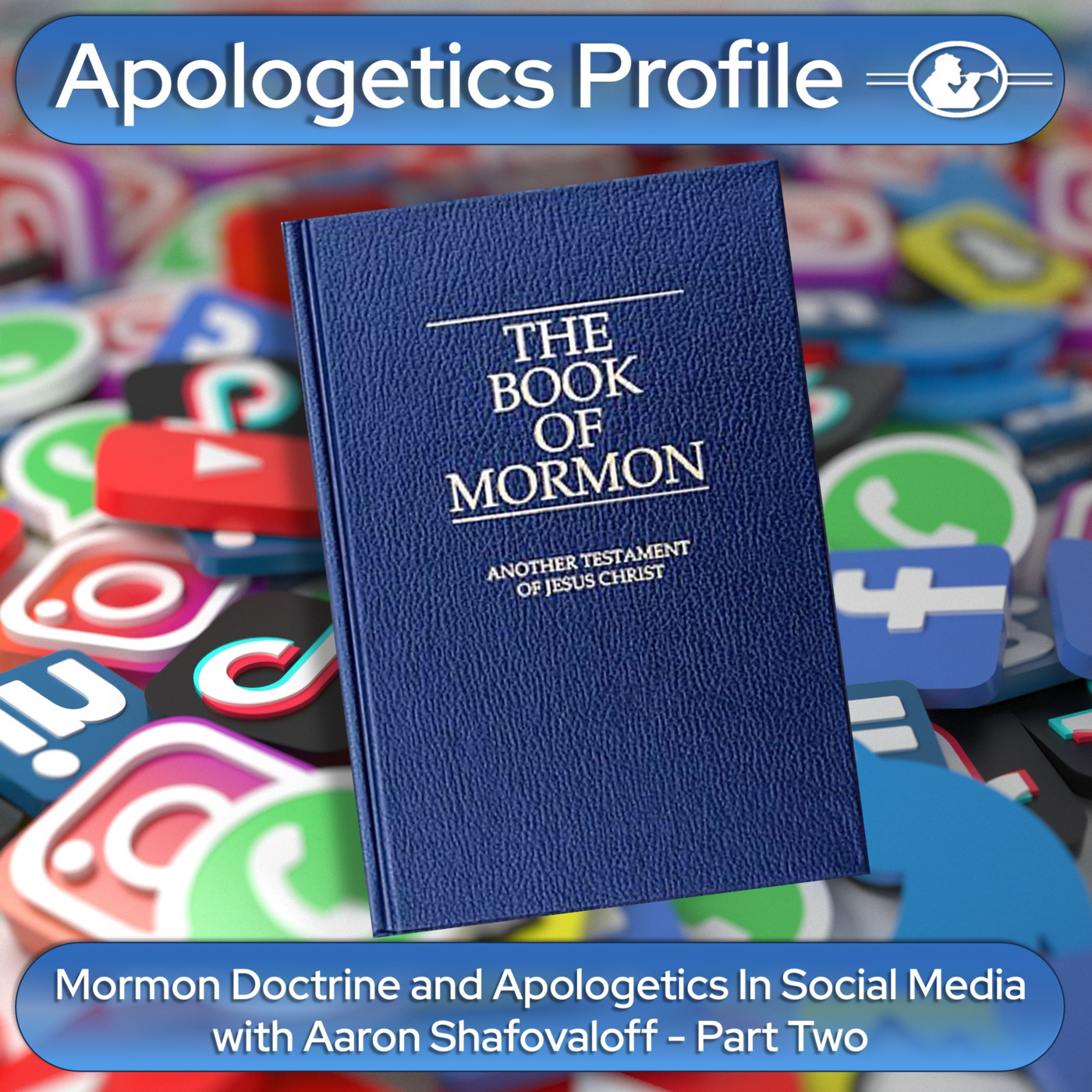
Episode 334: Mormon Doctrine and Apologetics in Social Media with Aaron Shafovaloff Part Two
About this Episode
What might you say to a Latter-day Saint missionary or acquaintance who questions you about the inerrancy and infallibility of Scripture?
We'll tackle this question and several other key issues between Mormons and Evangelicals this week on the Profile as we continue our conversation with apologist and evangelist to Mormons in Utah, Aaron Shafovaloff of Mormon Research Ministry in Draper, Utah (https://www.mrm.org).
Aaron became a student of Mormonism in 1998, when he was introduced to the religion by neighbors. His life was forever changed when he discovered Romans 4:5 “And to the one who does not work but trusts him who justifies the ungodly, his faith is counted as righteousness.” He joyfully looks back at his conversion in contrast to the “impossible gospel” set forth in the Miracle of Forgiveness and perfection of God’s law that he could never live up to.
Aaron is a computer programmer and a regular street evangelist. Aaron and his wife Stacie live in South Jordan, UT. Together they have a son and two daughters. He is working toward his Master of Biblical Studies at Midwestern Baptist Theological Seminary. https://mrm.org/team
Audio clips featured in this episode:
Ward Radio: https://youtu.be/7hOCZjc8nSk?si=qVA8QsWAd5Wa8smV
Frank and Hayden's exchange: https://youtu.be/9cQLSiNeNTc?si=N_Axsrf7wqHzxGUi
Hayden Carroll's review of the exchange: https://youtu.be/fIBkbO7Qtsw?si=EjNBloTi-oyn7m0v
Neil Armstrong (NASA): https://youtu.be/xSdHina-fTk?si=OKeFUfuCAfPDs7BW
Related Links:
- Watchman Fellowship Profile on the Church of Jesus Christ of Latter-day Saints: www.watchman.org/Mormonism
- Apologetics Profile podcast What Is the Gospel? with Mormon apologist Scott Gordon and Christian apologist James Walker (YouTube): www.watchman.org/GordonWalker
- Apologetics Profile podcast list of all episodes about Latter-day Saints https://www.watchman.org/files/ldspod.htm
Additional Resources:
FREE: We are also offering a subscription to our 4-page bimonthly Profiles here: www.watchman.org/Free
PROFILE NOTEBOOK: Order the complete collection of Watchman Fellowship Profiles (two volumes totalling over 700 pages -- from Astrology to Zen Buddhism) in either printed or PDF formats here: www.watchman.org/Notebook
SUPPORT: Help us create more content like this. Make a tax-deductible donation here: www.watchman.org/Give
Apologetics Profile is a ministry of Watchman Fellowship For more information, visit www.watchman.org © 2026 Watchman Fellowship, Inc.
Hosts & Guests
Transcript
You're listening to Apologetics' profile.
I'm a Latter-day Saint, also known as a Mormon.
And one of the things that prevents me from being an evangelical Protestant Christian
is the tradition of Soluscriptura.
Do you accept Soluscriptura?
Would you agree with Soluscriptura being the Bible, the six books of the Protestant canon
are the soul and foulable rule of faith in practice for Christians?
Even more so goes around the idea of the Scriptures being infallible.
Do you take that stand?
Do you posit that as a theological claim or do you have evidence for that or Jesus said
that the New Testament would be infallible?
Is that your position?
Does Christ ever say the Scriptures are infallible?
I'm hung up on this infallible.
Do the Scriptures need to be infallible?
We don't believe the Book of Mormon is infallible either, right?
The standard default position is that humans are fallible, therefore anything we
produce is fallible.
So do you think we need an infallible source?
Why do you posit that the author of the Bible, most of them anonymous, could understand
and interpret infallibly?
I'm not saying it's not correct.
I'm saying because fallible would be possible of error, but your position would be they
are not possible of error.
But you also are pointing to the text to prove the text, right?
You're looking at...
So do you accept that circular reasoning?
They are saying every line in the Bible is infallible.
That's just...
While also saying that humans are fallible, so how can a human write an infallible book?
That was Latter-day Saint and social media content creator Hayden Carroll during a question
and answer session with Christian author and apologist, Dr. Frank Turek, of crossexamined.org.
The event took place at Arizona State University on September 9th, 2024.
Crossexamined posted a video of the brief exchange between Hayden and Frank sometime in
early 2025.
That video engendered a lot of reaction from Latter-day Saint apologists on social media, including
Hayden himself, who posted a short review of the interaction.
Addressing Frank Turek directly at the end of his video, Hayden concluded that Frank
does not understand the Jesus of the Bible.
The reality is that you are the one who does not understand the Jesus of the New Testament.
The entire lens you view the Bible through is corrupted by false traditions, which jade
your entire perception of what the Bible really teaches and how it relates to the Church
of Jesus Christ of Latter-day Saints.
During their exchange, Frank told Hayden that Jesus affirmed the Old Testament.
Jesus said the Old Testament is the Word of God and He promised the New Testament.
And I just have a personal policy, Hayden, and somebody predicts and accomplishes his
own resurrection from the dead I just trust whatever the guy says.
Another popular Mormon social media platform called Ward Radio also reviewed Hayden's interaction
with Frank.
In this next clip, you'll hear one of the hosts of Ward Radio, Jonah Barnes, criticizing
Frank's statement regarding Jesus' affirmation of the Old Testament.
Well, Jesus Christ said that the Old Testament was Scripture, and you know, if He rose
from the grave, I'm gonna trust Him.
Woo, it gets cherished from the crowd, like, wait a minute, sorry.
Jesus Christ had no concept of the Old Testament that we have today.
What in the Holy Hacker are you talking about?
So where did Jesus Christ say the 1611 edition of the King James Old Testament is infallible?
That is such an insane claim.
That is so ridiculous.
Jesus Christ said, you know, you search the Scriptures because in them you think you
have eternal life.
The Old Testament in 30 AD, I hate when they do this.
They pray upon the ignorance of their preachers.
He knows this is a lie.
He knows this is BS.
There was no Old Testament in 30 AD.
There was no Old Testament in 30 AD.
There was no New Testament in 30 AD.
It wasn't called Old Testament.
There was the Ketuvim.
There was the Tanach.
There was, you know, the Torah, okay, you could kind of talk about those things, which
Jesus Christ doesn't.
He doesn't, okay?
Like, and so this guy, he acts like the Old Testament didn't even exist.
He's counting on his listeners being ignorant.
Contrary to Mr. Barnes' assertions, the Old Testament did exist in Jesus' day.
It was called the Tanach, which is the original Jewish name for the Hebrew Bible.
The Tanach of Jesus' day also contained all the 39 books we have in the Old Testament
today, though they were arranged slightly differently.
The Tanach was divided into three main sections called the Torah or Law, the Devaim, the
prophets, and the Ketuvim, the writings.
And contrary to Mr. Barnes' claims once again, Jesus did talk about them.
One very clear example of Jesus' speaking of the Tanach is found in Luke 24, verse 44,
where Jesus said to his disciples, quote, these are my words which I spoke to you while
I was still with you, that all the things which are written about me in the Law of Moses
and the prophets and the Psalms must be fulfilled."
The Torah, the Devaim, and the Ketuvim.
To be fair to Latter-day Saints, Ward Radio does not finally represent what all Mormons
believe, nor is the edgy style of Ward Radio representative of most Latter-day Saints you'd
meet in person.
Ward Radio is, however, one example of the growing phenomena of Latter-day Saints apologists
in social media.
Some LDS content creators, like Ward Radio, are a little bit more edgy and aggressive when
engaging with their critics.
And other LDS apologists take a more peaceable approach, sometimes even civilly engaging
in interviews and debates with evangelical Christians.
We highlighted Hayden's questions about inerrancy and infallibility this week because they are
one of the more prominent hot-button topics for Latter-day Saints apologists who critique
Protestant evangelical beliefs.
How might you answer the questions that Hayden asked?
That was Neil Armstrong speaking from the Moon on July 20, 1969, as he took the very first
and very famous one small step onto the lunar surface, a small step for Neil, a giant leap
for mankind.
There will never be another Neil Armstrong, the historical events of the first human being
to set foot into the Moon's silvery powder will never be repeated.
Neil Armstrong passed away on August 25, 2012.
But imagine for a moment NASA at a press conference, declaring that they intend to fill the
vacancy left behind by Neil's passing.
They announced that they will be selecting another living astronaut to become the first
man to walk on the Moon.
Most of us would likely think that NASA officials had lost their minds if they said anything
like that, because you simply cannot replace Neil Armstrong with another living astronaut.
Apollo 11's historic mission was a first for human space exploration.
It remains an unrepeatable once in a lifetime event, and by the end of 1972, 11 other human
beings would follow in Armstrong's footsteps.
Only 12 men in all of human history have ever set foot on another world.
NASA cannot systematically replace these astronauts with other astronauts.
The original 12 Apollo moonwalking astronauts will forever remain one of a kind.
Now you might be asking what does any of this have to do with the Bible's infallibility
and inerrancy?
Well first consider Jesus' words to Peter in Matthew 1618.
Quote, and I also say to you that you are Peter, and upon this rock, I will build my church,
and the gates of Hades shall not overpower it.
And Quote, Neil Armstrong was the first to walk on the Moon, but Peter walked with the
one who made the Moon.
Peter would also become the first living rock or stone, the first one through whom Jesus
as the chief cornerstone would begin to build his church.
Just as there will never be another Neil Armstrong or another first human being to set foot
on the lunar surface, there will never be another Peter, and there will never be another
origin of Jesus' church on Earth.
And just as there will never be another set of 12 original moonwalking astronauts, there
will never be another set of New Testament apostles.
With the exception of Judas, the original 12 disciples became the church's foundational
stones, the 12 apostles, whose names will be inscribed upon the 12 foundation stones
of the New Jerusalem, see Revelation 21-14.
So there will never be another New Testament apostle, akin to the apostles whom Jesus
hand selected and endowed with his authority.
There will never be a 13th foundational stone added to the New Jerusalem.
Once the first apostles died with the exception of Matthias replacing Judas, the early church
did not replace the original apostles.
Replacing deceased apostles would be like NASA replacing deceased moonwalking astronauts
with astronauts who never walked on the Moon.
The first apostles saw and interacted with the risen Jesus.
They received their authority from Jesus himself, and the early church recognized and understood
the apostolic authority and how they preserved and protected what Jesus passed along to them.
It is likely that during the lifetimes of the apostles, the gospel accounts and epistles
that make up the New Testament today were written and circulated through the growing church.
While liberal biblical scholarship often tends to date the writings of the New Testament
much later, there is good evidence, internal evidence, that the entire corpus of the 27
books of the New Testament we have today were all completed by 70 AD.
None of the books of the New Testament, for example, mentioned the destruction of Jerusalem
in 70 AD.
There is no mention of Emperor Nero's persecution that began in 64 AD in any of the 27 books.
The Apostle Paul was martyred under Nero's persecution but was still alive when Luke
wrote the Book of Acts.
Acts, therefore, had to be written before Paul died.
Paul even quotes Luke as scripture in 1 Timothy 518.
And Peter is believed to have been martyred under Nero as well, so his epistles would have
had to have been written before them.
Acts account is believed to be the first of the four gospel accounts and is believed
to have come from Peter himself.
If Luke was written before Paul's death, then Mark's account must have been completed
even earlier.
All of this to say, the inerrancy and infallibility of the Bible, both the Old and New Testaments,
came through the authority of Jesus himself, who attested to the veracity and authority
of the Tanakh, the Hebrew Bible, and bestowed authority to his chosen apostles, giving
them the Holy Spirit, the Spirit of Truth, and it was through the agency of the Holy Spirit
that both the authors of the New Testament books and the original apostles themselves created
and authenticated the 27 books of the New Testament we have today.
What hated another Latter-day Saints who argue against infallibility of the Bible miss
is that the Holy Spirit guided fallible men to create and eventually codify an infallible
inerrant set of texts.
This Latter-day Saints simply find it impossible that fallible men could author infallible texts.
But this is to completely dismiss the agency of the Holy Spirit, the Spirit of Truth,
whom Jesus told his disciples would guide them in all truth and bring to mind the things
Jesus said and did.
In summary, the Spirit of Truth, the Holy Spirit, is incapable of error when guiding us into
all truth.
He will not guide us into error because he cannot guide us into error.
Therefore, under the God-breathed authority and inspiration of the Spirit of Truth, the
authors of the New Testament wrote infallible inerrant documents.
Scripture is the true and without error, not because Scripture says it is without error,
but because the triune Godhead of Father, Son, and Holy Spirit have inspired and authenticated
it, guiding its human authors into all truth.
Jesus himself declares that he is the way, the truth, and the life.
There is no higher authority, there is no more fundamental source of truth than Jesus
himself.
But the Apostle Paul reminds us that, quote, natural man does not accept the things
of the Spirit of God, for they are folly to him, and he is not able to understand them
because they are not spiritually discerned, end quote, see 1 Corinthians 2, 14.
So finally, there is no greater witness, there is no higher authority, no more secure or
everlasting source of truth than the triune Godhead of Father, Son, and Holy Spirit.
God cannot, will not, and does not lie to us or lead us into error.
As the Lord says in Psalm 89, quote, once I have sworn by my holiness, I will not lie to
David.
His descendants shall endure forever, and his throne as the Son before me.
It shall be established forever, like the moon, and the witness in the sky is faithful.
Here once again is Aaron Schaffelwolleth.
When you give up on inerrancy, you give up on grace.
You need something infallibly good.
If you are going to be saved, you need to receive something that you can bank on and trust.
You need the grace that comes from pure power and truth.
So if you have nothing ultimately to stand on, then grace will not be a final fruit of
the path you are going down.
The other thing too is, I don't think people realize this, but Latter-day Saint apologists
and philosophers typically don't believe that God himself is logically infallible.
I should unpack that for just a couple of sentences.
Because Heavenly Father was once a man like we were.
It requires a little bit of unpacking.
There are a variety of Latter-day Saint views on the history of God, Faeogony, God's origin
story.
The idea in Latter-day Saint history is that God the Father experienced a mortality.
The question is, was he a redemptive savior in his own mortality?
Was he a sinless mortal, but not a redemptive figure?
Was he more like us, perhaps?
Was he more generally like us, but not exactly like the sun?
So there's a question of how some of the confelt discourse phrases are to be construed.
That's a big debate.
Even within the Latter-day Saint community, there's a variety of positions.
There's even a variety of positions on what is even official, or if there is even an
official doctrine on it.
Modern Latter-day Saint apologists typically argue that there is no heaven the grandfather.
Now, that's a change, because after the death of Joseph Smith, with perhaps one notable
exception, but essentially from pioneer Mormonism onward, Latter-day Saint prophets and apostles
who spoke to the issue affirmed an ascending recursive and infinite regress in the philosophical
language.
At least a regress, if not an infinite regress, at least that there's a heaven the grandfather.
Well, they were thinking about this at least when W. Phelps wrote high into colab.
One of the verses says, can we begin to contemplate where God's began?
The God's began to be.
And I think that phrase and that hymn at least functioned in Latter-day Saint discourse
to perpetuate the regress of Deity's concept.
And to sort of put it out of the epistemic reach of human beings.
It's just something about God that we don't understand.
Let's just sing about it.
And it's an interesting point, because they're singing in awe of the fact that it's incomprehensibly
big.
But what they're not celebrating in that case is that God Himself is the incomprehensibly
transcendent big God.
They're really celebrating a reality that is bigger than God Himself.
So the emotional worship idolatry question here is, where do you locate your sense of
awe?
Is it in the infinite depth of God's own rich being?
In Anselm's words, the greatest conceivable being in the Latter-day Saint theology is the
infinite regress of God's, not God.
In the dominant Latter-day Saint tradition, it's been gods who have fathers, who have
fathers, who have fathers.
And I mean spirit fathers, or gods have gods have gods.
Recently in the Latter-day Saint, apologetic space, there are exceptions to this.
But recently, most of the ones that are prominent argue that the regress lineage of Deities
actually terminates on our Heavenly Father that we really got lucky.
Our Heavenly Father is the first Heavenly Father, and that while we can become gods, Heavenly
Father Himself doesn't have a God.
Now, there's a really strange twist on that, because they still have to answer the question
of what God was Heavenly Father submitting to in His mortality.
And they're probably the most prominent influential philosopher in that space.
He posits that, and I'm not making this up, this is in Blake Osler's works.
He argues that when Heavenly Father became mortal, there was another deity that filled
in for him temporarily.
So one of the subordinate deities to Heavenly Father became a temporary relational
superior that Heavenly Father worshipped, and then that inferiority, superiority relational
positioning then flipped back once Heavenly Father resurrected and ascended.
So you have the problem that you've run into many times in the 20 years you've talked
to Latter-day Saint, so I'm sure in Mormon research ministries here, the same thing.
The question always comes up, or the issue always comes up.
If you quote somebody that's saying something that is unusual or strange or no longer adhered
to, if you quote an authority of past authority in the church, counsel of the 70,
quorum of the 12, the office of the first president, if somebody said something even ten
years ago, well, that's not really what we believe, or that's not really the church's
official doctrine.
That comes up a lot.
You mentioned Blake, and Jacob Hanson, or anybody that you want to refer to, if you put
the onus on that person for saying that thing, the exception clause is in vote, like a draw
four in Uno.
Yeah.
Yeah.
Hanson himself is very much influenced by Osler.
He actually talks about how he felt very uncomfortable with the regress of deities, idea,
and he took great comfort and relief in finding out that Blake was offering an alternative
position.
Saturday Saints often cite Psalm 82 in support of their belief in a multiplicity of gods.
Consider, for example, verse one, where we read, quote, God takes his stand in the congregation
of the divine among the gods he judges, end quote, that is a literal English rendering of
the Hebrew.
The word for gods used in this verse is Elohim, which is the very same word used for
God himself.
Now Mormons are quick to point this out, claiming that other gods do, in fact, exist.
But Elohim can sometimes refer to sons of God, and in the Hebrew, this appears as the
phrase beneath Elohim.
This use of Elohim is traditionally understood as another way to refer to angelic beings.
See Job 387 where we see the sons of God rejoicing with God at the creation of the world.
Elohim can also mean simply judges, which is likely the intended meaning of Psalm 82.
What Psalm 82's use of Elohim does not mean is that other gods like Yahweh actually exist.
There are a number of verses throughout the Bible, which state plainly that no other gods
like Yahweh exist.
Mormons will typically claim that the exclusivity of Yahweh, proclaimed in these verses, is
merely referring to the supremacy of Yahweh among a pantheon of gods that are like Yahweh.
Not that Yahweh is exclusively the only God who exists.
But the problem for Mormons in trying to interpret verses like Deuteronomy 4, 35 and 39,
or Isaiah 43, 10 and 11, or Isaiah 44, 6 and 8, or Isaiah 45, 21, just to name a few, is
that in both the Old and New Testaments, there is nothing good ever said about these
other alleged gods.
The commandments, for example, forbid us to have other gods, see Exodus 20, 3, and Deuteronomy
5, 7.
These real would provoke God with their sacrifices to demons that were not gods, see Deuteronomy
32, 16, and 17.
The Apostle Paul was grieved by the multiplicity of Athenian gods he saw in the marketplace,
CX 17, 16.
And Paul reminded the Galatians that before they became followers of Christ, they were
enslaved to gods that were not in fact gods, see Galatians 4, 8.
So if Latter-day Saints wish to advocate for the existence of a multiplicity of divine
beings, they must also address the question of why these so-called gods mentioned in the
Bible are never favorably portrayed.
Why would Latter-day Saints then wish to aspire to something that not only grieves God,
but is expressly forbidden by God?
It is an age-old temptation, common to every human being who has ever lived.
Note, you shall be like God, knowing good and evil."
See Genesis 3, verse 5.
So some of these guys have sort of like, they're almost like testimonies or stories of how
much Blake rescued them from having to believe what their own prophets and Apostles had
taught.
Wow.
So the only reason I know there's this situation where like, it's like Bart Erman with
atheism, Bart's my hero, he pulled me out of Christianity with his textual criticism
kind of thing.
Since Blake is kind of Blake Osler is sort of like the rescuer for modern Mormon apologists,
it's not that the typical Latter-day Saint even knows who Blake Osler is, but the modern
Mormon apologist finds a kind of comfort and relief in getting permission from Blake
intellectually not to have to affirm what their own prophets and Apostles have traditionally
and dominantly taught.
So the reason I bring that up, though, and the only reason I'm quoting Osler here is
that we only got here because of Osler.
Osler's the one who has influenced people to reinterpret the Kingfallate discourse, reinterpret
the sermon and the grove.
And I shouldn't push too hard in all directions because Blake, I think, is operating off of a
quasi Protestant impulse.
But in his book, he uses many of the same passages that Evangelicals use, like Psalm
90, verse 2, from everlasting to everlasting, you are God.
Blake even, at one point, appeals to Morin at 818, it goes on to say, God is unchangeable
from all eternity to all eternity.
And Blake even appeals to those passages to argue that it's, that we should believe
that Heavenly Father was unchangeably God, at least up until his condescension.
And so, but there's this impulse there that God would not be, I think some Latter-day
Saints have a quasi evangelical impulse, that's just to say here, they have a conscience
that's, that's not a completely asleep.
And they know that if there is a Heavenly grandfather and a Heavenly Great grandfather
and an ascending recursive lineage of God's, well, what a form of polytheism if there
ever was one.
I know there's different forms of polytheism.
I've heard, I've heard one individual on Facebook who's part of the Holy Rebellion talking
about henotheism as if, as if Latter-day Saint theology was henotheistic.
That means basically, as you know, there is a God, a high God, a God, a God that we pick.
But there, there's a pantheon, but we exalt this one God out of the pantheon.
Yeah, there's some semantic category shifting going on there.
They'll say, well, the Old Testament affirms the, the existence of other gods, but they're
really not doing the, the upfront rhetorical work of defining how much of a semantic
range.
Well, they love to quote first Corinthians, eight, five and six, were Paul's like talking
about idolatry.
And Paul says, well, there are many lords and many gods, but they omit the verse before
it where Paul's calling them so-called gods because there's not really any idols, there's
not really any gods, but you have to, they never contextualize that with Paul's sermon
on Mars Hill, where he's grieved by the idea of other gods.
It's not something he celebrates.
Yeah, it's a great passage to bring up in the sermon in the grove and I, I am hopeful
that that will enter into the evangelical LDS discourse more.
The, the Kingfellet discourse was given an April.
The Navu Expositor was destroyed two months later in June and just some days later Smith
responded to the Navu Expositor with the sermon in the grove.
A brief background on the sermon in the grove.
The Navu Expositor is a paper created by former members of Smith's fledgling church and
they published their grievances against Smith on June 7th, 1844.
Historian Robert B. Flanders, in his 1966 book, Navu Kingdom on the Mississippi, briefly
describes how and why the Navu Expositor came to be, quote, conflict over the issues of
plurality of wives and other altruist doctrines, including plurality of gods, had grown
within the circle of Mormon leaders until an open break occurred in the spring of 1844.
A number of prominent men withdrew and formed their own reformed church.
They were led by William Law, a member of the first presidency since 1841, Wilson Law,
a brigadier general in the Legion, Austin Cowles, a member of the Navu High Council, James
Blakely, a prominent 70, and Robert D. Foster, Chauncey Higby, and Charles Ivans, prominent
businessmen.
They resolved to publish their views and to expose the secret and abominable teachings
of the Mormon hierarchy in an opposition newspaper to be named the Navu Expositor.
On June 7th, they issued the first and only edition of their paper, end quote.
Joseph Smith, as mayor of Navu, ordered the press to be destroyed.
On June 10th, the order was carried out.
On June 16th of 1844, just six days after the Navu Expositor had been destroyed, Joseph
Smith delivers his last public discourse, his sermon in the grove, defending himself
against his critics, and the charge that he taught a plurality of gods.
In that sermon, Smith doubles down on his King Follett discourse he gave at the April
1844 General Conference, stating clearly that he believed that father, son, and holy
ghost are, quote, three distinct personages and three gods, end quote.
Smith went on to affirm his conviction of this plurality of gods by twisting the Apostle
Paul's words in 1 Corinthians 8 verses 5 and 6, where Paul appears to affirm the existence
of many gods.
But this is not what Paul is actually saying.
In Galatians 4, 8 for example, Paul reminds the Galatians that before becoming followers
of Christ, they were enslaved to gods who were not actually gods at all.
In Acts 1716, Paul was grieved by the idolatry of false gods of the Athenians he saw in
the marketplace.
In 1 Corinthians 8, Paul then is not affirming the actual existence of other divine beings
like Yahweh, but he is actually acknowledging the idolatrous reverence Pagan's had for
so-called gods.
Deuteronomy 32 17, for example, says that Israel often, quote, sacrificed to demons who were
not God, to gods whom they have not known, new gods who came lately, whom your fathers
did not know.
End quote.
Smith, however, uses 1 Corinthians 8 to affirm his polytheistic theology, quote, but if
Joseph says there are gods many and lords many, they cry away with him, crucify him, crucify
him.
Paul, if Joseph Smith is a blasphemer, you are.
I say there are gods many and lords many, but to us only one, and we are to be in
subjection to that one, and no one can limit the bounds or the eternal existence of eternal
time.
End quote.
Nine days after the sermon in the grove on June 25, Smith and his brother Hiram are arrested
and jailed in Carthage, Illinois.
Two days later on June 27, a mob attacks the jail and kills both Joseph and Hiram in
a gun battle.
The Navi expositor complained that Joseph Smith taught innumerable ascending gods above
Heavenly Father.
And the sermon in the grove, responding to his critics, argues, there is so much to
say, but I'll go straight to your passage.
In 1 Corinthians 8, Paul says, Lord's many and gods many, but for us there is one God.
Now, if you just zoom out to the immediate context, you'll see, oh, he's talking about
pagan deities who aren't like God.
It's not that they're also creators, but over other jurisdictions.
Paul even says of God that he alone is the creator.
And then there's these prepositions that Paul uses to make God look glorious.
So there's from whom, through whom, to whom in Romans 11, for from him and through him
in two of them are all things.
And forgive me if I get the details wrong here, but it's from God.
All things are from God.
And then all things are through Christ in that.
Yeah.
In collagens one, everything's from him by him and for him.
And then 1 Corinthians 8, if I, maybe you can fill it in for me, but he taps into
yet more prepositions that God has created all things, like you said, through Christ.
So these prepositions as applied, as used, are uniquely suitable to God.
And God, I'm sorry, yeah, God who creates is the one who creates through Christ.
And so Paul is applying prepositions that are uniquely appropriate to God.
Yeah.
He says, Christ.
He says verse 4 of chapter 8, he says, we know that there is no such thing as an idol
in the world.
And there is no God but one verse 5.
Even if there are so-called gods, whether in heaven or on earth, as indeed there are
many gods and many lords, but again, keeping in mind what Paul thought of God's in
Acts 17, yet for us there is but one God, the Father, from whom are all things.
And we exist for him and one Lord Jesus Christ, by whom are all things.
And we exist through him.
So that is, that's fuel for worship, by the way, that's awesome.
But in Paul's mind, that's true of God through Christ, not true of these other gods.
And so if you think he's dignifying these other beings as gods, well, it's not a proper
dignity.
It's sort of like it's a relative dignity.
I mean, they might be angelic, they might be demonic, they might be other kinds of creatures
that are extraordinary in heavenly, but they're not like when Paul taps back into the singular
one God.
He assigns a different kind of category to that.
And he assigns certain kinds of unique divine activity to that.
So I'm sort of finished it out in the sermon in the Grove, Joseph Smith zeros in on that
text because he knows that this is a key text for this issue.
And Joseph Smith interprets it to mean that when Paul says there is one God for us,
he means there is a variety of other gods over other dominions, but there's only one
that pertains to us.
So Smith regionalizes or relativizes or circumscribes the dominion of God and allows for other
gods over other dominions.
And he essentially relativizes what should otherwise be absolute.
So he's twisting the passage to allow for arguably an ascending recursive backwards lineage
of gods, an infinite regress of other gods who have gods who have gods who have gods.
Now this is just before he went to Carthage, right?
Correct.
This is his final major sermon on theology proper.
And we are utterly wrong to say the king, like Jacob Hansen claimed, I think back in December,
he said that the king felt discourse was Joseph Smith's last discourse on the subject,
utterly false, very misleading, not helpful.
The sermon in the Grove is where Smith doubles down on these notions.
And we should be clear to listeners who are kind of unfamiliar with what we're talking
about.
The Navu Expositor only printed one paper because Smith and company went, I don't know if
they dressed up or whatever they did, they actually went in and destroyed the paper because
of what the paper was printing about Joseph Smith.
And this is why he landed in Carthage, the jail, before a trial to see if there was disorderly
conduct or whatever.
But the Navu Expositor lived up to its name and exposed what Joseph Smith was doing at
the time.
And the mob that rushed the jail, I mean, you cannot long flirt or engage with or, you know,
approach or abscond with other men's wives before you're going to have a mob coming after
you in a sense.
Proudly Campbell, if my listeners are interested to learn more, Proudly Campbell runs God loves
Mormons.com.
And he has a whole video on the Navu Expositor.
It's extraordinary.
It's a great video.
He researched the heck out of it.
He did a great job on it.
I highly recommend it.
I don't know if Smith himself was a part of the mob, but he was a part of the council that
approved and pushed for the mob.
So that's like, it's kind of like Brigham in the mountain meadows.
We don't really know.
Well, we do know from minutes, we do know from the minutes of the councils that he was
in that he was pushing for authorizing, he was in charge in multiple ways.
But we don't know if he was there that night.
I think we know he wasn't there.
As we're kind of coming to the end here, I wanted to talk about briefly.
You hear this all the time.
Latter-day Saints talking about, especially missionaries, keeping the commandments, keeping
our commandments, promises to God that they look at commandments, uh, covenants.
They make a covenant with God.
And that covenant is, I'm going to do my best to keep the covenant.
This is the kind of speech you get on your front porch from a letter day saint, a well-meaning
letter day saint missionary.
We're going to keep covenants.
We keep covenants.
That's what we're supposed to do.
Uh, I had an engagement with a young man on Facebook a couple of weeks ago about this
very issue of covenants.
And I went back to Genesis chapter 15 and I asked him what his knowledge was about the
Abrahamic covenant and what was unique about it.
And I explained to him and he seemed to take no interest in the explanation or had any
kind of follow up to it.
But I said, you know, what a covenant was, Susarian treatise, the king of the ancient
areas would make a covenant, a contract, we might call it in the modern world, with
his vassals, with a subjected people that he conquered or his own people.
He promised to do acts and the people would promise to do why.
And if one side or the other broke the covenant, usually the penalty was death for that kind
of covenant breaking.
But the covenant in Genesis chapter 15 is along these lines, but the stunning reality
of it is is that God takes the place of both sides of the covenant.
In other words, the covenant is not contingent upon how well Abraham can behave.
This is a royal decree that is fulfilled by God himself.
He takes the side of the covenant breaking people and he takes the kingship and he makes
a covenant between himself for Abraham and his descendants.
And that's why he can promise Abraham and Genesis 15.
Five, your descendants will be like the stars, count the stars if you're able.
So this idea that this is embedded in Mormon theology to where salvation, when they talk
about salvation, is contingent upon their, their, their ability to keep covenants, to do
all they can do.
God's grace will come after all they can do until they renounce all on Godliness.
Will they get the grace of God?
So have you noticed, when you talked to LDS, that this, this behavioral contingent upon
trying to keep a covenant with God?
And they're, when you, I find in my conversations with them, when you get honest about, well,
how's your covenant keeping coming, they will routinely say that they're not living
up to, to knowing what they should be?
Well, if that's the case, then you can't receive grace according to your own scriptures
because you haven't yet done all that you can do.
You haven't yet.
So I think there's that, that tension there in the salvation and the covenant keeping.
It's all kind of a salvation in the LDS church.
They're under a lot of pressure to behave and to perform and to do rituals and duties
and things in order to try to earn God's favor to some extent.
I think that's essentially true, though I would try to help my evangelical friends shift
some of the rhetoric and I'll give you some background.
I do think that because of this bilateral obedience contract view of covenants, namely
that there's some arrangement where we covenant with God to keep all the commandments and
our success in keeping all the commandments is what our exaltation is predicated on.
Are we keeping celestial law, then we can be selectionally exalted?
Are we on the covenant path?
Are we fulfilling the commandments?
Are we qualifying?
Are we worthy of it?
There's like a dozen different rhetorical ways, later these saints talk about this and
it was extremely clear in pioneer Mormonism and into the 1900s, it was extremely clear
and Mormons were extremely proud that their theology was a merit system.
They called it that.
That's not my, they proudly celebrated it as a merit system and this even, this rhetorically
even amped up in the anti-calmingism era of Ezra Taf Benson, where he taps into the
economic metaphors of capitalism and hard work and that even cranks up even more that this
is a merit.
So Ezra Taf Benson, Spencer W. Kim will probably represent the height of perfectionism in
Latter-day Saint rhetoric.
Miracle of forgiveness.
Yes.
He essentially argues that you can't be forgiven for a sinful habit until you've successfully
and permanently purged yourself of it.
Engaging with the mastery of self-will, being in the mastery of your own destiny, I was
just reading through that recently where he sounds more like Albert Camus or some existentialist
and he does a theologian.
A lot of Latter-day Saints think that the book is problematic for its tone, but I don't
think they're thinking clearly about the system that he...
He calls Paul and Ephesians, the doctor that the, by grace you have been saved through
faith and not of yourselves, it is a gift let anyone should boast, he calls that a doctrine
of Satan.
He calls the doctrine of grace alone, yeah, of Satan, yeah.
So for Kim, Kimble brings that to peak and then that's, was it that the 70s and that's
a book that was given to a lot of people on the other end of the desk in an interview with
their bishop.
So if you're confessing your sins to your, you're getting counsel from your bishop, that
is a book that a bishop would have a stack of copies of and that that became pervasively
influential in LDS culture and that's part of why Christians who are reaching Latter-day
Saints for, with the gospel of grace, we used the miracle forgiveness in the 80s and
90s and early 2000s a whole lot, Eric Johnson still does.
Another passage that we used that functioned as a summary one-liner for how Latter-day
Saints thought about this system of, of a covenant keeping unto forgiveness and a final
exaltation was 2nd Nephi 2523 which says we're saved by grace after all we can do.
I think the earlier version says after all that we can do or something like that.
So a little twist here that I would love to, a little correction that I've helpful cautioned
to my, to my evangelical friends, that passage really wasn't used in Latter-day Saints teaching
to push a works-based theology until the late 1950s.
Okay, interesting.
And I didn't know that.
And it became, it even became a passage used by Latter-day Saints to distinguish themselves
from evangelicals.
What was the catalyst for that change?
I don't know.
I've traced the beginning, I don't know the cause, but it really, it entered into common
Latter-day Saints interpretation and they would couple it with Morenate 1032.
So here's my caution.
It looks like since the 90s and then really into full swing now in the 2000s, 2010s especially,
it looks like this new generation of Latter-day Saints, they don't use that passage in the
same way.
In fact, the BYU professors who were influential since the 1990s have essentially convinced
LDS leadership that that passage means that we're saved by grace in spite of all that
we can do.
So we can, we can cribble about what we think at the verse originally meant in 1830.
That's another question.
But what it meant to Latter-day Saints from the 1950s to the 1990s is no longer the case
in 2026.
In 2020, Latter-day Saints and Biblical scholar Dan McClellan wrote a 19-page article on
the issue of how the meaning of 2 Nephi 25-23 has changed for Latter-day Saints over
the last several decades.
2 Nephi 25-23 reads, quote,
For we labor diligently to write, to persuade our children, and also our brethren, to believe
in Christ, and to be reconciled to God.
For we know that it is by grace that we are saved after all we can do."
From this verse alone, it seems that grace comes to us only after all we can do.
And for years, this is precisely how the LDS Church has understood and interpreted this
verse.
As McClellan points out in his article, quote,
This traditional reading has long been employed for the rhetorical purpose of exhorting
members of the Church to give their all to Christ, and no less salient, it has become a central
identity marker for our community.
The side effect has been the sociocultural embedding of an inaccessible soteriology,
something with which many members of the Church have struggled, particularly the youth,
end quote.
McClellan then cites the LDS Bible dictionary, which can be found online.
Grace, the definition says, quote,
Cannot suffice, without total effort on the part of the recipient, hence the explanation,
it is by grace that we are saved after all we can do, end quote.
So McClellan is correct when he notes, quote,
If all we can do is the prerequisite for grace, no one will ever receive it, end quote.
Recognizing this impossibility is what McClellan argues constituted a recent shift in how
2nd Nephi 2523 is understood by Mormons today.
McClellan's article offers an in-depth analysis of the language and idioms of Joseph Smith's
time in place in an attempt to determine what 2nd Nephi 2523 is allegedly really saying.
But studying the late 18th and early 19th century idioms and the linguistic and rhetorical
styles of American English to understand what 2nd Nephi 2523 really means would be like
studying the nuances of modern 21st century English to understand the meaning of ancient
Hebrew or Greek words.
You don't need an English lexicon like the Oxford English Dictionary, you would need
a Hebrew or Greek dictionary.
So to know what 2nd Nephi 2523 really means, we would need to study a reformed Egyptian
lexicon and understand the culture and times in which the reformed Egyptian was written.
But no such lexicons exist, and neither do the original gold plates upon which the alleged
reformed Egyptian was first inscribed.
McClellan goes on to cite the Oxford English Dictionary to make his case that after all
we can do really means in spite of all we can do.
But Joseph Smith did not consult the Oxford English Dictionary when he was interpreting
the gold plates.
The OED wasn't published until 1884, long after Smith first published the Book of Mormon
in 1830.
But McClellan does make a solid point about how the meaning of 2nd Nephi 2523 has shifted
in recent years for Latter-day Saints.
It would appear Saints likely recognize the impossibility of receiving grace if they must
first do all they can do.
So McClellan's article brings to the surface another chief difficulty, the ways in which
LDS doctrines, interpretations of scripture and practices have changed and evolved over
the years.
Today you might believe that 2nd Nephi 2523 means in spite of all we can do, but perhaps
a prophet president some 20 years from now during a general conference speech will reintroduce
the older interpretation as sacrosancts.
So if I can make a concrete suggestion is that Evan Jalakles we would replace 2nd Nephi
2523 with Moroni 825, Moroni 825, which says fulfilling the commandments bringeth remission
of sins.
That's a really good example of where the Book of Mormon in spite of its 1830 Revivalistic
Wesleyan Evan Jalakles fervor at different points.
It is at least stowing the seeds of a works-based system that Latter-day Saints eventually adopted
wholesale.
I think that's a great verse showing that ultimately in the Latter-day Saint framework
even if you say that God is graciously helping you, empowering you, equipping you, enabling
you, even if you rhetorically can speak of the grace of God being necessarily involved
in the whole process, modern Latter-day Saints really try to stress the rhetoric of grace
and that excites Evan Jalakles, it sounds great, but when you peel beneath the typical
system that they're promoting still is differentiating levels of heaven and by levels of, I don't
really have a problem in theory with levels of heaven.
They don't really have levels of heaven merely, they have different heavens, they have different
kingdoms.
In the Christian view, heaven is wholesale the presence of Heavenly Father and the Lord
Jesus Christ.
Jesus says, in my Father's house are many mansions and he goes on to say, I wouldn't tell this
to you unless I was going back, unless I was going to come back to bring you back to where
I am.
I go and prepare a place for you.
So Jesus isn't preparing places where He isn't, He's preparing places where He is.
The rooms of the mansions are the plentitude of space and dwellings where the Father and
the Son are.
In the Latter-day Saint view, there are different heavens, different kingdoms, different degrees
of glory.
Some of which people are essentially damned, I'm using their language, not mine, to be
away from the presence of Heavenly Father and Jesus Christ forever.
And there's some asterisks for the terrestrial kingdom where Jesus visits you, but the dominant
view is that Jesus is not, you are essentially separated from the Lord Jesus Christ and the
terrestrial kingdom, very separated from Heavenly Father and you are not enjoying the blessed
unity of God's people and the richness of full fellowship with all of God's people.
So they say, you can go to heaven by grace alone, but what they often mean is, well, you
can go to a heavenly kingdom where you will arrive in a regretful pain for all of eternity
out of regret for not doing enough to qualify for and be worthy of the higher levels of the
kingdoms of heaven where you would have had more relational intimacy with the Father, the
Son, and all of God's people.
So they've mixed in traditional Orthodox Christian terms, their position on salvation
is an admixture of what we would call justification and sanctification.
They've confused the two that they don't accept the ultimate final justification.
You are right with God solely because of what and through Jesus has done, through his
passive obedience on the cross and his perfect obedience in obeying the law, they've taken
that justification and they've intermingled it with sanctification and sort of behavior
modification and obedience and everything that is contingent upon, you know, what we're
supposed to do.
Well, Jesus says to keep my commandments, Jesus says to do all this kind of stuff, but
it seems to me that the bigger issue is one of being able to get your LDS friends to
understand the difference between justification and sanctification when it comes to salvation
because we're not all using the same terms.
No, and Christians have been saying that for two centuries about the LDS faith, we use
a different dictionary.
We have different terms.
I think we could also say we not only have a different dictionary, but we probably also
have a different philosophy of whether the dictionary even matters.
That's a harsh statement, but what I mean by it is this, Latter-day Saints culturally
have a different set of sensibilities over whether the definitions even matter or how
far of a semantic range or what kind, how much of equivocation is culturally tolerable
or what is your threshold or your willingness to switch definitions on the fly or to use
terms in unexpected ways that are not clarified.
I think evangelicals have a different set of sensitivities to the use of language, whereas
the Latter-day Saints culture on matters of theology, not with respect to business or
neighborly stuff, but with respect to theology and doctrine, Latter-day Saints have a different
dictionary, different lexicon, but they also have a different philosophy of whether we
should even clarify what's in the dictionary.
I would say that their theological epistemology is as solid as a cloud.
You can keep falling through it.
It's like tissue paper.
You can't really stand on it.
It's almost very postmodern, Aaron.
It does smell like that.
One really concrete example I'll give people just so it doesn't sound like I'm bad-mouthing
my neighbors who I love, is if you were to ask a Latter-day Saint, did God ever learn
to be God?
What we've experienced on the street is Latter-day Saints will, I think, out of an instinct
and a reflexiveness not wanting to sound awful, they'll say, of course not.
No, God's always been God.
God never learned how to be God.
If you just ask a few probing diagnostic questions, not but 90 seconds later, you'll hear,
well, as far as work concerned, he's always been God, but maybe prior to this eternity,
he was a man who had yet to become a God.
I'm saying it even more clearly than perhaps they would.
What I'm really saying is if you probe, if you're patient, if you're not superficial
but you're more substantial in your use of religious terminology, if you're willing
to pause and kindly and patiently probe and diagnose and question, I think you'll
find that the initial Latter-day Saint reflexive answer sometimes is more of a defense mechanism
or a reflexive?
I think Latter-day Saints are eager to be agreeable.
They're eager, not good, conflict.
I think they even want the approval of their evangelical neighbors and friends.
They don't want to be called non-Christian.
They don't want to be embarrassed by the Protestant world.
When you ask Latter-day Saint, did God ever learn to be God?
The reflexive answer is often no.
Then the follow-up answer is often, well, maybe.
That's just a really good example of the use of terminology is critical in evangelical
LDS discussion.
It's like for you, we take the dictionary seriously.
You can open up the Oxford English Dictionary and find the word run and use the first definition,
but they'll go, well, there's five other definitions.
Maybe we can use those, but if you try to, in other words, what you're saying is be patient,
be gracious, sounds like first Peter 315, be compassionate, be gentle, ask a few good
questions, but be prepared for the, I don't mean this in a pejorative way, but be prepared
for the ambiguity that comes up with the more detailed you get into a discussion, especially
the theological terminology.
It turns out that you thought and met one thing might end up meeting the exact opposite
of what they initially thought, that they initially portrayed themselves to be.
Right.
Well, Aaron, thank you so much for your time.
What are some final thoughts you can give to our evangelicals and our Latter-day Saint
friends that might be listening?
Oh, I would stop listening to me and start listening to Bradley Campbell of God loves
Mormons.com.
He's more accessible.
He's more probably, it's probably a better resource for your man on the street, typical
Latter-day Saint or evangelicals.
It's just, I think I get in the weeds sometimes with some of these details.
Bradley has done a great job of communicating effectively for people for everyday conversations.
Using listening to a Paragetics profile, a podcast ministry of Watchman Fellowship
incorporated.
For more information about our ministry and resources, visit our website at Watchman.org.
More from Apologetics Profile
View all episodes →
Episode 339: The Doubt Project with Devin Squeri - Part Two
Apologetics Profile
Apr 27, 2026·35:24·failed
Episode 338: The Doubt Project with Author Devin Squeri - Part One
Apologetics Profile
Apr 20, 2026·34:19·failed

Episode 337: On Getting out of Bed - The Burden and Gift of Living with Author A...
Apologetics Profile