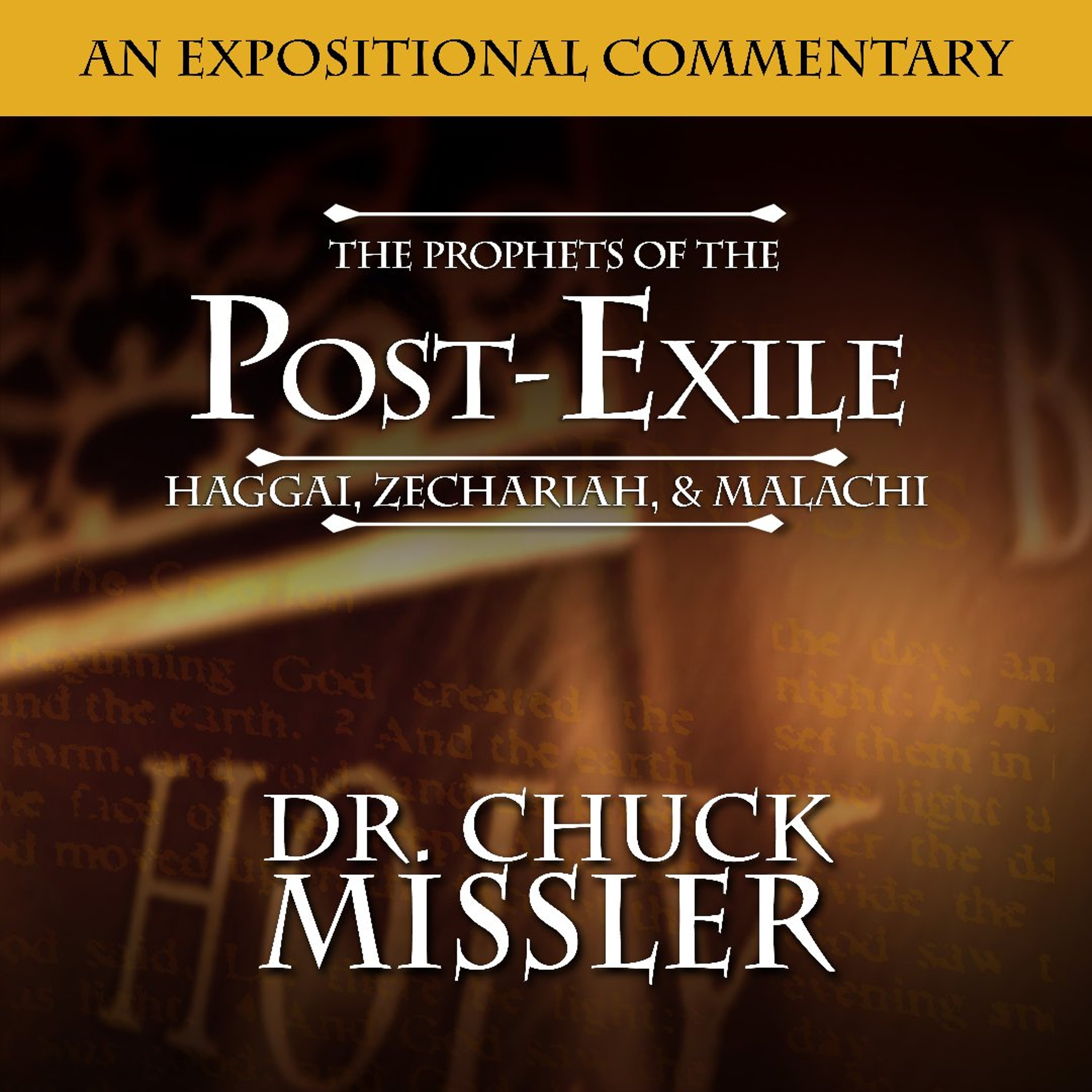
Episode for Tuesday September 15th - Malachi Chapter 1 - Part 1
About this episode
Get every episode summarized
Each time Daily Radio Program for Chuck Missler publishes, we email you a written briefing from the transcript — the topics, who appeared, and any specific claims, with the ad reads skipped.
Email me new episodesFree for 3 shows. No card needed.
Hosts & guests

Transcript ready
195 searchable segments. Every word is indexed and playable.
Full transcript
Daily Radio Program for Chuck Missler — Episode for Tuesday September 15th - Malachi Chapter 1 - Part 1. Machine-transcribed; use the interactive transcript above to jump the player to any line.
66.6640. Your future lies in 6640. 66 books by 40 authors, and yet we now discover it's an integrated message system from outside our time domain. Welcome to 6640, the Ministry Outreach of Coenania House and Coenania Institute. Today's Bible Teacher is Chuck Missler, connecting the Bible to your life and the world around you. In today's study, Chuck continues his teaching on the book of Malachi, chapter 1. So God's love is first of all unconditional. And boy, that's a hard concept for us to get used to, because we use the word love in a totally different context. And I won't go through the classic four, love as you've all heard that, but I just want to focus on that, which I think we know, but we should just get in our minds, is that when we think of love, we think of something that's a response.
We think of it as an emotion, we think of it as the arrows, so we think of it as a, I love you because, feeling the blank, whenever that changes that I don't love you. God's love is unconditional, it's hard for us to grasp that, it's hard for us to appreciate what that means, but it's essential that we do, it's essential that we understand that. Now, something else about God's love that's just surprising, the fact that it's unconditional is exciting. God loves you and God never changes. You see why His unchangeableness is immutability is so important? Because if He loves you, it's nothing's going to change that. And we remember from our study in Ephesians chapter 1 verse 4, when did He choose you? Long before you were born, before the foundation of the world, where He's going to make the point shortly here that He chose Jake before, over ESA, before they were born. How can He do that? Because He knows the end from the beginning. But that's not why He chose us. I think Wilbur Smith said, if He chose me now, He might change his mind.
But Moses finds something very surprising in God's love. We're in fact, we should probably, we're in Deuteronomy 10, and pick it up about verse 4-14. Do you remember in 10-14, behold the heaven and the heaven of heavens, belong to Lord thy God, the earth also, with all that therein is. Only the Lord had to delight in thy fathers to love them, and He chose their seed after them, even you above all people as it is this day. In Moses' tone here, the idea is getting across is, here's the God of the universe who owns the heaven of heavens, and yet He loved your fathers and thus you. He's amazed that God would bother and His love is personal. In Hosea, chapter 11, Hosea is amazed. He talks about the love as a father taking his son by his arms to teach him to walk.
He sees a very personal thing. In Hosea's point, he draws his people with cords, but not ordinary cords, the cords of love. And then of course, he also speaks both on the old and the new testament, the highest form, at least the highest analogy, is the husband and wife. We talked about that when we studied Ephesians chapter 5. And it's that love that we need to try to understand. It's a love that's willing to forgive the most, that is, it's willing to look beyond and pay the price for, the worst of faults. And yet is a love that condones the least, because that love is while continuing to forgive, never ceases coaxing, urging, wishing and hoping for the best in the other partner. So it's a love that is willing to look beyond the worst of faults, and yet condone the least.
And it's that tension, if you will, of the forgiving the most and condoning the least that helps us understand the uniqueness of God's love. He's got his most generous and offering a pardon and acceptance while at the same time still maintaining the high and holy standard of his righteous to which he calls us. You see, he'll forgive the worst and yet condones the least. You won't lower his standards to bring us in. So rather than giving up and attending to condone our sins or failures to meet us high standards, he faithfully continues to love us without making excuses for our failures or lowering the standard to meet us where we are. Rather he's given his own merit and righteousness on our behalf to make us eligible for that fellowship. So this is where God starts that he says, I have loved you and then in verse 3 says, and yet you say, where in is our love this? Was not Esau, Jacob's brother, sayeth the Lord. Yeah, I love Jacob and hated Esau. We'll come to that here in a minute.
See, so Israel was called to reciprocate that love in kind at least and yet they have scoffing skepticism. And so the hard times caused them to veer towards a very pragmatic atheism. See, when times are hard, it's hard to believe that God loves us. And that's for you at the Book of Malachi is all about. It was necessary to raise their sights from their myopic skepticism. Some of us in this room might feel that same way. We're going through tough times or have some affliction. The realities of our life may make us feel that gee God doesn't love us and that's Satan's lie. And that's what Malachi is going to try to deal with. Now in Israel's case, their realities of life were quite different than what they had expected. Because they looked at all the Messianic prophecies. Miraculous fruitfulness of Ezekiel 34, the swelling population Isaiah talks about in Isaiah 54, the glorious rate of the Davidic reign that was coming in Jeremiah 23 and nation serving them. And Isaiah 49, the Littron saw none of this. It was quite the opposite. The land was in bad shape and the Winding population the rest.
So now Malachi is going to hit this hard. The present hardships are brought on by a frigid formalism and disloyalty to their Lord. And their reluctant resultant sins and deepersickness in their hearts and external evidences were all a lack of inward reality and fear of God, lack of inward reality. And that's our danger too. Now what Malachi is going to do is urge them to get out of theirself pity long enough to observe their blood brothers, the Edomites. We'll come to that here in a minute. Because there's a law of righteousness and morality that always operates in history. And on more than one occasion, Edom or Esau, Jacob's brother, refused to help or even worse urged on an enemy and helped looting Israel when she's under attack. We find this discussed in Psalm 137. The book of Obadiah deals with this. Amos chapter 1 and Jeremiah 49, all of the passages dealing with that. Now Israel would also have been subject to God's removal. But God, his unmerited election love for her. And that's what Malachi is going to deal with here as we get further in the book.
And then of course, he also talks about the day of the Lord coming. So Malachi is going to reveal God in at least three relationships. And then he will be the father, Lord, God and judge. And of course Israel's response here is sarcastic, oblivious and super-siliest. So the root of all of Israel's sins, by the way, were her unawareness of God's love, the unawareness of God's love. And also the unawareness thus of their own sin. I get to verse 3 and I hated Esa and laid his mountains and his heritage waste for the dragons of the wilderness. Now this is the verse that gives everybody a lot of problems because he loves Jacob and hated Esa. And I love Gryphothomus' reaction to this verse. His reaction is the mystery isn't why God hated Esa. The mystery is why he loved Jacob. Many of the commentators see this love and hate thing in a comparative sense or an atomic pair, like the adenins.
We could go into Genesis 29. A lot of other examples of this where that is used, that the words are used comparatively. Leia and Rachel, one is loved more than the other. You can argue from the language, from Genesis, that this term simply means that he loved Jacob and he loved Esa less. And you can make that argument many people do. The apostle Paul quotes this in Romans chapter 9 verse 13 and he's quoting it, not from Genesis, but from Malachi. And so we get the Holy Spirit illuminates this. We might want to just turn to that to see it for yourself. Turn to Romans chapter 9. In verse 13, he was said under her, the elders shall serve the younger, verse 12, and as it is written, Jacob, have I loved, but Esa have I hated. And he goes on to make his point. He's drawing this distinction from Rebecca, et cetera, when the two twins, Jacob and Esa are born. And he's quoting this directly from the book of Malachi. And so the elders shall serve the younger is illustrating a doctrine of God in his sovereignty in dispensing favors.
Jacob is chosen before he was born. And that's when you compare Genesis 25 through 2 with Romans 9 and 11 in here. In Romans, if you look back at verse 11, for the children being not yet born, neither having done good or evil, that the purpose of God, according to election, might stand not of works but of him that call it. You see the emphasis there. And so the statement in Romans 9, 13 is quoted from this prophecy, not from Genesis. And although they're born as twins, the hatred of Esa had been well deserved after he continued opposition to God through the centuries. See, when you study the history of Eden, you discover there's good reason for God to hate Esa. Now, all these theological problems evaporate. If you recognize at times a physical dimension, God's outside that, he can see the end from the beginning. So it's perfectly understandable for him to understand ahead of time what the guy was going to do. This is, in effect, pointing to God's election of. But there's also God's justice love, and it turns out that when that part of the world was ravaged by the Caldian army, the country of Eden was among the rest laid to ruins.
And it was made literally for a habitation for dragons of the wilderness, as was foretold in Isaiah 34, verses 6 and 11. And when Jerusalem was overthrown, the Edomites rejoiced at that. And that's in Psalm 137. And therefore it was just with God to put the same cup of trembling in their hands, and though Edom's ruins were the last, they were permanent. They were lasting. And there's a difference between Jacob and Esa on that. Jacob was, yes, he had ruined, but he was rebuilt. Edom was not. And it says in Zechariah chapter 1 verse 15, against Israel, God was a little displeased, but against Edom he had his indignation. And we'll have forever, for they are the people of his curse, Isaiah says in chapter 34 verse 5. So let's talk a little bit more about him, we get down to verse 4 here. Whereas Edom's death, we are impoverished, but we will return and build the desert places. Thus,eth, the Lord of hosts, they shall build, but I will throw down. And they shall call them the border of wickedness, and the people against whom the Lord hath indignation forever.
See, as business of you're saying, well, we're impoverished, but we're going to rebuild. That's their boast, their brag, their hope, but God says no way. They're ruined, their desolation is permanent. This wasting of his heritage is made at a literally a place for jackals in the wilderness, and every attempt to rebuild will be met with defeat. Jacob's cities were also laid waste, but they were rebuilt. Edom's are laid waste, but never rebuilt. See, the sufferings of righteous will have an end, and will end well, but in all their grievances will be redress, the sorrow will be turned to joy, but the sufferings of the wicked will be endless and remedy less as he himself says in. That's something you and I have no capacity to understand, to be without hope. So, no matter how bad it gets, you can always hope that it's going to get better. See, from James, we've got the troubles, but they know they've got promises, and they know God will keep those promises. But the Edomites know, and God is saying, you may try to build, but no, I'll throw you down forever.
And that's probably the best description of hell in the Scripture. There's all these idioms of fire and so forth, and probably idioms of trying to describe something we have no capacity to understand. But the one thing that does describe it perhaps more eloquently than anything else is a place that is eternally without hope. You and I have no capacity to imagine being without hope. Now, we have here, of course, the fact that the hopes of the Edomites are vain, and the disappointment of them, we will build, they say, but, of course, God won't, their temps will be baffled or thrown down. Now, that's exactly, in the Edomites were then wiped out by the Nabatean Arabs in the 5th century BC, ransacked Edom, and leaving only pockets of refugees, and they gave desert, according to First Maccabees. And it was the same Nabateans that set up a nation called Idyumea with its capital in Hebron, and one of its great cities built in the cliffs was called Petra.
But their destruction of Edom was permanent, Edom in the sense of really being two Edomites, and when is the last time you ever saw an Edomite? Anyone? Who's going? So this judgment of God against Edom should also warn not only a skeptical Jacob, here's Jacob or Israel, skeptical. It was, in a sense, Malachi's way of warning them by looking at their destiny to realize where they really are, how much better off they are because they have, in fact, a covenant commitment with the God of the universe. But the judgment of God against them should be a warning against Jacob, but also should be a warning to America. One of the questions you and I do not know the answer to, are we Israel? By analogy, are we Edom? Interesting question right now. Edom was known in Malachi, verse 4, as the wicked country. What's America known as? The Great Satan. That's an appellation by our enemies, and yet it's not without merit. But getting back to Petra, I can't touch on this issue, we'll go forward in Malachi.
But the other issue to think about, there's a very, very peculiar prophecy in Daniel chapter 11, verse 41. And we'll just touch upon it quickly, but it's something to be aware of for lots of reasons. In Daniel chapter 11, verse 41, Daniel 11, last half of Daniel 11, deals with the career and issues of the Antichrist. In verse 41 of Daniel 11, speaking of this coming world leader, the Antichrist, as he's properly called, it says, he shall enter also into the glorious land, that's a term for Israel. And many countries shall be overthrown, but these shall escape out of his hand, even Edom, Moab, and the chief of the children of Eman. This is a very strange verse, because most of the verses in the book of Daniel, book of Revelation, also are emphasized that he will rule, if not literally all, virtually most of the world.
He's going to be a world leader. That's why I prefer the term the coming world leader. He has 33 different titles in the Old Testament. The word of God highlights a region that for some reason escapes his thumb, and that's Edom, Moab, and the chief of the children of Adam. Now those areas, if you look at a biblical map in the back of your Bible, you'll discover that area is known today as Jordan. It was a creation of Winston Churchill during Second World War called Transjordan, and thus laid the groundwork for this country today is known as Jordan. Very unusual history. Why would the Holy Spirit have that region escape the hand of the Antichrist? It's a speculation, but most scholars recognize all kinds of prophecies which indicate that the remnant of Israel, when they flee the attack on Jerusalem at the very, very end, the Battle of Armageddon and all of that, they flee to Basra. Now Basra, the term Basra means a sheepfold, and many scholars believe that refers in effect to Petra. There's also a city called Basra, but they believe it refers to Petra because it's a natural sheepfold.
A very, could hold over a million inhabitants, but you can only get in by a very, very narrow gorge. And Petra is a very fascinating place to visit, and it looks like it is being sort of set apart in history to provide that opportunity for the remnant to flee there, and that's the place that Jesus comes and fights for them before going to the Mount of Olives. When he does return and I encourage you, if you're interested in this whole area, we have a briefing called the Next Holocaust, the refugee need him, and you might want to look at that for a little more background. We're down to verse 5, being great progress tonight. And your eyes shall see, and ye shall say, the Lord will be magnified from the border of Israel. What this is really saying is that God is going to be magnified beyond Israel alone. Psalm 35 verse 27, Psalm 40 also touches on this, that God is going to be magnified in the world beyond Israel alone. So God's love, again, with Malachi saying, God's love, and its graciousness and in its judgments, will exceed the traditional national, geographic, political, or cultural boundaries.
And Malachi's in effect saying, it's going to go beyond them just as God promised Abraham and Genesis chapter 12. Remember in the first three verses of Genesis chapter 12, God called Abraham out of the worthy Caldys, and promises that through him all the nations of the earth will be blessed. And the word blessing there is used by Paul in Galatians 3.8 as referring to the gospel, the gospel. And of course, all mankind has been offered salvation, in effect, through Jacob. We've got a lot more to do, of course, in Malachi, but so far the one caution that is flying in the nested here with Malachi is that we should be careful not to doubt God's love. Just because we might be in some affliction that God has brought upon us to strengthen us, to grow us, or to prepare us to minister some others with that affliction. If you're going through someone's usual trouble, God has a hundred ways to ask you, do you trust me?
And one of the reasons, not the only purpose of suffering, but one of the reasons is that He may be preparing you to minister to people who would have that problem, unless you've been there, you know. So we'll pick it up next time at verse 6 and move a little bit faster, I think, as we go, we want to go all the background. But the people of God, apparently here, we're going to see a little more of that as we go, we're insensitive to God's blessings. God bless them abundantly, and they were not sensitive to that. Are we? Are you an I sensitive? Do we realize how much God has blessed you? Have you ever tried, in a quiet time, was your prayer? Have you ever tried to list the way God has blessed you? You know, there's in time. So He says, you know, I pray, but I can't see how these people spend hours in prayer. First of all, it depends on Him at yard with Him. But the second thing is, just try being exhausted, and you can't be. It blows you away.
But the other thing that the Malachi readers or listeners were obtuse to was their own departure from what He wanted them to be. Their departure from Him. Now it's interesting when you get to the book of Revelation, you get to New Testament. We have, of course, 21 epistles in the New Testament, but there's seven everybody always overlooks. There's actually 28 epistles. The seven that you overlook are by Jesus Christ Himself. The seven letters to seven churches in Revelation chapter 2 and 3. What's interesting about those seven letters is they are basically report cards. And what's amazing, there are many things about the seven letters that's entitled to a very specialized study in its own right. And I encourage you to do that if you haven't. The book of Revelation is the only book in the Bible that has a promise of blessing to the reader. No other book of the Bible has the audacity to say, read me, I'm special. Revelation does. But as you study the book of Revelation, and I've made it a hobby for more than 40 years, you'll discover very quickly the most relevant, most mystical, but the most useful, practical, relevant part of the entire book.
And the only part of the book that applies to you and I, to you and me, sorry, some day I'll learn that, right? Is chapter 2 and 3, which after four on its post-rapture. 6 to 19 is an expansion of the 70th week of Daniel. We're going to watch it from the month of Mezzanine. Now, of those seven letters to seven churches, the surprising thing is that every church was surprised. When you read those letters you discover, now we're not talking now early church for several centuries. We're talking within 60 years of the crucifixion. And already by then the churches in trouble. Church didn't get in trouble for a second, third century. Yeah, it was in trouble already. Jesus writes the report card, but what's interesting, even the churches that were doing well are surprised. They didn't know how well they're doing. The churches that are not doing well are also surprised. There's two churches there that nothing bad was said of.
There's two churches there that nothing good was said of. But the interesting thing is that all seven churches, if you read the letter and understand the letter, you discover this is news for the church. The churches surprised, didn't realize where they were. I wonder if we know where we are. Some things you probably feel pretty good about. Well, we might re-examine that and really understand where we are. And of course, in Malachi, all of them had a lack of reverence for God. Just returned from a conference where Alan Keys, one of the ones that made a run for a nomination president, given an articulate presentation of our heritage. You have the Declaration of Independence. And you read where all men are created equal. When you got the word created, he paused. He says, I love to pause after that word. All men were created. Yes, equal. But first point, it's created. Think about it. Do we deny that today in this country?
And where the Creator is the source of our ineligible rights, not man. See, one thing you need to realize, the globalists that would enslave you that are pushing for a global government, the first thing they have to do is deny God to get there. Because our heritage says that our rights are given to us, not by man, but by God. Therefore, they're not negotiable. And so the first thing you have to do is to get God out of the equation if you're going to enslave those people. Kind of interesting. So, Malachi is all about the love of God. And this precedes all other issues. You can't love God, you can't respond to God, you can't do anything until you discover that God really loves you. And my wife has done a beautiful job of this with her world famous series of the last 20 years called the Way of Agape. And the first step she's discovered, both from the Scripture and also from her experience with counseling people and rest, is that until you discover God loves you, you're dead in the water.
You need to discover that the breath taking discovery, that God really loves you. And the way of Agape is a prelude to its sequel, V.E. Transform. The V.E. Transform book is incredibly popular, getting rave notices, changing lives is wonderful. But partly, I believe this because of the prelude. You really need to understand God loves you. First, and the other thing that Malachi in effect is going to deal with as we go is that God is a person, not some kind of force or the pantheism of the New Ages. And one of the questions we want to be asking ourselves is we get deeper into Malachi as we understand the predicament he's dealing with there, is our we, Israel, allegorically, or are we eat them? Makes a big difference. Makes a big difference. Us individually, God loves us, but what's our response to him?
You've been listening to 6640, the Ministry Outreach of Coenania House and Coenania Institute. Today's Bible teacher was Chuck Missler, teaching through the book of Malachi. Download the new K-House TV app to access an ever-growing collection of free resources. Visit the Apple or Android App Store, or search K-House TV on your Roku or Fire TV streaming device. Thank you for listening to 6640, and for your continued, prayerful support of this ministry. Until next time, as we continue this series, may God bless you with the knowledge of his son, Jesus Christ, as you study his word.
More episodes
More from Daily Radio Program for Chuck Missler

Episode for Monday September 14th - Malachi Chapter 1 - Part 1
Daily Radio Program for Chuck Missler
Episode for Friday September 11th - Malachi Chapter 1 - Part 1
Daily Radio Program for Chuck Missler

Episode for Wednesday December 23rd - The Christmas Story - Part 4
Daily Radio Program for Chuck Missler
Episode for Friday December 25th - The Christmas Story - Part 6
Daily Radio Program for Chuck Missler