Loading...
newsdaily
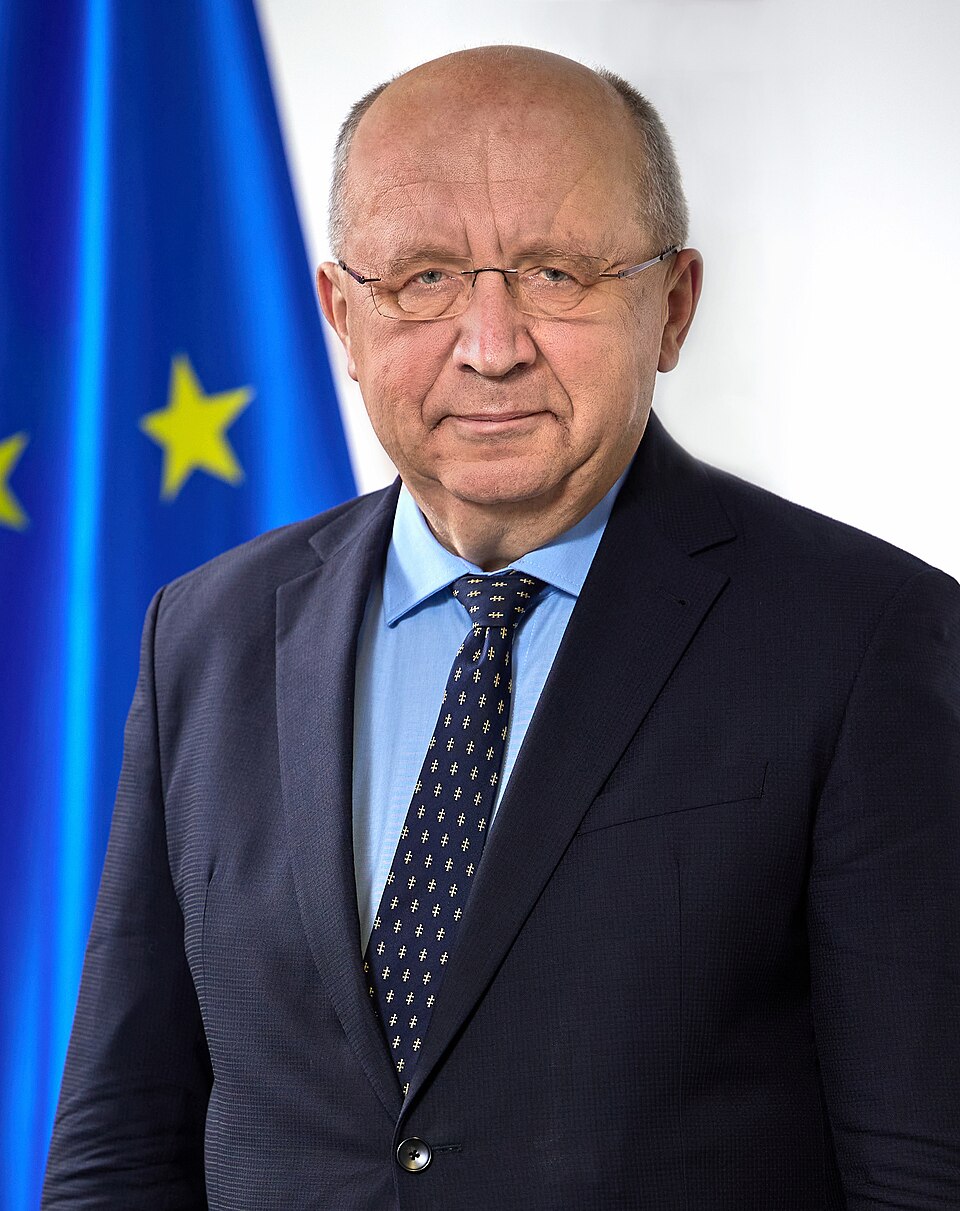
EU Defence Chief: Europe must help de-escalate Iran conflict
About this Episode
US President Donald Trump has warned “a whole civilisation will die tonight” if Iran fails to meet his latest deadline to strike a deal that includes reopening the Strait of Hormuz.
But if the Trump Administration follows through on its threats - it shouldn't expect help from leaders in Europe - who have have been clear in their refusal to join the US' war efforts.
Those responses have angered Donald Trump and strained diplomatic relations - as Europe continues to support Ukraine's war effort on its own borders.
- GUEST: Andrius Kubilius, European Commissioner for Defence and Space and former Lithuanian prime minister
- PRODUCER: Brooke Young
Hosts & Guests
Transcript
The U.S. President Donald Trump has given this warning overnight on social media that
a whole civilisation will die tonight if Iran fails to meet the latest deadline that
is set to strike a deal and that deal would include reopening the Strait of Hormuz.
But if the Trump administration follows through on its threads, it shouldn't expect help
from leaders in Europe who have been consistent in their messaging since the war began.
I'm going to act in the British national interest in all the decisions that I make, and
that's why I've been absolutely clear that this is not our war, or we're not going to
get dragged into it.
We are not party to the conflict, and therefore France will never take part in operations
to open or liberate the Strait of Hormuz in the current context.
We will not take part in the war.
We've said this from day one.
We will not participate in ensuring freedom of navigation in the Strait of Hormuz by
military means.
It seems to us that the plan for how it will develop is pretty unclear, and that's the
danger with initiating wars that they really follow as scripts.
We have denied the United States the use of the rotor and moron bases for this illegal
war, all flight plans that involved actions related to the operation in Iran were rejected.
If you're Prime Minister, you don't get to come back a week later and say, oops, I made
a mistake about that war.
Can I come back out of it now?
So those responses are ones that have angered Donald Trump, but have strained diplomatic
relations as Europe continues to support Ukraine's war efforts on its own borders.
Andreas Kabilius is a former Prime Minister of Lithuania, who's now the European Commissioner
for Defence and Space.
I spoke with him earlier.
Thank you very much for joining me on Radio National Breakfast this morning.
But pleasure.
Donald Trump's latest deadline for Iran is today, and overnight we've seen that quote
he's threatening a whole civilization will die tonight.
End quote.
If Iran doesn't strike a deal with the US and that includes opening the state of Hormuz,
what do those sorts of comments from Donald Trump signal to you?
Well, you know in Europe, how do you say, we are becoming accustomed to unpredictable
statements or decisions from present Trump.
So we are not keen to comment against recent statements, so we are really very much looking
how to escalate situation, how to achieve stability and how to gain open Hormuz rates
for shipping and so on and so on.
Do those sorts of comments require condemnation, given how extreme they are in nature, rather
than letting them slide by without comment?
Well, you know, it's for us most important really is to resolve that situation.
So how we can achieve that, it definitely depends very much on next steps.
And so we would like to see that some kind of stability will come to that region.
You know, we did not started this war.
We are really very much worried about how things are developing because everybody is suffering
and the surprises are increasing.
So we have a really interesting to see end of this story.
What do you think it will take to get to the point of de-escalation?
What will it take for the U.S. and Israel and also for Iran to step away from this increasingly
escalating conflict?
Well, as we see, you know, from public media, there is some attempts to start negotiations.
Pakistan is playing the role of intermediary and we hope that that will bring us and some
kind of solution.
We are not involved into that process and that's only what we can do.
We can wish that really agreements will be fined and some in some way peace will be established.
Are you confident that Europe can remain outside of this conflict?
If it drags on and continues to have such a big impact economically around the globe,
is there a point at which Europe will be required to be involved in some form?
Well, you know, from the very beginning, we were not participating in any kind of military
activities and for time being, we are not planning to do anything else.
We shall see how situation is developing but for, you know, it's very difficult to predict
and again, you know, we hope that rationality will prevail on all the sides of this conflict
and the appropriate agreements will be reached.
How do you view the relationship right now between the EU and the U.S.?
Well, we are, you know, transatlantic partners which have common, you know, use on security
of our different regions.
Of course, sometimes we have disagreements, but in general, what, you know, Americans,
American illustration, asking from Europe in the national defense strategies that we
need to develop our European capabilities to defend ourselves, at least in conventional
means.
That is what we are trying to build up because we understand that the United States will
shift more and more of their attention towards Indo-Pacific and Western Hemisphere.
That's, you know, rational where we understand such, you know, development and we have
very clear vision of what we need to do.
He's also threatened to leave NATO.
He's been calling NATO a paper tiger.
He's talked about potentially just walking away from the conflict in Iran and leaving
Europe to get its own oil and leave Europe to deal with reopening the strait of hormones.
Does that not indicate a deterioration of the relationship between the EU and the
US?
First of all, what we are taking into account, of course, official documents, official
positions, which are defined by different strategies.
And for example, recently published the United States National Defense Strategy, speaks
exactly about this division of responsibilities when Americans are looking forward that we
as Europeans will take responsibility on European defence, the United States and Europe will
be going to play some kind of secondary role, but they are not speaking about any kind
of leaving NATO or destroying NATO.
It's opposite, at least what we have had in Brussels from defence and the Secretary
of the British Colby.
He was speaking about so called NATO as three zero, which the concept is quite rationally
acceptable for us, and we are looking how we can know on both sides of Atlantic to build
such kind of NATO's three zero, making it much stronger than its at the moment.
You're listening to Radio National Breakfast, where the EU Commissioner for Defence and Space
Andreas Kabilius is our guest, as we talk about Europe's role in the Middle East conflict
and more broadly.
You were on a so-called missiles tour last week, looking at how European countries can shore
up missile stockpiles.
Is this now a top defensive priority for Europe?
Definitely.
It's a very, very important topic.
We started to plan this missile tour when we got the responsibility to administer so
called Ukrainian support loan with 60 billion of European loan to support Ukrainian defence.
And from Ukrainian authorities we understood that they have several priorities, and among
of course among them missiles are crucial important.
And definitely we understood why, because during last year Ukraine faced around of 2000
missile attacks from Russia, and after from them 900 were ballistic missiles.
And to destroy all ballistic missiles, we need to have a proper anti-ballistic defence
system, what time being mainly this is American Patriot system, and that is why we started
to look how we can ensure supply of those missiles to Ukraine and this has become harder.
I assume given how much of that missile production is now being used to assist Gulf states
in their protection, is it now harder to secure the stockpiles that Ukraine needs?
Of course, of course, and that is why we are looking how we can start production of similar
or new type of anti-ballistic missiles in Europe, because we understand very well, and
also statistics are showing that for the next several years American production, which
is not very big in the numbers, will be devoted, first of all, to replenish American stockpiles
or stockpiles of Gulf countries.
And while we have you, given you also the EU Commissioner for Spacer, I do wonder what
your reflections are on the success so far of the American Artemis II mission, have you
been following it?
Of course, we are following, because as Europe we are participating in that mission, we
provided an important part of equipment for that mission, allowing this, you know,
Orion rocket to have a propulsion system, which allows the whole expedition to be successful
in changing trajectory of orbits and so on and so on.
So, of course, this is a big achievement for, you know, for the whole global humanity and
we will show the success for that mission.
Andreas Cabilius, thank you very much for speaking to Radio National Breakfast this morning.
Thanks a lot.
More from Radio National Breakfast
View all episodes →
Breakfast Wrap: What is the future of the Iran ceasefire?
Radio National Breakfast
Apr 10, 2026·24:42·pending

Poltical Panel: Australia's response to Trump's threats on Iran
Radio National Breakfast
Apr 9, 2026·14:15·pending
Greens call for Australia to 'start pushing back' on America
Radio National Breakfast