About this episode
Hello and welcome to season nine of Origin Story. After last season’s history of socialism, we’re returning to our usual format of taking on a completely different topic each time, and we’re starting with a big one. As we approach the 10th anniversary of the UK voting to leave the EU, we’re telling the three-part story of European union itself: not just the 33-year-old organisation — an incredible achievement that is too easily taken for granted — but the much older concept.
We begin by explaining how Europe came to think of itself as an identity as well as a continent. For centuries, Europe was synonymous with something else, whether it be the Roman Empire, the Catholic Church or the values of the Enlightenment. The only efforts to unify its peoples were through imperial domination, from the Pax Romana to Charlemagne to Napoleon. It was the desire to avoid war between nation states that inspired the dream of the United States of Europe, and the cataclysm of the First World War that gave that dream real urgency.
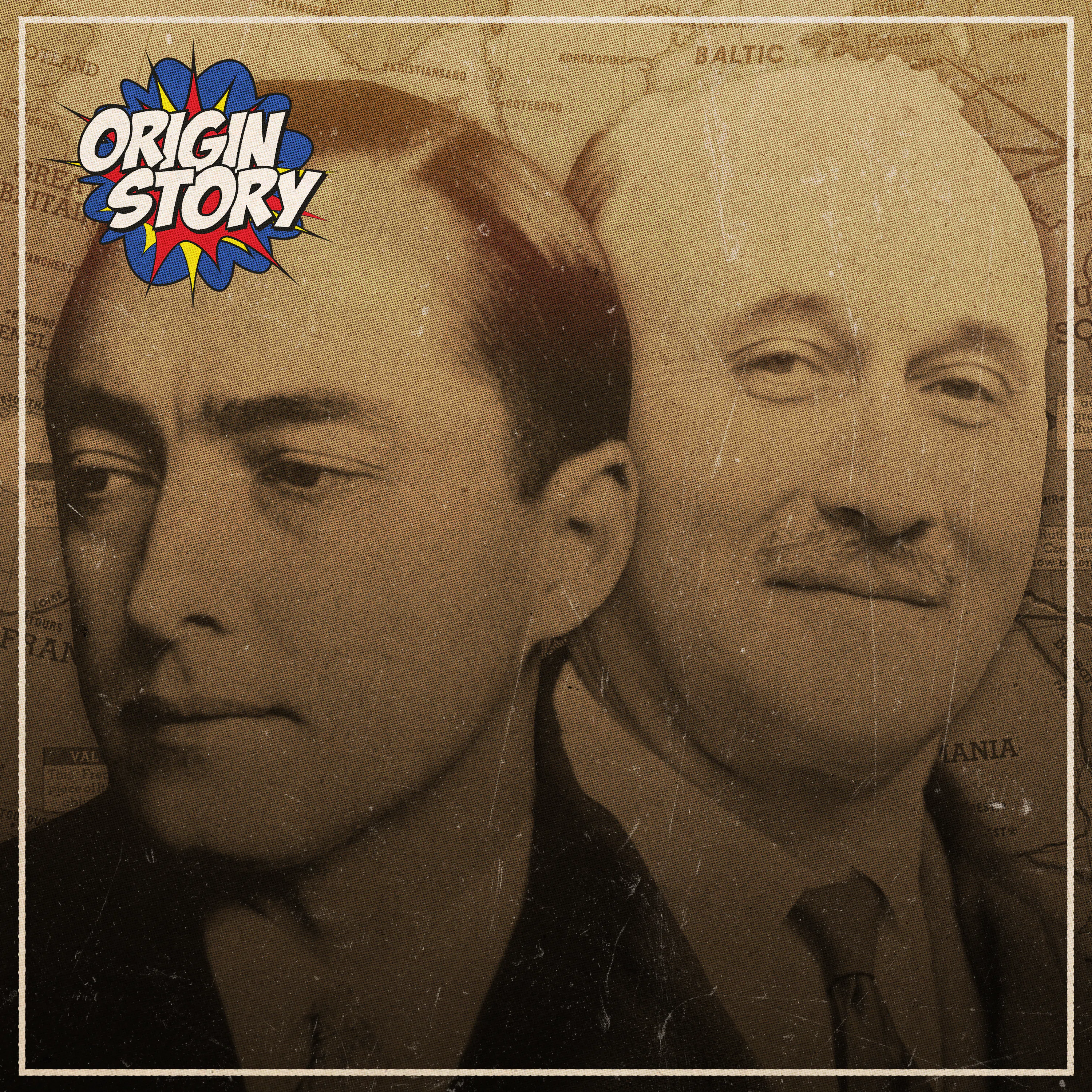
We meet two extraordinary and visionary men who dedicated their lives to bringing Europe together. Count Richard von Coudenhove-Kalergi, the so-called grandfather of the European Union, was an Austrian-Japanese aristocrat and ardent internationalist whose Pan-European Movement kept the dream alive between the wars, inspiring the likes of Einstein, Freud and Churchill. Jean Monnet was the brandy merchant, diplomat and wartime fixer who came out of the Second World War with a serious plan to realise it: the European Coal and Steel Community.
Churchill, who co-founded the Council of Europe, famously said that Britain should be “with Europe but not of it”. This ambivalence kept Britain outside the European project for more than 20 years but the real story of this period is the psychodrama between France and Germany: eternal enemies who became tense allies. We close part one in 1955, when the political aftermath of the war is finally resolved but the trauma still shapes Europe’s fears and desires.
What did it mean to be European before the twentieth century? Did it always take a war to force nations to consider cooperation? Why was Kalergi such an influential figure and why does he still inspire far-right conspiracy theories? How did Monnet use the shock of the Second World War, and the seemingly mundane issue of coal and steel production, to set Europe on the road to union? And was Britain right to be sceptical or simply deluded? It’s an epic story of how war and peace turned utopian dreams into political reality.
• Support Origin Story on Patreon
• Buy the Origin Stories books on Centrism, Fascism and Conspiracy Theory
• Subscribe to Origin Story on YouTube
Reading list
• Anonymous – ‘Europe: Then It Will Live...’, Time (6 October 1961)
• Roderick Beaton – Europe: A New History (2026)
• Richard von Coudenhove-Kalergi – Crusade of Pan-Europe: Autobiography of a Man and a Movement (1943)
• W.B. Curry – The Case for Federal Union (1939)
• House of Commons – Schuman Plan debate (27 June 1950)
• Roy Jenkins – A Life at the Centre (1991)
• Tony Judt – A Grand Illusion? An Essay on Europe (1996)
• Tony Judt – Postwar: A History of Europe Since 1945 (2005)
• Tom McTague – Between the Waves: The Hidden History of a Very British Revolution 1945-2016 (2025)
• Jean Monnet – Memoirs (1978)
• George Orwell – ‘Toward European Unity’ (1947)
• Fintan O’Toole – Heroic Failure: Brexit and the Politics of Pain (2018)
• Ernesto Rossi and Altiero Spinelli – The Ventotene Manifesto (1941)
• Robert Saunders – Yes to Europe!: The 1975 Referendum and Seventies Britain (2018)
• Martin Sustrik – ‘Jean Monnet: The Guerilla Bureaucrat’, LessWrong (20 March 2021)
• Simon Usherwood and John Pinder – The European Union: A Very Short Introduction: Fourth Edition (2018)
Written and presented by Ian Dunt and Dorian Lynskey. Producer: Simon Williams. Videographer: Connor Newson. Music by Jade Bailey. Art by Jim Parrett. Logo by Mischa Welsh. Group Editor: Andrew Harrison. Origin Story is a Podmasters production
www.podmasters.co.uk
Learn more about your ad choices. Visit podcastchoices.com/adchoices
Get every episode summarized
Each time Origin Story publishes, we email you a written briefing from the transcript — the topics, who appeared, and any specific claims, with the ad reads skipped.
Email me new episodesFree for 3 shows. No card needed.
Hosts & guests
No transcript yet
This episode has not been transcribed. Request it and it moves to the front of the queue.
More episodes
More from Origin Story

Section 28 – Anatomy of a Moral Panic
Origin Story
Aug 26, 20261:22:05pending

The Duke of Buckingham – How a queer love story predicted modern politics
Origin Story
Aug 12, 20261:17:43pending

Origin Story live show announcement!
Origin Story
Jul 22, 20263:05pending

Starmer Revisited – Where Did It All Go Wrong?
Origin Story
Jul 17, 20261:27:40pending