Loading...
About this Episode
Preparedness does not begin with bunkers and panic. It begins with the ordinary decisions you make before something goes wrong.
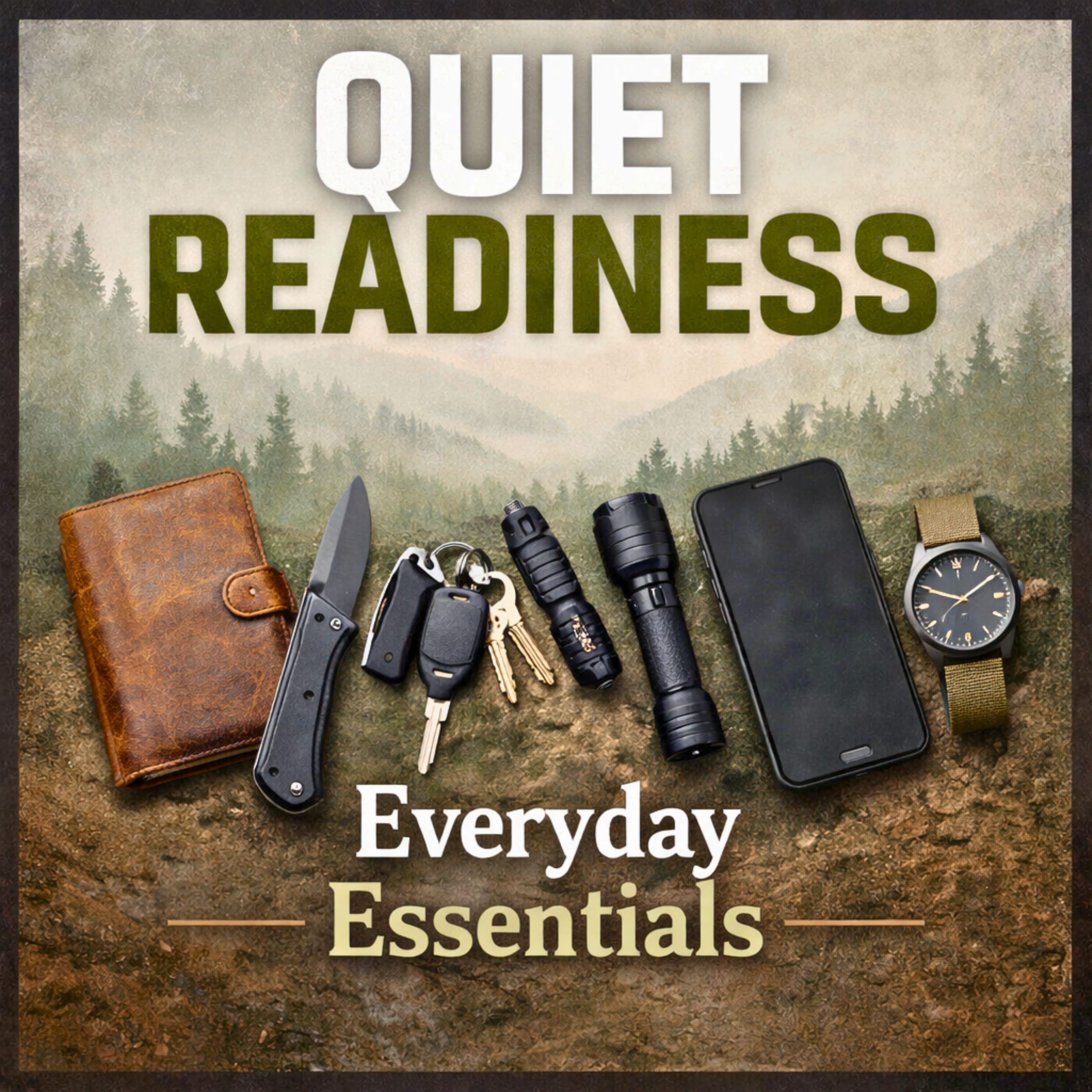
In this episode of Quiet Readiness, David Burnell takes a practical look at three layers of readiness:
* What to carry on your body
* What to keep in your vehicle
* How to build a realistic 72-hour kit
Drawing from operational experience, rescue work, and real-world emergency thinking, this episode covers the gear, habits, and priorities that matter most when you are stranded, cut off, delayed, displaced, or forced to move.
This is not about fear. It is about reducing friction when life gets chaotic.
This is a public episode. If you'd like to discuss this with other subscribers or get access to bonus episodes, visit davidburnell.substack.com/subscribe
Hosts & Guests

Transcript
Every day essentials what to carry on you in your car and for 72 hours.
Preparedness is one of those words people either over complicate or avoid completely.
Some hear it and immediately think about bunkers, stockpiles, and worst-case scenarios.
Others hear it and decide it sounds extreme, paranoid, or unnecessary.
But real preparedness is usually much simpler than that.
It is not about fear, it is not about fantasy.
And it is not about trying to control everything that could ever go wrong.
Preparedness is about reducing friction when life gets difficult.
It is about making sure that when something unexpected happens,
whether that is a car breakdown, a winter storm, a freeway closure,
a natural disaster, a power outage, or a medical emergency,
you are not starting from zero.
So today I want to walk through a practical way to think about readiness in three layers.
What you carry on your body, what you keep in your vehicle,
and what belongs in a realistic 72 hour kit.
If you can think clearly about those three layers, you are already ahead of most people.
The first layer is what you carry on your body every day.
This is not supposed to be a survival store hanging from your belt.
It is simply the gear that gives you the highest return for the smallest amount of space.
The goal is to have the things you are most likely to need in the next few minutes.
Not the next few months.
At the most basic level, your phone is part of that.
It is your communication device, your map, your emergency contact tool,
and often your first source of information when something changes quickly.
But a phone is not enough by itself.
It needs to be charged.
And if you regularly spend long days away from home,
a compact backup battery and charging cable are not overkill, they are practical.
A small flashlight is another thing I strongly recommend.
Not just the light on your phone, but a real flashlight.
It does not need to be huge, tactical looking or complicated.
It just needs to work.
Light solves a lot of problems.
It helps you see hazards, navigate dark spaces, find things when power is out,
and avoid turning uncertainty into panic.
A knife or small tool also makes sense, assuming you carry it legally
and responsibly.
I am not talking about drama.
I'm talking about utility, opening packaging, cutting cordage, freeing a trapped
seat belt, improvising when life becomes inconvenient, tools matter.
Then there is medical, even a minimal on body medical capability is better than
none. That may be as simple as gloves, a compact dressing or the ability to
address bleeding until help arrives.
If you have the training, a tourniquet and trauma supplies are worth serious
consideration.
If you do not have the training yet, get it.
Training matters more than buying gear.
You do not know how to use.
And then there are the essentials people often forget, identification,
a little cash, critical medications, and anything tied directly to your
personal health.
If you rely on an inhaler, glucose, prescription medicine, glasses, or any
other life supporting item, that is not optional equipment.
That belongs in your readiness thinking.
That is the first layer, simple, useful, close at hand.
The second layer is your vehicle.
A lot of people assume that if something goes wrong, they will just sit in
the car and wait it out.
Sometimes that is true.
Sometimes it is not roads close, traffic locks up, weather turns, vehicles
fail. A person gets injured, a child gets cold.
The situation changes and suddenly the car becomes either a shelter, a storage
point, or something you have to leave behind.
So your vehicle kit should help you deal with all three possibilities.
The first priority is water.
Water is non-negotiable.
Every official emergency supply list starts there for a reason.
At home, the standard recommendation is roughly a gallon per person per day
for at least three days.
In a vehicle, you carry what is realistic for your space and climate.
But the principle stays the same.
Hydration comes first, next comes food, not elaborate meals, not comfort food,
not things that melt, spoil, or require too much preparation.
Think shelf-stable calories that you can eat under stress and replace easily.
Meal bars, protein bars, simple ration items, or similar foods that tolerate
storage reasonably well.
You are not trying to create a pantry in your trunk.
You are just creating breathing room.
Then there is clothing and this gets overlooked constantly.
If you spend your day in business clothes, dress shoes, or anything you would
hate to walk in for several miles, keep shoes in your car, real shoes, walking
shoes, something that lets you move, add socks, add a warm layer, add a hat or
gloves if your climate justifies it.
The goal is not fashion, the goal is mobility and warmth.
A blanket or compact sleep system also matters more than people think.
If you get stranded, delayed, or forced to spend the night in your vehicle,
or somewhere less comfortable than home, warmth becomes a serious issue very
quickly.
You do not need a giant expedition setup, but you do need something better
than optimism.
Then comes light and signaling.
A quality flashlight belongs in the car, along with spare batteries, if needed.
Reflective gear is smart too.
A vest, reflective straps, or something else that helps people see you if you
are outside your vehicle at night.
A whistle can also be useful.
It takes very little space and gives you a way to signal without exhausting
yourself.
A radio is another item people often skip until they need it.
A battery powered or hand crank radio, especially one with weather
capability, can become far more useful than your phone if power is down.
Or the network is overloaded.
Medical is a big one.
Your vehicles should have a real first aid kit, not just a tiny pouch filled
with cheap bandages and expired wipes.
You want gloves, dressings, pain relief, if appropriate, and enough wound care
capability to handle a real problem until help arrives.
If you know how to use trauma gear, that belongs there too.
You should also think in terms of tools and practical support, jumper cables,
a tire inflator if that is part of your setup.
A basic toolkit, seasonal items like an ice scraper or traction aid,
local maps, wipes, tissues, garbage bags, simple sanitation items.
Those are all small things until the moment they are not one principle matters
here. Your vehicle is not a vault.
Do not turn it into a display case for expensive gear, secure what needs to
be secured, keep visible clutter down and understand that convenience and
security are always balancing against each other.
Then we come to the third layer, the 72 hour kit.
This is where people often either do too much or nothing at all.
A 72 hour kit is not supposed to be an apocalyptic fantasy bag.
It is simply a practical way to support yourself or your family for about
three days if life gets disrupted and normal systems are not working smoothly.
That might mean evacuation.
It might mean sheltering somewhere temporary.
It might mean being cut off from home or utilities.
The basics are consistent, water, food, clothing, shelter, medical, light
communication, sanitation, documents, and any special needs items tied to your
family. Water still comes first.
You need enough to start with and ideally some way to acquire more if the
situation stretches.
Food should remain simple, shelf stable, easy to pack, easy to rotate.
Your shelter and sleep items depend on your climate and mobility needs.
That could be a blanket, bivvy, poncho, tarp, or sleeping bag.
Clothing should include socks, underwear, practical layers, and sturdy shoes.
Not a complete change of wardrobe for every day, just enough to stay functional
and reasonably clean.
You need light, you need medical supplies, you need chargers or power
options, you need important documents and some cash, you need sanitation items.
And if you have infants, pets, seniors, or anyone with medical dependencies in
your household, their needs must be built in from the start.
A generic kit is not enough if your family is not generic.
And one more thing matters here, can you carry it?
That question gets ignored all the time.
A 72 hour kit is supposed to help you move, not become the reason you cannot.
If you load it with everything you might ever want, it becomes a burden instead
of a tool.
So build around the most likely disruptions first.
Be honest about your fitness, your family, your environment, and your actual
needs, then maintain it.
A kit you built two years ago may now contain dead batteries,
expired food, wrong size clothing, outdated documents, and medications
that no longer help anyone.
So revisit it, rotate it, improve it.
Preparedness is not one shopping trip, it is maintenance.
And underneath all of this, there is one truth worth remembering, gear matters,
but mindset matters more.
The calm person with a decent kit will usually outperform the panicked person
with expensive equipment.
Readiness is not about owning impressive things.
It is about thinking clearly before, during, and after disruption.
What do I need in the next hour, the next night, in the next three days?
That kind of thinking changes everything.
So if you want to become more prepared, do not try to solve your entire
life this afternoon, build in layers, start with what you carry on your body.
Then make your vehicle more useful, then build a 72 hour kit that actually
fits your life.
And when you are done, test your assumptions.
Can you carry it?
Can your spouse use it?
Can your kids find it?
Can you reach it quickly?
Does it still make sense for your climate, your budget, and your family?
Preparedness is not paranoia.
It is simply respect for reality.
This is David Bernal, and this has been quiet readiness.
Stay ready, stay steady, and make your life a little easier before the storm ever
comes.