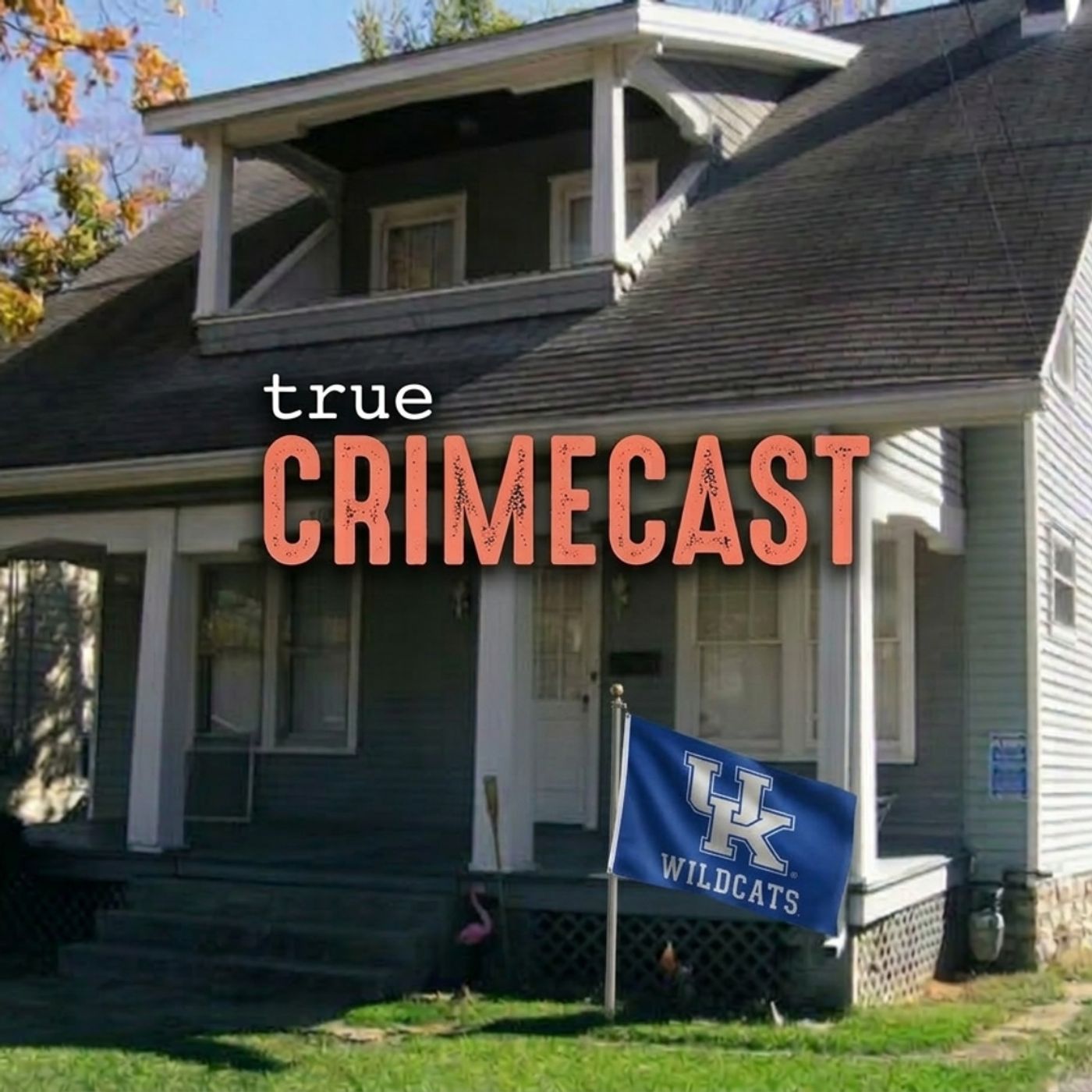
About this episode
On a humid Kentucky night in July 1994, Trent DiGiuro, a rising star on the University of Kentucky offensive line, was sitting on his front porch just three days away from his 21st birthday. Without warning, a single rifle shot rang out from the darkness 100 yards away. Trent was gone before his friends even realized what the sound was.
For six years, the case remained one of Lexington’s most haunting mysteries. The breakthrough didn't come from a forensic lab or a high-speed chase, but from a secret whispered in a bar and a woman who had the courage to wear a wire. In this episode of True Crimecast, John and Jamie explore the life of the "big teddy bear" who walked onto the UK team and the wealthy, privileged peer who allegedly could never forgive a social slight.
--
For early, ad free episodes and monthly exclusive bonus content, join our Patreon!
Hosted by Simplecast, an AdsWizz company. See pcm.adswizz.com for information about our collection and use of personal data for advertising.
Get every episode summarized
Each time True Crimecast publishes, we email you a written briefing from the transcript — the topics, who appeared, and any specific claims, with the ad reads skipped.
Email me new episodesFree for 3 shows. No card needed.
Transcript ready
764 searchable segments. Every word is indexed and playable.
Full transcript
True Crimecast — Faulty Metallurgy - Trent DiGiuro. Machine-transcribed; use the interactive transcript above to jump the player to any line.
Stove Lake Media Igniting Conversation This is True Crimecast, Jamie here with John, dude, we're like two weeks ahead. We never do this. Don't jinx it. Don't jinx it. Don't jinx everything. One of us has some major life changes happening and just feel the need to stay ahead of the game. We'll see what happens. It's going to be a little bit busier, but that's quite all right. We are still going to make time for True Crimecast. I'm going to read a few reviews that came over on Spotify, a few comments. John, I owe you an apology. Oh, well, it's about time. When we did our John Gotti episode, I said that Castelano should be Castiano.
Since he's Italian, it is actually Castelano. This comes from pancakes, which is the best user name on Spotify ever made. Now I want a pancake. So Castiano would be the Spanish or Latin based one. Yeah. I mean, in all fairness, I think the way that you said it was probably it felt right at the time, but I'm going to take it. Yeah. Castelano. I'll win as a win. Comment comes from TAD, H-G-R-O-0-5, TAD, TAD Hargo. I just want another pancake. Can you do criminal mastermind Netflix doc, please? That is the pizza bomber, the evil genius Netflix special. And we covered that about six months after it came out. So that is in our repertoire. That is in our catalog. So go check that out. Thanks for the comments. Please keep those coming. We will read those in any five-star reviews that come in. Yep. I'll show. I also want to say thank you to Matt, Matt joined us on Patreon.
And yeah. So Matt and all the others who have joined us this month are going to get access to early ad-free episodes from our main feed. Most importantly, you get one episode a month that is exclusive to Patreon. That will not be available for the broad-listening public. So if you want that kind of content, once a month, on the first of the month, we drop that, visit patreon.com, p-a-t-r-e-o-n, dot com, search up true crime cast. That's actually a slash true crime cast. I updated that last week. Sweet. There you go. Patreon.com slash what crime cast true crime cast? That's the name of our podcast. Yeah. I didn't know if maybe you just went with the last word, I don't know. Oh, good. But Jamie, are there also opportunities for folks who want to go to crime con to get 10% off? Absolutely. If you're interested in crime con, it's in Vegas the last weekend of May. Use code TCC10, that's TCC10 to get 10% off your badge.
We will have a table there on podcast row. And would love to meet you there in case you've ever even considered going flights to Vegas are generally cheap. This is a great time. And I promise. I've never been to anybody that went and was disappointed. There it is. Such a good time. You're in a room full of people that are a lot like you. So go check that out. If you're interested, use that code to save some mula. Jamie, we have a case that involves murder, football, fraternity organizations. It's a case that hit close to home, although it was a long time ago. Why don't you get us started? Yeah. Close to home. Literally. We're going to go to Lexington, Kentucky. We're near to us the biggest quote unquote city to us. There's some other towns that want to be cities. I don't know if we count those. I definitely count it. Lexington, for me, growing up, it is a big city. Now, not Atlanta big, but now that I've lived here for a while, I get what you're saying. It's just really spread out, but it's not that big.
It's not. It is very spread out, but it does have the University of Kentucky, which plays a role in our story. We are going to go back to 1994, July the 17th. It was a good year. It was a good year. Yeah. I was in fourth grade. Zero responsibility. Life was so good in the early days. I don't know. I was trying to think of like, I don't think I remember being stressed out as a kid. Maybe something's wrong with me. Oh, no. I just didn't have ability and the responsibilities or a family to keep protected, fed, clothed, housed. Yeah. I mean, the biggest stress was not getting caught by your parents anyway. Ninety-four. Right here. I'm doing things. Not breaking the law, but a group of college friends had gathered on a front porch. The University of Kentucky, it does have on campus housing. There's a ton of housing around the campus, like most campuses, over by the football stadium. There are a ton of fraternities, sorority houses on that street. So they were gathered on a porch, laughing, having a few drinks, and then the guests of
honor walked up. This guy's 20 years old, and he's three days away from his 21st birthday. He's earned a starting spot on the University of Kentucky Wildcats offensive line. That's a big, that's a big role, like he's a big old boy, obviously, super strong. You're talking in the trenches, offensive line, SEC football. So this kid, this young man, rather, is a pretty legit. He is legit. 6'2", 277 pounds, a mostly muscle. Everybody said he was a teddy bear, he was a sweet guy. So he gets there, they're sitting out on the porch, and then tragedy strikes. And around 2'40am, so this would be the morning of the 18th, a single rifle shot rings out from across the darkened street. At that time, the big man slumped over in his recliner, and blood started coming out of his left ear.
And in a matter of seconds, Trent DeGiro was gone. Yeah, what's wild is there had been no argument before that. Everything seemed fun. They were sitting on a porch having a good time. There was no confrontation, but there was also no warning. There was just one shot that obviously was a deliberate shot from the darkness at a 20 year old, and that took his life instantly. And to say Lexington was stunned would be an understatement. I mean, this is July, so it is right before fall camp would happen in Lexington, so people from the football team, people from the community, I mean, basketball at that time, especially was a much bigger deal in Kentucky, but anybody who's a fan of UK athletics would have known this name. So we're left with a question of who would want to kill Trent? In the answer, when it finally came, but it would take six years for it to come, was
too strange to even make sense. So the alleged motive was not money, it was not a drug deal gone wrong, and it was not a love triangle, but it was a fraternity black ball, a social slight from three years earlier that one young man could apparently never let go. So we're going to be talking about this story and why his life was cut so tragically short. Yeah, I didn't go to a school where there was Greek life, no fraternities and sororities. I have worked at schools where that has existed, but I'm often grateful that I mean, I know a lot of people love it. You make lifelong friends. I get it, but for me, I think it would have been unhealthy. And in this situation, it seems that somebody didn't get into a fraternity and held a grudge for it. Let's learn more about Trent DeGiro. He was born on July 20th, 1973. He grew up in a town called Goshen, Kentucky, which is a small community in Oldham County,
northeast of Louisville. He had attended South Oldham High School where he found his footing as an athlete. From the time he was a little kid, he stood out and he loved football, worked really hard to be the best of the best. Now he wasn't the most heavily recruited out of high school, but that didn't stop him. He started out at the University of Kentucky as a walk on his freshman year, meaning that he showed up to try out for the team or they agreed to let him come, but did not offer him a scholarship. But he worked so hard that they eventually would give him a scholarship and he got to be a starter by the spring of 94, which is going into a senior year. He was going to be the right guard on the offensive line. Again, starting as one of the strongest units, the offensive line in what was, I have to say was right now, because they haven't won lately was the best conference in college
football. And that was the South Eastern conference still is, baby. I don't know. They haven't won the last side of the last three years. He made the SEC academic honor roll in 1993. He was majoring in business and was even considering going to law school. He was the kind of guy that people gravitated toward the glue guy in the locker room with his friends, one childhood friend named Peyton Turner said he was the great protector of all of his friends makes total sense when you think of him as an offensive lineman defense of lineman. They're also big and scary, but they're trying to kill the quarterback, the offensive lineman, big and scary trying to protect the quarterback. I don't know if you can tell. I think I have offensive line instincts rather than defensive line. I don't know. I can be pretty aggressive right now and I didn't even bring it up. Another friend would say if they did have a fight and a brawl broke out that the Joro
was the one jumping in and breaking it up and saying no more. He was not looking for trouble. He was looking to have a good time and to enjoy his friends. Blessed be the peacemakers. That summer of 1994, Trent was living at 570 Woodland Avenue. This was a Bluetooth story house that he had rented with a few teammates near UK's campus. I don't know if it's still standing or not, but I'm definitely familiar with Woodland or Woodland Avenue. His housemates included a quarterback, Antonio O'Farell. Do you remember this guy at all? I don't know that he played in a second-story. I don't think he was starting. I think after who was the quarterback during this year? I think it was Billy Jack Haskins. I have not looked that up. That's just my recollection. Tim Kouch and Tim Kouch. Tim Kouch. There may have been somebody between them, but you know, we were bad. So Trent had not pledged to any fraternity, but he was popular enough to have been recruited by multiple houses, but he preferred to stay friendly with everyone.
He didn't want to be exclusive and then have built-in enemies just by pledging somewhere. So in the early morning hours of July 17, the friends gathered at the house on Woodland Avenue and they were having a good time. So this wasn't a rager. This wasn't like a crazy party. This was just guys hanging out having a good time. The homicide sergeant who worked the case later described it as a 30 to 40 of his friends who were just having a few drinks and just having a good time. As the night went down Trent and if you remaining friends settled onto the front porch, he sat back in his favorite brown leather recliner. Let me just say ball or move to have a leather recliner outside much respect. A lot of the houses in that area have a porch that's got like netting around it. So it's kind of like an extra room, but it's technically outside. That's what I envision here, but he also might have just had a recliner on the porch. I love it.
It makes it easy for when UK was winning all those national championships to just haul it off the porch and burn it in the street because that is a tradition. That's true. They were just two years away from the basketball, Natty. So somewhere across the street in the darkness between houses on Woodland Avenue, roughly a hundred yards away, someone was already watching. Yeah. And there are multiple reports depending on who you ask about the exact firing position. Some reports say it was at the corner of Woodland and Columbia avenues and that somebody was sitting under a dogwood tree. There are other reports and testimonies that describe as an alley between houses on Woodland. And it may be the same location, but varying descriptions. So I'm going to make that a note. And I have one correction even from earlier John. It turns out that Antonio O'Farell was the starting quarterback for Kentucky that season. The Kentucky went one in 10. So that's probably why I don't remember it.
They were late in rushing that year by Mo Williams who I saw play live and ended up being really good, played for the Vikings, sorry, back to the scene. So O'Farell, who was the quarterback and Trent's roommate had just gone to bed when this happened, he described what he heard as chaos, screaming, yelling and crying coming from all around the house. On the porch, when the loud crack of the gun rang out, some of Trent's friends thought it was a car back firing, which absolutely in that area, I think that would be a common thought. So one of them turned to ask Trent what he thought the sound was. And that's when they saw him slumped over in the big leather chair with blood running down his face from his left ear. Emergency services were called immediately. He was transported to a nearby hospital, literally down the street from University of Kentucky hospital, but he was pronounced dead within 30 minutes of arriving. He had been struck by a single rifle bullet to the head.
And once again, this was a young man going into a senior year on top of the world and just three days away from his 21st birthday. Of course, Lexington was up in arms over this, and the thorough investigation followed, but what they found out may not end up being the truth, would do that after the break. The lead detective on this case was named Don Evans of the Lexington police department. He would go on to serve over 20 years with the department eventually retire. But at the time of this investigation, he was only 21 years old. That is almost the exact age of the victim, Trent, in this case.
And Don was handling this case and it was his first major case. He arrived at the scene around 3 a.m. He would be spending years of his career on this particular investigation. So in the immediate aftermath, police did what they always do. They interviewed everyone that was at that party. Nobody had saw a gun. Everyone had heard the shot, but there was really nothing to go off of. I think the detectives presumed at the scene that this was going to be a shot from a handgun, because that's typically what happens. I mean, that's just the way it is. Nobody was thinking at the time this was a long range attack, but so he was questioning everybody. Hopefully somebody had saw someone with a gun earlier in the night, but there was nothing. There was one early lead. So earlier in the night, there was a pickup truck containing four young men who had driven past the party and allegedly bothered some women who were there at the party.
So police searched for that vehicle. They were looking for four unknown men in an unknown truck. You could imagine that went nowhere. How mean? We're in Kentucky and Kentucky and you couldn't pick it out. I think if they were four unknown men in a sedan, that might have got somewhere. We'll just stood out. But that went nowhere. But then ballistics came back and they're finding changed everything. So the bullet had not come from a handgun. It had come from a rifle, a point two, four, three caliber rifle to be exact. So based on that information, the trajectory of the shot had been fired from across the street over a hundred yards away. So when the detectives went there to try to look around and find something, they found a small mound in the darkened space between two houses across the street. They also found two small depressions in the ground. These depressions were consistent with the feet of a bipod. So think a tripod cut off the back leg and that's a bipod and that is used to stabilize
a weapon. So you can be laying down what's called a prone position with that and it just helps you hold up the weapon so you can use your shoulder and other arm to aim that a lot better. And it will get you a lot more accurate shot. So this is not a drive by, this is not someone at the party who is mad. This was basically an assassination and that was someone targeting him specifically. A hundred yards away is not an easy shot either. So it was for somebody to even own a bipod, which I want people to know that John just said a lot of things about bipods that are not in the outline. You're a bipod expert. I have a bipod. I have a tripod and a bipod. That's a lot of pods. For cameras, bipods for guns. That goes the show. I have a unopod too. That's just called a stick there. There was evidence that somebody had set up intentionally in this location and staked out the time for the right shot. So this is next level stuff and for somebody handling his first murder case, I mean, you're
wanting to handle something that has a clear motive has a clear, I mean, witnesses and all the things, but he doesn't have that no suspects in the investigation, stalled pretty quickly. This ended up on America's most wanted and it generated a flood of tips, almost all of it nowhere. I have to assume with that America's wall swan in has done a lot of good, but it's also gotten a lot of worthless phone calls, but the good outweighs that of course in the spring of 96 detectives got an unusual call from a man named David Canty. He claimed to know something about this and when detectives went to meet him, they found something kind of unsettling. He had paper plates, dozens of them covered in handwritten notes about DeGiro's murder. He'd made his own calculations about their trajectory. He had been doing, oh, it seemed his own investigation of this one plate apparently
said that he and DeGiro were twins. He owns a 243 caliber rifle, the same kind that the bullet came from. Investigators took his weapon and ran ballistics. We debate about this often. I don't think they're 100% reliable, but I do think they could potentially rule out a weapon and they seem to rule out this one. Canty seemed to have no meaningful connection to DeGiro. So how was he even involved here? It was almost like a strange obsession, but they didn't believe that he was the killer so they didn't really pursue him any longer and then the case went cold in years past before they had another good lead. That is so, so weird. I've tried to dig into this guy to see if there were any other issues that popped up since then. I couldn't find anything, but I'm going to continue my deep dive. Yeah. Not only notice this, and totally not making notes on paper plates.
Yes, paper plates. That's so interesting. Well, in 1999, there was a local Lexington TV station that aired a segment re-examining this unsolved murder and a lot of tips came in. Most all of them led absolutely nowhere, but one tip delivered shortly afterward through a local attorney stuck. The attorney's name was Tom Bullock. He was a friend of a woman who had come to him with a troubling secret. She told him, vaguely at first, that she might have information about a high profile murder. Bullock eventually brought the information to Detective Evans without revealing his source. The attorney client privilege, I guess, you know, I think that means you're not supposed to give the information, but I'm assuming she gave him permission to share that part. So maybe, and maybe if maybe attorney client privilege doesn't really work if she's not necessarily your client, she's someone you know. So the name he provided was Shane Ragland.
So Evans began to dig into this name to see what he could find. Yeah, let's talk some about Shane Ragland. He grew up in Frankfurt, Kentucky, which if you don't know is the actual capital of Kentucky and is even smaller than Lexington. His father, Jerry Ragland, was a prominent wealthy businessman who owned a lot of real estate across the region of central Kentucky, including properties, leased to the government. A lot of ways Shane was the son of privilege, someone who had a name that at the mention of it could open some doors. He enrolled at the University of Kentucky in 1991, which overlaps with the jurors time there. And like many incoming students, Shane had his sights set on the right fraternity, specifically he wanted to be in sigma alpha epsilon, widely regarded as one of the more elite chapters on campus with alumni connections that mattered. So he threw himself into the rush. He attended the parties, he did the things, he worked really hard to get into the fraternity,
but it didn't work out, John, why not? Yeah, so one night during rush, Shane was in a dorm room with other prospective pledges, including a young man named Matt Blanford, who was also rushing to try to get into that same fraternity, SAE, Shane spotted a photo calendar on the wall featuring women affiliated with the fraternity. He pointed to one of the women and told the room that he knew her, that he had slipped with her. The problem was that the woman in the photo was the girlfriend of the SAE chapter president. That's not something good to say if you want to land a spot in this fraternity. So of course, word got back to leadership and Shane was removed from the pledge process. He was black bald. He was furious, to say the least. This was a young man who was accustomed to getting his way. His family name meant something everywhere else in the world except for in this fraternity.
And he blamed Blanford for snitching on him, telling on him. Soon after that, Ragland ran into Blanford and Trent on campus and angrily confronted those men. That's when Trent stepped in. According to court reports, Trent told Ragland that he, Trent, was the one who had told the fraternity president, taking the blame onto himself to try to defuse the situation. Jamie, you mentioned earlier that he is a guy who didn't want to see confrontation. He would try to de-escalate. He would get in the middle of it only to separate things and try to get order back, you know, established. One of us a protector of all of his friends. And that's what he was doing here. He hadn't actually done that. He just wanted to tone things down a little bit. So he was doing what his friends always said. He was stepping between people and protecting others. For Trent, it was a throwaway moment of decency. He probably thought he was doing the right thing.
After they left, I bet he did not give a second thought as to how dangerous this guy would end up being. For Shane Ragland, this was anything but that. He let this go way too far. When a attorney Tom Bullock brought the name Shane Ragland to Detective Evans, investigators immediately went to work. They pulled records at SAE and found out exactly what they suspected. There was a pledge list with Ragland's name on it, but his name had been crossed out. But having a motive to hurt somebody or be mad at somebody and building a case or two very different things, Bullock had protected his source by not saying who had given him the name and detectives needed to find that person and eventually they did. They were able to locate this source. Her name was Amy Lloyd and she was Shane Ragland's ex-girlfriend. She had been carrying the secret that she said had been weighing on her for years that
she knew he had done this and she finally had to tell somebody. So here's what Amy Lloyd eventually told investigators. In April of 1995, nine months after the murder, she and Shane had been together at a local bar when the conversation turned personal. What was the worst thing they'd ever done? They asked each other and Shane Ragland told her that he had killed Trent. He described what he'd done. He had seen the birthday party at Trent's house. He put his hop-powered rifle with a scope into a duffle bag and got on his bicycle. He rode to a position in and alley between the houses across the street and he set up the shot, waited for the right moment and fired. He allegedly showed her the rifle. Amy was in love and she told herself this could not be true that he is just making this up and it's a crazy outlandest story. So she stayed silent and their relationship continued for a short time.
Then on the five year anniversary of Trent's death, she saw a newspaper article in it. Trent's father Mike was quoted saying someone knows something. Somebody knows what happened and those words hit her. She went back to her trusted friend Tom Bullock and asked hypothetically whether someone could report a crime without revealing who they were. She was vague at first and then she eventually revealed enough that Bullock understood this was about a high-profile murder. So he went to Evans with the name but not with Amy's identity. And they really needed Amy. She needed to be a part of this investigation. They needed something that they could take to court. So Evans asked Amy to do something that's extraordinarily difficult. He asked her to reach back out to the man that she believed was capable of killing somebody. He wanted her to meet up with Shane and to wear a wire. And she agreed. John, this happens in cases we cover not often but it comes up.
How would you feel about being asked to wear a wire and go into this situation? Where's the balance between personal safety and the pursuit of justice? Man, I would be an absolute nervous wreck. I would not want to do it. I'm not saying I'll wouldn't but I just would not want to. I think I'd sweat out of nervousness and electrocute myself. That's what I would fear. Nearly six years after Trent DeGioiro's death, Amy Lloyd resumed contact with Shane Raglan. It told him she'd be passing through Lexington on business and wanted to see him. So they arranged to meet at the Lexington Bluegrass airport. If you've never been, you're not missing much. It's very small. She walked in wired, surrounded by undercover officers and FBI agents. They talked about old times and eventually she brought up the secret that he had confided to her years earlier. He started to get uncomfortable like why would she bring this up after all this time?
At one point he asked her directly, are you setting me up? And she kept her composure and said she didn't know what he was talking about. She was just bringing up old memories, but apparently Raglan said just enough in that interview or in that conversation with Amy to be arrested. On July 14th of 2000, they moved in. This is just three days before the sixth anniversary of Trent's death. And Raglan was arrested in Frankfurt and charged with murder. Following his arrest, investigators searched both of his parents' homes. So at his father's house, they found a box of 243 caliber ammunition. This was the ammo that was the same caliber used in the murder of Trent. At his mother's house, they found at 501 Capitol Avenue in Frankfurt. They found the .243 caliber, whether be Vanguard rifle. This was presumably the rifle that was used in this murder.
A ballistics examiner testified later in trial that the markings on the bullets that were testified from that specific rifle matched the markings on the murder bullet. And I think critically important, there were other test fires on three different .243 whether be Vanguard rifles, manufacturing during the same time period and those bullets did not match the markings. So that's really, really critical and helps pinpoint exactly which rifle was and was not used in this murder. So Jerry Raglan posted a $1 million bond for his son. So Shane was released and he remained free for nearly two years before the trial. I kind of referenced earlier, I'm not all in on ballistics. I think there's enough commonalities to where there could be a false match. I don't know, this seems pretty clear. I love the fact that he had that many other test rifles. I think that goes a long way to show consistency.
It does seem a little wild that in the era of mass production, that these guns don't match precisely, but we don't know. I mean, maybe this was an older Vanguard. I mean, I've never shot one of those. But yeah, I mean, it's good that at least in this case, there were distinctions that were enough to separate. In March of 2002, the trial began in Fayette County. And the prosecution presented the airport recording where they pointed out that Raglan partially admitted guilt to Amy. And they had captured that on tape. They presented the rifle. They presented the testimony about the ballistics matching that rifle to the murder bullet. And they presented FBI metallurgist Kathleen Lundy, who testified about something called comparative bullet lead analysis. A technique that compared the chemical composition of the murder bullet to bullets found in Raglan's home.
Lundy testified that nine bullets found in Raglan's ammunition box were analytically indistinguishable in metallurgical composition from the bullet that killed Trent de Giro. That implication was clear that the bullet and Raglan's bullets had come from the same melt of lead. Now... That is some big comm science for the late 90s, early 2000s. And I love it. That's a lot. And again, why would they not all come from... Well, I guess the melt is going to be different from bullet factory to bullet factory. Maybe batch to batch. Yeah, that's all right. Depending on where they got the lead for that particular melt, then yeah, I could see how there would be just... I mean, I don't think there would be major differences. But if they're able to say this is precisely the same exact kind and like the material makeup of the lead as the one that was found at the scene,
then yeah, that's perfect. I'd say what? If nothing else, this was very impressive science to bring to the jury and the jury bought it. They convicted Shane Raglan a murder. He was sentenced to 30 years to life in prison. And Trent DeGiro's family finally had an answer and they had a verdict, at least for a while. Yeah, it wouldn't last. So you said and wonder why wouldn't it lie? I mean, everything we just talked about seemed like one of the most open and shut cases. Seems pretty clear. But we got to remember Raglan's defense team what had been well-funded by his father. One reporter said that the family had spent well over a million dollars on their son's defense team alone. So you got to imagine in that situation appeals are going to happen and they did happen immediately. So their lead attorney was Jay Guthrie Tru of Frankfurt. In November of 2004, the Kentucky Supreme Court overturned the conviction for the first time.
That must mean there's more than one time. Yeah, so so the reason that this one was overturned. Let's get into that. Deering his closing argument prosecutor Mike Malone had referenced to the fact that the exact location of the shot was unknown and said that the only person sitting in that chair over there knew and he hadn't seen fit to tell them. So he pointed out the defendant said the only person in here who knows where that shot was fired is that guy over there and he hasn't told a shit. Raglan's attorneys argued immediately that there was a direct comment on their clients fifth amendment right not to testify. So basically they're saying hey you put words in our defendant's mouth that he didn't say and that violates his fifth amendment right. You're also not allowed to reference the fact that they don't testify. So to say he hasn't seen fit to tell us violates the court order to not address that. Yeah, so you know, I don't know if in the moment that was not, you know,
was there an objection? I don't know, but I think that's probably not even what the prosecutor meant. I think he just meant to say that the only person that moves the killer and that's him. Yeah, so they moved for a mistrial and it was overruled. The Kentucky Supreme Court in a four to three decision found that the comment was an intentional and flagrant violation of Raglan's constitutional right to remain silent. So a new trial had to be ordered. So for the Trent or for Trent's family, this was a devastating blow. They're going to have to see a man who was convicted, you know, face a new trial, which means they're going to have to like live this hell all over again. Right. And I wish that upon no one, I want everybody to get the rights that they are or attributed from our constitution, what do you think about this one? So to say this violated the comment,
contradicted his fifth amendment right not to testify. I think for an appeal, you have to prove, A, this thing happened, and B, it would have made a difference. Yeah. I don't know that this made a difference. Yeah, I guess where I'm at on it is the appeals process really just looks at, did the court follow everything judicially they should have? It's about process. If they would have like, you know, addressed this in court, told the jurors that they should act as if they'd never heard that. Strike it. Yeah, then maybe we wouldn't have this appeal, but, you know, wait, here we are. And it sucks. It absolutely sucks. Retrial was set in motion, but there was a second blow to the case that came. Can I say one more thing though? Yeah, I wish that and I wish they could go to the judges or the jurors rather and say, here is what is being brought up. Did this play a role in your decision to convict? And if it's a unanimous no, then you forego the appeal process.
Yeah, that's a good question, I think. I think they would have heard so much overwhelming science that about half of them didn't even remember that. A throw away comment. I mean, they're probably not even pay attention by that point. I don't know, I shouldn't have said that. Maybe you're wrong. Maybe a little too callous. But there was a problem with the second trial. The FBI's comparative bullet lead analysis, which was the technique used to link the bullets in the box to the murder bullet was collapsing at a national level. In September of 2004, the FBI quietly announced, I feel like I need to whisper, that it was discontinuing the CBLA entirely, having determined it was not scientifically reliable enough to continue using. The National Research Council of the National Academy of Sciences had been commissioned to evaluate this technique and their findings were not good. Wrackling's defense seized on this, arguing that the metallurgists from the FBI had given
false testimony during the pretrial hearing, and this is a proceeding to determine what science should be made admissible in the first place, that she misled them about how reliable this would be. And then they found out, look at it, the FBI is not even using this anymore. Now, you and I were talking earlier about how great that would be if this science was legit. It seems like it's not that easy to tell what melt a bullet came from as they were leading on. And because of that, the Supreme Court overturned the first conviction a second time, this time in a five-two ruling, they found that the CBLA, again, that is the comparative bullet lead analysis, would no longer be used and would no longer be admitted in this trial. And of course, that's going to set a precedent for other things. And this is given the fact that the FBI is now saying it's garbage. So they couldn't use that to give to the jurors because it's not helpful.
So finally, they got a second trial, a second new trial started in the works. Yeah. So now the prosecution faced an impossible decision. So the Commonwealth's attorney, Ray Larson, had promised Amy Lloyd, who had worn a wire, who had put herself at personal risk, and who had already testified through one trial, and who had also been put on witness protection because of all of this, that she would only have to go through that ordeal one time. And he kept that promise. But the case was transferred to Jefferson County for a retrial after a change of in-you motion was granted. So Jefferson County is where Louisville is. So another big town, if not the biggest town in Kentucky. So in 2007, when Amy Lloyd was unwilling to testify again, the Commonwealth offered Ragland a plea. He pleaded guilty to second degree manslaughter.
The recommended sentence was eight years with credit for time already served. And at the end of the day, that is what he got plus three additional days. Days, not years, not months, days. So he served eight years and three days. He walked out of this a free man. This was a man that a jury had unanimously found guilty of murdering Trent, and he was released. Ray Larson later said that this case was one of the most regretted cases of his career. Mike, who was Trent's father, said that he didn't blame Larson. The DA had done what he could with what he had. So we have somebody being convicted of first degree murder, and then the Kentucky Supreme Court ruled twice that his rights have been violated. So if you remove the information that would have been shared during,
or that couldn't, could no longer be shared in this trial, the DA didn't think they could win. So if the DA didn't think they could win, I don't know what, like, do we think? Do they think he really did it? I mean, I don't know. I mean, that's tough, I guess. Well, I mean, the plea deal obviously, he still had a risk of the conviction being reaffirmed in a new trial, but there's also the risk of it not happening. So the plea deal, I guess, remove risk from both parties, but if you believe they did it, I don't know, and I realize there's not always the evidence available to prosecute. So maybe the plea deal was a win for the prosecution, but that's just hard for me to swallow the evidence they had were Lloyd's testimony, and then the the ballistics and the metal working and all that. And both of those are off the table now. She's not willing to testify, which sucks, absolutely sucks. And then the FBI said,
this is junk science, basically. I guess they still have the ballistics matching the rifle, but didn't want to just rely on that. Yeah. And I think you have to toss aside all the stuff about the fraternity and all that. All that circumstantial doesn't have anything to do with it. But I think it's not hearsay at that point because you can't question her about it. Yeah. And but the science, even if it's just the ballistics, feels like it's enough, but maybe not. With the criminal case closed, the DeGiro family turned to civil court. They filed a wrongful death suit against Shane Raglan, the civil trial produced a new detail that had never been made public. There was a man named James Adams that testified that Raglan had also told him as far back as October of 91, two years before the murder that he had planned to kill Trent DeGiro. Adams had been visiting a stepbrother at UK University of Kentucky,
who was also in the essay fraternity when he heard about this. He said that he came forward only after the criminal conviction was overturned and that he regretted not coming up sooner so that he could have helped in the criminal proceedings. In August of 2008, a Fayette County jury delivered its verdict. 63.3 million dollars in damages rewarded to the family of Trent DeGiro from the Raglan family. This included $3.3 million in lost wages for a 21-year-old who never got to build his career. It's the largest civil judgment ever awarded in Fayette County and the second largest in Kentucky history. Yeah, that's wild. So at the civil trial, Raglan's own guilty plea worked against him. So usually part of the guilty plea is they have to admit on record exactly what they had done and respond to the specific allegations from the original
murder indictment. So that videotape was played for the civil jury and on it, he admitted to everything to the point where Raglan and his own attorney, Steve Romans, they didn't even show up for this trial. Basically, they said there's no point in defending Raglan had already pleaded guilty and he was not going to argue that Trent's life was not worth that amount of money. Meanwhile, the Trent DeGiro family started a foundation that has channeled their grief into something that would be a lasting testimony to Trent. Since 1995, the foundation has awarded hundreds of thousands of dollars in scholarships to walk on football players at the University of Kentucky. So student athletic managers and graduating seniors from Oldham County high schools can all earn scholarships that carry Trent's name forward. Every one of them is a part of the legacy that Trent had a chance to build. Shane Raglan, I would love to tell you, turned his life around and
and did a lot of good as well, but that's not the case. In 2012, he was seriously injured in a single vehicle accident Louisville. And this damage is spinal cord and left him paralyzed from the waist down. From that point on, he has used a motorized wheelchair. In 2013, he was convicted in Franklin district court of alcohol intoxication at a public place and possessing an open alcohol container in a vehicle. In 2014, a former girlfriend came forward and saw a domestic violence protective order alleging that he had tried to hit her in the head with a metal rod attempt to run her over with his wheelchair and repeatedly threatened to kill her. Those charges would eventually be dropped after the girlfriend asked the court to dismiss them and withdrew her statements. Then in June of 2024, police were called to the home of Raglan's own mother, Kathy Moore. This is this is wild. So according to that arrest warrant from Franklin County district court, Raglan had forced his mother
out of her own home. She went to a friend of hers named Tony and they went back over to help her get back inside. Once they were inside, Raglan allegedly ran over both women's legs with his motorized wheelchair and struck them with his arms and his hands. This guy is allegedly a piece of crap unhinged. The responding officer observed bruising on both women consistent with their accounts on a video recorded by the friend, a man's voice believed to be Raglan's could be heard threatening to kill her if she didn't leave. He allegedly told her that if he could get his hand on his cult 45, he would shoot her in the head. Sounds vaguely familiar, right? He was charged with two counts of fourth degree assault and two counts of third degree terroristic threatening. In February of 2025, Raglan pleaded guilty to the assault charges from that incident,
and separately to disorderly conduct and public intoxication, stemming from a separate incident at a Frankfurt CVS pharmacy. A counseling report filed as part of the proceedings noted that Raglan had reported a history of untreated mental health struggles. Trent's father, Mike, told reporters that Raglan being involved in violent situations is not surprising that everywhere he is gone, he has perpetrated those kinds of crimes. I wonder if Mike's got like a lot of regrets as far as spending all of that money to get his deadbeat son out of prison. There's a fine line as a parent, you love your kids. There's a point where you become part of the problem. And I feel like this is a spoiled kid who is used to getting his way and we're seeing the outcome of that. Yeah, I think Jerry says that's name, but he, uh, yeah, and I wonder, I've never, like, I know common names in Kentucky of people that are rich
and powerful. Raglan's not one I've heard. So I wonder if his name still carries that kind of weight in Frankfurt. Trent's story has been told and retold in stories over time, date lines covered at oxygen had a special on their dying to belong series, investigation discovery covered it as well. But it really raises a lot of uncomfortable questions. Somebody has found guilty of murder. The Kentucky Supreme Court overturned that verdict twice, one on a constitutional technicality. And one based on the FBI's junk science. Neither reversal said that Raglan didn't do it, but they undid the verdict that he did do it. And the prosecutor ultimately decided not to move forward. And that's the only piece of this that I've, I mean, the appeals honestly were legitimate. I don't know that the wording of
that guy over there won't tell us should have been enough for appeal, but I think the science was. So I just don't know about the decision not to proceed detective Don Evans who arrived at the scene at three in the morning that day said the whole thing came down to motives so small that was almost incomprehensible, not getting into her fraternity. Who would think that something that small and the confrontation confrontation they had on campus three years later would lead to this. And there's just tragedy upon tragedy in this case, but the the motive itself, I don't know, maybe the most or at least the hardest to believe, maybe? Yeah. I mean, it sucks. I feel like this guy is just the epitome of a spoiled brat and that something this, I don't know, insignificant would lead him to take a man's life. And he pled guilty to it. So he did it according to himself. Right. Yep. It really sucks. And we often ask was just the served. And this is just a hard
no. I wish this guy would have spent the rest of his life in prison. And he continues to hurt people. And I think that's what we often see when people aren't held accountable for the violence they administer as they continue to do it and often escalate. I think if without his physical limitations, they may have have several other bodies on his hands. Who knows? I feel like it would not be inappropriate if you were released after pleading guilty for murder. If you are released, you're on a lifetime probation. Right. You do one thing that's not okay. You go back to your life in prison. Done. So I'm totally for that. Guys, we appreciate you all. This was a story. Honestly, I grew up in Kentucky, not in Lexington area, but never heard of this. So it's a it's a fascinating story from beginning to end has a lot of twists, not a lot of justice, but it's interesting. We could spend, you know, we could have our own podcast on football players
in the news for crimes. I mean, shoot, we could do a decade or the Georgia itself. Right. So I mean, Tennessee players wear orange to play football on Saturday, go hunting on Sunday and do work release on Monday. So it works. Yeah. There's unfortunately a lot of Tennessee football players who have been in the news for some really bad things too. I guess the moral of that story is everyone, no matter what you do, is capable of bad. And I mean, here we see the football player is the not only the victim, but the hero. He was the protector of his friends. He was protecting his friend. And that's what caused the confrontation that led to this. So wish more people were much more like Trent Dijero. Absolutely. Guys, we appreciate you sticking around. Don't forget, if you have not already signed up for Patreon, you can go check it out patreon.com slash true crime cast. Yep, we appreciate you all send us a rating or a review. Also a great way to recommend new cases and we'll read those live on the air.
Until next crime, this has been true crime cast. You've listened to True Crime Cast, distributed by Stoveleg Media. Check out Stoveleg.com to find out more about your hosts and to find other podcasts to listen to Stoveleg Media. Igniting
More episodes
More from True Crimecast

Cargo Largo - Dangers of the Swamp
True Crimecast

All You Can Eat Fraud - The Governer and the Receiver
True Crimecast

Postpartum Psychosis - Andrea Yates
True Crimecast

Locked In - Streaking Success Stories
True Crimecast