Loading...
About this Episode
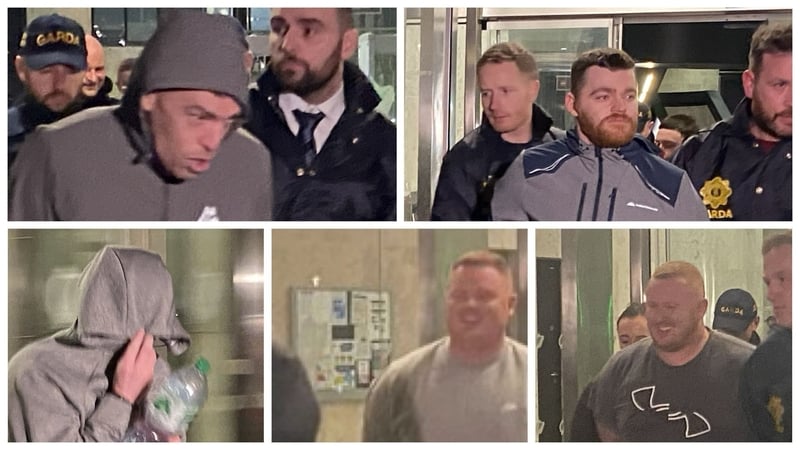
Five members of the Hennessy Organised Crime Group were jailed this week. Paul Reynolds, RTÉ's Crime Correspondent, profiles the group.
Hosts & Guests
Transcript
Welcome back. Five members of a West Dublin family-based organized crime group known as
the Hennesses were jails this week at the special Criminal Court for their roles in a sustained
and violent assaults last year. During the attack the victim was beaten, repeatedly branded
with a burning catalar and bearing the word rat, had his arm broken with a steel bar and
was driven over with an e-bike. More serious charges had originally been brought, but
were not pursued after the victim Barry Moore declined to give evidence saying he was afraid.
Jason Kennedy, one of those convicted, featured briefly in a 2020 Virgin Media documentary The
Guards Inside the K, which included footage of an altercation with the garter, much of it
too explicit to broadcast.
And that was Jason Hennessy. We're joined now by a crime correspondent Paul Reynolds.
Paul, who are the Hennesses?
Well, as is clear from that clip, the members of the Hennessy organized crime gang are volatile,
violent and extremely dangerous criminals. In organized crime, there are a number of tears
and wild gangs like the Kinhen organized crime group are transnational at the very top level,
dealing directly with South American drug cartels, gun suppliers, and high-finance money
launders. They also need street gangs to distribute and sell their cocaine, cannabis, and heroin,
and that's where street gangs like the Hennesses come in. The Hennessy gang is rooted in family
and based in West Dublin. Its members live in the communities they operate in, the greater
Blanchard's town area. They are violent and dangerous and have been known and feared for years
for their erratic and extreme levels of violence as is evidenced by this case. People in Sheep Hill,
Cardolph, Blake's town, the communities in Castelcora are terrified of them. The Hennesses
have been operating out of their fortified home in Sheep Hill Avenue for years. It has
steel gates, bulletproof windows, and a shed with living space at the back. They also kept
dangerous dogs there, exiled bully dogs until the new legislation was brought in, which allowed
the gargity to seize them. The three Hennessy brothers Jason, Devon, and Brandon are
recidivist criminals. At 30, Devon is the eldest. He has 37 previous convictions from numerous
offenses, including assault causing harm and violent disorder. Jason, who is a year younger,
has 26 previous convictions. Also for assault and violent disorder. While 24-year-old Brandon
is a convicted drug dealer, having been caught last year, with 32,000-year-old worth of cocaine,
he has five convictions, including for violent disorder. In relation to the Fitzymons,
who are also part of the gang, 26-year-old Dean has 42 previous convictions. He's known as an
enforcer. He has convictions for firearms offenses, while his father, 46-year-old Kenneth Fitzymons,
has 17 previous convictions, and he's also has convictions for gun crime. The gang was headed
up by the Hennessy brothers' father, the late Jason Hennessy senior. He was the patriarchal figure
who recruited young men into street-level drug dealing and violence, particularly children who
were impressionable, vulnerable, who had dissociated themselves from the education system,
and had moved away from their families. Some of these young men were convicted in relation to the
attack, the murder of both Jason Hennessy senior and Tristan Sherry, the gunman in that case.
There were at least five young people, or seven young people should I say, convicted in relation
to those murders. Some of them referred to Jason Hennessy senior as my dad or daddy-jay,
such was his influence on them. But if that's the history of the Hennessy's, can you tell us
about the case that was before the special criminal court? Yeah, it's effectively the torture of a
man called Barry Moore. Barry Moore was a friend of the Hennessy's, or at least he thought he was.
He called him to their home at a quarter past six on the 12th of February, 2025, to buy a
tracksuit. It all started off very relaxed and convivial and friendly until suddenly it wasn't.
He was showing them a photo on his phone when Jason Hennessy smashed the phone out of his hand
and punched him in the jaw. Devon then jumped up and started punching him in the head. Jason hit him
again. Kenneth Fitzsimons hit him with a breaker bar, a five feet of solid steel, seven or eight times
on the legs before breaking his right arm. The problem was the Hennessy's believed that Barry
Moore was giving information about them to arrive a organized crime gang that they'd been feuding
with, which had led to the murder of their father. Jason Hennessy believed someone had previously
set him up to be attacked at a cost of coffee shop and it convinced himself, his brothers and
Fitzsimons that Barry Moore was either behind it or had something to do with it. Now Brad and
Hennessy also claimed that he had given Barry Moore false information in relation to the upstairs
back windows of their home and the saying that they were not bulletproof, which he claimed more
had leaked to rival gangsters and Moore repeatedly told the gang members that they knew nothing
about it, but nothing he would say would convince them otherwise. So in their den, at the back of
their home on Cheap Hell Avenue, at that day last year, they tortured him for an hour. This
included Brandon Hennessy hitting him with a steel bar, threatening to rape him with a stick,
Dean Fitzsimons driving over him on an e-bike, threatening to cut his ears off with a standing knife
and waterboarding him with a towel and a bucket of water till he thought he was going to drown.
And Jason Hennessy branding him with especially made cattle branding iron with the letters R-A-T
on his back, on his stomach and on his face. Each of the letters R-A-T was thick and deep
and measured 4 centimeters. It left the 34-year-old disfigured. The details you just listed there are
shocking. And as I mentioned in the introduction, more serious charges had originally been brought,
but were not pursued. Why is this? Well, effectively, we don't know. We know that the Guaradi managed
to get Barry Moore to make a statement telling them all that happened. They also raided the Hennessy's
compound, retrieved CCTV, forensic evidence and the branding iron. They built a case, they arrested
and charged the five gang members with assault causing serious harm, organized crime offences,
and false imprisonment. These are charges that could have led to the men spending life in prison.
However, by then, Barry Moore's family and children had already been threatened and he was
terrified. And more than disappeared, he didn't turn up when the case was brought to court for the
first time for the first two hearings in November of last year. The start of the trial had to be
postponed. The Guaradi opened lines of communications with him, but he still wouldn't come to court.
A warrant had to be issued for his arrest to get him to the special criminal court.
In the words of the senior investigating officer in the case, Detective Inspector Liam Dunhu,
Barry Moore was, quote, gripped with fear. Criminal elements, quote, had been attempting to
interfere with the case and were issuing threats. Moore had to be remanded in custody, but even when
he was brought into the special criminal court, he refused to testify. He apologized to the three
judges, but he told them he wasn't giving any evidence in the trial ever. And finished with it,
he told them he remained in his seat, looking at the ground with his head in his left hand.
Now, the court was also told that day that the director of public prosecutions believed at that
stage that the evidence in the case would support Moore's account of what happened to him,
and that his statements to Guaradi should be admitted as evidence in the trial without him having
to take the stand. Now, this would probably have to have gone to legal argument. This was Saturday,
the 6th of December last year. The court had sat, especially on a Saturday for this case.
It adjourned until Monday, the 8th of December. When the case was called two days later,
the situation had completely changed. A deal had been done. Devon Hennessy wasn't involved because
he had already pleaded guilty to the more serious charges. However, the other four had held out.
And we're smiling in the dock that day when the case was called. Jason and Brandon Hennessy
and Kenneth and Dean Fitzsimons had agreed to pleaded guilty to the lesser charge of assault
causing harm. Not serious harm, assault causing harm. That carries a maximum of 10 years in prison.
All five men were sentenced this week to terms of between three and eight and a half years in prison.
They'll automatically get prison remission, which is a quarter. They've already spent a year in prison.
It means the longest Jason Hennessy will be out in five years, while Devon Hennessy should be out
later this year or next year at the latest. Given what you just said, Paul, what questions
does this case raise for the prosecution of organized crime cases even when they're before the
special criminal court? Well, we've been speaking to a number of guardians and people in the community
in relation to this case who are terrified at the prospect of the Hennessy coming back out to West
Dublin. I mean, first of all, why were the four men allowed pleaded guilty to assault causing harm
when it was clear from the facts of the case that the crimes they had committed had caused serious
harm, lifelong injuries, disfigurement, and severe mental trauma to Barry Moore?
Why did the state not proceed with the prosecution on the more serious charges?
Declare Barry Moore, a hostile witness, put his statement into evidence without him having
to take the stand and corroborated with the medical forensic CCTV and other evidence.
Situations like this were supposed to have been catered for in law following the murder
of the by the IRA of Detective Garda Jerry McCabe in Limerick in 1996. People might remember
that the farmer in this in that case who was a witness was brought to the special criminal court.
He refused to testify because he was terrified and the charges against the four
IRA men of murder were reduced to manslaughter. Individual Garda in this case,
they won't say it publicly, but they're extremely frustrated by the DPP's decision to allow
such violent and dangerous criminals as the Hennessy's to plead to lesser sentences and get
lighter sentences. I mean, Garda, who investigate organized crime say that people like the Hennessy's
with them, you don't get too many chances and this was a chance to put them away for a very long
time. There's also the question of what a decision like this says to the communities who live in
fear of organized crime gangs like the Hennessy's. On the one hand, the Garda say they appeal for
information. They ask people to come forward. The state says it will protect people who do come
forward. But what message does this send to communities, people who want to come forward?
And indeed, what message does Garda say does it send to criminals themselves? There's no doubt
that other violent criminals, other organized crime groups, will take note of this and believe
that violence, threats and intimidation work, even where they're not supposed to work in the special
criminal court. Now, already put these questions to the Minister for Justice, the Garda Commissioner
and the Director of Public Prosecutions, who made the decision to substitute the charges the
five Hennessy gang members had faced with the less serious one. Both the Minister for Justice and
the Garda Commissioner have said that they can't comment on the Director of Public Prosecutions'
decision. They point out that the DPP is totally independent. Garda Headquarters also said it's
cognizant of the statutory period in which a court outcome may appeal. The Office of Director
of Public Prosecution says it does not comment on individual cases, either during or after a case
has concluded. It says, quote, the Director will not be in a position to participate in an interview
or issue any statement in relation to this case. Ortiz Crime correspondent Paul Reynolds