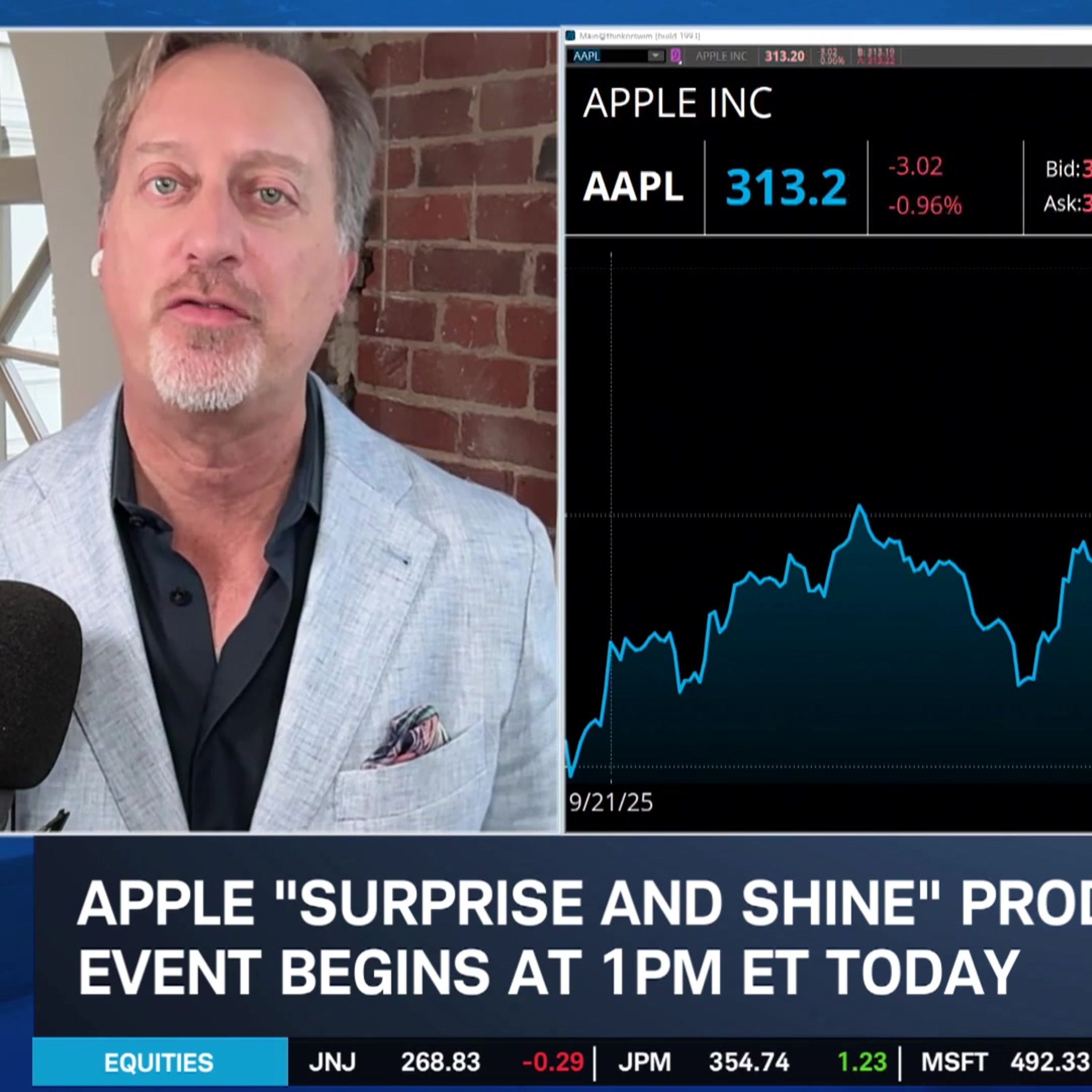
About this episode
Cory Johnson draws a line from increasing component costs at Taiwan Semiconductor (TSM) to Apple's (AAPL) expected $2,000-plus price point for its new foldable phone. He also links Apple's historical financial struggles to current tech giants' emphasis on high-profit margins and substantial cash reserves now fueling massive AI investments.
======== Schwab Network ========
Empowering every investor and trader, every market day.
Subscribe to the Market Minute newsletter - https://schwabnetwork.com/subscribe
Download the iOS app - https://apps.apple.com/us/app/schwab-network/id1460719185
Download the Amazon Fire Tv App - https://www.amazon.com/TD-Ameritrade-Network/dp/B07KRD76C7
Watch on Sling - https://watch.sling.com/1/asset/191928615bd8d47686f94682aefaa007/watch
Watch on Vizio - https://www.vizio.com/en/watchfreeplus-explore
Watch on DistroTV - https://www.distro.tv/live/schwab-network/
Follow us on X – https://twitter.com/schwabnetwork
Follow us on Facebook – https://www.facebook.com/schwabnetwork
Follow us on LinkedIn - https://www.linkedin.com/company/schwab-network/
About Schwab Network - https://schwabnetwork.com/about
Get every episode summarized
Each time Schwab Network publishes, we email you a written briefing from the transcript — the topics, who appeared, and any specific claims, with the ad reads skipped.
Email me new episodesFree for 3 shows. No card needed.
Transcript ready
90 searchable segments. Every word is indexed and playable.
Full transcript
Schwab Network — From TSM Component Costs to a $2,000-Plus Foldable iPhone. Machine-transcribed; use the interactive transcript above to jump the player to any line.
joining us now, Cory Johnson, chief market strategist at a Pisterphe capital research. Cory always great to talk to you. I was just talking to Don Kaufman and the big three. He had Apple as his last choice. I saw. And he just cannot wrap his head around this $2200 potentially foldable phone. Do you think that is going to be a pervasive sentiment if we do get this foldable phone and it does in fact have that $2000 plus dollar price tag? I think he's cheap. I mean, I don't know him. He seems a nice guy, but he seems cheap to me. Look, inflation is a real thing and we're seeing in the pricing of these Apple products. Yesterday was probably your last chance to get iPhones at a cheaper price than they're going to be today and going forward. It reflects a lot of things. It certainly reflects a lot of things going on in the economy. We talk about the broader market issues and what the Federal Reserve is going to do when we talk about interest rates and the measurement of housing and consumer price index. Look, iPhones matter a lot and iPhones sell a lot and they're a key component in the pricing
of what goes on with inflation. And indeed, the things that have been driving the market and GDP are not consumer electronics. It is technology. It is AI. But the AI memory prices, the driving up of memory prices, the capacity suck that is happening at Taiwan. So, making it into other places is causing Apple to have to raise their prices because their components are getting more expensive. And you see that reflected in the prices we're going to see today from the announcements down at Cupertino. And Quarer, you did a very thorough breakdown as you always do of all of the components that could potentially go in to this new phone. Of course, you just said TSMC there. They made every Apple Silicon design for the last decade. The expectation here is that that's going to be a part of this foldable phone. So, are you looking at that as sort of the least important discussion point because it's already a known entity? And if so, what should we talk about in terms of the components and what matters most here? So, I think look, this phone's going to be super
cool. I expect the foldable phones are a really neat thing as your guests were talking about earlier while Andrews had these things for a while. In the US, we are more of an iPhone market in terms of percentage of market share for smartphones than an Android market. And so, for a lot of people, this is going to be the first experience of seeing these foldable phones. And they're very impressive devices. It's nice to be able to see so much more information when you're looking at information. I'm a friend who's a district attorney who loved to be able to review files on the phone in his pocket. So, these things start to matter a lot for people who have those use cases and have some of it look cool as good. We expect that Apple is going to ship 78 million of these phones in this year. But, you know, it's a lot of the components outside of the phone in the hinge will be similar to the other iPhones out there. I think you expect the antennas are going to be the same as you mentioned. We expect Taiwan's semiconductor is going to be making the same CPU inside of these phones as we've had in the other iPhones. And that allows Apple to benefit
from the economies of scale that those devices get. We also think that Foxconn is doing the assembly hot high precision as the official name of the company. And so, a lot of the same supply chain aspects involved here. But, of course, what we know from Apple, there's a terrific book, I strongly recommend called Apple in China that talks a lot about how the supply chain works for Apple, how they really beat up suppliers to get better and better at the things that they do. So, as cool as this first hinge phone might be, this first foldable phone might be there's probably a lot more down the line. And I expect this is going to be a very successful product for them. Does it all hinge on the hinge? I mean, part of it. I see what you think. I'm looking at it. I think foldable phone, I think back to when they replaced the glass screen and everyone started dropping it. It was breaking and that was a problem. You would think that with the hinge in a foldable phone, the problem may be that people are breaking the hinge. So, how do they choose the right supplier? How do they scale at such an
overwhelming size when hinges are one of the things, at least based on your research and the little bit that I did before our conversation, seem to be a difficult material to produce at scale. Yeah, and I think that's why this has taken so long for them. We've heard rumors, Mark Germain at Bloomberg has done such great reporting on this and he's been talking with these foldable phones for years. And I think that that has been the delay and we can only surmise, but that's the toughest component to make in these things and they're being held to a high standard. They're also going to be held to a different standard now because they've got a new CEO. And I'm not saying the Tim Coke could screw up or would screw up, but he probably had built up enough good will that if there was an issue with a major issue with a device, it wouldn't be seen as a reflection on his leadership. Whereas John Ternis probably can't be blamed for anything that he's announcing today, because it was all in a works for a long time. And yet if there is a problem with this phone, it's going to sit in his shoulders with a different weight than it might have for Tim Cook or for that matter for Steve Jobs. And so Corey, how much pricing power does Apple really have here?
I mean, we've got memory costs higher. We've got a TSMC under significant constraints. We've got more parts than we're usually working with the hinge and the glass is different here. With the significant premium of the proposed $2,000 plus dollar price tag, is that enough to offset the higher component and manufacturing costs associated with this phone? We expect this will be a very positive gross margin of operating margin device. As just about everything coming out of Apple is they're not competing on price here and they haven't really for decades. You know, there's been so much documentation and I've lived through so much of Apple's history, but there was a time when Apple tried to compete on price. There was a time when Apple was going up against IBM and computers and and try and compact and the like and trying to come out with products that were competitive on a price basis and it nearly cost the company, the company. The company was nearly bankrupt when Steve Jobs returned to run this company what 25, 30 years ago. And I think that that left it left a permanent impact not just in Apple,
but I think on all Silicon Valley and you see it playing out today with the spending on AI. Let me connect those tots for you. Apple was nearly gone. Apple was nearly broke. Apple was a company that so many people looked up to and yet it almost didn't make it because it ran out of cash. And so you saw the subsequent tech giants of Apple, of Google and many others run up big cash balances, not use debt as other companies would throughout the economy and and insist on profit margins both gross margins and operating margins so that they would last and be here for the long haul. So I don't think Apple would even consider launching a product without both the demand and the profit margin built into that in order to be successful and to stay around for a long time. And so that was as connected to AI and AI build out. Companies had so much cash in their books and were creating so much free cash flow whether it was Amazon or or Google and even even Meta and Facebook. All those companies filled with some executives who had worked at Apple in the past.
I think they wanted to build up that cash. They had that cash. They had that cash available to invest in in AI so that now when they add on just a little bit of borrowing, it's a big change and gives them a lot of power and that all goes back to the cash struggles of Apple I think from 30 years ago. Well, we'll see here in just a little over an hour what these new products are. If perhaps there's some other surprise we don't know about but it will be an interesting day for John Turner's for sure. Corey really appreciate you sharing your research with us and bringing it down for us. Corey Johnson Chief Market Strategist at Epistrophy Capital Research.
More episodes
More from Schwab Network

Stock Market Today: ORCL & ADBE Earnings, AEO Plunges Near 52-Week Low
Schwab Network

Thursday's Final Takeaways: Crude Taps $103 & PPI Hotter than Expected
Schwab Network

Balancing High-Conviction AI With High-Dividend Diversification
Schwab Network

EARNINGS PANEL: ORCL, ADBE
Schwab Network