Loading...
About this Episode
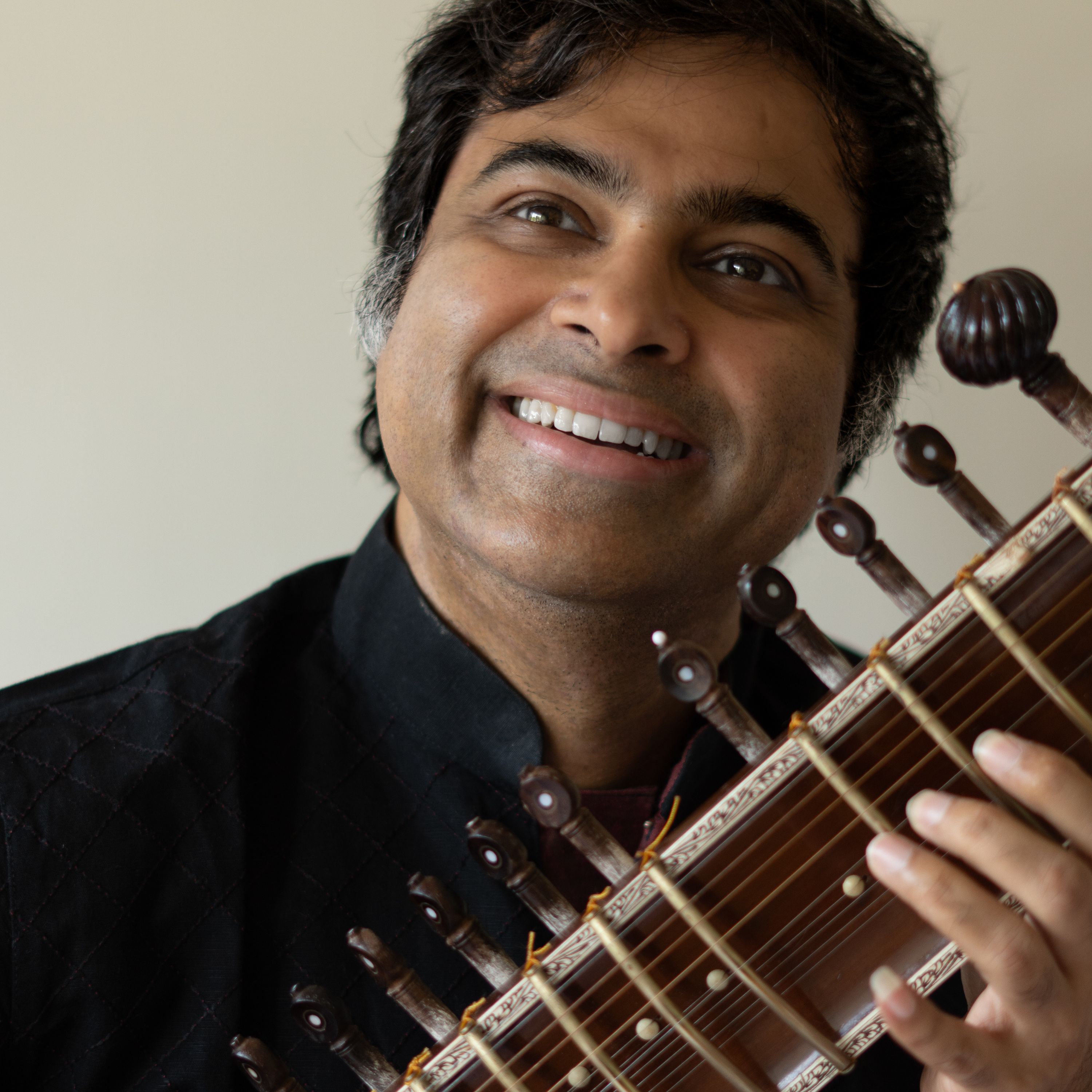
Indian sitar master Purbayan Chatterjee performed at this month's Get Lit with All Of It event with author Megha Majumdar. This month's book selection, A Guardian and a Thief, takes place in Kolkata, a city for which Chatterjee wrote an anthem.
Photo courtesy of the artist
Hosts & Guests
Transcript
All of it is supported by progressive insurance.
You chose to hit play on this podcast today.
Smart Choice.
Make another smart choice with auto-quote explorer
to compare rates for multiple car insurance companies
all at once.
Try it at progressive.com.
Progressive casualty insurance company
and affiliates, not available in all states or situations.
Price is very based on how you buy.
With the Venmo debit card at $1.1,
an ordering a ride in the other means you're
stacking your rewards.
Nice.
Get up to 5% cash back with Venmo stash
on your favorite brands when you pay with your Venmo debit card.
From take-out to ride cheers, entertainment, and more.
Pick a bundle with your go-to's and start earning cash back
at those brands.
Venmo stash bundles terms and exclusions apply.
Seatsherms at Venmo.me slash stash terms.
Max $100 cash back from mom.
Few things are as uplifting as the greatest moments in sports.
And nothing brings us together quite like Team USA
at the Olympic Winter Games.
From NBC Universal's iconic storytelling
to the innovative technology across Xfinity and Peacock,
Comcast brings the Olympic Games home to America,
sharing every moment with millions.
When Team USA steps onto the world stage,
we're not just watching.
We're cheering together.
This winter, we're all on the same team.
Comcast, proud partner of Team USA.
You're listening to all of it on WNYC?
I'm Allison Stewart.
Our March Get Lit with all of it,
Book Club Selection was the novel,
A Guardian and a Thief by Mega Majemdar.
The story takes place in a future version of Kolkata India
that has been utterly transformed by climate change.
So we were thrilled that for our Get Lit event,
we were joined by a musical guest
who also calls Kolkata his hometown.
Prabayan Chatterjee is a virtuosic guitar player,
whose work combines Indian classical music
with global genre fusion.
He is played with Bella Fleck, Herbie Hancock,
and the late Zakir Hussein.
He actually changed his flight from India
in order to join us for our event.
You'll hear my conversation with Prabayan in just a moment,
but first, here he is with a special performance
alongside top-of-player Vivek Bhandia.
The
That was extraordinary.
What was the name of that song?
So this is Aragha, which is called Aragha Yaman,
And then we have various varieties of it,
and this was actually called Yamann Kalyan.
It almost sounded like, can I say that you were shredding your sitar?
Yes, you're love to sit down.
I read in an interview that you said you watched guitar players,
and it changed the way you thought about how you could play the sitar.
Could you explain that a little bit?
Yes, lots of guitar players.
Actually, I had the good fortune of...
And that's how it all started, you know, my foray into jazz music,
or into other forms of music.
I had the good fortune of hanging out and meeting Pat Matini here in New York.
Yeah, in his home studio.
And he played my sitar, and I played his guitar.
And that's how it all started.
It's interesting when you think about sort of...
You play Indian classical music,
but you have broadened out into this global genre of jazz
and different kinds of music.
When did your interest in jazz really start?
So, I think early 2000s is when I started listening to a lot of,
you know, Miles Davis, Ornette Coleman, all of that.
And then onwards to this meeting with Pat Matini was in 2009.
And I think...
And then I subsequently met people like Czech Korea, Bela Flek.
And onwards to Snarky Puppy, and I got a chance to play with them very recently.
And they became great friends of mine.
What's challenging about combining traditional music with contemporary music?
Well, I think, you know, if you forget the tradition and what is contemporary,
I think you first need to look at musical language and genre.
And every kind of musical culture has its own language and own building blocks.
In our case, it's the Raga.
It's more or less modal in nature.
And when you try to connect with any Western form of music,
then there's a whole world of harmony out there.
But when I started to kind of look at trying to bridge the gap,
I first started learning some of the other traditions of the world.
And I think I've come to a point where now I think,
you know, because the word tradition is just so relative.
And I'm quoting the great Ustad Zakhir Hussein and he said,
tradition is a point in time to which we feel like we are tethered,
but it's also a moving point because we redefine tradition at several points.
So I try to kind of keep in mind when I compose
or when I write for an album.
I try to keep in mind the language that I've been taught,
but I also try to keep in mind a language that will be relevant
to larger numbers of people.
How long have you been playing this guitar?
I started when I was five years old, very long time ago.
You were a prodigy growing up.
When did it become clear to you that music was going to be your career?
So incidentally, I grew up in the same city as Megha, as, you know, in Kolkata.
And I started learning music at the age of three, vocal music,
and then the sitar at the age of five.
And I went to a school which is called the Calcutta Boy School.
And I fought hard with my mom.
You know, I always thought that I could do this and I could make a living.
And I think she had her doubts about it.
I got a lot of support from my dad, though, because he was, you know, he was my guru
and he is my guru and, you know, he's a musician himself.
I think when I, in my first year of college,
I went to this college called Presidency College,
in my first year of college when I was hanging out with my peers
and my, you know, college mates.
I found this calling increasingly within me
where I kind of decided that it was either going to be this or nothing else.
As you said, you're from Kolkata.
And you were involved with making a song for the city, is that true?
I was and I haven't published it yet.
Oh, not yet.
You know, funnily enough, I wrote that song, finished the production.
I got some 32 different artists, some of whom are no more.
And then as I finished mixing and mastering that song,
I moved from Kolkata to Mumbai.
So I guess I was a little ashamed to publish a song at the back point.
I understand you have a new album.
There's going to be coming out.
What can you, it's not out yet, but what can you tell us about it?
This is very exciting for me because I've worked with Mark Latiri,
who is part of the Snarky Puppy Band.
And we've created this album, which is a potpourri of Raga music,
of funk jazz, which is what Mark does,
and a lot of modern electronics.
So I can just say that this album has a lot of tradition
and a lot of what's considered contemporary.
It's interesting.
What do you think people can learn about the way you make music,
the way you break down between genres?
What can people learn about human behavior that way?
I think human behavior...
What do we deal with one another?
Yeah, I mean, it's so different yet so similar in my travels across the world.
I've seen that.
I think the fundamentals are the same across cultures,
across different countries in the globe.
It's only the specifics which differ.
There are protocol, which there's protocol, which changes,
and there's maybe language, and there's culture.
I think as you interact with larger number of people
from larger number of cultures,
you begin to learn more about yourself.
And that's what goes into writing a book or writing a piece of music.
It's all the same.
I think you get better at it as you learn more about yourself.
You're going to be at the Big Year's Music Festival in Tennessee on March 28th.
What are you looking forward to about that gig?
I've heard a lot about this festival and I think I'm going to be reaching out to an audience
which is probably relatively uninitiated to Indian classical music.
So I want to be able to spread the word.
Every time I perform for a new audience,
I want to tell people how much fun Indian music is
because people are always talking about how spiritual and how serenity is,
which it is, but it's also a lot of fun.
What are you going to play for us the next song?
What are you going to hear?
So I've thought about this raga called Mishra Pahadi,
which has got a folk undertones to it.
And this is something that I have written for another album
which I'm going to publish in the next couple of years, once this one's out.
And it's called Mishra Pahadi.
It's in a 6-8 rhythmic cycle.
Music
Music
Music
Music
Music
Music
Music
Music
Music
Music
Music
Music
.
.
.
.
.
.
.
.
.
.
.
.


