Loading...
newspolitics
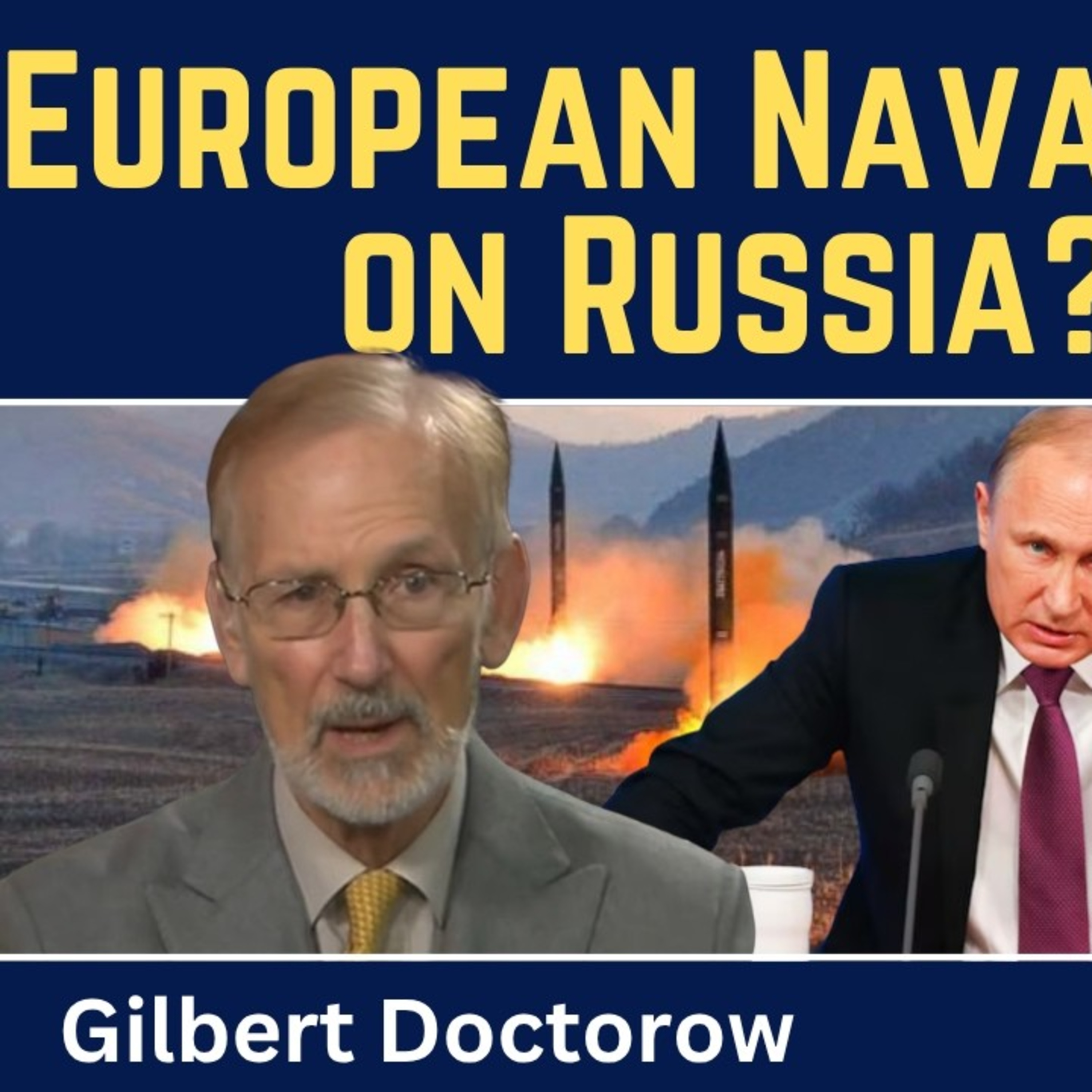
Gilbert Doctorow: European Naval Blockade on Russia? Europe-Russia War Coming
About this Episode
Dr. Gilbert Doctorow discusses how European leaders are sleepwalking into a war with Russia.Follow Prof. Glenn Diesen: Substack: https://glenndiesen.substack.com/ X/Twitter: https://x.com/Glenn_DiesenPatreon: https://www.patreon.com/glenndiesen Support the research by Prof. Glenn Diesen: PayPal: https://www.paypal.com/paypalme/glenndiesenBuy me a Coffee: buymeacoffee.com/gdiesengGo Fund Me: https://gofund.me/09ea012fBooks by Prof. Glenn Diesen: https://www.amazon.com/stores/author/B09FPQ4MDL
Hosts & Guests

Transcript
Welcome back, we are joined by Gilbert Doktorov, historian and international affairs analyst.
Thank you for coming back on the program. It's been a while.
Thank you.
So you recently published volume two of your war diaries.
This is, as I understand, I haven't gotten to read it the whole thing, but this is largely about the period when
the Russia Ukraine war evidently switched from being simply a war between Ukraine and Russia to becoming more obvious European Russian proxy war.
I was wondering if you could say something about your new book and that period.
Well, I'll use the plural here because volume three, 2025 will probably come out between six and eight weeks from now, depending on the speed of the production company in our zone with us doing the layout.
From 2024 was, as you say, and as I described in the book, was a period of transition from an SMO, especially most evaporation concept to a war with the West collective West, not just with Europe, but with the United States.
And with a new nuclear doctrine by Russia, which came out of late November of 2024, which was the culmination of warnings to the West that have started to exert use March and April of that year.
As a result of the action on the ground, as a result, particularly of the new threats to Russian security coming from Europe and also from the United States in the form of long range missiles, which were being put up by other Germans, already medium, well, let's say 300 kilometer range missiles.
I've been supplied by the British and the French under a, well, it's a common missile scalpen in French.
And because of the shadow of the, I forget exactly what it was, it was the British storm shadow.
These have been supplied and had been more or less neutralized by the Russians, they learned how to handle them.
But longer range missiles were an offer from the United States and from Germany, particularly.
It is towerous missile.
And as early as March of 2024, when there was intercepted and published by the Russians at the conversations between top level, Air Force people in Germany, discussing how they could get around the chance to show its prohibition on supplying such weapons to Ukraine.
And that conversation with intent to use the towers missile destroy the carriage bridge, which was the iconic achievement of engineering, putting a bringing together the mainland of Russia and the Crimea peninsula.
So that was a scandalous and it tipped off a wave of, of rethinking in Russia over what their security threats were.
And that ultimately in the revised nuclear strategy, which came out in November, it was all put together pieces which came out from March through September when, and cousin Puchin had a very important interview with paddles that Rubin was on the streets of Petersburg.
Just off of the college square air principles were set out piece by piece and all calm related in a nuclear drought, doctrine, which seriously lowered the threshold for Russian use of nuclear weapons against those who were equipping or equipping Ukraine with long range weapons, long range missiles and the sources of production.
So that was a very, and also the whole notion of what the nuclear threat was or the strategic threat to Russia changed from having been based for decades on ICBMs, intercontinental ballistic missiles, which were the key issue in the in a soft treaty of the strategic arms limitation treaties.
Now the Russians saw as the biggest strategic threats in themselves, medium range missiles that that the United States had already agreed on the Biden to place in Germany during this currency or in time in 2027.
So they were, they adopted there or read the, they, they re advised their strategic doctrines around this new reality.
So that was the, that is why I see is the key point, which makes the, a lot of describing 2026, sorry, 2025 different from the preceding volume one, which was 2223.
Also, of course, my own life changed during 24 when I was started doing almost daily interviews, the Indians were the first to bring me into that very frequent.
So I saw a few of breaking news, and which compelled me to get my mind around issues, which otherwise I might have ignored from week to week.
That was the case in my volume one, there were breaches, there were, there were periods, which I was not covering in a daily or even weekly sense, which in 2024 I was necessarily because I was being invited to, as I say, get my mind around some, some, some issues.
Before the general news came out of the West because I was dealing with a broadcast to, who had access to, to what was being said or stated before it reached the general public.
And I also, in that volume two, putting a lot of references, a lot of links to many of these interviews is good. I didn't burden too much with, with the transcripts because I don't know the whole volume but balloon it out.
But a few I did give just so people have a taste for what these discussions like the one we're having now are like, and I quote them discussions rather than interviews because in this case, and one or two other cases, the invite the holder of the platform zero engages in a discussion.
So this is the, the feature of volume two volume three will be different from the one one by only I work, go on about it, but about 19, it's our 2025 was the year Trump.
And the whole attention, the whole nature of what I was covering change from what's going on in the battlefield, how has been evaluated by other commentators to how we evaluate the course negotiations.
Are they real substantial, are they just.
Hard air, so that those issues became the driving force of all commentary 2025, so there you have it.
Well, if you forward two years on to 2026, we see now that the involvement of NATO countries in this war is well, it's very overt now if we look at this whole process over the past four plus years as being.
This incrementalism or salami tactics, now we see it being quite blatant, for example, yesterday we saw NATO surveillance drones monitoring Russia's Black Sea coast, and then this morning very predictably the strikes are coming in.
We also see similar these attacks that is attacks on the Baltic Sea coast in Russia around St Petersburg.
This is also seems very likely or one could say even more with greater certainty, almost certainly an attack coming out of the Baltic states.
I mean, this is how long do you think this can go on because from what I understand the pressure is building up in the Kremlin not to simply allow this kind of escalation control on the side of the Europeans that they can simply launch attacks on Russia and pretend it's Ukraine and Russia can't do anything in return.
Well, we spend a lot of time these days talking about Mr. Trump and about midterm elections and how his handling of the looks for a for an off ramp to the war on Iran that he and Israel launched how that is modified according to the political calculus of the November elections.
Strangely, we don't apply the same kind of logic or analytic approach to Mr Putin, we behave as we deal with him as if well he is the whole of Russia that's been going on for two decades.
There's only one man whom you want to listen to in Russia and that is Mr. Putin.
And we don't consider him as living in a democratic country, which actually is there are kinds of deformations in democracy as we as I know when the big neighbor to my west in France, where the president is an effect of King, but we don't we only talk about occasionally here in in Russia.
Yes, Mr. Mr. Putin is a political animal and he also has elections by the way, not his personal presidential election, but he has like Mr. like Mr. Trump, he faces parliamentary elections and in the case of Russia, they have to take place before the 26th of September.
And so there is it's not just you and me and the western observers who we mark on these dramatic and destructive attacks on Russian refineries and other critical infrastructure, which are enabled by the not by the United States and European intelligence on a daily basis, providing the targeting information necessary.
Not where the target is located, that's pretty obvious, but how you get to it, because these drones all they don't fly it at several kilometers, they fly just at very low levels and they can smash into electric power lines and all kinds of obstacles on the way if they are properly gutted.
So that critical information is provided from the west. No, the Russians, a lot of Russians are enraged by this. And while I agree completely with peers who are saying, oh, look up up to the Putin leaders within seven, it is now 70% rating down from 80, but that really doesn't make much difference.
But they're not talking about the party politics version, they're not talking about the collapse of support for United Russia, which was traditionally going back decades, 30% of the electorate versus about 20% of 18% of the electorate for communist party and maybe 12% of the electorate had didn't for Geronovsky's part of the of the ultra right.
Now, they've dropped from 30% to 20%, which means, I mean, to my understanding, they're very close neck and neck with the communists. And from 20%, it's pretty hard to stretch yourself over to 51%, even if you're playing electoral games with how you, how you designate the winners in electoral districts by the party party lists or by candidate names.
The elections in September are not a foregone conclusion to a backing of Mr. Putin's policies on the contrary, they will be highly contested and will see who wins.
So I say we have to apply to Russia the same analytic techniques that we usually examine what's going on in France or what's going on in the States.
But for some strange reason, those of us who all admire Mr. Putin's Russia refuse to recognize the democracy.
It's how do you think though, if essentially this pressure builds up so much that Russia has to find a way of responding, how do you think this could.
I guess manifest itself because I've heard talks now about Russia invading the Baltic States. This seems very unlikely. I'm not sure what they would exactly do there. It seems more likely that Russia might be moving towards something similar, what the Europeans are doing.
This kind of strikes on Russia with the plausible deniability, but of course the Russians don't have a proxy state to attack from.
So how do you think the Russians might approach this if they decide to step over this line and begin to attack in a way that they know where the attack comes from, but again, plausible deniability.
I don't see a reason for plausible deniability. What they would be counter-attacting is by every international measure, it causes belly.
When the Estonians and the Latvians and Lithuanians permit Ukrainian drones to fly over their territory and attack the Russian Baltic ports, you've got to warn over that.
So I don't see why they have to look for a proxy or an excuse. If they want to be a world power, which they want to be, but not a global power in a sense of being able to project their military might around the globe, but at least in their region, at least in Eurasia, then there is no reason to be apologetic.
In fact, this is a demand that you've just assert your rights. As you and I have discussed, and as you as a theoretician in this domain of deterrence have made very clear, are you using it very elusive?
And there are many people, and the start of course the bad boy of Russian geopolitical thinking is Sergei Karaganov, and going back to when he half years he made a very plain that Russia has to do something.
And he just he's expanded on that. There's much recent published statements, but all the ways at the cutting edge that Russia cannot just take this trespassing on his red lines, idly or job on about it or responded with ways that are other inadequate to the level of damage has been done to them.
And so, uh, invade the politics, why? No reason whatsoever. Nothing to be gained and a lot to be lost. Just attack the military assets in the politics, including by the way, the German military outpost, I think it's in Lithuania.
Um, I've got several, several thousand people there.
Blow them up. That'll be a good signal. And it's completely within international law. Now, if you want to say, well, this is a path to world war three, I fall back on, um, on a colleague in a, in a very small minority of, of commentators and that it is Paul Craig Roberts, who's been saying, but saying, at least to you before I've, I joined part of his argumentation that this type of,
um, turning get a cheek is, uh, is leading us in exactly the opposite direction, but you would think prudence takes you. It is leading us to, uh, other, uh, by the violent and overthrow of the existing powers that be within the Kremlin, and a violent, uh, violent counterstrike, uh, that, uh, could really be world war three.
Or Mr. Putin himself, uh, follows the, the advice of everyone around him now, or of many people around him now, and, um, doesn't just job on, could actually uses military action against native countries in a very selective and legally justified way.
Well, I think that's a good point. People often view this, um, the retaliation as being dangerous because it does push us towards world war three, which I guess isn't wrong, but it's also that dilemma, the failure to uphold once the turns. I mean, I, when I listen to the media and the politicians across Europe, the, the, the logic is somehow that, well, if anyone thinks that Russia has any right to retaliate and, you know, then they're spreading Russia.
Propaganda, but this is a very dangerous self delusion. This idea that we can continue to attack Russia and somehow they would never respond. I mean, this kind of rejecting that Russia should have any, uh, the turns. It's, uh, it's taking us down this very strange path. And I'm glad you mentioned Germany, because this seemed to be to a large extent at the forefront of this new strange mentality where, uh, well, essentially it's a social, the more.
The reality is a social construction in which, you know, if we say that Russia has the right to retaliate, then it has. So as long as we all pretend that, uh, this is a completely legitimate, we're just helping Ukraine. There's no reason to be concerned about the Russian retaliation. I mean, it's, it's good for deluding our own public, but we're not deluding the Russians. They, they know what's happening.
So how do you say German, Germany playing into this because, you know, Chancellor Blackrock, Merz, he continued to plummet in the polls, of course, but, but the policies nonetheless continue as to do across Europe. That is, you know, Merz has this dream about building the largest military in Europe is quite open about the desire to escalate the war against Russia. He overseas is the industrializing economy.
He wants to purge the political opposition us, you know, said he plummets. Uh, where do you think that this is heading for the Germans?
Well, and Russian folk wishes to have this image of a couple in the bed, and each one is trying to pull blanket over itself. Now, actually there are three people this bed in each of these three or three groups that are trying to pull back blanket to themselves and leave the others exposed.
Mr. Chancellor, Merz as is, as you say, is laying claim to being the military leader of Europe, based on the industrial military industrial potential journey.
Uh, and this population, of course, where they was 85 million, I lost track, um, million people, which is one of the most popular countries in Europe.
And of course, the, the best manufacturing industry to China's more or less destroy the German auto industry.
And he is making claims at the same time his lane claims is working against another German, uh, with this party up to putting to position as the president of the European Commission from the lane.
And he has publicly disputed her rights, both to run the military of Europe and to run the legislation of Europe as it affects businesses and the economy.
This is a public spat spat came out of last week and from the land had to go to Germany and try to make peace with with Merz, but this she can't make peace with them because they're both aspiring to top leadership positions in Europe.
And he has a much more powerful position that she does.
Hers is bureaucratically created and this is a by election in the most powerful country in the continent.
So, uh, there, there you have two parties that are, that are trying to pull a full of micro.
So it's because I say that because she had several weeks ago, then a very strong local advocate for a response to a map to NATO's being diminished or or struggling with the United States withdrawal from Europe.
Um, she responded by by a clarity in call to all of European union members and certain NATO members to join in a United Europe army, which of course she would head.
Uh, uh, an after all she can make reference to where service, uh, as the Minister of Defense of Germany before coming to Brussels.
Well, that didn't fly with a lot of people in Europe.
Uh, Chancellor Merz's, uh, attempt to pull the blank to him, uh, has been a critical in the ways that is the received.
Uh, the French have said, uh, Yine.
Uh, yes and no.
Uh, there's the big dispute over this.
This jet jet fighter project, which the Germans and French had co offered and now is very great out.
And the, but generally speaking, the French and the British are very quietly.
Uh, trying to pull the blank to themselves because nobody there wants to see a Germany that runs Europe, not just politically as Germany has since the days of chance of Chancellor Merkel.
But militarily, uh, which is the potential of the stories, uh, the Minister of Defense today and, and of, and of his boss, Merz, uh, what you would get as a result of this is Hitler's dream come true.
So, uh, people do have a memory.
They know what World War II is thought about, which was largely to prevent just what Mr Merz is advocating.
One of the another issue, um, is, uh, well, I guess this Trump split with Merz, with Merz, obviously the two men don't like each other very much.
But we saw that the Trump now, Sarah Merz was trying to make himself a Europe's frontman in in Washington with the war in Iran that is he went to Washington, he positioned himself very much as being the number one supporter of Trump.
This is when he thought that the war against Iran would go well. Now, of course, he's, he sees that the war isn't going well. So he, you know, he goes where the wind is blowing and is now criticizing Trump.
And as a result, we now see Trump threatening to draw down US forces in Germany, uh, given this split that's emerging. Let's say Russia now, uh, sees this, uh, this attack on itself by obviously backed by Europeans to be untenable.
Besides to strike, well, for example, uh, some German arms industry, if not logistics as well as targets in the Baltic States, how likely do you think it would be that the United States would, uh, I guess come to the rescue of the Europeans now?
Well, the, the American rescue reference has been in doubt ever since Trump, uh, came back into, into office. He made a scathing comments about, about NATO, uh, not quite as open as Macron had done a couple of years earlier saying make it was branded.
But close to that. So there is also made it clear that without a 5% budgeting of European NATO members, uh, for NATO for defense, uh, the United States would not, uh, but would have an honor its obligations under the NATO treaty of one for all and all for one.
And, uh, so I think you don't, I think it is reasonable to say that European should have no expectation of Trump coming to their aid if they, uh, uh, by provocations and, uh, by giving Russia legally valid cash as belly as they are doing now, find themselves in the direct war with Russia.
Um, in Europe now is totally, uh, disorganized in terms of defense principles, objectives, and, uh, the only thing tonight, the tonight's all of Europe is the lack of the technologically advanced, um, armaments, both defensive and offensive to stay to last for more than a few days in a war with Russia.
The most recent news now, of course, is the United Kingdom leading, uh, group of 10 European countries, uh, who are going to create a naval alliance against Russia.
The language they use is meant to sound defensive. So they're going to contain Russia's Russia at sea. But this of course comes at the backdrop of the threats being made, well, from the Americans to invade Kaliningrad.
Uh, you heard, we see now also the targeting of Russian vessels, either by boarding or piracy, however, who wants to frame it of what's referred to as Russia, Russia's shadow fleet, but also we see direct attacks on Russian, uh, civilian vessels as well, under the guise of it being the European, sorry, being the Ukrainians.
But given that this is now being set up, we, it's kind of obvious the direction. This is going ahead. They're going to seemingly, well, do a little bit like what Americans did with Venezuela or Cuba or now with Iran.
This is starting to look like a naval blockade, which is an act of war. Uh, some would say that the Russians invited us on themselves, given that they didn't uphold their deterrence in the other area.
But do you think this is like the more of PR stunt or do you think they're actually moving ahead with this?
As long as the cause of current Russian leadership backs off each time that Europe, NATO, United States, it lands, uh, this will continue.
However, I don't believe they can back off much longer. The issues that you and I discussing are being discussed publicly, uh, in Russian social media.
And it's not at all flattering to the current leadership of the country.
So either, uh, Mr. Putin and his colleagues will change policy and strike back.
I did a little hint when they had the Russian naval vessel, uh, accompanying two, uh, shadow fleet tankers through the straight through the English channel.
Uh, they were giving education, they're ready to defend their shadow fleet with naval force.
The issue again, I mean, is that Russia has all the military wearable to sink everything that NATO could throw at it.
Uh, they're, they're joking that there are more missiles and cleaning grids that more people are going to grudge.
So, uh, it's all there. The question is, where is the will to use it? And Mr. Putin has been very poor performance of that.
But I don't think this can continue much longer. His colleagues are getting more assertive. The public is getting more assertive.
Uh, and it doesn't look good. If he were to stay long with this turning the other cheek.
Uh, I think he will have to change his policy or someone who will replace him.
I see that the spokesperson, uh, Peskov was making the point that if the Europeans try to put what is essentially a blockade on naval blockade on Russia, then they would put an entire, a naval blockade on the all of the European Union.
And again, I'm not sure if he's blowing hot there or exactly what this wouldn't tell, but obviously then they also lock themselves into position once you begin to utter this rhetoric and nothing would happen.
Uh, you know, this would be a further disaster for your deterrent and they would, they would be even more pressure to come back hard later in terms of restoring this.
So it's a, again, it seems very, very dangerous what dangerous what is being done.
Um, I didn't want to ask though about how you see the Europeans also pushing this on the rest of the world.
Uh, the European Union, they threatened the possible sanctions we've seen now against Israel for buying grain from Russia.
So everything that was done in Gaza, attack on Iran, Lebanon, all of this was, well, not just looked other way, but also had some support from the European Union.
But now, of course, buying stolen grain from Russia. This is where they drew the line and it's interesting the wider context because we now see that you also putting some pressure on East Asia, not to buy Russian oil as, well, energy markets are coming under squeeze.
Do you, I mean, do you see the EU being able to push this or is this just posturing?
Well, just posturing would mean that they are consciously aware that there's nothing behind these threats.
I don't think it's just postured. I think they, they're making these statements, assertions, because they correspond to their deep beliefs and it corresponds to the deep, because they are not politicians.
They are ideologists and politicians are people who look for practical solutions.
The European Union has stopped looking for practical solutions for at least 20 years, not just last week.
And it's coming at, it's breaking at the seams. I couldn't believe last week when I turned on your news and I heard a debate actually something resembling a debate over the harmful effects of European legislation, regulations concerning building construction, housing construction in Europe, which affects Holland.
And the Netherlands said, he spoke to them for a thousand, saying this is terrible.
It makes the cost of new housing exorbitant. People can't afford it and we, and we are not building enough new lodgings to meet demands.
There was an open space, but we won't know. Every one of us who I bought sold property two years ago and had to fill out 50 pages of description, technical descriptions of the buy sold and whatever.
Where 10 years ago it was like three pages. When I had to have performance of an energy of the proof, which cost a thousand euros, that someone came to my department to confirm that the electricity works properly.
Well, this rubbish, which affects everyone, the buys and sells and bills in Europe, is finally coming out on your news. And who's behind that? Well, not just Madam Frontalayan, the whole silly European parliament, their ideologists.
And the whole green movement which took control, simply because it was an essential part for a durable coalition of the European people's party, which the European people's party held its strength in the last parliamentary elections for four years.
But its colleagues, the socialists lost, and so to maintain Madam Frontalayan power, they had to deal with greens. The results of all this are that Europe is cracking at the seams in every which way, not just at the military defense issue, but the military defense issue. It's the most irrational from Colossus statements, what you have said, are indicative of the other insanity that the people who are running Europe today.
Telling Southeast Asia not to buy your Russian oil. When there's no alternative, 90% of the oil of several of those countries was coming from the Middle East and now it's blocked. You see saying, oh, don't buy Russian oil. It makes Europe totally irrelevant as a geopolitical player, totally irrelevant. They will laugh in the face of Europe.
As Japanese, laughed in the face of the prime minister, laughed to Donald Trump's face when he told her not to buy Russian oil. And she said the German, the Japanese economy could not do without it. So let's talk about something else.
These attempts to play a global power when you don't have the wherever the law. And when you really don't know what you're talking about, which is the case of Colossus, most of the time, make a mockery of Europe.
I couldn't agree more than what you're saying about the irrationality and growing irrelevance and the ideologues. That is the policies now of Europe. They can't defend this in any rational way, which is I think also why this increasingly, well, irrational foreign policy is always complemented with growing censorship and centralization of power.
But in my last question, it was just about the changing relationship now between the United States and Russia, because I think you, much like myself, was somewhat optimistic in the larger parts of 2025 about the possibility of the US and the Russia toning down or producing some of these great power tensions, which again risks taking us to world war three essentially.
But now it looks like the Russians are also starting to give up on this idea that Trump can actually deliver on any of the things that he said. And well, in the in the context of this, we see, of course, the foreign minister of Iran are actually coming to Russia, meeting with Putin. And this apparently didn't go down well with Trump. I was wondering, how do you read the situation?
Well, I'd like to use a scalpel and go a little bit where you get where Russia stands.
Mr. Kaskoth is the spokesman for Mr. Putin. But there are around him, around Putin, there are liberals and there are conservatives.
The liberals are in a very small minority, because they're the old overs from the years.
Now, Mr. Kaskoth, who went to the Great Lanes to describe to the public the one and a half hour long telephone conversation between Putin and Trump, which was initiated by Trump two days ago, he's a liberal.
And he and Mr. Karaganov would be one of his threats. Let's be clear about this. Mr. Dmitriyev, who is Putin's emissary to many of the talks with the Americans, he's a liberal.
He is an American asset to be very precise about it. He worked for many years with American corporations. His English is fluent, his knowledge of American business culture is terrific, which is why he was chosen to be a counterpart to to Trump's emissaries,
and a Kushner and Whitkoff. But he's not a strong defender of Russia's interests.
So you've got in the circle of Virginia about people who are aggressive and your people who are very termy of a cheek, and very hopeful of reconciliation from our states, just as you have division of such people in Iran,
which is why they never concluded in December of 2021, 2024, just after Putin Trump had been elected, they didn't conclude on a agreement with Russia on military alliance.
So these in these countries, you've got pro-Westerners and anti-Westerners. The anti-Westerners now are, I think, in majority in the circle around Putin.
But there are very important people like Ushakoff, who is a close advisor to Vladimir Putin, and was an ambassador in the states.
So he knows the issue very well, but he's politically and others on the other side, and for accommodation.
I don't see an accommodation in that state has been a reality.
Despite all of the talk of Ushakoff and of Yaskoff in the last day, how wonderful this one-and-a-half-hour conversation is in the United States, as you said at the beginning,
is still providing critical and military intelligence, enabling the devastating facts on Russian oil refineries and critical energy infrastructure.
So the two nations are the traditional terms of diplomacy at war and everything with name.
And to think that they will have a reconciliation, or if there are such big deals, business, the mystery of his talking about all the time, is to my appraisal nonsense.
I believe this will lend without any help from Mr. Trump. It'll end because the Russians will achieve their minimal objectives of reaching the NEPR and taking the desert.
And that will be enough. And the rest of the world will have to live with that.
So I believe there will be an end to this war. I don't expect to have 10 volumes of war diaries.
I think that the current volume 4, which is now at 115 pages, maybe will go to 150 and will be cut off by what I just described.
It's hard to see this going on for at least that much more, that much longer.
But it appears that we reached this breaking point where it's not possible for Russia anymore not to respond to the Europeans.
And again, it's so much happening at the same time. On one hand, you see the US stepping back, living this to the Europeans, you see Ukraine beginning to falter on the front lines.
And at this point in time, when the Europeans do not have this Ukrainian shield behind them and the big American standing behind them,
this is the point in time where they decide to really step up and go essentially make it very obvious that this is a direct war on Russia.
And while this is happening, they're putting themselves in the cross areas of Russia.
We see on the Russian side, all this pressure on Putin, we see essentially the lessons taken from Iran that they should have retaliated
and gone up the escalation ladder as opposed to just allow the West to dictate to go up and down as they please without Russia following them.
So it looks as if we're heading into a war now.
I know it's not getting any headlines, but in the media at the moment, but this is at least how I see it though that major war is coming unless something dramatic happens to change the situation.
Do you have any final thoughts before we wrap up?
Well, I agree with you. The only thing that is to be discussed in weeks is how this war will play out, how long will last?
I'm thinking like a week, because that's about the extent of European munitions and using conventional weapons.
The thing that's bizarre about it all is that every all the announcements that have been made to 2022 is kind of the target date for the war.
That's when they say the Russians will attack, but actually the obviously inverses meant when they're able to attack Russia.
And so it's all it's all out there at the moment when Russia is still as the window of opportunity that enables rooted in February 2022 to make to initiate his special matter operation.
He knew that after 2018 he had a 10 year advantage on the United States and probably still bigger advantage in strategic weapons against Europe.
And so he went in and that still holds, although it's diminishing, we're now five, almost five years into this war.
And so the five years remain before Europe and America will have caught up to the necessary stage to wage war with Russia effectively.
This is the time for Russia to finish it up and finish off Europe.
They have the capability, they have the will is not story.
Well, like I said, disaster pending. So no, it's so depressing to see the irresponsibility of the politicians.
And I would put the media in the same class as they all seem to insist the moral thing to do is put some blindfolds on and march towards the cliff, but here we are.
Thank you for taking time off today and to speak with us and have a good one.
Well, thanks for the presentation.
More from Glenn Diesen - Greater Eurasia Podcast
View all episodes →
Scott Ritter: Iran War Reignites as U.S. Pushes to Reopen the Strait of Hormuz
Glenn Diesen - Greater Eurasia Podcast
May 4, 2026·22:59·pending
John Mearsheimer: Alliance System Collapses & Risk of Nuclear War
Glenn Diesen - Greater Eurasia Podcast
May 4, 2026·1:02:09·pending