Loading...
kidsfamilyeducation
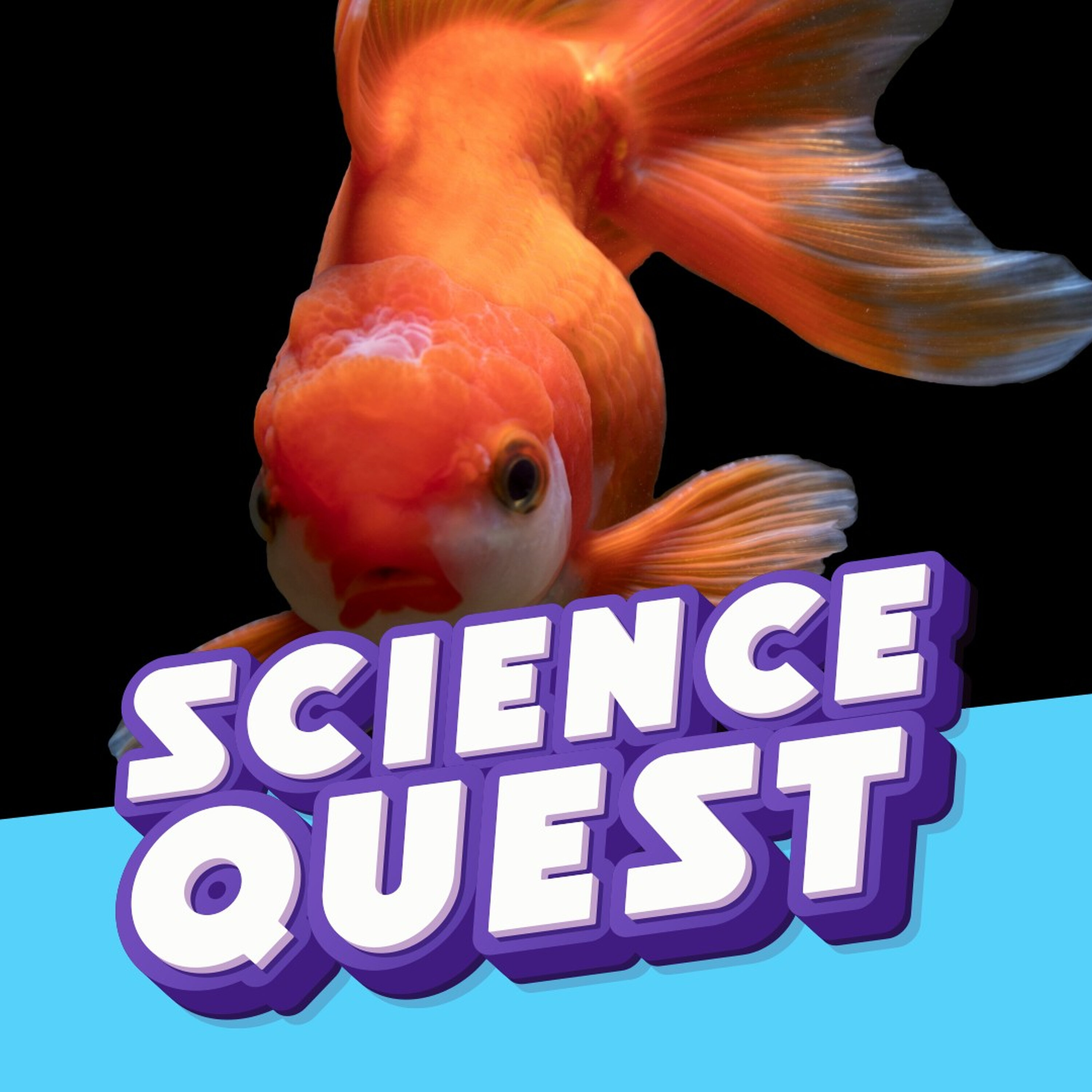
GOLDFISH MYTH: The Truth About Their 3-Second Memory🐠🧠
About this Episode
It's time for another BIG and BRILLIANT adventure into the world of science on this week’s Science Quest!
In Science in the News, NASA is preparing to launch the Artemis 2 mission, sending astronauts around the Moon for the first time in 50 years. UK beekeepers report worrying losses this winter, and Elena Hoicka from the University of Bristol joins Dan to explore the surprising news that babies may begin learning to lie from a very young age!
It’s time for your questions too. Clem wants to know how weather forecasts work, and Cait Newport from Oxford University answers Apolline’s question about whether or not Goldfish really do have a three-second memory.
Dangerous Dan introduces the Oak Processionary Caterpillar, a creature you definitely do not want to get too close to.
And in Battle of the Sciences, Dr Christopher Terrell-Nield takes us deep into the fascinating world of cave biology and the life that thrives in total darkness.
Plus, Kareena and K-Mistry head to the British Museum to discover the chemistry behind prehistoric cave art.
What we learn about:
• Whether goldfish really have a three-second memory
• How weather forecasts are made
• NASA’s Artemis 2 mission to the Moon
• Why bees are disappearing in the UK
• Whether babies can learn to lie
• The oak processionary caterpillar
• How animals survive in caves
• The chemistry behind prehistoric cave art
All that and more on this week’s Science Quest!
Join Fun Kids Podcasts+: https://funkidslive.com/plus
See omnystudio.com/listener for privacy information.
Hosts & Guests
Transcript
Hello, explorer. Welcome along, vizers down. I hope you're strapped in ready for Blast off across the universe. It's a brand new science quest.
My name is Dan. You have landed on the smartest podcast in the history of the universe.
We're here to explore everything lurking through our galaxy and beyond.
All those science secrets we will turn them over.
We'll expect what's true, what's awesome, what's dangerous. We'll get to your questions too.
This week, we're putting one of the biggest animal myths to the test.
So I can unequivocally say that no, they don't have a three-second memory.
They are able to remember how to do things that they've learned for long periods of time.
Also, you can hear about a caterpillar that falls from the sky to poison you
and will head to a world without sunlight and plants uncovering the incredible secrets deep inside caves.
What I'm interested in are things like amphibia that live in caves, like, for example, the Olm,
which is the European cave salamander, whose larvae look a little bit like baby dragons.
And in fact, that's one of the ideas as to why the dragon myths might have originated.
It's all on the way in a brand new science quest.
And we start being current and up to date with this week's science in the news,
NASA, the United States Space Agency, they say they're on track to launch the Artemis II mission in just a few weeks,
where astronauts will fly around the moon for the first time in over 50 years.
You might remember, we spoke about this a couple of weeks ago.
It was meant to happen at the start of March, but a helium leak was discovered, so it was sent back for repairs.
NASA now says it's confident it's fixed the issue and says it could launch on the 1st of April.
But that's brilliant, it's vital, traveling up to space on a rocket such high speed, such high temperatures and energy,
anything can go wrong.
So just fine-tuning any tiny little problem could be the link the deciding factor between success, failure and disaster.
So it's brilliant that they fixed it and amazing that we might get humans near the moon again really soon.
Also beekeepers in the UK say they've lost an unusual amount of bees.
And local colonies are devastated.
The bees have either flown away or sadly died.
Now on an average year beekeepers can expect to lose 10% of their bees, but some have lost as much as 80%.
Experts think that wet winters have been a big problem, with the insects not being able to find food or warmth in the conditions.
And scientists measure how well the world is doing, how well ecosystems are doing, by the amount of bees really,
because bees are so vital in transporting pollen and making nectar, in giving life to other plants, the animals and then we end up eating.
So the health of our bees is so important and it's really devastating to hear that in the UK they've not done so well recently.
And our final story this week it turns out babies can be liars.
Scientists have found that babies younger than a single year old practice lying.
They hide toys and they pretend not to hear their parents.
Should we find out why?
Why are they liars?
Elena Hoyka is professor of education at the University of Bristol and has worked on this.
Elena, thank you for being there.
What made you first study where the babies are liars?
Well, I've been interested in where lying comes from.
You know, from three years we know that kids are pretty good liars, but they must do something before that to get to that point.
So we look to animal literature.
So animals like chimpanzees, for instance, they will do lots of deceptive behavior.
So if they find some nice food and there's a dominant chimpanzee and they don't want to share it, they might eat up behind, you know, some big rock or something where they can't be seen.
So we were wondering if we look at these kind of animal type deceptions, as well as the kinds of things we normally think about.
Like if you sneak a chocolate bar, your pair asks, did you eat the chocolate bar?
And you say, no, you know, all these kinds of things are these things happening early on and it turns out they are.
So what did you do to try and find out how much babies lie?
What we did was we went through lots and lots of research about animals and children and found 16 different types of deception that maybe kids under four years would do.
And then we asked over 750 parents of really young kids to tell us if their kids engaged in these kinds of deceptions.
And we used that to find out actually, yes, this is happening about a quarter of kids were doing this from 10 months and about half by 17 months.
16 different types of lying, how on earth did you figure out that list, what made it, what didn't make it? How do you know what's a lie like that?
So we looked at other research that people have done. And so, you know, a really a task that has been run 46 times with two and three year olds is this peaking task.
So in that task, you would, for instance, put something in a bag and then you tell the kid, okay, don't, don't peek.
I'm just going to go out of the room for a minute, but there's secret cameras in the room.
And, you know, first of all, see does the child peek. So that's a type of deception. If they're doing this in secret, come back and say, did you peek?
They might say, no. And then you might ask a follow up, what do you think's in the bag? And if they're really good liars, let's say there's a toy bear in the bag, they might say, oh, I think it's a truck.
It's probably a truck so that they're covering up their lives. So that already is three types of lies. So we went through and found lots of different ones, things like hiding things from others.
So you don't have to share. It could also be a really big one early on is pretending not to hear my kids kind of ages three, seven and 10 now.
They all do this a lot. So if I say time to tidy up time to go to bed, they just pretend they haven't heard.
So that seems to happen really early as well.
Well, baby's being so young under a year old and being able to deceive is quite amazing because when you are that young, I imagine parents of newborn children, they want to be the nicest people ever.
They want to make everything they do as good as gold. So does that mean babies aren't learning to lie because they're not really seeing it. Is it just something that's natural inside them?
I think it's a bit of both. And one thing to think about is, you know, especially before two years, I don't think kids are being mean. They just want to get what they want to get and they're finding ways to do that.
Partly because we do see this in other animals. And because, you know, I think a lot of parents don't want kids to do these things. They're doing that they're lying or deceiving to get things maybe their parents don't want.
They're probably is something innate, something children are born with. But we also ask parents if they lie to their, if they deceive their children or they encourage their kids to deceive.
And we found that parents who deceive their children, their kid, you know, knew more ways to deceive. Very few parents said they would encourage their kids to deceive.
But those who did, their kids also could deceive in more ways. So it could also be learned.
You can also imagine maybe if you have siblings or like other kids around, you might notice them do things and get away with stuff and copy that as well.
Babies are really sweet and everyone grows up to be different people. We think of lying as a bad thing. But actually, is this important? So it's nice to know, but do we care that some babies lie?
I think pretty much, you know, from around a year and a half to two years, most kids are doing that. So it's really normal as the first thing. It is actually quite normal.
And I think lies, you know, often they can be bad, but sometimes they can be good and it depends what it is, you know.
So for instance, if somebody, you know, spent all their money on a new jumper and it looked hideous, you might say, looks great. So they don't feel bad.
So, you know, sometimes we can lie to be nice, but other times might lie to get someone else in trouble. So you might, you know, break something, blame it on your brother.
So that they can get in trouble and you'll be okay. And that's not as nice. But everyone does these things.
Well, it's been a real joy to hear about these deceptive babies. Professor Elena Hoiker, thank you so much for being there.
Thank you.
Let's get to your questions then. If you ever have anything sciencey that you want answered on this podcast, scienceysmart,
maybe a little bit silly, just something that you're wondering what happens inside your body, what happens in the world,
what's happening further away across the universe, I will find the answer.
If I can't, I'll give a call to a genius that I know will be able to sort it out. We get all the experts on science quest.
Easiest way for you to send in your question is as a voice note on the free fun kids app, you can do that at funkidslive.com
to click that big red record button. It will come through to me and I will do the digging.
First up this week from Klem, who is 10, who wants to know, how do weather forecasts work?
Well, there are three important sages to a weather forecast.
Number one, knowing what the weather is doing now and then calculating how it will change in the future.
And then the last one, third and final is using meteorological expertise to refine the details.
So in order to know what the weather will do in the future, we need to know really accurately what's happening right now.
Recordings of the differences in weather, 24 hours of the day constantly all around the globe,
because what weather is happening in one part of our planet will influence what's happening in another part of our earth.
These are used with satellite pictures to get a real clear image of what's happening in the atmosphere now.
So there are observations and then you've got supercomputers, huge things.
They use those observations as starting conditions for very complex equations.
And they can predict how the weather will move and how it will evolve as time goes on.
They do this because they've got a real big history of what weather has come before.
So they can quite accurately say, well if this happens now, here's what did happen.
So I guess logic and patterns say that this is what will happen in the future.
These computer models have run several times a day, meteorologists are working around the clock to check that the forecast is going to plan.
And little things make big changes.
If the temperature is slightly lower than expected, that can mean the difference between frost or no frost by the end of the night.
And whether a lorry needs to go out and grit the roads, think how many people depend on what their weather is doing,
farmers, delivery drivers, just so many workers really have to think about what's happening in the sky.
So it's a vital job that meteorologists with their incredible intelligence and these supercomputers,
which know the history of what happened, they work together to find an accurate forecast.
Thank you so much for that, Clem.
On another one, shall we? This is a voice note, brilliant. It's from Appalien.
Hi, my name is Appalien and I love your podcast.
My question is, do goldfish really have a three second memory?
Thank you.
Appalien, thank you so much for your question.
Do goldfish really have a three second memory?
That's what we're told, but can it possibly be true and more to the point, how can we possibly ever find out what's going on inside a goldfish's brain?
Should we try and discover more with Dr. Kate Newport from Oxford University who's good enough to join us?
Kate, thank you so much for being there.
Do you remember first hearing about goldfish maybe having a three second memory?
I don't remember the first time I heard it, probably as a child, and I didn't really think much of it until I started training to become a scientist.
So let's get to the bottom of it then from what we know, do goldfish really have a three second memory?
So I can unequivocally say that no, they don't have a three second memory, they are able to remember how to do things that they've learned for long periods of time.
And scientists have actually known this for a long time.
Well, before I was even born, they started studying this in the 60s to try and understand how memories were formed and if animals were able to have memories.
And what kind of tests might a scientist have done to figure out what a goldfish can remember and how long for?
So I actually do a lot of these in my lab. Like a lot of the work I do is actually training fish, including goldfish.
And we use it for all sorts of tasks where we're trying to understand what they can learn how to do or what they already know or even how they perceive things.
So like how do they see something if they can tell the difference between red and blue color, for example.
So we actually train them to go up and, for example, touch something red and then they'll get a food reward.
Now in the 60s, they were doing slightly different things. Instead of doing nice training with food rewards like we do, often they would give them electric shocks.
And so they would sort of, if the fish went to one side of the tank, they would shock them and if they stayed on the other side of the tank, then they wouldn't shock them.
And what they found is the fish learned to do this really quickly and they really remembered to avoid one side of the tank for quite a long period.
What's it like trying to do a study like this with a goldfish?
It must be quite hard animals to get to train and do what you would like them to do.
I think it really depends on the species that you're working with. Goldfish aren't too bad for a lot of the simple tasks.
So like I said about being able to find different colors, being able to find food, learning to turn left or right, these are pretty good at.
We've done some really tricky ones where, for example, I had one student try and train a fish to swim in a straight line towards a goal.
And the key thing is it had to be a straight line and they really took a long time to get them to do that because they naturally want to take curvy lines.
So it really depends on the task. There's other fish species that are so much faster to train than a goldfish. But equally there's fish that are a little bit slower to learn.
So we know that they don't have a three second memory. Are we able to put a timeline on how long they can remember things for? Or is that just too simplistic?
No, no, it's not. I think again, it's task dependent. So if you're doing something that's really scary, for example, or could lead to immediate death, then an animal is going to learn that really quickly and for a lot longer.
But if they're doing something, for example, telling them a red circle from a blue circle, if you don't kind of repeat that over and over for months, then they will forget it just like we might because it's not something that's important for us to remember.
So I can't give you an exact number for the goldfish because I think it changes depending, as I said, depending on that task and how important it is.
But we certainly have evidence of five months in that range as a bare minimum. Now there are other fish that we know have shown to be able to still remember a task or an event that happened for up to 11 months.
But part of the problem is not many scientists have gone around and trained a fish and waited three years and then tried to go ahead. So we don't really have necessarily an upper limit of how much they can remember.
Well, there you go. That's all about goldfish's memory. Dr. Kate Newport, thanks for joining us.
Thank you for having me.
If you've got a question that you want answered on this show, make sure you leave it as a voice note for me on the free fun kids app. You can do it at funkidslive.com too.
And it's time for this week's dangerous Dan, where we take a peek at some of the weirdest, the most strange and uniquely deadly things all across the universe.
In this episode, we're continuing to take a look at some of the strangest creepy crawlies around. Let's look at a fuzzy, spiky beast found on trees across Europe.
It's got a brilliantly grand name, the oak processionary caterpillar. It sounds royal. All right, kings and queens, nobles, they move in processions.
Well, this caterpillar is called that because they also move in long nose to tail lines, each one behind the other swirling around the oak trees where they build their silky nests.
They're very fuzzy. They're covered in thousands of microscopic hairs. Quite small as well. Around three centimeters long, that's about the size of a fingernail.
They greenish brown, covered in light markings and some fine hairs, but other dangerous ones there.
They look normal, a bit alien when they're on the tree, or together like a swarm taking over this oak.
That's not an issue. It's when they fall off that there's a problem. They drop down when they're disturbed, or perhaps their tiny hairs drift through the air.
And these hairs, when they reach your skin, they can cause itchy rashes. They can irritate your eyes. If you breathe them in, it can cause coughing and strong allergic reactions.
You might not be able to see them as they blend in with the trees, so sometimes when they fall off, it can be quite a dangerously painful surprise.
And they're taken seriously. If there are too many, the infested woodland can be closed off, so there's no chance of them causing you damage. So this caterpillar, just by being on the trees, being nearby, without you knowing, it can cause serious harm.
And that's why this small, fuzzy, spiny beast, the oak processionary caterpillar, is going straight on our dangerous down list.
It's time for this week's battered of the sciences, where we try and uncover the most amazing field in the history of the world.
We travel all over the place, we go under the ocean, up into space, through dense rainforests. Today, we're headed to one of the most unique places on our planet, where it's dark, it's dank, and I think a little bit slimy.
We're talking cave biology with Dr Christopher Terrell Neild, who joins us. Christopher, thank you for being there. You have one minute to tell us why cave biology is the greatest of them all. And that minute starts in three, two, one, go!
Hello! Just think of finding a dark habitat where no one's been before. As you look around, strange shapes appear out of the gloom, unknown creatures scuttle to hide, others glare at you with large, flinty eyes.
Some don't seem to have any eyes at all, but are aware of your presence. They start edging towards you.
In the distance, a low rumble shakes the air, a dragon, perhaps, so you venture to explore. You aren't in a dank tropical forest, or an explored valley, or an ancient castle, but in the cave.
I knew the open one where there is a chance of finding new species, new patterns of evolution. Perhaps fossils of extinct animals, possibly evidence that someone's been there before, but very long time ago.
That's the interest of caves and why I like to investigate them. They are one of nature's evolutionally laboratories.
Wow, Chris, thank you so much. Well, listen, I mentioned in the intro that there is so many science scientific places that you could explore, and you could focus your energies and your intellect.
What was it about the habitat and the ecosystem of caves that has really caught your imagination?
It's essentially the adaptations. I mean, just think about being in a place where there is no light, very, very little food, not much chance of meeting anybody, and you have to make your living.
And so all kinds of adaptations of a risen light, for example, animals losing the power of sight, but instead picking up the inability to hear, or to feel vibrations, or for aquatic animals, electric fields, and so on.
Ways of catching prey in the dark, like webs and traps, and so on. So all sorts of adaptations. And then, of course, you've got to think about how am I going to get out of the cave?
How can I disperse to another cave? How can they get out if I'm so highly adapted? That's actually part of the science. But for me, it's really about how these animals cope with the conditions that are present inside the cave, which are difficult, but in some ways actually quite nice.
When we think about evolution, we think about, as you say, a creature species adapting to where they are, but also trying to go a little further to explore and then adapting again.
How true of that is beasts in caves, or have you found that when they grow there, they're happy to stay there because that's what they know, and that's what they're adapted brilliantly for?
Well, first of all, there are different sorts of animals that live in caves, and some of them go in there to hibernate. That's part of their natural yearly cycle to modest, for example, and they're, of course, bats do the same thing.
So they're adapted to living in caves and also hunting outside. And then there are some animals like the big cave spiders, which can be found in caves and also turn them else into other places. So they've adapted in many ways to living with us.
You find them in your cell, you find them down a mine, find them in a rowy tunnel and so on. So they're actually more adaptable than just living in the deep, dark cave.
But then there are the real true cave animals, what we call chocolate bites, and these are the ones that often like pigments. They're often completely white, or completely black.
They don't have any eyes, but they have enhanced senses. And of course, with these enhanced senses, they can do things that they couldn't do else.
So navigate, for example, in total darkness, and avoid predators in total darkness.
But then they've got the problem of how to actually get out of a cave, and that's the tricky part. For the spiders, they use a technique, some of them use a technique called ballooning, which is something that outside spiders do.
They essentially produce small young, which produce some silk, and then they wafter way on the wind to find the new cave.
So for a short time, they're actually outside in the big, wide world, but the rest of the time, as an adult, certainly, they are down the cave in the dark.
So these adaptations can help them to have different places, other than just a cave.
I would imagine that some of your scientific studies have taken you to rather unique caves across the world, perhaps.
I wonder if you could give us a glimpse of some of the things that you've seen, some of the strange places that you've found, and particularly really unusual beasts that we might not spot anywhere else.
Well, quite close to home, of course. We have plenty of caves in the UK, and one of the animals, which I'm very much like working with, is the European cave spider, which is one of Britain's biggest spiders.
It's called Meta Monardi. It produces very webs, but that doesn't catch flies, so it should actually catch things that crawl on the cave walls. That's in the UK, and also across Europe.
But outside Europe, what I'm interested in are things like amphibia that live in caves, like, for example, the Olm, which is the European cave salamander, whose larvae look a little bit like baby dragons.
In fact, that was one of the ideas as to why the dragon myth might have originated, because these things breeding caves, then you release the offspring and they swim out, and some of them look a lot like ancient pictures of what people thought dragons look like.
So that's an interest there. And of course, in the caves themselves, you get all sorts of weird and wonderful noises, so perhaps howls and grunts and rolls of creatures much bigger than the cave salamanders.
And then, of course, in America, we have lots and lots of things like blind cave fish. They live in total darkness in caves. They just completely lost their eyes, but they are the same group of fish as ones who live outside, which you've got perfectly good eyes.
Now, I always ask the same question to finish, and I wonder what the answer might be for you. I don't have an idea, because everything that you're really discovering is new and almost unexplored at times.
But Chris, if I were to throw you towards the end or to the end of your career working in cave biology, what's the one thing you want to discover? What's the one question in your field that you'd love to get answered?
I would like to know how long things lasting caves. We've got an experiment, which have actually been running up in the caves at Kreuzlok Cranks for over 30 years.
And it involves some animals we put in there, dead animals, back in the 1990s. And I want to see these through. I like to think they've actually spent longer doing an experiment than Charles Darwin did with his earthworms and stones work.
And I want to be able to sort of say about how long things can actually survive and still be recognizable, because then that can be fed through to the archaeologists who can understand how things actually survive in these particular habitats.
So long term experiments, I'd like to get an answer to that particular question, just how long can things last in a recognizable state underground?
Oh, taking us to dark and dank places. Dr. Christopher Terrell Neild, thank you so much for joining us. Thank you.
Awesome to dive into caves, learning all about the strange ecology of what's happening in there.
We can do a little bit more of that now, actually. We're catching up with Karina and Kay Mystery. It's a brilliant series that explores so much around the world and through history and chemical mysteries.
And this week, we're taking a look at chemistry and art heading to the British Museum to learn all about the prehistoric ones.
Chemistry and art with the Royal Society of Chemistry.
So, I'm here at the British Museum with school. We're looking at art through the ages, as you see.
Although it's turning into a project all about being bored through the ages.
Where's a girl superhero or teago when you need one?
Chemistry, superhero, to the rescue. Come on Karina, this is brilliant.
Yeah, I know chemistry is exciting, but what's exciting about a load of scribbles done by some manky old caveman?
You are joking. Cave art is packed with chemistry. Wanna see?
It's a bit musty in here. Where? Or should I ask when are we?
We've gone back over 40,000 years. Welcome to the Paleolithic Period.
Paleo-ly?
Basically, when everyone was like a caveman. Looks like he's just spitting paint at the wall.
That's like so gross, but also slightly cool. He's using his hand like a stencil.
But that's still pretty gross. Compared to the 21st century, art at this time was a little more simple.
Men and women would draw pictures of themselves and animals around them.
And as time went on, they also drew crazy creations of half humans, half beasts.
That's less gross, but where's the chemistry? Well, what?
You see our caveman over there? He's grinding up some charcoal and mixing it with water.
As it's a bit too wet to use, he'll then heat the mixture to remove water.
And what's left behind forms a type of black paint.
Another color he might be making is red. He'll grind up some oakite. That's earth that's rich in iron oxide.
Oh, I know that one. Iron oxide is what you get when iron and oxygen mix, creating the red color of rusty metal.
That's right! Ah! It looks like our caveman has finished making some paint.
He's now mixing it with some gloop to make it stick on the wall.
Yeah, but what is that gloop? Could be plant sap or even spit.
Er, not again. But hey, I guess our caveman's a bit of a chemist, even though he won't realise it.
So, can different rocks be ground up to make different colours?
You betcha! Oh, let's take a flight in my superhero auto-ego hot air balloon.
From high or up, you'll get a better view. You come in. Er, duh.
From up here, we can see many different rocks and minerals, hold on.
Or some minerals. Minerals are naturally occurring substances that are found all over the earth.
Every mineral is made of a specific mix of chemical elements which grow as crystals.
They are substances that have never been alive. So unlike things like charcoal,
aren't formed from old plants and animals.
Right, let's have a look. Ah, over there. That's hematite.
It's what gives the mineral ochre its reddish colour. Amazing! Hey, what's that craggie yellow rock?
It's called limonite and is used to make yellow. Wow, look at that glaring white cliff.
That's limestone. Ah, now what else have we got?
Alright, check out the browns and blacks over there. The brown is called manganite,
whilst the black is pyrolyocyte. Er, what about blue and green?
Ah, well, the minerals and chemicals that make those colours are pretty rare.
That's why you don't get many blue and green cave paintings.
Come on, let's get back.
That was so cool!
It's a shame in a way that there aren't more cave paintings to see in the museum.
Like, where are the ones from Britain?
Unfortunately, most cave paintings haven't stood the test of time.
The best examples are found in very dry countries.
And whilst Britain may be many things, it ain't that dry.
But at least we can go and see them in other countries, right?
Like France and Spain? Yeah!
But people are another reason why cave paintings disappear.
All those visitors take moisture into caves.
Which means fungus, bacteria and molds can grow.
There have been cave paintings at Las Cours in France for 17,000 years.
But they've been seriously damaged by bacteria brought in by visitors over the last 100 years.
So much so, it isn't even safe to go in the caves now.
Well, that's a shame. Well, maybe looking at pictures in an exhibition is the best way to learn.
Well, that's if you haven't got a superhero or to ego to take you on at all.
Ha ha, pretty much!
Anyway, it looks like your class is moving.
I'd better move too.
Catch you later! Bye, Chemistry!
Chemistry and art with the Royal Society of Chemistry.
Find out more and get hands-on with chemistry at funkidsly.com slash chemistry.
That's it for this week's Science Quest.
You can hear more of K mystery and tons more brilliant podcasts and series that we've got.
Wherever you're listening to this, it's on Google Apple Spotify on the Free Fun Kids app.
Wherever you get your shows at funkidsly.com too.
If you have a question that you'd love to get answered in a few days in our next episode,
make sure you fire it over as a voice note for me on the Free Fun Kids app.
You can do that at funkidsly.com too.
And fun kids, we are a children's radio station from the UK.
Listen all around the country on our app on the website easiest way if you've got a smart speaker.
Wake it up and ask it to play fun kids. And I'll see you soon!


