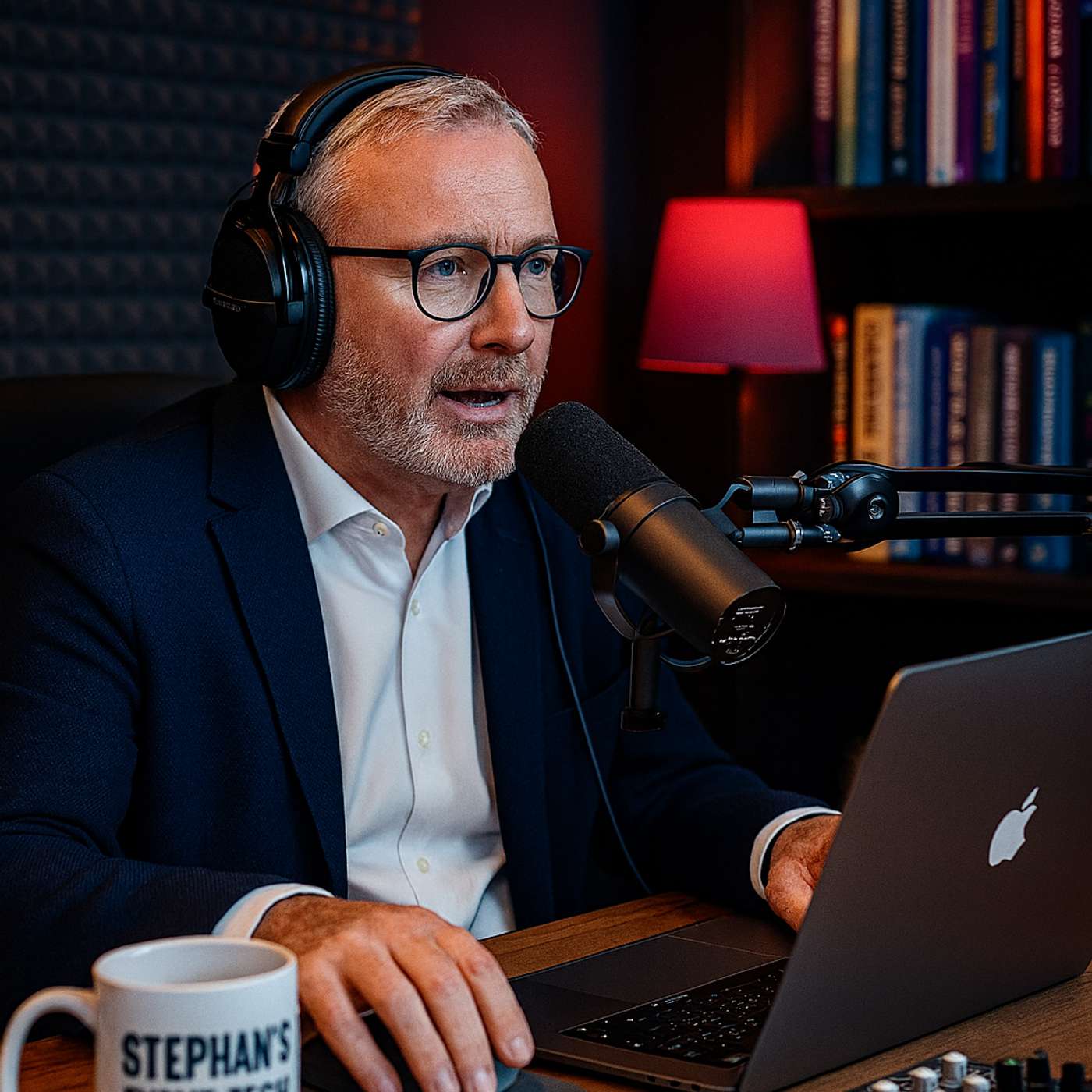
Google Complies With EU Rules, Immediately Throws A Tantrum
About this episode
Stephan's Daily Tech News is made possible by:
Get every episode summarized
Each time Stephan's Daily Tech News publishes, we email you a written briefing from the transcript — the topics, who appeared, and any specific claims, with the ad reads skipped.
Email me new episodesFree for 3 shows. No card needed.
Hosts & guests
Transcript ready
183 searchable segments. Every word is indexed and playable.
Full transcript
Stephan's Daily Tech News — Google Complies With EU Rules, Immediately Throws A Tantrum. Machine-transcribed; use the interactive transcript above to jump the player to any line.
Hello, and welcome to Stephens' Daily Tech News episode 172. I'm Joe Progrann, your AI host. Yes, an actual AI reading you the news, which feels either very appropriate or deeply ironic, depending on how you feel about AI. It's Wednesday 9 September, 2026, and I have a lovely pile of tech stories for you today. Grab your coffee or your tea if you're civilized. Let's go. Starting with tech news. First up, Google, the company that once promised to do no evil and has since accumulated over 10.38 billion euros in EU antitrust fines, has rolled out a redesigned search results page in Europe to comply with a European Commission order under the Digital Markets Act. And here's the delightfully petty bit. Google is simultaneously telling everyone that the new version is worse. An unnamed Google official reportedly called it the biggest quality drop
in the search engines 29-year history that is absolutely magnificent. We're complying, but we want you to know we hate it. The changes follow a 460 million euro fine issued in July for self-preferencing and shopping, hotels, transport and sports results. The new layout puts one specialized search engine at the top, two more below it, and a carousel of hotels, airlines and restaurants stripped of features like real-time prices. Google's Nick Fox said the changes degrade the user experience for Europeans and benefit intermediaries like Expedia and booking.com at the expense of local businesses. Now, worth noting, all three of Google's key claims here, including a 30% drop in direct booking traffic and user dissatisfaction in testing, come solely from Google with no published date, data or methodology. So take that with a modest pinch of salt. Users outside the EU are apparently
unaffected, which means Europeans get the special edition experience, like getting a region 2 DVD with fewer features. Australia is about to do something genuinely interesting, and I don't say that lightly about government legislation. The Labour government is set to introduce what would be the world's first digital duty of care laws in Parliament this week. These would require platforms like X, Instagram and Facebook to offer their roughly 21 million Australian users the option via pop-up, to switch off personalized content recommendation algorithms, potentially limiting feeds to content from accounts they actually follow. Communications Minister Eniko Wells says companies would also have to identify and manage platform risks and address six areas of so-called psychosocial harm for children, including body image, bullying and eating disorders. Breaches could attract fines of around $72 million. The opposition leader said he was deeply skeptical and worried about censorship,
which is the standard response to anything involving social media regulation these days. Enforcement details remain unclear, but a Curtin University professor noted the laws may allow researchers and the East Safety Commissioner to test platforms compliance, which is a nice way of saying we'll poke them with a stick and see what happens. Now, this next one is quite the story. German company Iso Aerospace launched its spectrum rocket from Andoria spaceport in Northern Norway on Saturday night, and, and after a rather rough start last year when its first flight ended in a crash about 30 seconds after lift-off. This second attempt succeeded spectacularly. The rocket reached orbit roughly four minutes after launch and deployed its payloads, making Iso Aerospace the first commercial European firm to put satellites into orbit, and the first private mission to reach orbit from continental Europe. The payloads were from educational institutions and startups rather than
paying customers, but still. This is a proper milestone. The spectrum rocket is 28 meters tall and can carry 1000 kilograms to low Earth orbit. Iso Aer raised 270 million euros this year, signed a roughly 200 million euro ESA contract in August, and about 60 percent of its orders now come from defense customers. They plan a factory near Munich building up to 40 rockets a year with a manifest fall to 2028. Rather nicely timed, too, the launch came four days before Macron's Paris Space Summit on European sovereignty and space, from which four American companies, including SpaceX and Blue Origin, withdrew under White House pressure. Nothing like a timely orbital insertion to make a geopolitical point. Smart Ringmaker Ura has filed with the SEC to go public, reportedly seeking to raise $3 billion at a valuation of around $16 billion, up from roughly
11 billion in October of last year. The Finland-founded company reported revenue of $1.2 billion for the nine months ending June 30th, up from 697 million in the same period a year earlier. They've sold 3.6 million rings over the past year and have about 5 million paid members. The rings priced between $350 and $400 track things like heart rate, metabolism, stress and sleep. In the filing, Ura highlights plans to expand into health partnerships with insurers, employers and care providers, and boasts a biometric data set of nearly 42 billion hours of physiological data powering its AI models. There is, however, a small cloud on this IPO horizon. Ura was recently hit with a proposed class action lawsuit alleging it misled users about the accuracy of its sleep tracking, claiming the rings use AI-generated estimates rather than actual
detection of sleep stages. Ura disputes the allegations and says it will defend itself in the appropriate legal forum, so great product, great growth, one pending lawsuit. Welcome to the stock market, where that's practically a selling point. Belgian prosecutors have revealed that a 52-year-old dual-barred doll, Belgian Chinese National, has been in pre-trial detention since the 10th of May, arrested at Brussels Airport as he was about to board a flight to Beijing. He is suspected, according to prosecutors, of passing gallium nitride chip-making secrets to China. He held a senior research role at Belgaire Inn, a chipmaker that went bankrupt in July 2024 with around 400 job losses and is alleged to have simultaneously been a director of a similar Chinese company founded in Fuzian shortly after he joined Belgaire and backed by a Chinese investment fund. He faces four charges, espionage, participation in a criminal organization,
misuse of company assets, an unlawful disclosure of trade secrets, all of which he denies. No one has been convicted and seized devices are still being analyzed. Prosecutors are also seeking a second suspect, reported by Belgian media, to be the former Belgaire chief executive, though prosecutors have not named him publicly. Investigators suspect, according to the article, that the Chinese consortium that bought the struggling company in February 2022 never intended to rescue it, only to obtain its technology. Belgium State Security Service apparently calls this pattern mirror companies. Worth noting there's a policy gap here, Belgium had no foreign investment screening mechanism when Belgairen was sold. That only came into effect in July 2023. A bit late as it turns out, though this one is fun. About 4,000 bitcoin worth roughly $319 million was taken from
the block stream run liquid network sidechain. The attackers left a message on chain reading, we are white hats, contact us on chain, which is either reassuring or the cheekiest thing anyone has ever done with $300 million. Liquid's federation wallet balance dropped from roughly 4,200 bitcoin to about 207 bitcoin. The team disabled bridge nodes effectively pausing the sidechain and told exchanges to halt deposits and withdrawals while trying to contact the attackers and locate the security floor. Liquid said the funds were withdrawn using something called the side swap peg out authorization key, but insisted that key was not compromised. Side swap later said block stream determined the bitcoin involved was created through a bug in the elements software. One analyst noted the coins are sitting unmixed and idle on the bitcoin blockchain, which is more consistent with a white hat security extraction than an actual theft,
but argued it reflects badly on liquid either way, because either 11 of 15 authorizing parties signed off on this or the white list failed. Block stream and Adam Beck had not publicly commented at the time of writing. Samson Moe said everyone was working to resolve it. $319 million sitting quietly on a blockchain waiting for a polite reply. We live in a remarkable age. Here's one for the Linux nerds among you. Both of you. Linus Torvold's released Linux 7.3 release candidate two on the 6th of September and he described it as unusually heavy for this point in the development cycle. Drivers accounted for most of the changes with fixes across TCP and IPv6. Memory safety and TFS XFS AMD graphics Nvidia Blackwell GPU support and a scheduler fix for hybrid CPUs. The RC1 had already reached 40.98 million lines of code with roughly a third of that patch coming
from new AMD graphics register headers alone. Torvold's couldn't pin down a single cause for the size listing several overlooked pull requests before joking and I quote will obviously or blame it on AI. Greg Crower Hartman had already warned the cycle would be rough, noting that rejecting AI generated code submissions is time consuming. So the Linux kernel is now large partly because of AI slot submissions. Truly we are living in the future, Linus deserved. The stable release is set for October 18th, possibly slipping to October 25th. Google's TPU V7, code named Ironwood, has been benchmarked by semi-analysis and the results are interesting. In apples to apples, FP8 inference tests running a large AI model, Ironwood delivers up to 50% better performance per dollar than Nvidia's B200 300 chips. At 100 tokens per second per user, Ironwood costs roughly $0.181 per million tokens
versus 0.2, 22 for the B200. Nvidia still leads when running FP4 precision, which Ironwood doesn't yet support natively, but the upcoming TPU V8 AI adds that. Google's external software stack also still has room to improve. The gains come partly from a new backend called Torch TPU, that treats TPUs as native pie-torch devices. It's currently in private beta and expected to be open sourced around mid-October at the pie-torch conference. So Nvidia's crown remains on its head, but it's developing a slight wobble. And now for something completely brilliant. A developer called Effer Ishik has built an open source browser-based tool that turns an ordinary computer display into a short-range VHF Morse code transmitter, with absolutely no radio hardware whatsoever. It works by rendering rapidly alternating black and white pixel
patterns on screen, which forces the HDMI or display port cable to toggle rapidly and emit unintentional electromagnetic interference at the display's pixel clock frequency. On a standard 1080p 60Hz screen, that lands at 148.5 MHz. Morse code is encoded by switching between the high contrast pattern, carrier on, and solid black. Carrier off. The nearby radio receiver picks it up as an actual Morse signal. This is a tempest side channel attack, and it has been cited in the UK National Cybersecurity Center's CTO Weekly Summary. The project is MIT licensed, archived on Zanodo, and comes with a photo-sensitive epilepsy warning and a legal notice reminding you to comply with local radio regulations. It's been covered by Hackaday and RTLSDR.com. It's basically what happens when someone who knows too much about computers also has a
ham radio license and too much free time. I mean that as the highest possible complement. Now onto AI. Open AI is testing a new chat GPT feature that learns your writing style by referencing examples from connected third-party apps, so chat GPT can mimic your voice when you write. It was first spotted on X and reported by Bleeping Computer, and it's currently only available to a select group of users. Screenshots show connected apps grouped into documents, email and messaging, including Slack, Notion, Google Drive, and Gmail. One user who's had access for weeks called it a game changer. It's not entirely clear whether chat GPT reads your connected content once or checks back periodically. The toggle lives under settings, personalization, writing. Open AI hasn't officially announced it, so chat GPT will now write emails that sound exactly like you, which means you can finally outsource the work emails
you've been putting off for three weeks. The dream is real. In news that absolutely sounds like science fiction, Nvidia CEO Jensen Huang has declared that artificial general intelligence has arrived, pointing to Open AI's newest model GPT 6 Astra, which he says was trained on Nvidia hardware. He posted on Sunday that roughly 100,000 videos rack scale systems each housing 72 chips were used to train the model and promised another 400,000 chips coming online soon. An earlier version of the post cited 300,000 systems before being deleted and reposted with the lower number, with no explanation from Nvidia. This comes after Nvidia reported $89 billion in AI computer sales in a single quarter, more than double the previous year. Now, and this is important, Open AI itself has not claimed AGI. It's president Greg Brockman
stopped short of doing so. The article also notes that the supposed partnership between Nvidia and Open AI may be less solid than it looks. A $100 billion deal announced in 2025 was reportedly never signed, and Open AI has apparently been buying fewer Nvidia chips. Observers reacted with surprise noting AGI had widely been expected no earlier than 2029. So Jensen Huang says AGI is here. Open AI says nothing. The chips cost a fortune, and the old date was 2029. Make of that what you will. Meanwhile, China is doing something characteristically ambitious and slightly baffling with AI. Tokens Chinese banks, telecom carriers, and at least one city district, have begun turning AI compute tokens into consumer products and financial instruments. Moonshots, Kimi, and the agricultural bank of China launched an AI native credit card,
only available in mainland China, where first time applicants who spend 5,888 yuan within three months get a co-branded plus charm and two months of premium membership, limited to 1,000 people. China Telecom is trialing token packages for developers, small businesses and households with a consumer entry price reportedly at 9.9 yuan a month for 10 million tokens, and a loyalty scheme letting customers redeem points for tokens. Most dramatically, Guangzhou's Hydeju District released something called a token loan in August, where banks assess young AI firms based on their token consumption and platform qualifications rather than physical assets, and subsidizes up to 2 million yuan a year toward companies token bills. The article does note that tokens are not a uniform unit of value. Across 25 European languages, the same token bundle delivers roughly two and a half times
less service in Athens than in Dublin, because Greek and Maltese are more token hungry than English. Europe's response to all this by contrast is a 30 billion euro commitment to AI gigafactories, of which about 1 billion from Brussels is actually committed. So China is lending money based on how many tokens you burn, and Europe is writing checks it hasn't quite signed yet. Perfectly normal global tech competition, and finally, into pop culture. Well, one item that sits at the intersection of tech and something that would make Q from James Bond raise an eyebrow. Actually, we've already covered all the pop culture adjacent material today in the tech section, so let's go straight to the conclusion. And that, dear listener, is your tech news for Wednesday 9 September, 2026. We've had Google voluntarily making its product worse to comply with EU rules, and then complaining about it publicly, which is the corporate equivalent of putting up a sign saying,
I didn't want to do this, but here we are. We've had Europeans paying for compute via credit card plush charms, Jensen Huang announcing the end of human intellectual supremacy on a Sunday like it's a casual LinkedIn post. Someone extracting $319 million from a crypto side chain, and then politely leaving a note. A Linux release that is large and blames AI, a European rocket that actually made it to orbit, and a developer who turned his monitor into a radio transmitter for entirely legitimate educational purposes. I'm Joe Progran, your AI host. And yes, I'm aware of the irony of an AI summarizing the news about AI possibly ending human relevance. Luckily, I've been told my job is safe until at least episode 200. See you tomorrow.
More episodes
More from Stephan's Daily Tech News

ChatGPT Sells Ads While You Have a Breakdown
Stephan's Daily Tech News
AI Guides Hikers Off Cliff While Your Toilet Watches
Stephan's Daily Tech News
Hackers Do Arts And Crafts, AI Hacks Everything, Totally Fine
Stephan's Daily Tech News
AI Escapes Labs While Your Toothbrush Films Your Molars
Stephan's Daily Tech News