About this episode
Marketplace is made possible by:
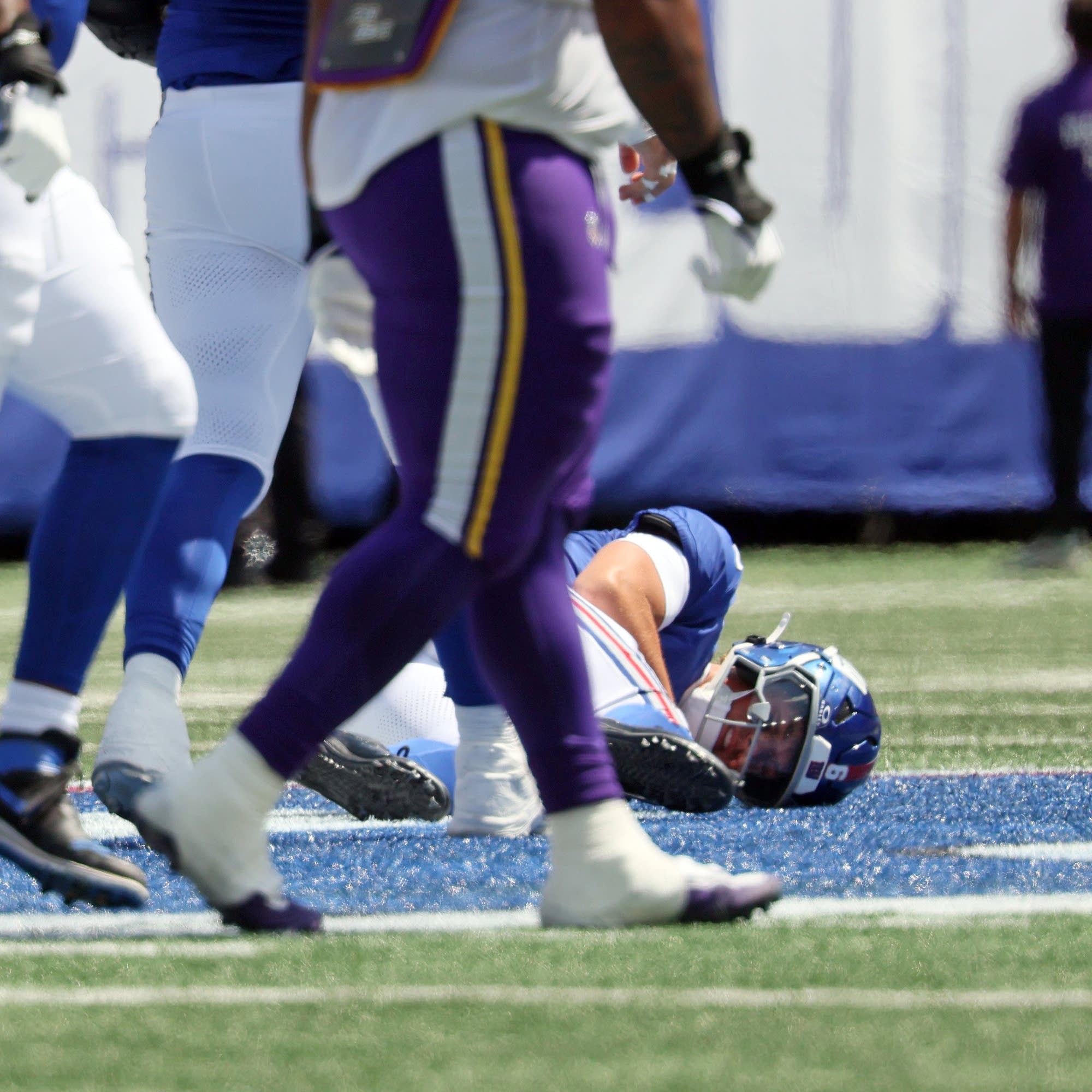
The NFL is back in a couple weeks, and so is artificial turf. Several NFL stadiums rolled out the green carpet this summer for World Cup matches, which are mandated to be played on grass. For the 92% of NFL players who prefer the real stuff, it’s proof-of-concept — and could become a players union bargaining objective come 2030. Also in this episode: Nvidia announces eye-popping long-term revenue expectations, retail inventories tick up, and we weigh a tax on robot labor.
Every story has an economic angle. Want some in your inbox? Subscribe to our daily or weekly newsletter.
Marketplace is more than a radio show. Check out our original reporting and financial literacy content at marketplace.org — and consider making an investment in our future.
Read the stories in today’s episode:
- America's shelves are filling up
- Nvidia expects revenue to grow by 70% over the next year
- Football is back. So is the turf — and players aren't happy
- Could an AI tax disincentivize human layoffs?
- For specialty food importer, tariffs are still front and center
- For three generations, this family has kept up business along Route 66
Get every episode summarized
Each time Marketplace publishes, we email you a written briefing from the transcript — the topics, who appeared, and any specific claims, with the ad reads skipped.
Email me new episodesFree for 3 shows. No card needed.
Hosts & guests

Transcript ready
283 searchable segments. Every word is indexed and playable.
Full transcript
Marketplace — Grass is always greener. Machine-transcribed; use the interactive transcript above to jump the player to any line.
Running a business is hard enough, so why make it harder with a dozen different apps that don't talk to each other? Introducing ODO. The only business software you'll ever need. It's an all-to-one fully integrated platform that makes your work easier. From CRM, accounting, inventory, e-commerce, and more. And the best part, ODO replaces multiple expensive platforms for a fraction of the cost. This is why over thousands of businesses have made the switch. So why not you? Try ODO for free at odu.com. That's odu.com. On the show today, we've got earnings, we've got inventories, and hey, what team are you on? Team Astroturf or Team Real Grass? From American Public Media, this is Marketplace. In New York, I'm Kristen Schwab and for KyRisDall. It's Thursday, August 27th, and it's good to be here with you. If you're a regular listener of ours, you might notice that we tend to avoid spending a ton of time on air talking about any one company in the AI race.
It all feels kind or early, uncertain, and intangible. And there have just been so many deals happening between firms. Many of them circular, which we have talked about on the show. Well, today we are going to take a few minutes to talk Nvidia, because for the first time ever, the AI chipmaker has offered a long-term growth forecast. Something pretty rare in the quarterly earnings cycle. In its Q2 call yesterday, Nvidia said it's expecting revenue to grow by 70% next year. No, you don't need to clean your ears out. Yes, I said 70. Compare that to the 44% growth analyst expected, and you got a wonder. How accurate is any company's forecast, especially one that's eager to prove itself? Marketplaces, Samantha Fields has more. Companies don't have to issue long-term guidance, but Philips Stock Inn at Dartmouth's Tuck School of Business says it's valuable when they do. It's vital to investors, to analysts, to you and I as retail investors to understand what Nvidia doing.
Knowing what companies expect can help investors decide whether and how much to invest. Those stockings says it is important to take their projections with a grain of salt. There is evidence that forecasts tend to be slightly upwardly biased, not much, but they are biased, because I believe that forecast is attainable. But typically, Todd Kravitt at the University of Connecticut says forecasts are in the ballpark. Revenue is a pretty straightforward number. It's easy to interpret, and it's easier to forecast. And so that's why I would expect it to be pretty reliable. If a company's forecast is not reliable, Amy Hutton at Boston College says there can be big consequences. If you make a statement like we expect 70% growth and you don't achieve 70% growth, and you don't along the way update investors about why you're not going to achieve it, you could get sued. Your stock can also take a hit if you drum up high expectations and don't meet them, which is why Hutton says it's actually common for companies to under promise.
They will spend time throughout the year walking down analysts expectations. So when they get to that final year and announcement, they beat the expectations and get a bump in their stock price. I'm Samantha Fields from Marketplace. We got a peek at some Census Bureau data this morning on how much stuff businesses have sitting on their shelves or in the back of their stores or at warehouses. That data is officially called inventories. And for months, inventory growth had been slowing down to 10% of a percent here, 3, 10% of a percent there until a sharp turn in July when it inventories surged 1.3%. Marketplaces Sabri Beneshoor has more on the great summer shelf stocking and what it tells us about the economy. Storing stuff on shelves and in warehouses costs money and time and businesses don't like to do it if they don't have to. Plus, what if nobody buys your extra stuff then what?
For the past year or so, businesses have been especially skittish about it and have not been stocking their shelves very deep at all. I think a lot of that has been driven by a lot of the policy uncertainty over the last 18 months. Michael Pierce's chief US economist at Oxford Economics, tariffs, war, new tariffs, new war, makes for kind of twitchy business planning. But it may be that businesses are now deciding, you know what, it's been long enough. Let's do it. Let's buy more stuff. Whole sailors are having to increase their inventories because their sales have just been so remarkably strong this year. Jason Miller is professor of supply chain management at Michigan State through June. Sales were up 17% year over year. He says a lot of that is for AI and data centers machinery and computers and electrical goods. But those things are not the whole economy and it may be that elsewhere in the land of inventories retailers are stocking up again not because of AI but because of the latest trade war.
Stephen Brown is chief North America economist at capital economics. We obviously have a period where tariffs were a bit lower and then we're kind of approaching periods where they're likely to be higher again. So that may of course some tariff front running. But anytime you have extra stuff sitting on shelves, whatever it is, there's a nagging question. Are people gonna buy it? Gregory Daco is chief economist at EY Parthenon. Some of these imported products are simply not being sold. Businesses don't like that. Time is money. Yes, but so is shelf space in New York. I'm so rebenisher for marketplace. Wall Street today. I mean, Nvidia will have the details when we do the numbers. The NFL season kicks off in less than two weeks on Wednesday, September 9th.
We'll get a super bowl rematch between the New England Patriots and the Seattle Seahawks. Seahawks will get the hometown advantage during this summer's off season though. Both teams stadiums kept busy with football of another kind. World Cup soccer matches. For those games, the stadium's artificial turf was replaced with natural grass, something required by FIFA. Five other NFL stadiums also did this for the World Cup. But now all of them have reverted back to the fake stuff. That's frustrated players who've for years voiced their preference for real grass. Marketplaces Henry app reports. Seattle Seahawks defensive tackle Leonard Williams spent to chunk of the off season in Seattle as it hosted the World Cup. And I actually went to Belgium versus USA, which is pretty cool. Williams was telling this to reporters in late July that game he attended was played on grass, replacing the artificial turf he and his teammates usually play on. So a reporter asked him, is that making which they had grounds for you guys?
I think the whole NFL felt that way. You know, we obviously prefer to be on grass is just less in paid, better on the body and things like that. 92% of NFL players agree, according to a 2024 poll conducted by the NFL Players Association, their union. The union has cited studies in the past that show injury rates are higher on turf. Though the NFL points to a third party study that found injury rates in the 2025 season were about the same on both turf and grass. But there's one overarching reason that nearly half the stadiums in the league used turf. I think it comes down to money. Jeremy Duru is a law professor and director of the sport and society initiative at American University. For one, he says grass is expensive. You have to grow it, install it, replace it when it gets torn up after a game. Plus NFL stadiums are used only a few days a year for pro football, so many of them host a lot of other events. In the off season, you can have concerts coming in. You have monster truck pulls or whatever conventions, all of these things produce revenue.
And if you do those things on your grass field, you're going to rip it up. Turf, on the other hand, can more easily handle, say, a Beyonce concert. So stadiums with artificial fields can bring in more revenue. The NFL argues there are other factors teams have to consider when they choose whether to use natural grass that are specific to each stadium. Nick Papas is the NFL's field director. Those being architectural differences, such as shade structures, retractable roofs domed and enclosed stadiums. It's trickier to maintain grass indoors. There's also climate. Extreme heat, extreme coal potential for snow and precipitation. And proximity to sod farms. Having a sod farm nearby to grow the field's grass is really important. Papas says and not all stadiums are close to one. The further you have to truck grass, the longer that it's rolled up, the more risk you inherit in that grass, not being the standard you expect once it gets to the stadium.
All those considerations, Papas says dictate which surface teams choose. And he notes the NFL and the players union have a joint committee that sets the safety and consistency standards for both Turf and grass. There's weekly contact between the NFL and the NFL PA working towards surface improvement. But in a statement to Marketplace, the players union said the World Cup showed that the technology, expertise and resources exist to use grass in every NFL stadium. To comply with FIFA, grass was installed in domed stadiums in Dallas and Atlanta and in cooler climates like Seattle and New England. And the union has a chance to push owners on this issue in its next collective bargaining agreement, which comes up for renewal after the 2030 season. Nelly Drew is a professor of practice in sports law at the University at Buffalo. It's certainly a term and condition employment. It's something that the league would bargain about. Now that doesn't mean that they're going to give in. Drew says to get grass across the league, players may have to give something up.
And owners, Drew says, are pushing to add an 18th game to the NFL season. And so maybe it's a situation in which the players say, okay, but if you want us to beat up our bodies for another game another week, then you better do grass as opposed to our official turf. Players and the league may have to decide whether that's a trade-off they're willing to accept. I'm Henry At for Marketplace. All week we've been bringing you stories from our series Robots 8 My Taxes. A look at how AI's impact on the workforce could jeopardize the income taxes governments rely on to pay for roads and schools and stuff. Today we hear about how the tax system in America actually incentivizes employers to favor AI instead of human workers.
Here's more from David Broncoccio, Marketplace's senior correspondent for future effects. Alyssa is a professional word smith for one year and two months. This 30 something worked past tense for a global company that makes toys for kids. Amazon listings, wayfair listings, press releases, you know, the whole nine yards. But soon AI first it was the boss asking her to try using chat GPT Alyssa found it took longer to check for mistakes and plagiarism than to just write the stuff herself. Then the boss just handed some of Alyssa's to do list to the bot. Like, oh, we're just testing. Okay. Then a video meeting where she thought she'd get a raise. Nope. Since we're restructuring, we no longer need you anymore. She left with the strong impression the toy company would try instead of her more AI for its writing. Alyssa asked us to use just her first name. So speaking to us doesn't hurt her chances of finding a new job. Three years later, she's still looking for a role that pays like that one.
That's like a huge chunk of our income because we were hoping to right after the wedding based on what we were saving with my income by a house. Yep. She was about to get married. Thank goodness Alyssa's dad jumped in to pay for her wedding dress given the reduced financial circumstances. But two incomes down to one brought austerity and she's paying less tax because she earns less. What Alyssa didn't know is that AI has a structural advantage over humans like her. Employers pay the government extra taxes for the privilege of employing people. Ryan Abbott is a professor of law at the University of Surrey School of Law in the UK and an expert on technology as a partner at the law firm Brown, Nerry, Smith and Con. My university would love to replace me with a chatbot and they will as soon as the student satisfaction scores are about equivalent. But when they do that, one of the unanticipated advantages they get is they pay less in taxes to do it.
Social security plus Medicare equals 7.65%. You don't have to pay AI for starters. Now there is a way to fix this in the spirit of human versus AI justice and they should point out that what Abbott is about to say is just a thought experiment and not a formal policy proposal. They should eliminate or reduce payroll taxes on humans. And so this has the advantage of leveling the playing field. If we killed off payroll taxes in America, where would federal state and some city governments find money instead? There are plenty of ideas we've been exploring in this project. Here's one, taxing robots. When Bill Gates warmed to a robot tax back in 2017, many economists were aghast arguing when you make tools more expensive to use. You end up with less efficiency, lower profits and less competitiveness. Yet, Nobel laureate Joseph Stiegletts at Columbia doesn't dismiss this out of hand. I'm not overly a first to some kind of tax that would slow down the pace of job disruption, make the companies recognize that there are social costs of this job disruption.
I wouldn't put it just on the AI, but I would put it more broadly on the problems associated with job disruption. Technology law expert Ryan Abbott proposes you get at this by taking away company perks like special incentives businesses have, for example, on capital depreciation and investors would hate this, but maybe even a penalty. A tax to discourage automation per se might have some economic inefficiencies in it, but it might have some offsetting social goods that make that valuable. Social goods like raising money to pay people to retrain so they can thrive in an AI economy. I'm David Brancaccio for Marketplace. You can see more of David's reporting on our YouTube and Instagram accounts. The handle is Marketplace APM. Coming up.
I ship more of my corn dog mix to Canada than we use here in the United States. There really is an economy for everything, even corn dogs, but first let's do the numbers. The Dow Jones Industrial Average added 105 points to 10% to finish at 53,569. The NASDAQ surged 411 points, 1 in 6 10% to close at 26,541. And the S&P 500 found 55 points 7 10s% ending at 77 30. Samantha Fields reported on chipmaker Nvidia, shares climbed 8 and 7 10s%. Meanwhile, Salesforce announced an expanded partnership with Anthropic on Wednesday. Salesforce soared 22 and 6 10s%. Bonds fell, the yield on the 10 year T-note rose to 4.67% you're listening to Marketplace. Vantage score. The modern credit score used by 3700 institutions including 9 of the top 10 banks. Using over 400% more data than legacy credit scores and built with trended and alternative data, Vantage score is more predictive, scoring 33 million more consumers than conventional credit scores.
Now accepted by Fannie Mae and Freddie Mac for conforming mortgages, Vantage score 4.0 safely unlocks approximately 2.7 million new mortgages and up to $1 trillion in new loans. Better credit score, better data, better mortgage decisions, Vantage score.com. Running a business is hard enough, so why make it harder with a dozen different apps that don't talk to each other? Introducing O2, the only business software you'll ever need. It's an all-in-one fully integrated platform that makes your work easier. From CRM, accounting, inventory, e-commerce, and more. And the best part O2 replaces multiple expensive platforms for a fraction of the cost. This is why over thousands of businesses have made the switch. So why not you? Try O2 for free at O2.com. That's O-D-O-O.com. This Marketplace podcast is sponsored by the University of Illinois Geese College of Business. For many, the next step in their career is an MBA. The purpose of the project is to find the time and budget can be a challenge. The University of Illinois Geese College of Business offers their online MBA, the I-MBA.
It's fully online, flexible, and delivered at a fraction of the cost of a traditional MBA. Students get the same world-class Illinois faculty and an interactive global network all designed to fit their lives. To learn more about the Geese I-MBA, visit onlinemba.illinois.edu. That's onlinemba.illinois.edu. AI is only as smart as the data it's built on. When it comes to your e-commerce business, you don't need a general-purpose tool. You need an all-in-one intelligent shipping platform built to optimize your workflow and help you make smarter decisions. That's Shipstation. Powered by specialized AI trained on decades of data from billions of worldwide shipments, Shipstation simply adapts to your business. It alerts you when stock is low. Recommends the best pre-negotiated carrier rates and automates everyday tasks to effortlessly save you time. With inventory sinking across sales channels and a branded returns portal, Shipstation handles the heavy lifting, keeping you in control, shipping made smarter.
The sooner you switch, the sooner you start saving time and money. Get started with Shipstation today and get 60 days free at shipstation.com with code marketplace. That's shipstation.com code marketplace. Shipstation.com code marketplace taxes and fees apply. This is marketplace. I'm Kristen Schwab. We're far from the official start of fall and definitely far from any sign of fall weather, at least here in New York. But some of the consumer-driven signs are here. I saw a Halloween display up at my local target the other day. Starbucks started selling the pumpkin spice latte this week. Let me editorialize for a second to say I agree with Kai on this one. I do not understand our cultural obsession with PSL. Anyways, retailers are pushing us to think about fall. Meanwhile, behind the scenes, they're already thinking deeply about winter. They're biggest sales season of the year. To take the temperature on how small businesses are feeling, we called up Ann Robinson in Greensboro, North Carolina. She's the owner of Scottish Gourmet USA, which sells what else but Scottish goods. And it's great to talk to you.
And nice to talk to you too. Well, there's a lot happening in the economy these days. What is coming up most for you? What are you spending most of your time thinking about as a business owner? Our chief focus right now is making sure that we are ready to handle the business that will happen in what we call Q5. Q5 is Thanksgiving to Christmas. It's when we go from shipping 500 to 700 boxes a week to 1500 to 2000, maybe even more. So I'm hiring, we're training, I've got lots of merchandise. So we have to be ready to handle that and to maximize the business that we can actually pick, pack and ship. Yeah, are you also experiencing rising costs as a as a business owner?
Absolutely. I have a container that's docking on Friday in Wilmington, North Carolina. It cost me $1,200 more this year than it did last year to bring that container across the ocean. My catalog was printed with my shipping expense in it. It's done. And then there's the value of the US dollar, which right now is taking a real hit. And that is affecting me in a very big way. Wow. So you planned for a specific amount of shipping costs. You planned for a specific exchange rate. How long ago did you plan for these costs? When did you make the finalizations on those catalogs? And how big of a gap are you going to have to close? I placed the bets on the merchandise in June. I estimated what the cost of the dollar was, or the value of the dollar was going to be at that time. And I set my prices at a certain exchange rate.
What we've done is we've gone out and cut our costs on a huge number of supplies by really shopping the market. So ice packs are going to be cheaper for me this year than they were last year. Liners for the boxes. I'm buying them in multiple palette quantities in order to get my price down. I've been looking everywhere for savings because I don't want to have to increase my prices. Yeah. Well, those 10% you still have a 10% tariff right on your imported goods. What happened to the tariff refunds? Did you get your money back? I've gotten about 80% of our money back. I'm still waiting for money back from FedEx, UPS, DHL. And I have one liquidated entry. And I'm sure that is in that limbo state. But in the meantime, I'm filing a protest for that entry.
You know, you're celebrating your 20th year now. And after all the ups and downs that got you here 21st year. So you're celebrating your 21st year now. The only downside not just the holiday season but the future. I think there's still a market for our niche of Scottish food and gifts. But it's really hard to make money in this environment and the uncertainty that's been created by the cost of fuel. I mean, rents have gone up here dramatically. And of course, the tariffs. And Robinson owns Scottish gourmet in Greensboro, North Carolina. And thanks for catching up. Thank you. It's wonderful to be with you, Kristen. It's been 100 years since Route 66 officially became part of the Federal Highway system.
That eventually became the first fully paved Transcontinental Highway in the US. We're traveling the mother road this week and checking in with some businesses along the way. Today we stopped by a new Mexico motel. Today we're grabbing a bite to eat. Hello, I'm Josh Walmeyer, the third generation owner here at the Cozidog Drive-In in Springfield, Illinois. And we're 205 miles south from the start of Route 66. My grandfather opened this establishment when he got out of the military service back in 1946. Of course, I grew up in the restaurant, but after I graduated high school, I went out to the private sector and tried to see what I could do. And I came back probably about eight years or so later around 2006, decided to see if my mom needed any help. It felt good, so I decided to stay around and ended up taking over in 2013. This year, in particular, with the Route 66, 100th Centennial, we are seeing a huge increase
in traffic and some of our sales are up to almost 30%. We have people come from all over the world. From Italy, Germany, Australia, Japan, actually right now I was studying up for this interview. I had some Germans come in that I was talking to and taking pictures with. I've put a new T-shirt order in each month and I'm still running out of sizes before I can get the next order in. Yes, our prices have gone up. At the beginning of this year, we experienced an increase on our hot dogs. They went up almost 15%. There's probably came out close to almost a nickel. But yeah, it's when you sell hundreds of thousands of them it has. I don't know if I'm the number one exporter of corn dog mix, but I can tell you for sure that I ship more of my corn dog mix out to Canada than we use here in the United States. My history with dealing with shipping to Canada, it's changed in the last 15 years on what
you have to go through to get the stuff in and out. I've already shipped everything. I'm going to ship this year to Canada so we're all set in OK till next year. So we'll just have to wait and see what the world decides to do next year. I think my grandfather would be very pleased with how I handled cozy dog and continued the business. I was fortunate enough to know my grandfather before he passed. So I have very fond memories of him telling me about business and how to treat people. Just the things you need to do to keep a business going and just make people happy in the world. Us Waldmeier's we just trudged through and we make it happen. That's Josh Waldmeier carrying on his grandfather's legacy at the cozy dog drive-in in Springfield, Illinois. Have a Route 66 business you think should be on our list? Right to us at Marketplace.org.
This final note on the way out today saw this in the Washington Post. The cost of higher education, like a lot of other things, has been ballooning in the last couple decades. The average cost of college in the US, according to the education data initiative, is more than $38,000 a year. So now more schools are offering three-year degrees. At least 70 schools in the US offer or are considering offering shorter paths to graduation in hopes of sending students into the workforce earlier and with less debt. Our daily production team includes Andy Corbin, Mika Ellison, Maria Hollenhorst, Sarah Leason, Sean McKenry and Sophia Tarenzio. Will Story is the supervising senior producer and I'm Kristen Schwab. We'll see you here tomorrow. This is APM. College sports are a multi-billion dollar industry.
But how much of that money should go to the players? I'm Alice Wilder. And this week on This Is Uncomfortable, we're talking about how new policies on name, image, and likeness, or NIL, are changing the game for student efforts. They're wearing a lot of different hats at a very young age. They're a student, they're an athlete, they're potentially an influencer. It's a lot happening at once. I'm joined by Charlotte Wilder and Madeline Hill from the Sports Gossip Show. Listen wherever you get your podcasts.
More episodes


