Loading...
About this Episode
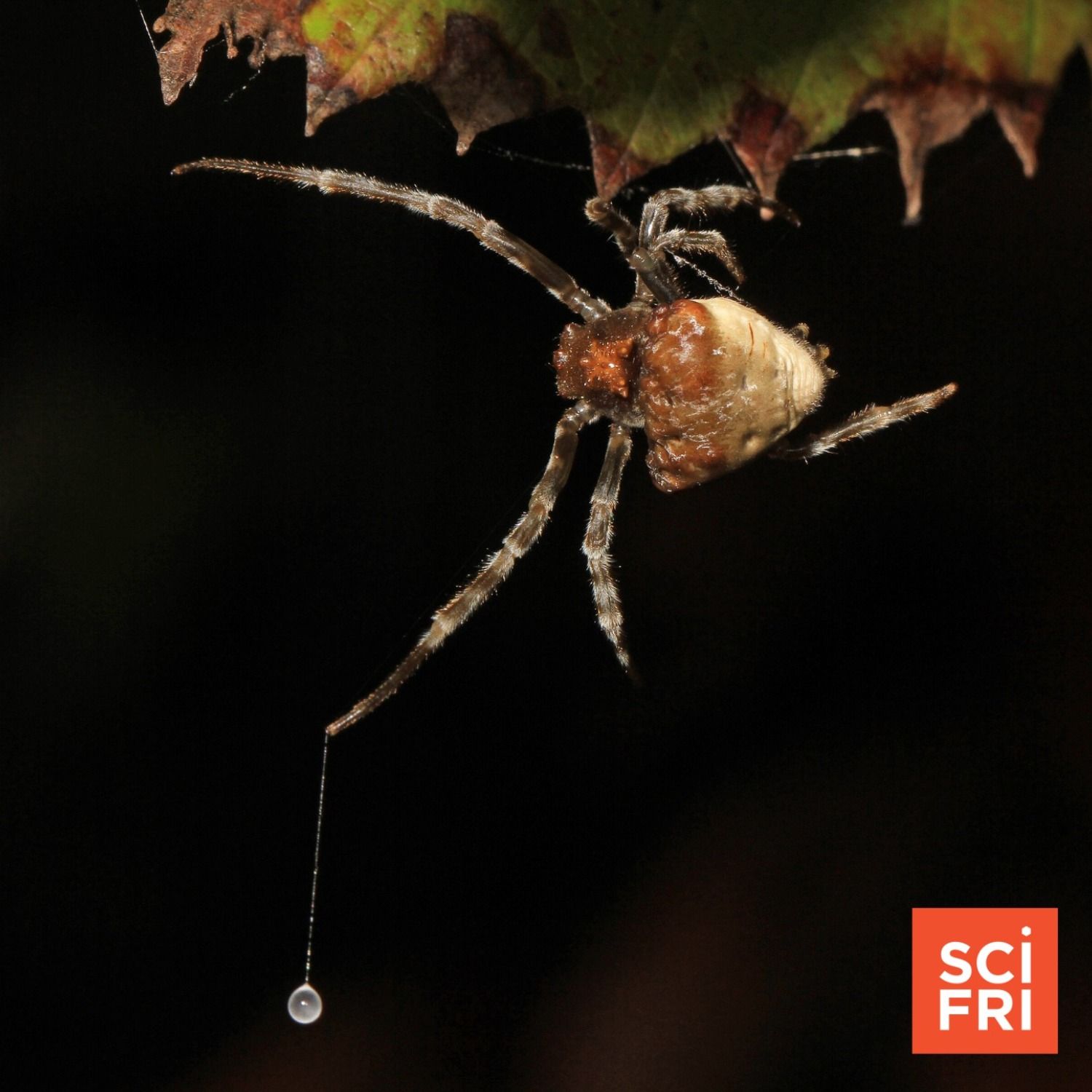
A listener recently called in asking how they might get a pair of functioning web shooters so they could operate as a local Spider-Man. While web shooters (sadly) don’t exist, we can say that the ways real spiders use silk put Peter Parker’s powers to shame. Spiders can use their sticky threads to sail through the air, capture prey larger than them, and even live underwater. And scientists trying to harness those powers.
Host Flora Lichtman chats with spider-silk aficionado Cheryl Hayashi about the wonders of silk, and Fiorenzo Omenetto shares how his engineering lab uses silk in the design of biomedical tools, like vaccines and sensors.
Guests:
Dr. Cheryl Hayashi is the senior vice president and provost of science at the American Museum of Natural History in New York City.
Dr. Fiorenzo Omenetto is a biomedical engineer and director of the Silklab at Tufts University in Massachusetts.
Transcripts for each episode are available within 1-3 days at sciencefriday.com.
Subscribe to this podcast. Plus, to stay updated on all things science, sign up for Science Friday's newsletters.

Transcript
WNYC Studios is supported by Odoo.
When you buy business software from lots of vendors,
the cost's at up and it gets complicated and confusing.
Odoo solves this.
It's a single company that sells a suite of enterprise apps
that handles everything from accounting to inventory to sales.
Odoo is all connected on a single platform
in a simple and affordable way.
You can save money without missing out on the features you need.
Check out Odoo at odo.com.
Hey, it's Flora Lichtemann and you're listening to Science Friday.
You may have seen that the next Spider-Man movie comes out this summer.
The trailer, which came out just this month,
hit a billion views.
Because I'm not just Peter Parker.
I'm Spider-Man.
And, relatedly, in a superhero story,
this would be called a twist of fate,
this question came in on our listener line.
My name is Christian.
I'm in Richmond, but, you know, I'm,
I'm healing from Pennsylvania, you know, the vibes.
I'm calling because I wanted to inquire about my ability to have a pair
of functioning web shooters so I can operate as a local Spider-Man
and I would love for you guys to let me know.
Okay, Christian, sci-fi to the rescue.
Although web shooters for now are the stuff of sci-fi,
the Spider-Verse did get this right.
Still seems to have superpowers.
So, what can Spider-Silk really do and how are people trying to harness it?
On the line is Spider-Silk biologist Dr. Cheryl Hayashi,
Senior Vice President and Provost of Science at the American Museum of Natural History.
Cheryl, thanks for joining me.
Thank you.
Off the bat, give me your first reaction to Christian's question.
I love that question.
We should always be inspired by nature.
And who doesn't want to have web shooters on their body?
I agree.
Is this a personal fantasy for you?
It's not a swing from buildings, but a personal fantasy for me would be
if I could be a spider for a day and actually have the coordination
and the ability to weave a web.
That would just be amazing.
To weave a web.
That would be your fantasy.
Why?
Why weave a web?
Because it's one of the most remarkable wonder structures that's a nature.
In order to make a web, a spider has to be able to make the silk.
And they make that silk in their body.
So, in their abdomen, they have little tiny glands that pump out silk protein.
And then they have little spinnerretts on their abdomen.
And they touch their legs to the spinnerretts.
And that's how they pull silk out.
And then they have to have sort of the right choreography in order to construct a web.
And that's just really hard to do.
It's just an amazing, amazing feat of engineering and design.
Yeah.
Okay.
I mean, I want to be able to picture this, like in Marvel movies, you know,
the silk is shooting out of, I guess, spinnerretts glands in Peter Parker's or Spider-Man's Rists.
What does it actually look like on a spider?
Each kind of so, a spider has many, many silk glands.
And most spiders have many types of silk gland.
And each has its own recipe, its own recipe of silk ingredients.
And so what comes out of, you know, these silk glands is a variety of different types of silk glands.
Some types of silk are really strong.
Some types of silk are stretchy.
Some are sticky.
Can they tune the recipe for the area of the web that they're making?
They do that in terms of, they use, they draw out a particular kind of silk for the particular architectural element of the web.
So for instance, the frame and sort of the radii, sort of the spokes, that's one kind of silk and a different kind of silk.
A much stretchier silk would be used as the spiral that gets laid on the spokes.
And so spiders are mixing and matching the different kinds of silks they make, depending on, you know, what they need to do with their silk.
So it's not really spider silk, it's spider silks.
Exactly.
There's not just one kind of spider silk.
Each spider makes at least one kind of silk.
And each type of spider silk is made up of its own, you know, set of proteins.
So that's why I always say silks.
So a lot of S's in there.
And there's over 53,000 described species of spiders.
And so if you kind of do the math, most of them make more than one kind of silk, there's a lot of silk out there.
A lot of spider silks.
Wow.
Like in the tens of thousands at least.
Oh my gosh.
Yes.
Yes.
Like yes.
What were you going to say?
I would add a few more zeros to that.
You know, we hear these big claims with spider silk.
Like it's stronger than steel.
It's tougher than kevlar.
Is that true for some silks?
Oh, yes.
It is true for some silks.
And you know, people might say, how could that, how could that be true?
You have to think about the scale.
So spider silk is often so thin.
You can barely see it.
So it's very fine fibers.
And so, but they're able to do things like, you know, stop flying insect.
Like that takes a lot of strength and toughness.
Yeah.
Okay.
Spider-man obviously shoots silk out and then uses it as a mode of transportation.
Do spiders use silk that way?
So spiders, they don't necessarily shoot silk out like the way, you know, spider-man does.
Spiders tend to more pull silk out or they might attach silk to a substrate.
Maybe it's, you know, the eve of your window or a branch.
And then they might use gravity to drop from it.
So that's a common way that spider silk gets, gets drawn out.
And then they can sort of walk on that line.
Some spiders, especially tiny little spiderlings, let some silk out.
And it functions sort of like, like a little parachute or a little sail.
So they can be caught by the wind.
And we call that ballooning.
So spiders can basically fly around the earth.
In fact, you can even find spiders at high altitude, little tiny spiders at high altitude flying with their drag lines.
So spiders never evolved wings, but they can fly with their silk.
That's wild.
Are there any other sort of lesser known uses of silk that we should call out?
Sure.
So some other lesser known uses of silk is there's another spider called a bolus spider,
which has changed their orb web down to a single line with a single ball of sticky glue at the end.
So it's like a little ball of snot with a little string attached to it.
And when insects approach that spider, that spider starts swinging that bolus.
And then that little sticky ball gets, gets stuck to the insect.
And the insect goes into tethered flight.
And the spider can reel it in.
I think that's a super cool use for literally being a web slinger.
A spider lasso.
I love it.
Yes.
Yes.
Okay.
I mean, here's the thing.
I don't think I'm speaking out of turn here.
I don't think I'm going to say anything that's surprising.
Spiders look are not particularly well loved.
I would say generally.
And yet they do confer this great power in one of our most beloved superheroes.
How do you think about our relationship with spiders?
Oh, that's a good question.
Of course, I don't really relate to this thing about, you know, spiders not being beloved.
I find them absolutely, absolutely fascinating.
And so, yeah, I think that.
I think it's fair, though, that they inspire, right?
I mean, they, they're so amazing.
They've been spinning silk for hundreds of millions of years.
They're nearly everywhere on an all terrestrial habitats.
There's even some spiders that live underwater.
So, I think they're, they've earned their place in terms of inspiring us.
Underwater spiders?
Yeah, there are a few spiders that live underwater.
They, spiders never evolved gills.
So, they do need to have air.
So, you might want to guess what they trap their air with.
I'm going to guess the most amazing, you know, material known to man, spider silk.
Yeah, they, they basically go to the surface and air sticks to their little hairs and their waxy body.
And then they can capture the air bubble and then they can put into their little silk chamber.
It's like a scuba tank, a spider silk scuba tank.
Yeah, yeah.
It's just, they basically, and they can hang out in there and that's, they can go back up to the surface and replenish.
There, there are some spiders that live, that live underwater.
There's spiders that live on the, on the shoreline and that high tide.
They'd be submerged and at low tide, they're out.
So, what they do is they live in little burrows and they have a little door on it and make a little waterproof door.
And you might want to guess what is that waterproof door made of.
Silk?
Yes, isn't just, just amazing.
It's like better than duct tape.
Better than duct tape.
Oh, I love that.
I mean, are people trying to harness the power of spider silk?
Like, is that it?
Is that a thing?
Oh, that's definitely a thing.
So, it's been long recognized that spider silk has these remarkable properties.
And so, there's been a considerable effort into try to understand what's the secret.
So, people study the silk proteins, they study the silk structure.
And there are people that study, you know, well, how can we replicate this?
Do we replicate it by sort of, do we mimic the structure, you know, using other chemical means?
Or do we actually try to make a lot of silk protein?
And there's research going on in all, in sort of all those areas.
What's the hardest part?
Is it the fabrication?
The fabrication does seem to be quite, quite difficult.
And it's just an amazing thing that, you know, when you see, you either watch a spider make a web or you just see, you know,
silk lying around your house or outdoors, that there's a little creature that's doing something that seems so effortless for them that is really hard for humans to do.
Dr. Cheryl Hayashi, Senior Vice President and Provost for Science at the American Museum of Natural History in New York City.
Cheryl, thanks for joining me today.
Thanks.
We got to take a break, but along those lines, when we come back, we're talking to a biomedical engineer who's trying to do just that to fabricate silk and use it for devices like sensors and implants.
Don't go away.
Science Friday is supported by Audible presenting Project Hail Mary.
One of the most beloved adventure stories by Andy Weir, Project Hail Mary, is now a major motion picture.
So there's never been a better time to immerse yourself in the best-selling audiobook.
As the sole survivor on a desperate last-chance mission, Ryland Grace must save the Earth from disaster, except that right now he doesn't know that.
He can't even remember his own name, let alone the nature of his assignment or how to complete it.
Part scientific mystery, part dazzling interstellar journey, Project Hail Mary is a tale of discovery, speculation, and survival to rival the Martian.
While taking us to places, it never dreamed of going.
Narrated by fan favorite Ray Porter, who brings every moment to life with humor, heart, and pulse-pounding tension,
listen to the audiobook available on Audible and watch the Black Buster movie starring Ryan Gosling in theaters now, Project Hail Mary.
Listen, watch, save the world.
Listen now at audible.com slash Hail Mary.
Science Friday is supported by Planet Visionaries, the podcast created in partnership with the Rolex Perpetual Planet Initiative.
If you're feeling overwhelmed by climate headlines, here's something different, a show about solutions.
It's called Planet Visionaries hosted by Alex Honnold, who you might recognize as the climber from free solo and skyscraper live.
Now Alex is turning his focus to the biggest challenge of all, protecting our planet.
Every episode brings you stories that aim to prove climate optimism isn't naive. It's a strategy.
You'll hear from experts and storytellers who are reshaping the future in practical and inspiring ways.
Upcoming guests include Gregor Cortine and Zosiline Block, a neuroscientist and neurosurgeon duo advancing spinal cord injury treatment with groundbreaking neural implants.
Episodes span the globe from Arctic scientists and Amazon forest guardians to entrepreneurs reimagining fashion and food systems.
In partnership with the Rolex Perpetual Planet Initiative, this is Planet Visionaries.
Listen or watch on Apple, Spotify, YouTube, or wherever you're listening to this podcast.
Up next, let's talk about fabrication and how exactly scientists are putting insect silk to use.
Here to pull that thread with us is Dr. Fiorenzo Omaneto, a biomedical engineer and director of the silk lab at Tufts University in Massachusetts.
Feel welcome back to Science Friday.
Thank you.
You run a whole lab devoted to finding silk applications. Why silk?
Oh, gosh. What a tough question to answer because from a material standpoint, it's a very nice technical material so it can be formed on the nanoscale.
It can interface with electronics. It can make very solid blocks and so have all these material formats that are very versatile.
But the thing that silk really does is it's able to store and preserve the activity of what you mix inside of it in these end formats.
An example is, for instance, if you take this glass of silk and you add some blood inside of it and then you pour it on the table and you let it dry, once you lift up a sheet of material that looks like plastic, like a red transparent film of plastic.
And you can leave it on the table for several months and then cut a little piece and send it to the hospital and then they'll take the blood out and your analysis, your labs from that blood are just as good as a fresh blood draw.
What?
It's like a craze. That's an amazing preservation device.
It's the one thing that makes working with this material very exciting because you can hide superpowers in materials.
So it's really a material scientist's dream. It gives a lot of opportunity to explore and domains that are otherwise very hard to explore.
And you use worm silk, right? Not spider silk.
We use silk worm silk. Yes, we use silk that commonly is used as a commodity material for textiles.
So there's an abundance of it and we deconstruct it into its liquid state so that we can then reform it into a variety of materials.
What is it about silk, like what's the secret sauce that allows it to do this, that allows you to store superpowers in a material?
I wish I could tell you that this was designed with purpose and equations and long hours, but I think that this is something that comes from directed evolution of, in this case, from domesticating the silkworm over thousands of years.
And ultimately the selection was to make the strongest, finest, the most lustrous fiber that would give you the supless scars and the best garments that you could weave.
But ultimately this gave a molecule, a particular kind of molecule that is very unusual in the way that it assembles.
And in the way that it interfaces with the materials that it's mixed with.
So I think it's really nature's offering in a way of a very technologically sophisticated polymer that happens to be very benign and very friendly to interface with the body or to disperse in the environment.
I mean, I feel like I always, I often see silk for, for sensors, you know, like biosensors or, you know, within the body or outside.
Is that again just because the silk can hold the actual sensing material and keep it stable in lots of different environments, or is it playing any other role?
Well, there's, there's a little bit of both. I think that the main, that the main advantage of the main feature is really that silk will, will stabilize chemistries that otherwise otherwise are confined to laboratories and to wet labs and to a lab bench.
And so, and so you can imagine really that you can make silk inks that contain enzymes that otherwise would need to be refrigerated and you can just print them on surfaces and then just look at the way that the surfaces react to the environment around them.
And so this is a very, this is a very nice way of using the stabilization function in the, in the bioavailability to do, to do all sorts of, all sorts of sensing from little adhesive patches and, you know, and band-aid type reporters to printed t-shirts that react to your body to tapestries that you hang, that you hang in a room and respond to the environment around it.
I do now want my t-shirts responding to my body more than they already do. Just saying, okay, are there silk uses in, in the wild that I might encounter at a store?
So, the process of, of generating silk pollution has been scaled up and has been put to industrial use in food preservation, in, in vaccine stabilization to give a couple of examples. And now the production has, has been scaled to very large amounts. So, so yes, you may encounter it in these, in these domains.
You know, I love that this very ancient biomaterial is being used in these kind of futuristic sounding ways. How do you think about that?
I think that it's beautiful. I think that there's a recontextualization of things, of things that used to be artisan skills and have been around for, for such a long time.
But there's a, there's a beauty in, in reimagining things and finding new context for, for materials that have been around for a long time.
Sometimes I, I talk about, I, I give this example of, of maybe there's an artisan in the world that is just the best person at doing, at doing shoelaces and, and braiding the best shoelaces on the planet. And this craft has been pushed out by industrialization and volume and scale.
But that craft becomes contemporary if the material that you use to make, to make the shoelaces now becomes a material that is medically relevant and can be used to replace ligament and tendons.
And so, and so all of these things that, that we have around and that have all these unbelievable properties, either from nature or from people using natural materials have.
I think a, I think a beautiful, a beautiful second life and maybe a third and a fourth life.
It's a lovely place to end. Dr. Fiorenzo Ominato is a biomedical engineer and director of this silk lab at Tufts University in Massachusetts.
Thanks for joining me. Thanks for having me.
I want to thank you Christian for dropping us a line and listeners, if you have a spidey sense about a certain question, you think we can help with, you've surfed the web but haven't found an answer that sticks, give us a ring.
We love hearing what you're interested in and we love looking into your questions.
877-4SyFry, 877-4SyFry, just leave us a voicemail.
This episode was produced by Russia Aredi.
I'm Flora Lichtman, we'll catch you next time.
At Nature's Bounty, the belief is simple.
You already have a brilliant body, supplements just help support your journey.
For over 50 years, Nature's Bounty has offered vitamins and supplements to help you eat, sleep, thrive or pee.
From magnesium glycinate or heart and muscle support to hair growth capsules for fuller, thicker hair and probiotics with 20 billion live cultures for digestion.
Nature's Bounty, it's in your nature to thrive. Learn more at naturesbounty.com.
These statements have not been evaluated by the Food and Drug Administration. These products are not intended to diagnose, treat, cure or prevent any disease.


