About this episode
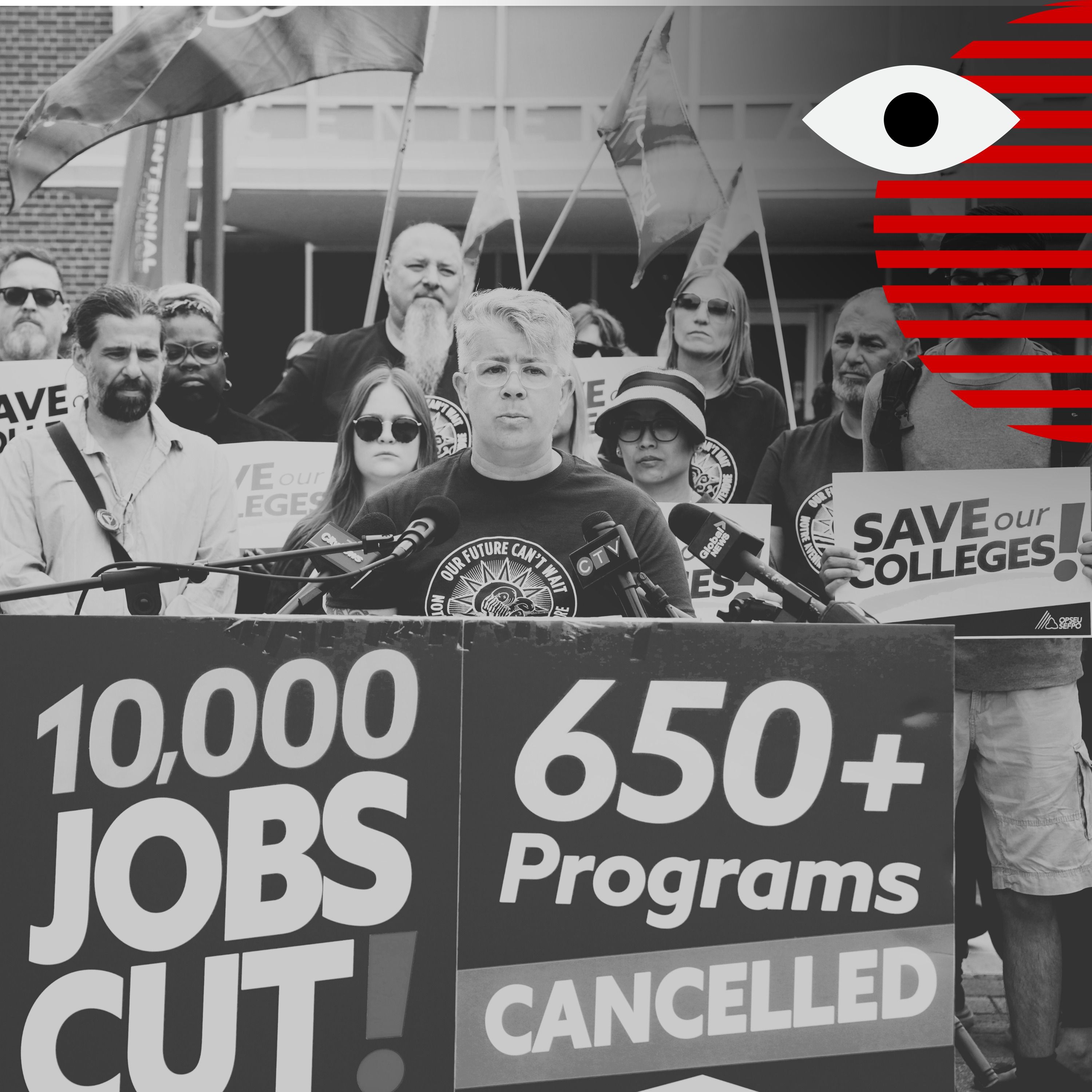
Decades ago, Ontario's colleges operated with a goal of improving local economies and regional communities. Now, Premier Doug Ford claims if you're not in a highly-skilled field, the baskets you're looking to weave are no where to be found.
With cuts to OSAP on the provincial level, and caps to student visas on the federal level, the mission of our colleges have seemed to have shifted towards keeping the lights on with as little investment as possible.
Host Maria Kestane speaks to Dr. Emilda Thavaratnam, an educator at Centennial College. She authored an article called 'Ontario’s colleges were founded to serve local and regional needs — have we forgotten that?'. The two discuss how the college system's ethos has shifted from locally-driven to profit-yielding, and how the province's most vulnerable are falling between the cracks.
We love feedback at The Big Story, as well as suggestions for future episodes. You can find us:
Through email at [email protected]
Or @thebigstory.bsky.social on Bluesky
Hosted by Simplecast, an AdsWizz company. See pcm.adswizz.com for information about our collection and use of personal data for advertising.
Get every episode summarized
Each time The Big Story publishes, we email you a written briefing from the transcript — the topics, who appeared, and any specific claims, with the ad reads skipped.
Email me new episodesFree for 3 shows. No card needed.
Hosts & guests
Transcript ready
301 searchable segments. Every word is indexed and playable.
Full transcript
The Big Story — Has Ontario lost its way with colleges?. Machine-transcribed; use the interactive transcript above to jump the player to any line.
Frequency podcast network, stories that matter, podcasts that resonate. Education in Ontario is changing right before our eyes. Whether it be layoffs of thousands of college employees, the termination of hundreds of programs, huge cuts to government-assisted grants, or ending the freeze of tuition prices. Sentiment on education, also taking a bit of a turn with Premier Ford urging students to... You have to invest in your future into in-demand jobs because a lot of the students, I'm not one to say, you know, like you're picking basket-weaving courses and there's not too many baskets being sold out there. Go into healthcare, go into trades, go into jobs of the future. As our provincial government warns of the need for healthcare workers or people in the
trades or the need for people in tech, it seems to have drifted far off from the original purpose of Ontario's college system, which was to stimulate local economies and communities. Not just for the type of work, but also how the system is funded. What used to be propped up by a public financial model now is a system that relies on private donors and heavily on international student fees, which we know will become less frequent due to caps on student visas. So how has the Ontario College system shifted form from its original purpose and is there a way to restore that vision in a province that so heavily focuses on its bottom line? I'm Maria Castan and today on a big story, I'm speaking to Imilda Thavaratnam, an educator at Centennial College and the author of an article called Ontario's Colleges were founded to serve local and regional needs, have we forgotten that?
And that's exactly what we're talking about today. Imilda, thank you so much for joining me today. Thank you for having me. Can you begin by telling me a little bit about how and why the college system was created in Ontario decades ago? It's very interesting, the College of Applied Arts and Technology, they were established in 1965 under William G. Davis. He was the Minister of Education at the time and then later he became the premier of Ontario. And so there's this document called the Basic Documents and you can find these documents in the Ontario Department of Education archives. And this really outlines the original purpose of the college system. And it was meant to provide an accessible alternate pathway for students to serve their communities. And so this gave colleges a unique purpose to fill and need that universities did not. So Davis, he proposed a model of affordable, accessible, vocational education to prepare
students for the workforce. And so this was actually a result of the post-war period in the 60s and there was a real shift in our economy from agricultural to an industrial service-based economy. So what that meant was that there was a real growing demand for community service workers, and office administrators, nurses, and the focus was to really have a regional and local support for communities. And I just want to continue with discussing two important facts. There were two important acts that were passed during this time on the federal level. And this made the Ontario College system possible. So the first one was the Technical and Vocational Training Assistance Act. And this was in 1960. And this helped Ottawa join with provinces to fund the capital costs for these sort of training facilities. And so within the six years, there were 662 new schools and roughly, you know, 439,000
student placements. And a lot of these institutes were converted to community colleges. And then I wanted to mention one more act, the Adult Occupational Training Act. This was passed at the federal level as well. And this act focused on training and supporting underemployed and unemployed students. And this was for short-term retraining programs. This act was really, really important because it experimented with methods which would motivate and train adults who were, you know, educationally disadvantaged. So maybe they were out of school for a while or didn't have access. And over time, this program revealed that there was a real need for basic adult education because there were many Canadians at the time who would not even qualify for retraining, right? And, you know, I, this is becoming a little long-winded. But I wanted to mention this because what this shows is that there was a real public investment behind the college system right from the beginning.
So, and at the time, a founding, right, the majority of funding came from the government to with tuition being modern, but to the majority was from the government. And how was the financial model set up originally? Like what did that look like? So at the time, right, so Ontario colleges, we have a long history of funding. So they had an older cost-sharing model at the time or out of a matched provincial spending very directly. So basically, they would share the cost with provinces funding the majority of it. And like if we take a step back at the history of funding, the biggest change to funding started in 1977 under Prime Minister Peter Trudeau. And that was when the government introduced established program financing or EPF. And that shared the initial older cost-saving model where Ottawa matched provincial spending
directly. So what happened at that time in 1977, the first major shift, we see, is instead provinces received what's called block transfers. And this was for health and post-secondary education. So the federal government would give provincial government a block transfer. And this was first instanced where federal support became less visible and less directly tied to college funding. Then as time progressed, 1995 was a much sharper turning point. And you might remember this under Jean-Christienne, the government replaced the earlier agreements with the Canada Health and Social Transfer. And that reduced federal support for social services, such as post-secondary. And then at the same time, under Premier Mike Harris, you know, the common sense revolution, one billion was cut from education in the early years.
And that impacted post-secondary education very much, even as enrollment was growing, right? And then we have in 2005, the Ray Review, which marked another shift. This was led by former Ontario Premier Bob Rae for adult to make it these government. And he argued that, you know what, colleges and universities should be judged more by results they produce. So things like graduation rates, employment outcomes, student success, and it sort of laid the groundwork for more of an outcomes driven approach. And then in 2019, we have Premier Doug Ford, colleges faced another major revenue shock because domestic tuition was cut by 10%. And that cut was followed by a big freeze, which was just recently lifted. And even though the freeze was lifted, tuition increase were capped now at 2% a year.
And that's leaving colleges with very little room to shift, right? Because of inflation. And then in 2024, there was a big crisis that just hit under Prime Minister Justin Trudeau, the federal government and choose introduced a cap on international study permits, right? And that is what is kind of broadest to the current crisis, which colleges are undergoing right now. And I should actually have really mentioned the funding model for colleges, before I talked about the history, which is really important to understand. So how the funding model works is the federal government provides funding to provinces through the Canada social transfer, which I mentioned. And that's funds services, right, like post-secondary social assistance and so forth. And on the provincial level, the government distributes these funds. And the Ontario government doesn't just decide how much funds a college receives.
It controls how much colleges can charge by setting tuition rules. They decide the freeze or limits on tuition increases. They also decide how fund things distributed, such as do we fund them on factors like jog market demands or performance outcomes, or is it simply about how many students are finishing a program? So it's not so much about how many students a college have, but it's about how students perform. Now one key factor I wanted to mention that I find very interesting was at the federal government, at the federal level, the government plays a key role because they make immigration policies. So one example is that recent federal cap on international student enrollment. This immigration policy directly impacts the way colleges are functioning, right? And their ability to stabilize and function.
So that's sort of a history of the funding model and where we are right now in the current crisis. Yeah. I want to dig into all of what you just said. Specifically, I want to talk about that international student piece because I hear in Ontario, we are so dependent on international students and the revenue they bring. But as you said, back in 2024, we're now seeing these new cuts to international student permits. I mean, since when did Ontario's, I guess post-secondary institution in general, but I guess because we're talking about colleges here, we can stick to colleges. When did our colleges become so dependent on international tuition? Yeah. I think there wasn't a pivotal moment, like there wasn't a month or a year. It was over. It was through decades of the shift in funding, okay? And one of the most important pieces of information that I find important to this conversation
is that Ontario is behind the rest of the country on public funding, okay? And this is really important. According to the Financial Accountability Office, you know, operating funding for colleges was about 7,900 per domestic student in 2024 and 2025. And the FAO office estimates that the total college spending per student is about $17,600. So what that means is colleges face a large gap between what the province provides and what it actually costs to educate students. So they have to make up the difference through tuition and other revenue sources, right? So over time, through this structural change in funding, what happened was students were trying to stabilize and finance through other revenue sources and one of them being international
students because international students pay double the amount, right? And the problem is that, you know, if you look at the student tuition freeze in 2019 as well, right? Over the last five years, inflation has, you know, there's a consumer price index report that says 19.9% over the last five years, right? So in order to sustain themselves, internationalization became a primary source of revenue, right? And on the federal level, you know, they made it possible. The federal government made it possible for colleges to recruit international students. They made it an attractive study destination by having the postgraduate work permit. So what that meant was once you graduated an institution in Ontario, you have eligible for pathways to funding work and permanent residency, right? So it was a gradual shift over time and because of this, right, international students paid
a significant amount, right? Like in 2020, 2021, in Ontario, there was 1.7 billion in tuition from international students. So education sort of became an export and a function pillar to our economy. So it was over time through structural shifts in funding. You mentioned, you know, the recent changes to, you know, funding in Ontario in terms of post-secondary institutions like OSAP, you know, OSAP is going through a pretty big overhaul in terms of its structuring, you know, changing how much a student can get in terms of grants compared to loans. And as you said, those, those, that the lifting of that tuition freeze, how do you see those changes affecting post-secondary education across Ontario? Yeah. So, you know, in February, Ontario responded with 6.4 billion post-secondary funding package.
This is over four years. And this funding is mainly, you know, aimed at workforce priorities. So things like skilled trades help care stem. And it also includes a 6% increase in base student funding for full-time students. And it's ended the tuition freeze like you mentioned for up to 2% a year for the next 3 years. So this tells you two things right away. First the crisis had become too serious to ignore. And then secondly, the province is acknowledging that the old funding model is not sustainable. But the bigger question is that is this going to be enough? Because Ontario colleges, you know, they have a sector that's still facing a deficit. So the colleges of Ontario actually mentioned that there's a deficit of 1.5 billion projected up until 2027. And the problem is that this funding is also closely tied to labor market demands. And what this means is that, again, they're going away from William G. Davis's original
mission and vision, right, of local, regional, accessible needs, right? And then at the same time, we have students who are being asked to carry the cost again through tuition increases. So what Doug Ford has recently mentioned is that he is reducing grants and increasing loans. So this doesn't really replace the revenue colleges that have lost. It's just showing how the burdens being shifted and redistributed to students, right? And the deeper concern is when funding is tied to economic demands and measurable outcomes, we're judging education more narrowly by job placement and short-term economic returns. And again, string away from Davis's original mission of community development, lifelong learning, the arts, local culture, community services, right? So again, we're just shifting the burden onto our students right now, which is very unfortunate.
And it's very refreshing to see that students are leading the way advocating for themselves through the protests downtown. And I find that very, very reassuring and positive. And hopefully, our leaders will listen. In your article, you discussed this idea of broadening marketization of higher education. Talk to me a bit about that. How is that played a role, especially considering how colleges were made and designed with wanting a distinction from universities? How is that played a role, this marketization of higher education? Like I mentioned in the history, we talked about funding and we talked about, give you one example, under Brian Melruany, right? He had a really big focus on the marketization. So he was really focused on austerity measures. So under his common sense revolution, he was really focused on constraining fees, right? So reducing the educational funding.
And what happened was it was leaving institutions to focus on ways of sustaining themselves and stabilizing themselves through sort of, I guess, marketized approach. And when we say marketized approach, we can look back to this ideology called neoliberalism, right? And you might have heard of that term before and it is sort of an economic ideology that says when you have minimal government intervention, when you deregulate, when you privatize that the economy does well. But what's missing right now is that when you have that ideology, you focus on, you miss the most important part, which is the social services and programs get cut. And as a result, education increasingly functions as a business entity, rather than for the good, right, of, you know, local and global development, right?
I'm curious to know, like what is, what is, what's the simple solution if there is one? Do we need Ontario to fund more and to pay more out of pocket or do we need a complete overhaul of the system? Like how do we, how do we kind of migrate back to that original goal that was set out for Ontario colleges? Or is that goal not applicable anymore? Is it, is it not relevant to the realities of 2026? You know, that's such an excellent question. It's something I think about a lot. And I think it's, we need to shift the way we fund and think about colleges. And I'm speaking about colleges because that's where my experience lies. Being faculty at various colleges over my time and seeing the way students experience education. So, I think first, you know, Ontario needs to close the per student funding gap with
the rest of Canada, provide stable, predictable operating funding that keeps pace with inflation enrollment. And you know, without that increase of funding, colleges will continue to rely on unstable revenue sources. And then secondly, I think we need to international education needs to be stabilized. That means that we need better federal provincial coordination so that immigration policy, housing capacity, institutional funding are aligned. And I think that, you know, colleges play a key role in workforce development. But they also support communities, lifelong learning, especially in smaller rural regions. And these are part of the systems that need to be funded and protected, right? We need to have honest conversations about cost sharing methods, you know, if colleges are public institutions, then we need to have public funding bear a large share of that
cost rather than shifting the burden on to students, right? Like the current crisis, there's projected, there's a projection of 8,000 layoffs, right? 600 program closures, campus closures. And this is really important because when we think about local and regional needs, this is especially impacting students in rural communities where colleges and programs are being shut down and it, you know, affects their access to education. So I think it's a holistic approach and, you know, it needs to start by having an honest conversation and for our leaders to pay attention. My final question for you, in terms of that honest conversation, like, how do we make sure that all Ontario taxpayers are getting, I guess, a return on investment? I mean, people in northern communities are more rural communities, you know, paying
taxes and not seeing that return to their, you know, municipalities or their local communities. How do we make sure that the Ontarians across the entire province are getting the same access and the same benefits of the college system here? I think it's really about holding our community leaders and MPs accountable and advocating. So like I mentioned, going back to the funding gap, right? So participate in these advocacy campaigns, right? If you see protests, local protests, join them, email your MPs, you know, we need to start making sure that the taxes we're paying are supporting our students and the newer generation. And we really need Ontario to close the per student funding gap with the rest of Canada. We are 40% behind and is really affecting the way students are experiencing education
and students that will not have access to education, right? Like even with the recent OSAP changes, you know, we need to see advocacy, we need more grants for students, especially in these communities that can afford to, you know, go to school. So advocacy, calling your employees, MPs all very, very important. All right, Mildem, I'm going to leave it on that note. I really appreciate your insights on this. Thank you. Thank you for having me. And that was the big story. How do you think Ontario's college system or post secondary system for that matter has changed throughout time? I want to hear your thoughts and opinions. Send them our way at hello at the bigstorypodcast.ca or find us on blue sky at the big story. If you have episode ideas, I'd love to hear them as well. The big story publishes new episodes every weekday morning and don't miss our weekend lessons. And of course, make sure you catch big headlines, our daily five minute news show hosted
by Vergesche Day. You can listen to it right here on the big story. I'm Maria Castane, thanks for listening, we'll catch you tomorrow.
More episodes
More from The Big Story

Big Headlines: Canada and the U.S. mourn 9/11 on the 25th anniversary of the ter...
The Big Story

What happened to our attention spans?
The Big Story

Big Headlines: Carney convenes his cabinet in Alberta and Trump vows American ad...
The Big Story

The age of technological imperialism
The Big Story