Loading...

newsdaily
Hegseth claims 'historic battlefield victory' over Iran
About this Episode
As a fragile ceasefire begins, both the United States and Iran claim victory. US Defence Secretary Pete Hegseth says Iran will no longer enrich uranium, and that Operation Epic Fury has destroyed Tehran's ability to build missiles or other sophisticated weaponry. Iran has broadcast triumphant messages of victory on state TV, warning that "the slightest mistake by the enemy will be met with full force".
Despite statements from Iran and mediators Pakistan that fighting will cease on all fronts, Israel says Lebanon is not included in the two-week truce, and has announced its "biggest strikes" since the start of its ground operation there. Our correspondent reports from Beirut, where the government says Israeli strikes have killed dozens and wounded hundreds across the country.
As both parties prepare for negotiations, scheduled for Friday in Pakistan, will they be able to find a long-term agreement to end the war?
The Global News Podcast brings you the breaking news you need to hear, as it happens. Listen for the latest headlines and current affairs from around the world. Politics, economics, climate, business, technology, health – we cover it all with expert analysis and insight. Get the news that matters, delivered twice a day on weekdays and daily at weekends, plus special bonus episodes reacting to urgent breaking stories. Follow or subscribe now and never miss a moment. Get in touch: [email protected]
Hosts & Guests

Transcript
You're listening to the Global News Podcast from the BBC World Service.
Hello, I'm Oliver Conway.
We're recording this at 15 hours GMT on Wednesday, the 8th of April.
The US and Iran both say they're ready for further negotiations after agreeing a two-week ceasefire,
but has the world changed forever?
Iranian just realized, the Irish you see realized they have a more lethal weapon in their hand than nuclear weapon.
It is a straight-up homeless.
Global oil prices have fallen and stock markets are up,
but Israel has carried out its heaviest strikes so far in its latest conflict with Hezbollah in Lebanon.
We'll hear from Beirut, Washington and from Inside Iran.
A total and complete victory for America or a crushing defeat.
The US and Iran have very different viewpoints on the significance of their two-week ceasefire.
President Trump agreed to hold off on his threat to wipe out an entire civilisation
after Iran came up with a ten-point proposal that he said could form the basis of a long-term solution.
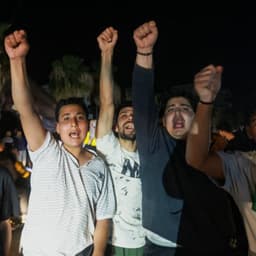
Iran denied backing down and broadcast a triumphant statement.
The honorable, great and heroic nation of Iran,
the enemy has suffered an undeniable, historic and crushing defeat in its cowardly, illegal and criminal war against the Iranian nation.
Well, that was the Iranian view.
For his part, the US Defense Secretary Pete Hegseth said it was Iran that had been defeated.
Operation Epic Fury was a historic and overwhelming victory on the battlefield,
a capital V military victory.
Iran accepted the ceasefire under overwhelming pressure.
The new Iranian regime understood that a deal was far better than the fate that awaited them.
They know this agreement means that they will never, ever possess a nuclear weapon.
Now we have a chance at real peace and a real deal.
The US and Iran are expected to begin negotiations in Pakistan on Friday to try to reach a permanent agreement.
President Trump has outlined his view of where things stand on social media.
James Menendez heard more from our Washington correspondent, Ioni Wells.
We've had a couple of different posts from Donald Trump saying, for example,
that there will be 50 percent tariffs imposed on countries who supply military weapons, for example,
to Iran, also saying that Iran will have no nuclear material.
Something that we heard from Pete Hegseth as well is this idea that we've heard from Trump too,
that they're essentially going to get Iran to hand over nuclear material,
nuclear dust, as they call it, to the United States.
Now, they haven't been particularly specific about what that might entail,
but Pete Hegseth seemed to suggest in this press conference that if Iran doesn't do that,
then they know exactly what Iran has and where it is and that they will essentially go in and take it out.
Now, it isn't clear where negotiations may be about this,
but we do know from what Donald Trump has said previously on this matter,
that the U.S. understands any enriched uranium that Iran may possess is varied, for example,
deep under rock and underground and the mountains in some cases, and therefore would be pretty difficult
to extract. So, I think the suggestion seems to be that if Iran doesn't simply hand it over,
there could well be quite significant further military action in future.
Yeah, and on the negotiations more broadly, I mean, there is this 10-point plan that Iran has
put forward that's been circulating. I mean, at the moment, both sides look a long way apart,
is that fair? Yeah, I think so. I think in the short term, this ceasefires achieved what the
U.S. initially wanted, which was the state of humours being reopened, but we have to remember
that is a benefit that existed before this war even started. Iran only closed the
state of humours as leverage in response to attacks from the U.S. and Israel.
So, while Iran has significantly been weakened following weeks of this war,
the U.S. and Iran are now negotiating things that Iran wants and didn't really have leverage
on in the way it does now. These include things like providing compensation to Iran, lifting sanctions
on Iran, ending not just this war, but other conflicts. Also, allowing Iran to maintain control
over the state of humours going forward. Yes, Iran has agreed as well not to pursue a nuclear weapon,
but that has always really been Iran's position publicly. Now, it's not clear if the U.S. and Iran
will agree to any of these points at all, meaning we could just be back to square one, back to where
we were last night, again, in two weeks' time. I think the next two weeks are going to be really
key to show who gives or takes more in these negotiations, but also if this ceasefire holds,
because both rounds of nuclear talks in the past year between the U.S. and Iran, both direct and
indirect ones have been interrupted by military escalation, by strikes on Iran, by the U.S. and
Israel. Has there been a political cost for the White House over this war? I mean, there has been
criticism from many points on the political spectrum, hasn't there? Yes, that's right. I think
increasingly as the war went on, there were Republican voices voicing dissent, as well as
Democrat criticism, too, largely because of the economic cost of the war. The impact we saw
domestically on gas prices, on stocks, the markets, reacting. The impact that had on the cost
of living at a time that Donald Trump's ratings have been slipping more generally in a year where he
does face midterm elections, I think also there were concerns among some Republicans about his
promise not to engage in more foreign wars when he was campaigning to be re-elected, and then,
of course, the U.S. engaging in this one. So I think there has been a political cost. I think also
internationally, while a ceasefire has now been agreed at least temporarily, many of the U.S.'s
allies won't forget the language that Donald Trump used last night, threatening that a whole
civilisation would die if a deal wasn't reached. That is, language that is more extreme than he
has used previously in their conflict. And I think we'll trouble a lot of his allies going forward.
I only wells in Washington, and we have more on this on YouTube search for BBC News on our YouTube
channel, and you'll find the global news podcast in the podcast section there. Iran has avoided a
massive onslaught on its civilian infrastructure, but a regime hated by many Iranians remains in power.
So how is the ceasefire going down there? Our colleagues from the BBC Passion service
have been receiving messages from inside the country. I think the unfair situation in Iran will
continue. Things will become normal, but unfair. The war will end, but I have a few questions for
those who support the war. Has the Islamic Republic been overthrown now? Has freedom arrived?
Well, J.R. Goh from BBC Passion gave his assessment. What we are seeing on state control media
television, and also, for example, the Iranian ambassador to Kuwait published an AI-generated video
of Donald Trump walking down from Air Force One and with a white flag and kneeling on the tarmac,
I think that's a sentiment. Iranian media trying to depict and selling to their bases inside the
country. We won, and we stopped the most powerful nation on earth, United States, and Israel. And I
think that's the kind of images we see, but as you just mentioned, there is a lot of people
opposition groups inside Iran, or extremely worried about the situation, because even in the
midst of this war, the Islamic Republic of Iran is still executing those protesters who were
arrested in January, and some of them were arrested three years ago in the nationwide protest.
It is all the sign that the regime is still worried about the scent inside the country, because
as the war stops, the economy is in a very dire situation. I know, for example, a restaurant owner,
I talked to him, myself, he said, in the past six weeks, he hasn't been able to sell anything.
He was thinking about if this war continues, he has to shut down his restaurant. And I think
that's the kind of issues we have to wait and see in the coming months. The economy has been
crippling the situation in the country's dire, how to resume cope with the scent inside the
country. Yeah, they've lost many leaders, but how strong is that control on the country?
I think at this point of time, we could say, with confidence, it is the revolutionary guards
in effect controlling the country, because in the past, almost six weeks, we haven't heard
much from the president of Iran. You would expect the president of the country come out on
occasion. It was most of the time, the revolutionary guards' commanders were coming out and
talking about the future, whether the war continued or the war stopped. And even right now,
ISNAN News Agency, one of the Iranian news agencies says, Mohamed Bakr Khalibaf, the speaker of
parliament, and one of the former powerful revolutionary guards, commander and hardliner,
close to former Supreme Leader of Iran, who was killed on the first day of war. He would be
having the negotiation team, Iranian team in Pakistan. And I think all the sign is,
it is the revolutionary guards who's controlling the country at this point of time.
And they will be standing firm on their demands not to give up all their nuclear material to
keep control of proxies and to control the straight of whole moves. Exactly. I think if you look at
the ten points, the Iranian have submitted. It doesn't say we will halt nuclear enrichment.
It says, we do not pursue nuclear weapons. That has been something in the past decades. Iran
has repeatedly saying that our Supreme Leader issue a fatwa, religious duty, that we do not pursue
nuclear weapons. And I think one thing we should understand at this point, I think Iranian just
realized, the IRGC realized, they have a more lethal weapon in their hand than nuclear weapon.
It is a straight of war. By disrupting the movement of the shipment right now,
they force the United States come to the negotiation table, or at least agree to a ceasefire.
G.R. Goal of the BBC Pershing Service. Israel says it's now observing a ceasefire
with Iran after completing an overnight wave of strikes there. But it is continuing its war
with the Iranian-backed group Hezbollah in Lebanon, which it says is not covered by the ceasefire
deal, contradicting statements from Iran and the mediator Pakistan. In the past month,
a fighting more than 1,500 people have been killed in Lebanon, and a million residents forced
to leave their homes, according to the authorities. Today, Israel carried out the heaviest attack yet
of its current conflict with Hezbollah. The sound of a strike on southern Lebanon on Wednesday
morning, the southern suburbs of the capital Beirut were also hit, as I heard from our
correspondent Linus Injeb. Well, it's really, if a word can't describe it, it's a hell on earth
because there were dozens of airstrikes across the country, but especially year across Beirut,
in my street by itself, to my left, one street up from me, a building was hit, and to my right,
by the seaside, an area that is really condensed with people, another airstrike happened. These are
all within proximity of less than 10 minutes walk from me. So imagine the situation across
other parts of the city, you know, in Kornish Mezra, in Beir Hassan, they were all coordinated within
the same minutes. I mean, when the strike took off, my building was shaking, my windows were rattling,
and I was just like in total fear. And then the ambulances started, and then people were rushing,
and then the phone started to ring, everyone's checking if people are alive, because these are
really civilian areas that were targeted, and they're really saying that they've hit almost
a hundred locations simultaneously. It's really scary. The red christened here saying they're not
even able to cope with the demand, and with the cause of for ambulances, for rescue,
we're not sure about the death toll at this moment, but this is a pattern that reminds me
of the last war, just today before the ceasefire. Also, there were mad airstrikes across the city,
in random areas, civilian areas, very populated areas. So it may be the sign that this is the
last day of strikes, but it is really, really frightening. That's interesting, because Hezbollah
earlier today was talking about a possible ceasefire announcement coming up and calling from
restraints. I mean, is there any way of clarifying whether this overall deal between the US
and Iran does cover Lebanon? Well, the Israelis already said it's not. They continued with their
warning, with their airstrikes, but actually they really intensified. All the airstrikes that
happened, you know, an hour ago or less than an hour ago, were not listed in the evacuation
orders that were, you know, issued in the early hours of the morning. And Hezbollah did not confirm
that they are part of the ceasefire, but they warned people from heading back to their towns and
villages, because they were worried that if people are heading back, they would be more airstrikes.
So that's also a sign that there hasn't been an agreement that includes, you know, Lebanon in this.
But analyzing the pattern that Israel is doing today is really similar to the day before the
ceasefire was announced in 2024. And I think maybe this is a wishful thinking for many Lebanese
thinking that, okay, that's the last round. It's intensified already before this round. The
death toll was 1,530 this morning. So it's it's it's really increased now, but it's hoping that it
will be the end. Lena Sinjab in Beirut. Neri Zilba is a correspondent for the financial times
based in Tel Aviv in Israel. He told James Menendez why Israel was attacking Lebanon despite the
U.S. Iranian ceasefire deal. So I'll say a couple of things. Number one, from the very beginning
of the war with Iran, Israeli officials that I spoke to and that my colleagues spoke to,
were very clear that even once the Iran front ended, that Lebanon would continue and that Israel
would actually free up military assets, primarily air assets devoted to Iran to then be directed
towards his bala in Lebanon. So that was the thinking for what five weeks now. But again,
the uncertainty this morning kind of clouded that. So in and of itself, this escalation by Israel
against his bala in Lebanon was not a surprise. What was a surprise was that this was not included
in the overall ceasefire deal between the U.S. and Iran that is now at least going to last for
two weeks. And so it seems that Netanyahu was given a free hand by the Trump administration
to do exactly as he wanted to do. And then the third thing I will say, the domestic politics behind
this here in Israel, there was a lot of concern this morning that Netanyahu had been forced
to stop not only the war against Iran, but also against his bala, at least on one front. He got
his wishes. I mean, is the war still, what Israel's doing? Is it still popular in Israel?
I believe so. I mean, according to opinion polls, even a week ago, the majority of the public,
especially the Jewish Israeli public, wanted Israel to continue the war against Iran and against his
bala in Lebanon. And so right now, there's, look, I'll head just slightly, it's a Jewish holiday
today. So the overall official public reaction has been quite muted. Muted will get a likely more
deliberate response from the Israeli government later this evening after the holidays over. But I
think, especially for Northern Israeli residents, the fact that the offensive against his bala was not
halted as part of this overall ceasefire with Iran is actually good news. They've been demanding
a more forceful military response against his bala to, in their words, put a stop to the threat
emanating from Lebanon, but obviously the toll on the Lebanese side only growing. And again,
it remains fairly clear that Israel was given a green light by the Trump administration to actually
escalate in Lebanon. Nari Zoba from the Financial Times in Tel Aviv.
Still to come on the podcast. America started this war along with Israel in the belief that
their overwhelming military superiority would force the Islamic Republic to collapse or capitulate.
And it's done neither. Where do the US and Iran go from here? We have analysis from our security
correspondent.
You're listening to the Global News podcast. The ceasefire was announced in the early hours of
Wednesday morning by Pakistan's Prime Minister Shepaz Sharif. And his country will now host
talks on Friday. Our Islamabad correspondent Caroline Davis told us how Pakistan, which shares a
land border with Iran and also has good relations with the Trump administration, has positioned
itself as a trusted intermediary between the US and Iran. Well, Pakistan really does have skin
and the game when it comes to trying to find a solution that means that this crisis, that this
conflict doesn't escalate any further. For example, the fact that Pakistan is highly reliant
on imported oil that's the straightforward news and the increased cost of oil is already
having a real impact here in Pakistan. And the fact as well that Pakistan has got a defence
pact with Saudi Arabia. So if the conflict was to expand, Saudi Arabia to get involved, would they
ask Pakistan to also get involved in that defence pact? And then Pakistan is in a very difficult
position of having a conflict with Iran, which would be likely to be very highly unpopular here
in Pakistan amongst the public. Many of whom are much more sympathetic to Iran than they are to
the US and Israel in this conflict. All Pakistan's in the difficult position of saying no to Saudi
Arabia is an important economic ally. But in terms of the exact role that Pakistan might play in
that sort of intermediary role, that's still really unclear. I think that will also be down to
exactly what level of delegation we see here arriving in Pakistan. Both sides do send. And I think
that's the other thing that's really crucial. This Pakistan source that I spoke to last night,
I also spoke to again this morning. And they've talked about the fact that this is still feeling
relatively fragile. So whether we will start to see some more solid language coming out from
Iran, from the US, talking about who they might be sending to delegations, but we might hear more
from Pakistan about exactly how these talks might take shape. Those are the sorts of things
that we're waiting to hear more about in the coming days. Caroline Davis in Islamabad.
After the ceasefire was announced, the oil price fell sharply and stock markets rose.
But the global economy will take time to return to normal, particularly if Iran continues to
exert control over the state of whole moves. The International Air Transport Association says
jet fuel suppliers could take months to recover. Asia Business Correspondent Nick Marsh told me more
about that. And first, the significance of oil dropping below $100 a barrel. The price of oil
underpins the price of everything, doesn't it? I mean, you were just talking about jet fuel there.
That's just one example. That doesn't just mean your ticket prices for your flights are going to
be more expensive. It means that the transportation or food or any goods that comes in via air is going
to be more expensive. Oil is needed to make plastics to power factories to fill your car.
It's just gas as well. We talked a lot about oil, but gas has been stuck near the streets of
whole moves. You need that to make fertilizer to heat homes, what have you. So the lower these
energy costs are generally the lower the cost of living is. And we have seen that bounce reflected
in the stock market oil price of oil going down. Gas expected to go down. And indices in Asia
ending the day much higher. So about 7% in South Korea's cost be more than 5% in Japan's
Nikkei index. And we're expecting the markets which have opened now in Europe to go up as well.
And then when Wall Street opens up a bit later on in the day, that will surely see a bounce.
Now we saw the problems arrive for the world economy very quickly after the war started.
Why will it take so long to unwind? Because basically at the moment, the traffic going through
the strait of hall moves, assuming that it does start flowing. We haven't actually seen
concrete indication of it flowing. But assuming the ceasefire holds, assuming that some peace
talks do get underway, that's just the oil and gas and cargo that's in the water already.
That's going to take a bit of time to clear in terms of that blockage, but it will start flowing.
But the problem is production. Production is, I mean, it's not ground to a halt, but it is
effectively collapsed in the Middle East. You know, countries such as Saudi Arabia,
Iran, UAE, whatever, they said it's not the point producing oil if we can't send it anywhere,
if it's got nowhere to go. And oil production and the infrastructure and all the logistics,
you can't just turn it on like a switch. So it's going to take months for that production
to reach the levels it was before the war. So for many months now, we're going to have
a quite lowered supply, and therefore prices are still going to be high. The below $100
is a barrel, but that's still pretty high. Nick Marsh in Singapore. Under the UN Convention
on the Law of the Sea, ships are supposed to have a right of passage through waterways like
the Strait of Hormuz. An Iranian official said it would reopen on Thursday or Friday,
but crews would still have to coordinate with the Iranian military. So how might the deal affect
the shipping industry? Mark Label spoke to Jacob Larson from the Baltic and International Maritime
Council. What I hope to see is that the authorities issue some sort of guidance to the shipping
industry on how to conduct transits in the Strait of Hormuz. And from the looks of it, with Iran
announcing that they want to retain control of traffic, that means that we are going to need some
more information from the Iranians on how they see this. Obviously also the American side we need
to have a say. Currently the shipping industry is maintaining a closed dialogue with the American
military and the international maritime authorities in the area. And what we hope is that they
will be able to issue some more guidance to the shipping industry on how to conduct the
transits safely. Do you think we could see trade routes redrawn now? Because people wouldn't want
to be subject to stoppages like this in the future. So thinking of Saudi Arabia's Red Seaports
and expanded pipeline capacity, maybe offering an alternative energy corridor and looking at the
UAE's east coast as well? Yes, clearly something on everyone's mind. Can this happen again? And how
do we mitigate the associated risks to the economy and of course to the people involved? So I'm sure
that all stakeholders are now thinking in terms of contingencies and what we can do to reduce the
impact of any future incidents. Shipping is a business that is used to dealing with risks.
And while this has been utterly unpleasant, it has still been manageable so far at least.
But of course we hope that repetitions can be avoided in the future.
Jacob Larson, with the ceasefire in place, is there now a sense of relief across the Middle East?
I asked our security correspondent Frank Gardner. There is, but it's very much
tempered with skepticism. I think really this is a case of kicking the can down the road,
kicking the problem down the road because the fundamental gap between the two sides negotiating
positions, the US and Iran, is still very wide. It's hard to believe that the US is going to pay
reparations to Iran, which it's insisting on. Is it going to accept and will its gulf allies
accept Iranian dominance over the straighter four moves? I mean, Iran has said, yeah, that's fine.
For two weeks, ships can pass through, but they need to be checked over and it needs to be done
in coordination with our own military, the Revolutionary Guards Corps. In other words, this war
has left Iran in a strategically stronger position, militarily weakened in terms of its hardware
and the number of commanders it's lost. But if you look at the big picture strategically,
it now controls the straighter four moves, which it didn't before. But at least if there is a
cessation of bombs falling on Iran and missiles heading the other way, it gives
cooler heads a chance to prevail, doesn't it? Yes, it certainly does, and I mean,
pretty much everybody wanted was an end to this. But don't forget that yesterday Bahrain
has had the rotating presidency of the UN Security Council. It had its motion defeated,
or blocked by Russia and China, which was a fairly watered-down proposal to have a kind of defensive
mechanism, a military but defensive mechanism to basically police the straighter four moves.
And that was shot down, as it were. So there is still a lingering problem over the straight
four moves. Yes, it's certainly better than having missiles flying. The problem is that I think
America started this war along with Israel in the belief that their overwhelming military
superiority would force the Islamic Republic to collapse or capitulate, and it's done neither.
They've totally underestimated the resilience of that regime, a regime which showed
absentee no hesitation in slaughtering thousands of its own people in January, and they didn't
seem to see it coming, that Iran would play the Hormuz card, which it always threatened to do.
Everybody in the region knew that they could do this, and yet Donald Trump said that he was
surprised that they did this. Frank Gardner.
And that is all from us for now, but the global news podcast will be back very soon.
This edition was mixed by Darcy Obrey and produced by Richard Hamilton.
Our editors Karen Martin, I'm Oliver Conway. Until next time, goodbye.