Loading...
About this Episode
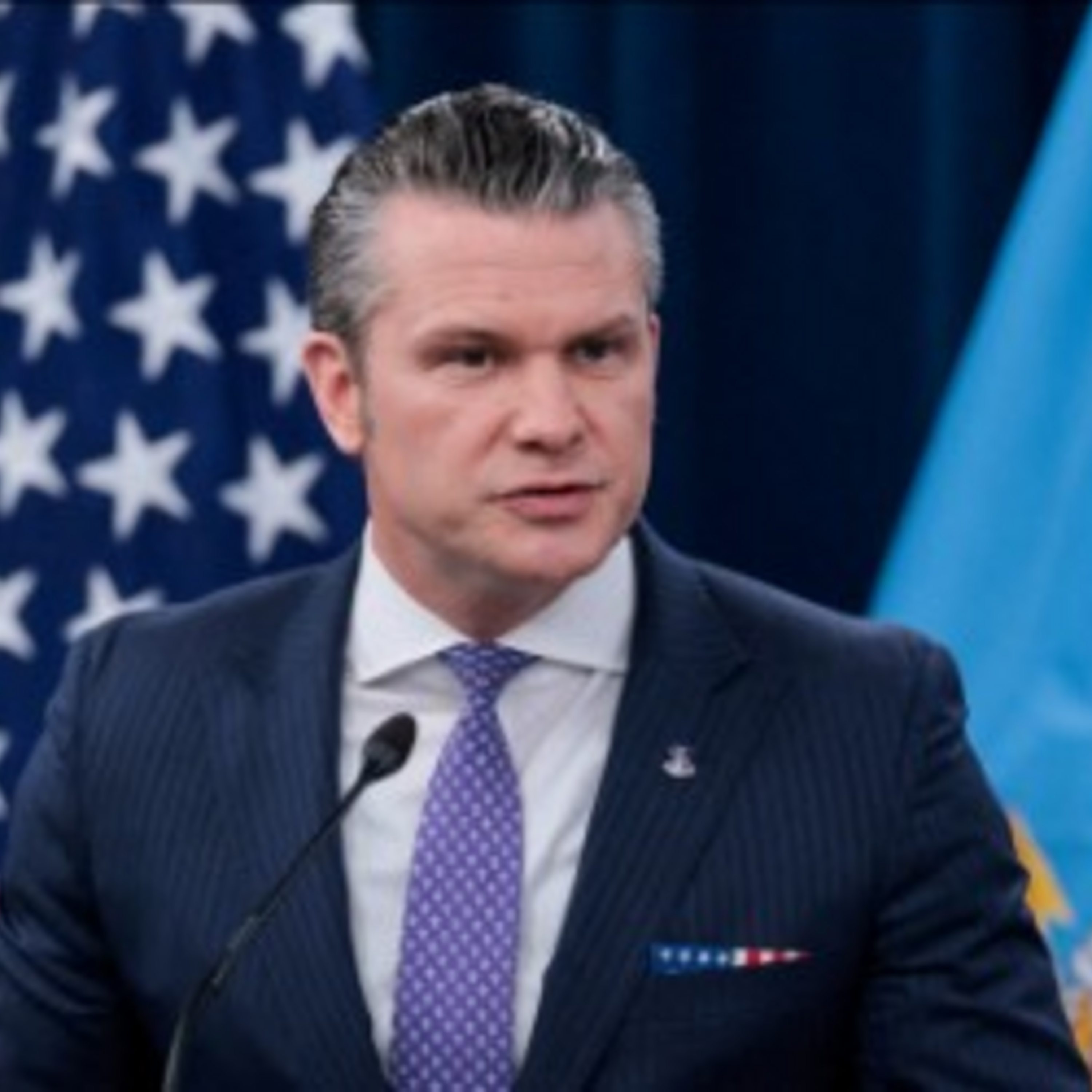
US Defence Secretary says President Trump is willing to make a deal to end the fighting, but if Iran doesn't accept the terms, the war will continue. Also: Israel's defence minister says his country's forces will destroy all homes in Lebanese villages adjacent to the Israeli border. The medical charity MSF says rape and sexual violence remain part of everyday life in parts of Sudan. Eurovision - the world's longest-running international music competition - is heading to Asia. And the organisers of a Barbie-themed festival in Florida agree to issue refunds after customers complained that the event was not as advertised.
The Global News Podcast brings you the breaking news you need to hear, as it happens. Listen for the latest headlines and current affairs from around the world. Politics, economics, climate, business, technology, health – we cover it all with expert analysis and insight. Get the news that matters, delivered twice a day on weekdays and daily at weekends, plus special bonus episodes reacting to urgent breaking stories. Follow or subscribe now and never miss a moment. Get in touch: [email protected]
Hosts & Guests

Transcript
This BBC podcast is supported by ads outside the UK.
Puerto Rico is having a moment of global attention.
As companies reassure and rethink supply chains,
they're choosing a US jurisdiction operating under federal law
with competitive tax incentives designed for long-term growth,
not culture or business, culture and business.
Puerto Rico, it's not what's next, it's where.
Visit investpr.org forward slash business.
It's 2009 and we're in the German mountains,
a man straps himself into a car on the world's most dangerous racetrack.
He whispers to himself.
It's time to put my balls on the dashboard.
If he starts the engine.
In 15 minutes, he's in an ambulance on conscious, in 15 years, he's a billionaire.
This is Total Wolf, Formula One's most powerful team boss,
and the breakout star of Drive to Survive.
This week on Good Bad Billionaire,
how Total Wolf made his billions.
Listen wherever you get your BBC podcasts.
This is the global news podcast from the BBC World Service.
I'm Charlotte Gallagher, and at 16 hours GMT on Tuesday, 31st of March,
these are our main stories.
The US Defence Secretary has claimed that America is closer than ever
to winning the war against Iran,
and the Iranians would be wise to make a deal with President Trump.
We're in Lebanon at a displacement centre for refugees,
as Israel says 600,000 people won't be able to return to their homes
for the foreseeable future,
and we look at the horrific toll of Sudan's civil war on women and girls.
Also in this podcast,
I hope people leave feeling empowered, excited,
and that their love for Barbie was reaffirmed.
The Barbie experience that definitely wasn't a dreamhouse.
The war in Iran grinds on,
and with conflicting and shifting messages from President Trump on his aims,
many are keen to get clarity about what the US wants to achieve
and when the conflict will be over.
For the first time in 12 days,
the US Defence Secretary Pete Hegseth
has been giving a briefing to journalists.
He said talks with Iran a very real, active, and gaining strength.
If Iran is wise, they will cut a deal.
President Trump doesn't bluff and he does not back down.
You can ask Kamenia about that.
The new Iranian regime should know that by now.
This new regime, because regime change has occurred,
should be wiser than the last.
President Trump will make a deal he is willing.
And the terms of the deal are known to them.
If Iran is not willing, then the United States War Department will continue
with even more intensity.
And just before the US Secretary of Defence spoke at the Pentagon,
President Trump said Iran had essentially been decimated.
Directing comments at his allies, he also said,
all of those countries that can't get jet fuel because of the
straightforward moves, like the United Kingdom,
should get their own will and start learning how to fight.
So does this look like there could be an end to the war?
Leyla Nathou put that question to our international editor, Jeremy Bowen.
I think they'd like a way out. I certainly think that
it's become so much more complicated than ever they expected,
with potentially pretty important, not to say potentially even seismic global
economic implications, and the US will not be able to remain isolated from that,
so they'd like to have a way out.
However, the thing about saying that they're decimated, meaning destroyed is what it means.
Well, they're still hitting back. I mean, that's the point.
The other day at the White House, his press secretary was saying,
they have to accept their beaten.
If you have to accept whether or not you're beaten,
being beaten in war is not a choice.
It's a reality. And if you can fight back, the chances are you're not beaten.
And as for the assertion that regime change has happened,
the Iranian regime is not just about the faces at the top.
It's about the system.
And while the faces may have changed because they've killed so many of the leaders,
the system hasn't changed.
It is based on institutions, not on individuals,
and that is why it has proved to be so resilient.
And that is why I think that they are, of course, will always have loads of tough rhetoric.
But the reality is, the Iranians have, in a sense, even gained much of the initiative,
despite the fact that undoubtedly, they're getting absolutely pounded and shattered
in so many different ways.
So Iran has the initiative, what then is the likelihood of negotiations,
which Pete Hegseth is again talking up the prospect of a deal?
It's really hard to say the degree to which they're actually talking,
because on one side, the Americans are saying it's going amazingly,
their desperate for a deal, we're going to get a deal.
The other side, the Iranians are saying there've been some contacts through third parties,
but that's about it.
And their declared public objectives are way apart, way apart.
So it's really hard to see how that gap gets bridged,
unless both sides decide what the heck and leap into this unknown middle ground.
And I don't see that happening.
So what do we go from here?
Well, essentially, it's decision time for Trump.
He can find a way to say, right, we're done,
and maybe they're preparing to do that.
Some kind of victory narrative that says, look, they're decimated,
there's been regime change, that's it.
We're going to stop now.
And then when it comes to the business of the strait of all moves,
it's ironic it's opening it has become a war aim,
because of course, when the war started with the American and Israeli attacks on the 28th
of February, it was not a war aim to open the strait of all moves.
Why? Because it wasn't closed.
It's been closed in response to the American and Israeli attacks.
Could they end the war?
Could the US declare an end to the war with the strait still blockaded?
They could do what they want.
I mean, they're very powerful country, and they have a very willful leader
whose mood seemed to be shaping policy rather than a sort of consistent and professional study.
Now, the FT North America editor has got Donald Trump's mobile number.
He called him over the weekend, and Trump answered.
And if you look at the things that this guy, the head loose, has been saying,
he says things like, well, Trump seemed to be all over the place.
He seemed to be casting around for policy options.
I think they're in a bind right now.
And while they are moving troops to the region and quite some considerable numbers,
enough to take maybe one of those key islands, they don't necessarily want to do that,
because it is a risky matter and they will lose soldiers.
So they would like a way out.
But I mean, the idea of this kind of abuse that Trump throws out saying,
you just come out and take the oil.
In other words, if you're man enough, go and get it.
I mean, it's playground stuff, really.
It's not how states should or ought to be behaving.
Jeremy Bowen.
Israel has said it will destroy all homes in Lebanese villages along its border
and keep control of a large sway of southern Lebanon
after the current conflict with Hezbollah ends.
The Defence Minister, Israel Katz, said more than 600,000 people would be unable to return,
unless the safety of Northern Israeli residents was guaranteed.
He drew a parallel with previous Israeli operations in the Gaza Strip.
Just as in Syria and Gaza, the same will be in Lebanon.
The IDF will defend the residents and communities from within enemy territory.
We promise to protect the northern communities,
and that is exactly what we will do.
Our Middle East correspondent, Yolan Nell, in Jerusalem,
told us more about those plans set out by the Israeli Defence Minister.
What he's doing really is giving a lot more details about Israel's military plans
going forward in southern Lebanon.
And he's talked about creating this buffer zone,
said that the area in the very south of Lebanon will come to resemble
Bit Hanun and Rafa in Gaza following the Gaza War.
That's the very south and the very north of the Gaza Strip.
We're during the war, there were these wide-scale demolitions.
He's also said that even after the current operation against Hezbollah is completed,
Israel will keep control, he's calling it security control,
of this wide area of southern Lebanon right up to the Latani river,
saying that more than 600,000 people who live in that area,
who were told earlier in the war by the Israeli military to leave,
that they will not be able to go back to their villages
until the security of the residents of northern Israel is guaranteed.
The authorities in Lebanon say more than 1,000 people have been killed
and hundreds of thousands displaced by the strikes,
many families not for the first time.
Karin Torbi of BBC Arabic is in southern Lebanon in one of the biggest displacement centres.
I am in what was or what is supposed to be a faculty of the Lebanese university.
It's several buildings and they have turned into shelters.
They were supposed to be classes and classrooms,
but they have turned into shared rooms for families.
We've seen lots of people from different ages.
This is the biggest displacement centre,
in the southern side and in the city and in the south.
It was one of several vibrant cities in the south,
but now it remains probably the only one.
Where life is relatively normal,
after lots of areas have become war zones
or have been included in the blanket evacuation orders that was issued by Israel.
I also met newborn babies.
They are just four or five days old twins, two brothers.
Very tiny, very cute, but just a slip in a place
where you would have never imagined.
You want babies, everything is extremely depressing.
I can hear behind you, it's noisy, it sounds quite chaotic.
And as you say, there are families there trying to bring up their children,
protect their children the best they can.
These people who had houses, rooms, toys,
and now they are completely uprooted.
They are uprooted from the area.
Most of them, they have experienced traumas of the war.
So you can imagine also that they are not in their best mental shape.
Also, they are now really unaware of what will happen.
They're just living day by day, hour by hour.
And their biggest fear is first that this war might drag on and on
and their conditions might deteriorate even further.
And second, that they might see their land, their houses occupied by Israel.
If it does what it says, it's once to do by expanding the borders
or creating some sort of a security zone as Israelis call it.
And basically that they might never be able to go back to their land.
And you can hear more from Lebanon on our YouTube channel.
Search for BBC News on YouTube and you'll find the global news podcast
in the podcast section.
There's a new story available every weekday.
Still to come in this podcast.
I think it's going to be fun.
I think it's going to be crazy.
I think it's going to be unpredictable.
But yeah, I think it should be pretty unmissable.
The biggest party in European music, Eurovision, is heading to Asia.
It's 2009 and we're in the German mountains.
A man straps himself into a car on the world's most dangerous racetrack.
He whispers to himself.
It's time to put my balls on the dashboard.
If he starts the engine.
In 15 minutes, he's in an ambulance on conscious.
In 15 years, he's a billionaire.
This is Total Wolf, Formula One's most powerful team boss
and the breakout star of Drive to Survive.
This week on Good Bad Billionaire, how Total Wolf made his billions.
Listen wherever you get your BBC podcasts.
The Civil War in Sedan has left thousands of civilians dead
and displaced millions.
But another distressing element of the conflict
has been widespread sexual violence against women and girls.
Now, report by the Medical Charity MSF
says abuse by armed men has become part of everyday life
in the Western Darfur region.
Darfur is under the control of the paramilitary group.
The rapid support forces are Africa correspondent Barbara Pettuscher.
Tell me more about the report.
The MSF report was based on more than 3,000 survivors
of sexual violence who sought treatment at their clinics.
But there are many, many more MSF says
because it's difficult to access care.
Services are scarce.
Traveling any distance is not secure.
And there's a social stigma to admitting that you've been raped
and it is very wide spread.
So the MSF reported or documented rapes
that were carried out in hot conflict zones
in northern Darfur, especially during the fall of the city of Elfashar.
Very disturbing accounts of very violent rape, very often gang rape,
ethnic targeting, Arab fighters targeting non-Arab communities.
But they also documented rapes carried out
regularly in South Darfur, which is not on the front line.
And there the report said rape had just become
part of everyday life.
Women were raped on their way to the market.
They were raped working in the field.
Again, often gang rapes.
And this they said MSF said is rooted in previous decades
of conflict, gender discrimination,
and frankly complete impunity.
What did the RSF say?
I remember in the past Barbara,
you've reported on appalling stories of even tiny children
being raped by their fighters.
Well, it has to be said that all of the warring parties in Sudan
are accused of sexual violence.
That includes the regular army and its allies,
as well as the RSF.
But Darfur is the stronghold of the rapid support forces
and the vast majority of survivors,
sexual violence survivors, identified the perpetrators
as RSF fighters.
The MSF report did say there was a significant number of victims
under the age of 18 in South Darfur, for example,
including 41 under the age of five.
Although in South Darfur, it was not just armed men,
which you also had criminal gangs and sometimes intimate partners.
But the RSF leadership has admitted
that individual violations were committed
during the takeover of El Fasher in particular.
It says these are being investigated
and the scale of atrocities it insists was exaggerated.
And is there anything that can be done
because this just feels like a desperate situation
that shows no sign of ending anytime soon?
Yes, both of those things, desperate
and it feels like there's no sign of ending.
So what MSF says is there has to be accountability.
It says that the parties that have influence
with the fighters should press them to protect civilians.
There should be the international groups
that monitor human rights violations,
should press forward with accountability measures.
It says there should be money by donors
to improve services for sexual violence.
And it also says there should be a greater presence
of UN agencies on the ground.
And if they're not,
then donor money should be given to local
and international NGOs that are.
Over more than five decades,
hundreds of thousands of children
from developing nations were sent
to Western countries to be adopted.
But concerns about fraud,
forged documentation,
and unethical practices in recent years
cause several European states
to halt into country adoption altogether
or significantly restricted.
Now a growing number of children
removed from their countries of origin
are returning as adults
to uncover their roots.
Stephanie's one of them, as she tells Tanya Dutta.
I spent a year in an orphanage here in Mumbai
and this is where I've been adopted
from by my French parents.
And now you're back.
And now I'm back.
And now I'm trying to reconnect with my birth story.
Stephanie's French.
She's 39 and she was adopted from India
when she was just a 16-month-old baby.
Stephanie had a happy childhood
with her adoptive French parents
and freely admits she was never interested
in her roots.
Nor her birth mother,
because this is what she was told.
I was abandoned.
It was on paper.
So you move on somehow.
It's not like the story was,
oh, she could not keep you.
I didn't have that.
I just have a line on the paper
and saying you've been abandoned.
Parents are known and that's it.
So you have to move on too.
You have to grow up with that.
Absolutely abandoned and destitute.
That's what it said on Stephanie's adoption document
from the missionaries of charity orphanage.
And that paperwork also stated
it should be considered Stephanie's birth certificate too.
But when we visit our undole,
co-director of adoption rights council,
a non-profit helping Indian adoptees
reconnect with their roots
and a leading anti-adoption activist,
he tells her the orphanage shouldn't have done this.
So this is just issued by the missionaries of charity.
This is nothing.
It's worse nothing.
They have no authority to issue a birth certificate.
Birth certificate can be only issued
by the Bombay Municipal Corporation
with Decent Births Registrar.
This was done to concede your original identity.
Aaron Dole, who's an inter-country adoptee too,
believes it was all about smoothing the way
for Stephanie's adoption in France.
And he says most Indian adoptees weren't abandoned
with unknown parents,
as Stephanie's believed all her life.
Those children were usually born
to unmarried teenage women.
So what has been done here systematically
is separating young,
single mothers,
from their babies.
There was no informed consent.
No free will,
social pressure,
pressure from the agencies,
and the demand from adoptive parents
to have a child.
And that created systematic child trafficking.
And that may be a crime against humanity.
For Stephanie, listening to Aaron,
it's the first time she's really encountered
critical views of inter-country adoption.
In the French family,
full of love,
very nice,
and with this nice story about adoption,
and then you come to this country
and you realize,
it cannot all the time be
as it has been told.
And also,
he has a very strong point of view
on international adoption,
on being a crime against humanity,
being like child trafficking.
Obviously, I did not grow up with this opinion.
Didn't change my opinion also.
I fully agree on there's some abuse,
but I would strongly disagree on every adoption is this case.
At least my story,
I didn't feel it that way.
Tanya Datter reporting.
It was conceived 70 years ago,
as a way of bringing Europe together.
It's got the music,
the costumes,
millions of fans,
and the occasional dash of global politics.
Now, your vision,
the world's longest running international music competition,
is heading to Asia.
Broadcasters from 10 countries in the region
have already confirmed
they're taking part in the contest.
They'll each hold national selections
before the final in Bangkok in November,
so why the expansion?
Rob Lillie Jones is the host
of the Euro-trip podcast.
He's been speaking to Leyla Nathoo.
I think one of the reasons is
because of the huge popularity of Eurovision,
the contest that we know
in the Asian continent.
And there are so many potential viewers for this programme.
The Eurovision team have been saying
potentially 4.7 billion people live in Asia
who could conceivably watch the show.
So it's a huge untapped market.
Why do they need the Eurovision brand,
as it were?
Do they not have their own regional seeing contest
or even national ones that could be more popular?
What does Eurovision think it's got to offer?
That others don't?
Well, they hope that this will be a competition
that celebrates the cultural identity
of all of the participating nations.
And you've got a country like South Korea
they're taking part.
And obviously, you know,
PayPal, absolutely massive.
But then also you've got smaller nations in there,
like Cambodia, Bhutan, for example, Laos as well.
So the amount of different musical genres
and different cultures that are going to be celebrated,
all in that one show in Bangkok,
in Thailand on the 40th of November.
I mean, I think one thing that we will potentially see,
and again, this is one thing
that the team behind it are hoping we'll see,
is that artists from Asia will be looking at Eurovision Asia
as a platform to, of course,
introduce themselves to a wider market across Asia.
But also, we have heard that there are hopes
that the winner of this first edition of Eurovision Asia
will then go on to perform at the 2027 edition
of the Eurovision Song Contest, wherever that may be.
So then giving them a platform, of course,
even further around the globe here in New York as well.
What do you expect to be that sort of vibe of Eurovision Asia?
I think it's going to be fun.
I think it's going to be crazy.
I think it's going to be unpredictable.
But yeah, I think it should be pretty unmissable.
Rob Lillie-Jones.
Finally, the organizers of a Barbie Festival in Florida
have agreed to issue refunds after customers complained.
The event was not as advertised.
The creators of the Barbie Dream Fest weekend
had promised an unforgettable experience.
But many families who paid hundreds of dollars for tickets
were left underwhelmed as Richard Hamilton explains.
The event at a convention centre in Fort Lauderdale
was billed as the perfect place to let your imagination soar.
And there certainly was a lot left to the imagination.
Visitors found a mostly empty grey warehouse
with a scattering of pink Barbie props.
The larger-than-life interactive dreamhouse
was a cardboard cutout with a strip of artificial grass,
a picnic blanket, and a camper van.
The 80s disco roller rink was a cluster of metal barricades
arranged in a rectangle.
Speaking before the complaint started rolling in,
Michael Corrigan from Barbie Dream Fest
talked up the experience.
Barbie dared you to dream big.
You know, and I think that like,
it's been really fun to see this concept come to life
and seeing how much people have taken to it.
I think there's so much opportunity to further grow it,
whether that's to other cities.
But I hope people leave feeling empowered, excited,
and that their love for Barbie was reaffirmed.
The event was not cheap.
A single-day adult pass cost $72.
Those who paid $250 for all three days
got a swag bag with Barbie hand sanitizer.
The experience has drawn parallels with other famous flops.
There was the infamous Willy Wonka chocolate experience
in Glasgow in 2024.
Families arrived to find a virtually abandoned warehouse
on an industrial estate where embarrassed actors
tried to make the best of a bouncy castle,
and a woman dressed as an umper-lumper
became an unlikely internet sensation.
And before that, there was the disastrous fire festival
in the Bahamas in 2017.
Guests paid up to $100,000 for luxury villas
at what was supposed to be a music event on a private island,
but they were greeted by rain-soaked mattresses,
disaster relief tents, and cheese sandwiches.
In the case of the Barbie Dream Fest,
at least the financial nightmare seems to be over.
Mattel announced that all tickets
would be fully refunded by the event creator,
mischief management,
which licensed the Barbie brand from their company.
He's not just Ken.
That was Richard Hamilton.
And that's all from us for now.
If you want to get in touch,
you can email us at globalpodcast.bbc.co.uk.
You can also find us on x at BBC World Service.
Use the hashtag globalnewspod
and don't forget our sister podcast, The Global Story.
This edition of The Global News Podcast
was mixed by Daniella Verella Hernandez
and the producer was Marion Strong.
The editor is Karen Martin.
I'm Charlotte Gallagher.
Until next time, goodbye.