Loading...
historysocietyculture
Historic lighthouse saved by a nonexistent ghost ... but was she, really?
About this Episode
But did Lischen M. Miller create the story of Muriel Trevenard, the mysterious young woman who came to Newport in the 1870s and vanished ... or did she merely write down a story that locals whispered to each other on stormy nights? (Newport, Lincoln County; 1870s, 1890s, 1940s) (For text and pictures, see https://offbeatoregon.com/1709a.muriel-trevenard-evan-macclure-yaquina-bay-lighthouse-ghosts-459.html)
Hosts & Guests
Transcript
Good morning, Oregon. I'm Finn J.D. John, FJ at OffbeatOrgan.com, and this is the daily
Offbeat Oregon History Podcast. Thanks for downloading, and I sure hope you enjoy the
show today.
The story was first published on September 3rd of 2017. Under the headline, Ghost
may never have existed, but she saved Equine Bay light. It is a rewriting and thorough
re-researching of a much shorter column first published in December of 2009. Here we go.
Next time you're in Newport, on the Central Oregon coast, if you haven't yet, take a few
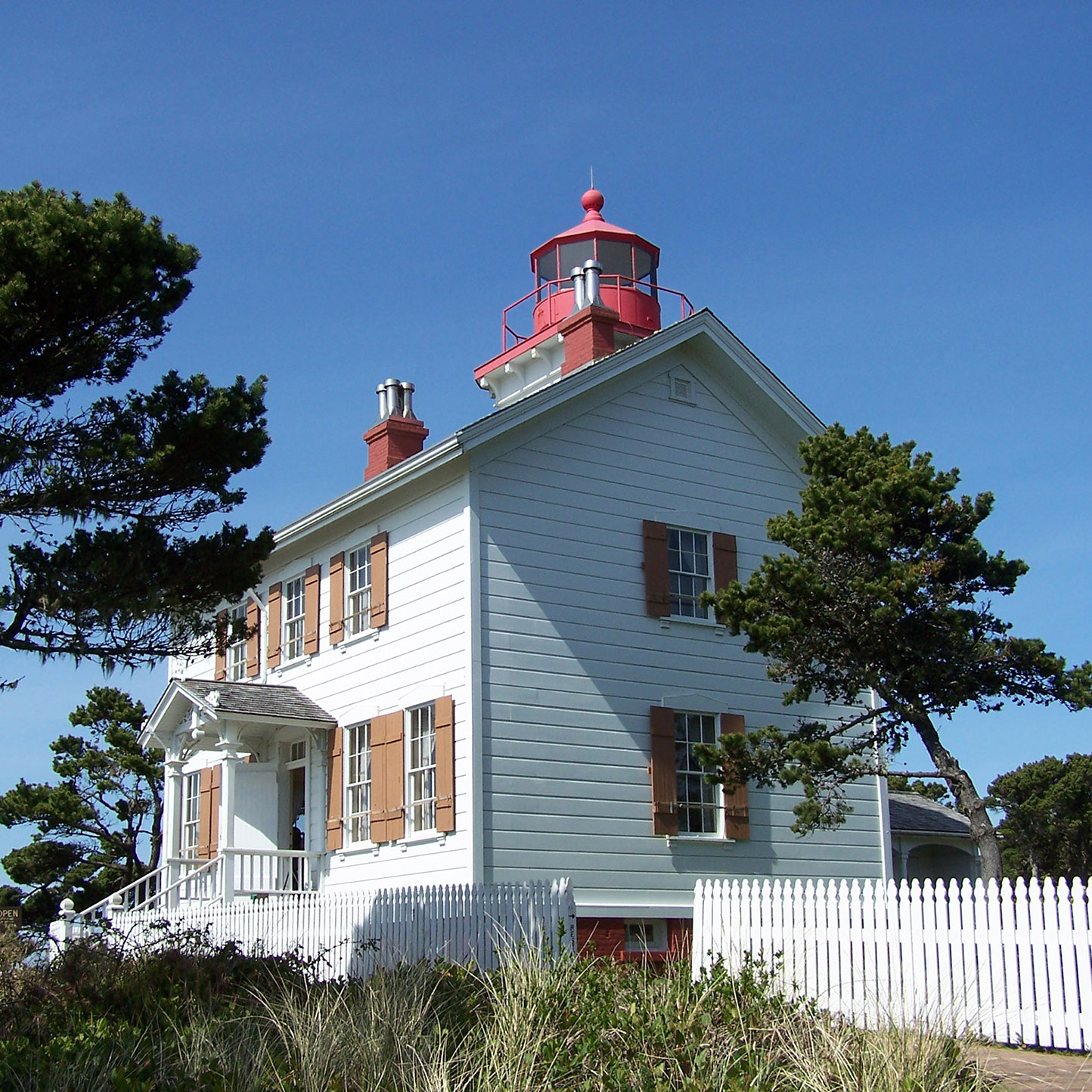
minutes to check out the Equine Bay Lighthouse. It's the only lighthouse I know of in Oregon
or elsewhere that was saved from the wrecking ball by a non-existent ghost. At least I
think she was non-existent. The ghost's name is Muriel Trevinard, and she was born on
a dark and stormy night in the late 1890s when Eugene resident Lysian M. Miller, the sister
in law of poet Joaquin Miller, created her as a character in a story called The Haunted
Light at Newport by the Sea. In this charming and magnificently shuttersome little 24-hundred
word story, Miller wove a gripping story of a mysterious young woman left at a Newport
boarding house by her seafaring father who plans to pick her up in two weeks. She takes
up with a group of tourists from the valley who are camping nearby. One day the group
of them decides to explore the old Equine Bay lighthouse, a small structure built in
an unfortunate spot in 1871, and shut down for good just three years later to be replaced
with the Equine Head Lighthouse a few miles north. The story takes place just a year or
two after that closure, so probably 1875. Equine by the way is spelled as if it should
be pronounced Yaquina, but it's a Native American name rather than a Spanish one, so
Yaquina. Inside the abandoned lighthouse, the adventurer is
find a secret door leading to a shaft that apparently runs all the way down through
the sandy bluff to a sea cave. A chill fog moves in and the explorers decide to go leaving
the secret door open behind them. As she is about to leave the girl, Muriel, realizes
that she has left her handkerchief in the lighthouse and goes back to get it. Shortly
thereafter screams are heard, the party races back to the house and finds the secret door
closed and locked and no sign of Muriel save for a pool of warm red blood. The door is
securely and unmovably locked, the Wayne Scotting is back in place, and they are never
able to budge it again, nor did they ever hear anything more of Muriel or her father.
And as time goes by, everyone forgets all about the incident with one or two exceptions.
Quote, but to this day it has said the blood stains are dark upon the floor in that upper
chamber, the story finishes, and one there was who carried that little handkerchief next
to his heart till the hour of his own tragic death. Moreover, the lighthouse itself is the
story tells us haunted by Muriel's ghost which screams for help in the night when, quote,
the fog comes drifting in from the sea and completely envelops the lighthouse and then
stops in its course as if its object had been attained. The story itself is very nearly
perfect, with deaf touches of dread here and there answering a few questions and leaving
many hanging cryptically unanswered. What was at the bottom of that well? Who was Muriel's
tall, dark, aristocratic father? How did Harold's hinted at tragic death come about?
Such realistic touches in a fictional story are an invitation to the reader to wonder,
is this really fiction I'm reading? Could this actually be truth masquerading as fiction?
Is there truly a Muriel trevonard? In writing this spooky story of events long past,
did Lysian Miller make it all up or was she writing down for posterity and actual ghost
story whispered to her by one of the tourists from the valley? Questions like these were
in the air almost from the start when Miller's magnificent little gem was published in the
August 1899 issue of Pacific Monthly magazine, and they've gained strength and credibility
with every passing year since. Visitors to the lighthouse still ask to see the bloodstains
and mysterious linen closet upstairs. And though most people familiar with the legend don't
actually believe it, there are those who do. Among those who believe the story, the stories
of Muriel's ghost don't end with screams in the night and mysterious lights guiding ships
at sea. Author Susan Smitten in her book about ghostly hauntings cites a 1975 article in
the register guard out of Eugene, in which Lincoln County Historical Museum curator Pat
Stone recounts the story of a young hitchhiker who came through, looking for work, having
nowhere to stay and no money to rent a room he enrolled a sleeping bag at the lighthouse.
That night he said a ghostly young woman appeared floating outside one of the windows. She
told him not to worry and that he would find work the next day. And so he did.
Probably the most intriguing derivative ghost story though was the legend of Captain
Evan McClure, skipper of the wailing ship Moncton. And in fact, it may be that the Muriel
Trevenard story is derivative of it rather than the other way around. The crew of this wailing
ship, according to the story, Mute Need and put Captain Evan McClure overboard in a small
robot just off the Oregon coast in the early 1870s. He was never seen again. But supposedly
there were a number of hauntings of houses and taverns along the coast after that. By a
red bearded skeleton-faced character prowling in search of someone to, quote, join me in
death.
The theory is that Lish and Miller wrote her story with an eye towards supplying a
denouement to the Evan McClure story, involving old Evan finally finding someone to take him
up on his spooky offer. But of course it's impossible to document which ghost story came
first so will likely never know. But Muriel Trevenard, the possibly fictional ghost, needed
no help from Evan McClure for her greatest achievement, the preservation of the lighthouse.
By the time the 1940s rolled around, the place was in awful shape and wrecking crews had
it on the schedule. In response, the citizens of Lincoln County formed the Lincoln County
Historical Society, specifically to prevent it from being demolished and to restore it,
which, with the help of Ohio industrialist and Oregon native son El E. Warford, they
would eventually do. Meanwhile, to buy the additional time they would need to complete
their plans, a group of citizens actually had to form a human chain around the building
to stop the demolition from proceeding. Would all this have happened without the fame
and narrative excitement generated by Muriel Trevenard and the story of her death? Possibly.
It seems unlikely though. In the 1940s, old buildings were generally regarded very unromantically,
even old lighthouses. Today, restored to its former glory, it's a state park. It's
also the oldest structure in Newport and the only wooden lighthouse in Oregon.
Key sources in this story included works by John B. Horner, Susan Smitten, yakwinolights.org,
and lighthousefriends.com.
Well, that's our show for today. Thanks again for listening. This podcast is part of
Offbeat Oregon History, a public history resource for the state we love. What you've been
listening to is one of more than 700 stories originally created and published as newspaper
columns in first-run syndication between 2008 and today. You can read them all at offbeat Oregon.com.
Other offbeat Oregon goodies include an active Facebook page, a ton of historic photos,
and a bunch more stuff, including visuals for today's show, and full citations to sources,
all accessible through our hub page at offbeat Oregon.com.
My theme music is by the Atlas String Band and was written by Carmen Ficarra. Listen
and learn more at AtlasStringBand.com.
Episodes of Offbeat Oregon History are uploaded around 6 a.m. every weekday, so the next one
will be on your device and ready to go before you know it. Until then, go out and fill
up the rest of the day with good stuff. Bye now.


